中国组织工程研究 ›› 2026, Vol. 30 ›› Issue (30): 7861-7868.doi: 10.12307/2026.959

• 口腔组织构建 oral tissue construction • 上一篇    下一篇

牙种植体喷砂酸蚀表面处理工艺质量评价与一致性分析

高  娜,李  帆,杨  蕊,王  达,呼  啸,孙慧杰,张露文,李坎园,张  庆,张  博   

  1. 山东省医疗器械和药品包装检验研究院,山东省济南市   250010
  • 收稿日期:2026-05-11 修回日期:2026-06-02 出版日期:2026-10-28 发布日期:2026-09-11
  • 通讯作者: 张博,硕士,高级工程师,山东省医疗器械和药品包装检验研究院,山东省济南市 250010
  • 作者简介:高娜,女,1985年生,山东省济南市人,汉族,硕士,高级工程师,主要从事医疗器械检验研究。
  • 基金资助:
    山东省重点研发计划 (重大科技创新工程)项目(2024CXGC010610),项目名称:可注射仿生骨修复医用材料开发与产业化,项目参与人:张博;山东省医疗器械和药品包装检验研究院科学基金项目(LH202501),项目名称:骨科植入物动静态力学性能有限元分析能力的建立,项目负责人:高娜

Quality evaluation and consistency analysis of sandblasted and acid-etched dental implants

Gao Na, Li Fan, Yang Rui, Wang Da, Hu Xiao, Sun Huijie, Zhang Luwen, Li Kanyuan, Zhang Qing, Zhang Bo   

  1. Shandong Institute of Medical Devices and Pharmaceutical Packaging Inspection and Research, Jinan 250010, Shandong Province, China
  • Received:2026-05-11 Revised:2026-06-02 Online:2026-10-28 Published:2026-09-11
  • Contact: Zhang Bo, MS, Senior engineer, Shandong Institute of Medical Devices and Pharmaceutical Packaging Inspection and Research, Jinan 250010, Shandong Province, China
  • About author:Gao Na, MS, Senior engineer, Shandong Institute of Medical Devices and Pharmaceutical Packaging Inspection and Research, Jinan 250010, Shandong Province, China
  • Supported by:
    Shandong Provincial Key R&D Program (Major Scientific and Technological Innovation Project), No. 2024CXGC010610 (to ZB [project participant]); Shandong Provincial Medical Device and Drug Packaging Inspection Institute Science Fund Project, No. LH202501 (to GN) 

摘要:


文题释义:
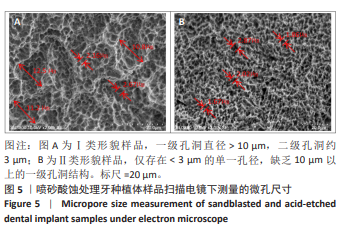
喷砂酸蚀:一种牙种植体表面改性技术,先使用大颗粒(如Al2O3)喷砂形成10-60 µm一级孔洞,再经强酸蚀刻形成2-6 µm二级微孔,从而增加比表面积和骨结合能力。此次研究中21批喷砂酸蚀样品的表面粗糙度实测范围为1.02-3.27 µm,不同产品多级孔洞规整率介于 33.3%-66.7%,显示了工艺控制水平的量化差异。
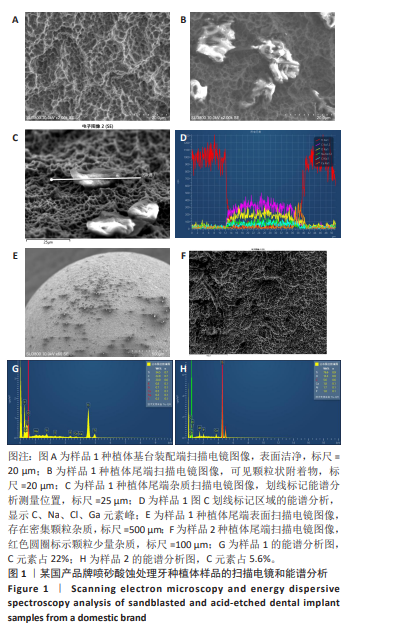
工艺一致性:指同一生产企业同一表面处理工艺下,不同批次或同批次不同样品在表面成分、微观形貌、表面粗糙度等关键指标上保持稳定的能力。此次研究中某国产品牌同批次喷砂酸蚀样品碳元素含量波动达5.6%-22%,并且部分样品检出C、Na、Cl、Ga等杂质,量化反映了工艺一致性的显著差距。

背景:牙种植体的表面处理工艺直接影响其骨结合效率与临床长期稳定性,喷砂酸蚀工艺因能显著提升种植体的生物相容性,已成为目前临床应用最广泛的表面处理技术之一,但不同企业工艺水平差异显著,亟需开展系统性质量评价。
目的:系统评价喷砂酸蚀表面处理牙种植体在表面成分、微观形貌及表面粗糙度等方面的工艺一致性与质量差异。
方法:收集24批不同企业生产的牙种植体样品,其中喷砂酸蚀处理牙种植体样品21批(国产品牌12批,进口品牌9批),采用能谱分析、扫描电镜、白光干涉法分别检测各样品的表面元素、微观形貌与表面粗糙度,对比国内外牙种植体样品的差异;3批非喷砂酸蚀处理牙种植体样品仅作定性展示。
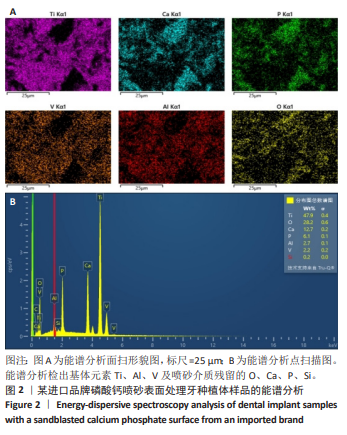
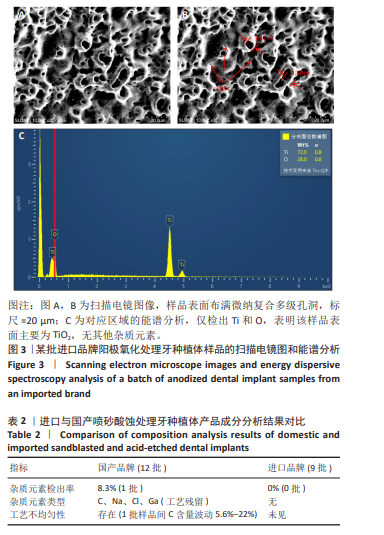
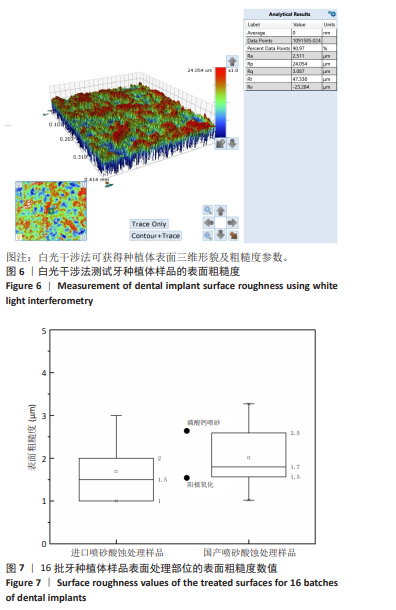
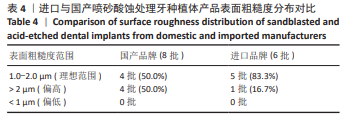
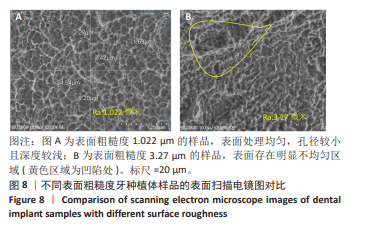
结果与结论:①24批不同企业生产的牙种植体样品中,喷砂酸蚀处理牙种植体样品占主导地位,进口品牌处理工艺类型更多样,国产品牌则集中于喷砂酸蚀处理工艺。1批国产品牌喷砂酸蚀处理样品存在同批次处理工艺不均匀现象,进口品牌喷砂酸蚀处理样品均未检出杂质元素,也无同批次处理工艺不均匀现象;国产品牌中1批(8.3%)存在杂质元素(C、Na、Cl、Ga)及同批次样品间C含量显著波动(5.6%-22%),表明部分国产品牌在喷砂酸蚀处理工艺的清洗过程控制方面仍存在不足,而进口品牌的喷砂酸蚀处理工艺成分控制更为稳定。进口品牌喷砂酸蚀处理工艺牙种植体样品的Ⅰ类孔洞(多级孔洞规整型)占比66.7%,远高于国产品牌喷砂酸蚀处理牙种植体样品的33.3%,说明进口品牌对喷砂和酸蚀处理工艺参数的优化更为充分。喷砂和酸蚀处理牙种植体样品表面粗糙度分布在1.02-3.27 µm 之间,进口品牌控制更为精准,国产品牌存在偏粗糙倾向。②结果表明,喷砂酸蚀处理工艺整体成熟可靠,但部分企业在工艺控制稳定性与质量一致性方面仍需进一步提升,进口品牌在工艺稳定性、多级孔洞规整性及表面粗糙度精准控制方面整体优于国产品牌,建议企业进一步完善产品技术要求,强化生产过程控制,并将种植体表面处理部位的表面粗糙度纳入关键质量指标进行管控。
https://orcid.org/0009-0006-8715-6869 (高娜) 


中国组织工程研究杂志出版内容重点:干细胞;骨髓干细胞;造血干细胞;脂肪干细胞;肿瘤干细胞;胚胎干细胞;脐带脐血干细胞;干细胞诱导;干细胞分化;组织工程

关键词: 牙种植体, 喷砂酸蚀, 表面形貌, 表面粗糙度, 工艺评价, 进口与国产产品对比

Abstract: BACKGROUND: Surface treatment processes of dental implants directly influence their osseointegration efficiency and long-term clinical stability. Sandblasting and acid etching process (SLA) has become one of the most extensively applied surface treatment techniques in clinical practice because of its remarkable improvement on implant biocompatibility. However, manufacturing capabilities vary substantially across manufacturers, leading to uneven quality of SLA-treated dental implants. Therefore, a systematic quality evaluation is urgently needed.
OBJECTIVE: To systematically evaluate the process consistency and quality differences of dental implants with SLA surface treatment in terms of surface composition, micromorphology, and surface roughness.
METHODS: A total of 24 batches of dental implants from different manufacturers were collected, among which 21 batches adopted the SLA process (12 domestic batches and 9 imported batches). Surface elements, micromorphology, and surface roughness were characterized by energy dispersive spectroscopy, scanning electron microscopy, and white light interferometry, respectively. Differences between domestic and imported products were compared. Three batches of non-SLA samples were used for qualitative demonstration only.
RESULTS AND CONCLUSION: Among the 24 batches of dental implant samples from different manufacturers, SLA-treated dental implant samples predominated. Imported brands exhibited more diverse processing techniques, while domestic brands were mainly concentrated on the SLA process. One batch of domestic SLA samples showed uneven treatment within the same batch. No impurity elements were detected in the imported SLA samples, nor was there any unevenness within the same batch. Among domestic brands, one batch (8.3%) contained impurity elements (C, Na, Cl, and Ga) and showed significant fluctuation in C content (5.6%-22%) within the same batch, indicating that some domestic brands still have deficiencies in the cleaning process control of the SLA process, whereas imported brands showed more stable compositional control of the SLA process. The proportion of type I pores (regular hierarchical pores) in imported SLA dental implant samples was 66.7%, much higher than 33.3% in domestic SLA samples, indicating that imported brands have more fully optimized the parameters of the sandblasting and acid etching processes. The surface roughness of SLA-treated dental implant samples ranged from 1.02 to 3.27 µm, with imported brands achieving more precise control and domestic brands tending to be rougher. These findings indicate that the SLA process is generally mature and reliable, but some enterprises still need to further improve process control stability and quality consistency. Imported brands are overall superior to domestic brands in terms of process stability, regularity of hierarchical pores, and precise control of surface roughness. It is recommended that enterprises further refine product technical requirements, strengthen production process control, and incorporate the surface roughness of the treated implant area as a key quality indicator.  


Key words: dental implants, sandblasting and acid-etching, surface morphology, surface roughness, process evaluation, imported and domestic product comparison 

中图分类号: