中国组织工程研究 ›› 2026, Vol. 30 ›› Issue (29): 7654-7662.doi: 10.12307/2026.225
• 组织构建综述 tissue construction review • 上一篇 下一篇
代谢异常与骨关节炎的关联机制及代谢靶向治疗
郭姗姗1,马 丁2,董炳辰2
- 1陕西省人民医院中心实验室,转化医学中心,陕西省西安市 710068;2西安市第九医院骨科,陕西省西安市 710054
-
收稿日期:2025-09-02修回日期:2025-11-20出版日期:2026-10-18发布日期:2026-03-06 -
通讯作者:董炳辰,硕士,主治医师,西安市第九医院骨科,陕西省西安市 710054 -
作者简介:郭姗姗,女,1990年生,博士,助理研究员,主要从事生理与病理机制研究。 -
基金资助:西安市第九医院青年培育项目(2025qn02) ,项目负责人:董炳辰
Metabolic dysregulation in osteoarthritis: mechanisms and targeted therapeutic strategies
Guo Shanshan1, Ma Ding2, Dong Bingchen2
- 1Central Laboratory & Translational Medicine Center, Shaanxi Provincial People's Hospital, Xi'an 710068, Shaanxi Province, China; 2Department of Orthopedics, Xi’an No. 9 Hospital, Xi’an 710054, Shaanxi Province, China
-
Received:2025-09-02Revised:2025-11-20Online:2026-10-18Published:2026-03-06 -
Contact:Dong Bingchen, MS, Attending physician, Department of Orthopedics, Xi’an No. 9 Hospital, Xi’an 710054, Shaanxi Province, China -
About author:Guo Shanshan, PhD, Assistant Researcher, Central Laboratory & Translational Medicine Center, Shaanxi Provincial People’s Hospital, Xi’an 710068, Shaanxi Province, China -
Supported by:Youth Cultivation Project of Xi’an No. 9 Hospital, No. 2025qn02 (to DBC)

摘要:

文题释义:
软骨细胞代谢重编程:是指骨关节炎软骨细胞为适应病理微环境(如缺氧、炎症、高糖)而发生的系统性代谢表型改变,其核心是能量代谢从氧化磷酸化向糖酵解的转换(即“Warburg效应”)。骨关节炎软骨细胞中糖酵解速率显著提高导致乳酸过量堆积,直接激活疼痛相关离子通道,同时线粒体功能障碍致使活性氧水平升高,进而激活核因子κB/丝裂原活化蛋白激酶信号通路,促使基质降解酶表达上调,并伴随色氨酸代谢紊乱及脂肪酸氧化异常,共同驱动软骨退变和疾病进展。
骨关节炎代谢靶向治疗:是指基于骨关节炎的代谢病因学,通过药物再定位、开发新药或生物技术手段选择性调控关键代谢节点,以延缓或逆转疾病进展的治疗策略。骨关节炎代谢靶向治疗核心是从“对症镇痛”转向“对因治疗”,代表疾病修饰药物开发的新方向。
背景:代谢异常在骨关节炎发生发展中的核心作用长期被忽视。近年研究发现,肥胖、糖尿病等代谢综合征与骨关节炎进展密切相关,但其通过分子网络驱动关节退变的机制尚未系统阐明。
目的:系统梳理骨关节炎代谢异常的病理机制研究进展,整合多组学证据解析代谢-关节轴的调控网络,为临床防治提供新视角。
方法:以中文关键词“骨关节炎,代谢异常,脂肪因子,糖酵解,线粒体功能障碍,代谢组学,磁共振成像”检索中国知网、万方数据库;以英文关键词“osteoarthritis,metabolic dysregulation,adipokine,glycolysis,mitochondrial dysfunction,metabolomics,MRI”检索PubMed、Web of Science数据库。通过标题/摘要筛选及全文评估,最终纳入108篇文献进行综述分析。
结果与结论:①流行病学研究证实代谢综合征(肥胖、糖尿病、血脂异常)与骨关节炎风险呈正相关,体质量指数每增加1 kg/m2,膝骨关节炎风险升高15%,非负重关节受累佐证代谢因子的独立致病作用;②代谢因子网络失衡驱动骨关节炎进展:肥胖致瘦素/脂联素比值异常(瘦素升高3.2倍,脂联素降低40%),通过激活基质金属蛋白酶13(升高2.1倍)和抑制组织金属蛋白酶抑制因子2加速软骨降解;③细胞内代谢重编程特征显著:骨关节炎软骨细胞呈现糖酵解亢进、线粒体功能障碍、脂滴沉积(游离脂肪酸升高1.8倍)三联征;④代谢-炎症正反馈环路:脂肪组织释放白细胞介素1β/肿瘤坏死因子α激活关节核因子κB通路,后者抑制胰岛素受体信号加剧代谢紊乱;⑤临床转化路径:血清脂联素联合关节液乳酸可预测骨关节炎进展;建议代谢综合征患者早期应用单磷酸腺苷激活的蛋白激酶激动剂并联合肌肉训练与营养干预。
https://orcid.org/0000-0002-1089-5798 (郭姗姗)
中国组织工程研究杂志出版内容重点:干细胞;骨髓干细胞;造血干细胞;脂肪干细胞;肿瘤干细胞;胚胎干细胞;脐带脐血干细胞;干细胞诱导;干细胞分化;组织工程
中图分类号:
引用本文
郭姗姗, 马 丁, 董炳辰. 代谢异常与骨关节炎的关联机制及代谢靶向治疗[J]. 中国组织工程研究, 2026, 30(29): 7654-7662.
Guo Shanshan, Ma Ding, Dong Bingchen. Metabolic dysregulation in osteoarthritis: mechanisms and targeted therapeutic strategies[J]. Chinese Journal of Tissue Engineering Research, 2026, 30(29): 7654-7662.
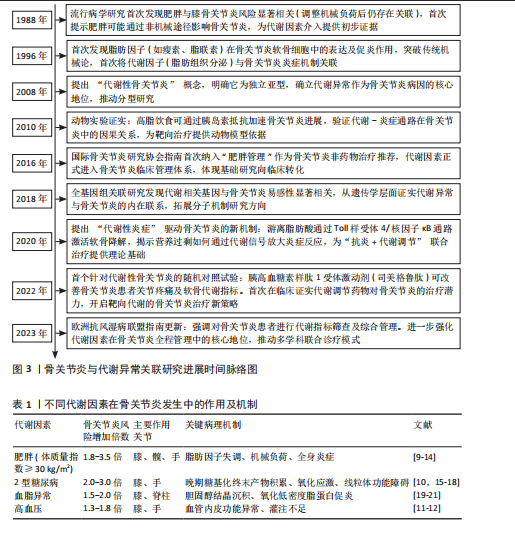
2.2 代谢异常与骨关节炎的流行病学关联 代谢综合征涵盖肥胖、高血压、血脂异常、高血糖及胰岛素抵抗等核心组分,这些因素不仅独立促进骨关节炎的病理进程,更通过协同效应显著提升心血管事件风险[9-12]。大型多中心研究证实,慢性肥胖人群的膝关节内侧软骨损伤风险增加3.12倍(95%CI:2.85-3.42),且体质量指数每升高5 kg/m2,膝骨关节炎发病风险相应增加35%(RR=1.35,95%CI:1.28-1.42)[13]。值得注意的是,肥胖患者非负重关节(如手部)的骨关节炎风险亦显著上升1.8倍(95%CI:1.5-2.1),这一现象佐证了代谢因子的独立致病机制,超越了传统机械负荷理论的解释范畴[14]。
糖脂代谢紊乱在骨关节炎发展中扮演关键角色[10]。慢性高血糖与胰岛素抵抗通过三重途径驱动关节退变[15]:①诱导促炎因子(肿瘤坏死因子α、白细胞介素1β)及基质金属蛋白酶的异常合成;②促进晚期糖基化终末产物积累,激活晚期糖基化终末产物受体信号通路;③引发线粒体功能障碍,导致氧化应激反应增强[16]。流行病学数据显示,2型糖尿病患者骨关节炎发病风险较非糖尿病人群升高2.3倍(95%CI:2.0-2.6),且该效应独立于体质量指数[17-18]。在脂代谢层面,高胆固醇血症与低密度脂蛋白水平升高可加速骨关节炎进展(HR=1.85,95%CI:1.62-2.11),而高密度脂蛋白则表现出保护效应——其浓度每增加0.26 mmol/L,骨关节炎风险相应降低15%(HR=0.85,95%CI:0.79-0.92)[19-21](表1)。
饮食模式与代谢状态存在显著交互作用。韩国横断面研究(n=8 342)发现,高血糖指数饮食使女性症状性膝骨关节炎风险增加40%(OR=1.40,95%CI:1.12-1.75)[10];而北美大型队列(n=12 591)证实,严格遵循地中海饮食(低高血糖指数特征)的个体膝骨关节炎风险降低30%(HR=0.70,95%CI:0.62-0.79)。这种代谢异常不仅增加骨关节炎易感性,更直接影响临床转归——加拿大关节置换登记研究(n=24 768)显示,代谢综合征患者术后功能恢复延迟(6 min步行距离下降18%,P < 0.01),再手术风险增加2.2倍(95%CI:1.8-2.7)[22]。
值得注意的是,代谢综合征各组分通过“肥胖→胰岛素抵抗→高血糖→血脂异常”的恶性循环形成正反馈网络:肥胖诱发胰岛素抵抗,导致高血糖及晚期糖基化终末产物积累;高血糖又进一步加剧血脂异常,共同促进关节组织退变[23]。这种复杂的协同效应使得针对单一代谢因素的干预策略效果有限,亟需建立综合代谢调控体系以改善骨关节炎的临床预后[24]。
2.3 代谢性炎症的核心机制
2.3.1 脂肪因子紊乱与关节组织损伤 脂肪组织不仅是能量储存器官,也是重要的内分泌器官。在肥胖状态下,脂肪组织功能失调导致多种脂肪因子分泌异常,形成慢性低度炎症状态,即“代谢性炎症”[25-26],这些脂肪因子通过血液循环到达关节组织,直接参与骨关节炎的病理过程。
瘦素是研究最为深入的脂肪因子之一。在骨关节炎患者关节液中,瘦素水平显著升高,且与软骨破坏程度呈正相关[25]。瘦素通过多种途径促进骨关节炎进展:①刺激软骨细胞产生基质金属蛋白酶,特别是基质金属蛋白酶13,加速细胞外基质降解[27];②促进促炎因子(白细胞介素6、白细胞介素1β和肿瘤坏死因子α)的产生;③诱导软骨细胞肥大分化,加速软骨钙化[28];④促进骨赘形成[26]。临床研究发现,老年人群血液瘦素水平与膝关节软骨容积呈负相关,提示瘦素具有作为骨关节炎生物标志物的潜力[29]。
脂联素的作用则与瘦素相反[29],这种具有抗炎作用的脂肪因子在肥胖患者和骨关节炎患者中显著降低[30]。脂联素可通过多种机制保护关节:①下调白细胞介素1诱导的基质金属蛋白酶13表达[31];②上调金属蛋白酶组织抑制
物2的表达[32];③抑制核因子κB信号通路[33]。临床研究证实,血浆和关节滑液中的脂联素水平与骨关节炎疾病严重程度呈负相关,表明脂联素具有保护作用[34]。
抵抗素和内脂素是另外两种促炎脂肪因子。抵抗素抑制软骨蛋白聚糖合成,并促进白细胞介素6、白细胞介素8和前列腺素E2释放[26]。内脂素又称B细胞前体克隆增强因子,在骨关节炎软骨中高表达,通过刺激基质金属蛋白酶3/基质金属蛋白酶9、前列腺素E2及含血小板结合蛋白基序的解聚素样金属蛋白酶5加剧软骨分解[35]。
新型脂肪因子白细胞趋化因子2(Leukocyte cell-derived chemotaxin 2,LECT2)和补体C1q/肿瘤坏死因子相关蛋白3(C1q/TNF-related protein 3,CTRP3 )也是连接脂代谢紊乱与骨关节炎的关键递质[36-38]。动物模型证实,白细胞趋化因子2通过胆固醇-25-羟化酶(CH25H)-细胞色素P450家族成员7B1(CYP7B1)-维A酸相关孤儿受体α(RORα)信号轴抑制胆固醇逆转运,导致软骨细胞内胆固醇蓄积[39]。过表达白细胞趋化因子2的小鼠出现严重软骨破坏、骨赘形成及软骨下骨板增厚[40]。临床研究进一步发现,高脂饮食后人体循环白细胞趋化因子2水平上升40%,且骨关节炎患者关节组织中白细胞趋化因子2表达显著高于健康对照,首次建立了脂代谢异常与骨关节炎的直接因果关联[41]。补体C1q/肿瘤坏死因子相关蛋白3通过激活过氧化物酶体增殖物激活受体α-酰基辅酶A硫脂酶12通路维持软骨稳态,干预实验显示重组补体C1q/肿瘤坏死因子相关蛋白3可使软骨降解标志物基质金属蛋白酶13表达降低52%[39,42](表2)。
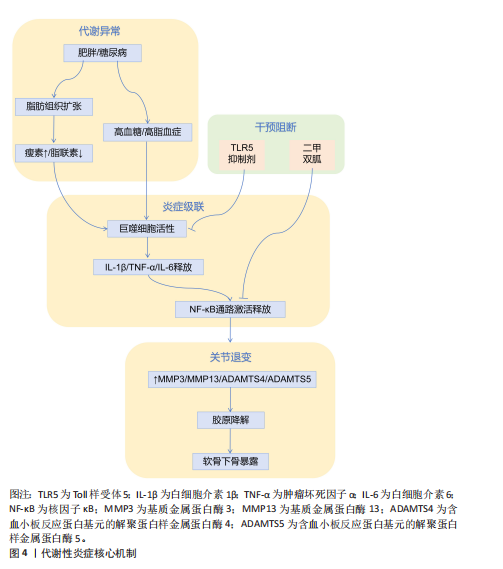
2.3.2 炎症信号级联放大 代谢异常引发的炎症反应在骨关节炎进展中起核心作用[43-44]。脂肪组织产生的促炎因子与关节局部炎症形成恶性循环,不断放大炎症信号[45]。促炎细胞因子包括白细胞介素1β、肿瘤坏死因子α和白细胞介素6,主要由活化的巨噬细胞合成,在骨关节炎相关的炎症反应中起关键作用[21,46](图4)。流行病学研究已将糖尿病和肥胖确定为骨关节炎发展的促成因素,在人体内诱导局部或全身低度炎症状态[47]。高血糖环境和肥胖可增加促炎因子如白细胞介素1β、白细胞介素6和肿瘤坏死因子α的表达,进一步激活核因子κB信号通路,增加关节软骨细胞的分解代谢活性并促进细胞外基质降解,最终导致骨关节炎进展。在应激诱导的骨关节炎小鼠模型中,高脂饮食组血清肿瘤坏死因子α水平显著升高,软骨损伤更严重;而Toll样受体5缺陷(Tlr5 KO)小鼠组血清白细胞介素6水平显著低于其他组,表明肥胖通过增加促炎因子表达加剧骨关节炎进展[48]。另一研究证明,高脂饮食小鼠血清中白细胞介素1β显著升高,白细胞介素1β通过激活核因子κB信号通路在骨关节炎软骨细胞中诱导炎症反应[49]。值得注意的是,二甲双胍不仅降低肥胖个体的体质量指数,还降低骨关节炎患者关节置换手术比率[18]。在小鼠研究中,肿瘤坏死因子α和白细胞介素1β显著增加原代关节软骨细胞中基质金属蛋白酶3、基质金属蛋白酶13、含血小板结合蛋白基序的解聚素样金属蛋白酶4和含血小板结合蛋白基序的解聚素样金属蛋白酶5的mRNA表达水平,而二甲双胍有效抑制肿瘤坏死因子α和白细胞介素1β诱导的基质金属蛋白酶13和基质金属蛋白酶3表达,揭示二甲双胍通过减弱炎症细胞因子诱导的分解代谢反应保护关节软骨细胞[50]。因此,抑制促炎因子表达对骨关节炎治疗具有积极疗效[51]。
白细胞介素1β和肿瘤坏死因子α是骨关节炎中的关键促炎因子[47,52]。在肥胖引起的低炎症状态下,这些细胞因子水平升高,抑制软骨基质合成,促进基质金属蛋白酶表达,诱导一氧化氮合酶产生,增加氧化应激,促进软骨细胞凋亡[46]。临床研究表明,抑制白细胞介素1的药物可缓解骨关节炎症状,减缓疾病进展[49]。白细胞介素6家族细胞因子(包括白细胞介素6、制瘤素M和白血病抑制因子)在骨关节炎中同样发挥重要作用,15%-30%血液循环中的白细胞介素6来自脂肪组织[48]。白细胞介素6可与白细胞介素1协同作用,抑制软骨细胞合成蛋白多糖,诱导软骨细胞产生过氧化反应,导致胶原降解[53]。临床研究发现,老年人血液中白细胞介素6水平可预测2年后骨密度损失,且白细胞介素6水平与膝关节软骨损失呈正相关[54]。基质金属蛋白酶是细胞外基质降解的关键执行者,其中基质金属蛋白酶13是降解Ⅱ型胶原效率最高的酶。在代谢异常状态下,脂肪因子和炎症因子协同上调基质金属蛋白酶表达,同时降低金属蛋白酶组织抑制物表达,打破基质金属蛋白酶-金属蛋白酶组织抑制物平衡,导致细胞外基质过度降解,加速软骨破坏[50]。
2.3.3 细胞内代谢通路重编程 近年研究发现,骨关节炎软骨细胞经历显著的代谢重编程,主要表现为糖酵解增强、脂肪酸氧化障碍和线粒体功能障碍[55]。在骨关节炎的不良微环境(如缺氧、营养缺乏、炎症因子刺激)下,软骨细胞从相对静止状态转变为高度激活状态,导致具有致炎和促蛋白分解作用的中间代谢产物增加[56](图5)。
糖代谢异常是骨关节炎代谢重编程的核心特征,在缺氧和炎症条件下,软骨细胞糖酵解速率显著提高,产生过量乳酸,降低细胞外pH值,激活酸性敏感离子通道,导致疼痛[48,57]。同时,高血糖环境促进晚期糖基化终末产物积累,晚期糖基化终末产物通过与受体结合,激活核因子κB信号通路,促进炎症因子表达[48]。在2型糖尿病患者中,长期高血糖导致晚期糖基化终末产物积累,促进基质硬化[56]。此外,晚期糖基化终末产物与软骨细胞膜上的受体结合,激活丝裂原活化蛋白激酶信

号通路,增强白细胞介素6和白细胞介素8表达,加剧炎症反应[58-59]。晚期糖基化终末产物还促使关节软骨基质分解代谢增加,阻碍细胞外基质更新[60]。研究报道骨关节炎患者软骨中晚期糖基化终末产物水平显著高于健康个体,晚期糖基化终末产物积累使胶原网络脆弱化,增加骨关节炎风险[59]。
活性氧是含有氧的高反应性分子,肥胖和糖尿病可诱导体内活性氧水平升高[61-62]。脂肪组织和高血糖水平营造促炎环境,导致M1型巨噬细胞和促炎细胞因子增加,进一步刺激活性氧产生[63-64]。在骨关节炎软骨细胞中,过量活性氧激活丝裂原活化蛋白激酶和核因子κB信号通路,破坏软骨分解代谢和合成代谢平衡[65]。研究表明,H2O2孵育软骨细胞会导致活性氧增加、软骨细胞死亡及细胞外基质降解[66];
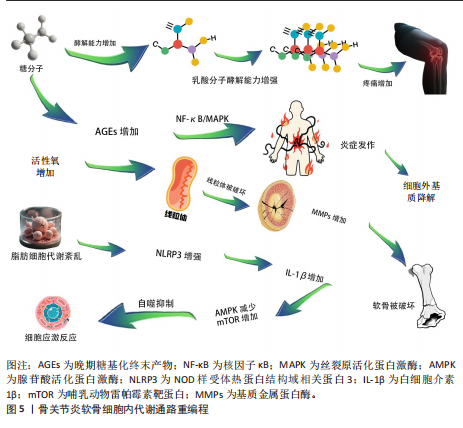
而活性氧抑制剂可降低膝关节软骨损伤严重程度,减少基质金属蛋白酶13和含血小板结合蛋白基序的解聚素样金属蛋白酶5表达,增加Ⅱ型胶原和聚集蛋白聚糖表达[67]。在白细胞介素1β诱导的骨关节炎模型中,氧化应激标志物8-羟基脱氧鸟苷水平升高4倍,添加抗氧化剂可降低基质金属蛋白酶13和含血小板结合蛋白基序的解聚素样金属蛋白酶5表达[68]。研究还发现骨关节炎软骨细胞中活性氧水平升高阻碍线粒体呼吸链,引起线粒体DNA突变,促使基质金属蛋白酶1和基质金属蛋白酶3表达增强[68-69]。
脂质代谢过程包括细胞内脂质的合成和降解,当稳态平衡破坏时易患骨关节炎[19]。研究显示代谢紊乱个体的骨关节炎患病率是对照组的2倍以上[19]。脂代谢紊乱参与骨关节炎进展:肥胖患者血液中升高的游离脂肪酸可进入软骨细胞,在缺氧条件下因β-氧化受阻而堆积,形成脂滴,诱发内质网应激和线粒体功能障碍;胆固醇结晶在关节组织沉积可激活NOD样受体热蛋白结构域相关蛋白3炎症小体,促进白细胞介素1β成熟和释放[19]。能量感应通路在骨关节炎代谢重编程中起调控作用,正常条件下腺苷酸活化蛋白激酶维持能量稳态[70-71];而在骨关节炎中,腺苷酸活化蛋白激酶活性降低,哺乳动物雷帕霉素靶蛋白信号增强,促进合成代谢和细胞应激[72]。实验研究表明,二甲双胍通过激活腺苷酸活化蛋白激酶可减轻骨关节炎动物模型的软骨破坏,医用臭氧通过腺苷酸活化蛋白激酶/哺乳动物雷帕霉素靶蛋白通路增强自噬,抑制白细胞介素1β诱导的基质金属蛋白酶13表达,藤茶黄酮则通过激活该通路改善脂质代谢并减少氧化损伤[50,71,73]。
2.4 骨关节炎代谢异质性分型与精准诊疗前景
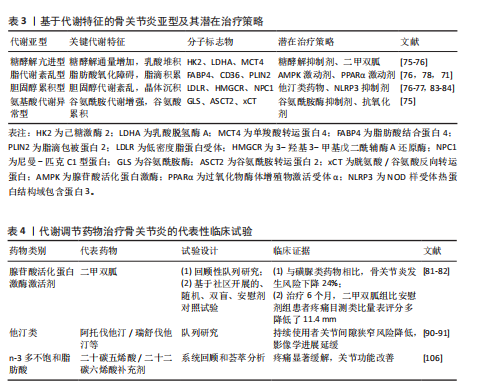
2.4.1 基于代谢特征的骨关节炎分型研究 骨关节炎患者存在显著的代谢异质性,这为精准分型提供了理论基础。2024年发表在《Phenomics》的一项研究采用非靶向代谢组学技术分析了不同严重程度骨关节炎患者的关节软骨代谢特征[74]。研究发现,与Kellgren-lawrence(K-L)3级患者相比,K-L 4级患者的胆碱、2-丙基哌啶、鼠李糖和单甲基戊二酸等代谢物显著上调,而1-甲基组胺、鞘磷脂、玉米赤霉醇等代谢物显著下调。这些差异代谢物主要富集于甘油磷脂代谢、组氨酸代谢、赖氨酸降解和甘氨酸/丝氨酸/苏氨酸代谢等通路[74]。
基于代谢组学的分型研究为骨关节炎的精准治疗提供了新思路。通过整合转录组、代谢组等多组学数据,可将骨关节炎分为不同代谢亚型,如糖酵解主导型、脂肪酸氧化障碍型、胆固醇代谢紊乱型等[74]。不同亚型对治疗的反应可能不同,例如糖酵解主导型可能对糖酵解抑制剂更敏感,而胆固醇代谢紊乱型可能对他汀类药物反应更佳[74-78]。
2.4.2 生物信息学驱动的靶点挖掘 生物信息学技术在骨关节炎代谢靶点挖掘中发挥重要作用。2025年发表在《BMC Musculoskeletal Disorders》的一项研究通过整合骨关节炎和动脉粥样硬化的基因表达谱,发现2种疾病共享9个枢纽基因(CCR5、IFIT2、MMP1、CXCL9、RSAD2、IFIH1、TNF、IFIT3和TBX21),均富集于免疫炎症反应通路(如趋化因子信号、干扰素应答),提示慢性炎症是代谢性关节-血管共病的核心机制[8]。
多组学整合分析是挖掘关键代谢靶点的有力工具。通过结合转录组、代谢组和表观遗传组数据,可构建骨关节炎代谢调控网络,识别关键调控节点。例如,基于基因共表达网络分析,研究人员发现胆固醇调节元件结合蛋白1、过氧化物酶体增殖物激活受体γ和肝脏X受体等转录因子在骨关节炎脂代谢紊乱中起核心调控作用[76]。胆固醇调节元件结合蛋白1调控脂肪酸合成酶、硬脂酰辅酶A去饱和酶表达,促进软骨细胞脂质蓄积[76]。过氧化物酶体增殖物激活受体γ介导脂肪细胞分化和脂解过程,其失活导致脂联素分泌减少[76]。肝脏X受体维持胆固醇外流,抑制其活性加剧胆固醇结晶沉积[76-77]。
人工智能在骨关节炎代谢分型和靶点预测中的应用日益广泛。机器学习算法通过分析高维代谢组学数据,识别潜在生物标志物和药物靶点[74]。基于代谢组学数据构建分类器,对骨关节炎亚型的鉴别准确率> 95% (如通过血清胆碱水平区分K-L 4级患者)[74]。深度学习模型可预测患者对不同代谢调节药物的反应,指导个体化治疗。利用图神经网络预测药物反应,例如糖酵解亢进型对二甲双胍的敏感性是脂代谢紊乱型的3.2倍(曲线下面积=0.88)[78]。
2.5 靶向代谢通路的治疗策略 基于对骨关节炎代谢机制的深入理解,药物再定位成为开发骨关节炎新疗法的有效策略。已有多种代谢调节药物在临床前研究中显示出对骨关节炎的治疗潜力。
二甲双胍作为经典的腺苷酸活化蛋白激酶激活剂,可通过多种机制减轻骨关节炎进展:①激活腺苷酸活化蛋白激酶信号,抑制哺乳动物雷帕霉素靶蛋白C1信号,降低白细胞介素1β/肿瘤坏死因子α合成(临床前模型显示软骨降解减少60%)[70,72]。②改善线粒体功能,增强线粒体呼吸链复合物活性,降低活性氧水平(体外实验证实超氧化物歧化酶2表达上调2.1倍)[67]。③阻断核因子κB核转位,减少基质金属蛋白酶13/含血小板结合蛋白基序的解聚素样金属蛋白酶5释放(动物实验显示国际骨关节炎研究学会评分下降40%)[68,79]。动物实验表明,二甲双胍可显著减轻前交叉韧带横断诱导的骨关节炎模型的软骨破坏[80]。一项回顾性队列研究结果显示,与磺脲类药物治疗相比,二甲双胍治疗的糖尿病患者骨关节炎的发生风险降低了24%[81]。2025年发表的一项报告也表明在肥胖和超重膝骨关节炎患者中,相比于安慰剂,持续使用二甲双胍6个月,患者疼痛显著减轻[82]。
他汀类药物因降脂和抗炎双重作用而被研究用于骨关节炎治疗[83-84]。他汀类药物作为3-羟基-3-甲基戊二酰辅酶A还原酶的选择性竞争抑制剂,通过阻断胆固醇内源性合成途径,可显著降低血清胆固醇水平,现已成为治疗高胆固醇血症的核心药物[85-86]。目前临床常用种类包括阿托伐他汀、氟伐他汀、洛伐他汀、匹伐他汀、普伐他汀、瑞舒伐他汀及辛伐他汀[84,86]。基础研究证实,他汀类在骨关节炎治疗中具有多重保护效应:①在培养的骨关节炎软骨细胞模型中,他汀可有效延缓软骨退变进程[83,87];②在多种骨关节炎动物模型(如前交叉韧带离断模型、自发性骨关节炎模型)中显示他汀抑制疾病进展的作用[88-89]。一项为期6.5年的随访研究发现,持续使用他汀类药物可显著延缓膝骨关节炎患者的整体病情进展(影像学与症状评分)[90];针对膝骨关节炎患者的对照研究显示,他汀使用者关节间隙狭窄风险较非使用者显著降低[91]。
过氧化物酶体增殖物激活受体γ在软骨组织中高表达,其激动剂在骨关节炎动物模型中表现出显著的抗炎与软骨保护效应[71,92]。研究发现,在STR/Ort小鼠骨关节炎进展过程中关节软骨过氧化物酶体增殖物激活受体γ表达下调,且在炎症微环境下该现象进一步加剧,导致膝关节软骨损伤及骨赘形成[93]。机制研究表明,过氧化物酶体增殖物激活受体γ可通过介导胆固醇外流途径促进兔骨关节炎软骨细胞的细胞外基质合成。最新证据显示,小泛素样修饰蛋白修饰的过氧化物酶体增殖物激活受体γ能有效改善软骨细胞脂代谢紊乱[94]。这些发现共同表明,激活过氧化物酶体增殖物激活受体γ对骨关节炎具有潜在治疗价值,但调控脂代谢延缓骨关节炎进展的具体分子机制仍需深入探索。与具有软骨保护效应的过氧化物酶体增殖物激活受体α/γ不同,过氧化物酶体增殖物激活受体δ激活可能加速骨关节炎进展[95]。当使用过氧化物酶体增殖物激活受体δ激动剂(GW501516)处理小鼠软骨细胞时,基质降解酶表达显著上调(基质金属蛋白酶2、基质金属蛋白酶3、含血小板结合蛋白基序的解聚素样金属蛋白酶2、含血小板结合蛋白基序的解聚素样金属蛋白酶5 mRNA水平升高),并增强软骨细胞脂肪酸氧化程度[96]。基因敲除研究进一步证实:软骨细胞特异性缺失过氧化物酶体增殖物激活受体δ基因可缓解小鼠内侧半月板切除手术诱导的骨关节炎症状,表明过氧化物酶体增殖物激活受体δ缺失对骨关节炎发展具有抑制作用[96]。过氧化物酶体增殖物激活受体δ加剧骨关节炎的潜在机制可能涉及:促进软骨细胞脂肪酸氧化诱导活性氧大量产生,进而加速软骨退变进程[96]。
前蛋白转化酶枯草溶菌素9(Proprotein convertase subtilisin/kexin type 9,PCSK9)抑制剂通过阻止低密度脂蛋白受体降解,可显著降低低密度脂蛋白胆固醇水平(降幅达50%-70%)。然而,这种临床降脂方案通常需与他汀类药物联用,而非单独使用。值得注意的是,在APOE*3Leiden. CETP小鼠高脂饮食诱导的膝骨关节炎模型中,阿托伐他汀与前蛋白转化酶枯草溶菌素9抑制剂联用虽有效降低血脂,却未能延缓小鼠软骨退变进程[97]。这表明尽管前蛋白转化酶枯草溶菌素9抑制剂对脂代谢紊乱治疗价值明确,但在代谢性骨关节炎中的应用仍存争议。
n-3多不饱和脂肪酸(Polyunsaturated fatty acid,PUFA)作为人体无法合成的必需脂肪酸,主要包括α-亚麻酸、二十碳五烯酸和二十二碳六烯酸,具有显著降低三酰甘油的作用。在白细胞介素1β诱导的软骨细胞及滑膜细胞炎症模型中,n-3多不饱和脂肪酸可降低炎症标志物表达[98-99]。犬软骨细胞实验显示n-3多不饱和脂肪酸减少诱导型一氧化氮合酶表达及一氧化氮生成[100],在人软骨细胞中降低基质金属蛋白酶13与前列腺素E2水平[101]。缓释二十碳五烯酸注射显著延缓手术诱导的小鼠膝骨关节炎进展[102]。但临床研究结果存在矛盾,补充磷虾油改善轻中度膝骨关节炎患者的疼痛、僵硬及关节功能[103],另一项随机对照试验未观察到n-3多不饱和脂肪酸对膝关节症状的显著改善[104]。此外,一项观察性研究表明,全膝关节置换术后血清n-3多不饱和脂肪酸水平与股四头肌肌力恢复呈正相关(r=0.356,P=0.004)[105]。研究提示n-3多不饱和脂肪酸可能通过减轻低度炎症延缓软骨降解[56]。一项荟萃分析结果表明,补充n-3多不饱和脂肪酸可以有效缓解骨关节炎患者疼痛和改善关节功能,而不增加治疗相关的不良事件风险。这些发现支持使用n-3多不饱和脂肪酸补充剂作为骨关节炎的替代治疗方法[106](表3,4)。
2.6 新型靶向治疗策略 多种新型靶向治疗策略正处于临床前或临床研究阶段。脂肪因子靶向治疗是重要研究方向。针对瘦素的单克隆抗体或受体拮抗剂在动物模型中显示出软骨保护作用,中和抗体LepAb在肥胖骨关节炎小鼠中使软骨缺损面积减少45%[76]。增加脂联素水平的策略(如脂联素受体激动剂AdipoRon)在骨关节炎动物模型中也取得了积极效果,AdipoRon通过腺苷酸活化蛋白激酶/过氧化物酶体增殖物激活受体α通路抑制炎症,恢复软骨合成代谢(Ⅱ型胶原表达增加1.8倍)。炎症小体抑制剂是另一重要方向。针对NOD 样受体热蛋白结构域包含蛋白 3(NOD-like receptor pyrin domain-containing protein 3,NLRP3)炎症小体的抑制剂可抑制白细胞介素1β成熟和释放,减轻关节炎症和软骨破坏[77]。代谢酶抑制剂也受到广泛关注。例如,靶向糖酵解关键酶己糖激酶2或乳酸脱氢酶A抑制剂可抑制软骨细胞过度糖酵解,减轻软骨破坏。同样,抑制谷氨酰胺代谢的关键酶谷氨酰胺酶可减少骨关节炎软骨细胞的氧化应激和炎症反应[75]。
2.7 非药物干预策略 生活方式干预是代谢相关骨关节炎的基础治疗策略。研究表明,体质量减轻10%可使膝骨关节炎患者的疼痛减轻50%(西部安大略省和麦克马斯特大学骨关节炎指数),并显著改善关节功能。减重的获益不仅源于机械负荷减轻,还与代谢炎症改善密切相关[76]。营养干预在调节代谢炎症中发挥重要作用,富含ω-3多不饱和脂肪酸的饮食可减少促炎脂肪因子的产生,降低炎症水平[78]。同样,热量限制和间歇性禁食可通过激活自噬、改善线粒体功能等机制减轻骨关节炎进展[78]。运动干预对代谢相关骨关节炎具有双重益处:一方面,运动可减轻体质量,降低关节机械负荷[107];另一方面,运动可改善胰岛素敏感性,增加肌肉力量,改善关节稳定性,并具有抗炎作用[107]。研究显示,水中运动对肥胖骨关节炎患者尤其有益,可在减轻关节负荷的同时提供有效运动刺激[108]。
| [1] HU Y, CHEN X, WANG S, et al. Subchondral bone microenvironment in osteoarthritis and pain. Bone Res. 2021;9(1):20. [2] HUNTER DJ, BIERMA-ZEINSTRA S. Osteoarthritis. Lancet. 2019;393(10182):1745-1759. [3] LOESER RF, GOLDRING SR, SCANZELLO CR, et al. Osteoarthritis: a disease of the joint as an organ. Arthritis Rheum. 2012;64(6):1697-1707. [4] TONG L, YU H, HUANG X, et al. Current understanding of osteoarthritis pathogenesis and relevant new approaches. Bone Res. 2022; 10(1):60. [5] PLOTZ B, BOMFIM F, SOHAIL MA, et al. Current Epidemiology and Risk Factors for the Development of Hand Osteoarthritis. Curr Rheumatol Rep. 2021;23(8):61. [6] YASUDA E, NAKAMURA R, MATSUGI R, et al. Association between the severity of symptomatic knee osteoarthritis and cumulative metabolic factors. Aging Clin Exp Res. 2018;30(5):481-488. [7] WEI G, LU K, UMAR M, et al. Risk of metabolic abnormalities in osteoarthritis: a new perspective to understand its pathological mechanisms. Bone Res. 2023;11(1):63. [8] JIN Y, ZHANG H. Comprehensive bioinformatics analysis uncover molecular pathways shared between osteoarthritis and atherosclerosis. BMC Musculoskelet Disord. 2025;26(1):449. [9] SELLAM J, BERENBAUM F. Is osteoarthritis a metabolic disease? Joint Bone Spine. 2013;80(6): 568-573. [10] BASAK S, HRIDAYANKA KSN, DUTTAROY AK. Bioactives and their roles in bone metabolism of osteoarthritis: evidence and mechanisms on gut-bone axis. Front Immunol. 2024;14:1323233. [11] HUANG S, CHEN J, ZHANG H, et al. Inflammatory mechanisms underlying metabolic syndrome-associated and potential treatments. Osteoarthr Cartil Open. 2025;7(2):100614. [12] CRUZ CJ, PATTERSON FM, GAIRE J, et al. Comorbid hypertension and osteoarthritis exacerbates joint remodeling and gait compensations in female rats with milder effects observed in males. Osteoarthr Cartil Open. 2025;7(3):100649. [13] SAMPATH SJP, VENKATESAN V, GHOSH S, et al. Obesity, Metabolic Syndrome, and Osteoarthritis-An Updated Review. Curr Obes Rep. 2023;12(3): 308-331. [14] REYES C, LEYLAND KM, PEAT G, et al. Association Between Overweight and Obesity and Risk of Clinically Diagnosed Knee, Hip, and Hand Osteoarthritis: A Population-Based Cohort Study. Arthritis Rheumatol. 2016;68(8):1869-1875. [15] BERENBAUM F, WALLACE IJ, LIEBERMAN DE, et al. Modern-day environmental factors in the pathogenesis of osteoarthritis. Nat Rev Rheumatol. 2018;14(11):674-681. [16] LEPETSOS P, PAPAVASSILIOU AG. ROS/oxidative stress signaling in osteoarthritis. Biochim Biophys Acta. 2016;1862(4):576-591. [17] DE SILVA VA, SURAWEERA C, RATNATUNGA SS, et al. Metformin in prevention and treatment of antipsychotic induced weight gain: a systematic review and meta-analysis. BMC Psychiatry. 2016; 16(1):341. [18] LU CH, CHUNG CH, LEE CH, et al. Combination COX-2 inhibitor and metformin attenuate rate of joint replacement in osteoarthritis with diabetes: A nationwide, retrospective, matched-cohort study in Taiwan. PLoS One. 2018;13(1):e0191242. [19] YANG Y, WEI J, LI J, et al. Lipid metabolism in cartilage and its diseases: a concise review of the research progress. Acta Biochim Biophys Sin (Shanghai). 2021;53(5):517-527. [20] COURTIES A, SELLAM J, BERENBAUM F. Metabolic syndrome-associated osteoarthritis. Curr Opin Rheumatol. 2017;29(2):214-222. [21] THIJSSEN E, VAN CAAM A, VAN DER KRAAN PM. Obesity and osteoarthritis, more than just wear and tear: pivotal roles for inflamed adipose tissue and dyslipidaemia in obesity-induced osteoarthritis. Rheumatology (Oxford). 2015;54(4):588-600. [22] VERONESE N, STUBBS B, NOALE M, et al. Adherence to a Mediterranean diet is associated with lower prevalence of osteoarthritis: Data from the osteoarthritis initiative. Clin Nutr. 2017; 36(6):1609-1614. [23] WEN W, FAN H, ZHANG S, et al. Associations between metabolic dysfunction-associated fatty liver disease and atherosclerotic cardiovascular disease. Am J Med Sci. 2024;368(6):557-568. [24] BI X, SUN L, YEO MTY, et al. Integration of metabolomics and machine learning for precise management and prevention of cardiometabolic risk in Asians. Clin Nutr. 2025;50:146-153. [25] ZHONG W, MA M, XIE J, et al. Adipose-specific deletion of the cation channel TRPM7 inhibits TAK1 kinase-dependent inflammation and obesity in male mice. Nat Commun. 2023;14(1):491. [26] ARNETH B. Interactions among nutrition, metabolism and the immune system in the context of starvation and nutrition-stimulated obesity. Nutr Diabetes. 2025;15(1):26. [27] FRIEDMAN JM. Leptin and the endocrine control of energy balance. Nat Metab. 2019; 1(8):754-764. [28] ABELLA V, SCOTECE M, CONDE J, et al. Leptin in the interplay of inflammation, metabolism and immune system disorders. Nat Rev Rheumatol. 2017;13(2):100-109. [29] STANNUS OP, CAO Y, ANTONY B, et al. Cross-sectional and longitudinal associations between circulating leptin and knee cartilage thickness in older adults. Ann Rheum Dis. 2015;74(1):82-88. [30] KANG EH, LEE YJ, KIM TK, et al. Adiponectin is a potential catabolic mediator in osteoarthritis cartilage. Arthritis Res Ther. 2010;12(6):R231. [31] YAMAUCHI T, KAMON J, ITO Y, et al. Cloning of adiponectin receptors that mediate antidiabetic metabolic effects. Nature. 2003;423(6941):762-769. [32] YAMAUCHI T, NIO Y, MAKI T, et al. Targeted disruption of AdipoR1 and AdipoR2 causes abrogation of adiponectin binding and metabolic actions. Nat Med. 2007;13(3):332-339. [33] KOSKINEN A, JUSLIN S, NIEMINEN R, et al. Adiponectin associates with markers of cartilage degradation in osteoarthritis and induces production of proinflammatory and catabolic factors through mitogen-activated protein kinase pathways. Arthritis Res Ther. 2011;13(6):R184. [34] HAO D, LI M, WU Z, et al. Synovial fluid level of adiponectin correlated with levels of aggrecan degradation markers in osteoarthritis. Rheumatol Int. 2011;31(11):1433-1437. [35] FUKUHARA A, MATSUDA M, NISHIZAWA M, et al. Visfatin: a protein secreted by visceral fat that mimics the effects of insulin. Science. 2005;307(5708):426-430. [36] ZHU S, BENNETT S, LI Y, et al. The molecular structure and role of LECT2 or CHM-II in arthritis, cancer, and other diseases. J Cell Physiol. 2022; 237(1):480-488. [37] WOLF RM, LEI X, YANG ZC, et al. CTRP3 deficiency reduces liver size and alters IL-6 and TGFβ levels in obese mice. Am J Physiol Endocrinol Metab. 2016;310(5):E332-345. [38] MAGHBOOLI Z, HOSSEIN-NEZHAD A, KHOSHECHIN G, et al. Possible association between circulating CTRP3 and knee osteoarthritis in postmenopausal women. Aging Clin Exp Res. 2019;31(7):927-934. [39] WILLIS SA, SARGEANT JA, YATES T, et al. Acute Hyperenergetic, High-Fat Feeding Increases Circulating FGF21, LECT2, and Fetuin-A in Healthy Men. J Nutr. 2020;150(5):1076-1085. [40] IKEDA D, AGETA H, TSUCHIDA K, et al. iTRAQ-based proteomics reveals novel biomarkers of osteoarthritis. Biomarkers. 2013;18(7):565-572. [41] CHOI WS, LEE G, SONG WH, et al. The CH25H-CYP7B1-RORα axis of cholesterol metabolism regulates osteoarthritis. Nature. 2019;566(7743):254-258. [42] HUANG Y, WAN G, TAO J. C1q/TNF-related protein-3 exerts the chondroprotective effects in IL-1β-treated SW1353 cells by regulating the FGFR1 signaling. Biomed Pharmacother. 2017; 85:41-46. [43] CHANG J, LIAO Z, LU M, et al. Systemic and local adipose tissue in knee osteoarthritis. Osteoarthritis Cartilage. 2018;26(7):864-871. [44] URBAN H, LITTLE CB. The role of fat and inflammation in the pathogenesis and management of osteoarthritis. Rheumatology (Oxford). 2018;57(suppl_4):iv10-iv21. [45] CAO C, SHI Y, ZHANG X, et al. Cholesterol-induced LRP3 downregulation promotes cartilage degeneration in osteoarthritis by targeting Syndecan-4. Nat Commun. 2022; 13(1):7139. [46] WANG T, HE C. Pro-inflammatory cytokines: The link between obesity and osteoarthritis. Cytokine Growth Factor Rev. 2018;44:38-50. [47] GALLO J, RASKA M, KRIEGOVA E, et al. Inflammation and its resolution and the musculoskeletal system. J Orthop Translat. 2017; 10:52-67. [48] GUSS JD, ZIEMIAN SN, LUNA M, et al. The effects of metabolic syndrome, obesity, and the gut microbiome on load-induced osteoarthritis. Osteoarthritis Cartilage. 2019;27(1):129-139. [49] JIANG M, LI X, YU X, et al. Oral Administration of Resveratrol Alleviates Osteoarthritis Pathology in C57BL/6J Mice Model Induced by a High-Fat Diet. Mediators Inflamm. 2017;2017:7659023. [50] LI J, ZHANG B, LIU WX, et al. Metformin limits osteoarthritis development and progression through activation of AMPK signalling. Ann Rheum Dis. 2020;79(5):635-645. [51] CONROZIER T. How to Treat Osteoarthritis in Obese Patients? Curr Rheumatol Rev. 2020;16(2):99-104. [52] JRAD AIS, TRAD M, BZEIH W, et al. Role of pro-inflammatory interleukins in osteoarthritis: a narrative review. Connect Tissue Res. 2023;64(3): 238-247. [53] ROGERO MM, CALDER PC. Obesity, Inflammation, Toll-Like Receptor 4 and Fatty Acids. Nutrients. 2018;10(4):432. [54] FROMMER KW, SCHÄFFLER A, REHART S, et al. Free fatty acids: potential proinflammatory mediators in rheumatic diseases. Ann Rheum Dis. 2015;74(1):303-310. [55] WANG C, YANG F, ZENG W, et al. Vine tea total flavonoids activate the AMPK/mTOR pathway to amelioration hepatic steatosis in mice fed a high-fat diet. J Food Sci. 2024;89(5):3019-3036. [56] ZHUO Q, YANG W, CHEN J, et al. Metabolic syndrome meets osteoarthritis. Nat Rev Rheumatol. 2012;8(12):729-737. [57] CENTERS FOR DISEASE CONTROL AND PREVENTION (CDC). State prevalence of self-reported doctor-diagnosed arthritis and arthritis-attributable activity limitation--United States, 2003. MMWR Morb Mortal Wkly Rep. 2006;55(17):477-481. [58] MOBASHERI A, RAYMAN MP, GUALILLO O, et al. The role of metabolism in the pathogenesis of osteoarthritis. Nat Rev Rheumatol. 2017;13(5): 302-311. [59] RASHEED Z, AKHTAR N, HAQQI TM. Advanced glycation end products induce the expression of interleukin-6 and interleukin-8 by receptor for advanced glycation end product-mediated activation of mitogen-activated protein kinases and nuclear factor-κB in human osteoarthritis chondrocytes. Rheumatology (Oxford). 2011; 50(5):838-851. [60] STEENVOORDEN MM, HUIZINGA TW, VERZIJL N, et al. Activation of receptor for advanced glycation end products in osteoarthritis leads to increased stimulation of chondrocytes and synoviocytes. Arthritis Rheum. 2006; 54(1):253-263. [61] MATSUDA M, SHIMOMURA I. Increased oxidative stress in obesity: implications for metabolic syndrome, diabetes, hypertension, dyslipidemia, atherosclerosis, and cancer. Obes Res Clin Pract. 2013;7(5):e330-e341. [62] NIEMANN B, ROHRBACH S, MILLER MR, et al. Oxidative Stress and Cardiovascular Risk: Obesity, Diabetes, Smoking, and Pollution: Part 3 of a 3-Part Series. J Am Coll Cardiol. 2017;70(2):230-251. [63] AHMED B, SULTANA R, GREENE MW. Adipose tissue and insulin resistance in obese. Biomed Pharmacother. 2021;137:111315. [64] PANENI F, BECKMAN JA, CREAGER MA, et al. Diabetes and vascular disease: pathophysiology, clinical consequences, and medical therapy: part I. Eur Heart J. 2013;34(31):2436-2443. [65] RENDRA E, RIABOV V, MOSSEL DM, et al. Reactive oxygen species (ROS) in macrophage activation and function in diabetes. Immunobiology. 2019; 224(2):242-253. [66] ZHOU F, MEI J, YUAN K, et al. Isorhamnetin attenuates osteoarthritis by inhibiting osteoclastogenesis and protecting chondrocytes through modulating reactive oxygen species homeostasis. J Cell Mol Med. 2019;23(6):4395-4407. [67] HAN J, PARK D, PARK JY, et al. Inhibition of NADPH Oxidases Prevents the Development of Osteoarthritis. Antioxidants (Basel). 2022;11(12):2346. [68] GUI T, LUO L, CHHAY B, et al. Superoxide dismutase-loaded porous polymersomes as highly efficient antioxidant nanoparticles targeting synovium for osteoarthritis therapy. Biomaterials. 2022;283:121437. [69] REED KN, WILSON G, PEARSALL A, et al. The role of mitochondrial reactive oxygen species in cartilage matrix destruction. Mol Cell Biochem. 2014;397(1-2):195-201. [70] XING H, LIANG C, WANG C, et al. Metformin mitigates cholesterol accumulation via the AMPK/SIRT1 pathway to protect osteoarthritis chondrocytes. Biochem Biophys Res Commun. 2022;632:113-121. [71] VASHEGHANI F, ZHANG Y, LI YH, et al. PPARγ deficiency results in severe, accelerated osteoarthritis associated with aberrant mTOR signalling in the articular cartilage. Ann Rheum Dis. 2015;74(3):569-578. [72] LIN XL, LIU MH, HU HJ, et al. Curcumin enhanced cholesterol efflux by upregulating ABCA1 expression through AMPK-SIRT1-LXRα signaling in THP-1 macrophage-derived foam cells. DNA Cell Biol. 2015;34(9):561-572. [73] LI J, WANG Y, CHEN D, et al. Oral administration of berberine limits post-traumatic osteoarthritis development and associated pain via AMP-activated protein kinase (AMPK) in mice. Osteoarthritis Cartilage. 2022;30(1):160-171. [74] SUN S, CHEN M, ZHANG T, et al. Identification of Key Factors in Cartilage Tissue During the Progression of Osteoarthritis Using a Non-targeted Metabolomics Strategy. Phenomics. 2024;4(3):227-233. [75] JAISWAL S, MISHRA V, MAJUMDER S, et al. Metabolomic profiling reveals grade-specific niacinamide accumulation and its therapeutic potential via SIRT1-CD38-EMT axis modulation in cervical cancer progression. Biochim Biophys Acta Mol Cell Res. 2025;1872(7):119994. [76] ZHAO C, KONG K, LIU P, et al. Regulating obesity-induced osteoarthritis by targeting p53-FOXO3, osteoclast ferroptosis, and mesenchymal stem cell adipogenesis. Nat Commun. 2025;16(1):4532. [77] WU Y, SHEN S, CHEN J, et al. Metabolite asymmetric dimethylarginine (ADMA) functions as a destabilization enhancer of SOX9 mediated by DDAH1 in osteoarthritis. Sci Adv. 2023;9(6):eade5584. [78] LIANG F, ZHENG Y, ZHAO C, et al. Microalgae-Derived Extracellular Vesicles Synergize with Herbal Hydrogel for Energy Homeostasis in Osteoarthritis Treatment. ACS Nano. 2025;19(8): 8040-8057. [79] BANNURU RR, OSANI MC, VAYSBROT EE, et al. OARSI guidelines for the non-surgical management of knee, hip, and polyarticular osteoarthritis. Osteoarthritis Cartilage. 2019;27(11):1578-1589. [80] LU H, WEI J, LIU K, et al. Radical-Scavenging and Subchondral Bone-Regenerating Nanomedicine for Osteoarthritis Treatment. ACS Nano. 2023; 17(6):6131-6146. [81] BAKER MC, SHETH K, LIU Y, et al. Development of Osteoarthritis in Adults With Type 2 Diabetes Treated With Metformin vs a Sulfonylurea. JAMA Netw Open. 2023;6(3):e233646. [82] PAN F, WANG Y, LIM YZ, et al. Metformin for Knee Osteoarthritis in Patients With Overweight or Obesity: A Randomized Clinical Trial. JAMA. 2025;333(20):1804-1812. [83] OESTERLE A, LAUFS U, LIAO JK. Pleiotropic Effects of Statins on the Cardiovascular System. Circ Res. 2017;120(1):229-243. [84] SABERIANPOUR S, ABOLBASHARI S, MODAGHEGH MHS, et al. Therapeutic effects of statins on osteoarthritis: A review. J Cell Biochem. 2022; 123(8):1285-1297. [85] GAI Z, WANG T, VISENTIN M, et al. Lipid Accumulation and Chronic Kidney Disease. Nutrients. 2019;11(4):722. [86] ISTVAN ES, DEISENHOFER J. Structural mechanism for statin inhibition of HMG-CoA reductase. Science. 2001;292(5519):1160-1164. [87] DU J, JIANG Q, MEI L, et al. Effect of high fat diet and excessive compressive mechanical force on pathologic changes of temporomandibular joint. Sci Rep. 2020;10(1):17457. [88] TANAKA T, MATSUSHITA T, NISHIDA K, et al. Attenuation of osteoarthritis progression in mice following intra-articular administration of simvastatin-conjugated gelatin hydrogel. J Tissue Eng Regen Med. 2019;13(3):423-432. [89] ZHOU B, CHEN D, XU H, et al. Proliferation of rabbit chondrocyte and inhibition of IL-1β-induced apoptosis through MEK/ERK signaling by statins. In Vitro Cell Dev Biol Anim. 2017;53(2):124-131. [90] CLOCKAERTS S, VAN OSCH GJ, BASTIAANSEN-JENNISKENS YM, et al. Statin use is associated with reduced incidence and progression of knee osteoarthritis in the Rotterdam study. Ann Rheum Dis. 2012;71(5):642-647. [91] HAJ-MIRZAIAN A, MOHAJER B, GUERMAZI A, et al. Statin Use and Knee Osteoarthritis Outcome Measures according to the Presence of Heberden Nodes: Results from the Osteoarthritis Initiative. Radiology. 2019;293(2):396-404. [92] SABATINI M, BARDIOT A, LESUR C, et al. Effects of agonists of peroxisome proliferator-activated receptor gamma on proteoglycan degradation and matrix metalloproteinase production in rat cartilage in vitro. Osteoarthritis Cartilage. 2002;10(9):673-679. [93] WATTERS JW, CHENG C, PICKARSKI M, et al. Inverse relationship between matrix remodeling and lipid metabolism during osteoarthritis progression in the STR/Ort mouse. Arthritis Rheum. 2007;56(9):2999-3009. [94] WANG X, WANG D, XIA P, et al. Ultrasound-targeted simvastatin-loaded microbubble destruction promotes OA cartilage repair by modulating the cholesterol efflux pathway mediated by PPARγ in rabbits. Bone Joint Res. 2021;10(10):693-703. [95] WANG H, SHI Y, HE F, et al. GDF11 inhibits abnormal adipogenesis of condylar chondrocytes in temporomandibular joint osteoarthritis. Bone Joint Res. 2022;11(7):453-464. [96] RATNESWARAN A, LEBLANC EA, WALSER E, et al. Peroxisome proliferator-activated receptor δ promotes the progression of posttraumatic osteoarthritis in a mouse model. Arthritis Rheumatol. 2015;67(2):454-464. [97] VAN GEMERT Y, KOZIJN AE, POUWER MG, et al. Novel high-intensive cholesterol-lowering therapies do not ameliorate knee OA development in humanized dyslipidemic mice. Osteoarthritis Cartilage. 2021;29(9):1314-1323. [98] LOEF M, SCHOONES JW, KLOPPENBURG M, et al. Fatty acids and osteoarthritis: different types, different effects. Joint Bone Spine. 2019; 86(4):451-458. [99] WU CL, JAIN D, MCNEILL JN, et al. Dietary fatty acid content regulates wound repair and the pathogenesis of osteoarthritis following joint injury. Ann Rheum Dis. 2015;74(11):2076-2083. [100] ADLER N, SCHOENIGER A, FUHRMANN H. Polyunsaturated fatty acids influence inflammatory markers in a cellular model for canine osteoarthritis. J Anim Physiol Anim Nutr (Berl). 2018;102(2):e623-e632. [101] YU H, LI Y, MA L, et al. A low ratio of n-6/n-3 polyunsaturated fatty acids suppresses matrix metalloproteinase 13 expression and reduces adjuvant-induced arthritis in rats. Nutr Res. 2015;35(12):1113-1121. [102] TSUBOSAKA M, KIHARA S, HAYASHI S, et al. Gelatin hydrogels with eicosapentaenoic acid can prevent osteoarthritis progression in vivo in a mouse model. J Orthop Res. 2020;38(10):2157-2169. [103] STONEHOUSE W, BENASSI-EVANS B, BEDNARZ J, et al. Krill oil improved osteoarthritic knee pain in adults with mild to moderate knee osteoarthritis: a 6-month multicenter, randomized, double-blind, placebo-controlled trial. Am J Clin Nutr. 2022;116(3):672-685. [104] MACFARLANE LA, COOK NR, KIM E, et al. The Effects of Vitamin D and Marine Omega-3 Fatty Acid Supplementation on Chronic Knee Pain in Older US Adults: Results From a Randomized Trial. Arthritis Rheumatol. 2020;72(11):1836-1844. [105] 黄泽晓,杨妹,林诗炜,等.血清n-3多不饱和脂肪酸水平与全膝关节置换早期股四头肌肌力变化的相关性[J].中国组织工程研究, 2021,25(9):1375-1380. [106] DENG W, YI Z, YIN E, et al. Effect of omega-3 polyunsaturated fatty acids supplementation for patients with osteoarthritis: a meta-analysis. J Orthop Surg Res. 2023;18(1):381. [107] HOCHBERG MC, ALTMAN RD, APRIL KT, et al. American College of Rheumatology 2012 recommendations for the use of nonpharmacologic and pharmacologic therapies in osteoarthritis of the hand, hip, and knee. Arthritis Care Res (Hoboken). 2012;64(4):465-474. [108] 位长强,于洪建,刘宁宁,等.下肢力线调整区域对胫骨高位截骨后膝关节功能及运动学的影响[J].中国组织工程研究,2025,29(27):5743-5749. |
| [1] | 刘 欢, 曾少鹏, 陈 珺, 贺琳茜, 杨 迎, 章 京. 衰老相关的葡萄糖代谢失调:癌症和神经退行性疾病的十字路口[J]. 中国组织工程研究, 2026, 30(6): 1527-1538. |
| [2] | 吕国庆, 艾孜麦提江·肉孜, 熊道海. 鸢尾素抑制人关节软骨细胞中铁死亡的作用及其机制[J]. 中国组织工程研究, 2026, 30(6): 1359-1367. |
| [3] | 高增杰, 蒲 翔, 李来来, 柴艺汇, 黄 华, 覃 裕. 甾醇酯增加骨质疏松病理性骨折风险:来自IEU-GWAS与芬兰数据库的证据[J]. 中国组织工程研究, 2026, 30(5): 1302-1310. |
| [4] | 魏炳琦, 张新月, 任星樾, 孙佳慧, 陈 柳, 李宜静, 祁翼帆, 王上增. 含锌指DHHC型结构域2是棕榈酰化调控骨关节炎发生发展的新型关键药物靶点[J]. 中国组织工程研究, 2026, 30(29): 7715-7723. |
| [5] | 黎征鹏, 邵微刚, 曾 浩, 向科霖, 张博涛, 邹顺一, 陈 胜, 祁 文, . 骨关节炎特征性基因及靶向药食同源中药预测:生信分析及动力学模拟鉴定[J]. 中国组织工程研究, 2026, 30(29): 7739-7748. |
| [6] | 昝俊浩, 胡淑娟, 袁新国, 蒲 锐. 运动调控细胞焦亡防治骨代谢异常疾病[J]. 中国组织工程研究, 2026, 30(28): 7347-7354. |
| [7] | 孙志远, 徐 凯, 田雪文, 商庆慧. 代谢功能障碍相关脂肪性肝病:共性和异质性途径介导的病理机制[J]. 中国组织工程研究, 2026, 30(28): 7378-7387. |
| [8] | 苏介茂, 齐岩松, 孔柯瑜, 翟赞京, 徐永胜. 软骨细胞铁死亡在骨关节炎发病中的作用[J]. 中国组织工程研究, 2026, 30(24): 6282-6288. |
| [9] | 李子敬, 陈旭武, 欧阳昕烨, 王茂源. 线粒体自噬障碍介导肌肉萎缩:来自果蝇模型的启示[J]. 中国组织工程研究, 2026, 30(23): 5897-5905. |
| [10] | 周梦晗, 刘书宁, 姜 涛, 孙壮壮, 曹玲玲, 苏 鑫, 于 澄, 郭军鹏. 系统性全基因组可成药孟德尔随机化鉴定重度抑郁症的治疗靶点[J]. 中国组织工程研究, 2026, 30(22): 5886-5896. |
| [11] | 许 鹏, 江 伟, 余 游, 雷正亮, 田 洋, 张 杰, 刘露畅. 氯化钴诱导缺氧环境加速新西兰兔膝关节软骨退变[J]. 中国组织工程研究, 2026, 30(22): 5650-5658. |
| [12] | 韩 杰, 胡天发, 吴亚超, 农 彬, 玉开龙. 叉头框转录因子O3影响骨代谢及参与多类骨相关疾病的病理进程[J]. 中国组织工程研究, 2026, 30(22): 5770-5781. |
| [13] | 廖兴传, 李光第, 吴亚滨, 刘星余, 万佳佳. 非编码RNA调控骨关节炎铁死亡的分子机制[J]. 中国组织工程研究, 2026, 30(18): 4713-4725. |
| [14] | 韩 杰, 姚国军, 黄业保, 徐志为, 邵微刚, 尚轲斌, 吴亚超, 廖 祯. 衰弱与类风湿性关节炎的共病遗传结构:全基因组关联分析[J]. 中国组织工程研究, 2026, 30(17): 4548-4556. |
| [15] | 陈鑫龙, 孟 涛, 王耀敏, 张克凡, 李 健, 石 辉, 张晨晨. 铁死亡抑制剂治疗骨关节炎:多样性和多靶点特征[J]. 中国组织工程研究, 2026, 30(16): 4166-4179. |
近年来研究显示,代谢异常是骨关节炎进展的独立驱动因子[6]。大型队列研究(n=1 764 061)表明,肥胖者膝骨关节炎风险为健康人群的3.05倍(95%CI:2.78-3.35),调整机械负荷后仍显著[7]。代谢综合征(肥胖、胰岛素抵抗、血脂异常)与骨关节炎存在共病机制:脂肪组织释放的瘦素、抵抗素等脂肪因子及肿瘤坏死因子α、白细胞介素1β等促炎因子,通过循环系统作用于关节组织,加速软骨降解[8]。
文章系统整合近年来骨关节炎代谢机制研究的突破性进展,从脂肪因子失调、细胞内代谢重编程(糖酵解亢进/线粒体功能障碍)到肠-关节轴发现,结合生物标志物筛选与多组学分析,阐释代谢亚型分类的科学依据,评估二甲双胍、他汀类等传统药物及熊去氧胆酸、胰高糖素样肽1受体激动剂等新型疗法的临床转化潜力。通过跨学科证据整合,旨在推动骨关节炎诊疗从对症治疗向病因干预的范式转变,为代谢靶向疾病修饰药物开发提供理论基石。
中国组织工程研究杂志出版内容重点:干细胞;骨髓干细胞;造血干细胞;脂肪干细胞;肿瘤干细胞;胚胎干细胞;脐带脐血干细胞;干细胞诱导;干细胞分化;组织工程
1.1 资料来源
1.1.1 检索人及检索时间 第一作者于2024年1-10月完成检索与筛选。
1.1.2 文献检索时限 检索时限范围设置为1985-2025年。
1.1.3 检索数据库 在中国知网、维普、万方、Medline、PubMed、Web of Science等中英文数据库进行检索。
1.1.4 检索词 中文关键词为“骨关节炎,代谢异常,脂肪因子,糖酵解,线粒体功能障碍,代谢组学,磁共振成像”,英文关键词为“osteoarthritis,metabolic abnormality,adipokine,glycolysis,mitochondrial dysfunction,metabolomics,MRI”。
1.1.5 检索文献类型 研究性论文与著作、综述性论文等。
1.1.6 检索策略 以PubMed数据库为例,检索策略见图1。

1.1.7 检索文献量 英文文献3 298篇、中文文献89篇。
1.2 纳入与排除标准
纳入标准:①探讨骨关节炎与代谢异常(肥胖/糖尿病/血脂异常)关联机制的研究;②包含分子机制、动物模型或临床干预数据;③明确描述代谢指标(如脂肪因子、代谢通路活性);④文章描述代谢异常;⑤文章描述骨关节炎及相关治疗手段。
排除标准:①重复的文章;②未能找到相应全文;③非重点研究骨关节炎的文章;④非重点研究代谢异常的文章;⑤未详细描述代谢异常与骨关节炎关联机制的文章;⑥非重点研究骨关节炎及相关治疗的文章。
1.3 数据提取 共检索得到文献 3 387篇,包括英文文献3 298篇、中文文献89篇。根据上述的纳入及排除标准筛选文献,并排除与研究内容相关性差、质量不高和重复的文献3 279篇,符合标准的文献共108篇,其中中文文献2篇、英文文献106篇。文献筛选流程图见图2。

在分子机制层面,脂肪因子网络构成代谢性炎症的核心枢纽[25-26]。研究发现瘦素通过Janus激酶2/信号转导和转录活化因子3通路上调基质金属蛋白酶13表达,加速软骨基质降解[25]。抵抗素激活Toll样受体4/核因子κB轴诱导滑膜炎症[32]。此外,内脂素在糖酵解型骨关节炎滑液中显著升高,通过尼克酰胺磷酸核糖转移酶/信号转导和转录活化因子1通路促进软骨细胞凋亡。而新型脂肪因子白细胞趋化因子2通过胆固醇-25-羟化酶-细胞色素P450家族成员7B1-维A酸相关孤儿受体α轴抑制胆固醇逆转运,首次建立脂代谢紊乱与软骨退变的直接因果关联[43]。补体C1q/肿瘤坏死因子相关蛋白3在脂紊乱型患者血清中降低38.2%,其缺失导致过氧化物酶体增殖物激活受体α信号失活,与关节间隙狭窄呈正相关[38,42]。这些发现揭示脂肪因子通过代谢-炎症-细胞死亡多维网络调控骨关节炎进展[38]。
代谢异质性分型为精准干预提供新路径。基于多组学数据构建的分型模型将骨关节炎分为糖酵解亢进型(标志物己糖激酶2/乳酸脱氢酶A)、脂代谢紊乱型(脂肪酸结合蛋白4/脂滴包被蛋白2)及胆固醇累积型(低密度脂蛋白受体/尼曼-匹克C1型蛋白),鉴别准确率达82.3%[74]。各亚型对治疗响应显著不同:糖酵解亢进型对二甲双胍敏感性为脂代谢紊乱型的3.2倍;脂代谢紊乱型响应匹伐他汀+非诺贝特联用;胆固醇累积型需他汀联合NOD样受体热蛋白结构域相关蛋白3抑制剂以抑制白细胞介素1β释放[75-76]。这种分型指导的精准用药可显著改善疗效[77-78]。
药物再定位与非药物干预展现协同潜力。二甲双胍通过激活腺苷单磷酸活化蛋白激酶抑制哺乳动物雷帕霉素靶蛋白C1信号,使动物模型软骨降解减少60%[70,72]。他汀类药物延缓膝骨关节炎影像学进展,而过氧化物酶体增殖物激活受体γ激动剂需警惕过氧化物酶体增殖物激活受体δ激活的负面效应[83-84]。值得注意的是,n-3多不饱和脂肪酸疗效存在亚型依赖性:磷虾油改善轻中度骨关节炎疼痛,但对晚期患者无效[98-99]。非药物干预中,体质量减轻10%使疼痛评分降低50%,机制与血清瘦素下降32.7%及抵抗素下降41.3%相关。“地中海饮食联合水中运动”方案通过下调促炎脂肪因子,使脂紊乱型骨关节炎软骨体积损失率降低44%[107]。
当前研究仍面临动物模型转化瓶颈:抵抗素在啮齿类动物与人类作用相反,白细胞趋化因子2人源化模型缺位导致靶向治疗验证困难。此外,前蛋白转化酶枯草溶菌素9抑制剂联用他汀未显示软骨保护效应,提示脂代谢干预需超越传统范式。未来应重点探索脂肪因子受体二聚化的病理意义,推进白细胞趋化因子2单抗Ⅰ期临床试验,并开发脂肪因子响应型递送系统(如水凝胶包载腺苷单磷酸活化蛋白激酶激动剂)。通过整合“血清脂肪因子谱+关节磁共振波谱筛查→分型靶向用药→补体C1q/肿瘤坏死因子相关蛋白3疗效动态监测”的三级体系,有望实现代谢性骨关节炎的精准诊疗突破。
中国组织工程研究杂志出版内容重点:干细胞;骨髓干细胞;造血干细胞;脂肪干细胞;肿瘤干细胞;胚胎干细胞;脐带脐血干细胞;干细胞诱导;干细胞分化;组织工程
近年研究彻底重塑了对骨关节炎的认知:从传统“机械磨损”模型转向“代谢炎症性疾病”范式。代谢综合征(肥胖、糖尿病等)通过脂肪因子紊乱、晚期糖基化终产物积累及氧化应激,构成独特的“代谢性骨关节炎”亚型,其特征是全身低度炎症加速软骨降解。治疗策略从“症状缓解”迈向“代谢精准干预”:二甲双胍、司美格鲁肽及靶向纳米药物已在临床前与真实世界研究中证实潜力。未来需通过多组学技术定义骨关节炎代谢类型,推动药物再定位与个体化治疗。
中国组织工程研究杂志出版内容重点:干细胞;骨髓干细胞;造血干细胞;脂肪干细胞;肿瘤干细胞;胚胎干细胞;脐带脐血干细胞;干细胞诱导;干细胞分化;组织工程
| 阅读次数 | ||||||
|
全文 |
|
|||||
|
摘要 |
|
|||||