中国组织工程研究 ›› 2026, Vol. 30 ›› Issue (30): 7930-7936.doi: 10.12307/2026.966

• 组织构建临床实践 clinical practice in tissue construction • 上一篇    下一篇

低强度加压抗阻训练对健康青少年女性内分泌、肌肉损伤及血液营养的影响

王  硕1,车同同2,赵宁宁3,厉中山4,蒋祥龙2,邢新阳1,宫天硕1,张  鹏5   

  1. 1河北体育学院,河北省石家庄市   050041;2青岛大学体育学院,山东省青岛市   266071;3河北省体育科学研究所,河北省石家庄市   050000;4东北大学体育部,辽宁省沈阳市   110819;5河北医科大学,河北省石家庄市   050017
  • 收稿日期:2026-06-26 修回日期:2026-07-04 出版日期:2026-10-28 发布日期:2026-09-12
  • 通讯作者: 张鹏,硕士,讲师,河北医科大学,河北省石家庄市 050017
  • 作者简介:王硕,男,1995年生,汉族,山东省人,硕士,讲师,主要从事体能优化与运动健康促进方面的研究。
  • 基金资助:
    河北体育学院院管科研课题(QN202610),课题名称:低负荷血流限制抗阻训练对青少年女性身体机能与训练适应的应用研究,项目负责人:王硕

Effects of low-intensity blood flow restriction training on endocrine function, muscle damage, and blood nutritional indicators in healthy adolescent females

Wang Shuo1, Che Tongtong2, Zhao Ningning3, Li Zhongshan4, Jiang Xianglong2, Xing Xinyang1, Gong Tianshuo1, Zhang Peng5   

  1. 1Hebei Sport University, Shijiazhuang 050041, Hebei Province, China; 2School of Physical Education, Qingdao University, Qingdao 266071, Shandong Province, China; 3Hebei Sports Science Research Institute, Shijiazhuang 050000, Hebei Province, China; 4Department of Physical Education, Northeastern University, Shenyang 110819, Liaoning Province, China; 5Hebei Medical University, Shijiazhuang 050017, Hebei Province, China
  • Received:2026-06-26 Revised:2026-07-04 Online:2026-10-28 Published:2026-09-12
  • Contact: Zhang Peng, MS, Lecturer, Hebei Medical University, Shijiazhuang 050017, Hebei Province, China
  • About author:Wang Shuo, MS, Lecturer, Hebei Sport University, Shijiazhuang 050041, Hebei Province, China
  • Supported by:
    Institutional Research Project of Hebei Sport University, No. QN202610 (to WS)

摘要:


文题释义:
加压训练:又称血流限制训练,近年来,血流限制训练在竞技体育领域得到了广泛应用,在力量型和耐力型运动项目中展现出显著成效,能够在较低负荷下实现与高强度训练相当的效果。在训练中对四肢局部施加适度压力以限制静脉血回流,从而在较低强度下实现类似高强度抗阻训练的效果,促进肌肉肥大和力量提升。这种方法在运动员恢复训练中具有独特优势,不仅能在低负荷条件下有效减少损伤风险,还能在受伤康复及训练时间有限的情况下发挥重要作用。

背景:低强度加压抗阻训练可在较低机械负荷条件下诱导肌肉适应,已在增强肌力、促进肌肉功能改善方面显示出应用潜力,但其对健康青少年女性内分泌状态、肌肉损伤及血液营养指标的长期影响尚缺乏系统研究。
目的:比较低强度加压抗阻训练与传统高强度抗阻训练对健康青少年女性血液指标的影响,探索更安全有效的力量训练方案。
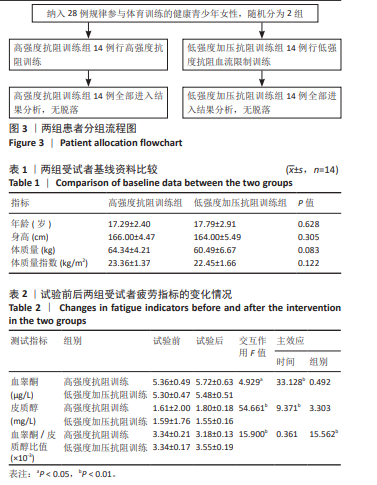
方法:招募28名健康青少年女性,随机分为高强度抗阻训练组(高强度抗阻训练,70%-85% 1RM)和低强度加压抗阻训练组(低强度加压抗阻训练,20%-30% 1RM,加压120-180 mmHg),两组在基础体能训练、饮食和恢复方面保持一致,干预持续12周,每周3次。测量干预前后受试者睾酮、皮质醇、血睾酮/皮质醇比值、肌酸激酶、血尿素、红细胞计数、血红蛋白和铁蛋白水平。
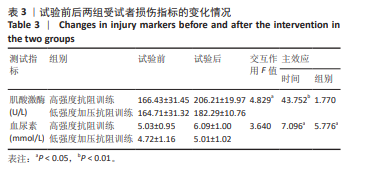
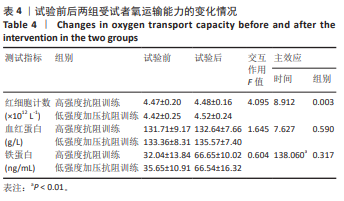
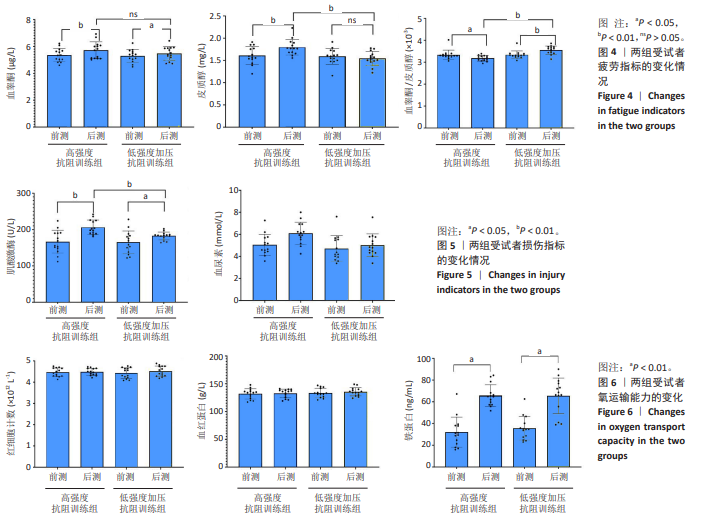
结果与结论:①两组睾酮水平均显著上升(P < 0.05);高强度抗阻训练组皮质醇显著增加(P < 0.01),低强度加压抗阻训练组皮质醇无显著变化(P > 0.05);血睾酮/皮质醇比值在高强度抗阻训练组下降(P < 0.05),在低强度加压抗阻训练组上升(P < 0.01);②肌酸激酶在两组均升高,但低强度加压抗阻训练组升幅较小(P < 0.05);血尿素方面,双因素重复测量方差分析显示时间主效应(P < 0.05)与组别主效应(P < 0.05)均显著,但无显著交互作用(P > 0.05);③两组铁蛋白在干预后均显著提高(P < 0.01),但组间无显著差异(P > 0.05);红细胞计数和血红蛋白略呈上升趋势但组内差异未达显著水平(P > 0.05),组间均无显著差异。提示低强度加压抗阻训练可在健康青少年女性中提高睾酮水平及血睾酮/
皮质醇比值,维持较稳定的内分泌状态,并在降低训练应激和减轻肌肉损伤方面优于高强度抗阻训练;同时,其改善血液营养及氧运输相关指标的效果与高强度抗阻训练相当。低强度加压抗阻训练可作为健康青少年女性较为安全、有效的抗阻训练方式。
https://orcid.org/0009-0004-2882-9061 (王硕)


中国组织工程研究杂志出版内容重点:干细胞;骨髓干细胞;造血干细胞;脂肪干细胞;肿瘤干细胞;胚胎干细胞;脐带脐血干细胞;干细胞诱导;干细胞分化;组织工程

关键词: 加压训练, 抗阻训练, 青少年女性, 血液生化指标

Abstract: BACKGROUND: Low-intensity blood flow restriction training can induce muscular adaptation under relatively low mechanical loads, demonstrating application potential in enhancing muscle strength and improving muscle function. However, its long-term effects on endocrine status, muscle damage, and blood nutritional indicators in healthy adolescent females remain insufficiently investigated.
OBJECTIVE: To compare the effects of low-intensity blood flow restriction training and conventional high-intensity blood flow restriction training on blood parameters in healthy adolescent females, and to explore a safer and more effective strength training protocol.
METHODS: Twenty-eight adolescent females were recruited and randomly assigned to either the high-intensity blood flow restriction training group (receiving high-intensity blood flow restriction training, 70%–85% of 1RM) or low-intensity blood flow restriction training group (receiving low-intensity blood flow restriction training, 20%–30% of 1RM, cuff pressure maintained at 120–180 mmHg). Both groups maintained consistent baseline physical conditioning, dietary intake, and recovery routines. The intervention lasted 12 weeks, with training sessions conducted three times per week. Levels of testosterone (T), cortisol (C), the T/C ratio, creatine kinase, blood urea nitrogen, red blood cell count, hemoglobin and ferritin were measured before and after the intervention.
RESULTS AND CONCLUSION: (1) After intervention, T levels were significantly increased in both groups compared with their respective pre-intervention levels (both P < 0.05). C levels increased significantly in the high-intensity blood flow restriction training group (P < 0.01) but showed no significant change in the low-intensity blood flow restriction training group compared with their respective pre-intervention levels (P > 0.05). The T/C ratio decreased in the high-intensity blood flow restriction training group (P < 0.05) and increased in the low-intensity blood flow restriction training group (P < 0.01) compared with their respective pre-intervention values. (2) After intervention, creatine kinase levels increased in both groups compared with their respective pre-intervention levels, with a significantly smaller increase observed in the low-intensity blood flow restriction training group (both P < 0.05). Two-way repeated-measures analysis of variance indicated significant main effects of time and group on blood urea nitrogen (both P < 0.05), with no significant time-by-group interaction (P > 0.05). (3) After intervention, ferritin levels were significantly increased in both groups compared with their respective pre-intervention levels (both P < 0.01), with no significant difference between groups (P > 0.05). Red blood cell counts and hemoglobin levels showed slight upward trends, but within-group differences did not reach statistical significance (P > 0.05), and no significant between-group differences were observed. These findings suggest that low-intensity blood flow restriction training can effectively elevate T levels and the T/C ratios in healthy adolescent females, maintaining a relatively stable endocrine status. Moreover, low-intensity blood flow restriction training appears to be superior to high-intensity blood flow restriction training in reducing training-induced stress and muscle damage, while achieving comparable improvements in blood nutritional and oxygen-carrying capacity-related indicators. Therefore, low-intensity blood flow restriction training may serve as a safe and effective resistance training modality for healthy adolescent females.


Key words: Pressure training, Resistance training, Adolescent female, Blood biochemical index

中图分类号: