1.1 设计 结合网络药理学与分子对接技术,探究芒果苷缓解骨关节炎疼痛的潜在机制及关键靶点,并进行动物实验验证。
1.2 时间及地点 研究于2020年3-12月在包头医学院实验动物中心完成。
1.3 材料 实验采用8周龄雌性SD大鼠,体质量180-230 g,购自斯贝福(北京)生物科技有限公司。
芒果苷(黄色粉末状)由中国食品药品检定研究院提供(货号:202004);小动物Micro CT扫描仪(德国布鲁克公司,货号:SkyScan 1174);双足平衡测痛仪(南京卡尔文生物科技;货号:KW-11A)。戊巴比妥钠注射液(武汉金诺化工,货号:20200205);碘伏消毒液(山东利尔康,货号:6303030029);脱毛剂(上海延慕,货号:20200607);盐酸利多卡因(成都倍特药业,货号:20200607);青霉素钠(华北制药,货号:2020008003);硫酸链霉素(国药集团,货号:202010012)。
实验方案经内蒙古科技大学包头医学院第一附属医院实验动物伦理委员会批准,批准号:YFYRC-BZNL-2020015。实验过程遵循了国际兽医学编辑协会《关于动物伦理与福利的作者指南共识》和本地及国家法规。
1.4 方法
1.4.1 运用网络药理与分子对接技术探究芒果苷在骨关节炎治疗中的效应
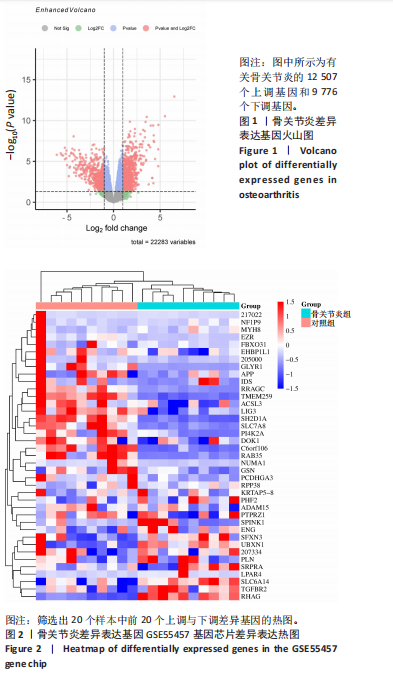
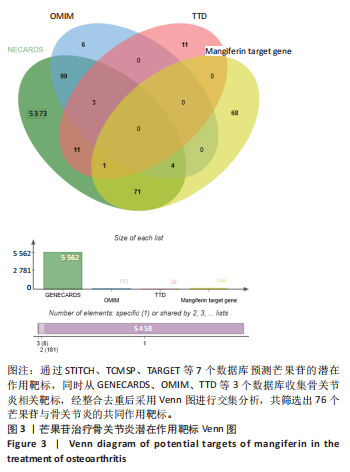
(1)骨关节炎基因芯片数据获取:通过GEO数据库,以“osteoarthritis”为检索词,获取GSE55457数据集(平台GPL96),选取10例骨关节炎滑膜样本和10例正常滑膜样本。数据处理时,采用P值小于0.05且绝对对数倍变值(|logFC|)≥1作为筛选差异表达基因的标准,随后通过火山图与热图实现可视化展示。
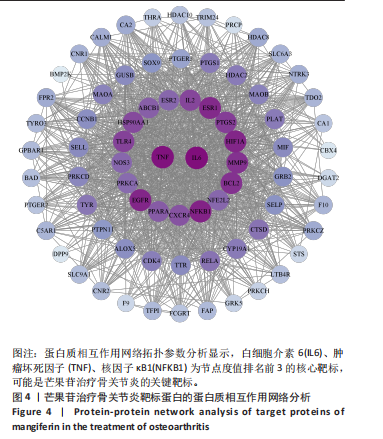
(2)芒果苷作用靶标收集:在Pubchem数据库(https://pubchem.ncbi.nlm.nih.gov/)检索 “mangiferin”,获取芒果苷的3D化学结构、Smile 号、InChikey 号等信息。利用 TARGET数据库(http://targetnet.scbdd.com/calcnet/index/)、HERB数据库(A high-throughput experiment- and reference-guided database of traditional Chinese medicine,本草组鉴)(http://herb.ac.cn/)、STITCH(Search Tool for Interacting Chemicals 相互作用化学物质的搜索工具)数据库(http://stitch.embl.de/)、TCMSP(Traditional Chinese Medicine Systems Pharmacology Database and Analysis Platform,中药系统药理学数据库与分析平台) 数据库(https://www.tcmsp-e.com/)、SEA(Similarity ensemble approach,相似集合法)数据库(https://sea.bkslab.org/)、Swiss Target Prediction 数据库(http://swisstargetprediction.ch/)以及 Super-PRED 数据库(https://prediction.charite.de/subpages/target_prediction.php),针对物种 “HomoSapiens” 开展芒果苷药物活性分子靶标预测。
(3)收集骨关节炎疾病相关靶标:在OMIM(Online Mendelian Inheritance in Man在线《人类孟德尔遗传》,http://www.omim.org/)、STRING(Search Tool for the Retrieval of Interacting Genes/Proteins,检索相互作用基因/蛋白质的搜索工具,http://string-db.
org/)、GENECARDS(GeneCards 基因名片数据库,https://www.genecards.org/)及TTD(Therapeutic Target Database治疗靶点数据库,https://db.idrblab.net/ttd/)数据库中,键入关键词“osteoarthritis”检索骨关节炎相关的潜在靶标。随后,利用UniProt数据库(https://www.uniprot.org/)对这些靶标进行验证、转换,并整合数据,剔除重复项。接着,借助jvenn平台(https://www.bioinformatics.com.cn/static/others/jvenn/example.html),将检索到的药物靶标与疾病靶标进行映射分析,旨在识别芒果苷在治疗骨关节炎中的关键靶标,并据此绘制出Venn图以直观展示分析结果。
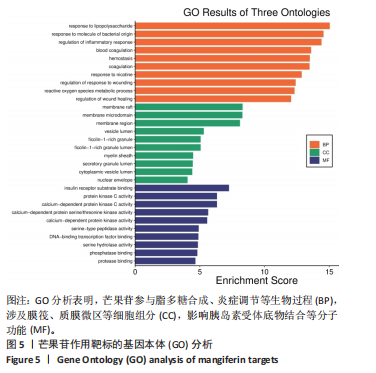
(4)构建靶标蛋白质相互作用网络:将筛选的关键靶标录入STRING v12.0数据库(https://cn.string-db.org/),设定物种为人类(Homo sapiens),选择 “高” 置信度,构建蛋白质相互作用网络并提取数据。用 Cytoscape v3.8.0 软件可视化,生成蛋白质相互作用网络图。图中节点大小和颜色依Degree值设定,直观展示数据关联。
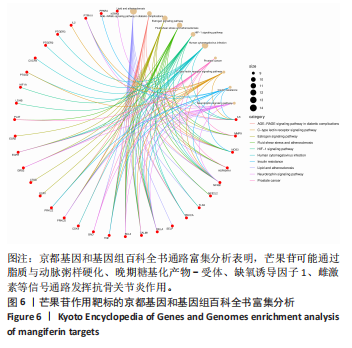
(5)进行靶标功能及通路富集解析:针对“Homo sapiens”,将关键交集靶标提交至Metascape平台(https://metascape.org/gp/index.html)进行京都基因和基因组百科全书信号通路以及基因本体功能包括生物过程、细胞组分及分子功能富集分析。筛选标准定为伪发现率小于0.1且P值小于0.05,取前10项结果,通过条形图和弦图进行可视化展示。
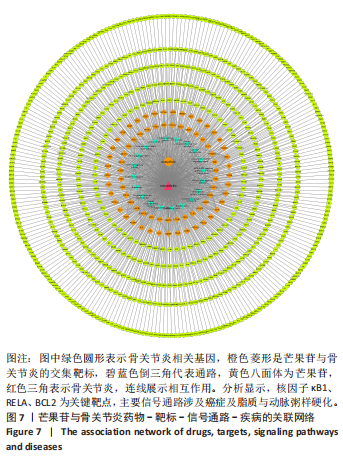
(6)构建“药物-靶点-通路-疾病”可视化网络:把关键靶标与疾病靶标、通路富集结果匹配,利用Cytoscape 3.8.0软件绘制 “药物-靶点-通路-疾病” 网络图,以连线数量反映通路和靶点的重要程度。
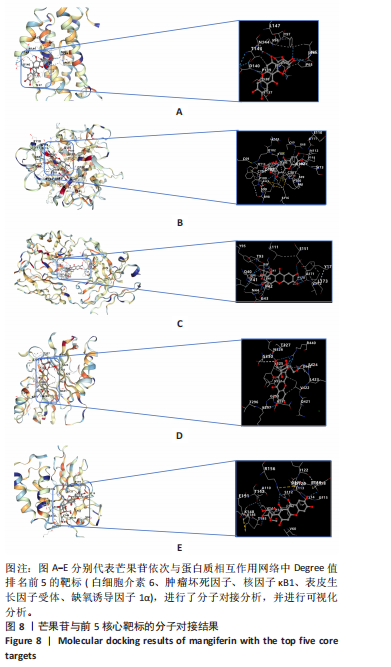
(7)分子对接分析及可视化:对蛋白质相互作用网络中 Degree 值排名前5的靶标开展分子对接分析,从PDB数据库(https://www.rcsb.org/)获取靶标蛋白3D结构,借助 CBDOCK2 在线平台进行(https://cadd.labshare.cn/cb-dock2/php/index.php)实施对接操作[8]。结合能低于−20.9 kJ/mol表示结合活性良好,低于−29.3 kJ/mol则表明结合活性更强。
1.4.2 动物实验方法
(1)动物模型的建立:采用左膝关节前交叉韧带切断术建立大鼠骨关节炎模型,腹腔注射40 mg/kg戊巴比妥钠麻醉,并用盐酸利多卡因局部浸润,经膝关节前正中入路切断前交叉韧带后缝合。假手术组大鼠只进行髌骨脱位复位。术后连续3 d腹腔注射青霉素和链霉素防感染,饲养环境为(23±2) ℃、湿度40%-60%、12 h明暗交替。
此次实验初始纳入24只雌性SD大鼠,其中18只接受前交叉韧带切断手术建立大鼠骨关节炎模型,假手术组6只仅进行髌骨脱位复位术。术后4周观察期内,通过每日观察大鼠膝关节红肿、活动度及一般状态评估造模质量,最终排除标准为:①膝关节感染(表现为局部化脓、皮温升高,共0只);②麻醉或手术相关死亡(共0只);③前交叉韧带切断不完全导致关节稳定性未破坏(通过术后 2 周 Micro CT 验证,共0只)。最终18只前交叉韧带切断模型大鼠均符合造模标准,造模成功率为 100%,确保了后续分组的有效性。
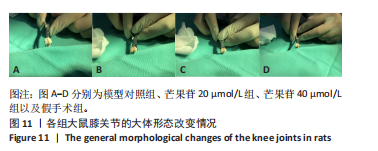
(2)动物分组及治疗:假手术组(n=6)仅行髌骨脱位复位术,不切断前交叉韧带,术后第5-8周每周1次膝关节腔注射100 μL 二甲基亚砜溶剂。根据相关研究显示,芒果苷20,40 μmol/L 在48,72 h时均能显著促进成骨细胞增殖,且40 μmol/L组效果更优[9];同时也有研究通过CCK-8法证实,5-40 μmol/L为芒果苷作用于鸭胚肝细胞(DEHCs)的安全浓度(80,160 μmol/L 组细胞增殖能力显著降低)[10],故此次实验选取20,40 μmol/L 作为干预浓度。18只完成交叉韧带切除术的大鼠按随机数字表法分为3组(n=6):模型对照组每只大鼠膝关节腔注射 100 μL二甲基亚砜溶剂;芒果苷20 μmol/L组每只大鼠注射 100 μL、浓度为20 μmol/L的芒果苷溶液;芒果苷40 μmol/L组每只大鼠注射100 μL、浓度为40 μmol/L的芒果苷溶液。造模术后第5-8周,每周1次关节腔注射;末次注射后7 d(即术后9周)戊巴比妥钠注射液150 mg/kg腹腔注射麻醉后处死大鼠,留取标本用于后续分析。
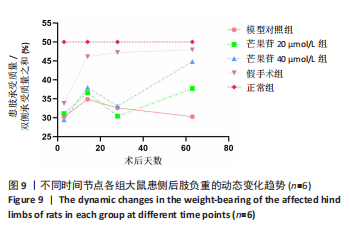
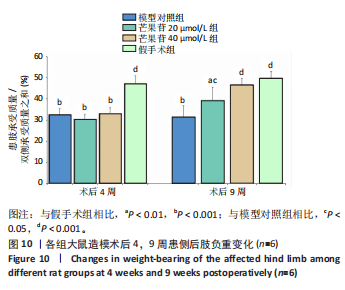
(3)疼痛评估:使用KW-11A双足平衡测痛仪评估大鼠后肢质量分布,反映患肢疼痛指数。大鼠因疼痛减少患肢负重,仪器检测双肢支撑力差异,差异越大表明疼痛越严重。操作时,将大鼠置于倾斜电容计上,双后肢分别放在独立传感器板上,仪器自动记录大鼠5次施力瞬间的双肢支撑力数据,每2次施力间隔为10 s,共获取5次施力对应的10个连续时间段(每个施力过程包含发力及缓冲2个时间段,每个时间段持续0.5 s)的支撑力数值,最终取这10个时间段的平均值作为单次测量结果。计算手术肢体质量占双肢总质量的百分比,重复测量5次后取均值。在术前及术后3 d、2周、4周、9周测量疼痛情况。
(4)标本获取:大鼠麻醉处死后,完整切下包含股骨近端、胫骨远端的膝关节,保留0.8-1.5 cm骨干,小心剔除肌肉等软组织,仅保留膝关节囊,随即进行Micro CT扫描。
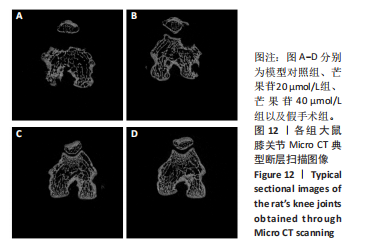
(5)Micro CT扫描:查看大鼠膝关节软骨的损伤与退变状况,

以评估股骨髁软骨面的缺损状况。扫描参数设定:扫描时间0.21 s,电压80 kVp,电流 500 μA,校准30次,最终获取轴向与横向视野均为30.74 mm的图像。此外,将显微CT图像重建为三维图像,直观展现关节的大体缺损及退变情况。
1.5 主要观察指标 在术前及术后3 d、2 周、4 周、9 周,使用 KW-11A 双足平衡测痛仪测量大鼠后肢体质量分布以评估疼痛情况;术后 9 周处死大鼠,获取膝关节标本,利用 Micro CT 扫描仪扫描并三维重建,观察关节大体形态及软骨损伤退变状况。
1.6 统计学分析 针对动物实验后肢负重数据,采用 SPSS 25.0 统计软件进行分析。组间比较运用方差分析(One-way ANOVA),检验多组之间的均值是否存在显著差异。之后,通过 LSD(最小显著差异法)进行事后两两比较,以明确具体哪些组之间存在差异,进而判断芒果苷的疗效。文章统计学方法已经由内蒙古科技大学包头医学院第一附属医院生物统计学专家审核,确保了统计分析的科学性与准确性,能够可靠地揭示实验数据背后的生物学意义。