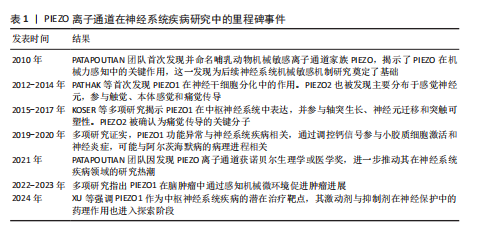
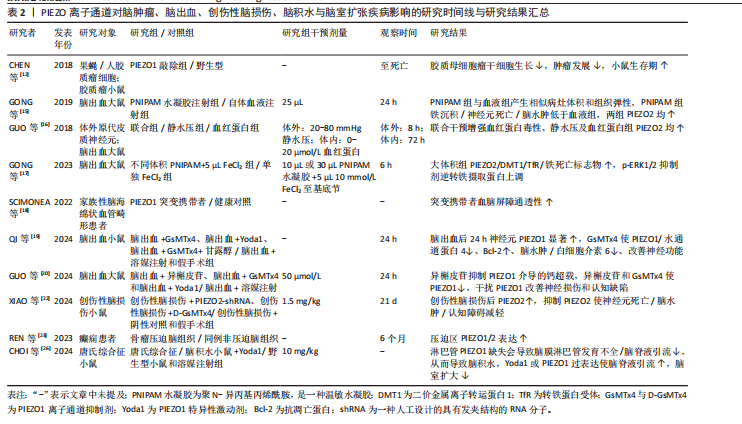
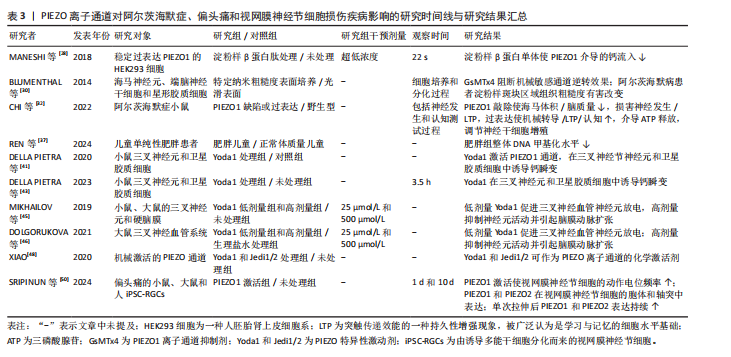
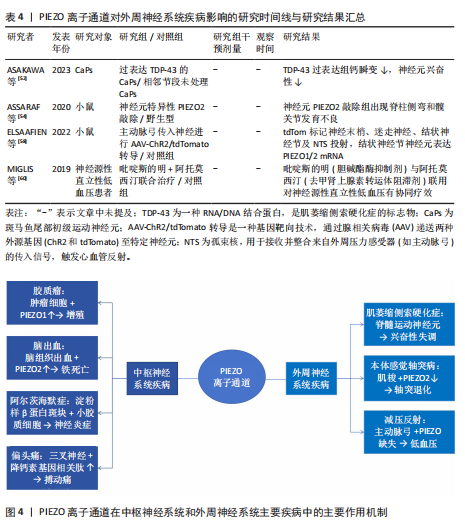
[1] XU Y, WANG Y, YANG Y, et al. Piezo1: the key regulators in central nervous system diseases. Front Cell Neurosci. 2024;18:1441806.
[2] VELASCO-ESTEVEZ M, KOCH N, KLEJBOR I, et al. Mechanoreceptor Piezo1 Is Downregulated in Multiple Sclerosis Brain and Is Involved in the Maturation and Migration of Oligodendrocytes in vitro. Front Cell Neurosci. 2022;16:914985.
[3] QIN L, HE T, CHEN S, et al. Roles of mechanosensitive channel Piezo1/2 proteins in skeleton and other tissues. Bone Res. 2021; 9(1):44.
[4] LIM J, TAI HH, LIAO WH, et al. ASIC1a is required for neuronal activation via low-intensity ultrasound stimulation in mouse brain. Elife. 2021;10:e61660.
[5] XU X, LIU S, LIU H, et al. Piezo Channels: Awesome Mechanosensitive Structures in Cellular Mechanotransduction and Their Role in Bone. Int J Mol Sci. 2021;22(12):6429.
[6] SAN SEBASTIAN W, SAMARANCH L, KELLS AP, et al. Gene therapy for misfolding protein diseases of the central nervous system. Neurotherapeutics. 2013;10(3):498-510.
[7] ZHAO Q, ZHOU H, LI X, et al. The mechanosensitive Piezo1 channel: a three-bladed propeller-like structure and a lever-like mechanogating mechanism. FEBS J. 2019286(13):2461-2470.
[8] LI X, HU J, ZHAO X, et al. Piezo channels in the urinary system. Exp Mol Med. 2022;54(6): 697-710.
[9] XIAO B. Mechanisms of mechanotransduction and physiological roles of PIEZO channels. Nat Rev Mol Cell Biol. 2024;25(11):886-903.
[10] QIU Z, GUO J, KALA S, et al. The Mechanosensitive Ion Channel Piezo1 Significantly Mediates In Vitro Ultrasonic Stimulation of Neurons. iScience. 2019;21:448-457.
[11] PARK JW, LEE K, KIM EE, et al. Brain Tumor Classification by Methylation Profile. J Korean Med Sci. 2023;38(43):e356.
[12] CHEN X, WANGGOU S, BODALIA A, et al. A Feedforward Mechanism Mediated by Mechanosensitive Ion Channel PIEZO1 and Tissue Mechanics Promotes Glioma Aggression. Neuron. 2018;100(4):799-815.e7.
[13] FU W, HOU X, DING L, et al. Piezo1-related physiological and pathological processes in glioblastoma. Front Cell Dev Biol. 2025;13: 1536320.
[14] QURESHI AI, TUHRIM S, BRODERICK JP, et al. Spontaneous intracerebral hemorrhage. N Engl J Med. 2001;344(19):1450-1460.
[15] GONG Y, GONG Y, HOU Z, et al. Establishment of an Experimental Intracerebral Haemorrhage Model for Mass Effect Research using a Thermo-sensitive Hydrogel. Sci Rep. 2019;9(1):13838.
[16] GUO T, REN P, LI X, et al. Neural Injuries Induced by Hydrostatic Pressure Associated With Mass Effect after Intracerebral Hemorrhage. Sci Rep. 2018;8(1):9195.
[17] GONG Y, DENG J, WU Y, et al. Role of mass effect on neuronal iron deposition after intracerebral hemorrhage. Exp Neurol. 2023;368:114475.
[18] SCIMONE C, DONATO L, ALIBRANDI S, et al. Evidences of PIEZO1 involvement in cerebral cavernous malformation pathogenesis. Microvasc Res. 2022;141:104342.
[19] QI M, LIU R, ZHANG F, et al. Roles of mechanosensitive ion channel PIEZO1 in the pathogenesis of brain injury after experimental intracerebral hemorrhage. Neuropharmacology. 2024;251:109896.
[20] GUO T, CHEN G, YANG L, et al. Piezo1 inhibitor isoquercitrin rescues neural impairment mediated by NLRP3 after intracerebral hemorrhage. Exp Neurol. 2024;379:114852.
[21] KHELLAF A, KHAN DZ, HELMY A. Recent advances in traumatic brain injury. J Neurol. 2019;266(11): 2878-2889.
[22] XIAO Y, ZHANG Y, YUAN W, et al. Piezo2 Contributes to Traumatic Brain Injury by Activating the RhoA/ROCK1 Pathways. Mol Neurobiol. 2024; 61(10):7419-7430.
[23] REN Y, LIU Y, WU H, et al. Subdural osteoma in an adolescent patient with epilepsy: an unusual case report and literature review. Childs Nerv Syst. 2023;39(11):3281-3288.
[24] HOCHSTETLER A, RASKIN J, BLAZER-YOST BL. Hydrocephalus: historical analysis and considerations for treatment. Eur J Med Res. 2022;27(1):168.
[25] EDWARDS RJ, DOMBROWSKI SM, LUCIANO MG, et al. Chronic hydrocephalus in adults. Brain Pathol. 2004;14(3):325-336.
[26] CHOI D, PARK E, CHOI J, et al. Piezo1 regulates meningeal lymphatic vessel drainage and alleviates excessive CSF accumulation. Nat Neurosci. 2024;27(5):913-926.
[27] MCKHANN G, DRACHMAN D, FOLSTEIN M, et al. Clinical diagnosis of Alzheimer’s disease: report of the NINCDS-ADRDA Work Group under the auspices of Department of Health and Human Services Task Force on Alzheimer’s Disease. Neurology. 1984;34(7):939-944.
[28] MANESHI MM, ZIEGLER L, SACHS F, et al. Enantiomeric Aβ peptides inhibit the fluid shear stress response of PIEZO1. Sci Rep. 2018;8(1): 14267.
[29] PARK M, HOANG GM, NGUYEN T, et al. Effects of transcranial ultrasound stimulation pulsed at 40 Hz on Aβ plaques and brain rhythms in 5×FAD mice. Transl Neurodegener. 2021;10(1):48.
[30] BLUMENTHAL NR, HERMANSON O, HEIMRICH B, et al. Stochastic nanoroughness modulates neuron-astrocyte interactions and function via mechanosensing cation channels. Proc Natl Acad Sci U S A. 2014;111(45):16124-16129.
[31] SATOH K, HATA M, TAKAHARA S, et al. A novel membrane protein, encoded by the gene covering KIAA0233, is transcriptionally induced in senile plaque-associated astrocytes. Brain Res. 2006;1108(1):19-27.
[32] CHI S, CUI Y, WANG H, et al. Astrocytic Piezo1-mediated mechanotransduction determines adult neurogenesis and cognitive functions. Neuron. 2022;110(18):2984-2999.e8.
[33] IVKOVIC S, MAJOR T, MITIC M, et al. Fatty acids as biomodulators of Piezo1 mediated glial mechanosensitivity in Alzheimer’s disease. Life Sci. 2022;297:120470.
[34] GENG J, SHI Y, ZHANG J, et al. TLR4 signalling via Piezo1 engages and enhances the macrophage mediated host response during bacterial infection. Nat Commun. 2021;12(1):3519.
[35] SCHELTENS P, DE STROOPER B, KIVIPELTO M, et al. Alzheimer’s disease. Lancet. 2021;397(10284): 1577-1590.
[36] LIM XR, ABD-ALHASEEB MM, IPPOLITO M, et al. Endothelial Piezo1 channel mediates mechano-feedback control of brain blood flow. Nat Commun. 2024;15(1):8686.
[37] REN Y, HUANG P, HUANG X, et al. Alterations of DNA methylation profile in peripheral blood of children with simple obesity. Health Inf Sci Syst. 2024;12(1):26.
[38] ZHENG Q, LIU H, YU W, et al. Mechanical properties of the brain: Focus on the essential role of Piezo1-mediated mechanotransduction in the CNS. Brain Behav. 2023;13(9):e3136.
[39] OH J, VIDAL-JORDANA A, MONTALBAN X. Multiple sclerosis: clinical aspects. Curr Opin Neurol. 2018; 31(6):752-759.
[40] YANG K, HE X, WU Z, et al. The emerging roles of piezo1 channels in animal models of multiple sclerosis. Front Immunol. 2022;13:976522.
[41] DELLA PIETRA A, MIKHAILOV N, GINIATULLIN R. The Emerging Role of Mechanosensitive Piezo Channels in Migraine Pain. Int J Mol Sci. 2020; 21(3):696.
[42] BURISH MJ, HAN C, MAWATARI K, et al. The first-line cluster headache medication verapamil alters the circadian period and elicits sex-specific sleep changes in mice. Chronobiol Int. 2021;38(6):839-850.
[43] DELLA PIETRA A, MIKHAILOV N, GINIATULLIN R. FM1-43 Dye Memorizes Piezo1 Activation in the Trigeminal Nociceptive System Implicated in Migraine Pain. Int J Mol Sci. 2023;24(2):1688.
[44] GINIATULLIN R. Ion Channels of Nociception. Int J Mol Sci. 2020;21(10):3553.
[45] MIKHAILOV N, LESKINEN J, FAGERLUND I, et al. Mechanosensitive meningeal nociception via Piezo channels: Implications for pulsatile pain in migraine? Neuropharmacology. 2019;149:113-123.
[46] DOLGORUKOVA A, ISAEVA JE, VERBITSKAYA E, et al. Differential effects of the Piezo1 agonist Yoda1 in the trigeminovascular system: An electrophysiological and intravital microscopy study in rats. Exp Neurol. 2021;339:113634.
[47] DELLA PIETRA A, GÓMEZ DABÓ L, MIKULENKA P, et al. Mechanosensitive receptors in migraine: a systematic review. J Headache Pain. 2024;25(1):6.
[48] XIAO B. Levering Mechanically Activated Piezo Channels for Potential Pharmacological Intervention. Annu Rev Pharmacol Toxicol. 2020;60:195-218.
[49] FENG Y, HU C, CUI K, et al. GSK840 Alleviates Retinal Neuronal Injury by Inhibiting RIPK3/MLKL-Mediated RGC Necroptosis After Ischemia/Reperfusion. Invest Ophthalmol Vis Sci. 2023; 64(14):42.
[50] SRIPINUN P, SEE LP, NIKONOV S, et al. Piezo1 and Piezo2 channels in retinal ganglion cells and the impact of Piezo1 stimulation on light-dependent neural activity. bioRxiv [Preprint]. 2024:2024.06.25.599602.
[51] HARDIMAN O, AL-CHALABI A, CHIO A, et al. Amyotrophic lateral sclerosis. Nat Rev Dis Primers. 2017;3:17071.
[52] ASAKAWA K, HANDA H, KAWAKAMI K. Dysregulated TDP-43 proteostasis perturbs excitability of spinal motor neurons during brainstem-mediated fictive locomotion in zebrafish. Dev Growth Differ. 2023;65(8):446-452.
[53] SONKODI B, KOPA Z, NYIRÁDY P. Post Orgasmic Illness Syndrome (POIS) and Delayed Onset Muscle Soreness (DOMS): Do They Have Anything in Common? Cells. 2021;10(8):1867.
[54] ASSARAF E, BLECHER R, HEINEMANN-YERUSHALMI L, et al. Piezo2 expressed in proprioceptive neurons is essential for skeletal integrity. Nat Commun. 2020;11(1):3168.
[55] KRÖGER S. Proprioception 2.0: novel functions for muscle spindles. Curr Opin Neurol. 2018; 31(5):592-598.
[56] YANG H, TENORIO LOPES L, BARIONI NO, et al. The molecular makeup of peripheral and central baroreceptors: stretching a role for Transient Receptor Potential (TRP), Epithelial Sodium Channel (ENaC), Acid Sensing Ion Channel (ASIC), and Piezo channels. Cardiovasc Res. 2022; 118(15):3052-3070.
[57] VALENZA G, MATIĆ Z, CATRAMBONE V. The brain-heart axis: integrative cooperation of neural, mechanical and biochemical pathways. Nat Rev Cardiol. 2025;22(8):537-550.
[58] ELSAAFIEN K, HARDEN SW, JOHNSON DN, et al. A Novel Organ-Specific Approach to Selectively Target Sensory Afferents Innervating the Aortic Arch. Front Physiol. 2022;13:841078.
[59] ZENG WZ, MARSHALL KL, MIN S, et al. PIEZOs mediate neuronal sensing of blood pressure and the baroreceptor reflex. Science. 2018;362(6413):464-467.
[60] MIGLIS MG, MUPPIDI S. Ion channels PIEZOs identified as the long-sought baroreceptor mechanosensors for blood pressure control, and other updates on autonomic research. Clin Auton Res. 2019;29(1):9-11.
|