1 对象和方法 Subjects and methods
1.1 设计 对比观察试验。
1.2 时间及地点 试验于2024年1-4月在赣南医科大学完成。
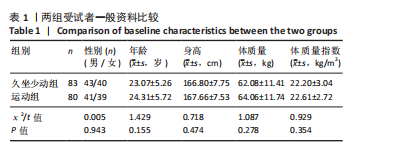
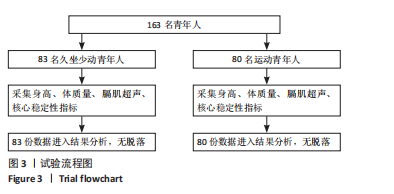
1.3 对象 在G-Power 3.1.9.7软件中采用独立样本t检验作为样本计算的依据,将膈肌超声参数作为此研究的首要参考指标。显著性水平设定为α=0.05,效应量=0.8,检验功效=0.95,计算得到每组样本量最少为42名,此研究最终纳入了163名普通青年人作为研究对象,平均年龄(23.65±5.51)岁,平均体质量(63.03±11.56) kg,平均体质量指数(22.41±2.83) kg/m2。依据《ACSM运动测试与运动处方指南(第九版)》所制定的标准,同时结合国际体力活动问卷(International Physical Activity Questionnaire,IPAQ)的测评结果,对所有参与者进行了分组,包括久坐少动组83名,运动组80名。
(1)纳入标准:①首次筛选标准如下:年龄在18-40周岁;均为腹部呼吸模式;不存在心血管系统疾患及代谢异常病;参照《ACSM运动测试同运动处方指南(第九版)》中所列分级规范:未能达到每周3次及以上、每次持续30 min的中等强度身体锻炼,且该状态维持超过3个月初步划归为久坐少动人群。②再次分类标准:经初筛合格的受试对象,需再次填写IPAQ问卷,基于该问卷体力活动分级体系,运动量不足的判定阈值为:每周5 d或更久时段内,步行、中等强度或高强度身体活动总代谢当量低于600 MET-min/周;久坐行为则定义为每日坐姿时间超过8 h[13],受试者最终分组方案由此确立。
(2)排除标准:①有运动禁忌证,或身体功能上存在缺陷;②躯干结构与功能异常(脊柱侧弯、慢性非特异性腰痛);③核心区控制能力相关的疾病,如帕金森病、脑卒中、精神药品的使用等;④躯干皮肤损伤;⑤1年内躯干骨骼肌肉创伤史;⑥呼吸道及心脑血管疾病史;⑦1级肥胖及以上(体质量指数> 30 kg/m2)。
此研究已获得赣南医科大学伦理委员会的批准(编号2024084)。
1.4 测试方法 基于指标全面、准确与可行性的考量[14-15],研究选取了膈肌厚度、增厚率、移动度、收缩斜率、躯干压力生物反馈、躯干本体感觉、单腿跳远、闭眼单腿站立、仰卧起坐、躯干伸肌耐力等作为研究的关键指标。这些指标的选择既基于科学性和代表性,又考虑了实际操作的可行性,能够有效支持较大样本横断面研究的顺利开展。
1.4.1 试验流程 在正式试验开始前1周,召集所有符合试验要求的受试者前往试验室,详细说明试验流程、注意事项以及签署知情同意书,并进行腹式呼吸的纠正与训练,以达到熟练进行腹式呼吸。在试验前24 h内,受试者不得吸烟、饮酒或服用任何药物,同时避免剧烈运动。在拟定的试验日,受试者在餐后2 h进入试验室。在参与试验之前,受试者需要填写基本资料调查表,仔细阅读注意事项,并熟悉试验的具体操作流程。受试者在试验开始前均进行了足够的预试验训练,均能掌握规定的呼吸方式和试验设备使用,以减少学习效应的影响。在每部分试验开始之前,每名被试需要跟随录像做2 min热身,让被试的呼吸肌及核心区肌肉功能达到较佳状态。测试历时约90 min,试验流程分为3个部分:基础值测试(身高、体质量)、膈肌超声与核心稳定性测试。测试时间:2024年1-4月。
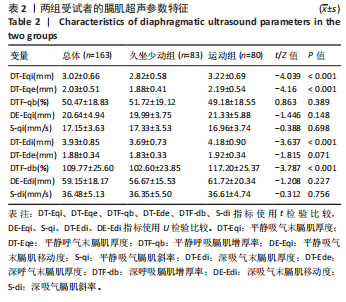
1.4.2 膈肌超声测试 膈肌结构与功能的评估指标较多,不同场景下各指标的应用各有特点与优势[16-17]。通过超声可获取膈肌厚度、增厚率、移动度、收缩斜率等参数[4],这些参数反映呼吸过程中膈肌所表现出的结构功能特性。
(1)膈肌厚度:右侧膈肌胸壁对合区较易实现厚度观测,左侧则因腹部气体存在干扰现象,测量误差较大[18]。采用智能超声系统(Wisonic Navi,中国)进行观测,常选用B超模式,受试者保持仰卧位且髋、膝关节处于屈曲状态。垂直于肋骨方向放置10 MHz高频线阵探头,与腋前线第8,9肋间隙走向一致[19]。切换至M型超声后,呈现出三层结构清晰的影像:高回声腹膜及胸膜环绕低回声膈肌(图1),测量胸膜和腹膜之间的距离,共进行3次呼吸测试,取平均值。
涉及膈肌厚度评估的指标主要涵盖以下几项:平静吸气末膈肌厚度(DT-Eqi)、平静呼气末膈肌厚度(DT-Eqe)以及平静呼吸过程中膈肌增厚率(DTF-qb)。此外还包括深吸气末膈肌厚度(DT-Edi)、深呼气末膈肌厚度(DT-Ede)以及深呼吸过程中膈肌增厚率(DTF-db)。采用如下公式计算膈肌增厚比率:(吸气末膈肌厚度-呼气末膈肌厚度)/呼气末膈肌厚度。呼吸测试均在无阻力状况下进行,平静呼吸过程不需主动刻意用力,在呼吸末感觉自然而放松的停顿,没有呼吸肌紧张。深呼吸没有爆发式的快速吸气或呼气,而是平稳而均匀地吸气,在深吸气末受试者有一种

自然的饱满感。缓慢而有控制地呼气,腹肌可以稍微用力以帮助肺部排空,但无需像最大呼气那样用力达到生理极限,深呼气末感觉自然而放松的停顿。录制受试者的呼吸过程,回放视频进行自我呼吸的评估和调整。男女受试者分别由2位不同性别康复师进行测试,均接受了医学影像科的专业培训。
(2)膈肌移动度与斜率:在呼吸过程中,膈肌位移量被定义为膈肌移动度。使用B型超声设备进行检测时,操作者需以肝脏作为透声窗。将频率为4 MHz的凸阵探头置于腋前线右肋弓下缘区域,朝向肩关节右上方,此时可获得右侧膈顶部的超声切面图像(图2)。位于肝实质后方的高回声结构即为右侧膈肌组织的影像。为了获取更优质的成像效果,探头的方向应调整为指向受试者右肩及背部区域。如此操作可确保超声波束与膈肌后1/3部分形成垂直投射关系。通过B超模式对上腹部区域实施初步扫查,确定最适合测量膈肌活动的解剖位置后,切换至M型超声模式进行记录。选择在膈肌的最高点(呼吸时膈肌最高位置的上缘)和最低点(呼吸时膈肌最低位置的上缘),记录这两个点在时间轴上的位置,共进行3次呼吸测试,取平均值。测量膈肌从最低点移动到最高点所需的时间(Δt),以及这两个点之间的距离(Δd)。斜率反映了膈肌在呼吸过程中的活动速度,用于评估膈肌的功能状态,尤其是快速反应能力和整体健康状况,计算公式:膈肌移动的距离(Δd)/移动所用的时间(Δt),共进行3次呼吸测试,取平均值,得到的膈肌移动度和斜率指标包括:平静吸气末膈肌移动度(DE-Eqi)、平静吸气膈肌斜率(S-qi)、深吸气末膈肌移动度(DE-Edi)、深吸气膈肌斜率(S-di)。

1.4.3 核心稳定性测试
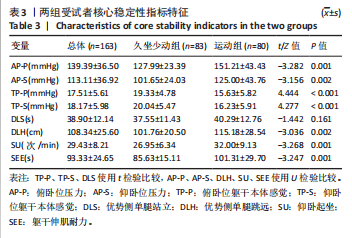
(1)躯干压力生物反馈:压力生物反馈仪(Stabilizer型,T-swylfky-0440款)用于腹内压强弱的测定,原理在于腰腹部肌肉收缩状态及对充气压力气囊变化的感知,从而反映躯干肌肉活动与核心稳定性[20]。该设备简易便携,在腹内压测量和腹部肌肉功能评估方面获得广泛应用[20]。采用肌骨超声与压力生物反馈仪检测健康受试者腹横肌形态功能,发现腹横肌厚度与腹内压水平呈正相关,同时仪器读数变动可间接指示腹横肌力量变化。研究涉及两组腰腹部压力测量动作,俯卧姿势压力值(AP-P)测定要求被试者双手置于治疗床两侧,双腿保持并拢平放,初始设定70 mmHg为基准值,设备安放于L2-L4椎体区域,腹部尽力扩张直至仪器读数稳定。仰卧姿势压力值(AP-S)测定则需受试者屈髋屈膝,双手置于躯干上方位置,40 mmHg作为起始数值,腰部持续下压至仪器数值稳定。设备摆放位置及数据采集流程与俯卧位测试保持一致[20]。两种体位初始压力基准值设定是基于腹部脏器分布及体质量负荷差异对腹腔内压产生的不同生理影响,并参考了既往关于躯干压力生物反馈研究方法。
(2)躯干本体感觉:躯干本体感觉评估的依据是生物反馈测试中实际压力值与目标压力值间绝对误差的测量。本体感觉功能的优劣由绝对误差压力值的大小决定,研究表明该数值越小则说明本体感觉能力越强[20]。测试过程如下:首先受试者尽可能排除视觉与听觉干扰,使用压力生物反馈仪测定最大腹压值。随后重复上述测试步骤,当受试者感知到目标压力水平时,应立即停止加压动作并保持2 s,此刻记录实际压力数据。实际压力与目标压力的差异程度(即绝对误差压力)是衡量躯干控制能力的重要参数。研究选取受试者测得压力与1/2最大腹压值间的绝对误差作为指标,进行3次测量,最终结果取平均值。在正式测试前,受试者可以睁眼练习3次,以熟悉压力生物反馈仪的使用流程,然后再闭眼进行正式测试[4]。躯干本体感觉测试包括:俯卧位躯干本体感觉(TP-P)和仰卧位躯干本体感觉(TP-S)。
(3)优势侧单腿站立:优势侧下肢支撑身体质量,非优势侧小腿向后抬高至膝关节呈90°屈曲状,两下肢间无接触。两臂胸前交叉放置,双手位于对侧肩部,闭眼进行测试[21]。测试终止条件包含以下任意项:双臂未能保持胸前交叉;非支撑足与地面发生接触;支撑足出现位移;眼睛睁开。3次重复测量,持续时间最大值作为最终成绩[21]。
(4)优势侧单腿跳远:优势侧单足支撑,受试者尽力向前跳跃。落地后仍需保持优势侧单足支撑,维持稳定需超过3 s。跳跃前后足尖至足跟水平距离作为测量指标,3次测试后选最优值[22]。
(5)仰卧起坐:受试者在体操垫上呈仰卧准备姿势,双膝关节屈曲至90°,足底部与地面保持固定接触。双臂胸前交叉,双手位于对侧肩部。躯干下放阶段要求肩胛骨区域必须接触垫面,上抬阶段则需肘关节-膝关节接触。每完成5次动作给予语言激励一次,1 min内完成次数作为最终结果。
(6)躯干伸肌耐力:受试者俯卧于长凳,躯干置于长凳外(髂前上棘与凳边缘对齐)。下肢由测试人员实施固定,受试者上半身抬升至与地面平行,双臂胸前交叉,双手位于对侧肩部,上臂部垂直地平面。当受试者无法维持躯干与地面的平行状态或手部触地时计时终止。每隔10 s进行一次语言激励,以保证测试效度[23]。
1.5 主要观察指标 每天14-18点完成膈肌超声参数和核心稳定性指标的数据采集。数据和图像处理在10 d内完成,数据经预处理后计算各类指标间的差异和相关关系。
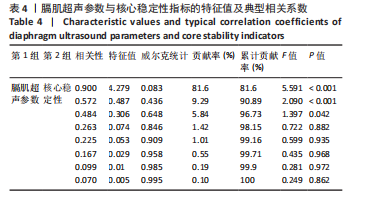
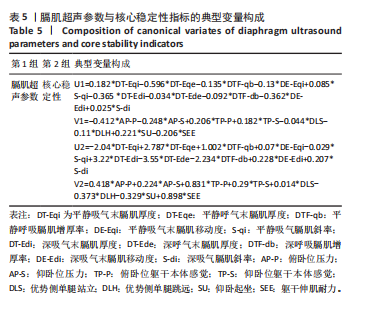
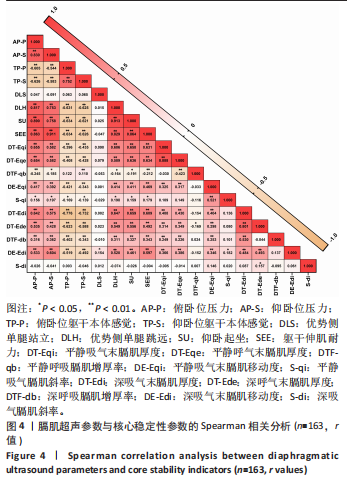
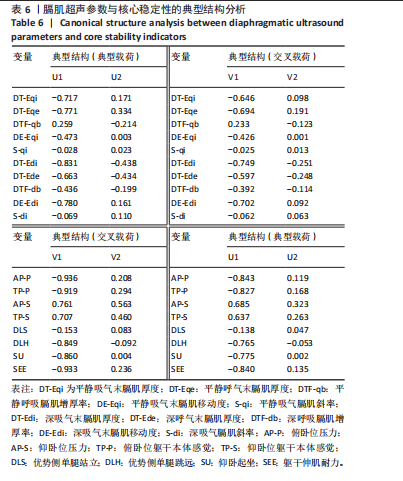
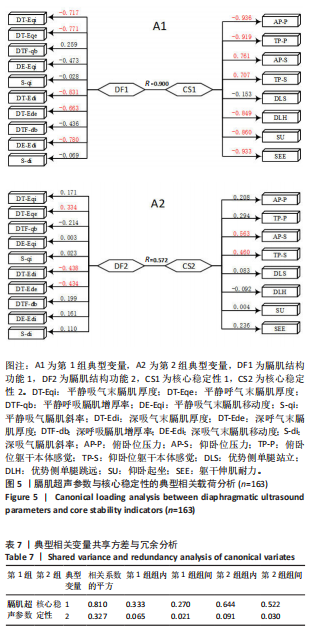
1.6 统计学分析 数据采用x±s表示,使用SPSS 25.0软件完成数据分析,使用GraphPad Prism 8.0和Visio软件完成统计图的绘制。通过Shapiro-Wilk检验法判定正态分布情况。组间差异的比较依据资料正态性和方差齐性检验结果而定,分别采用卡方检验、独立样本t检验或Mann-Whitney U检验。部分指标呈现非正态分布特征,采用Spearman检验进行膈肌超声参数与核心稳定性指标间的相关性分析。0.7≤|r|< 1为强相关性,0.3≤|r|< 0.7为中等程度相关性,|r|< 0.3则为弱相关特性;膈肌超声参数与核心稳定性间的整体关联通过典型相关进行分析,统计学意义的标准设定为P < 0.05。文章统计学方法已经通过赣南医科大学公共卫生与健康管理学院生物统计学专家审核。