中国组织工程研究 ›› 2026, Vol. 30 ›› Issue (31): 8264-8271.doi: 10.12307/2026.853
• 干细胞综述 stem cell review • 上一篇 下一篇
工程化外泌体长链非编码RNA在骨质疏松治疗中的创新策略
张传林,吴玉怀,周海祥,刘建平,徐 茜,张丽丽,李翠娥
- 昆明医科大学第六附属医院(玉溪市人民医院),云南省玉溪市 653100
-
收稿日期:2025-11-13接受日期:2026-01-22出版日期:2026-11-08发布日期:2026-05-26 -
通讯作者:李翠娥,硕士,副主任医师,昆明医科大学第六附属医院(玉溪市人民医院),云南省玉溪市 653100 -
作者简介:张传林,男,1974年生,主任医师,主要从事骨质疏松及骨关节疾病发生发展的研究。 -
基金资助:云南省科技厅科技计划项目-基础研究计划-面上项目(202301AY070001-133),项目负责人:李翠娥
An innovative strategy for engineered exosomal long non-coding RNAs in treatment of osteoporosis
Zhang Chuanlin, Wu Yuhuai, Zhou Haixiang, Liu Jianping, Xu Qian, Zhang Lili, Li Cuie
- Sixth Affiliated Hospital of Kunming Medical University/People's Hospital of Yuxi City, Yuxi 653100, Yunnan Province, China
-
Received:2025-11-13Accepted:2026-01-22Online:2026-11-08Published:2026-05-26 -
Contact:Li Cuie, MS, Associate chief physician, Sixth Affiliated Hospital of Kunming Medical University/People's Hospital of Yuxi City, Yuxi 653100, Yunnan Province, China -
About author:Zhang Chuanlin, Chief physician, Sixth Affiliated Hospital of Kunming Medical University/People's Hospital of Yuxi City, Yuxi 653100, Yunnan Province, China -
Supported by:Yunnan Provincial Department of Science and Technology Science and Technology Plan Project - Basic Research Program - General Program, No. 202301AY070001-133 (to LCE)

摘要:

文题释义:
骨质疏松:是一种多因素起源的全身性骨骼疾病,主要特征是骨矿物质密度降低、骨质量下降和骨微结构退化,导致病理性骨折风险增加。外泌体:是纳米大小的球形囊泡,直径为30-150 nm,由脂质双分子层组成。它们由多种细胞类型分泌,充当细胞间信使,促进生物活性分子(如蛋白质、脂质和核酸)的转移。外泌体起源于腔内囊泡,由内体膜向内出芽形成,在此过程中生物活性物质被捕获并包装成管腔内的囊泡,这些腔内囊泡被包含在多囊内含体中,当多囊内含体与质膜融合时,外泌体被释放到细胞外空间。
摘要
背景:近年来,外泌体长链非编码RNA逐渐成为骨质疏松机制研究的热点,外泌体与组织工程技术相结合在骨质疏松治疗药物、蛋白及RNA等小分子物质的靶向递送中发挥重要作用。
目的:探讨外泌体治疗骨质疏松的作用机制,为骨质疏松提供新的治疗策略。
方法:检索中国知网和PubMed数据库,中文检索词为“外泌体,长链非编码RNA,骨质疏松,细胞外囊泡,工程外泌体”等,英文检索词为“Exosomes,lncRNA,osteoporosis,extracellular vesicles,engineered exosomes”等,检索时限为各数据库建库至2025年7月,筛选出77篇文献进行分析总结。
结果与结论:①骨髓、脂肪及其他组织细胞来源外泌体可通过递送长链非编码RNA调控miRNA及其下游信号通路,提高成骨细胞活性,增加骨质疏松小鼠皮质骨厚度和骨小梁数量,缓解骨质疏松;②通过敲降破骨细胞中长链非编码RNA,可缓解卵巢切除小鼠骨质疏松症状,减少骨质流失;③将骨靶向肽连接修饰在外泌体表面,可在骨质疏松小鼠体内发挥骨靶向和骨生成的作用,增强外泌体治疗骨质疏松的疗效;④其他体外增强外泌体作用的修饰物还有阿仑膦酸盐、双功能肽、金涂层磁性纳米粒子和重组益生菌等,可促进骨髓间充质干细胞和内皮祖细胞的成骨分化和血管生成;⑤将特定mRNA等核酸分子封装在经骨靶向肽修饰的外泌体中可显著增加骨靶向效率,减轻骨质疏松小鼠的骨质流失;⑥通过超声将姜黄素、虫草素和17β-雌二醇等药物加载到骨靶向肽修饰的外泌体中可发挥药物和外泌体治疗骨质疏松的协同作用,表现出比未加载药物的外泌体更显著的骨质疏松修复效果。
中图分类号:
引用本文
张传林, 吴玉怀, 周海祥, 刘建平, 徐 茜, 张丽丽, 李翠娥. 工程化外泌体长链非编码RNA在骨质疏松治疗中的创新策略[J]. 中国组织工程研究, 2026, 30(31): 8264-8271.
Zhang Chuanlin, Wu Yuhuai, Zhou Haixiang, Liu Jianping, Xu Qian, Zhang Lili, Li Cuie. An innovative strategy for engineered exosomal long non-coding RNAs in treatment of osteoporosis[J]. Chinese Journal of Tissue Engineering Research, 2026, 30(31): 8264-8271.
2.1.1 间充质干细胞来源外泌体 间充质干细胞具有多细胞系分化潜力,包括分化成软骨细胞、成骨细胞和脂肪细胞等。间充质干细胞在维持骨吸收和骨形成之间的稳态方面起着重要作用。外泌体可调节间充质干细胞分化为成骨细胞谱系[20]。全转录组分析研究表明,长链非编码RNA与成骨分化过程密切相关,间充质干细胞向成骨谱系分化的能力下降是骨形成不足的原因之一。因此,探索与临床应用相关的长链非编码RNA至关重要[13]。
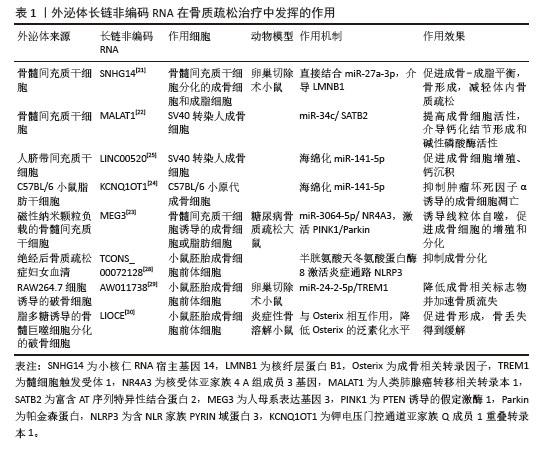
将骨髓间充质干细胞诱导为成骨细胞和脂肪细胞,然后与骨髓间充质干细胞外泌体共培养,成骨细胞中钙沉积面积显著增大,碱性磷酸酶水平升高,与成骨分化相关的矮小相关转录因子2和人骨钙蛋白表达显著上调,脂肪细胞中脂滴形成减少,与成脂分化相关的过氧化物酶体增殖物激活受体γ和增强子结合蛋白C/EBPα表达显著下调,表明骨髓间充质干细胞外泌体可促进骨髓间充质干细胞的成骨-成脂平衡,进一步研究结果显示,骨髓间充质干细胞外泌体是通过递送长链非编码RNA小核仁RNA宿主基因14介导miR-27a-3p/核纤层蛋白B1轴调节骨髓间充质干细胞的成骨和成脂分化[21]。研究表明,骨髓间充质干细胞衍生外泌体中人类肺腺癌转移相关转录本1可能通过充当miR-34c海绵上调富含AT序列特异性结合蛋白2表达,缓解骨质疏松症症状。根据生物信息学网站的预测结果,确定了miR-34c与人类肺腺癌转移相关转录本1或miR-34c与富含AT序列特异性结合蛋白2 3’UTR之间的假定结合位点,RNA下拉实验进一步证明miR-34c和人类肺腺癌转移相关转录本1可以相互结合并促进富含AT序列特异性结合蛋白2的表达。将过表达人类肺腺癌转移相关转录本1的骨髓间充质干细胞外泌体与SV40转染的人成骨细胞共培养可提高成骨细胞活性。注射过表达人类肺腺癌转移相关转录本1的骨髓间充质干细胞外泌体可促进骨质疏松小鼠股骨远端骨小梁增厚,小梁间连通性和成骨细胞数量增加,皮质骨分离减少[22]。磁性纳米粒子已逐渐成为潜在的药物载体,利用载有磁性纳米粒子的骨髓间充质干细胞衍生外泌体可以放大靶区的药物浓度,提高治疗效果。负载磁性纳米粒子的骨髓间充质干细胞衍生外泌体通过递送长链非编码RNA人母系表达基因抑制miR-3064-5p的表达,促进线粒体自噬、成骨细胞增殖和分化,缓解大鼠糖尿病骨质疏松症[23]。
肿瘤坏死因子α诱导的脂肪干细胞来源外泌体剂量依赖性阻断原代成骨细胞凋亡。在脂肪干细胞中转染钾电压门控通道亚家族Q成员1重叠转录本1慢病毒载体,其释放的外泌体可抑制肿瘤坏死因子α诱导的成骨细胞凋亡,表明长链非编码RNA-钾电压门控通道亚家族Q成员1重叠转录本1可能成为脂肪干细胞来源外泌体治疗骨质疏松症的潜在靶点[24]。
敲低LINC00520的人脐带间充质干细胞外泌体抑制SV40转染的人成骨细胞存活和钙沉积,加速细胞凋亡,而过表达LINC00520的人脐带间充质干细胞外泌体促进SV40转染的人成骨细胞增殖和钙沉积,延长细胞周期,表明人脐带间充质干细胞外泌体LINC00520可作为钙沉积的调节剂治疗骨质疏松[25]。
2.1.2 组织细胞来源外泌体 有学者选取骨量正常者、骨量减少者和骨质疏松症者的血液样本进行长链非编码RNA测序研究,筛选出与骨质疏松症发生发展密切相关的长链非编码RNA MIR22宿主基因,结果显示,绝经后骨质疏松症患者长链非编码RNA MIR22宿主基因水平显著降低[26]。成肌细胞来源外泌体配对相关同源盒蛋白2通过海绵miR-128参与长链非编码RNA MIR22宿主基因的转录激活,它可激活河马通路促进骨髓间充质干细胞的成骨分化[27]。从健康人和绝经后骨质疏松症患者的外泌体中鉴定出26个差异表达的长链非编码RNA,其中长链非编码RNA TCONS_00072128表达显著下调,过表达长链非编码RNA TCONS_00072128可正向调控半胱氨酸天冬氨酸蛋白酶8,促进碱性磷酸酶表达,从而增强骨髓间充质干细胞的成骨分化能力,延缓绝经后骨质疏松症的进展[28]。研究表明,含有长链非编码RNA AW011738的破骨细胞衍生外泌体可降低卵巢切除小鼠的成骨细胞活性,加速骨质流失,在破骨细胞中敲降AW011738后提取的外泌体可显著促进成骨细胞分化。卵巢切除小鼠尾静脉注射敲降AW011738后的外泌体可缓解骨质疏松,表明破骨细胞外泌体中长链非编码RNA AW011738可通过海绵化miR-24-2-5p增加髓样细胞触发受体1表达,抑制小鼠胚胎成骨细胞前体细胞的成骨分化[29]。炎性破骨细胞外泌体通过Eph相关受体酪氨酸激酶配体6/Eph受体A2特异性靶向成骨细胞,Eph受体A2敲除后,进入小鼠胚胎成骨细胞前体细胞的炎性破骨细胞外泌体数量显著减少,促进成骨细胞产生更多的钙化结节。长链非编码RNA LIOCE富集于炎性破骨细胞外泌体中,被小鼠胚胎成骨细胞前体细胞摄取后提高了成骨细胞活性,注射包封长链非编码RNA LIOCE的破骨细胞外泌体后,炎症性骨溶解小鼠的骨质流失得到缓解[30](表1)。
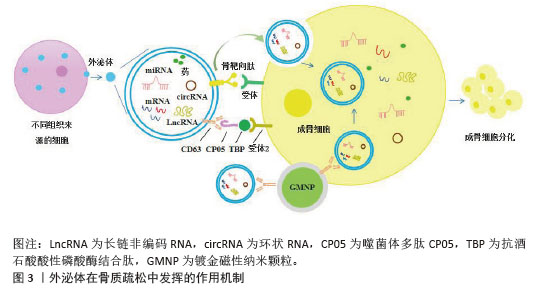
2.2 外泌体在骨质疏松症中的创新应用 尽管多种来源外泌体对骨质疏松症有一定的治疗作用,但它们的低产量、有限的功能性和不稳定的生物活性一直是阻碍外泌体实际应用的关键。除了天然分泌的外泌体外,近年来还研究了能够实现细胞特异性货物递送的转基因或化学修饰外泌体。例如,基因工程修饰的树突状细胞衍生外泌体通过将miR-140靶向递送至软骨深部区域,改善骨关节炎症状[31]。外泌体通过靶向表面修饰、分子封装机制发挥药物递送的协同作用,同时,外泌体与生物活性材料相结合是目前骨质疏松治疗研究中的热门方向。近年来,研究人员试图通过构建工程纳米囊泡来实现外泌体的大规模生产和精确靶向递送[32](图3)。经过修饰或材料加载的外泌体在治疗骨质疏松症方面显示出巨大的应用前景。
2.3 工程化外泌体的创新应用
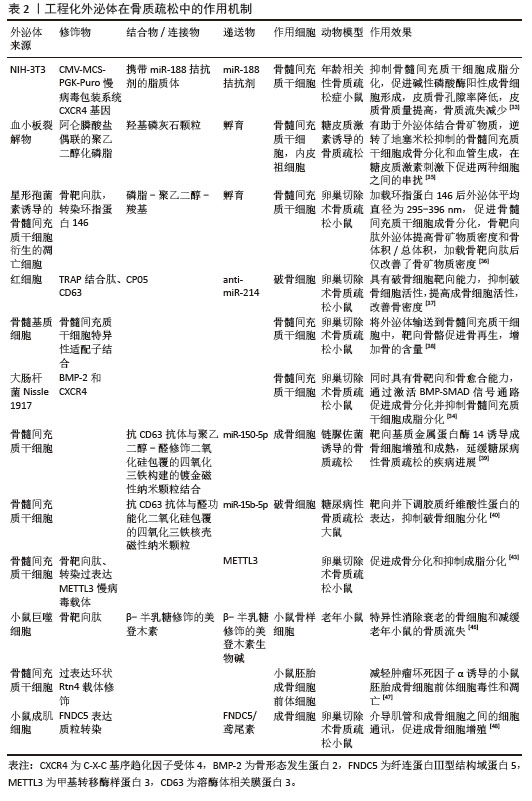
2.3.1 靶向表面修饰 外泌体的表面修饰是指在外泌体表面设计功能配体以靶向受体细胞并激活免疫,一般分为外泌体提取前修饰和提取后修饰。提取前修饰涉及通过基因工程方法编辑细胞的蛋白质表达,通常诱导靶向膜蛋白的高表达,使分泌的外泌体间接高表达靶膜蛋白。例如,有研究构建高表达C-X-C基序趋化因子受体4的基因工程NIH-3T3细胞,提取其外泌体,然后将C-X-C基序趋化因子受体4阳性外泌体与加载miR-188拮抗剂的脂质体挤出形成混合纳米颗粒,经Balb/c小鼠尾部静脉注射发现混合纳米颗粒特异性聚集在骨髓中并释放miR-188拮抗剂,促进碱性磷酸酶阳性成骨细胞形成并抑制骨髓间充质干细胞成脂分化,降低骨髓miR-188水平和皮质骨孔隙率并挽救与衰老相关的骨质流失,另外,注射后48 h小鼠肝肾功能保持稳定,表明混合纳米颗粒在体内无短期或长期细胞毒性[33]。有研究将骨形态发生蛋白2和C-X-C基序趋化因子受体4重组质粒与大肠杆菌细胞融合后提取外泌体用于骨质疏松治疗,该外泌体在体外可促进成骨细胞分化,抑制骨髓间充质干细胞成脂分化,通过激活骨形态发生蛋白/Smad信号通路改善骨质疏松症[34]。
提取后修饰是通过脂质插入修饰、共价交联修饰或化学修饰等方式直接将脂质分子插入到外泌体表面。ZHENG等[35]从血小板裂解物中分离出外泌体,随后将外泌体与阿仑膦酸钠接枝的聚乙二醇化磷脂结合,从而构建出一种骨靶向的血小板裂解物外泌体。血小板裂解物外泌体富集血小板衍生生长因子,经阿仑膦酸盐修饰的外泌体可逆转地塞米松对骨髓间充质干细胞成骨分化的抑制作用,提高内皮祖细胞的血管生成能力。骨靶向肽通过磷脂聚乙二醇羧基连接在骨髓间充质干细胞衍生的凋亡细胞外泌体表面,在卵巢切除小鼠模型中发挥明显的骨靶向和促进骨生成的作用[36]。将双功能肽(抗酒石酸酸性磷酸酶结合肽-噬菌体多肽CP05)与红细胞外泌体结合后产生破骨细胞靶向红细胞外泌体,静脉注射后该外泌体富集于骨质疏松小鼠骨骼中,有效递送miR-214至体内破骨细胞并抑制其活性,提高成骨细胞活性,改善骨密度[37]。LUO等[38]将骨髓基质细胞衍生外泌体与骨髓间充质干细胞特异性适配体结合,骨髓基质细胞外泌体被递送至骨髓间充质干细胞中,此复合物可增加卵巢切除术小鼠的骨量,加速骨折小鼠的骨愈合。磁性纳米粒子能够将外泌体与靶向药物输送系统相结合。研究人员通过在磁性氧化铁二氧化硅纳米粒子以及硅质外壳的表面覆盖聚乙二醇-醛来构建金涂层磁性纳米粒子,将骨髓间充质干细胞外泌体负载在金涂层磁性纳米粒子上,该外泌体可通过递送miR-150-5p靶向调节基质金属蛋白酶14诱导成骨细胞增殖和成熟,延缓糖尿病性骨质疏松的疾病进展[39]。在骨髓间充质干细胞中过表达miR-15b-5p,提取外泌体,体外将聚乙二醇化羧基修饰的介孔二氧化硅包裹超顺磁性四氧化三铁纳米颗粒与外泌体结合,大鼠破骨细胞可成功摄取该外泌体,将miR-15b-5p传递给破骨细胞,靶向抑制胶质纤维酸性蛋白表达缓解糖尿病性大鼠骨质疏松[40]。
2.3.2 外泌体功能分子封装 功能分子包封是指将指定的小分子药物、核酸和蛋白质装入外泌体中,将其转化为功能载体,用于递送治疗,包封方法主要有电穿孔、质粒转染或渗透剂孵育[41]。外泌体作为天然递送载体,具有优异的生物相容性和内在组织趋向性,靶向递送系统可以通过外泌体表面修饰进行优化[42]。例如,骨靶向肽的掺入可以提高外泌体的递送效率,这种修饰使封装的miRNA具有优越的稳定性,降低免疫原性,提高生物利用度。LI等[43]通过装载丰富的甲基转移酶样3 mRNA并用骨靶向肽修饰来改造骨髓间充质干细胞外泌体,修饰后的外泌体表现出卓越的骨靶向效率,可显著减轻小鼠卵巢切除术引起的骨量损失,促进小鼠骨髓间充质干细胞成骨分化,抑制脂质分化。将间充质干细胞外泌体与骨靶向肽结合形成的骨靶向修饰外泌体可特异性将siRNA递送给成骨细胞并介导成骨细胞Shn3基因沉默,促进成骨分化和H型血管形成,抑制破骨细胞形成[44]。骨髓间充质干细胞外泌体递送的miR-17促进成骨分化,并通过BARX同源盒蛋白2促进骨愈合[45]。在巨噬细胞外泌体中加入骨靶向肽6,包裹半乳糖修饰的美登素,可以破坏微管蛋白聚合,诱导衰老的骨细胞凋亡,对老年小鼠施用骨靶向外泌体可以减轻骨质流失,而不会产生明显的毒性[46]。circ-Rtn4修饰的骨髓间充质干细胞来源外泌体通过充当miR-146a海绵减轻肿瘤坏死因子α诱导的小鼠胚胎成骨细胞前体细胞毒性和凋亡[47]。用纤连蛋白Ⅲ型结构域蛋白5表达质粒转染成肌细胞,待分化成肌管后提取外泌体,该外泌体可促进成骨细胞分化[48]。采用超声波法将整合素连锁激酶的靶向抑制剂QLT0267转入到从健康女性血清提取的外泌体中,绝经期骨质疏松女性骨髓间充质干细胞矿化结节显著减少,抑制了成骨细胞分化[49]。有研究设计了一种可注射的基于淫羊藿的细胞外纳米囊泡负载羟基磷灰石纳米复合物,该复合物成功修复了雌激素剥夺诱导的骨质疏松大鼠下颌骨缺损,为中医药的应用提供了新的视角[50]。然而,外泌体从实验规模到临床生产的过渡等方面的挑战可能会限制它们的发展和临床应用(表2)。
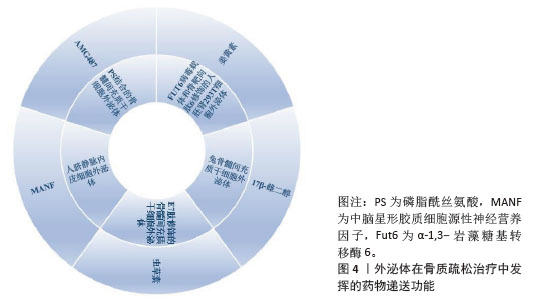
2.4 外泌体作为药物递送系统发挥骨质疏松治疗的协同效应 外泌体具有天然来源、介导细胞间通讯以及在脂质双层膜或管腔内包裹各种生物分子(如药物、蛋白质和核酸)的潜力[51],同时外泌体能够在细胞外液中安全移动并高效地将货物运输到目标细胞,因此外泌体可在体内提供更好的货物运输途径,发挥药物递送系统的作用(图4)。例如,磷脂酰丝氨酸是一种具有免疫抑制和吞噬信号传导功能的膜脂质,用薄膜水合结合挤出方法制备磷脂酰丝氨酸掺入的外泌体模拟物,该模拟物可抑制破骨细胞分化。此外,将趋化因子受体3拮抗剂AMG487封装于磷脂酰丝氨酸修饰的外泌体模拟物中,可有效防止卵巢切除小鼠的骨质流失[52]。将中脑星形胶质细胞源性神经营养因子用超声封装到人脐静脉内皮细胞外泌体中,封装后的外泌体经尾静脉注射到卵巢切除的骨质疏松小鼠体内,小鼠股骨干骺端的骨小梁体积、厚度和数量均显著增加,抑制破骨细胞分化,减少骨质流失[53]。外泌体可以通过亲和肽修饰来靶向特定细胞,E7肽是一种用于骨髓间充质干细胞靶向给药的亲和肽[54]。虫草素通过直接孵育或超声处理加载到E7肽修饰的外泌体中,研究人员通过小鼠电离辐射联合尾悬模拟航天诱发骨质疏松症,加载虫草素的E7肽修饰的外泌体可显著改善骨质疏松小鼠的骨质流失,成骨细胞活性增加[55]。将17β-雌二醇通过超声处理负载到骨髓间充质干细胞衍生外泌体中,与对照组相比,负载雌二醇的外泌体显著提高了骨髓间充质干细胞的存活率[56]。α-1,3-岩藻糖基转移酶6是一种与前列腺癌骨转移相关的关键蛋白质,将编码α-1,3-岩藻糖基转移酶6的反转录病毒载体与反转录病毒包装辅助质粒一起转染293T细胞,可生成表达α-1,3-岩藻糖基转移酶6的外泌体,用骨靶向肽6对这些外泌体进行修饰,合成α-1,3-岩藻糖基转移酶6-骨靶向肽6-外泌体,用超声处理使姜黄素负载于合成外泌体表面上,结果显示,α-1,3-岩藻糖基转移酶6的引入增加了骨髓内皮细胞对外泌体的摄取,在小鼠体内表现出更高的骨靶向效率,负载姜黄素的骨靶向外泌体恢复了吸烟相关骨质疏松小鼠的骨髓间充质干细胞成骨分化潜力,减轻骨质流失[57]。因此,当外泌体作为药物载体时,特异性靶向骨组织,很大程度上提高了药物的利用效率,增强了药物治疗骨质疏松的潜力。
2.5 外泌体与先进技术融合在骨质疏松治疗中的应用 循环系统的快速清除能力加速了外泌体的代谢,使外泌体无法持续作用于特定位置的组织修复。将外泌体与生物活性材料相结合,可以弥补外泌体在特定组织修复中的不足。生物活性材料表现出延长外泌体释放的能力,并利用其生物活性成分进行修复[58]。目前的研究表明,水凝胶和羟基磷灰石是与外泌体融合治疗骨质疏松的主要生物活性材料。水凝胶具有良好的生物相容性和疏松多孔的结构特性,可以作为外泌体的载体延长外泌体在特定区域的滞留时间,减缓外泌体的释放[59]。在供体细胞293T细胞中,通过选择性抑制NoBody蛋白翻译,可将骨形态发生蛋白2 mRNA富集到外泌体中,通过ally-L-甘氨酸改良的噬菌体多肽CP05连接子加载到甲基丙烯酰-明胶水凝胶中,缓慢释放外泌体,在受体细胞摄取后延长骨形态发生蛋白2的作用时间,在SD大鼠颅骨缺损模型中诱导持久的骨修复[60]。有研究开发了一种新型生物活性混合聚乳酸支架,该支架采用聚多巴胺和纤维蛋白凝胶包被,将转染活化T细胞核因子1 siRNA质粒和间充质干细胞来源外泌体封装在3D多孔聚乳酸支架中,该组合物可显著减少破骨细胞的形成和分化,增加人骨髓间充质基质细胞成骨分化,这种方法整合了破骨细胞抑制和促进成骨细胞分化的双重功能[61]。
羟基磷灰石表现出与天然骨骼相当的晶体尺寸、构型和生物力学特性[62]。一项动物研究表明,磁性羟基磷灰石支架能够改变破骨细胞来源外泌体释放方式,降低成骨细胞摄取外泌体的效率,进一步促进成骨细胞增殖,缓解骨质疏松。生物活性材料被证明是有效的载体,使外泌体能够持续发挥它的再生功效[63]。基于纳米羟基磷灰石的陶瓷载体可促进骨质疏松大鼠股骨颈骨缺损的骨形成。将硫酸钙/纳米羟基磷灰石基纳米水泥作为载体负载骨形态发生蛋白2、唑来膦酸盐和骨髓间充质基质细胞衍生外泌体。可促进骨质疏松大鼠股骨颈骨缺损模型的骨形成和缺损愈合[64]。然而,确保支架内外泌体的稳定释放和最佳释放速率仍然是需要深入探索的方向。
最新研究表明,锌-铜支架显著促进了施万细胞的增殖和外泌体的分泌。锌-铜合金支架结合低强度脉冲超声可显著提高骨质疏松大鼠骨髓基质细胞中成骨基因Ⅰ型胶原和骨钙素的表达,这表明外泌体与锌-铜合金支架结合可能会对骨再生产生协同作用[65]。
2.6 临床前研究的荟萃证据 迄今为止,尚未有针对骨质疏松症的注册或已发表的Ⅰ-Ⅲ期临床试验,大多数骨质疏松的外泌体策略仍然在技术就绪指数3-5之间(临床前至新药临床试验申请)。外泌体在骨质疏松症治疗中的应用仍处于动物研究阶段,尚未进展到人体临床试验[66]。来自健康人和骨质疏松症患者的血清外泌体内含物水平可作为骨质疏松症诊断和预后的生物标志物。如circFAM63B在绝经后骨质疏松患者血清外泌体中的表达显著升高,并且与骨密度密切相关,加载si-circFAM63B质粒的外泌体可显著增加卵巢切除小鼠的骨修复能力[67]。骨质疏松症患者骨髓干细胞衍生外泌体中穿梭的miR-424-5p可通过调节Wnt抑制因子1介导的Wnt/β-连环蛋白轴减弱成骨作用[68]。
尽管一些临床前试验已经完成,但目前还没有临床批准的外泌体治疗骨质疏松的方法。现阶段,在纯化和稳定提取外泌体方面存在许多困难。外泌体的分离方法主要包括重复超速离心和超滤,超速离心纯化因简便性和高容量而成为最广泛采用的方法。从不同的细胞中分离最佳的外泌体需要不同的离心力提取,人胚肾细胞HEK293最佳囊泡蛋白产量所需离心力为67 000×g,膀胱癌FL3细胞最佳囊泡蛋白产量所需离心力为100 000×g[69]。缓冲密度梯度超离心法可以根据密度不同产生多种分层,外泌体可以定位在不同浮力密度的层内。然而,缓冲密度梯度超离心法需要更多的时间来进行样品纯化。随着提取技术的不断发展,超滤技术显示出巨大的潜力,可用于处理和分析从人血浆中分离的大量外泌体,但产量在很大程度上取决于所使用的设备,该离心技术不仅需要昂贵的仪器,还需要耗时的程序[70-71]。微流控设备已成功用于从包括人血清和尿液在内的不同样品中分离外泌体。然而,没有一种设备可以统一应用于所有类型的样品[72]。未来,如果要将外泌体用于骨质疏松的临床治疗和预后,就需要改进外泌体的提取方法,以获得稳定的外泌体,以确保实验结果的稳定性和可重复性。另外,外泌体中货物的确切功能不能十分确定,来自不同组织或器官的细胞外泌体内容物可能会有所不同,如源自骨髓和脂肪组织的外泌体在转运RNA中存在巨大差异,特别是性别决定区Y-box2和POU5类同源框A/B[73]。由于缺乏临床试验证据,目前尚不清楚大规模生产的外泌体产量和纯度是否能满足临床需求。因此,如何更好地利用外泌体治疗骨质疏松症还有很长的路要走。
| [1] LI P, XU TY, YU AX, et al. The Role of Ferroptosis in Osteoporosis and Advances in Chinese Herbal Interventions. Biology (Basel). 2025;14(4):367. [2] TABATABAEI-MALAZY O, SALARI P, KHASHAYAR P, et al. New horizons in treatment of osteoporosis. Daru. 2017;25(1):2. [3] BUDHIA S, MIKYAS Y, TANG M, et al. Osteoporotic fractures: a systematic review of U.S. healthcare costs and resource utilization. Pharmacoeconomics. 2012;30(2):147-170. [4] PATIL S, DANG K, ZHAO X, et al. Role of LncRNAs and CircRNAs in Bone Metabolism and Osteoporosis. Front Genet. 2020;11:584118. [5] PARK-MIN KH, MUN SH, BOCKMAN R, et al. New Horizons: Translational Aspects of Osteomorphs. J Clin Endocrinol Metab. 2024;109(5):e1373-e1378. [6] ERIKSEN EF, DÍEZ-PÉREZ A, BOONEN S. Update on long-term treatment with bisphosphonates for postmenopausal osteoporosis: a systematic review. Bone. 2014;58:126-135. [7] LU J, ZHANG Y, LIANG J, et al. Role of Exosomal MicroRNAs and Their Crosstalk with Oxidative Stress in the Pathogenesis of Osteoporosis. Oxid Med Cell Longev. 2021;2021:6301433. [8] HU Y, WANG Y, CHEN T, et al. Exosome: Function and Application in Inflammatory Bone Diseases. Oxid Med Cell Longev. 2021;2021:6324912. [9] ZHANG X, MENG S, XU Y, et al. New Qiangguyin activates Wnt/β-catenin pathway by down-regulating Notum to improve osteoporosis in rats. J Ethnopharmacol. 2025;347:119745. [10] HU Y, HOU Z, LIU Z, et al. Oyster mantle-derived exosomes alleviate osteoporosis by regulating bone homeostasis. Biomaterials. 2024; 311:122648. [11] CORRADO C, RAIMONDO S, CHIESI A, et al. Exosomes as intercellular signaling organelles involved in health and disease: basic science and clinical applications. Int J Mol Sci. 2013;14(3): 5338-5366. [12] LIU W, LI Z, CAI Z, et al. LncRNA-mRNA expression profiles and functional networks in osteoclast differentiation. J Cell Mol Med. 2020;24(17): 9786-9797. [13] SILVA AM, MOURA SR, TEIXEIRA JH, et al. Long noncoding RNAs: a missing link in osteoporosis. Bone Res. 2019;7:10. [14] LIU S, HUANG H, CHAI S, et al. Expression profile analysis of long non-coding RNA in skeletal muscle of osteoporosis by microarray and bioinformatics. J Biol Eng. 2019;13:50. [15] WANG Q, LI Y, ZHANG Y, et al. LncRNA MEG3 inhibited osteogenic differentiation of bone marrow mesenchymal stem cells from postmenopausal osteoporosis by targeting miR-133a-3p. Biomed Pharmacother. 2017;89: 1178-1186. [16] PENG W, ZHU SX, WANG J, et al. Lnc-NTF3-5 promotes osteogenic differentiation of maxillary sinus membrane stem cells via sponging miR-93-3p. Clin Implant Dent Relat Res. 2018;20(2):110-121. [17] TONG X, GU PC, XU SZ, et al. Long non-coding RNA-DANCR in human circulating monocytes: a potential biomarker associated with postmenopausal osteoporosis. Biosci Biotechnol Biochem. 2015;79(5):732-737. [18] TENG Z, ZHU Y, ZHANG X, et al. Osteoporosis Is Characterized by Altered Expression of Exosomal Long Non-coding RNAs. Front Genet. 2020;11:566959. [19] ZHAO ZM, DING JM, LI Y, et al. Human umbilical cord mesenchymal stem cell-derived exosomes promote osteogenesis in glucocorticoid-induced osteoporosis through PI3K/AKT signaling pathway-mediated ferroptosis inhibition. Stem Cells Transl Med. 2025;14(3):szae096. [20] XIE X, XIONG Y, PANAYI AC, et al. Exosomes as a Novel Approach to Reverse Osteoporosis: A Review of the Literature. Front Bioeng Biotechnol. 2020;8:594247. [21] TANG JS, YU HX, RUAN RX, et al. LncRNA SNHG14 Delivered by Bone Marrow Mesenchymal Stem Cells-Secreted Exosomes Regulates Osteogenesis and Adipogenesis in Osteoporosis by Mediating the miR-27a-3p/LMNB1 Axis. Kaohsiung J Med Sci. 2025;41(5):e70004. [22] YANG X, YANG J, LEI P, et al. LncRNA MALAT1 shuttled by bone marrow-derived mesenchymal stem cells-secreted exosomes alleviates osteoporosis through mediating microRNA-34c/SATB2 axis. Aging (Albany NY). 2019;11(20): 8777-8791. [23] XU C, WANG Z, LIU YJ, et al. Harnessing GMNP-loaded BMSC-derived EVs to target miR-3064-5p via MEG3 overexpression: Implications for diabetic osteoporosis therapy in rats. Cell Signal. 2024;118:111055. [24] WANG SZ, JIA J, CHEN CH. lncRNA-KCNQ1OT1: A Potential Target in Exosomes Derived from Adipose-Derived Stem Cells for the Treatment of Osteoporosis. Stem Cells Int. 2021;2021:7690006. [25] WU J, ZHANG L, LIU H, et al. Exosomes promote hFOB1.19 proliferation and differentiation via LINC00520. J Orthop Surg Res. 2023;18(1):546. [26] 霍凯伦.LncRNA MIR22HG调节绝经后骨质疏松症破骨细胞异常活化的机制研究[D].银川: 宁夏医科大学,2024. [27] LI Y, WANG X, PAN C, et al. Myoblast-derived exosomal Prrx2 attenuates osteoporosis via transcriptional regulation of lncRNA-MIR22HG to activate Hippo pathway. Mol Med. 2023;29(1):54. [28] YANG Y, MIAO L, CHANG S, et al. Exosome-Derived LncRNA TCONS_00072128 Mediated Osteogenic Differentiation and Inflammation by Caspase 8 Regulation. Front Genet. 2022;12:831420. [29] LIU J, WANG B, CHEN H, et al. Osteoclast-derived exosomes influence osteoblast differentiation in osteoporosis progression via the lncRNA AW011738/ miR-24-2-5p/ TREM1 axis. Biomed Pharmacother. 2024;178:117231. [30] REN L, ZENG F, DENG J, et al. Inflammatory osteoclasts-derived exosomes promote bone formation by selectively transferring lncRNA LIOCE into osteoblasts to interact with and stabilize Osterix. FASEB J. 2022;36(2):e22115. [31] LIANG Y, XU X, LI X, et al. Chondrocyte-Targeted MicroRNA Delivery by Engineered Exosomes toward a Cell-Free Osteoarthritis Therapy. ACS Appl Mater Interfaces. 2020;12(33):36938-36947. [32] TRAN PHL, XIANG D, TRAN TTD, et al. Exosomes and Nanoengineering: A Match Made for Precision Therapeutics. Adv Mater. 2020;32(18):e1904040. [33] HU Y, LI X, ZHANG Q, et al. Exosome-guided bone targeted delivery of Antagomir-188 as an anabolic therapy for bone loss. Bioact Mater. 2021;6(9):2905-2913. [34] LIU H, SONG P, ZHANG H, et al. Synthetic biology-based bacterial extracellular vesicles displaying BMP-2 and CXCR4 to ameliorate osteoporosis. J Extracell Vesicles. 2024;13(4):e12429. [35] ZHENG G, MA HW, XIANG GH, et al. Bone-targeting delivery of platelet lysate exosomes ameliorates glucocorticoid-induced osteoporosis by enhancing bone-vessel coupling. J Nanobiotechnology. 2022;20(1):220. [36] GUI L, YE Q, YU L, et al. Bone-Targeting Peptide and RNF146 Modified Apoptotic Extracellular Vesicles Alleviate Osteoporosis. Int J Nanomedicine. 2024;19:471-488. [37] XU L, XU X, LIANG Y, et al. Osteoclast-targeted delivery of anti-miRNA oligonucleotides by red blood cell extracellular vesicles. J Control Release. 2023;358:259-272. [38] LUO ZW, LI FX, LIU YW, et al. Aptamer-functionalized exosomes from bone marrow stromal cells target bone to promote bone regeneration. Nanoscale. 2019;11(43):20884-20892. [39] XU C, WANG Z, LIU Y, et al. Extracellular vesicles derived from bone marrow mesenchymal stem cells loaded on magnetic nanoparticles delay the progression of diabetic osteoporosis via delivery of miR-150-5p. Cell Biol Toxicol. 2023;39(4): 1257-1274. [40] XU C, WANG Z, LIU Y, et al. Delivery of miR-15b-5p via magnetic nanoparticle-enhanced bone marrow mesenchymal stem cell-derived extracellular vesicles mitigates diabetic osteoporosis by targeting GFAP. Cell Biol Toxicol. 2024;40(1):52. [41] CHEN Y, HUANG Y, LI J, et al. Enhancing osteoporosis treatment with engineered mesenchymal stem cell-derived extracellular vesicles: mechanisms and advances. Cell Death Dis. 2024;15(2):119. [42] BUTREDDY A, KOMMINENI N, DUDHIPALA N. Exosomes as Naturally Occurring Vehicles for Delivery of Biopharmaceuticals: Insights from Drug Delivery to Clinical Perspectives. Nanomaterials (Basel). 2021;11(6):1481. [43] LI T, ZHAO J, YUAN J, et al. Harnessing engineered exosomes as METTL3 carriers: Enhancing osteogenesis and suppressing lipogenesis in bone marrow mesenchymal stem cells for postmenopausal osteoporosis treatment. Mater Today Bio. 2025;32:101648. [44] CUI Y, GUO Y, KONG L, et al. A bone-targeted engineered exosome platform delivering siRNA to treat osteoporosis. Bioact Mater. 2021;10:207-221. [45] JIANG X, WANG Q, YING P, et al. Bone Marrow Stromal Cells Promote Osteogenic Differentiation and Induce Bone Remodeling and Healing in Osteoporosis. Ann Clin Lab Sci. 2025;55(2):231-239. [46] HE Y, ZHANG L, CHEN X, et al. Elimination of Senescent Osteocytes by Bone-Targeting Delivery of β-Galactose-Modified Maytansinoid Prevents Age-Related Bone Loss. Adv Healthc Mater. 2024; 13(8):e2302972. [47] CAO G, MENG X, HAN X, et al. Exosomes derived from circRNA Rtn4-modified BMSCs attenuate TNF-α-induced cytotoxicity and apoptosis in murine MC3T3-E1 cells by sponging miR-146a. Biosci Rep. 2020;40(5):BSR20193436. [48] TAO L, WANG J, WANG K, et al. Exerkine FNDC5/irisin-enriched exosomes promote proliferation and inhibit ferroptosis of osteoblasts through interaction with Caveolin-1. Aging Cell. 2024; 23(8):e14181. [49] 刘毓灵.健康女性血清外泌体转运ILK促进PMOP患者BMSCs成骨分化[D].长沙:中南大学,2022. [50] HAN R, GAO C, TANG R, et al. A comprehensive study on Herba Epimedium-derived extracellular nanovesicles as a prospective therapy for alveolar bone regeneration in postmenopausal osteoporosis. Nanoscale. 2025;17(19):12270-12289. [51] XINYUE W, HONGLI L, CHUNHUI G, et al. Potential MiRNA therapies for premature ovarian failure: new challenges and opportunities. Stem Cell Res Ther. 2025;16(1):364. [52] KANG M, LI Z, CHANG I, et al. Phosphatidylserine-incorporated exosome mimetics encapsulating CXCR3 antagonist alleviate osteoporosis. Adv Funct Mater. 2024;34(38):2402521. [53] PI Z, WU Y, WANG X, et al. Exosomal Manf originated from endothelium regulated osteoclast differentiation by down-regulating NF-κB signaling pathway. J Orthop Surg Res. 2025;20(1):349. [54] XU X, LIANG Y, LI X, et al. Exosome-mediated delivery of kartogenin for chondrogenesis of synovial fluid-derived mesenchymal stem cells and cartilage regeneration. Biomaterials. 2021;269: 120539. [55] ZHAI Y, ZHANG Y, XU K, et al. Cordycepin ameliorates spaceflight-induced osteoporosis by preventing BMSCs oxidative stress and senescence via interacting with PI3K p110α and regulating PI3K/Akt/FOXO3 signalling. Free Radic Biol Med. 2025;228:108-125. [56] GHOLAMI FARASHAH MS, JAVADI M, SOLEIMANI RAD J, et al. 17β-Estradiol-Loaded Exosomes for Targeted Drug Delivery in Osteoporosis: A Comparative Study of Two Loading Methods. Adv Pharm Bull. 2023;13(4):736-746. [57] WANG Y, SUN L, DONG Z, et al. Targeted inhibition of ferroptosis in bone marrow mesenchymal stem cells by engineered exosomes alleviates bone loss in smoking-related osteoporosis. Mater Today Bio. 2025;31:101501. [58] JU Y, HU Y, YANG P, et al. Extracellular vesicle-loaded hydrogels for tissue repair and regeneration. Mater Today Bio. 2022;18:100522. [59] XIE Y, GUAN Q, GUO J, et al. Hydrogels for Exosome Delivery in Biomedical Applications. Gels. 2022;8(6):328. [60] YANG Z, LI X, GAN X, et al. Hydrogel armed with Bmp2 mRNA-enriched exosomes enhances bone regeneration. J Nanobiotechnology. 2023; 21(1):119. [61] LUO P, ZHANG Y, HUANG M, et al. Microdroplets Encapsulated with NFATc1-siRNA and Exosomes-Derived from MSCs Onto 3D Porous PLA Scaffold for Regulating Osteoclastogenesis and Promoting Osteogenesis. Int J Nanomedicine. 2024;19:3423-3440. [62] WANG T, GUO S, ZHANG Y. Effect of nHA/CS/PLGA delivering adipose stem cell-derived exosomes and bone marrow stem cells on bone healing-in vitro and in vivo studies. Sci Rep. 2024;14(1):27502. [63] ZHU Y, LI Z, ZHANG Y, et al. The essential role of osteoclast-derived exosomes in magnetic nanoparticle-infiltrated hydroxyapatite scaffold modulated osteoblast proliferation in an osteoporosis model. Nanoscale. 2020;12(16): 8720-8726. [64] QAYOOM I, TEOTIA AK, KUMAR A. Nanohydroxyapatite Based Ceramic Carrier Promotes Bone Formation in a Femoral Neck Canal Defect in Osteoporotic Rats. Biomacromolecules. 2020;21(2):328-337. [65] SONG W, ZHAO D, WANG J, et al. Ultrasound-Driven Innervated Bone Regeneration in Additively Manufactured Degradable Metallic Scaffolds. Adv Healthc Mater. 2025;14(12):e2404024. [66] CHEN G, LI H, CHEN R, et al. Exosomes as Emerging Therapeutic Strategies in Primary Osteoporosis: A Narrative Review. Drug Des Devel Ther. 2025;19:9099-9115. [67] LI F, ZHAO X, ZHANG Y, et al. Exosomal circFAM63Bsuppresses bone regeneration of postmenopausal osteoporosis via regulating miR-578/HMGA2 axis. J Orthop Res. 2024;42(6): 1244-1253. [68] WEI Y, MA H, ZHOU H, et al. miR-424-5p shuttled by bone marrow stem cells-derived exosomes attenuates osteogenesis via regulating WIF1-mediated Wnt/β-catenin axis. Aging (Albany NY). 2021;13(13):17190-17201. [69] JEPPESEN DK, HVAM ML, PRIMDAHL-BENGTSON B, et al. Comparative analysis of discrete exosome fractions obtained by differential centrifugation. J Extracell Vesicles. 2014;3:25011. [70] SHIREJINI SZ, INCI F. The Yin and Yang of exosome isolation methods: conventional practice, microfluidics, and commercial kits. Biotechnol Adv. 2022;54:107814. [71] DING M, WANG C, LU X, et al. Comparison of commercial exosome isolation kits for circulating exosomal microRNA profiling. Anal Bioanal Chem. 2018;410(16):3805-3814. [72] LE MN, FAN ZH. Exosome isolation using nanostructures and microfluidic devices. Biomed Mater. 2021;16(2):022005. [73] PEINADO H, ALEČKOVIĆ M, Lavotshkin S, et al. Melanoma exosomes educate bone marrow progenitor cells toward a pro-metastatic phenotype through MET. Nat Med. 2012;18(6): 883-891. [74] MEHRYAB F, RABBANI S, SHAHHOSSEINI S, et al. Exosomes as a next-generation drug delivery system: An update on drug loading approaches, characterization, and clinical application challenges. Acta Biomater. 2020;113:42-62. [75] ZHOU X, BROWN BA, SIEGEL AP, et al. Exosome-Mediated Crosstalk between Keratinocytes and Macrophages in Cutaneous Wound Healing. ACS Nano. 2020;14(10):12732-12748. [76] TAN A, RAJADAS J, SEIFALIAN AM. Exosomes as nano-theranostic delivery platforms for gene therapy. Adv Drug Deliv Rev. 2013;65(3):357-367. [77] QIU D, YAN B, XUE H, et al. Perspectives of exosomal ncRNAs in the treatment of bone metabolic diseases: Focusing on osteoporosis, osteoarthritis, and rheumatoid arthritis. Exp Cell Res. 2025;446(2):114457. |
| [1] | 陈惠挺, 曾伟权, 周剑鸿, 王 杰, 庄聪颖, 陈培友, 梁泽乾, 邓伟明. 椎体成形中拖尾锚定治疗伴裂隙征骨质疏松性椎体压缩骨折的有限元分析[J]. 中国组织工程研究, 2026, 30(9): 2145-2152. |
| [2] | 程旗圣, 居来提·买提肉孜, 肖 扬, 张陈伟, 帕尔哈提·热西提. 新型变径螺钉在腰椎改良皮质骨轨迹中的有限元分析[J]. 中国组织工程研究, 2026, 30(9): 2162-2171. |
| [3] | 曾 轩, 翁 汭, 叶仕成, 唐佳栋, 莫 凌, 李文超. 两种腰椎旋扳手法治疗腰椎间盘突出症:生物力学差异的有限元分析[J]. 中国组织工程研究, 2026, 30(9): 2153-2161. |
| [4] | 刘文龙, 董 磊, 肖争争, 聂 宇. 骨质疏松患者行固定平台单髁置换后胫骨假体松动的有限元分析[J]. 中国组织工程研究, 2026, 30(9): 2191-2198. |
| [5] | 陈 龙, 王小阵, 席金涛, 鲁齐林. 短节段置钉联合可扩张聚醚醚酮置换体在骨质疏松椎体中的生物力学性能[J]. 中国组织工程研究, 2026, 30(9): 2226-2235. |
| [6] | 吴妍廷, 李 宇, 廖金凤. 氧化镁纳米粒调控成骨与血管生成相关基因表达促进骨缺损愈合[J]. 中国组织工程研究, 2026, 30(8): 1885-1895. |
| [7] | 蒋星海, 宋玉林, 李德津, 邵建敏, 徐军志, 刘华凯, 吴应国, 沈岳辉, 冯思诚. 血管内皮生长因子165基因转染骨髓间充质干细胞构建血管化两亲性肽凝胶模块[J]. 中国组织工程研究, 2026, 30(8): 1903-1911. |
| [8] | 韩 腾, 马 洪, 杨若仪, 罗 祎, 李 超. 口腔鳞状细胞癌细胞来源外泌体递送血管生成素2参与肿瘤血管生成[J]. 中国组织工程研究, 2026, 30(7): 1755-1767. |
| [9] | 黄嘉雯, 潘之怡, 薛文君, 廉源沛, 徐建达. 植物源性囊泡与恶性肿瘤治疗:跨物种交流并调节宿主细胞反应[J]. 中国组织工程研究, 2026, 30(7): 1828-1838. |
| [10] | 王白燕, 杨 树, 王弋鸣, 吴梦晴, 肖 瑀, 郭梓璇, 张博艺, 冯书营. 外泌体递送CRISPR/Cas系统在靶细胞内可实现基因编辑[J]. 中国组织工程研究, 2026, 30(7): 1839-1849. |
| [11] | 王振泽, 刘奋德, 张 瑞, 李武军. 间充质干细胞治疗下肢动脉硬化闭塞症:系统评价和Meta分析[J]. 中国组织工程研究, 2026, 30(7): 1869-1876. |
| [12] | 周思瑞, 徐玉坤, 赵可伟. 白芷细胞外囊泡对抗黑色素的思路和方法[J]. 中国组织工程研究, 2026, 30(7): 1747-1754. |
| [13] | 胡雄科, 刘少华, 谭 谦, 刘 昆, 朱光辉. 紫草素干预骨髓间充质干细胞改善老年小鼠股骨的微结构[J]. 中国组织工程研究, 2026, 30(7): 1609-1615. |
| [14] | 宋浦蓁, 马贺宾, 陈宏广, 章亚东. 骨髓间充质干细胞外泌体联合转化生长因子β1对巨噬细胞的作用[J]. 中国组织工程研究, 2026, 30(7): 1616-1623. |
| [15] | 蔡子鸣, 于庆贺, 马鹏飞, 张 鑫, 周龙千, 张崇阳, 林文平. 血红素氧合酶1减轻脂多糖诱导髓核间充质干细胞的炎症反应[J]. 中国组织工程研究, 2026, 30(7): 1624-1631. |
外泌体是直径为30-150 nm的细胞外囊泡样物质,存在于几乎所有功能性和非功能性生物体液中,如血液、尿液、唾液、腹水和胆汁等[7]。自发现以来,外泌体的分泌途径已被广泛研究,来自不同细胞的外泌体与其亲本细胞具有相似的作用。外泌体通过细胞间通讯将核酸、蛋白质或脂质转移到靶细胞,引起靶细胞表型和功能变化[8]。人脐带间充质干细胞来源外泌体通过磷脂酰肌醇激酶/蛋白激酶B信号通路抑制铁死亡促进糖皮质激素诱导的骨质疏松症小鼠成骨分化;新强骨饮(添加沙棘)处理可减轻破骨细胞来源外泌体对骨髓间充质干细胞成骨分化的破坏作用,增加骨髓间充质干细胞活性,上调碱性磷酸酶、Runt相关转录因子2、骨桥蛋白和骨钙素表达,促进骨矿化,激活β-连环蛋白通路[9];牡蛎套膜来源外泌体可能通过激活成骨细胞中的磷脂酰肌醇激酶/蛋白激酶B/β-连环蛋白通路来提高成骨活性,并通过抑制破骨细胞中的核因子κB通路来减弱破骨细胞活性;口服牡蛎套膜来源外泌体可以有效减少卵巢切除诱导的骨质疏松小鼠骨丢失并改善骨微结构,并表现出优异的生物安全性[10]。上述研究表明,多种组织和天然物质来源外泌体对骨质疏松具有显著的调节作用,因此,对外泌体释放物质及外泌体创新应用的研究十分必要。
中国组织工程研究杂志出版内容重点:干细胞;骨髓干细胞;造血干细胞;脂肪干细胞;肿瘤干细胞;胚胎干细胞;脐带脐血干细胞;干细胞诱导;干细胞分化;组织工程
1.1.1 检索人及检索时间 由第一作者在2025年2-7月进行检索。
1.1.2 检索文献时限 各数据库建库至2025年7月。
1.1.3 检索数据库 PubMed数据库、中国知网。
1.1.4 检索词 英文检索词为“Exosomes,lncRNAs,osteoporosis,extracellular vesicles,drug treatment,engineered exosomes”,中文检索词为“外泌体,长链非编码RNA,骨质疏松,细胞外囊泡,药物治疗,工程外泌体”等。
1.1.5 检索文献类型 研究原著及综述。
1.1.6 手工检索情况 无。
1.1.7 检索策略 以PubMed数据库检索策略为例,见图1。

1.1.8 检索文献量 共得到中英文文献1 000余篇。
1.2 入组标准
1.2.1 纳入标准 ①骨质疏松相关文献;②外泌体相关文献;③外泌体在骨质疏松中发挥作用的文献;④外泌体通过长链非编码RNA在骨质疏松疾病中发挥作用的文献;⑤有关外泌体修饰和包封等先进技术在骨质疏松疾病治疗中发挥作用的文献;⑥携带药物的工程化外泌体在骨质疏松治疗中发挥作用的文献;⑦在同一领域选择发表年份较新的文献。
1.2.2 排除标准 ①除骨质疏松外其他不相关的骨科疾病文献;②外泌体、长链非编码RNA与骨质疏松主题不相关的文献;③工程化外泌体技术创新与骨质疏松研究不相关的文献;④中英文中研究内容相同或相似的重复性文献;⑤存在争议或预警期刊发表的文献。
1.3 资料整合 共检索到1 000余篇相关文献,实际纳入77篇,中文2篇,英文75篇。检索流程见图2。

中国组织工程研究杂志出版内容重点:干细胞;骨髓干细胞;造血干细胞;脂肪干细胞;肿瘤干细胞;胚胎干细胞;脐带脐血干细胞;干细胞诱导;干细胞分化;组织工程
外泌体作为自身生物活性物质,可以跨越许多药物无法跨越的障碍,能够将RNA精确递送至与骨代谢相关的特定组织或细胞,靶向关键信号通路、蛋白或基因,从而调节骨相关细胞的功能状态,促进正常生理平衡的恢复[77]。对外泌体进行骨靶向修饰,可以将靶向药物递送到病变部位来增加治疗效果。研究表明,通过将骨靶向肽、TRAP结合肽结合在外泌体表面对外泌体进行修饰,转染C-X-C趋化因子受体 4、环状RNA等质粒可增强外泌体的骨靶向性,促进成骨细胞分化,维持成骨-成脂平衡,缓解骨质疏松。以上研究表明,以外泌体为载体的长链非编码RNA治疗骨质疏松的方法逐渐崭露头角,未来有望结合水凝胶等生物活性物质广泛应用于外泌体治疗药物的开发,以开发长期、安全有效的骨再生方法。综上所述,外泌体可通过表面修饰、分子包封及借助甲基丙烯酰-明胶水凝胶等生物活性分子载体支架技术靶向递送外泌体内容物及药物,延缓外泌体的释放,增强外泌体对骨质疏松的治疗作用。传统的组织工程方法往往依赖于超生理剂量的干细胞和生长因子的应用。然而,这些策略的高成本和潜在的不良反应预示着临床转化面临着巨大挑战。载药外泌体在医疗和制药领域前景广阔,并持续增长。然而,基因工程或药物装载后对外泌体原始成分的潜在干扰是必须解决的挑战。对不同工程策略和外泌体产品长期使用的安全性、保质期和潜在影响的综合评估仍需进一步审查,对水凝胶等支架系统的机械性能改善、外泌体掺入比例及成骨相关的分子机制等方面开展更深入的探讨。
上述研究为基于外泌体的骨质疏松临床治疗提供了重要的理论和技术支持。一方面,外泌体递送系统通过提高长链非编码RNA的循环稳定性和生物利用度,克服了传统基因治疗工具效率低下和缺乏特异性的问题;另一方面,外泌体靶向给药的能力显著降低了脱靶效应和潜在的全身不良反应,显示出高度的特异性和治疗效果。尽管外泌体具有与细胞膜融合甚至跨越生物屏障将其内容物有效递送到靶细胞的天然能力,但外泌体在体内的生物分布和靶细胞特异性仍面临许多不确定性和挑战。潜在外泌体长链非编码RNA药物的动力学和毒性研究需要反复验证。此外,迫切需要通过动物和临床模型试验来评估外泌体长链非编码RNA是否能有效调节生理稳态或病理过程。
外泌体用于骨质疏松的发展时间历程,见图5。

中国组织工程研究杂志出版内容重点:干细胞;骨髓干细胞;造血干细胞;脂肪干细胞;肿瘤干细胞;胚胎干细胞;脐带脐血干细胞;干细胞诱导;干细胞分化;组织工程
文题释义:
骨质疏松:是一种多因素起源的全身性骨骼疾病,主要特征是骨矿物质密度降低、骨质量下降和骨微结构退化,导致病理性骨折风险增加。
外泌体:是纳米大小的球形囊泡,直径为30-150 nm,由脂质双分子层组成。它们由多种细胞类型分泌,充当细胞间信使,促进生物活性分子(如蛋白质、脂质和核酸)的转移。外泌体起源于腔内囊泡,由内体膜向内出芽形成,在此过程中生物活性物质被捕获并包装成管腔内的囊泡,这些腔内囊泡被包含在多囊内含体中,当多囊内含体与质膜融合时,外泌体被释放到细胞外空间。
#br#
中国组织工程研究杂志出版内容重点:干细胞;骨髓干细胞;造血干细胞;脂肪干细胞;肿瘤干细胞;胚胎干细胞;脐带脐血干细胞;干细胞诱导;干细胞分化;组织工程
该文通过国内外数据库对外泌体长链非编码RNA在骨质疏松疾病中的创新应用进行了相关文献检索,文章内容概括了现阶段热点研究的间充质干细胞和组织细胞来源外泌体长链非编码RNA在骨质疏松治疗中的作用等最新研究进展。该文突出介绍了骨靶向肽等修饰物修饰的外泌体对骨质疏松的作用效果,增加骨靶向性,降低骨质疏松小鼠的骨质流失。通过基因调控、中草药及生物工程相结合等多种手段增强外泌体药物递送功能,促进成骨细胞分化,抑制破骨细胞形成,缓解骨质疏松症状。
#br#
中国组织工程研究杂志出版内容重点:干细胞;骨髓干细胞;造血干细胞;脂肪干细胞;肿瘤干细胞;胚胎干细胞;脐带脐血干细胞;干细胞诱导;干细胞分化;组织工程
| 阅读次数 | ||||||
|
全文 |
|
|||||
|
摘要 |
|
|||||