1.1 设计 羧甲基纤维素基水凝胶的制备、表征、体外生物相容性验证及功能性验证,实验设计路线图见图1。

1.2 时间及地点 实验于2025年9月至2026年1月在内蒙古医科大学基础医学院分子生物学研究中心完成。
1.3 材料
1.3.1 细胞与菌种 实验所用小鼠胚胎成纤维细胞系NIH/3T3购自中国科学院典型培养物保藏委员会,由课题组在-196 ℃液氮保存常规传代培养。金黄色葡萄球菌(Staphylococcus aureus)、大肠杆菌(Escherichia coli)(北纳创联生物技术研究院)。
1.3.2 实验动物 SPF级雄性C57BL/6J小鼠3只,5周龄,体质量18-20 g,购自维通利华实验动物技术有限公司,许可证号:SCXK(京)2021-0006。小鼠自由饮水进食,适应性喂养1周后进行实验。实验已通过经内蒙古医科大学动物保护委员会批准,批准号:YKD202001015。
1.3.3 实验试剂 羧甲基纤维素Ⅰ(取代度DS=0.9,分子质量700 000 Da,黏度2 500-4 500 mPa·s,上海麦克林生化科技股份有限公司);聚乙二醇(相对分子质量4 000)、聚乙烯吡咯烷酮(相对分子质量1 200 000)、LB肉汤培养基(北京普西唐生物科技有限公司);体积分数75%乙醇溶液(山东卓健医疗科技股份有限公司);胎牛血清(上海VivaCell公司);青-链霉素双抗、DMEM培养基、0.25%胰蛋白酶(美国Gibco公司Trypsin);CCK-8细胞增殖-毒性检测试剂盒、PBS(安徽Biosharp公司);琼脂粉(德国Biofroxx公司);生理盐水(河北科星药业有限公司)。
1.3.4 实验仪器 加热型恒温磁力搅拌器(杭州佑宁仪器有限公司,HS-350型);分析天平(北京赛多利斯科学仪器有限公司,SQP型);多功能酶标仪(美国Molecular Devices公司,SpectraMax@ i3型);TA DHR-2流变仪(美国Waters公司,TA DHR-2型);TGA/DSC 1同步热分析仪(瑞士METTLER TOLEDO公司,TGA/DSC 1/1100LF型);场发射扫描电子显微镜(日本Hitachi公司,Regulus 8100型);冷冻干燥机(北京五洲东方科技发展有限公司,Alpha 1-2 LD plus型);傅里叶变换红外光谱仪(德国布鲁克光学仪器公司,VERTEX70型);倒置显微镜(日本Olympus公司,CKX53型);5%CO2细胞培养箱(日本Olympus公司,MCO-18AIC型);37 ℃恒温培养箱(上海一恒科学仪器有限公司,DHP-9162型);恒温水浴锅(韩国DAIHAN Scientific Co.,Ltd,WCB-11型);超净工作台(北京东联哈尔仪器制造有限公司,DL-CJ-1NDⅡ型);鼓风干燥箱(上海一恒科学仪器有限公司,DHG-9240A型);立式压力蒸汽灭菌器(重庆雅马拓科技有限公司,SN510C型);台式高速冷冻离心机(德国SIGMA公司,3-18KS型)。
1.4 实验方法
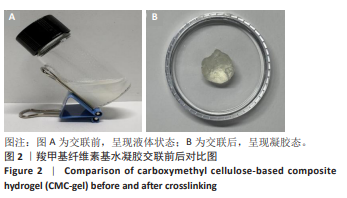
1.4.1 羧甲基纤维素基水凝胶的制备 称取羧甲基纤维素Ⅰ、聚乙二醇和聚乙烯吡咯烷酮按照8∶1∶1的质量比例溶解于100 mL体积分数65%乙醇溶液中,置于恒温磁力搅拌器(转速500 r/min)中75 ℃搅拌5 h,于75 ℃继续搅拌(转速500 r/min)老化2 h。老化后将水凝胶取出,3 000 r/min离心30 min初步脱除乙醇,置于通风橱24 h,采用冷冻干燥机干燥48 h后得到干燥水凝胶样品备用。
1.4.2 羧甲基纤维素基水凝胶的结构与理化性能表征
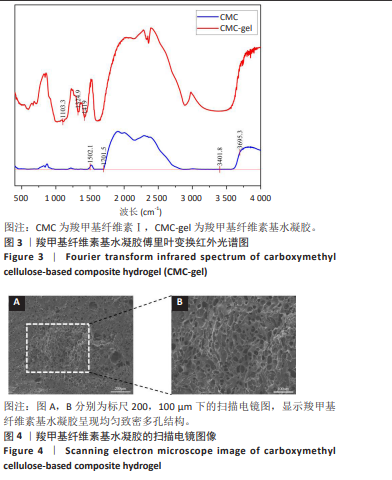
傅里叶红外光谱分析:取冷冻干燥后的水凝胶样品,研磨成粉末,避免水分干扰。研磨后过60目筛,与光谱纯溴化钾(KBr)按质量比1∶49混合均匀,在玛瑙研钵中充分研磨后,置于压片机中压制成透明薄片;以纯KBr薄片为背景,使用傅里叶变换红外光谱分析仪在波数范围400-4 000 cm-1内进行扫描,设置分辨率4 cm-1、扫描次数32次,记录红外光谱图,通过分析特征吸收峰的位置、强度及位移,验证复合效果及分子间相互作用。
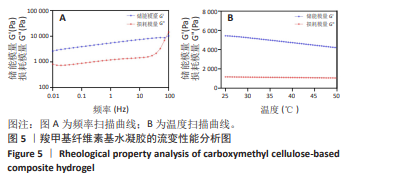
扫描电镜观察:将制备好的水凝胶样品加水溶胀,液氮脆断处理,再放入冷冻干燥机中干燥48 h得到水凝胶冻干样品,将样品表面及横断面喷金处理后,使用扫描电镜在电压10 kV下观察微观结构。
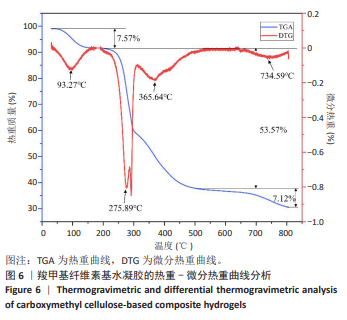
流变性能测定:取新鲜制备的水凝胶样品,使用流变仪,选用平行平板夹具,设置夹具间距与试样厚度一致,周边涂抹少量凡士林防止水分蒸发。测试分为温度扫描与频率扫描,温度扫描范围25-50 ℃,升温速率2 ℃/min,固定频率1 Hz、应变1%,记录储能模量(G’)、损耗模量(G’’)及复合黏度随温度的变化,确定水凝胶化温度;频率扫描范围0.1-100 Hz,固定温度37 ℃、应变1%,记录G’、G’’随频率的变化,评估水凝胶在生理温度下的结构稳定性。
热重分析:将水凝胶冷冻干燥去除水分,研磨成细粉置于坩埚中,使用氮气作为保护气体,流速40 mL/min,确保实验环境无氧气氧化干扰。测试温度设置为室温至800 ℃,升温速率为10 ℃/min,记录样品质量随温度的变化情况,并绘制热重曲线和微分热重曲线。
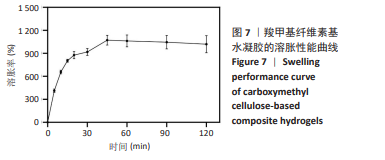
溶胀性能测定:将合成的水凝胶样品切成小块,充分干燥至恒质量(记作md);将干燥水凝胶浸入生理盐水中,在37 ℃恒温下使它自由溶胀。在5,10,15,20,30,45,60,90,120 min,用镊子取出水凝胶,用湿润滤纸迅速吸取表面残留的液体,称质量(记作ms),重复此步骤,直到水凝胶质量基本不变,利用公式(1)计算溶胀率。

式中,ms 表示水凝胶吸水溶胀后的质量,md 表示水凝胶充分干燥后的质量。
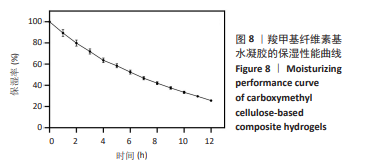
保湿能力测定:为了测量获得水凝胶的保湿性能,干燥样品浸泡在生理盐水中以达到溶胀平衡并称质量(记作m0)。然后,将溶胀后的水凝胶置于37 ℃的环境中,每1 h称质量一次,质量记作mt。保湿率由公式(2)确定:

式中,mt表示t小时后的水凝胶质量,md表示水凝胶完全干燥至恒质量后的质量,m0表示水凝胶吸水溶胀至平衡后的质量。
1.4.3 羧甲基纤维素基水凝胶的生物安全性评估
细胞培养:使用含体积分数10%胎牛血清、1%双抗的DMEM完全培养基培养NIH/3T3细胞,置于37 ℃、体积分数5%CO2培养箱中培养,待细胞稳定贴壁增长至85%-90%后胰酶消化传代,传代比例为1∶3。
水凝胶浸提液的制备:将1 g羧甲基纤维素基水凝胶置于紫外线照射下正反各30 min,在含1%双抗的DMEM培养基或PBS中于37 ℃自由溶胀,当水凝胶达到溶胀平衡后,转移至
10 mL含1%双抗的DMEM基础培养基或PBS中,置于37 ℃、体积分数5%CO2培养箱浸提24 h。将浸提后液体8 000 r/min离心10 min,取上清液,使用注射器吸取上清液通过0.22 μm滤膜除菌,制备得到水凝胶浸提液。
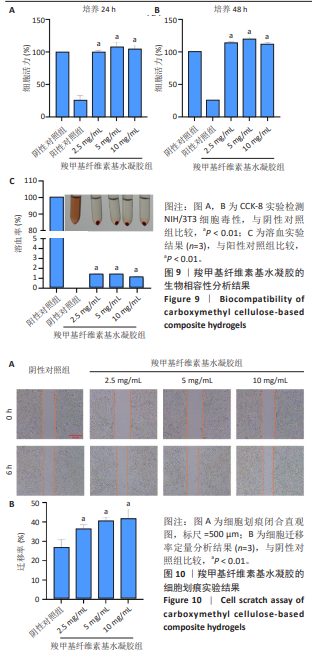
细胞毒性实验:将处于对数生长期的NIH/3T3细胞消化后,用培养基调整细胞浓度至8×107 L-1,按每孔100 μL接种于96孔板中,置于37 ℃、体积分数5%CO2培养箱中孵育12 h,使细胞贴壁。设置空白对照组(仅加完全培养基200 μL,无细胞)、阴性对照组(细胞+完全培养基200 μL)、阳性对照组(细胞+10% DMSO)水凝胶浸提液各质量浓度组[细胞+含2.5 mg/mL(或5,10 mg/mL)水凝胶浸提液的培养基200 μL],每组设置3个平行复孔,置于37 ℃、体积分数5% CO2培养箱中孵育24,48 h。孵育结束后,每孔加入10 μL CCK-8试剂和90 μL完全培养基,轻轻振荡培养板混匀并继续孵育1 h,使用酶标仪在450 nm波长下测定各孔吸光度值,由公式(3)计算细胞活力。

式中,Ae表示水凝胶浸提液各质量浓度处理组吸光度值,Ab表示空白对照组吸光度值,Ac表示阴性对照组吸光度值。
溶血实验:取C57BL/6J小鼠3只,腹腔注射三溴乙醇麻醉后眼眶取血150 μL,收集血液于含有抗凝剂的采血管中。室温静置20 min后转入无菌离心管中,2 000 r/min离心10 min后弃去上清血浆和白细胞层,保留底部红细胞沉淀。用等体积的PBS轻轻清洗重悬红细胞,2 000 r/min离心10 min,重复3次,直至上清呈现透明无色。用PBS将红细胞稀释至体积分数5%备用。设置阳性对照组(0.1 mL 5%悬浮红细胞+1 mL ddH2O)、阴性对照组(0.1 mL 5%悬浮红细胞+1 mL PBS)和实验组[(0.1 mL 5%悬浮红细胞+含2.5 mg/mL(或5,10 mg/mL)羧甲基纤维素基水凝胶的PBS浸提液1 mL],每组设置3个平行复孔,置于37 ℃恒温水浴锅中孵育1 h,2 000 r/min离心10 min后取上清液,放入96孔板中,在540 nm波长处测定吸光度值,使用公式(4)计算溶血率。

式中,As表示水凝胶浸提液各浓度处理组吸光度值,A-表示阴性对照组吸光度值,A+表示阳性对照组吸光度值。
1.4.4 羧甲基纤维素基水凝胶的细胞划痕实验 将2 mL NIH/3T3细胞接种于6孔板中,细胞浓度为3×108 L-1,观察细胞形成单层后,使用200 μL无菌枪头尖端进行刮除,在细胞层表面形成均匀划痕,使用PBS对细胞进行清洗,去除脱落细胞,分别加入含0(阴性对照),2.5,5,10 mg/mL羧甲基纤维素基水凝胶浸提液的DMEM完全培养基2 mL,置于37 ℃、体积分数5%CO2培养箱培养6 h。通过倒置显微镜观察不同时间细胞划痕闭合程度,为量化划痕闭合的程度,使用Image J图像分析软件测量划痕在2个时间间隔(0 h与6 h)的面积。细胞迁移率表示细胞移动并覆盖划痕区域的能力,使用公式(5)计算细胞迁移率。

式中,R0表示0 h划痕后面积,Rt表示t小时后划痕愈合后面积。
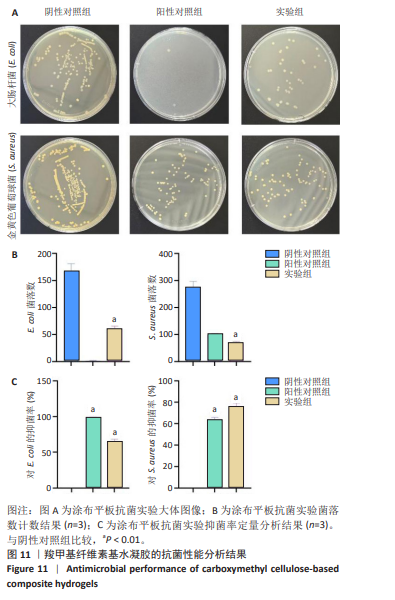
1.4.5 羧甲基纤维素基水凝胶的抗菌实验 慢性伤口感染常见的致病微生物为金黄色葡萄球菌(Staphylococcus aureus)、大肠杆菌(Escherichia coli)等,因此通过平板菌落计数法评估羧甲基纤维素基水凝胶对大肠杆菌和金黄色葡萄球菌的抗菌能力。
LB培养基制备:胰蛋白胨10 g,酵母浸提粉5 g,氯化钠10 g,加入去离子水定容至1 000 mL,置于121 ℃ 20 min高压灭菌备用。
LB琼脂固体培养基制备:胰蛋白胨10 g,酵母浸提粉5 g,氯化钠10 g,琼脂粉15 g,加入去离子水定容至1 000 mL,置于121 ℃ 20 min高压灭菌,待培养基冷却至50 ℃左右倒平板。
将羧甲基纤维素基水凝胶0.1 g置于紫外线下照射,正反各30 min灭菌,放入2 mL离心管中,加入100 μL初始菌液,是浓度为1×10⁸ CFU/mL的金黄色葡萄球菌(或大肠杆菌)菌液,阳性对照组使用庆大霉素(10 mg/mL)处理,阴性对照为单独培养的菌液,置于37 ℃共孵育3 h,加入1 mL无菌PBS混匀收集菌液,然后将菌液梯度稀释至10-6 CFU/mL,取100 μL菌液涂布于LB肉汤培养基上培养36 h,统计菌落数和抑菌率。

式中,N阴表示阴性对照组菌落数,N表示阳性对照组或实验组菌落数。
1.5 主要观察指标 羧甲基纤维素基水凝胶的生物安全性与生物学性能。
1.6 统计学分析 所有数据均使用平均值±标准差表示,组间差异的显著性通过单因素方差分析,使用SPSS 10.0软件辅助评估,P < 0.05被认为差异有显著性意义。该文统计学方法已经内蒙古医科大学生物统计学专家审核。