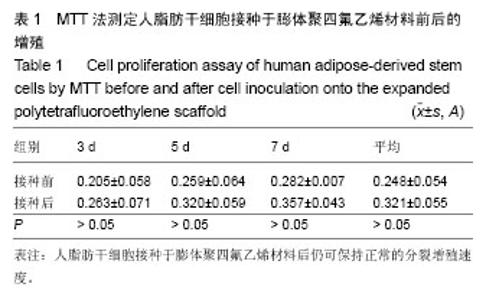
| [1] De Ugarte DA,Morizono K,Elbarbary A,et al.Comparison of multi-lineage cells from human adipose tissue and bone marrow.Cells Tissues Organs.2003;174(3):101-109.
[2] Mizuno H.Adipose-derived stem cells for tissue repair and regeneration: ten years of research and a literature review.J Nippon Med Sch.2009;76(2):56-66.
[3] 费剑锋,宋红权,孙洋,等.不同支架材料及接种培养方法对前脂肪细胞生长情况的影响[J].中华医学美学美容杂志, 2010,16(4):252-257.
[4] 张云松,高建华,鲁峰,等.Ⅰ型胶原支架材料与人脂肪干细胞体外生物相容性研究[J].南方医科大学学报,2007;27(2):223-225.
[5] Ham J,Miller PJ.Expanded ploytetra fluoroethylene implants in rhinoplasty, Literature review, operative techniques and outcome.Facial Plast Surg.2003;19(4):331.
[6] Kridel RWH,Kraus WM.Grafts and implants in revision hinoplasty.Facial Plast Surg Clin Norty Am.1995;3(4):473.
[7] 张召,熊雯,郑晋东,等.膨体聚四氟乙烯假体隆鼻术并发症的分析及防治[J].中国美容医学,2010,19(5);678-679.
[8] Mole B.The use of Gore-Tex implants in aesthetic surgery of the face. Plast Reconstr Surg.1992;2:200.
[9] Conrad K,Chapnik JS,Reifen E.E-PTEE (Gore-Tex) suspension cervical facial rhytidectomy.Arch Otolaryngol Head Neck Surg.1993;119:684.
[10] Zuk PA,Zhu M,Mizuno H,et al.Multilineage cells from humanadiposetissue:implicationsforcell-based therapies. Tissue Eng.2001;7:211-228.
[11] Zuk PA,ZhuM,ASHJIANP,et al.Human adipose tissue is a source of multipotent stem cells.Mol Biol Cell.2002; 13(12): 4279-4259.
[12] Yoshimura K,Shigeura T,Mastsumoto D,et al.Characterization of freshly isolated and cultured cells derived from the fatty and fluid portions of liposuction aspirates.Cell Physiol.2006;208 (1):64-76.
[13] Mitchell JB,McIntosh K,Zvonic S,et al.Immunophenotype ofhuman adipose-derived cells: Temporal changes in stromal-associatedand stem cell-associated markers.Stem Cells.2006;24:376-385.
[14] Kasten P,Luginbuhl K,van Gnensven M,et al.Comparison of human bone marrow stem cells seeded on calcium-deficient hydroxyapatite , beta-tricalcium phosphate and dematerialized bone matix.Biomaterials.2003;24:2593-2603.
[15] 李德保,田甜,章庆国.膨体聚四氟乙烯(ePTEE)内支撑组织工程软骨的构建实验研究[J].中国美容医学,2009,18(6):823-826.
[16] 王贺宾,刘清波.自体耳软骨与膨体聚四氟乙烯在鼻整形中的应用[J].中外健康文摘,2013,10(4):122-123.
[17] 李春光,陈和忠,李志刚,等.膨体聚四氟乙烯补片在胸壁重建中的应用[J].中国胸心血管外科临床杂志,2012,19(3):248-250.
[18] 袁义,蔡开灿,王振康,等.超微孔膨体聚四氟乙烯人工瓣膜行绵羊二尖瓣置换的血流动力学[J].实用医学杂志,2012,28(14):2318-2320.
[19] 田田,李英春,周斌,等.膨体聚四氟乙烯覆盖创面的实验研究[J].中华烧伤杂志,2009,25(2):133-136.
[20] Neel HB.Implants of Gore-Tex: comparisons with Teflon-coated polytetrafluroethlene carbon and porous polyethylene implants.Arch Otolaryngol.1983;109:427-433.
[21] Taha MF,Hedayati V.Isolation,identification and multipotential differentiation of mouse adipose tissue-derived stem cells. Tissue Cell.2010;42(4):211-216.
[22] Grothos S,Franklin DM,Leddy HA,et al.Surface protein characterization of human adipose tissue-derived stromal cells.J Cell Physiol.2001;189(1):54-63.
[23] Bunnell BA,Flaat M,Gagliardi C,et al.Adipose-derived stem cells: isolation, expansion and differentiation. Methods.2008; 45(2):115-120. |