1.1 设计 细胞实验研究,动物实验研究。
1.2 时间及地点 实验于2015年9月至2025年5月在徐州医科大学SPF级实验动物中心以及徐州医科大学肿瘤防治研究所完成。
1.3 材料
1.3.1 细胞株 人早幼粒白血病细胞系HL-60和人胚肾细胞系293T购于美国ATCC公司。小鼠原代中性粒细胞从野生型小鼠骨髓中分离得到。
1.3.2 主要试剂 IMDM及RPMI-1640培养基购于江苏凯基生物公司;胎牛血清、ECL化学发光试剂盒和SYTOX Green核酸染料购于Thermo fisher公司;蛋白浓度测定试剂盒购于碧云天公司;二甲基亚砜、脂多糖、N-甲酰-甲硫氨酰-亮氨酸-苯丙氨酸、白细胞介素8和PARP-1抑制剂AG14361购于Sigma公司;对照shRNA和PARP-1 shRNA购于Santa Cruz公司;PARP-1抗体、β-actin抗体、GAPDH抗体和鬼笔环肽染料购于武汉三鹰生物技术有限公司;DAPI细胞核染料购于武汉赛维尔生物科技有限公司;嘌呤霉素购于上海碧云天生物技术有限公司;实时荧光定量PCR引物由苏州金唯智生物公司合成;实时荧光定量 PCR相关试剂盒购于南京诺唯赞生物科技有限公司;PE标记的抗人C-X-C趋化因子受体2抗体、APC标记的抗人C-X-C趋化因子受体4抗体购于BioLegend公司;瓜氨酸化组蛋白H3抗体(货号:ab281584)购于Abcam公司。
1.3.3 实验动物 野生型雄性C57BL/6J小鼠36只,6-8周龄,体质量约20 g,购于北京华阜康实验动物技术有限公司,实验动物许可证号:SCXK(京)2014-0004,在SPF级条件下饲养。所有动物操作及实验方案均经徐州医科大学实验动物伦理委员会批准(伦理号为:2015090201),严格依照《徐州医科大学实验动物护理与使用指南》执行。实验过程遵循了国际兽医学编辑协会《关于动物伦理与福利的作者指南共识》和本地及国家法规。
1.4 实验方法
1.4.1 细胞培养 人早幼粒白血病细胞系HL-60用含1.3%二甲基亚砜的RPMI-1640完全培养基(含体积分数10%胎牛血清和1%青链霉素)诱导5-7 d,使其分化成中性粒细胞样细胞dHL-60[22]。人胚肾细胞系293T用含体积分数10%胎牛血清和1%青链霉素的IMDM培养基,在37 ℃、体积分数5%CO2培养箱中静置培养。
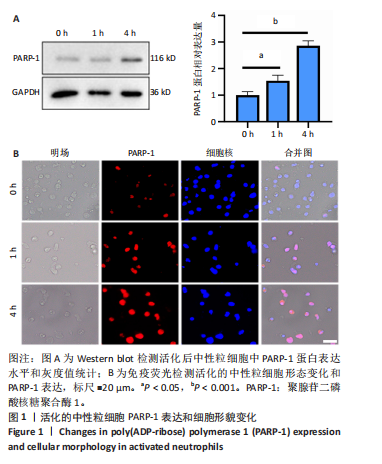
1.4.2 Western blot检测活化的中性粒细胞中PARP-1表达 将分化后的dHL-60细胞浓度调整至1×10¹⁰ L-1,使用1 μg/mL脂多糖处理1,4 h,使dHL-60细胞活化,0 h作为未活化对照组,1 000 r/min离心5 min收集活化后的中性粒细胞,采用含蛋白酶抑制剂的RIPA裂解液冰上裂解30 min,随后12 000 r/min离心10 min提取细胞总蛋白,采用BCA蛋白试剂盒检测蛋白浓度,经SDS-PAGE电泳分离蛋白后转移至硝酸纤维素膜,5%脱脂牛奶室温封闭1 h,分别与一抗PARP-1(稀释比例1∶1 000)和GAPDH(稀释比例1∶10 000)在4 ℃条件下孵育过夜,TBST洗膜3次,与相应的辣根过氧化物酶标记的二抗(稀释比例1∶10 000)室温孵育1 h,再次TBST洗膜3次,采用ECL发光反应液,通过凝胶成像检测PAPR-1表达。使用Image J软件对目标条带进行灰度值分析,以GAPDH为内参,评估中性粒细胞活化后PARP-1的表达情况。
1.4.3 免疫荧光染色观察活化的中性粒细胞的形貌变化 将分化后的dHL-60细胞以每孔1×10⁶个密度接种于预先包被有50 ng/mL纤连蛋白的盖玻片上,置于24孔细胞培养板中,在细胞培养箱静置10 min后,使用1 μg/mL脂多糖处理1,4 h,使dHL-60细胞活化,0 h作为未活化对照组。处理结束后,使用40 g/L多聚甲醛室温固定30 min,用0.2% Triton X-100溶液通透10 min,再用5%牛血清白蛋白室温封闭1 h以降低非特异性结合,接着加入PARP-1抗体(稀释比例1∶400) 4 ℃过夜孵育,PBS洗涤3次,加入Alexa Fluor 594标记的荧光二抗室温孵育1 h,PBS再次洗涤3次,加入DAPI染料进行细胞核染色,最后用PBS充分洗涤,以抗荧光淬灭封片剂封固,在荧光显微镜下观察、采集图像。
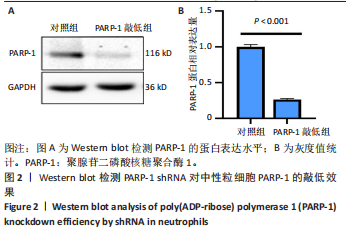
1.4.4 PARP-1低表达中性粒细胞系构建 以人早幼粒白血病细胞系HL-60为基础,利用慢病毒包装系统,将对照shRNA和PARP-1 shRNA(序列为:5’-TAT CAA CAA ATC TGA AAT-3’)分别和辅助质粒pMD2.G、psPAX2共转293T细胞,48 h后经离心过滤收集病毒液。将收集的病毒液感染HL-60细胞48 h后用1 μg/mL嘌呤霉素筛选阳性细胞,连续筛选3 d,收集shRNA-PARP-1感染的HL-60细胞,以shRNA-对照感染的HL-60细胞为对照组,用含蛋白酶抑制剂的RIPA裂解液冰上裂解30 min,随后经电泳、转膜、封闭、孵育PARP-1一抗、辣根过氧化物酶标记的二抗,Western blot检测HL-60细胞中PAPR-1的表达。以GAPDH为内参,评估shRNA-PARP-1在HL-60细胞中对PARP-1的敲低效果,以获得稳定的PARP-1低表达HL-60细胞系。将对照组和PARP-1敲低组HL-60细胞系经二甲基亚砜诱导分化为中性粒细胞样细胞dHL-60。
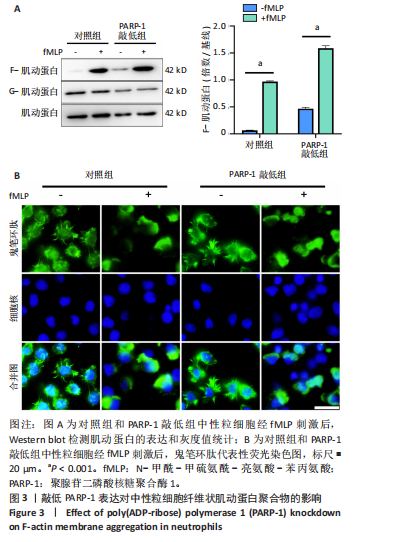
1.4.5 诱导中性粒细胞极化 将对照组和PARP-1敲低组的dHL-60细胞重悬至2×10¹⁰ L-1,取500 μL细胞悬液,根据预实验结果,用100 nmol/L N-甲酰-甲硫氨酰-亮氨酸-苯丙氨酸刺激2 min,诱导中性粒细胞极化,随后迅速加入500 μL含有蛋白酶抑制剂的2×MES膜物提取缓冲液将细胞裂解,室温放置10 min,提取细胞总蛋白,取出一部分细胞总蛋白,经13 000 r/min离心10 min,小心吸取上清液即为细胞质蛋白组分,沉淀用预冷的PBS重悬,作为细胞膜蛋白组分。通过Western blot检测中性粒细胞极化标志物肌动蛋白的表达,检测方法同上,一抗β-actin稀释比例1∶5 000,辣根过氧化物酶标记的二抗稀释比例1∶10 000,使用Image J软件进行灰度值分析,以细胞总蛋白中的β-actin为基线,评估细胞膜蛋白中β-actin相对于基线的变化倍比。
1.4.6 鬼笔环肽荧光染色 将对照组与PARP-1敲低组的dHL-60细胞以每孔1×10⁶个密度接种于预先包被有50 ng/mL纤连蛋白的盖玻片上,置于24孔细胞培养板中,在细胞培养箱静置10 min后,加入100 nmol/L N-甲酰-甲硫氨酰-亮氨酸-苯丙氨酸刺激2 min以诱导中性粒细胞极化。刺激结束后,使用40 g/L多聚甲醛室温固定30 min,随后用0.2% Triton X-100溶液通透10 min,再用5%牛血清白蛋白室温封闭1 h以降低非特异性结合,接着使用荧光标记的鬼笔环肽室温避光孵育10 min以标记F-肌动蛋白,PBS洗涤3次,加入DAPI染料进行细胞核染色,再次用PBS充分洗涤,以抗荧光淬灭封片剂封固,在荧光显微镜下观察、采集图像。
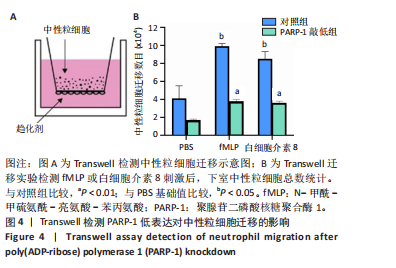
1.4.7 Transwell迁移实验 将对照组和PARP-1敲低组的dHL-60细胞重悬于无血清培养基中,并以每孔1×10⁶个密度接种于3 μm孔径的Transwell小室中,在小室外部培养基中加入N-甲酰-甲硫氨酰-亮氨酸-苯丙氨酸(100 nmol/L)或白细胞介素8 (10 ng/mL)作为趋化剂,以加入PBS作为阴性对照,将24孔培养板置于37 ℃、体积分数5%CO2培养箱中孵育1 h,孵育结束后移除Transwell小室,通过离心计数法来定量评估穿过Transwell小室的中性粒细胞数量,评估dHL-60细胞的迁移能力。
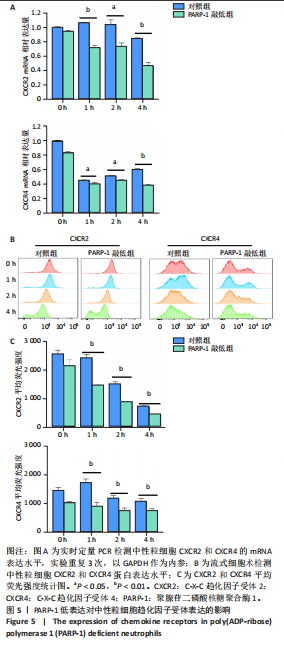
1.4.8 实时荧光定量PCR和流式细胞技术检测中性粒细胞表面趋化因子受体表达 将对照组和PARP-1敲低组的dHL-60细胞分别采用1 μg/mL脂多糖处理1,2,4 h,使dHL-60细胞活化,并将未经脂多糖处理(0 h)的细胞作为未活化对照组。
(1)在各指定时间点收集活化后的中性粒细胞,使用Trizol法提取RNA,经分光光度计检测RNA浓度与纯度合格后,按照HiScript QRT SuperMix for qPCR(含gDNA wiper)反转录试剂盒说明书将RNA反转录为cDNA,然后根据SYBR Green Master Mix实时荧光定量PCR试剂盒说明书,通过LightCycler 480实时荧光PCR系统进行扩增,检测C-X-C趋化因子受体2与C-X-C趋化因子受体4的mRNA表达水平,反应条件为95 ℃,10 min;95 ℃,10 s;60 ℃,34 s;40个循环。以GAPDH作为内参基因,采用2-ΔΔCt法对数据进行处理,计算目的基因相对表达量。所用引物序列见表1。

(2)在指定时间点收集活化的中性粒细胞,用预冷的PBS洗涤,将细胞重悬后,分别加入PE标记的C-X-C趋化因子受体2抗体与APC标记的C-X-C趋化因子受体4抗体,于4 ℃避光条件下孵育30 min,孵育结束后,用PBS洗涤以去除未结合抗体,随后上流式细胞仪检测。数据通过FlowJo软件进行分析,以平均荧光强度表示受体表达水平。
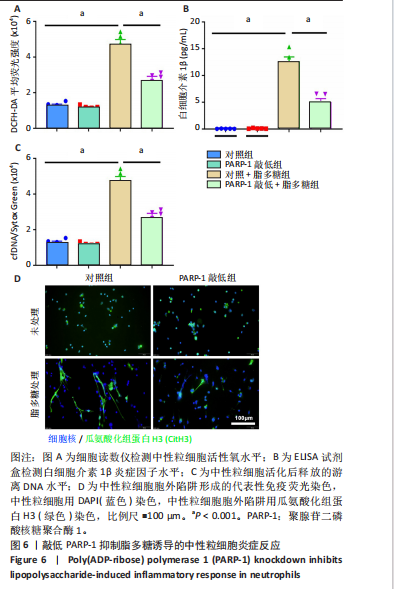
1.4.9 活性氧检测 将对照组和PARP-1敲低组的dHL-60细胞重悬至1×10⁹ L-1,采用1 μg/mL脂多糖处理2 h,使dHL-60细胞活化,并将未经脂多糖处理(0 h)的细胞作为未活化对照组,随后与10 μmol/L活性氧荧光探针(H2DCFDA)共同孵育30 min,经1 000 r/min离心5 min,PBS重悬细胞,立即通过Cytation 3细胞成像多功能微孔板检测系统(BioTek,Winooski,VT)直接读取结果,设置激发光波长为485 nm,发射光波长为528 nm。
1.4.10 酶联免疫吸附实验测定白细胞介素1β水平 将对照组和PARP-1敲低组的dHL-60细胞重悬至1×10⁹ L-1,采用1 μg/mL脂多糖处理4 h,使dHL-60细胞活化,并将未经脂多糖处理(0 h)的细胞作为未活化对照组,经1 000 r/min离心5 min收集活化中性粒细胞上清,使用人白细胞介素1β ELISA试剂盒检测白细胞介素1β水平,所有操作均严格按照制造商提供的实验流程进行。
1.4.11 细胞游离DNA检测 按照上述1.4.10方法收集中性粒细胞活化上清。将1 μmol/L SYTOX Green核酸染料与200 μL上清液混合后加入96孔板,室温避光孵育20 min,使用Cytation 3细胞成像多功能检测系统,在488 nm/525 nm的激发/发射波长下检测荧光强度。
1.4.12 免疫荧光染色检测中性粒细胞胞外诱捕网 将对照组和PARP-1敲低组的dHL-60细胞重悬至1×10⁹ L-1,取500 μL细胞悬液加入预放置多聚赖氨酸包被盖玻片的24孔板,采用1 μg/mL脂多糖处理4 h,使dHL-60细胞活化,未经脂多糖处理(0 h)的细胞作为未活化对照组,将盖玻片上的中性粒细胞用40 g/L多聚甲醛固定15 min,0.1% Triton X-100透化5 min,用10%牛血清白蛋白封闭1 h,于4 ℃暗室环境中与瓜氨酸化组蛋白H3一抗(稀释比例1∶2 000)孵育过夜,随后在37 ℃条件下与Alexa Fluor 488标记的二抗(稀释比例1∶2 000)共同孵育1 h,使用DAPI复染细胞核5 min,样本通过Zeiss LSM880共聚焦激光扫描显微镜进行分析。
1.4.13 小鼠模型动物实验
(1)小鼠原代中性粒细胞提取:从野生型C57BL/6J小鼠骨髓中分离中性粒细胞(前期证实体外存活时间为3-5 d),对小鼠实施安乐死,超净工作台内取双侧股骨和胫骨,无钙镁HBSS平衡液冲洗骨髓腔,将冲洗液收集于离心管中,1 800 r/min离心5 min,弃上清,向细胞沉淀中加入红细胞裂解液重悬细胞,室温避光孵育8 min,加入3倍体积磷酸盐缓冲液中和裂红液,振荡混匀后再次以1 800 r/min离心5 min,弃上清,随后用3 mL无钙镁HBSS平衡液重悬细胞沉淀。采用梯度密度离心纯化小鼠中性粒细胞,取15 mL离心管,依次缓慢加入3 mL 62%细胞分离液及等体积的上述骨髓细胞悬液,静置分层,以2 500 r/min水平离心35 min,离心后所得细胞沉淀即为中性粒细胞。
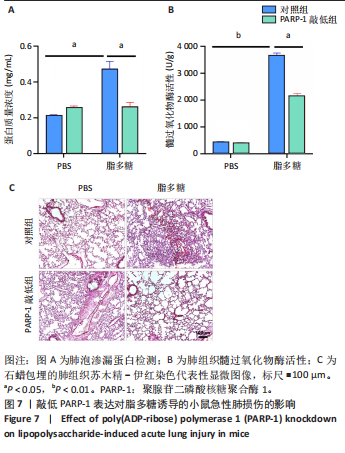
(2)小鼠中性粒细胞过继转移模型构建:利用慢病毒shRNA沉默中性粒细胞中PARP-1的表达,获得PARP-1敲低的小鼠原代中性粒细胞。将对照组与PARP-1敲低组中性粒细胞分别通过尾静脉注射至野生型C57BL/6J小鼠体内,注射剂量为每只小鼠5×105个细胞,注射10 min后,按照每只小鼠10 mg/kg的剂量通过腹腔注射脂多糖诱导小鼠急性肺损伤模型[23],并设置PBS溶剂处理组作为基础对照。将20只C57BL/6J小鼠随机分为4组(n=5):①注射对照组中性粒细胞+ PBS处理;②注射对照组中性粒细胞+脂多糖处理;③注射PARP-1敲低组中性粒细胞+ PBS处理;④注射PARP-1敲低组中性粒细胞+脂多糖处理。在脂多糖或PBS注射6 h后,将小鼠安乐死。
(3)肺水肿检测:①小鼠处死后,暴露气管并行气管插管。以预冷的无菌磷酸盐缓冲液缓慢注入肺部,轻柔抽吸3次,回收支气管肺泡灌洗液。将收集的灌洗液于4 ℃、1 500 r/min离心10 min,小心收集上清液。采用BCA蛋白浓度测定试剂盒检测上清液中总蛋白含量。通过渗漏到肺泡中的蛋白质含量,评估肺水肿。②称取肺组织湿质量后,置于60 ℃烘箱中烘烤3 d,称取肺组织干质量,以湿质量/干质量比值作为衡量肺水肿的指标。称取肺组织湿质量后,置于60 ℃烘箱中烘烤3 d,称取肺组织干质量,以湿质量/干质量比值作为衡量肺水肿的指标。
(4)髓过氧化物酶活性检测:取适量肺组织,称质量后,首先经预冷PBS灌洗以去除残留血液,随后加入50 mmol/L PBS进行组织匀浆,将匀浆液于4 ℃、14 000 r/min离心30 min,弃去上清;沉淀部分使用含0.5%十六烷基三甲基溴化铵的PBS溶液重悬,并剧烈振荡以确保充分分散,然后将样品于-70 ℃冷冻30 min,再于37 ℃水浴中解冻,此冻融过程旨在促进酶释放。解冻后,将混合物再次离心,最终取上清液作为待测样品。髓过氧化物酶活性在460 nm波长下进行动力学监测,持续记录
5 min,结果以每克肺组织最大反应速率(V-max)表示。
(5)苏木精-伊红染色:经气管注入体积分数10%甲醛溶液将肺组织固定,24 h后将肺组织进行石蜡包埋,并切成5 µm厚的切片,对切片进行苏木精和伊红染色,显微镜观察肺组织损伤情况。
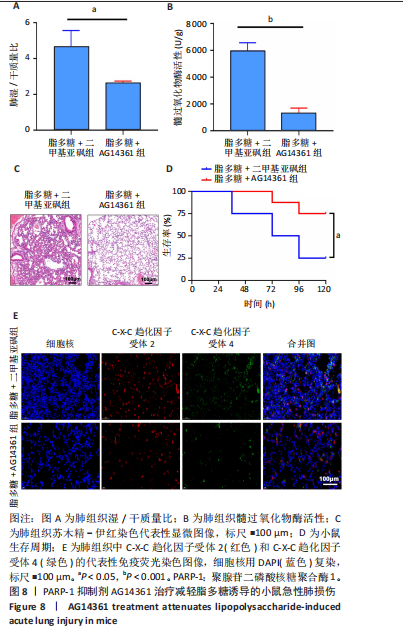
1.4.14 急性肺损伤小鼠生存实验 将16只野生型C57BL/6J小鼠随机分为2组(n=8),按15 mg/kg的剂量通过腹腔注射脂多糖构建脓毒症小鼠急性肺损伤模型。AG14361处理组小鼠在脂多糖注射前及注射后1 h,以30 mg/kg的剂量向小鼠腹腔内注射PARP-1抑制剂AG14361,对照组小鼠则在相同时间点注射等体积二甲基亚砜溶剂。观察记录每组小鼠死亡时间;收集小鼠肺组织,用于肺湿/干质量比值、髓过氧化物酶活性测定及苏木精-伊红染色等分析,具体检测方法同前所述。
肺组织免疫荧光检测C-X-C趋化因子受体2与C-X-C趋化因子受体4的表达:各组小鼠肺组织经40 g/L多聚甲醛灌注固定后,石蜡包埋并切片,切片经柠檬酸钠缓冲液进行抗原修复后,0.1% Triton X-100溶液透化组织,随后用5%牛血清蛋白室温封闭1 h,切片与兔抗小鼠C-X-C趋化因子受体2单克隆抗体及大鼠抗小鼠C-X-C趋化因子受体4单克隆抗体在4 ℃孵育过夜,PBS充分洗涤后,再与相应的山羊抗兔荧光二抗和山羊抗鼠荧光二抗室温避光孵育1 h,PBS充分洗涤后,使用DAPI染液复染细胞核10 min;最后用抗荧光淬灭封片剂封固,在荧光显微镜下观察并采集图像。
1.5 主要观察指标 ①中性粒细胞活化后PARP-1的表达水平;②中性粒细胞中PARP-1的敲低效率;③PARP-1对中性粒细胞极化的影响;④PARP-1对中性粒细胞迁移的影响;⑤PARP-1对中性粒细胞趋化因子受体表达的影响;⑥PARP-1 对中性粒细胞活化和炎症反应的影响;⑦在PARP-1基因缺失的中性粒细胞过继转移小鼠急性肺损伤模型中,观察PARP-1对中性粒细胞浸润和肺组织损伤程度的影响;⑧通过小鼠败血症模型,评价PARP-1抑制剂AG14361对生存率及肺组织损伤的影响。
1.6 统计学分析 通过GraphPad Prism 10.0对实验数据进行统计学分析和绘图。计量资料以x±s表示,采用 t 检验分析两组独立样本之间差异的显著性,多组间比较采用单因素方差分析。采用Log-Rank进行小鼠生存期分析。P < 0.05为差异有显著性意义。文章统计学分析方法由徐州医科大学生物统计学专家审核。