[1] DIAZ-GONZALEZ F, HERNÁNDEZ-HERNÁNDEZ MV. Rheumatoid arthritis. Med Clin (Barc). 2023; 161(12):533-542.
[2] ALMUTAIRI K, NOSSENT J, PREEN D, et al. The global prevalence of rheumatoid arthritis: a meta-analysis based on a systematic review. Rheumatol Int. 202;41(5):863-877.
[3] MUELLER AL, PAYANDEH Z, MOHAMMADKHANI N, et al. Recent advances in understanding the pathogenesis of rheumatoid arthritis: new treatment strategies. Cells. 2021;10(11):3011.
[4] DERKSEN V, HUIZINGA TWJ, VAN DER WOUDE D. The role of autoantibodies in the pathophysiology of rheumatoid arthritis. Semin Immunopathol. 2017;39(4):437-446.
[5] MCINNES IB, SCHETT G. Cytokines in the pathogenesis of rheumatoid arthritis. Nat Rev Immunol. 2007;7(6):429-442.
[6] 国家皮肤与免疫疾病临床医学研究中心(北京协和医院),中国医师协会风湿免疫专科医师分会,中国康复医学会风湿免疫病康复专业委员会,等.2024中国类风湿关节炎诊疗指南[J].中华内科杂志,2024,63(11):1059-1077.
[7] BAIG MMFA, WONG LK, ZIA AW, et al. Development of biomedical hydrogels for rheumatoid arthritis treatment. Asian J Pharm Sci. 2024;19(1):100887.
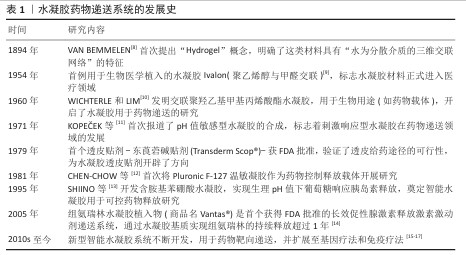
[8] VAN BEMMELEN JM. Das Hydrogel und das krystallinische Hydrat des Kupferoxyds. Diese Zeitschr. 1894;5(1):466-483.
[9] DODGE HW JR, GRINDLAY JH, CRAIG WM, et al.
Use of polyvinyl sponge in neurosurgery. J Neurosurg. 1954;11(3):258-261.
[10] WICHTERLE O, LÍM D. Hydrophilic Gels for Biological Use. Nature. 1960;185:117-118.
[11] KOPEČEK J, VACÍK J, LÍM D. Permeability of membranes containing ionogenic groups. J Polym Sci A1. 1971;9:2801-2815.
[12] CHEN-CHOW PC, FRANK SG. In vitro release of lidocaine from Pluronic F-127 gels. Int J Pharm. 1981;8(2):89-99.
[13] SHIINO D, MURATA Y, KUBO A, et al. Amine containing phenylboronic acid gel for glucose-responsive insulin release under physiological pH. J Control Release. 1995;37(3):269-276.
[14] DINEEN MK, TIERNEY DS, KUZMA P, et al. An evaluation of the pharmacokinetics and pharmacodynamics of the histrelin implant for the palliative treatment of prostate cancer. J Clin Pharmacol. 2005;45(11):1245-1249.
[15] CHENG R, FENG F, MENG F, et al. Glutathione-responsive nano-vehicles as a promising platform for targeted intracellular drug and gene delivery. J Control Release. 2011;152(1):2-12.
[16] DUNN SS, TIAN S, BLAKE S, et al. Reductively responsive siRNA-conjugated hydrogel nanoparticles for gene silencing. J Am Chem Soc. 2012;134(17):7423-7430.
[17] SHI K, FU W, FARHADI SABET Z, et al. Hydrogel-Mediated Jamming of Exosome Communications That Counter Tumor Adaption in the Tumor Immune Microenvironment. ACS Nano. 2024; 18(48):33042-33057.
[18] PRASAD P, VERMA S, SURBHI, et al. Rheumatoid arthritis: advances in treatment strategies. Mol Cell Biochem. 2023;478(1):69-88.
[19] LIU J, JIANG Y, ZHANG S, et al. Ivarmacitinib, a selective Janus kinase 1 inhibitor, in patients with moderate-to-severe active rheumatoid arthritis and inadequate response to conventional synthetic DMARDs: results from a phase III randomised clinical trial. Ann Rheum Dis. 2025;84(2):188-200.
[20] WANG L, XU D, FANG J, et al. Telitacicept, a Human Recombinant Fusion Protein Targeting and Neutralizing B Lymphocyte Stimulator (BlyS) and a Proliferation-Inducing Ligand (APRIL), in Rheumatoid Arthritis (RA) Patients with an Inadequate Response to Methotrexate (MTX): A Randomized, Double-Blind, Phase 3 Study. Arthritis Rheumatol. 2023;75(suppl 9).doi:10.1002/art.42355.
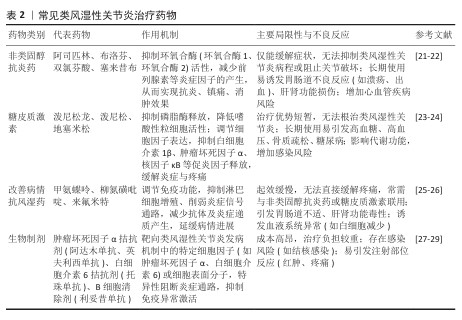
[21] GRAHAM GG, SCOTT KF. Limitations of drug concentrations used in cell culture studies for understanding clinical responses of NSAIDs. Inflammopharmacol. 2021;29(5):1261-1278.
[22] KOETTING MC, GUIDO JF, GUPTA M, et al. pH-responsive and enzymatically-responsive hydrogel microparticles for the oral delivery of therapeutic proteins: Effects of protein size, crosslinking density, and hydrogel degradation on protein delivery. J Control Release. 2016;221:18-25.
[23] CARRILLO-CONDE BR, BREWER E, LOWMAN A, et al. Complexation Hydrogels as Oral Delivery Vehicles of Therapeutic Antibodies: An in Vitro and ex Vivo Evaluation of Antibody Stability and Bioactivity. Ind Eng Chem Res. 2015;54(42): 10197-10205.
[24] COLLINS KH, PFERDEHIRT L, SALEH LS, et al. Hydrogel Encapsulation of Genome-Engineered Stem Cells for Long-Term Self-Regulating Anti-Cytokine Therapy. Gels. 2023;9(2):169.
[25] CHENG F, SU T, LIU Y, et al. Targeting Lymph Nodes for Systemic Immunosuppression Using Cell-Free-DNA-Scavenging And cGAS-Inhibiting Nanomedicine-In-Hydrogel for Rheumatoid Arthritis Immunotherapy. Adv Sci (Weinh). 2023; 10(26):e2302575.
[26] XU Y, ZHAO M, CAO J, et al. Applications and recent advances in transdermal drug delivery systems for the treatment of rheumatoid arthritis. Acta Pharm Sin B. 2023;13(11): 4417-4441.
[27] LEE S, CHOI S, KIM MS. Intra-articular hydrogel formulation prolongs the in vivo stability of Toll-like receptor antagonistic peptides for rheumatoid arthritis treatment. J Control Release. 2024;372:467-481.
[28] COX N, MALLEN CD, SCOTT IC. Pharmacological pain management in patients with rheumatoid arthritis: a narrative literature review. BMC Med. 2025;23(1):54.
[29] ARFEEN M, SRIVASTAVA A, SRIVASTAVA N, et al.
Design, classification, and adverse effects of NSAIDs: A review on recent advancements. Bioorg Med Chem. 2024;112:117899.
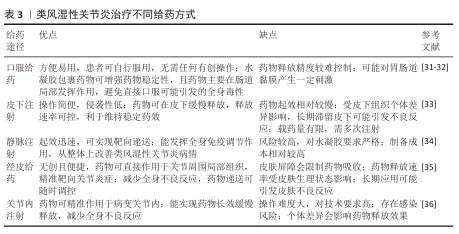
[30] ZHOU S, ZOU H, CHEN G, et al. Synthesis and biological activities of chemical drugs for the treatment of rheumatoid arthritis. Top Curr Chem. 2019;377(5):28.
[31] DOUMEN M, PAZMINO S, BERTRAND D, et al. Glucocorticoids in rheumatoid arthritis: Balancing benefits and harm by leveraging the therapeutic window of opportunity. Joint Bone Spine. 2023; 90(3):105491.
[32] HOFMAN ZLM, ROODENRIJS NMT, NIKIPHOROU E, et al. Difficult-to-treat rheumatoid arthritis: what have we learned and what do we still need to learn? Rheumatology. 2025;64(1):65-73.
[33] NEGI S, TANDEL N, SHARMA P, et al. Aceclofenac and methotrexate combination therapy could influence Th1/Th17 axis to modulate rheumatoid-arthritis-induced inflammation. Drug Discov Today. 2023;28(8):103671.
[34] MADRID-GARCÍA A, FREITES-NUNEZ D, MERINO-BARBANCHO B, et al. Mapping two decades of research in rheumatology-specific journals: a topic modeling analysis with BERTopic. Ther Adv Musculoskelet Dis. 2024;16:1759720X241308037.
[35] ZHAO F, HU Z, LI G, et al. Angiogenesis in rheumatoid arthritis: Pathological characterization, pathogenic mechanisms, and nano-targeted therapeutic strategies. Bioact Mater. 2025;50: 603-639.
[36] SONG YJ, NAM SW, SUH CH, et al. Biosimilars in the treatment of rheumatoid arthritis: a pharmacokinetic overview. Expert Opin Drug Metab Toxicol. 2023;19(11):751-768.
[37] BACK W, PARK JH. Hydrogel-Based Strategies for Managing Rheumatoid Arthritis: From Sustained Drug Release to Cell-Based Therapies. ACS Biomater Sci Eng. 2025;11(6):3262-3275.
[38] ALTEN R, KRUGER K, RELLECKE J, et al. Examining patient preferences in the treatment of rheumatoid arthritis using a discrete-choice approach. Patient Prefer Adher. 2016;10: 2217-2228.
[39] JIANG H, LU Q, HUANG X, et al. Sinomenine-glycyrrhizic acid self-assembly enhanced the anti-inflammatory effect of sinomenine in the treatment of rheumatoid arthritis. J Control Release. 2025;382:113718.
[40] QINDEEL M, ULLAH MH, FAKHAR-UD-DIN, et al. Recent trends, challenges and future outlook of transdermal drug delivery systems for rheumatoid arthritis therapy. J Control Release. 2020;327: 595-615.
[41] ZHAO YP, HAN JF, ZHANG FY, et al. Flexible nano-liposomes-based transdermal hydrogel for targeted delivery of dexamethasone for rheumatoid arthritis therapy. Drug Deliv. 2022; 29(1):2269-2282.
[42] KHAN D, QINDEEL M, AHMED N, et al. Development of an intelligent, stimuli-responsive transdermal system for efficient delivery of ibuprofen against rheumatoid arthritis. Int J Pharm. 2021;610:121242.
[43] KHAN D, AHMED N, MUHAMMAD A, et al. A macromolecule infliximab loaded reverse nanomicelles-based transdermal hydrogel: An innovative approach against rheumatoid arthritis. Biomater Adv. 2025;167:214093.
[44] GHARAT S, MOMIN M, PANCHAL U, et al.
Novel ethosomal gel formulation for enhanced transdermal delivery of curcumin and cyclosporine: a preclinical approach to rheumatoid arthritis management. Drug Deliv. 2025;32(1):2512620.
[45] WENDONG Y, XINGXING Y, XIANZE X, et al. Nanoformulation-assisted microneedle transdermal drug delivery system: An innovative platform enhancing rheumatoid arthritis treatment. Biomed Pharmacother. 2024;178: 117219.
[46] WANG X, YUE J, GUO S, et al. Dissolving microneedles: A transdermal drug delivery system for the treatment of rheumatoid arthritis. Int J Pharm. 2025;671:125206.
[47] BALDE A, KIM SK, NAZEER RA. A review on microneedle patch as a delivery system for proteins/peptides and their applications in transdermal inflammation suppression. I Int J Biol Macromol. 2025;307(Pt 2):141963.
[48] LI S, CHEN Q, ZHANG Y, et al. Hyaluronic acid dissolving microneedle patch-assisted acupoint transdermal delivery of triptolide for effective rheumatoid arthritis treatment. Sci Rep. 2024; 14(1):25256.
[49] ZHAO W, ZHENG L, YANG J, et al. Dissolving microneedle patches-mediated percutaneous delivery of tetramethylpyrazine for rheumatoid arthritis treatment. Eur J Pharm Sci. 2023;184: 106409.
[50] HUA P, YANG S, YU L, et al. Natural product-integrated microneedle patch for rheumatoid arthritis treatment through anti-inflammation and angiogenesis suppression. Biomater Sci. 2025;13(9):2462-2474.
[51] LIU T, FU J, ZHENG Z, et al. Active microneedle patch equipped with spontaneous bubble generation for enhanced rheumatoid arthritis treatment. Theranostics. 2025;15(8): 3424-3438.
[52] ZHANG X, CHEN J, HUANG N, et al. Microneedle-based sustained release delivery of TNF-α/IL-6R dual-specific fenobody alleviates inflammation and promotes bone regeneration in rheumatoid arthritis rat model. Mater Today Bio. 2025;33:101905.
[53] HUA P, LIANG R, YANG S, et al. Microneedle-assisted dual delivery of PUMA gene and celastrol for synergistic therapy of rheumatoid arthritis through restoring synovial homeostasis. Bioact Mater. 2024;36:83-95.
[54] BACK W, JEONG M, LE HT, et al. Immunosuppressive Cytokine-Tethered Hydrogel for Treating Rheumatoid Arthritis. Adv Healthc Mater. 2025;14(19):e2501613.
[55] XU M, FU T, ZHANG C, et al. Prolonged, staged, and self-regulated methotrexate release coupled with ROS scavenging in an injectable hydrogel for rheumatoid arthritis therapy. J Control Release. 2024;375:60-73.
[56] WANG N, MA J, SONG W, et al. An injectable hydrogel to disrupt neutrophil extracellular traps for treating rheumatoid arthritis. Drug Deliv. 2023;30(1):2173332.
[57] LEE S, SEO J, KIM Y H, et al. Enhanced intra-articular therapy for rheumatoid arthritis using click-crosslinked hyaluronic acid hydrogels loaded with toll-like receptor antagonizing peptides. Acta Biomater. 2023;172:188-205.
[58] LIU H, LIU Y, TIAN Z, et al. Coordinating Macrophage Targeting and Antioxidation by Injectable Nanocomposite Hydrogel for Enhanced Rheumatoid Arthritis Treatment. ACS Appl Mater Interfaces. 2024;16(29):37656-37668.
[59] SINGH R, MALHOTRA H, JADHAV K, et al. Intelligently Actuating Dual-Barrier Hyaluronic Acid-Functionalized Inflammation-Responsive Nanohydrogel for Targeted Rheumatoid Arthritis Therapy. ACS Appl Mater Interfaces. 2025;17(28): 40012-40034.
[60] ZHAO Y, LI Z, CHEN X, et al. MXenzyme-reinforced hydrogel enhances stem cell therapy through multidimensional regulation in rheumatoid arthritis management. Biomaterials. 2025;325:123560.
[61] ZHAO Y, SONG S, WANG D, et al. Nanozyme-reinforced hydrogel as a H2O2-driven oxygenerator for enhancing prosthetic interface osseointegration in rheumatoid arthritis therapy. Nat Commun. 2022;13(1):6758.
[62] SHI G, ZHOU Y, LIU W, et al. Bone-derived MSCs encapsulated in alginate hydrogel prevent collagen-induced arthritis in mice through the activation of adenosine A2A/2B receptors in tolerogenic dendritic cells. Acta Pharm Sin B. 2023;13(6):2778-2794.
|