[1] MATIJEVIC T, TALAPKO J, MESTROVIC T, et al. Understanding the multifaceted etiopathogenesis of foot complications in individuals with diabetes. World J Clin Cases. 2023;11:1669-1683.
[2] YU XP, LIU P, LI Z, et al. Function and mechanism of mesenchymal stem cells in the healing of diabetic foot wounds. Front Endocrinol(Lausanne). 2023;14:1099310.
[3] BRENNAN MB, HESS TM, BARTLE B, et al. Diabetic foot ulcer severity predicts mortality among veterans with type 2 diabetes. J Diabetes Complications. 2017;31(3):556-561.
[4] 张玉昌,陈翔,何波,等. 炎症因子在糖尿病溃疡中的作用及中医药治疗前景 [J]. 中国组织工程研究,2024,28(34):5544-5551.
[5] LIANG Y, LI M, YANG Y, et al. pH/Glucose dual responsive metformin release hydrogel dressings with adhesion and self-Healing via dual-dynamic bonding for athletic diabetic foot wound healing. ACS Nano. 2022;16(2):3194-3207.
[6] OKONKWO U, CHEN L, MA D, et al. Compromised angiogenesis and vascular Integrity in impaired diabetic wound healing. PLoS ONE. 2020;15(4): e0231962
[7] 韩强,柳国斌,严仕梦,等. 紫朱软膏通过抑制炎症反应促进糖尿病足溃疡愈合的研究 [J]. 海南医学院学报,2020,26(21):1617-1624+1629.
[8] 王莉娟,柳国斌,韩秋琴,等. 紫朱醇提取物对高糖高脂诱导血管内皮细胞损伤的保护作用 [J]. 中国组织工程研究,2023,27(26):4132-4138.
[9] 牛东霞,李西林,夏晶,等. 紫朱软膏质量标准研究 [J]. 中国中医药信息杂志,2014,21(6):95-97.
[10] 于鑫,李西林,柳国斌,等. 正交试验法优选水溶性紫朱软膏基质 [J]. 中国实验方剂学杂志,2012,18 (15):42-44.
[11] 姜小飞,冉兴无.糖尿病足溃疡面积及体积计算的方法学介绍 [J].华西医学,2008,23(1):114-115.
[12] ARMSTRONG DG, BOULTON AJ, BUS SA. Diabetic Foot Ulcers and Their Recurrence. N Engl J Med. 2017;376(24):2367-2375.
[13] ZHANG P, LU J, ZHANG YJ, et al. Global Epidemiology of Diabetic Foot Ulceration: A Systematic Review and Meta-Analysis. Ann Med. 2017;49(2): 106-116.
[14] ARMSTRONG DG, TAN TW, BOULTON AJ, et al. Diabetic Foot Ulcers: A Review. JAMA. 2023;330(1):62-75.
[15] 谷涌泉,冉兴无,郭连瑞,等. 中国糖尿病足诊治指南[J]. 中国临床医生杂志,2024, 52(11):1287-1296.
[16] GUO P, DU P, ZHAO P, et al. Regulating the mechanics of silk fibroin scaffolds promotes wound vascularization. Biochem Biophys Res Commun. 2021; 574:78-84.
[17] BURGOS-ALONSO N,LOBATO I,HERNANDEZ l, et al. Adjuvant Biological Therapies in Chronic Leg Ulcers. Int J Mol Sci. 2017;18(12):2561.
[18] RAI V, MOELLMER R, AGRAWAL DK. Stem Cells and Angiogenesis: Implications and Limitations in Enhancing Chronic Diabetic Foot Ulcer Healing. Cells. 2022;11(15):2287.
[19] ZHOU X, GUO Y, YANG K, et al. The signaling pathways of traditional Chinese medicine in promoting diabetic wound healing. J Ethnopharmacol. 2022; 282:114662.
[20] 丁玲芳,王海,马也名,等.中医药治疗糖尿病足溃疡的研究进展[J].中国民族民间医药,2024,33(17):48-51.
[21] 刘涛,魏晓涛,何志军,等.血管新生在糖尿病溃疡中的作用及中药干预研究进展[J].中国中药杂志,2023,48(7):1731-1738.
[22] 鲍亚玲,雷慧,马君,等. 黄芪阳和汤调控PI3K/AKT/NF-κB信号通路促进糖尿病足溃疡大鼠创面愈合[J]. 天津医药,2024,52(3):266-272.
[23] 康永,徐树彬,刘青,等. 顾步汤加减联合康复新液治疗糖尿病足部溃疡疗效及对患者微炎症状态、血管新生的影响[J]. 中国老年学杂志, 2024,44(11):2632-2636.
[24] PAN YQ, YA JX, XIANG DZ, et al. Effect and mechanisms of Polygonatum kingianum (polygonati rhizome) on wound healing in diabetic rats. J Ethnopharmacol. 2022;298:115612.
[25] NIE X, ZHANG H, SHI X, et al. Asiaticoside nitric oxide gel accelerates diabetic cutaneous ulcers healing by activating Wnt/β-catenin signaling pathway. Int Immunopharmacol. 2020;79:106109.
[26] CHAO YH, YANG WT, Ll MC, et al. Angelica dahurica and Rheum officinale Facilitated Diabetic Wound Healing by Elevating Vascular Endothelial Growth Factor. Am J Chin Med. 2021;49(6):1515-1533.
[27] 陆姿赢,王丽翔,焦晶,等. 紫朱软膏外用治疗下肢慢性皮肤溃疡72例临床疗效观察[J]. 浙江中医药大学学报,2015,39(4):289-291.
[28] 闫少庆,朱忠强,王丽翔,等. 紫朱软膏促进慢性创面愈合机制的临床研究 [J]. 上海中医药杂志,2017,51(S1):139-141.
[29] 韩强,柳国斌. 紫朱软膏外敷治疗非缺血性糖尿病足溃疡的疗效观察[J]. 四川中医,2021,39(3):112-117.
[30] 胡啸明,黄仁燕,韩强,等. 紫朱软膏对急性创面愈合过程中IL-1β、MMP-9和TGF-β的作用及自噬相关性研究[J]. 中医药学报,2020, 48(11):1-9.
[31] 黄仁燕,闫少庆,杨晓,等. 紫朱软膏治疗非缺血型糖尿病足溃疡临床疗效及其对细胞免疫水平的影响[J]. 山东中医杂志,2022,41(10):1096-1101.
[32] 樊炜静,李文惠,卢慧敏,等. 基于煨脓长肉理论探讨紫朱软膏通过NLRP3逆转糖尿病难愈性创面巨噬细胞胞葬逃逸的机制研究[J]. 中医药学报,2023,51(11):29-35.
[33] 黄仁燕,王宏飞,王徐红,等. 紫朱软膏对糖尿病溃疡小鼠创面炎症反应及上皮-间充质转化的影响[J]. 陕西中医,2023,44(12):1673-1677.
[34] 陆灏,倪青,柳国斌,等. 糖尿病足病中医病证结合诊疗指南[J]. 中医杂志,2021,62(12):1099-1104.
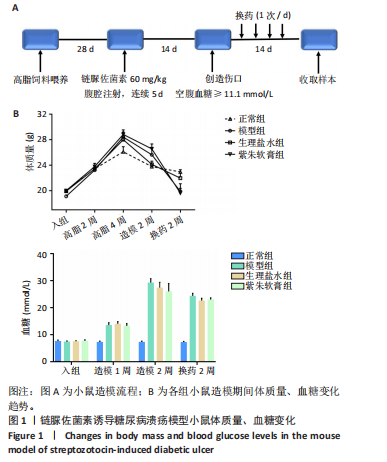
[35] LIU S, MA L, REN X, et al. A new mouse model of type 2 diabetes mellitus established through combination of high-fat diet, streptozotocin and glucocorticoid. Life Sci. 2021;286:120062.
[36] 王雪,呼永河. 糖尿病小鼠模型的常见种类及其构建要素分析[J]. 实验动物与比较医学,2023,43(4):415-421.
[37] LV LL, DU YT, CHEN X, et al. Neuroprotective Effect of Angiopoietin2 Is Associated with Angiogenesis in Mouse Brain Following Ischemic Stroke. Brain Sci. 2022;12(11):1428.
[38] ZHU Y, WANG Y, JIA Y, et al. Roxadustat promotes angiogenesis through HIF-1α/VEGF/VEGFR2 signaling and accelerates cutaneous wound healing in diabetic rats. Wound Repair Regen. 2019;27(4):324-334.
[39] WYSOCZYNSKI M, PATHAN A, MOORE JB T, et al. Pro-Angiogenic Actions of CMC-Derived Extracellular Vesicles Rely on Selective Packaging of Angiopoietin 1 and 2, but Not FGF-2 and VEGF. Stem Cell Rev Rep. 2019; 15(4):530-542.
[40] ISIDORI AM, VENNERI MA, FIORE D. Angiopoietin-1 and Angiopoietin-2 in metabolic disorders: therapeutic strategies to restore the highs and lows of angiogenesis in diabetes. J Endocrinol Invest. 2016;39(11):1235-1246.
[41] 黄桢奇,周艳林,柯婷,等. 糖尿病血管重构中miR-126作用机制研究进展[J]. 心血管病学进展,2025,46(3):249-253.
|