中国组织工程研究 ›› 2026, Vol. 30 ›› Issue (31): 8060-8067.doi: 10.12307/2026.435

• 脂肪干细胞 adipose-derived stem cells • 上一篇    下一篇

黄精多糖促进脂肪干细胞成软骨分化的分子机制

陈俊杰1,何佳洋2,王子赫1,彭  腾3,刘映岐4,5,李  森6,李敬池7,汪国友1,8,李  婷9,余婉欣10,沈骅睿1,8   

  1. 西南医科大学附属中医医院,1关节外科,7脊柱外科,8骨科,泸州市骨科疾病重点实验室, 四川省泸州市   646000;2西南医科大学,四川省泸州市   646000;3成都中医药大学药学院,四川省成都市   611137;4西南大学材料与能源学院,重庆市   400715;5西南大学附属医院,重庆市   400700;6南京大学医学院附属鼓楼医院骨科,江苏省南京市   210003;9西南医科大学药学院,四川省泸州市   646000;10上海交通大学生物医学工程学院& Med-X研究院,上海市   200030
  • 收稿日期:2025-10-17 接受日期:2026-01-29 出版日期:2026-11-08 发布日期:2026-05-22
  • 通讯作者: 沈骅睿,硕士,主任中医师,西南医科大学附属中医医院,关节外科,骨科,泸州市骨科疾病重点实验室, 四川省泸州市 646000
  • 作者简介:陈俊杰,男,1999年生,成都中医药大学在读博士,医师,主要从事骨关节疾病的研究。
  • 基金资助:
    四川省科技计划资助(2024NSFSC0570),项目负责人:沈骅睿;西南医科大学项目(2023ZYYJ05),项目负责人:沈骅睿;四川省中医药管理局项目(2024zd018),项目负责人:沈骅睿;泸州市人民政府-西南医科大学科技战略合作项目(2021LZXNYD-J31),项目负责人:沈骅睿;2022年西南医科大学附属中医医院科研团队培育项目(2022-CXTD-08),项目负责人:沈骅睿;重庆市自然科学基金面上项目(CSTB2023NSCQ-MSX0644),项目负责人:刘映岐;重庆市中医药重点建设学科西南大学中医康复学(2021-4322190044),项目负责人:刘映岐

Molecular mechanism of polygonatum sibiricum polysaccharide-promoted chondrogenic differentiation of adipose-derived stem cells

Chen Junjie1, He Jiayang2, Wang Zihe1, Peng Teng3, Liu Yingqi4, 5, Li Sen6, Li Jingchi7, Wang Guoyou1, 8, Li Ting9, Yu Wanxin10, Shen Huarui1, 8   

  1. 1Department of Joint Surgery, Affiliated Hospital of Traditional Chinese Medicine, Southwest Medical University, Luzhou 646000, Sichuan Province, China; 2Southwest Medical University, Luzhou 646000, Sichuan Province, China; 3School of Pharmacy, Chengdu University of Traditional Chinese Medicine, Chengdu 611137, Sichuan Province, China; 4School of Materials and Energy, Southwest University, Chongqing 400715, China; 5Affiliated Hospital of Southwest University, Chongqing 400700, China; 6Department of Orthopedics, Gulou Hospital Affiliated to Nanjing University Medical School, Nanjing 210003, Jiangsu Province, China; 7Department of Spinal Surgery, Affiliated Hospital of Traditional Chinese Medicine, Southwest Medical University, Luzhou 646000, Sichuan Province, China; 8Department of Orthopedics, Affiliated Hospital of Traditional Chinese Medicine, Southwest Medical University, Key Laboratory of Orthopedic Diseases, Luzhou 646000, Sichuan Province, China; 9School of Pharmacy, Southwest Medical University, Luzhou 646000, Sichuan Province, China; 10School of Biomedical Engineering & Med-X Institute, Shanghai Jiao Tong University, Shanghai 200030, China
  • Received:2025-10-17 Accepted:2026-01-29 Online:2026-11-08 Published:2026-05-22
  • Contact: Shen Huarui, MS, Chief physician, Department of Joint Surgery, Affiliated Hospital of Traditional Chinese Medicine, Southwest Medical University, Luzhou 646000, Sichuan Province, China; Department of Orthopedics, Affiliated Hospital of Traditional Chinese Medicine, Southwest Medical University, Key Laboratory of Orthopedic Diseases, Luzhou 646000, Sichuan Province, China
  • About author:Chen Junjie, MD candidate, Physician, Department of Joint Surgery, Affiliated Hospital of Traditional Chinese Medicine, Southwest Medical University, Luzhou 646000, Sichuan Province, China
  • Supported by:
    Sichuan Provincial Science and Technology Plan, No. 2024NSFSC0570 (to SHR); Southwest Medical University Project, No. 2023ZYYJ05 (to SHR); Sichuan Provincial Administration of Traditional Chinese Medicine Project, No. 2024zd018 (to SHR); Luzhou Municipal Government-Southwest Medical University Science and Technology Strategic Cooperation Project, No. 2021LZXNYD-J31 (to SHR); 2022 Research Team Cultivation Project of Southwest Medical University Affiliated Traditional Chinese Medicine Hospital, No. 2022-CXTD-08 (to SHR); Chongqing Municipal Natural Science Foundation (General Program), No. CSTB2023NSCQ-MSX0644 (to LYQ); Chongqing Municipal Key Construction Discipline of Traditional Chinese Medicine-Southwest University Traditional Chinese Medicine Rehabilitation, No. 2021-4322190044 (to LYQ)

摘要:

文题释义:

黄精多糖:是以→6)-β-D-Fruf-(2→为主链,两→1)-β-D-Furf-(2→为侧链的果聚糖单体,有降血脂、抗衰老、抗病毒、提高免疫力的作用。
转化生长因子β3/Smad2通路:转化生长因子β3通过Smad蛋白介导信号通路的方式,调节细胞中的基因转录过程,进而对细胞的分化以及增殖具有调节作用。

摘要
背景:黄精多糖作为中药黄精的主要活性成分,具有抗炎、抗氧化及促进组织修复的作用。近年来研究表明,黄精多糖在骨与软骨代谢中可能发挥重要作用。
目的:探讨黄精多糖联合转化生长因子β3诱导大鼠脂肪干细胞向软骨细胞分化的效果及机制。
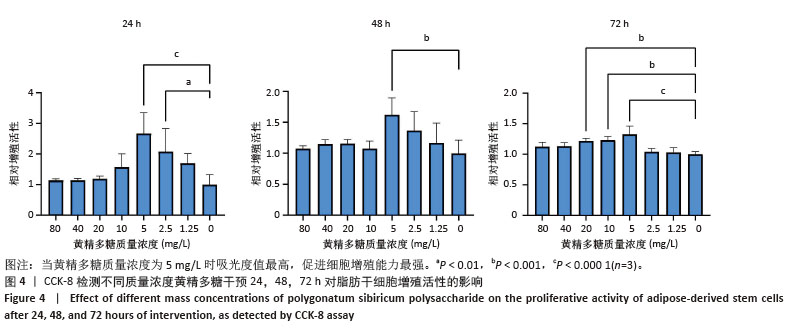
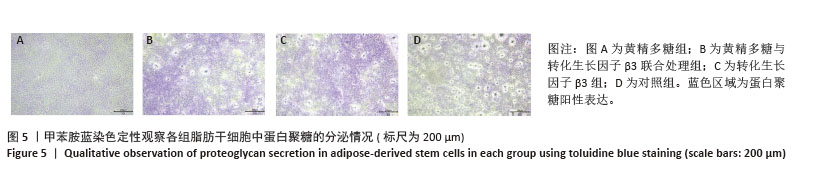
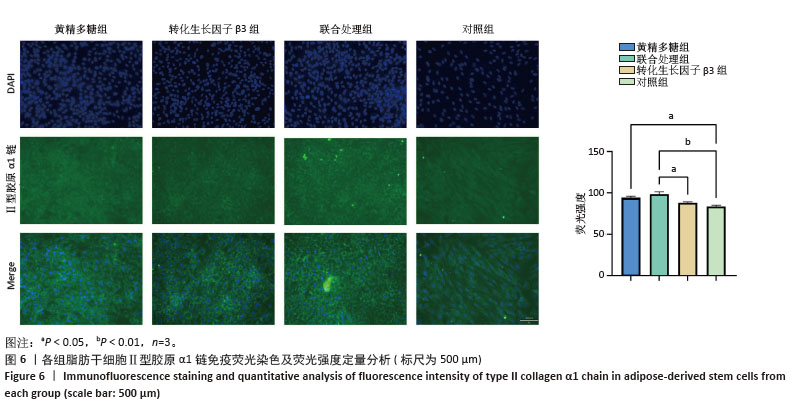
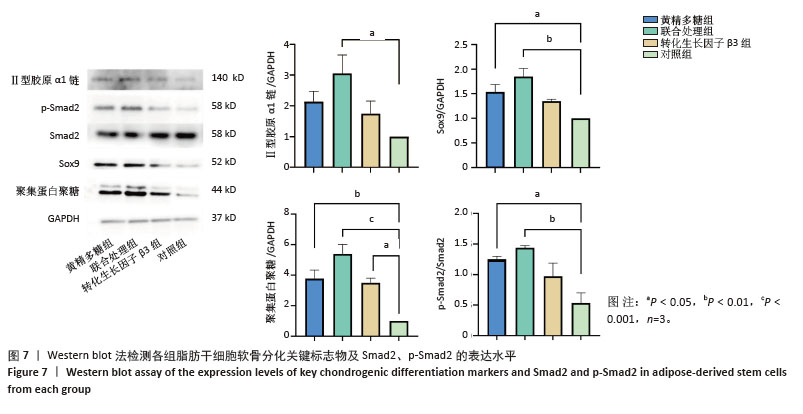
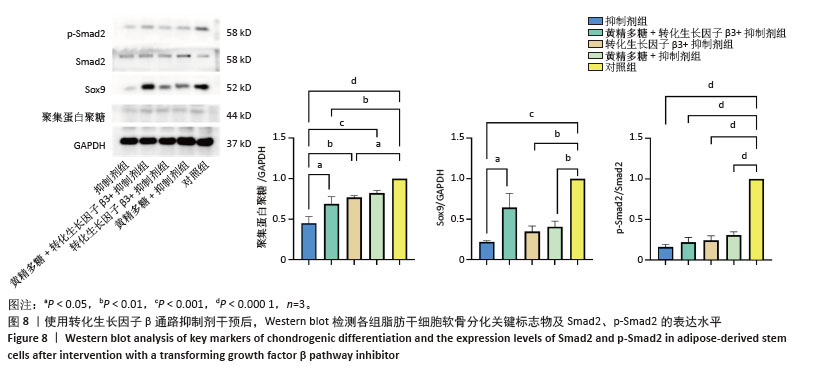
方法:采用酶消化法从大鼠腹股沟脂肪分离脂肪干细胞。首先采用CCK-8法检测不同质量浓度黄精多糖对脂肪干细胞增殖的影响,以筛选最佳促增殖质量浓度,然后将脂肪干细胞分为4组进行成软骨诱导分化:对照组、黄精多糖组、转化生长因子β3组、黄精多糖+转化生长因子β3组,通过细胞形态学观察、甲苯胺蓝染色、免疫荧光染色及Western blot检测软骨分化标志物的表达;采用Western blot检测转化生长因子β3/Smad2信号通路相关蛋白表达。为验证黄精多糖与转化生长因子β3是否通过转化生长因子β3/Smad2通路调控软骨分化,使用转化生长因子β受体激酶抑制剂SB-505124对通路进行特异性阻断,将脂肪干细胞分为5组:对照组、抑制剂组、黄精多糖+抑制剂组、转化生长因子β3+抑制剂组、黄精多糖+转化生长因子β3+抑制剂组,采用Western blot检测软骨分化标志物和转化生长因子β3/Smad2信号通路相关蛋白表达。

结果与结论:①CCK-8实验确定5 mg/L 黄精多糖为最佳干预质量浓度;②甲苯胺蓝染色显示,黄精多糖组、转化生长因子β3组及黄精多糖+ 转化生长因子β3组的蓝染面积均显著高于对照组(P < 0.05);③细胞免疫荧光染色进一步证实,与对照组相比,黄精多糖组、黄精多糖+转化生长因子β3组的Ⅱ型胶原α1链荧光强度显著增强,其中黄精多糖+转化生长因子β3组荧光强度最高(P < 0.05);④Western blot检测显示,与对照组相比,黄精多糖组、转化生长因子β3组及黄精多糖+转化生长因子β3组均能显著上调p-Smad2/Smad2以及软骨标志物Ⅱ型胶原α1链、Sox9、聚集蛋白聚糖的蛋白表达水平(P < 0.05),且联合处理组上述指标蛋白表达量最高(P < 0.05);⑤加入转化生长因子β受体激酶抑制剂后,与抑制剂组相比,其余组上述蛋白表达显著升高(P < 0.05)。结果表明,黄精多糖通过激活转化生长因子/Smad2信号通路进而诱导脂肪干细胞向软骨细胞分化。

https://orcid.org/0009-0002-4929-7506(陈俊杰)


中国组织工程研究杂志出版内容重点:干细胞;骨髓干细胞;造血干细胞;脂肪干细胞;肿瘤干细胞;胚胎干细胞;脐带脐血干细胞;干细胞诱导;干细胞分化;组织工程

关键词: 软骨损伤, 黄精多糖, 转化生长因子β3/Smad信号通路, 脂肪干细胞, 成软骨诱导, 骨关节炎, 转化生长因子β3, 细胞分化

Abstract: BACKGROUND: Polygonatum sibiricum polysaccharide is the main active component of the traditional Chinese medicine polygonatum and has anti-inflammatory, antioxidant, and tissue repair properties. Recent studies have shown that polygonatum sibiricum polysaccharide may play an important role in bone and cartilage metabolism. 
OBJECTIVE: To investigate the effect and mechanism of polygonatum sibiricum polysaccharide combined with transforming growth factor-β3 on inducing the differentiation of rat adipose-derived stem cells into chondrocytes.
METHODS: Adipose-derived stem cells were isolated from rat inguinal fat using enzymatic digestion. First, the effect of different mass concentrations of polygonatum sibiricum polysaccharide on adipose-derived stem cell proliferation was detected using the CCK-8 assay to screen for the optimal proliferative concentration. Then, adipose-derived stem cells were divided into four groups for chondrogenic differentiation induction: control group, polygonatum sibiricum polysaccharide group, transforming growth factor β3 group, and polygonatum sibiricum polysaccharide + transforming growth factor β3 group. Cell morphology observation, toluidine blue staining, immunofluorescence staining, and western blot assay were used to detect the expression of chondrogenic differentiation markers. Western blot assay was used to detect the expression of related proteins in the transforming growth factor β3/Smad2 signaling pathway. To verify whether polygonatum sibiricum polysaccharide and transforming growth factor β3 regulate chondrogenic differentiation through the transforming growth factor β3/Smad2 pathway, the transforming growth factor β3 receptor kinase inhibitor SB-505124 was used to specifically block the pathway. Adipose-derived stem cells were divided into five groups: control group, inhibitor group, polygonatum sibiricum polysaccharide + inhibitor group, transforming growth factor β3 + inhibitor group, and polygonatum sibiricum polysaccharide + transforming growth factor β3 + inhibitor group. Western blot assay was used to detect the expression of cartilage differentiation markers and proteins related to the transforming growth factor β3/Smad2 signaling pathway. 
RESULTS AND CONCLUSION: (1) The CCK-8 assay determined that 5 mg/L of polygonatum sibiricum polysaccharide was the optimal intervention concentration. (2) Toluidine blue staining showed that the blue-stained area in the polygonatum sibiricum polysaccharide group, transforming growth factor β3 group, and polygonatum sibiricum polysaccharide + transforming growth factor β3 group was significantly higher than that in the control group (P < 0.05). (3) Immunofluorescence staining further confirmed that compared with the control group, the fluorescence intensity of type II collagen α1 chain was significantly enhanced in the polygonatum sibiricum polysaccharide group and the polygonatum sibiricum polysaccharide + transforming growth factor β3 group, with the highest fluorescence intensity in the polygonatum sibiricum polysaccharide + transforming growth factor β3 group (P < 0.05). (4) Western blot assay showed that compared with the control group, the polygonatum sibiricum polysaccharide group, transforming growth factor β3 group, and polygonatum sibiricum polysaccharide + transforming growth factor β3 group significantly upregulated the p-Smad2/Smad2 and the protein expression levels of cartilage markers type II collagen α1 chain, Sox9, and aggrecan (P < 0.05), and the combined treatment group showed the highest protein expression levels of these indicators (P < 0.05). (5) After adding the transforming growth factor β receptor kinase inhibitor, compared with the inhibitor group, the protein expression levels of the above indicators were significantly increased in the other groups (P < 0.05). The results indicate that polygonatum sibiricum polysaccharide induces the differentiation of adipose-derived stem cells into chondrocytes by activating the transforming growth factor β/Smad2 signaling pathway.

Key words: cartilage injury, polygonatum sibiricum polysaccharide, transforming growth factor β3/Smad signaling pathway, adipose-derived stem cells, chondrogenic induction, osteoarthritis, transforming growth factor-β3, cell differentiation

中图分类号: