[1] LIU N, ZHENG C, WANG Q, et al. Treatment of non-traumatic avascular necrosis of the femoral head (Review). Exp Ther Med. 2022;23(5):321.
[2] 邵卓恒,李雷,唐林峰.显微外科技术治疗股骨头坏死的研究进展[J].实用临床医药杂志,2025,29(9):136-142.
[3] 李纪书,郭成龙,任行全,等.激素性股骨头坏死相关信号通路及发病机制研究概述[J].现代中医药,2024,44(1):5-10.
[4] WANG R, TIAN X, SHI L, et al.Osteonecrosis of the femoral head is associated with cytomegalovirus reactivation. J Bone Miner Res. 2026;41(7):751-761.
[5] PARIKH RR, MIRZAEI A, BUTLER ME, et al. Diagnosis and treatment of nontraumatic osteonecrosis of the femoral head: a systematic review and meta-analyses for the ARCO clinical practice guideline development workgroup. Med Sci. 2026;14(1):107.
[6] LEONHARDT Y, WöRTLER K. Avascular necrosis of the femoral head. Radiologie. 2026;66(2):100-108.
[7] WANG Q, MA S, WU L, et al. Clinical value of dual detector spectral CT in predicting risk of femoral head necrosis. Medicine. 2025;104(33):e43685.
[8] YU T, XIE L, ZHANG Z, et al. Value of CT in quantitatively diagnosing and assessing collapse in patients with femoral head necrosis based on finite element mechanics analysis. BMC Musculoskelet Disord. 2026;27(1):540.
[9] CARDíN-PEREDA A, GARCíA-SáNCHEZ D, TERáN-VILLAGRá N, et al. Diagnostic reliability of plain radiography in osteonecrosis of the femoral head: general radiological features revised. Curr Med Imaging. 2023. doi: 10.2174/1573405620666230829150229.
[10] SHINOHARA I, INUI A, HWANG K, et al. Leveraging AI models for lesion detection in osteonecrosis of the femoral head and T1-weighted MRI generation from radiographs. J Orthop Res. 2025;43(3):650-659.
[11] ZAMANI E, SAMIEI S, ZAMANI S, et al. Deep learning in the diagnosis, staging, and prognosis of osteonecrosis of the femoral head: a systematic review. BMC Musculoskelet Disord. 2026. doi: 10.1186/s12891-026-09926-3.
[12] GAO S, ZHU H, WEN M, et al. Prediction of femoral head collapse in osteonecrosis using deep learning segmentation and radiomics texture analysis of MRI. BMC Med Inform Decis Mak. 2024;24(1):320.
[13] LIU Y, SHE GR, CHEN SX. Magnetic resonance image diagnosis of femoral head necrosis based on ResNet18 network. Comput Methods Programs Biomed. 2021;208:106254.
[14] KIM B, LEE GY, PARK SH. Attention fusion network with self-supervised learning for staging of osteonecrosis of the femoral head (ONFH) using multiple MR protocols. Med Phys. 2023;50(9):5528-5540.
[15] LIANG C, MA Y, LI X, et al. Aiding diagnosis and classifying of early stage osteonecrosis of the femoral head with convolutional neural network based on magnetic resonance imaging. Indian J Orthop. 2025;59(1):121-127.
[16] GUO L, CHENG J, ZHANG Z. Mapping the knowledge domain of financial decision making: a scientometric and bibliometric study. Front Psychol. 2022; 13:1006412.
[17] 翟君伟,瞿英,郭菲,等.基于LDA主题模型的文献特征项多重共现可视化方法[J].河北科技大学学报,2022,43(2):181-193.
[18] ARRUDA H, SILVA ER, LESSA M, et al. VOSviewer and Bibliometrix. J Med Libr Assoc. 2022;110(3):392-395.
[19] VAN ECK NJ, WALTMAN L. Software survey: VOSviewer, a computer program for bibliometric mapping. Scientometrics. 2010;84(2):523-538.
[20] GUO Y, SUN L, ZHONG W, et al. Artificial intelligence-assisted repair of peripheral nerve injury: a new research hotspot and associated challenges. Neural Regen Res. 2024;19(3):663-670.
[21] CHENG FJ, WANG LX, XIE YM. Visualization of research on Chinese medicine-induced kidney injury by CiteSpace. Zhongguo Zhong Yao Za Zhi. 2021;46(21): 5475-5485.
[22] LI Y, FU X, HUANG L, et al. Global research trends and hotspots in the pathophysiology, imaging and therapy of type 3 macular neovascularization (MNV3) in age-related macular degeneration (AMD). Front Med. 2026;13: 1811978.
[23] SUN W, ZHOU T, DING P, et al.Bibliometric analysis of intestinal microbiota and lung diseases. Front Cell Infect Microbiol. 2024;14:1347110.
[24] YANG K, HU Y, QI H. Digital health literacy: bibliometric analysis. J Med Int Res. 2022;24(7):e35816.
[25] 陈雷雷,陈晓波,洪郭驹,等.联合高分辨率MRI和micro-CT评价桃红四物汤对兔股骨头坏死的修复作用[J].中国实验动物学报,2017,25(1):25-30.
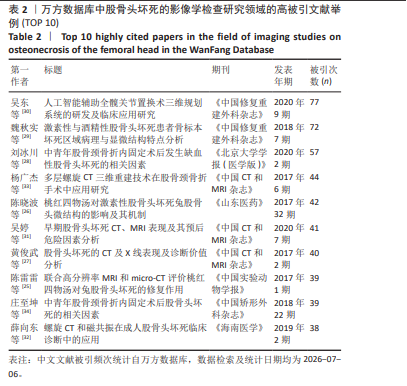
[26] 陈晓波,陈雷雷,洪郭驹,等.桃红四物汤对激素性股骨头坏死兔股骨头微结构的影响及其机制[J].山东医药,2017,57(32):5-9.
[27] 黄俊武,叶菊花.股骨头坏死的CT及X线表现及诊断价值分析[J].中国CT和MRI杂志,2017,15(2):128-130.
[28] 刘冰川,孙川,邢永,等.中青年股骨颈骨折内固定术后发生缺血性股骨头坏死的相关因素[J].北京大学学报(医学版),2020,52(2):290-297.
[29] 魏秋实,杨帆,陈哓俊,等.激素性与酒精性股骨头坏死患者骨标本坏死区域病理与显微结构特点分析[J].中国修复重建外科杂志,2018,32(7):866-872.
[30] 吴东,刘星宇,张逸凌,等.人工智能辅助全髋关节置换术三维规划系统的研发及临床应用研究[J].中国修复重建外科杂志,2020,34(9):1077-1084.
[31] 吴婷,赵永强,周涛,等.早期股骨头坏死CT、MRI表现CT和MRI表现及其预后危险因素分析[J].中国CT和MRI杂志,2020,18(7):155-157.
[32] 薛向东,李波,张燚,等.螺旋CT和磁共振在成人股骨头坏死临床诊断中的应用[J].海南医学,2019,30(2):223-225.
[33] 杨广杰,陈有,王永胜,等.多层螺旋CT三维重建技术在股骨颈骨折手术中应用研究[J].中国CT和MRI杂志. 2017,15(6):139-141.
[34] 庄至坤,许志庆,郭金花,等.中青年股骨颈骨折内固定术后股骨头坏死的相关因素[J].中国矫形外科杂志,2018,26(22):2044-2049.
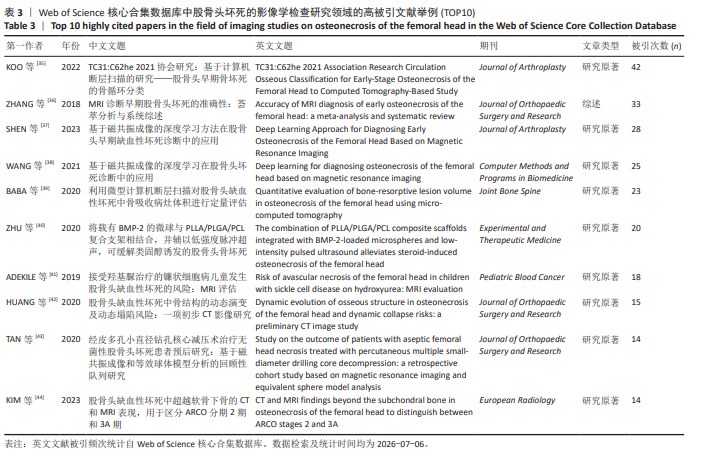
[35] KOO KH, MONT MA, CUI Q, et al. The 2021 association research circulation osseous classification for early-stage osteonecrosis of the femoral head to computed tomography-based study. J Arthroplasty. 2022;37(6):1074-1082.
[36] ZHANG YZ, CAO XY, LI XC, et al.Accuracy of MRI diagnosis of early osteonecrosis of the femoral head: a meta-analysis and systematic review. J Orthop Surg Res. 2018;13(1):167.
[37] SHEN X, LUO J, TANG X, et al. Deep learning approach for diagnosing early osteonecrosis of the femoral head based on magnetic resonance imaging. J Arthroplasty. 2023;38(10):2044-2050.
[38] WANG P, LIU X, XU J, et al. Deep learning for diagnosing osteonecrosis of the femoral head based on magnetic resonance imaging. Comput Methods Programs Biomed. 2021;208:106229.
[39] BABA S, MOTOMURA G, IKEMURA S, et al. Quantitative evaluation of bone-resorptive lesion volume in osteonecrosis of the femoral head using micro-computed tomography. Joint Bone Spine. 2020;87(1):75-80.
[40] ZHU H, SHI Z, CAI X, et al. The combination of PLLA/PLGA/PCL composite scaffolds integrated with BMP-2-loaded microspheres and low-intensity pulsed ultrasound alleviates steroid-induced osteonecrosis of the femoral head. Exp Ther Med. 2020;20(6):126.
[41] ADEKILE AD, GUPTA R, AL-KHAYAT A, et al. Risk of avascular necrosis of the femoral head in children with sickle cell disease on hydroxyurea: MRI evaluation. Pediatr Blood Cancer. 2019;66(2):e27503.
[42] HUANG Z, TAN B, YE H, et al.Dynamic evolution of osseous structure in osteonecrosis of the femoral head and dynamic collapse risks: a preliminary CT image study. J Orthop Surg Res. 2020;15(1):539.
[43] TAN Y, HE H, WAN Z, et al. Study on the outcome of patients with aseptic femoral head necrosis treated with percutaneous multiple small-diameter drilling core decompression: a retrospective cohort study based on magnetic resonance imaging and equivalent sphere model analysis. J Orthop Surg Res. 2020;15(1):264.
[44] KIM J, LEE SK, KIM JY, et al. CT and MRI findings beyond the subchondral bone in osteonecrosis of the femoral head to distinguish between ARCO stages 2 and 3A. Eur Radiol. 2023;33(7):4789-4800. |