[1] 卓瑜,严凯,孙瑜,等.眼动追踪技术在认知功能中的研究进展[J].实用医院临床杂志,2024,21(4):188-191.
[2] TAO L, WANG Q, LIU D, et al. Eye tracking metrics to screen and assess cognitive impairment in patients with neurological disorders. Neurol Sci. 2020;41(7):1697-1704.
[3] KELLER J, GORGES M, HORN HT, et al. Eye-tracking controlled cognitive function tests in patients with amyotrophic lateral sclerosis: a controlled proof-of-principle study. J Neurol. 2015;262(8):1918-1926.
[4] 尤佳璐,惠延年,张乐.眼球运动及眼动追踪技术的临床应用进展[J].国际眼科杂志,2023,23(1):90-95.
[5] 刘革平,冉文妍,杨瑜颖,等.VR环境下认知追踪关键技术综述[J].人工智能科学与工程,2024(2):1-17.
[6] GODFROID A, HUI B. Five common pitfalls in eye-tracking research. Second Lang Res. 2020;36(3):277-305.
[7] 杨宇轩,张晗,杜娟,等.眼动追踪的动态任务评估脑卒中后单侧空间忽略的价值研究[J].中国全科医学,2023,26(32): 4020-4025.
[8] 韦卓男,樊响,余可妍,等.结构MRI联合基于VR眼动追踪技术的计算机化认知评估在阿尔茨海默病早期诊断中的应用价值[J].磁共振成像,2024,15(6):49-53.
[9] SKARAMAGKAS V, GIANNAKAKIS G, KTISTAKIS E, et al. Review of Eye Tracking Metrics Involved in Emotional and Cognitive Processes. IEEE Rev Biomed Eng. 2023;16:260-277.
[10] TAYLOR G, HERBERT JS. Eye tracking infants: investigating the role of attention during learning on recognition memory. Scand J Psychol. 2013;54(1):14-19.
[11] 李进,尹兵兵,杨颖,等.基于游戏为主的康复干预对脑瘫患儿精细运动功能及依从性的影响[J].中国当代医药,2021, 28(34):90-93.
[12] 李慧,赵玲,徐晓娅.眼动追踪技术在神经退行性疾病认知功能障碍中的研究进展[J].中国神经精神疾病杂志,2024, 50(10):608-614.
[13] 王烽,赖江峰,蓝诚红,等.眼动追踪技术在神经退行性疾病中的应用研究进展[J].眼科新进展,2024,44(11):908-913.
[14] CHEN C. Searching for intellectual turning points: progressive knowledge domain visualization. Proc Natl Acad Sci U S A. 2004;101(Suppl 1):5303-5310.
[15] CHEN C. CiteSpace II: Detecting and visualizing emerging trends and transient patterns in scientific literature. J Am Soc Inf Sci Technol. 2006;57(3):359-377.
[16] ARRUDA H, SILVA ER, LESSA M, et al. VOSviewer and Bibliometrix. J Med Libr Assoc. 2022;110(3):392-395.
[17] VAN ECK NJ, WALTMAN L. Citation-based clustering of publications using CitNetExplorer and VOSviewer. Scientometrics. 2017;111(2):1053-1070.
[18] DONTHU N, KUMAR S, PATTNAIK D. Forty-five years of Journal of Business Research: A bibliometric analysis. J Bus Res. 2020;109:1-14.
[19] VAN ECK NJ, WALTMAN L. Software survey: VOSviewer, a computer program for bibliometric mapping. Scientometrics. 2010;84(2):523-538.
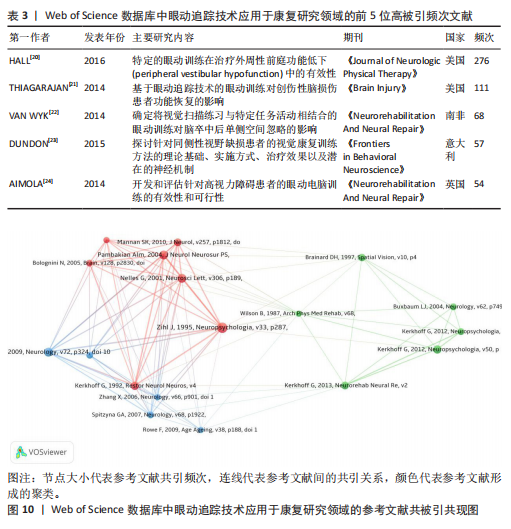
[20] HALL CD, HERDMAN SJ, WHITNEY SL, et al. Vestibular Rehabilitation for Peripheral Vestibular Hypofunction: An Evidence-Based Clinical Practice Guideline: From the american physical therapy association neurology section. J Neurol Phys Ther. 2016; 40(2):124-155.
[21] THIAGARAJAN P, CIUFFREDA KJ. Versional eye tracking in mild traumatic brain injury (mTBI): effects of oculomotor training (OMT). Brain Inj. 2014;28(7):930-943.
[22] VAN WYK A, EKSTEEN CA, RHEEDER P. The effect of visual scanning exercises integrated into physiotherapy in patients with unilateral spatial neglect poststroke: a matched-pair randomized control trial. Neurorehabil Neural Repair. 2014;28(9):856-873.
[23] DUNDON NM, BERTINI C, LÀDAVAS E, et al. Visual rehabilitation: visual scanning, multisensory stimulation and vision restoration trainings. Front Behav Neurosci. 2015;9:192.
[24] AIMOLA L, LANE AR, SMITH DT, et al. Efficacy and feasibility of home-based training for individuals with homonymous visual field defects. Neurorehabil Neural Repair. 2014;28(3):207-218.
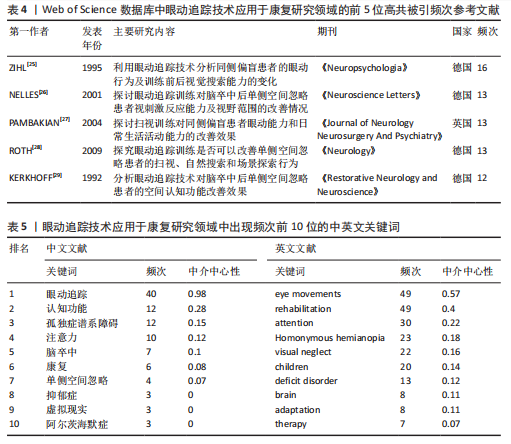
[25] ZIHL J. Visual scanning behavior in patients with homonymous hemianopia. Neuropsychologia. 1995;33(3):287-303.
[26] NELLES G, ESSER J, ECKSTEIN A, et al. Compensatory visual field training for patients with hemianopia after stroke. Neurosci Lett. 2001;306(3):189-192.
[27] PAMBAKIAN AL, MANNAN SK, HODGSON TL, et al. Saccadic visual search training: a treatment for patients with homonymous hemianopia. J Neurol Neurosurg Psychiatry. 2004;75(10):1443-1448.
[28] ROTH T, SOKOLOV AN, MESSIAS A, et al. Comparing explorative saccade and flicker training in hemianopia: a randomized controlled study. Neurology. 2009;72(4): 324-331.
[29] KERKHOFF G, MÜNßINGER U, HAAF E, et al. Rehabilitation of homonymous scotomata in patients with postgeniculate damage of the visual system: saccadic compensation training. Restor Neurol Neurosci. 1992; 4(4):245-254.
[30] 赵生美,黄鹏,陈立艳,等.国内外医学伦理学教育可视化比较分析及启示[J].中国医学伦理学,2023,36(1):95-101.
[31] LIU Z, YANG Z, GU Y, et al. The effectiveness of eye tracking in the diagnosis of cognitive disorders: A systematic review and meta-analysis. PLoS One. 2021;16(7):e0254059.
[32] PRZYBYSZEWSKI AW, ŚLEDZIANOWSKI A, CHUDZIK A, et al. Machine Learning and Eye Movements Give Insights into Neurodegenerative Disease Mechanisms. Sensors (Basel). 2023;23(4):2145.
[33] 张慧,陆媛,刘文斌,等.眼动检查在轻度认知功能障碍筛查中的应用[J].同济大学学报(医学版),2024,45(4):543-549.
[34] JOHKURA K, KAWABATA Y, AMANO Y, et al. Bedside evaluation of smooth pursuit eye movements in acute sensory stroke patients. J Neurol Sci.2015;348(1-2):269-271.
[35] RIEK HC, BRIEN DC, COE BC, et al. Cognitive correlates of antisaccade behaviour across multiple neurodegenerative diseases. Brain Commun. 2023;5(2):fcad049.
[36] SINGH T, FRIDRIKSSON J, PERRY CM, et al. A novel computational model to probe visual search deficits during motor performance. J Neurophysiol. 2017;117(1):79-92.
[37] KAUFMANN BC, CAZZOLI D, PFLUGSHAUPT T, et al. Eyetracking during free visual exploration detects neglect more reliably than paper-pencil tests. Cortex. 2020;129: 223-235.
[38] 王佳佳,刘博文,林蓓蕾,等.眼动追踪技术在脑卒中患者康复中的应用进展[J].中国实用神经疾病杂志,2024,27(4):514-518.
[39] NEGIN C, MAHSHID F, MAHDIEH E, et al. 317-Behavioural markers of mild cognitive impairment: diagnostic value of eye-tracking study. Int Psychogeriatr. 2020;32(S1):75-75.
[40] 龚翔,赵若欣,杨云,等.垂直感知在脑卒中患者姿势控制障碍中的研究进展[J].中国康复,2022,37(8):504-508.
[41] 王万宏,毕鸿雁,邱振刚,等.视觉追踪训练联合六字诀对帕金森病患者运动功能和生活质量的影响[J].康复学报,2020, 30(6):474-478.
[42] CHASTE P, LEBOYER M. Autism risk factors: genes, environment, and gene-environment interactions. Dialogues Clin Neurosci. 2012; 14(3):281-292.
[43] 许金波,韩辉,施磊,等.眼动追踪技术在儿童孤独症谱系障碍中的研究进展[J].中华全科医学,2023,21(9):1571-1575.
[44] LAI MC, LOMBARDO MV, Baron-Cohen S. Autism. Lancet. 2014;383(9920):896-910.
[45] 张轶凡,李丹丹,张龙,等.孤独症谱系障碍患者社会注意缺陷的眼动追踪研究[J].中华行为医学与脑科学杂志,2022, 31(1):89-94.
[46] 孙宾宾,韦臻,冯哲,等.眼动追踪技术在孤独症谱系障碍临床诊断中的应用研究[J].中国儿童保健杂志,2020,28(1):10-14.
[47] GUAN DX, PETERS ME, PIKE GB, et al. Cognitive, Behavioral, and Functional Outcomes of Suspected Mild Traumatic Brain Injury in Community-Dwelling Older Persons Without Mild Cognitive Impairment or Dementia. J Acad Consult Liaison Psychiatry. 2025;66(2):118-129.
[48] 魏家航,吕晨燕,张赓华,等.眼动仪在神经康复中的应用现状及研究进展[J].机器人外科学杂志,2022,3(3):229-234.
[49] CADE A, TURNBULL PR. Clinical testing of mild traumatic brain injury using computerised eye-tracking tests. Clin Exp Optom. 2022;105(7):680-686.
[50] RATIU I, FISSEL-BRANNICK S, WHITING M, et al. The Impact of Mild Traumatic Brain Injury on Reading Comprehension and Eye Movements: Preliminary Results. J Commun Disord. 2022;96:106197.
[51] STUART S, PARRINGTON L, MARTINI D, et al. The Measurement of Eye Movements in Mild Traumatic Brain Injury: A Structured Review of an Emerging Area. Front Sports Act Living. 2020;2:5.
[52] BERRYMAN A, RASAVAGE K, POLITZER T, et al. Oculomotor Treatment in Traumatic Brain Injury Rehabilitation: A Randomized Controlled Pilot Trial. Am J Occup Ther. 2020;74(1):7401185050p1-7401185050p7.
[53] 高文艳,郑兆燕,潘尚,等.Theta爆发式经颅磁刺激的文献计量学和可视化分析[J].中国组织工程研究,2025,29(20):4389-4400.
[54] ORLOSKY J, ITOH Y, RANCHET M, et al. Emulation of Physician Tasks in Eye-Tracked Virtual Reality for Remote Diagnosis of Neurodegenerative Disease. IEEE Trans Vis Comput Graph. 2017;23(4):1302-1311.
[55] 林宜杰,张利,徐琳峰,等.基于眼动技术的VR认知训练在卒中后右脑半球损伤注意障碍患者中的康复应用[J].中国康复,2024,39(2):72-75.
[56] WIEBE A, SELASKOWSKI B, PASKIN M, et al. Virtual reality-assisted prediction of adult ADHD based on eye tracking, EEG, actigraphy and behavioral indices: a machine learning analysis of independent training and test samples. Transl Psychiatry. 2024;14(1):508.
[57] PULAY MÁ. Eye-tracking and EMG supported 3D Virtual Reality - an integrated tool for perceptual and motor development of children with severe physical disabilities: a research concept. Stud Health Technol Inform. 2015;217:840-846.
[58] ADHANOM IB, MACNEILAGE P, FOLMER E. Eye Tracking in Virtual Reality: a Broad Review of Applications and Challenges. Virtual Real. 2023;27(2):1481-1505.
|