中国组织工程研究 ›› 2026, Vol. 30 ›› Issue (34): 9056-9066.doi: 10.12307/2026.868
• 组织构建循证医学 evidence-based medicine in tissue construction • 上一篇 下一篇
不同物理因子治疗膝骨关节炎:有效性和安全性的网状Meta分析
武瑞骐1,2,董盼锋1,张洪瑞1,2,吕永斌1,2,彭清林1,卓映宏1,陈跃平1
- 1广西中医药大学附属瑞康医院,广西壮族自治区南宁市 530000;2广西中医药大学,广西壮族自治区南宁市 530299
-
收稿日期:2025-11-19修回日期:2026-01-23出版日期:2026-12-08发布日期:2026-04-15 -
通讯作者:陈跃平,博士,主任医师,博士生导师,广西中医药大学附属瑞康医院,广西壮族自治区南宁市 530000 并列通讯作者:董盼锋,硕士,副主任医师,副教授,硕士生导师,广西中医药大学附属瑞康医院,广西壮族自治区南宁市 530000 -
作者简介:武瑞骐,男,1998年生,海南省海口市人,汉族,广西中医药大学在读博士,主要从事脊柱、骨关节创伤性疾病防治研究。 -
基金资助:国家中西医协同“旗舰”科室-广西中医药大学附属瑞康医院骨伤科,项目负责人:陈跃平;广西自然科学基金项目(2023JJA140318),项目负责人:陈跃平;广西自然科学基金项目(502189963012),项目负责人:董盼锋;广西中医药大学研究生教育创新计划项目(YCBXJ2025029),项目负责人:武瑞骐;广西中医药大学A类“桂派中医药传承创新团队”项目(2022A004),项目负责人:陈跃平
Different physical factor therapies for knee osteoarthritis: a network meta-analysis of efficacy and safety
Wu Ruiqi1, 2, Dong Panfeng1, Zhang Hongrui1, 2, Lyu Yongbin1, 2, Peng Qinglin1, Zhuo Yinghong1, Chen Yueping1
- 1Affiliated Ruikang Hospital of Guangxi University of Chinese Medicine, Nanning 530000, Guangxi Zhuang Autonomous Region, China; 2Guangxi University of Chinese Medicine, Nanning 530299, Guangxi Zhuang Autonomous Region, China
-
Received:2025-11-19Revised:2026-01-23Online:2026-12-08Published:2026-04-15 -
Contact:Dong Panfeng, MS, Associate chief physician, Associate professor, Master’s supervisor, Affiliated Ruikang Hospital of Guangxi University of Chinese Medicine, Nanning 530000, Guangxi Zhuang Autonomous Region, China -
About author:Wu Ruiqi, PhD candidate, Affiliated Ruikang Hospital of Guangxi University of Chinese Medicine, Nanning 530000, Guangxi Zhuang Autonomous Region, China; Guangxi University of Chinese Medicine, Nanning 530299, Guangxi Zhuang Autonomous Region, China Corresponding author: Chen Yueping, PhD, Chief physician, Doctoral supervisor, Affiliated Ruikang Hospital of Guangxi University of Chinese Medicine, Nanning 530000, Guangxi Zhuang Autonomous Region, China -
Supported by:Department of Orthopedics and Traumatology, Ruikang Hospital Affiliated to Guangxi University of Chinese Medicine, a National Flagship Department for the Integration of Chinese and Western Medicine (to CYP); Guangxi Natural Science Foundation, No. 2023JJA140318 (to CYP); Guangxi Natural Science Foundation, No. 502189963012 (to DPF); Graduate Education Innovation Program of Guangxi University of Chinese Medicine, No. YCBXJ2025029 (to WRQ); Class A Project of the Guipai Traditional Chinese Medicine Inheritance and Innovation Team, Guangxi University of Chinese Medicine, No. 2022A004 (to CYP)

摘要:

文题释义:
膝骨关节炎:由年龄、体质量、遗传、关节创伤以及生活习惯等多种因素共同导致的关节软骨病变,症状主要表现为关节疼痛,并伴随着关节僵硬、功能障碍等一系列退行性变化。
物理因子治疗:是康复医学的重要组成部分,以非药物、非侵入性手段,通过声、光、电、磁、热、力等能量作用于机体并诱发一系列生物物理和生物化学反应,进而镇痛、消炎、改善循环、促进组织修复及功能重建。
目的:膝骨关节炎的物理因子治疗方式越来越多,尚缺乏全面评估不同物理因子之间疗效对比的研究。因此,此次研究通过网状Meta分析比较不同物理因子治疗膝骨关节炎的有效性及安全性。
方法:应用计算机检索PubMed、Web of Science、Cochrane Library、EMbase数据库以及中国知网、维普数据库、万方数据库、中国生物医学文献服务系统,选择各数据库建库至2025-07-25有关物理因子治疗膝骨关节炎的随机对照试验,筛选文献及提取数据后,通过Cochrane推荐的风险偏倚评价工具评估纳入文献的质量,采用Stata 16.0、RevMan 5.4.1软件进行统计学分析。
结果:①最终纳入65篇文献,共3 418例患者,包括治疗组1 726例、对照组1 692例,并研究了7种物理因子治疗膝骨关节炎的康复方案。②网状Meta分析显示,在提高治疗总有效率方面,累积概率排名曲线下面积由高到低的干预措施为(排名前3):脉冲电磁场+常规康复>超声波+常规康复>经皮电刺激+常规康复;在改善膝关节目测类比评分方面,累积概率排名曲线下面积由高到低的干预措施为(排名前3):经皮电刺激+常规康复>体外冲击波+常规康复>超声波+常规康复;在改善WOMAC总评分方面,累积概率排名曲线下面积由高到低的干预措施为(排名前3):超声波+常规康复>脉冲电磁场+常规康复>超声波+经皮电刺激+常规康复;在减少WOMAC关节僵硬评分方面,累积概率排名曲线下面积由高到低的干预措施为(排名前3):经皮电刺激+常规康复>超声波+常规康复>超声波+经皮电刺激+常规康复;在改善生活质量SF-36评分方面,累积概率排名曲线下面积由高到低的干预措施为(排名前3):脉冲电磁场+常规康复>体外冲击波+常规康复>超声波+常规康复;在改善Lysholm膝关节评分方面,累积概率排名曲线下面积由高到低的干预措施为(排名前3):超声波+常规康复>超声波+经皮电刺激+常规康复>体外冲击波+常规康复;在不良反应方面,各研究均未报道严重不良反应,多数研究仅报道了轻微的皮肤刺激、过敏反应。
结论:经皮电刺激联合常规康复治疗在改善膝骨关节炎患者目测类比评分与WOMAC关节僵硬评分方面显示出较高的优势;超声波联合常规康复治疗在改善Lysholm膝关节评分及WOMAC总评分方面的表现相对较好;脉冲电磁场联合常规康复治疗在改善膝骨关节炎患者整体生活质量方面具有一定的潜在优势,每种物理因子都有其独特的优势,但受纳入文献质量与数量限制,上述结论有待更多高质量、多中心、大样本的随机对照试验加以验证。
https://orcid.org/0000-0003-2729-307X(武瑞骐);https://orcid.org/0000-0003-3860-1568(陈跃平);https://orcid.org/0000-0002-7273-6610(董盼锋)
中国组织工程研究杂志出版内容重点:干细胞;骨髓干细胞;造血干细胞;脂肪干细胞;肿瘤干细胞;胚胎干细胞;脐带脐血干细胞;干细胞诱导;干细胞分化;组织工程
中图分类号:
引用本文
武瑞骐, 董盼锋, 张洪瑞, 吕永斌, 彭清林, 卓映宏, 陈跃平. 不同物理因子治疗膝骨关节炎:有效性和安全性的网状Meta分析[J]. 中国组织工程研究, 2026, 30(34): 9056-9066.
Wu Ruiqi, Dong Panfeng, Zhang Hongrui, Lyu Yongbin, Peng Qinglin, Zhuo Yinghong, Chen Yueping . Different physical factor therapies for knee osteoarthritis: a network meta-analysis of efficacy and safety[J]. Chinese Journal of Tissue Engineering Research, 2026, 30(34): 9056-9066.
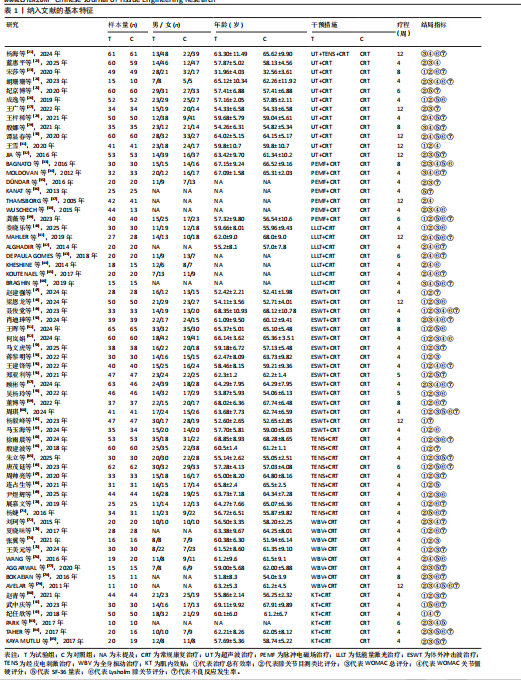
2.2 纳入文献的基本特征 共纳入3 418例患者,均符合膝骨关节炎的临床诊断,其中治疗组1 726例、对照组1 692例,入选患者年龄40-75岁,其中55-70岁最常见。使用常规康复治疗作为对照组,包括常规的关节活动度训练、肌力训练、日常功能训练及一般护理指导等,试验组为常规康复治疗联合物理因子治疗,涉及超声波、脉冲电磁场、低能量激光、体外冲击波、经皮电刺激、全身振动和肌内效贴7种物理因子治疗,治疗持续时间为4-12周。结局指标方面,报道治疗总有效率的共有33项研究、膝关节目测类比评分的共有57项研究、WOMAC总评分的共有35项研究、WOMAC关节僵硬评分的共有29项研究,SF-36量表的24项研究、Lysholm膝关节评分的共有39项研究。纳入文献的基本特征,见表1。
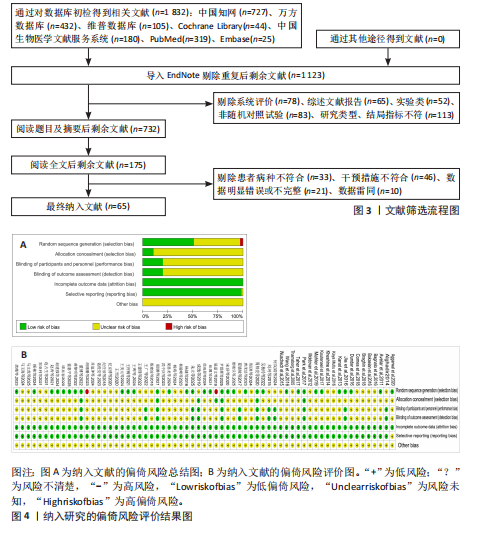
2.3 纳入文献的质量评价 纳入65篇文献均为随机对照试验[21-85]。随机顺序产生方面,29项为随机数字表法[22-23,28-30,32,35,39-41,45,48,57-59,63,65-67,69,71,74-77,79-80,83-84],2项采用抽签随机法[51,54],1项采用分层区组随机[69],以上研究均判为“低风险”,1项根据治疗方案的不同进行分组[36],2项按照患者采用就诊先后顺序[24,70],均判为“高风险”,其余研究未报告具体随机方法判为“风险未知”。分配隐藏方面,7项研究采用信封法进行分配隐藏[26,59,29,67,69-70,83],判为“低风险”,其余研究均未提及分配隐藏方案,评为“风险未知”。盲法方面,13项研究采用双盲[27,29,32,39,42,52,59,65,67,69,72-73,83],均判为“低风险”, 其余研究均未提及盲法判为“风险未知”。纳入研究数据完整,结局评价可靠,评为“低风险”。在选择性报告方面,均未在中国临床试验注册中心上搜索到研究计划书均评为“风险未知”。在其他来源偏倚风险方面,所有研究对资助来源等方面未报告均评为“风险未知”。采用RevMan 5.3软件绘制纳入研究的偏倚风险图,见图4。
2.4 治疗总有效率分析结果
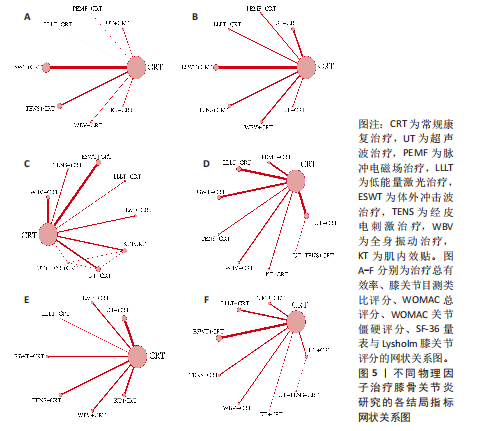
2.4.1 证据网络 33项随机对照试验报道了治疗总有效率[23,26,31,39-40,47-49,51-56,58-70,73-75,80-82],共涉及8种干预措施:超声波+常规康复、脉冲电磁场+常规康复、低能量激光+常规康复、体外冲击波+常规康复、经皮电刺激+常规康复、全身振动+常规康复、肌内效贴+常规康复和单纯常规康复治疗,总样本量2 689例。网络图中,各圆点分别表示不同的干预措施,圆点大小代表此干预措施的样本量,圆点之间连线粗细代表各干预措施的研究数量,直线表示2种干预措施间存在的直接或间接比较,不同干预措施间均存在直接或间接比较的证据,具备进行网状Meta分析的基本条件。治疗有效率的证据网络总体以常规康复治疗为中心,干预措施间无闭合环产生,无需进行不一致性检验,见图5A。
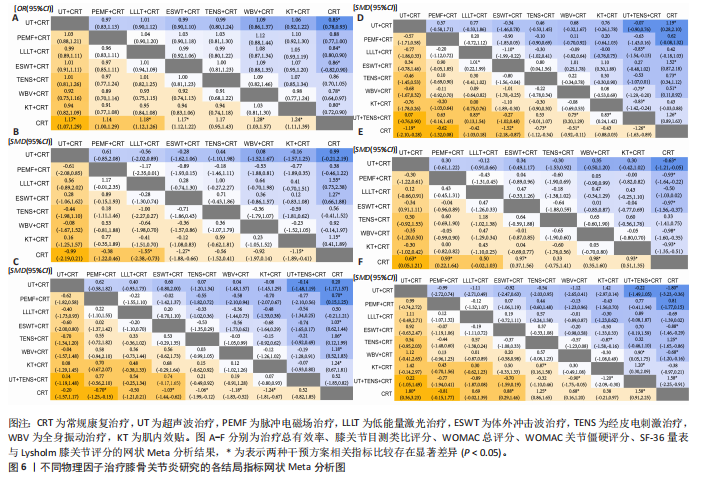
2.4.2 网状Meta分析与SUCRA排序 对8种干预措施进行两两比较,共产生28项两两比较。网状Meta分析显示,肌内效贴+常规康复(OR=1.17,95%CI[1.07,1.29])、经皮电刺激+常规康复(OR=1.18,95%CI[1.12,1.26])、体外冲击波+常规康复(OR=1.17,95%CI[1.12,1.22])、脉冲电磁场+常规康复(OR=1.28,95%CI [1.03,1.57])、超声波+常规康复治疗(OR=1.24,95%CI[1.11,1.39])治疗在提高治疗总有效率均优于单纯常规康复治疗(P < 0.05),其余干预措施间治疗总有效率相比较差异无显著性意义
(P > 0.05),见图6A。
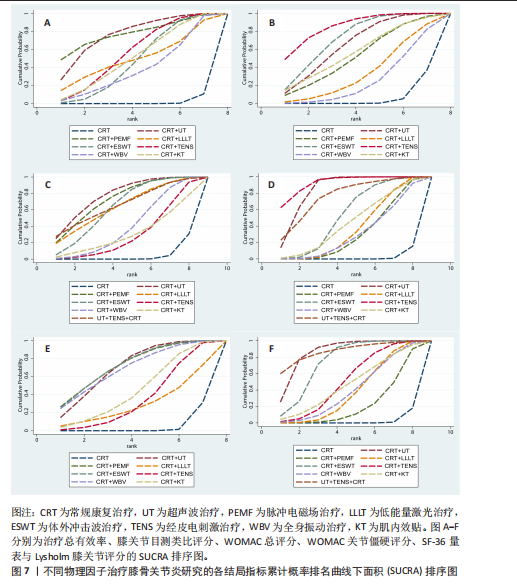
在报告治疗总有效率的研究中,治疗总有效率的SUCRA值由高到低排序为:脉冲电磁场+常规康复(77.5%) >超声波+常规康复(76.8%) >经皮电刺激+常规康复(56.5%) >肌内效贴+常规康复(51.4%) >低能量激光+常规康复(50.0%) >体外冲击波+常规康复(47.4%) >全身振动+常规康复(38.7%) >常规康复(2.6%),见图7A。
2.5 膝关节目测类比评分分析结果
2.5.1 证据网络 57项随机对照试验报道了膝关节目测类比评分[22-28,30-33,35,37-45,47-60,62-80,83-85],共涉及8种干预措施,总样本量4 044例,证据网络总体以常规康复治疗为中心,干预措施间无闭合环产生,故无需进行不一致性检验,见图5B。
2.5.2 网状Meta分析与SUCRA排序 对8种干预措施进行两两比较,共产生28项两两比较。网状Meta分析显示,经皮电刺激+常规康复(SMD=-1.55,95%CI[-2.38,-0.73])、体外冲击波+常规康复(SMD=-1.27,95%CI[-1.88,-0.66])、超声波+常规康复(SMD=-1.15,95%CI [-1.89,-0.41])治疗在改善膝关节目测类比评分方面优于常规康复治疗(P < 0.05),其余干预措施间相膝关节目测类比评分比较差异无显著性意义(P > 0.05),见图6B。
在报告膝关节目测类比评分的研究中,膝关节目测类比评分的SUCRA值概率排序为:经皮电刺激+常规康复(85.6%) >体外冲击波+常规康复(72.9%) >超声波+常规康复(65.8%) >肌内效贴+常规康复(57.1%) >脉冲电磁场+常规康复(53.0%) >低能量激光+常规康复(34.1%) >全身振动+常规康复(25.4%) >常规康复(6.1%),见图7B。
2.6 WOMAC总评分分析结果
2.6.1 证据网络 35项随机对照试验报道了WOMAC总评分[21-22,24,28-29,32-35,38,40,46,48-50,52-54,57-58,60,63,65,67,69,72,74-75,77-80,83-85],共涉及9种干预措施,总样本量2 379例,证据网络总体以常规康复治疗为中心,干预措施间产生闭合环,见图5C。为了确保分析结果的稳健性,需运用节点分裂法进行局部的一致性检验,检验结果显示P > 0.05,是说明研究间具有一致性,故在一致性模型下进行网状Meta分析。对闭环进行一致性检验,结果显示闭环IF=1.98、95%CI[0.73,3.42],提示一致性良好。
2.6.2 网状Meta分析与SUCRA排序 对9种干预措施进行两两比较,共产生36项两两比较。网状Meta分析显示,与常规康复治疗相比,肌内效贴+常规康复(SMD=-0.70,95%CI[-1.25,-0.15])、经皮电刺激+常规康复(SMD=-1.03,95%CI[-1.44,-0.62])、体外冲击波+常规康复(SMD=-1.06,95%CI[-1.99,-0.12])、低能量激光+常规康复(SMD=-1.18,95%CI[-1.83,-0.52])、脉冲电磁场+常规康复(SMD=-1.24,95%CI[-1.81,-0.67])治疗在减少WOMAC总评分方面的效果更佳(P < 0.05),其余干预措施间WOMAC总评分相比较差异无显著性意义(P > 0.05),见图6C。
在报告WOMAC总评分的研究中,WOMAC总评分的SUCRA值由高到低排序为:超声波+常规康复(77.6%) >脉冲电磁场+常规康复(72.9%) >超声波+经皮电刺激+常规康复治疗(66.0%) >低能量激光+常规康复(63.8%) >体外冲击波+常规康复(63.5%) >全身振动+常规康复(40.7%) >肌内效贴+常规康复(31.3%) >经皮电刺激+常规康复(29.7%) >常规康复(4.6%),见图7C。
2.7 WOMAC关节僵硬评分分析结果
2.7.1 证据网络 27项随机对照试验报道了WOMAC关节僵硬评分[21-22,24,28-31,33-34,37-38,41-46,49-50,52,55,57,72,76,79,82-83],共涉及9种干预措施,总样本量2 000例,证据网络总体以常规康复治疗为中心,干预措施间无闭合环产生,故无需进行不一致性检验,见图5D。
2.7.2 网状Meta分析与SUCRA排序 对9种干预措施进行两两比较,共产生36项两两比较。网状Meta分析显示,与常规康复治疗相比,超声波+经皮电刺激+常规康复(SMD=-1.19,95%CI[-2.10,-0.28])、经皮电刺激+常规康复(SMD=-1.52,95%CI[-2.18,-0.87])、体外冲击波+常规康复(SMD=-0.73,95%CI[-1.12,-0.34])、低能量激光+常规康复(SMD=-0.51,95%CI[-0.92,-0.11])、超声波+常规康复(SMD=-1.26,95%CI[-1.63,-0.89])在减少WOMAC关节僵硬评分方面的效果更佳。此外,经皮电刺激+常规康复治疗在减少WOMAC关节僵硬评分方面优于全身振动+常规康复(SMD=-1.10,95%CI[-1.99,-0.22]),超声波+常规康复治疗在减少WOMAC关节僵硬评分方面优于全身振动+常规康复(SMD=-0.83,95%CI[-1.54,-0.13])、低能量激光+常规康复(SMD=-0.75,95%CI[-1.29,-0.20])、脉冲电磁场+常规康复(SMD=-0.83,95%CI[-1.42,-0.24])治疗,差异有显著性意义(P < 0.05),其余干预措施间WOMAC关节僵硬评分比较差异无显著性意义(P > 0.05),见图6D。
在报告WOMAC关节僵硬评分的研究中,WOMAC关节僵硬评分的SUCRA值由高到低排序为:经皮电刺激+常规康复(92.8%) >超声波+常规康复(83.9%) >超声波+经皮电刺激+常规康复(75.9%) >体外冲击波治疗+常规康复治疗(53.1%) >肌内效贴+常规康复(44.0%) >低能量激光+常规康复(37.0%) >全身振动+常规康复(30.9%) >脉冲电磁场+常规康复(30.1%) >常规康复(3.0%),见图7D。
2.8 SF-36量表分析结果
2.8.1 证据网络 25项随机对照试验报道了SF-36量表[25-26,28-30,32-33,36,39,41,46,51,56,60,65-66,68,71,76-77,79,81,83-85],共涉及8种干预措施,总样本量1 727例,证据网络总体以常规康复治疗为中心,干预措施间无闭合环产生,故无需进行不一致性检验,见图5E。
2.8.2 网状Meta分析与SUCRA排序 对8种干预措施进行两两比较,共产生28项两两比较。网状Meta分析显示,肌内效贴+常规康复(SMD=0.63,95%CI[0.05,1.21])、全身振动+常规康复(SMD=0.93,95%CI[0.22,1.64])、体外冲击波+常规康复(SMD=0.97,95%CI[0.37,1.56])、脉冲电磁场+常规康复(SMD= 0.98,95%CI[0.35,1.60])、超声波+常规康复(SMD=0.93,95%CI[0.51,1.35])治疗在改善SF-36量表方面优于常规康复治疗(P < 0.05),其余干预措施间SF-36量表相比较差异无显著性意义(P > 0.05),见图6E。
在报告SF-36量表的研究中,SF-36量表的SUCRA值由高到低排序为:脉冲电磁场+常规康复(72.8%) >体外冲击波+常规康复(72.2%) >超声波治疗+常规康复(70.8%) >全身振动+常规康复(68.4%) >肌内效贴+常规康复(45.4%) >经皮电刺激+常规康复(35.9%) >低能量激光+常规康复(29.8%) >常规康复(4.7%),见图7E。
2.9 Lysholm膝关节评分分析结果
2.9.1 证据网络 38项随机对照试验报道了Lysholm膝关节评分[21,23-24,26,30,33-34,38-46,48-52,55,57-60,62-63,66,69-71,73,76,78-79,81,84],共涉及9种干预措施,总样本量2 783例,证据网络总体以常规康复治疗为中心,干预措施间无闭合环产生,故无需进行不一致性检验,见图5F。2.9.2 网状Meta分析与SUCRA排序 对9种干预措施进行两两比较,共产生36项两两比较。网状Meta分析显示,超声波+经皮电刺激+常规康复(SMD=1.80,95%CI[0.36,3.23])、经皮电刺激+常规康复(SMD=0.88,95%CI[0.29,1.46])、体外冲击波+常规康复(SMD=1.25,95%CI[0.86,1.65])、低能量激光+常规康复(SMD=0.68,95%CI[0.16,1.20])、超声波+常规康复(SMD=1.58,95%CI[0.91,2.25])治疗在改善Lysholm膝关节评分方面优于常规康复治疗(P < 0.05);此外,体外冲击波+常规康复治疗在改善Lysholm膝关节评分方面优于脉冲电磁场+常规康复治疗(SMD=0.87,95%CI[0.16,1.58]),超声波+常规康复治疗在改善Lysholm膝关节评分方面优于脉冲电磁场+常规康复(SMD=1.20,95%CI[0.30,2.09])、低能量激光+常规康复治疗(SMD=0.90,95%CI[0.05,1.75]),差异有显著性意义(P < 0.05),其余干预措施间
Lysholm膝关节评分比较差异无显著性意义(P > 0.05),见图6F。
在报告Lysholm膝关节评分的研究中,Lysholm膝关节评分的SUCRA值由高到低排序为:超声波+常规康复(86.6%) >超声波+经皮电刺激+常规康复(86.5%) >体外冲击波+常规康复(74.1%) >经皮电刺激+常规康复(51.5%) >肌内效贴+常规康复(48.0%) >全身振动+常规康复(39.7%) >低能量激光+常规康复(38.9%) >脉冲电磁场+常规康复(22.3%) >常规康复(4.5%),见图7F。
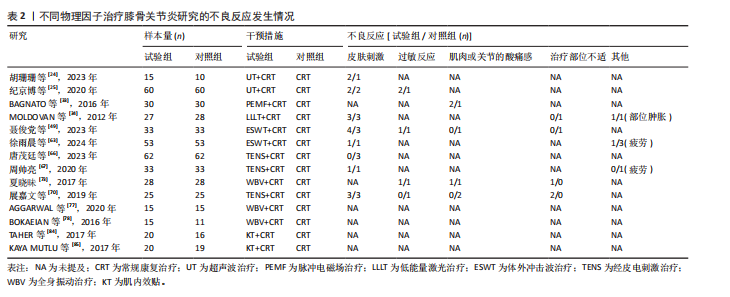
2.10 不良反应发生率 46项随机对照试验报道了不良反应发生率[21,23-25,27-30,32,34-36,39,41-43,45-47,49-50,53,55-57,59-61,63-67,70-73,75,77-82,84-85],其中,32篇报告治疗期间均未发生与干预措施等相关的不良反应,14篇对不良反应发生情况进行了描述,共涉及8种干预措施,共有65例患者出现不良反应,主要包括皮肤刺激、过敏反应、肌肉或关节的酸痛感和治疗部位稍肿胀等表现,由于每个研究间不良反应不同,因此只作描述性统计,见表2。
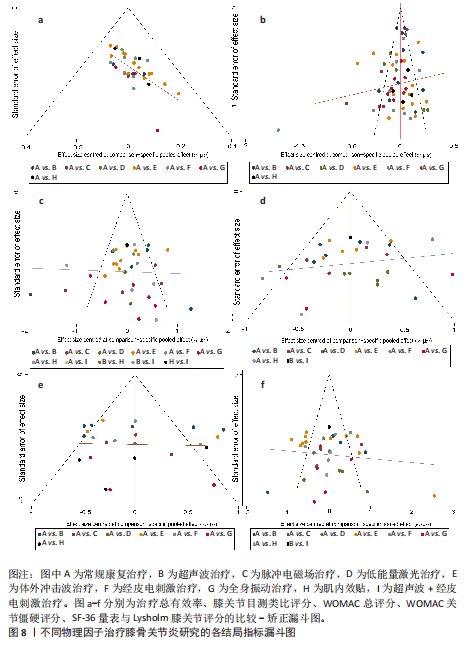
2.11 文献发表偏倚 此次研究对各结局指标进行发表偏倚分析,绘制“比较-矫正”漏斗图,进行偏倚分析,漏斗图中的圆点表示不同干预措施之间的一对一比较,点的颜色代表不同的干预措施或对照组类别,每种颜色点的数量代表报告比较的研究数量。如果不存在小样本量或发表偏差的影响,漏斗图中的点对称且均匀分布在垂直线的两侧(X=0)。检验结果显示,治疗总有效率、WOMAC总评分、WOMAC关节僵硬评分、SF-36量表和Lysholm膝关节评分结局指标的纳入研究总体对称分布于倒漏斗图的中上部,围绕中线左右两侧,提示发表偏倚的可能性较小;膝关节目测类比评分结局指标的漏斗图左右对称性欠佳,并且部分圆点散落在95%CI区域外,提示纳入文献可能存在一定的发表偏倚或是小样本效应,见图8。
进一步进行对所有结局指标进行敏感性分析Egger检验,结果显示治疗总有效率的P=0.532、膝关节目测类比评分的 P=0.780、WOMAC总评分的P=0.322、WOMAC关节僵硬评分的P=0.725、SF-36量表的P=0.617、Lysholm膝关节评分的P=0.403,提示所纳入的研究不存在小样本研究效应且具有一定的稳健性。
| [1] BANNURU RR, OSANI MC, VAYSBROT EE, et al. OARSI guidelines for the non-surgical management of knee, hip, and polyarticular osteoarthritis. Osteoarthritis Cartilage. 2019;27(11):1578-1589. [2] 中华中医药学会.膝骨关节炎中西医结合诊疗指南(2023年版)[J].中医正骨,2023,35(6):1-10. [3] DI J, BAI J, ZHANG J, et al. Regional disparities, age-related changes and sex-related differences in knee osteoarthritis. BMC Musculoskelet Disord. 2024;25(1):66. [4] GIORGINO R, ALBANO D, FUSCO S, et al. Knee Osteoarthritis: Epidemiology, Pathogenesis, and Mesenchymal Stem Cells: What Else Is New? An Update. Int J Mol Sci. 2023;24(7):6405. [5] TONG L, YU H, HUANG X, et al. Current understanding of osteoarthritis pathogenesis and relevant new approaches. Bone Res. 2022; 10(1):60. [6] ZENG C, ZHANG W, DOHERTY M, et al. Initial analgesic prescriptions for osteoarthritis in the United Kingdom, 2000-2016. Rheumatology (Oxford). 2021;60(1):147-159. [7] WENG Q, GOH SL, WU J, et al. Comparative efficacy of exercise therapy and oral non-steroidal anti-inflammatory drugs and paracetamol for knee or hip osteoarthritis: a network meta-analysis of randomised controlled trials. Br J Sports Med. 2023;57(15):990-996. [8] JANG S, LEE K, JU JH. Recent Updates of Diagnosis, Pathophysiology, and Treatment on Osteoarthritis of the Knee. Int J Mol Sci. 2021;22(5):2619. [9] DANTAS LO, SALVINI TF, MCALINDON TE. Knee osteoarthritis: key treatments and implications for physical therapy. Braz J Phys Ther. 2021;25(2): 135-146. [10] PERS YM, NGUYEN C, BORIE C, et al. Recommendations from the French Societies of Rheumatology and Physical Medicine and Rehabilitation on the non-pharmacological management of knee osteoarthritis. Ann Phys Rehabil Med. 2024;67(7):101883. [11] YANG X, HE H, YE W, et al. Effects of Pulsed Electromagnetic Field Therapy on Pain, Stiffness, Physical Function, and Quality of Life in Patients With Osteoarthritis: A Systematic Review and Meta-Analysis of Randomized Placebo-Controlled Trials. Phys Ther. 2020;100(7):1118-1131. [12] AVENDAÑO-COY J, COMINO-SUÁREZ N, GRANDE-MUÑOZ J, et al. Extracorporeal shockwave therapy improves pain and function in subjects with knee osteoarthritis: A systematic review and meta-analysis of randomized clinical trials. Int J Surg. 2020;82:64-75. [13] WU Y, ZHU F, CHEN W, et al. Effects of transcutaneous electrical nerve stimulation (TENS) in people with knee osteoarthritis: A systematic review and meta-analysis. Clin Rehabil. 2022;36(4):472-485. [14] PAGE MJ, MOHER D, BOSSUYT PM, et al. PRISMA 2020 explanation and elaboration: updated guidance and exemplars for reporting systematic reviews. BMJ. 2021;372:n160. [15] 骨科学分会关节外科学组.骨关节炎诊治指南(2018年版)[J].中华骨科杂志,2018,38(12):705-715. [16] KOLASINSKI SL, NEOGI T, HOCHBERG MC, et al. 2019 American College of Rheumatology/Arthritis Foundation Guideline for the Management of Osteoarthritis of the Hand, Hip, and Knee. Arthritis Rheumatol. 2020;72(2):220-233. [17] 中华医学会物理医学与康复学分会,四川大学华西医院.中国膝骨关节炎康复治疗指南(2023版)[J].中国循证医学杂志,2024,24(1):1-14. [18] HIGGINS JP, ALTMAN DG, GØTZSCHE PC, et al. The Cochrane Collaboration’s tool for assessing risk of bias in randomised trials. BMJ. 2011;343:d5928. [19] EGGER M, DAVEY SMITH G, SCHNEIDER M, et al. Bias in meta-analysis detected by a simple, graphical test. BMJ. 1997;315(7109):629-634. [20] BEGG CB, MAZUMDAR M. Operating characteristics of a rank correlation test for publication bias. Biometrics. 1994;50(4):1088-1101. [21] 杨海,蔡菊红,周驰,等.超声波结合经皮神经电刺激对膝骨关节炎患者膝关节疼痛和功能的影响[J].中国康复医学杂志,2024,39(8):1174-1179. [22] 蓝惠平,刘芳.超声波治疗仪联合抗阻训练在膝骨关节炎患者中的应用效果[J].医疗装备, 2025,38(4):85-88. [23] 宋莎,刘勇,张彬霞,等.低强度脉冲超声波联合股四头肌肌力强化训练治疗膝骨关节炎患者的临床疗效观察[J].现代生物医学进展, 2020,20(14):2668-2671. [24] 胡珊珊,刘晓,罗汉才,等.低强度脉冲超声调控治疗疼痛性膝骨关节炎的临床研究[J].实用医学杂志,2023,39(21):2783-2788. [25] 纪京博,赵忠全,李学福,等.低强度脉冲超声对膝骨关节炎患者血清TIMP-2和软骨MMP-13表达的影响[J].川北医学院学报,2020,35(6): 986-989. [26] 成逸,徐艳,王飞.低强度脉冲超声缓解膝骨关节炎疼痛与修复关节软骨损伤研究[J].中国现代医生,2019,57(25):32-35. [27] 王广,王传敏,马利中.低强度脉冲超声联合本体感觉训练治疗膝骨关节炎疗效观察[J].医学理论与实践,2022,35(1):161-163. [28] 王枰稀,曾凡伟,张东,等.低强度脉冲聚焦超声对早中期膝关节骨关节炎患者关节功能影响的研究[J].川北医学院学报,2021,36(4):433-436. [29] 殷娜,汤锋武,符锋,等.低强度脉冲聚焦超声联合等速肌力训练对膝骨关节炎患者膝关节本体感觉、生活质量和炎性因子水平的影响[J].现代生物医学进展,2021,21(22):4275-4278,4297. [30] 谭显春,李智,李欣,等.低强度脉冲聚焦超声治疗对膝骨关节炎患者疼痛和关节功能的改善作用及其安全性[J].临床和实验医学杂志, 2020,19(5):541-544. [31] 王雪.扶他林乳胶剂局部外用作为超声介质联合超声波治疗膝骨性关节炎的疗效[J].中国处方药,2020,18(10):94-95. [32] JIA L, WANG Y, CHEN J, et al. Efficacy of focused low-intensity pulsed ultrasound therapy for the management of knee osteoarthritis: a randomized, double blind, placebo-controlled trial. Sci Rep. 2016;6:35453. [33] BAGNATO GL, MICELI G, MARINO N, et al. Pulsed electromagnetic fields in knee osteoarthritis: a double blind, placebo-controlled, randomized clinical trial. Rheumatology (Oxford). 2016;55(4): 755-762. [34] MOLDOVAN I, DIŢĂ R, POP L. The effects of focused pulsed electromagnetic field therapy in patients with knee osteoarthritis. A randomised, placebo-controlled study. Palestrica of the Third Millennium Civilization and Sport. 2012;13:91-95. [35] DÜNDAR Ü, AŞIK G, ULAŞLI AM, et al. Assessment of pulsed electromagnetic field therapy with Serum YKL-40 and ultrasonography in patients with knee osteoarthritis. Int J Rheum Dis. 2016; 19(3):287-293. [36] KANAT E, ALP A, YURTKURAN M. Magnetotherapy in hand osteoarthritis: a pilot trial. Complement Ther Med. 2013;21(6):603-608. [37] THAMSBORG G, FLORESCU A, OTURAI P, et al. Treatment of knee osteoarthritis with pulsed electromagnetic fields: a randomized, double-blind, placebo-controlled study. Osteoarthritis Cartilage. 2005;13(7):575-581. [38] WUSCHECH H, VON HEHN U, MIKUS E, et al. Effects of PEMF on patients with osteoarthritis: Results of a prospective, placebo-controlled, double-blind study. Bioelectromagnetics. 2015; 36(8):576-585. [39] 龚薇,龚瑜,陈淑君.脉冲电磁场联合康复护理对膝骨关节炎患者的疗效[J].医疗装备, 2023,36(15):114-116. [40] 娄晓乐,陶雅亭,林霖,等.神经肌肉运动训练联合半导体激光对膝骨关节炎患者的影响[J].康复学报,2025,35(4):439-444. [41] MAHLER EAM, MINTEN MJ, LESEMAN-HOOGENBOOM MM, et al. Effectiveness of low-dose radiation therapy on symptoms in patients with knee osteoarthritis: a randomised, double-blinded, sham-controlled trial. Ann Rheum Dis. 2019;78(1):83-90. [42] ALGHADIR A, OMAR MT, AL-ASKAR AB, et al. Effect of low-level laser therapy in patients with chronic knee osteoarthritis: a single-blinded randomized clinical study. Lasers Med Sci. 2014;29(2):749-755. [43] DE PAULA GOMES CAF, LEAL-JUNIOR ECP, DIBAI-FILHO AV, et al. Incorporation of photobiomodulation therapy into a therapeutic exercise program for knee osteoarthritis: A placebo-controlled, randomized, clinical trial. Lasers Surg Med. 2018;50(8):819-828. [44] KHESHIE AR, ALAYAT MS, ALI MM. High-intensity versus low-level laser therapy in the treatment of patients with knee osteoarthritis: a randomized controlled trial. Lasers Med Sci. 2014;29(4):1371-1376. [45] KOUTENAEI FR, MOSALLANEZHAD Z, NAGHIKHANI M, et al. The Effect of Low Level Laser Therapy on Pain and Range of Motion of Patients With Knee Osteoarthritis. Phys Treatments, 2017;7(1):13-18. [46] BRAGHIN A, MOEZY A, NEJATI P, et al. Efficacy of high-intensity laser therapy in comparison with conventional physiotherapy and exercise therapy on pain and function of patients with knee osteoarthritis: a randomized controlled trial with 12-week follow up. Lasers Med Sci. 2019; 34(3):505-516. [47] 赵建强,陈颖,张帅.不同频率冲击波治疗膝骨性关节炎效果观察[J].中国城乡企业卫生,2024, 39(1):137-138. [48] 梁恩龙,胡运翔,唐玉萍,等.体外冲击波触发点疗法治疗早中期膝骨关节炎的临床研究[J].中国医药科学,2024,14(24):165-169. [49] 聂俊党,宋涛.体外冲击波联合常规康复治疗膝骨关节炎疼痛的临床效果[J].长治医学院学报,2023,37(6):435-438. [50] 肖迪珅,赵恒,刘凌.体外冲击波联合扶他林乳胶剂外用治疗对早中期膝骨关节炎患者的临床研究[J].中华保健医学杂志,2024,26(2):254-256. [51] 王晖,杨佳媛,李文.体外冲击波联合神经肌肉训练治疗老年膝骨关节炎及对膝关节滑液IL-1β、IL-17、PGE2水平的影响[J].宁夏医科大学学报,2024,46(8):791-796. [52] 何岚娟.体外冲击波联合双氯芬酸二乙胺乳胶剂治疗膝骨关节炎患者的效果[J].中国民康医学,2024,36(22):49-51. [53] 马文虎,祁晓.体外冲击波联合中药外敷治疗膝骨关节炎的临床效果及对炎症因子的影响[J].中国当代医药,2025,32(9):48-58. [54] 蒋黎明,于小明,丁余武,等.体外冲击波疗法联合站桩训练治疗膝骨关节炎的临床疗效[J].广西医学,2022,44(16):1847-1850. [55] 王建锋,张海明,刘杰.体外冲击波穴位疗法对膝骨性关节炎患者关节功能及骨代谢分子分泌的影响[J].中国卫生检验杂志,2022,32(15):1855-1859. [56] 郑亚利,杨青山.体外冲击波治疗对膝骨关节炎患者临床相关指标的影响[J].中国临床医生杂志,2021,49(6):717-719. [57] 顾彬,段建军,谢红霞,等.体外冲击波治疗膝骨性关节炎的近期疗效分析[J].中外医疗, 2024,43(20):79-83. [58] 吴杨玲,钟婷,唐芳.体外冲击波治疗早中期膝骨关节炎的临床效果观察[J].实用医院临床杂志,2022,19(2):62-64. [59] 董博,雷涛.体外穴位冲击波治疗早期膝骨关节炎的疗效研究[J].现代中医药,2022,42(1): 108-110. [60] 周琪.推拿手法配合冲击波穴位疗法治疗膝骨性关节炎患者的疗效及其对运动功能的影响[J].慢性病学杂志,2024,25(5):745-751. [61] 杨毅峰,黄健,邸申,等.膝骨关节炎患者应用体外冲击波联合站桩训练的效果及炎症水平分析[J].中国医学创新,2023,20(10):116-119. [62] 马玉海,张霆,赵文修,等.穴位及经筋结点体外冲击波疗法治疗膝骨关节炎的临床研究[J].浙江中西医结合杂志,2024,34(12):1147-1150. [63] 徐雨晨,沈松筠.常规康复治疗配合经皮穴位电刺激在膝骨关节炎中的应用效果[J].中外医学研究,2024,22(34):169-172. [64] 殷建波,王敏,任丽,等.经皮电刺激神经疗法配合宣氏强刺激推拿法治疗膝骨性关节炎[J].中医临床研究,2018,10(3):64-67. [65] 朱立,赵学田.经皮神经电刺激联合等速离心训练对膝骨关节炎患者疼痛程度及肌肉力量的影响[J].临床医药实践,2025,34(2):109-112. [66] 唐茂廷,王振.经皮神经电刺激治疗对膝骨关节炎患者膝关节功能、VAS评分及效果的影响[J].名医,2023(6):51-53. [67] 周帅亮,岑珏,郭艳明,等.经皮穴位电刺激结合运动疗法治疗膝骨关节炎的临床研究[J].中国中医骨伤科杂志,2020,28(2):15-18. [68] 连占生,徐振文,李青天.经皮穴位电刺激治疗膝骨关节炎的临床效果研究[J].名医, 2021(10):141-142. [69] 尹煜辉,陈明,李玲慧,等.松筋调膝手法联合经皮神经电刺激治疗膝骨关节炎的临床研究[J].中国中医骨伤科杂志,2025,33(4):27-32. [70] 展嘉文,王尚全,朱立国,等.经皮穴位电刺激治疗膝骨关节炎的临床研究[J].中国中医骨伤科杂志,2019,27(8):28-31. [71] 杨婕.经皮穴位电刺激与温针灸治疗膝骨性关节炎的比较研究[J].内蒙古中医药,2016,35(2): 134-135. [72] 刘珂,陈光,黄月乔,等.全身振动训练对膝骨关节炎有效性的随机对照研究[J].生物医学工程与临床,2015,19(6):609-612. [73] 夏晓昧,刘臻,陆飞,等.全身振动训练联合有氧训练治疗膝关节骨性关节炎的疗效观察[J].影像研究与医学应用,2017,1(11):186-188. [74] 张翼,秦佳维,何泽祥,等.全身振动训练联合运动疗法在膝关节骨性关节炎中的应用效果[J].中国当代医药,2021,28(8):77-80. [75] 王美元,冯瑞伟,雷鸣,等.针刺配合全身振动训练治疗膝骨关节炎的临床观察[J].中国中医急症,2024,33(12):2152-2155. [76] WANG P, YANG L, LI H, et al. Effects of whole-body vibration training with quadriceps strengthening exercise on functioning and gait parameters in patients with medial compartment knee osteoarthritis: a randomised controlled preliminary study. Physiotherapy. 2016;102(1):86-92. [77] AGGARWAL A, PARANJAPE PR, PALEKAR TJ, et al. Effect of whole body vibration on lower body strength and balance in osteoarthritis knee. Int J Physiother. 2020;7:86-92. [78] BOKAEIAN HR, BAKHTIARY AH, MIRMOHAMMADKHANI M, et al. The effect of adding whole body vibration training to strengthening training in the treatment of knee osteoarthritis: A randomized clinical trial. J Bodyw Mov Ther. 2016;20(2):334-340. [79] AVELAR NC, SIMÃO AP, TOSSIGE-GOMES R, et al. The effect of adding whole-body vibration to squat training on the functional performance and self-report of disease status in elderly patients with knee osteoarthritis: a randomized, controlled clinical study. J Altern Complement Med. 2011; 17(12):1149-1155. [80] 赵青,代洪燕,张春雷,等.肌内效贴扎辅助治疗对膝骨关节炎患者疼痛水平的影响[J].武警后勤学院学报(医学版),2021,30(11):20-22. [81] 武中庆,许侃娜,沈云龙,等.肌内效贴治疗早期膝骨关节炎的效果[J].中国医药导报,2023, 20(24):89-92. [82] 纪任欣,余波,何霏,等.中西医结合改良肌内效贴对膝骨性关节炎影响的临床研究[J].上海中医药杂志,2018,52(2):71-74,108. [83] PARK SH, PARK YH, LEE JH. Effects of magnetic field therapy after taping application on pain and function of patients with knee osteoarthritis. J Phys Ther Sci. 2017;29(9):1548-1551. [84] TAHERI P, VAHDATPOUR B, ASL MM, et al. Effects of Taping on Pain and Functional Outcome of Patients with Knee Osteoarthritis: A Pilot Randomized Single-blind Clinical Trial. Adv Biomed Res. 2017;6:139. [85] KAYA MUTLU E, MUSTAFAOGLU R, BIRINCI T, et al. Does Kinesio Taping of the Knee Improve Pain and Functionality in Patients with Knee Osteoarthritis?: A Randomized Controlled Clinical Trial. Am J Phys Med Rehabil. 2017;96(1):25-33. [86] TUNCER T, CAY FH, ALTAN L, et al. 2017 update of the Turkish League Against Rheumatism (TLAR) evidence-based recommendations for the management of knee osteoarthritis. Rheumatol Int. 2018;38(8):1315-1331. [87] SABHA M, HOCHBERG MC. Non-surgical management of hip and knee osteoarthritis; comparison of ACR/AF and OARSI 2019 and VA/DoD 2020 guidelines. Osteoarthr Cartil Open. 2021;4(1):100232. [88] MELZACK R, WALL PD. Pain mechanisms: a new theory. Science. 1965;150(3699):971-979. [89] VANCE CGT, DAILEY DL, CHIMENTI RL, et al. Using TENS for Pain Control: Update on the State of the Evidence. Medicina (Kaunas). 2022;58(10):1332. [90] REICHENBACH S, JÜNI P, HINCAPIÉ CA, et al. Effect of transcutaneous electrical nerve stimulation (TENS) on knee pain and physical function in patients with symptomatic knee osteoarthritis: the ETRELKA randomized clinical trial. Osteoarthritis Cartilage. 2022;30(3):426-435. [91] TEIXEIRA PEP, ALAWDAH L, ALHASSAN HAA, et al. The Analgesic Effect of Transcranial Direct Current Stimulation (tDCS) combined with Physical Therapy on Common Musculoskeletal Conditions: A Systematic Review and Meta-Analysis. Princ Pract Clin Res. 2020;6(1):23-26. [92] RAHIMI F, NEJATI V, NASSADJ G, et al. The effect of transcranial direct stimulation as an add-on treatment to conventional physical therapy on pain intensity and functional ability in individuals with knee osteoarthritis: A randomized controlled trial. Neurophysiol Clin. 2021;51(6):507-516. [93] TAVARES DRB, OKAZAKI JEF, SANTANA MVA, et al. Motor cortex transcranial direct current stimulation effects on knee osteoarthritis pain in elderly subjects with dysfunctional descending pain inhibitory system: A randomized controlled trial. Brain Stimul. 2021;14(3):477-487. [94] SCHAMBRA HM, BIKSON M, WAGER TD, et al. It’s all in your head: reinforcing the placebo response with tDCS. Brain Stimul. 2014;7(4):623-634. [95] CAKIR S, HEPGULER S, OZTURK C, et al. Efficacy of therapeutic ultrasound for the management of knee osteoarthritis: a randomized, controlled, and double-blind study. Am J Phys Med Rehabil. 2014;93(5):405-412. [96] ÖZGÖNENEL L, OKUR SÇ, DOGAN YP, et al. Effectiveness of Therapeutic Ultrasound on Clinical Parameters and Ultrasonographic Cartilage Thickness in Knee Osteoarthritis: A Double-Blind Trial. J Med Ultrasound. 2018;26(4):194-199. [97] JIA L, CHEN J, WANG Y, et al. Focused Low-intensity Pulsed Ultrasound Affects Extracellular Matrix Degradation via Decreasing Chondrocyte Apoptosis and Inflammatory Mediators in a Surgically Induced Osteoarthritic Rabbit Model. Ultrasound Med Biol. 2016;42(1):208-219. [98] YEĞIN T, ALTAN L, KASAPOĞLU AKSOY M. The Effect of Therapeutic Ultrasound on Pain and Physical Function in Patients with Knee Osteoarthritis. Ultrasound Med Biol. 2017;43(1):187-194. [99] RODRÍGUEZ-GRANDE EI, OSMA-RUEDA JL, SERRANO-VILLAR Y, et al. Effects of pulsed therapeutic ultrasound on the treatment of people with knee osteoarthritis. J Phys Ther Sci. 2017;29(9):1637-1643. [100] YILDIZ SK, ÖZKAN FÜ, AKTAŞ I, et al. The effectiveness of ultrasound treatment for the management of knee osteoarthritis: a randomized, placebo-controlled, double-blind study. Turk J Med Sci. 2015;45(6):1187-1191. |
| [1] | 刘金龙, 阿卜杜吾普尔•海比尔, 白 臻, 苏丹阳, 苗 鑫, 李 菲, 杨晓鹏. 不同非手术方法治疗青少年特发性脊柱侧凸效果的系统综述与网状Meta分析[J]. 中国组织工程研究, 2026, 30(9): 2370-2379. |
| [2] | 王振泽, 刘奋德, 张 瑞, 李武军. 间充质干细胞治疗下肢动脉硬化闭塞症:系统评价和Meta分析[J]. 中国组织工程研究, 2026, 30(7): 1869-1876. |
| [3] | 郑 银, 吴振桦, 张 成, 阮可馨, 刚骁琳, 汲 泓. 免疫吸附治疗类风湿关节炎的安全性和有效性:网状Meta分析和系统评价[J]. 中国组织工程研究, 2026, 30(5): 1260-1268. |
| [4] | 冷晓轩, 赵玉欣, 刘西花. 不同神经调控刺激方式改善帕金森病患者非运动症状的网状Meta分析[J]. 中国组织工程研究, 2026, 30(5): 1282-1293. |
| [5] | 杨媛媛, 周珊珊, 成小菲, 冯露叶, 汤继芹. 非侵入性脑刺激治疗脑卒中后下肢运动功能障碍的网状Meta分析[J]. 中国组织工程研究, 2026, 30(4): 1008-1018. |
| [6] | 王燕飞, 靳连海, 李清雅, 付远飞, 谭黄圣, 邓鹏伟, 高 坤, . 滑膜液外泌体介导滑膜细胞与软骨细胞信号互作在膝骨关节炎发生发展中的作用[J]. 中国组织工程研究, 2026, 30(34): 9032-9040. |
| [7] | 廖广滔, 冯梓誉, 傅小勇, 赵清兰, 陈 超, 洪劲松. 距下关节制动治疗儿童柔性扁平足:影像学指标与临床疗效的关系[J]. 中国组织工程研究, 2026, 30(3): 661-670. |
| [8] | 赵 珂, 张 萍, 席永平, 曾繁智, 张丽茹. 成年人慢性腰背痛的最佳运动方案:网状Meta分析[J]. 中国组织工程研究, 2026, 30(29): 7688-7695. |
| [9] | 雍 侨, 孙 鑫, 汪国友, 张 磊, 沈骅睿, 刘 欢, 关钛元. 少阳生骨方抑制氧化应激延缓膝骨关节炎大鼠软骨衰老[J]. 中国组织工程研究, 2026, 30(28): 7251-7259. |
| [10] | 摆 雪, 田育魁, 郭 蕾, 石梦妮, 崔小锋, 王 程, 李静先, 朱清广, 刘俊昌. 构建早期膝骨关节炎大鼠模型:CatWalk步态分析评估[J]. 中国组织工程研究, 2026, 30(28): 7280-7286. |
| [11] | 李思慧, 王 芹, 崔慎红, 成小菲, 冯梓芸, 王德花, 梁春婷, 冷 军. 非侵入性神经调控技术对脑卒中后失语患者言语功能影响的网状Meta分析[J]. 中国组织工程研究, 2026, 30(28): 7485-7493. |
| [12] | 范萌萌, 丁嘉莉, 万宇杰, 黄海量. 神经调控技术促进脑卒中后上肢运动功能的系统评价与网状Meta分析[J]. 中国组织工程研究, 2026, 30(28): 7494-7504. |
| [13] | 张凯静, 李春年, 李一卓, 徐世芳, 刘新月. 不同骨修复材料对根尖骨缺损治疗效果的网状Meta分析#br#[J]. 中国组织工程研究, 2026, 30(26): 6946-6951. |
| [14] | 邵云博, 郭珈宜, 李 峰. 单侧膝骨关节炎患者下肢肌肉运动激活的特征[J]. 中国组织工程研究, 2026, 30(24): 6174-6181. |
| [15] | 聂 越, 宋淑华, 赵胜挺, 董杨洋, 杨柄鑫. 不同虚拟现实设备治疗脑卒中上肢运动功能障碍的网状Meta分析[J]. 中国组织工程研究, 2026, 30(24): 6365-6372. |
目前,膝骨关节炎的临床管理主要集中在药物镇痛和外科干预上,但这两种方法均存在显著的局限性。非类固醇抗炎药、类固醇和镇痛药仍然是膝骨关节炎疼痛管理的首选药物,然而,长期使用这些药物与胃肠道出血、心血管并发症和肾功能损害有关,对于老年人群和有慢性合并症的患者,这一安全性问题尤为突出[6-7]。虽然关节置换手术在终末期膝骨关节炎患者中能有效恢复功能,但临床应用受到手术侵入性、昂贵医疗费用以及潜在术后并发症的制约[8],这些局限性促使人们关注疾病早期非药物治疗替代方法,包括运动治疗、再生修复疗法和物理因子治疗。相比之下,物理治疗提供了非侵入性且具有成本效益的替代方法,并且有安全性较高、不良反应小、可长期干预等优势,因而在膝骨关节炎的早中期治疗及长期康复管理中具有重要价值[9]。
现代研究表明,采用低能量激光疗法、体外冲击波治疗和超声波治疗等技术,通过调节炎症细胞因子、促进组织再生和血管新生可以有效缓解膝骨关节炎的慢性疼痛和关节功能障碍等症状,维持远期疗效,降低复发率,预防相关并发症的发生,达到标本兼治的效果[10]。多项Meta分析表明,多种物理因子治疗在改善膝骨关节炎患者感觉与疼痛、日常生活活动评分等指标上具有常规西药无可比拟的作用[11-13],
但物理因子治疗方式繁多,不同物理因子之间缺乏临床疗效对比的依据,不利于确定最佳诊疗方案。因此,此次研究充分利用现有临床研究数据,对不同物理因子治疗膝骨关节炎的有效性及安全性进行网状Meta分析,为膝骨关节炎的治疗提供循证医学证据。
中国组织工程研究杂志出版内容重点:干细胞;骨髓干细胞;造血干细胞;脂肪干细胞;肿瘤干细胞;胚胎干细胞;脐带脐血干细胞;干细胞诱导;干细胞分化;组织工程
1.1 资料来源 此次研究严格按照系统评价和荟萃分析(PRISMA)最新指南和范例条目执行[14],并已在PROSPERO网站注册,注册号CRD420251127647。研究方案设计见图1。
1.1.1 检索者 由2名研究人员按照检索词独立查阅文献,互不干预。
1.1.2 检索资料库 应用计算机检索PubMed、Web of Science、Cochrane Library、EMbase数据库以及中国知网、维普数据库、万方数据库、中国生物医学文献服务系统。
1.1.3 检索策略 中文检索关键词为“骨关节炎”“膝”“膝骨关节炎”“康复”“物理治疗”“超声波治疗”“脉冲电磁场治疗”“低能量激光治疗”“体外冲击波治疗”“经皮电刺激治疗”“全身振动治疗”“肌内效贴”等,英文检索词为“osteoarthritis” “knee” “knee osteoarthritis” “rehabilitation” “physical therapy” “ultrasound therapy”“pulsed electromagnetic field therapy” “low-level laser therapy” “extracorporeal shock wave therapy” “transcutaneous electrical stimulation therapy” “whole-body vibration therapy” and “Kinesio Taping Therapy”等,限定词为临床研究,采用主题词与自由词相结合的方式进行计算机检索,最后再人工检索纳入文献的参考文献及灰色文献。以PubMed数据库为例,检索式见图2。
1.1.4 文献检索时限 各数据库建库至2025-07-25。
1.2 纳入与排除标准
1.2.1 纳入研究类型 公开发表的物理因子治疗膝骨关节炎疗效和安全性的随机对照试验,对语言和发表时间没有限制。
1.2.2 研究对象 该文遵循PICOS框架来确定研究的纳入标准,根据中华医学会骨科学分会的《骨关节炎诊治指南》或美国风湿病学会修订的膝骨关节炎诊断标准,明确诊断为膝骨关节炎的成人患者,不受年龄、种族、性别、地区的限制[15-16]。由于该文的主题是膝骨关节炎,因此包括髋骨关节炎、脊柱骨关节炎、手指骨关节炎等其他骨关节炎亚型患者的临床试验被排除研究之外。
1.2.3 干预措施 试验组和对照组针对其他基础疾病的治疗须保持一致,包括降压、降糖、降脂等对症治疗,对照组采用常规康复或药物治疗,试验组则在对照组基础上联合或者不联合使用参考指南推荐的物理因子治疗,具体疗程不作统一限制[17]。
1.2.4 结局指标 膝关节疼痛、西安大略和麦克马斯特大学骨关节炎指数(Western Ontario and McMaster Universities Osteoarthritis Index,WOMAC)作为主要结局,次要结局包括治疗总有效率、WOMAC关节僵硬评分、生活质量和膝关节功能。其中膝关节疼痛采用目测类比评分进行评估,生活质量采用SF-36量表进行评估,膝关节功能采用Lysholm膝关节评分进行评估。此外评估干预措施治疗膝骨关节炎患者的安全性,不良事件发生率也被纳入次要结局,纳入研究至少包括1种结局指标。
1.2.5 排除标准 ①非随机对照试验;②干预措施中包括手术或再生修复疗法等的研究;③非临床研究;④与膝骨关节炎无关的研究;⑤数据不完整或信息有误的研究;⑥重复发表的文献(保留数据最完整者);⑦无法获得全文的文献;⑧综述、Meta分析、论著、述评文献。
1.3 文献筛选与数据提取 由2名研究者独立进行文献筛选和数据提取,将检索出的文献题录导入NoteExpress软件进行去重,部分文献需手动去重。再根据纳入及排除标准进行筛选,最终确定纳入随机对照试验。若双方意见不一致,则需与第三方讨论。采用Excel表进行数据提取及录入工作,提取内容包括文献第一作者的姓氏、出版年份和设计的盲目性、参与者人数和疾病特征、平均年龄、干预措施、疗程、结局指标等。

1.5 统计学分析 应用Stata 16.0(https://www.stata.com)对数据进行网状Meta分析,二分类变量采用相对危险度(Oddsratio,OR)作为效应分析指标,连续型变量采用标准化均数差(Standardized mean difference,SMD)作为效应分析指标,并计算和描述95%置信区间(Confidence interval,CI),若二分类变量的95%CI不包含1或连续型变量的95%CI不包含0,则认为组间差异有显著性意义。采用累积概率排名曲线下面积(Surface under the cumulative ranking curve,SUCRA)对不同干预措施的疗效进行排序,SUCRA越大表示该干预措施的效果越好,绘制联赛表,当95%CI值包含0/1时,表明结果此差异无显著性意义;当SMD < 0时,则表明行干预措施优于列干预措施,反之,则列干预措施优于行干预措施。最后绘制“比较-校正”漏斗图评价是否存在小样本效应或发表偏倚,对于视觉确认的漏斗图上的不对称性,另外还进行了Egger检验和Begg检验[19-20]。该研究统计学方法已经过广西中医药大学和广西中医药大学附属瑞康医院统计学专家核实。
此次研究纳入具有广泛基线特征的65项随机对照试验,涉及7种物理因子治疗膝骨关节炎的康复方案,采用治疗总有效率、膝关节目测类比评分、WOMAC总评分、WOMAC关节僵硬评分、SF-36量表、Lysholm膝关节评分为结局指标。在膝骨关节炎患者中,疼痛通常是主要症状之一,膝关节目测类比评分能够定量描述膝关节的疼痛感受。WOMAC总评分是评估膝骨关节炎常用的自评量表,涵盖了疼痛、关节僵硬和功能障碍3个方面,该评分系统能够全面反映膝关节功能的各个方面,具有较高的临床价值。WOMAC关节僵硬评分专注于评估膝骨关节炎患者在日常活动中的关节僵硬感,反映关节炎症的减轻和关节功能的恢复。SF-36量表能够提供关于生活质量的全面评估,尤其是在疼痛控制、功能恢复和心理状态等方面。Lysholm膝关节评分主要用于评估膝关节的功能状态,特别是在运动能力和日常生活活动中的表现。网状Meta分析结果表明,经皮电刺激+常规康复治疗在改善膝骨关节炎患者目测类比评分和WOMAC关节僵硬评分方面显示出较高的概率优势;超声波+常规康复治疗在改善Lysholm膝关节评分及WOMAC总评分方面的表现相对较好;脉冲电磁场+常规康复治疗在改善膝骨关节炎患者整体生活质量方面具有一定的潜在优势。针对不良反应方面,总体上各物理治疗发生不良反应的情况较少,安全性较高,各研究均未报道严重不良反应,报道的大多数不良反应表现为皮肤刺激、过敏反应、肌肉或关节的酸痛感等,休息或进行基础的对症治疗可以消除这些症状。
3.1.1 经皮电刺激+常规康复治疗在改善膝骨关节炎疼痛与WOMAC关节僵硬评分方面的疗效最佳 网状Meta分析表明,常规康复治疗单独或联合不同物理因子涉及的9种康复方案中,在改善膝关节目测类比评分方面,经皮电刺激+常规康复治疗最有可能成为最佳干预措施,其次是体外冲击波+常规康复治疗和超声波+常规康复治疗;在改善WOMAC关节僵硬评分方面,经皮电刺激+常规康复治疗最有可能成为最佳干预措施,其次是超声波+常规康复治疗和超声波+经皮电刺激+常规康复治疗。
经皮电刺激治疗在膝骨关节炎的治疗中广泛应用,具有无创、安全、简单易操作等优势,旨在缓解膝骨关节炎引起的疼痛和僵硬,从而维持或改善身体功能[86]。一项关于骨关节炎康复管理指南的系统评价显示,10项指南中有8项推荐使用经皮电刺激治疗[87]。经皮电刺激治疗的作用机制涉及多个神经生理过程,主要包括痛觉传导的调节、内源性镇痛系统的激活以及对关节僵硬的改善,主要基于MELZACK和WALL提出的门控理论和内源性镇痛机制双重作用[88],该理论认为脊髓背角的神经元是疼痛信号传递的门控结构。经皮电刺激治疗通过在皮肤表面施加电刺激激活大直径的感觉神经纤维,这些纤维传递的信号能够抑制小直径的伤害性感觉纤维传递的疼痛信号,从而减少中枢神经系统对疼痛的感知[89]。另一个机制是经皮电刺激通过激活内源性镇痛系统来减轻疼痛,主要通过诱导内源性阿片类物质的释放,这些物质通过与中枢神经系统中的阿片受体结合抑制疼痛的感知,这些机制可能解释了经皮电刺激治疗技术应用的合理性。神经调节策略在康复中具有很大潜力,因为一旦达到疼痛缓解,可以通过其他康复治疗逐步增加治疗强度。此外,疼痛感知的改善直接影响残疾和生活质 量[90]。TEIXEIRA等[91]系统评价分析了经皮电刺激联合物理治疗对常见肌肉骨骼疾病的镇痛效果,经皮电刺激与治疗性运动相结合时的镇痛效果比经皮电刺激与外周电刺激治疗时更为显著。
研究表明,经皮电刺激干预膝骨关节炎后的疼痛阈值会因神经纤维静息膜电位的间接变化而受到调节[92];此外,还涉及丘脑皮质对腹侧后外侧核和后内侧核的抑制,通过刺激非伤害性感觉神经纤维并释放内源性类鸦片物质起到抑制疼痛的作用[93]。SCHAMBRA等[94]研究发现,对于膝骨关节炎急性疼痛,通过经皮电刺激后可采取低频高强度刺激以达到快速止痛的效果;对于慢性疼痛,则采用高频低强度刺激能明显缓解;对于术后止痛,可采用高低频交替刺激,既能发挥镇痛作用又能减少阿片类药物的应用,从而对膝关节局部组织进行神经信号传导抑制,改善局部血管微循环炎症水平,缓解疼痛。此次研究结果可被认为是膝骨关节炎康复治疗的一个重要进展,因为膝骨关节炎患者疼痛与残疾和生活质量的下降密切相关,减轻患者的慢性疼痛仍然至关重要,这为未来的治疗带来了良好的前景;此外,必须开展更多具有更严谨方法学多样本量的随机对照试验,以获得更精确的结果。
3.1.2 超声波+常规康复治疗改善膝骨关节炎患者Lysholm膝关节评分与WOMAC总评分的疗效最佳 网状Meta分析表明,常规康复治疗单独或联合不同物理因子涉及的9种康复方案中,在改善Lysholm膝关节评分方面,超声波+常规康复治疗最有可能成为最佳干预措施,其次是超声波联合经皮电刺激+常规康复治疗和体外冲击波+常规康复治疗;在改善WOMAC评分方面,超声波+常规康复治疗最有可能成为最佳干预措施,其次是脉冲电磁场+常规康复治疗和超声波+经皮电刺激+常规康复治疗,并且优于单独常规康复治疗。
膝骨关节炎不仅影响关节软骨,还涉及整个关节,包括软骨、滑膜、韧带、关节囊和关节周围的肌肉。物理因子超声波治疗可促进生物体局部的血液循环、淋巴循环,加强新陈代谢,提高组织的再生能力和营养状况,降低肌肉和结缔组织张力及感觉神经兴奋性,包括肌腱病和附着点病变的部位,有助于缓解各种肌肉和肌腱痉挛[95]。超声波治疗的生物学作用可能因输出类型和应用位置而有很大不同。传统高频超声波治疗因使用高频率(≥1 MHz)超声波的穿透性差,几乎无法传播到骨骼,无法将超声能量传递到关节软骨,导致缓解膝骨关节炎患者的肌肉和肌腱痉挛方面的热效应非常有限[96]。聚焦式低强度脉冲超声波的平均强度为120 mW/cm²、频率为0.6 MHz、脉冲重复频率为300 Hz,低强度脉冲超声能够传播通过髌骨和软组织直接刺激软骨,并通过减少关节积液量、炎症、细胞凋亡以及诱导细胞增殖来保护软骨[1]。研究表明,低强度脉冲超声波治疗膝骨关节炎患者3个月后关节软骨缺损指数有显著降低,起到了一定保护软骨的作用,同时缓解关节疼痛、僵硬、关节活动受限以及行走功能下降等症状[97]。低强度脉冲超声波通过下调软骨细胞的凋亡并上调细胞增殖,显著促进了细胞外基质的生成,这一机制可能通过改善软骨细胞的生存状态和功能增强软骨组织的结构稳定性,从而延缓或逆转退行性病变。低强度脉冲超声波还能够显著减少关节积液的形成,通过减少关节腔内的液体积聚减轻因关节液体积增大所引起的机械性疼痛[98],这一效应有助于恢复关节的正常运动范围,并缓解由于积液所导致的组织压力,从而减少疼痛和不适。低强度脉冲超声波可能通过调节促炎递质的释放,特别是前列腺素E2和一氧化氮等炎症分子,进而缓解由炎症引起的疼痛,这种抗炎效应有助于减轻关节内的炎症反应,抑制炎症递质的持续作用,从而为膝骨关节炎患者提供更长效的疼痛缓解和功能改善[99]。综合来看,低强度脉冲超声波的生物学效应通过多重机制共同作用显著改善了膝骨关节炎患者的症状,除了低强度脉冲超声波的物理参数外,选择超声能量应用的位置也是治疗中的一个关键考虑因素。研究发现,应用低强度脉冲超声波可在膝关节内侧和外侧关节腔提供更适当的声学通道,使得超声能量能够传递到关节内退变软骨的表面,与安慰剂组相比,接受低强度脉冲超声波治疗3个月后的膝骨关节炎患者在疼痛、膝关节功能、残疾、行走活动和健康相关生活质量各项指标上均显示出显著改善[100]。然而,此次研究因纳入文献的超声波治疗膝骨关节炎方案未统一,如输出类型和应用位置等方法不同,因此,研究结果仅提示超声波治疗可能是改善膝骨关节炎患者Lysholm膝关节评分与WOMAC总评分的潜在方法,确定最优的超声波治疗方案仍需高质量的、标准化的随机对照试验及分亚组Meta分析。
3.2 研究局限性 该研究也存在一定的局限性:部分研究质量偏低,未描述盲法及分配隐藏,存在一定的小样本效应和发表偏倚,可能会对成果效能产生影响;由于所有纳入的随机对照试验分类不明确,没有对年龄、性别和病因等对膝骨关节炎有显著影响的主要危险因素进行亚组分析;结局指标中不同干预措施之间未形成闭合环,因而缺乏物理因子之间的直接比较,可能会影响研究结果的准确性,对结果的解释应该谨慎。
3.3 适用性及对未来研究的启示 在以往传统Meta分析基础上,此次研究纳入最新的随机对照试验,在膝骨关节炎患者膝关节疼痛、关节僵硬、关节功能和生活质量等方面,利用网状Meta分析将膝骨关节炎康复指南中不同物理因子治疗方案的疗效进行直接对比,为临床治疗膝骨关节炎患者提供了更明确、更具有优势及针对性的治疗方案,为现有知识体系带来了一定贡献。在未来临床应用中,还应加强定期随访,更进一步探讨不同物理因子治膝骨关节炎患者的长期效果,以便选择最合适的治疗方案,更好地改善膝骨关节炎患者的膝关节疼痛、僵硬、关节活动。
3.4 结论 此次研究采用网状Meta分析方法比较了7种物理因子联合常规康复治疗膝骨关节炎的疗效和安全性,为膝骨关节炎患者的临床治疗提供一定的合理化、针对性、个体化选方用药方案。进一步分析膝关节疼痛、僵硬和关节功能等各项结局指标中,疗效排序确定了前3种物理因子治疗方案:经皮电刺激、超声波和体外冲击波联合常规康复治疗,这3种联合康复治疗方案通常被认为可缓解膝骨关节炎的症状,如膝关节疼痛、僵硬、关节活动受限以及行走功能下降等,从而抑制膝骨关节炎的发生发展。因此,在解释此次研究结果时,临床医生应考虑患者状况、偏好、经济状况和可用设施等因素,以选择最合适的物理治疗方式。建议未来开展更多的大样本、多中心、双盲、高质量、长期随访的随机对照试验,以验证某些物理方式的有效性或探索各种物理干预措施对膝骨关节炎有效性的差异,旨在提供最佳治疗策略并提高膝骨关节炎患者的生活质量。
中国组织工程研究杂志出版内容重点:干细胞;骨髓干细胞;造血干细胞;脂肪干细胞;肿瘤干细胞;胚胎干细胞;脐带脐血干细胞;干细胞诱导;干细胞分化;组织工程
此次研究系统整合国内外关于物理因子治疗膝骨关节炎的随机对照试验数据,首次采用网状Meta分析方法,在同一统计框架下实现多干预措施间的直接与间接比较,较以往单一疗法的传统Meta分析更具系统性与综合性。该方法能够在缺乏头对头对照试验的情况下,量化比较不同物理因子疗法的相对疗效与安全性,为临床制定个体化康复方案提供了更高层次的循证依据。纳入7种主流物理因子治疗方式,包括超声波治疗、经皮电刺激、体外冲击波、脉冲电磁场、激光疗法、热疗及磁疗,通过SUCRA排序等方法,对各干预措施在疼痛缓解、关节功能改善及生活质量提升等多维度结局指标中进行了层级比较,揭示不同治疗手段的优势领域与适应人群,为精准康复提供量化参考。
中国组织工程研究杂志出版内容重点:干细胞;骨髓干细胞;造血干细胞;脂肪干细胞;肿瘤干细胞;胚胎干细胞;脐带脐血干细胞;干细胞诱导;干细胞分化;组织工程
| 阅读次数 | ||||||
|
全文 |
|
|||||
|
摘要 |
|
|||||