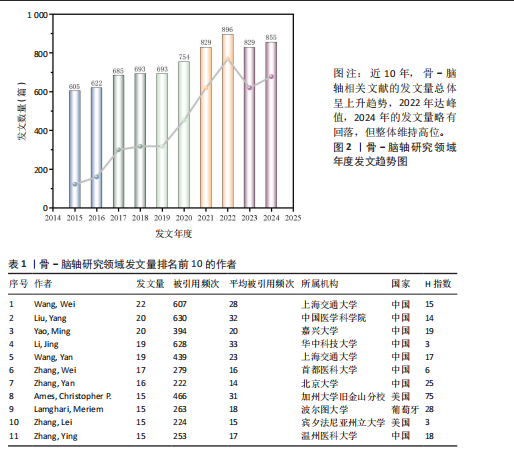
2.1 年度发文趋势 对骨-脑轴研究领域的年度发文趋势进行可视化分析,结果如图2所示。2015-2024年间,骨-脑轴相关文献的发文量总体呈上升趋势。2015年发文量为605篇,随后逐年递增,至2019年达到693篇,2020年进一步增至754篇。2021年发文量显著上升至829篇,2022年达到峰值896篇。此后,2023年发文量略降至829篇,2024年回升至855篇。整体来看,近10年骨-脑轴领域的发文量增长了约41.3%,反映出该领域研究热度持续提升,尤其是2020-2022年增长尤为显著,可能与骨-脑轴在骨质疏松与神经退行性疾病关联研究中的重要性日益凸显有关。2024年的发文量略有回落,但整体维持高位。这提示该领域研究仍处于活跃发展阶段,并具有持续的科研潜力与学术影响力。
2.2 作者可视化结果 骨-脑轴领域作者分析结果如表1、图3所示。研究共涉及44 003名作者,其中发文量≥6篇的核心作者261位,发文量≥10篇的作者进一步筛选后构建共现网络。从发文量前10的作者数据来看,Wang Wei以22篇位居首位(被引用频次607,平均被引用频次28);其次是Liu Yang和Yao Ming,各发文20篇(Liu Yang被引用频次630,平均被引用频次32;Yao Ming被引用频次394,平均被引用频次20);Li Jing和Wang Yan分别以19篇并列第四(Li Jing被引用频次628,平均被引用频次33;Wang Yan被引用频次439,平均被引用频次23)。图中显示,Zhang Wei(17篇,
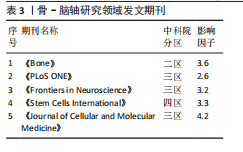
被引用频次279,平均被引用频次16)、Li Jing和Jake Xu等作者节点较大,且合作网络密集,表明其在领域内的核心地位。Zhang Ying(15篇,被引用频次253,平均被引用频次17)、Wang Wei和Chen Di等作者形成另一合作集群,合作关系较为紧密。整体来看,骨-脑轴领域作者合作网络呈现多中心分布,核心作者间协作频繁,但国际合作仍需拓展。
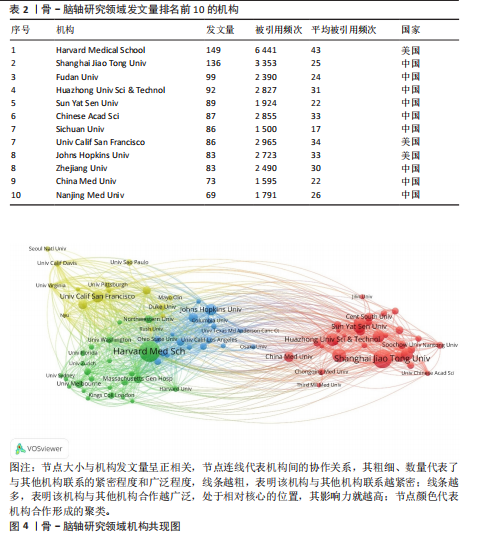
2.3 机构可视化结果 骨-脑轴领域机构共现分析结果如表2、图4所示。研究涉及7 329个机构,其中发文量≥30篇的机构共88个。发文量排名靠前的机构包括Harvard Medical School(哈佛医学院)、Zhejiang University(浙江大学)和Chinese Academy of Medical Sciences (中国医学科学院),形成多个合作集群。从发文量前10的机构数据来看,Harvard Medical School以149篇位居首位(被引用频次6 441,平均被引用频次43),远超其他机构,显示其在该领域的绝对领先地位,可能是由于其在神经科学和骨代谢研究中的资源优势和国际影响力。Shanghai Jiao Tong University(上海交通大学)以136篇位列第二(被引用频次3 353,平均被引用频次25),Fudan University(复旦大学)以99篇位列第三(被引用频次2 390,平均被引用频次24)。值得注意的是,University of California, San Francisco(加州大学旧金山分校)和Sichuan University(四川大学)均以86篇并列第七,但前者平均被引用频次(34)远高于后者(17),表明University of California, San Francisco (加州大学旧金山分校)的文献影响力更强,可能是其研究更具创新性或更受国际关注。Huazhong University of Science and Technology (华中科技大学,92篇)和Chinese Academy of Sciences(中国科学院,87篇)发文量虽略低于前三,但平均被引用频次较高,反映其研究质量较高。
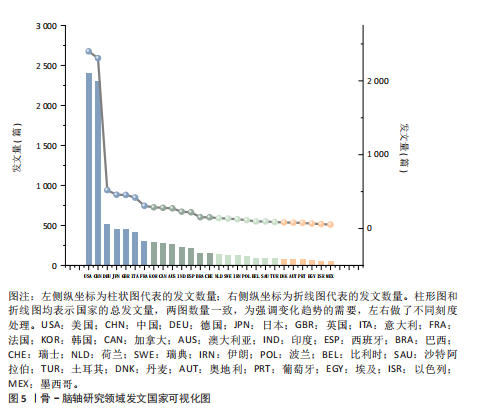
2.4 国家可视化结果 图5为发文量排名全球前28位的国家发文柱状图,United States(美国)以2 397篇位居首位,China(中国)以2 307篇紧随其后,Germany(德国)和Japan(日本)分别以515篇和455篇位列第三、四位,其余国家如United Kingdom(英国)、Italy(意大利)等发文量在200-418篇之间,呈现明显递减趋势。整体来看,骨-脑轴领域研究主要集中于北美、东亚和西欧,全球发文分布不均,发展中国家参与度较低。
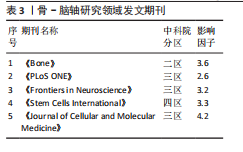
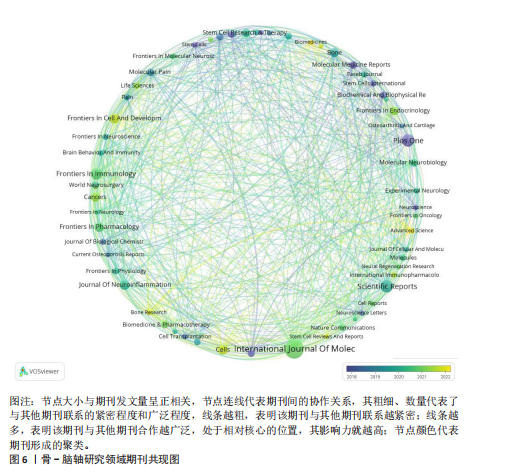
2.5 期刊可视化结果 骨-脑轴领域期刊共现分析结果如图6所示。图中节点大小反映期刊发文量,连接线表示期刊间引证关系,颜色条从蓝色(2018年)到黄色(2022年)表示发文时间演化。发文量较大的期刊包括《Bone》《PLoS ONE》和《Frontiers in Neuroscience》,其中《Bone》和《PLoS ONE》节点较大,表明其在领域内影响力突出,引证网络密集。Frontiers系列期刊如《Frontiers in Neuroscience》《Frontiers in Immunology》和《Frontiers in Neurology》形成紧密的引证集群,反映其在神经科学和免疫学交叉领域的活跃度。《Stem Cells International》和《Journal of Cellular and Molecular Medicine》等期刊发文时间集中于2020-2022年,显示近年研究热点上升趋势。整体来看,骨-脑轴领域文献主要集中于骨科、神经科学和细胞生物学相关期刊,引证网络以高影响力期刊为核心,近年跨学科期刊参与度有所提升。核心文献主要发表期刊的影响因子介于2.6-4.2之间,见表3。其中,《Bone》作为骨科学权威期刊,反映该领域对骨代谢基础研究的持续关注;而《Frontiers in Neuroscience》等神经类期刊的活跃发文则提示神经调控在骨-脑轴研究中的重要地位。此外,干细胞相关期刊如《Stem Cells International》亦有一定发文比重,显示干细胞介导的调节机制或将成为后续研究的潜在热点。总体来看,当前研究尚处于机制探索与交叉整合阶段,未来有望在高影响力期刊中进一步拓展。
2.6 关键词可视化结果
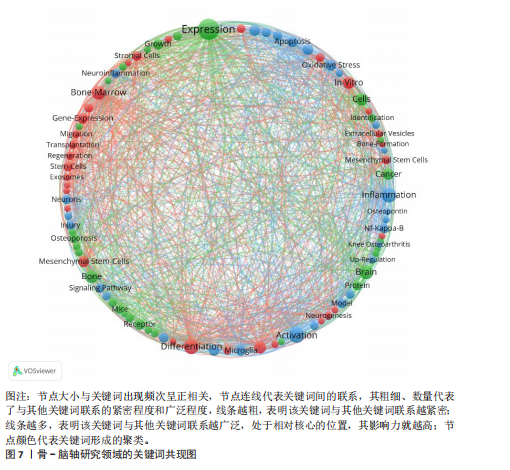
2.6.1 关键词共现结果 骨-脑轴领域关键词共现分析结果如图7所示。研究共涉及31 328个关键词,图中节点大小反映关键词出现频率,连接线表示关键词间的共现关系。通过VOSviewer的关键词共现聚类分析,识别出以下研究热点,包括“Bone Marrow”(骨髓)、“Stem
Cells”(干细胞)、“Osteoporosis”(骨质疏松)和“Neuroinflammation”(神经炎症),其中“Bone Marrow”(骨髓)和“Stem Cells”(干细胞)节点最大,表明其为研究热点,与“Mesenchymal Stem Cells”(间充质干细胞)、“Regeneration”(再生)和“Signaling Pathway”(信号通路)等关键词联系紧密,形成骨代谢与细胞治疗研究集群。“Osteoporosis”(骨质疏松)与“NF-Kappa-B”(核因子κB)、“Inflammation”(炎症)和“Oxidative Stress”(氧化应激)共现频繁,反映骨质疏松症与炎症和氧化应激的病理关联研究较多。此外,“Neuroinflammation”(神经炎症)与“Brain”(大脑)、“Microglia”(小胶质细胞)和“Neurogenesis”(神经发生)形成神经退行性疾病相关研究聚类,显示骨-脑轴在神经炎症和脑功能调控中的重要性。整体来看,骨-脑轴领域关键词网络呈现多主题交叉,骨代谢、炎症和神经调控为主要研究方向。
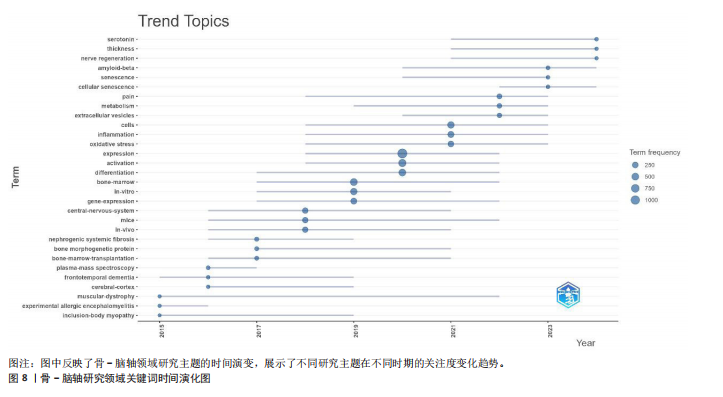
2.6.2 关键词时间演化结果 骨-脑轴领域关键词时间演化分析结果如图8所示。图中横轴为年份(2015-2023),纵轴为关键词,圆点大小表示出现频率(250-1 000次)。早期(2015-2017年),关键词如“inclusion-body myopathy”(包涵体肌病)、“experimental allergic
encephalomyelitis”(实验性变态反应性脑脊髓炎)和“muscular-dystrophy”(肌肉萎缩症)较为活跃,反映神经肌肉疾病研究初期的关注。2017-2019年,“bone-marrow-transplantation”(骨髓移植)、“nephrogenic systemic fibrosis”(肾源性系统性纤维化)和“mice”(小鼠)等关键词频率增加,表明骨-脑轴研究向动物模型和骨髓相关机制拓展。2020年后,“oxidative stress”(氧化应激)、“inflammation”(炎症)和“extracellular vesicles”(细胞外囊泡)等关键词显著增多,频率达750-1 000次,显示炎症和氧化应激在骨-脑轴病理机制中的核心地位。近期(2022-2023年),“serotonin”(血清素)、“thickness”(厚度)和“nerve regeneration”(神经再生)成为热点,反映研究聚焦神经递质和再生机制。整体来看,骨-脑轴领域关键词随时间演化呈现从神经肌肉病理向炎症、氧化应激及神经再生方向的转变。
2.6.3 关键词突现结果 骨-脑轴领域关键词突现分析结果如图9所示。图中列出了2015-2024年间突现强度排名前20的关键词,红色区间表示突现活跃期,突现强度反映关键词的爆发性关注度。“in vivo”(体内)以41.23的最高强度于2015-2018年突现,表明体内实验研究在此阶段受到广泛关注。“mice”(小
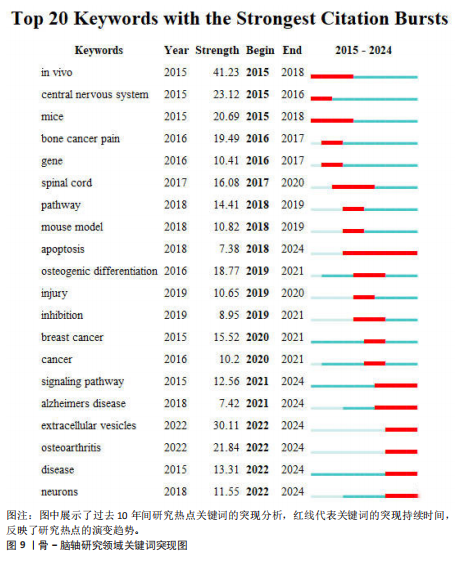
鼠)以20.69强度同期突现,显示小鼠模型的广泛应用。“extracellular vesicles”(细胞外囊泡)和“osteoarthritis”(骨关节炎)分别以31.84和13.31强度在2022-2024年突现,反映近年对细胞外囊泡和骨关节炎机制的关注激增。2016-2017年间,“bone cancer pain”(骨癌痛)以19.49强度突现,2018-2019年“pathway”(通路)和“mouse model”(小鼠模型)分别以14.41和10.82强度活跃,显示分子通路和小鼠模型研究的热潮。此外,“alzheimers disease”(阿尔茨海默病)和“neurons”(神经元)在2021-2024年间突现,强度分别为7.42和11.55,表明神经退行性疾病成为近期研究焦点。整体来看,骨-脑轴领域关键词突现趋势从早期体内实验和小鼠模型研究,逐步转向细胞外囊泡、骨关节炎和神经退行性疾病的机制探索。


