Chinese Journal of Tissue Engineering Research ›› 2026, Vol. 30 ›› Issue (33): 8802-8810.doi: 10.12307/2026.386
Previous Articles Next Articles
Effects of different non-invasive brain stimulation modalities on unilateral spatial neglect after stroke: a network meta-analysis
Wang Dehua1, Liang Chunting1, Cheng Xiaofei1, Li Sihui1, Yao Xiaoduo2, Tang Jiqin3
- 1College of Rehabilitation Medicine, 3College of Continuing Education, Shandong University of Traditional Chinese Medicine, Jinan 250355, Shandong Province, China; 2College of Rehabilitation, Shandong Second Medical University, Weifang 261053, Shandong Province, China
-
Received:2025-07-11Revised:2025-10-15Online:2026-11-28Published:2026-06-17 -
Contact:Tang Jiqin, Associate professor, Master’s supervisor, College of Continuing Education, Shandong University of Traditional Chinese Medicine, Jinan 250355, Shandong Province, China -
About author:Wang Dehua, MS candidate, College of Rehabilitation Medicine, Shandong University of Traditional Chinese Medicine, Jinan 250355, Shandong Province, China -
Supported by:Science and Technology Research Program of Shandong Society of Geriatrics, No. LKJGG2021Z018 (to TJQ)

CLC Number:
Cite this article
Wang Dehua, Liang Chunting, Cheng Xiaofei, Li Sihui, Yao Xiaoduo, Tang Jiqin. Effects of different non-invasive brain stimulation modalities on unilateral spatial neglect after stroke: a network meta-analysis[J]. Chinese Journal of Tissue Engineering Research, 2026, 30(33): 8802-8810.
share this article
Add to citation manager EndNote|Reference Manager|ProCite|BibTeX|RefWorks
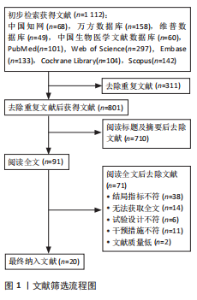
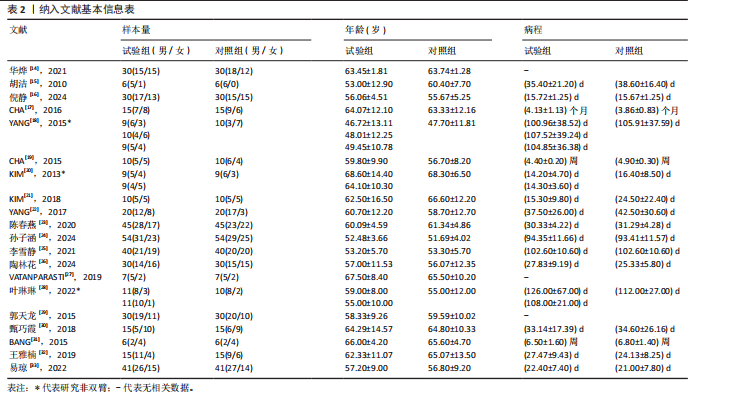
2.1 文献筛选结果 初步检索共获得1 112篇文献,严格按照纳入、排除标准进行筛选,最终纳入20项随机对照试验[14-33],总样本量为900例,其中试验组472例,对照组428例,文献筛选流程见图1。"
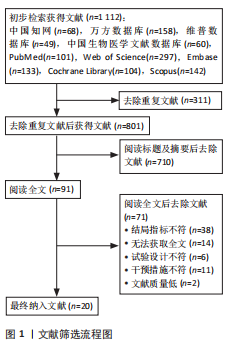
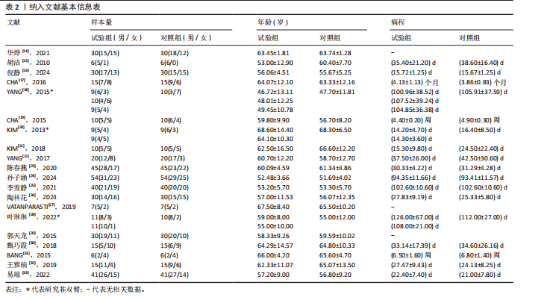
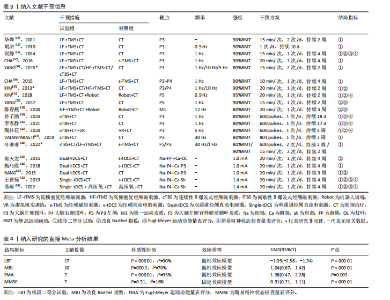
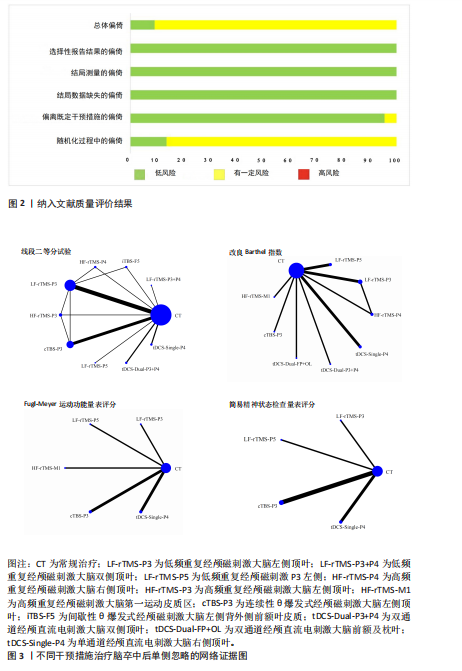
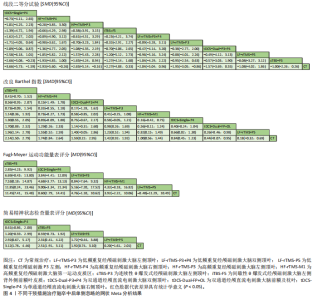
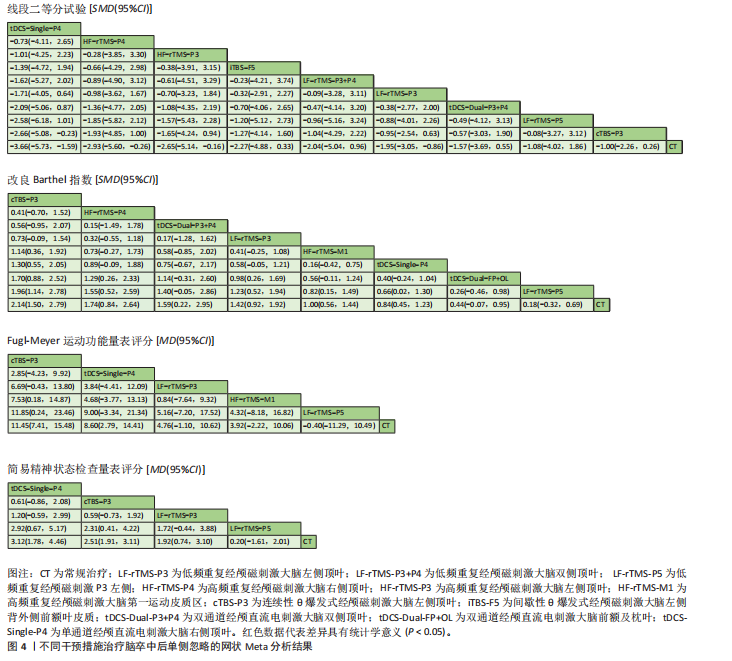
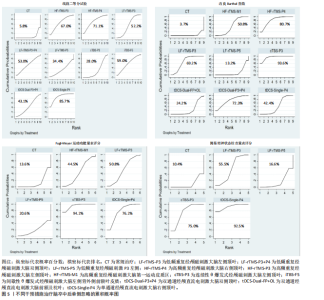
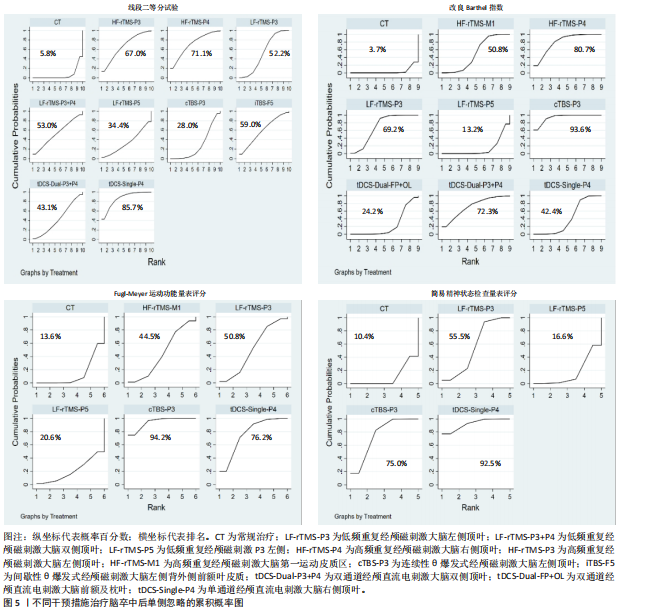
2.2 纳入文献基本特征 共纳入20篇文献,发表年限为2010-2024年,干预周期为10-28 d,纳入文献涉及低频重复经颅磁刺激(Low-frequency repetitive transcranial magnetic stimulation,LF-rTMS)大脑左侧顶叶(LF-rTMS-P3)、低频重复经颅磁刺激大脑双侧顶叶(LF-rTMS-P3+ P4)、低频重复经颅磁刺激P3左侧(LF-rTMS-P5)、高频重复经颅磁刺激(High-frequency repetitive transcranial magnetic stimulation,HF-rTMS)大脑右侧顶叶(HF-rTMS-P4)、高频重复经颅磁刺激大脑左侧顶叶(HF-rTMS-P3)、高频重复经颅磁刺激大脑第一运动皮质区(HF-rTMS-M1)、连续性θ爆发式经颅磁刺激(Continuous theta burst stimulation,cTBS)大脑左侧顶叶(cTBS-P3)、间歇性θ爆发式经颅磁刺激(Intermittent theta burst stimulation,iTBS)大脑左侧背外侧前额叶皮质(iTBS-F5)、双通道经颅直流电刺激大脑双侧顶叶(tDCS-Dual-P3+P4)、双通道经颅直流电刺激大脑前额及枕叶(tDCS-Dual-FP+OL)、单通道经颅直流电刺激大脑右侧顶叶(tDCS-Single-P4)在内的11项非侵入脑刺激的不同干预方案以及常规治疗,见表2,3。 2.3 偏倚风险评估结果 在纳入20篇文献中,3篇被评为低风险[17,19,28],其余17篇被评为存在一定风险,无高风险文献。13项研究提及随机序列的产生办法,包括随机数字表法、随机信封法等,6项研究仅提及随机二字,具体方法未知,1项研究未提及分组方法[14]。在盲法方面:1项研究为双盲试验[20],7项研究对评估治疗者设盲,2项研究对受试者施盲[17,19]。所有纳入研究均数据完整,不存在结局数据缺失及结果的选择性报道偏倚,见 图2。 2.4 直接Meta分析结果 传统Meta分析共纳入20篇文献[14-33],线段二等分试验、改良Barthel指数、Fugl-Meyer运动功能量表评分3个结局指标的异质性均较高,因此选用随机效应模型;简易精神状态检查量表评分异质性较低,选用固定效应模型。研究结果显示非侵入性脑刺激对各项结局指标的治疗效果均优于常规康复,见表4。 2.5 网状Meta分析结果 2.5.1 线段二等分试验 共有17项研究报道了线段二等分试验,涉及10种干预措施。整体不一致性检验结果显示P=0.74,说明直接与间接比较结果较为一致,网络证据图(图3)显示共形成6个闭环,采用节点劈裂法对局部进行环不一致性检验,发现各组数据P值处于0.22-0.89之间,因此采用一致性模型进行分析。 网状Meta结果显示:单通道经颅直流电刺激大脑右侧顶叶、高频重复经颅磁刺激大脑右侧顶叶、高频重复经颅磁刺激大脑左侧顶叶、低频重复经颅磁刺激大脑左侧顶叶4种干预措施治疗效果优于常规治疗;单通道经颅直流电刺激大脑右侧顶叶优于连续性θ爆发式经颅磁刺激大脑左侧顶叶;其他各个干预措施间比较差异并无统计学意义,见图4。 依据SUCRA对干预措施治疗效果进行排序,结果显示:单通道经颅直流电刺激大脑右侧顶叶(85.7%) > 高频重复经颅磁刺激大脑右侧顶叶(71.1%) > 高频重复经颅磁刺激大脑左侧顶叶(67.0%) > 间歇性θ爆发式经颅磁刺激大脑左侧背外侧前额叶皮质(59.0%) > 低频重复经颅磁刺激大脑双侧顶叶(53.0%) > 低频重复经颅磁刺激大脑左侧顶叶(52.2%) > 双通道经颅直流电刺激大脑双侧顶叶(43.1%) > 低频重复经颅磁刺激P3左侧(34.4%) > 连续性θ爆发式经颅磁刺激大脑左侧顶叶(28.0%) > 常规治疗(5.8%),见 图5。 2.5.2 改良Barthel指数 共有10项研究报道了改良Barthel指数,涉及9种干预措施。整体不一致性检验结果显示P=0.93,说明直接与间接比较结果较为一致,网络证据图(图3)显示形成1个闭环,采用节点劈裂法对局部进行环不一致性检验,结果显示P=0.95,采用一致性模型进行分析。 网状Meta结果显示:连续性θ爆发式经颅磁刺激大脑左侧顶叶、高频重复经颅磁刺激大脑右侧顶叶、双通道经颅直流电刺激大脑双侧顶叶、低频重复经颅磁刺激大脑左侧顶叶、高频重复经颅磁刺激大脑第一运动皮质区、单通道经颅直流电刺激大脑右侧顶叶6种干预措施优于常规治疗;连续性θ爆发式经颅磁刺激大脑左侧顶叶、高频重复经颅磁刺激大脑右侧顶叶、低频重复经颅磁刺激大脑左侧顶叶、高频重复经颅磁刺激大脑第一运动皮质区、单通道经颅直流电刺激大脑右侧顶叶5种干预措施优于低频重复经颅磁刺激P3左侧;连续性θ爆发式经颅磁刺激大脑左侧顶叶、高频重复经颅磁刺激大脑右侧顶叶、低频重复经颅磁刺激大脑左侧顶叶3种干预措施优于双通道经颅直流电刺激大脑前额及枕叶;连续性θ爆发式经颅磁刺激大脑左侧顶叶优于单通道经颅直流电刺激大脑右侧顶叶及高频重复经颅磁刺激大脑第一运动皮质区,其他对照间差异无统计学意义,见图4。 依据SUCRA对干预措施治疗效果进行排序,结果显示:连续性θ爆发式经颅磁刺激大脑左侧顶叶(93.6%)> 高频重复经颅磁刺激大脑右侧顶叶(80.7%)> 双通道经颅直流电刺激大脑双侧顶叶(72.3%)> 低频重复经颅磁刺激大脑左侧顶叶(69.2%)> 高频重复经颅磁刺激大脑第一运动皮质区(50.8%)> 单通道经颅直流电刺激大脑右侧顶叶(42.4%)> 双通道经颅直流电刺激大脑前额及枕叶(24.2%)> 低频重复经颅磁刺激P3左侧(13.2%)>常规治疗(3.7%),见图5。 2.5.3 Fugl-Meyer运动功能量表评分 共7项研究报道了Fugl-Meyer运动功能量表评分,涉及6种干预措施。由于未形成闭环,因此无需进行不一致性检验,见图3。 网状Meta分析结果显示:连续性θ爆发式经颅磁刺激大脑左侧顶叶、单通道经颅直流电刺激大脑右侧顶叶优于常规治疗;连续性θ爆发式经颅磁刺激大脑左侧顶叶优于高频重复经颅磁刺激大脑第一运动皮质区、低频重复经颅磁刺激P3左侧;其他对照间差异无统计学意义,见图4。 依据SUCRA对干预措施治疗效果进行排序,结果显示:连续性θ爆发式经颅磁刺激大脑左侧顶叶(94.2%)> 单通道经颅直流电刺激大脑右侧顶叶(76.2%)> 低频重复经颅磁刺激大脑左侧顶叶(50.8%)> 高频重复经颅磁刺激大脑第一运动皮质区(44.5%)> 低频重复经颅磁刺激P3"
"

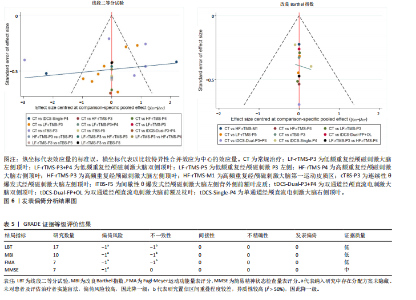
左侧(20.6%)> 常规治疗(13.6%),见图5。 2.5.4 简易精神状态检查量表评分 共7项研究报道了简易精神状态检查量表评分,涉及5种干预措施。由于未形成闭环,因此无需进行不一致性检验,见图3。 网状Meta分析结果显示:单通道经颅直流电刺激大脑右侧顶叶、连续性θ爆发式经颅磁刺激大脑左侧顶叶、低频重复经颅磁刺激大脑左侧顶叶优于常规治疗;单通道经颅直流电刺激大脑右侧顶叶、连续性θ爆发式经颅磁刺激大脑左侧顶叶优于低频重复经颅磁刺激P3左侧;其他对照间差异无统计学意义,见图4。 依据SUCRA对干预措施治疗效果进行排序,结果显示:单通道经颅直流电刺激大脑右侧顶叶(92.5%)> 连续性θ爆发式经颅磁刺激大脑左侧顶叶(75.0%)> 低频重复经颅磁刺激大脑左侧顶叶(55.5%)> 低频重复经颅磁刺激P3左侧(16.6%)> 常规治疗(10.4%),见图5。 2.6 发表偏倚评估 绘制偏倚漏斗图对纳入文献≥10篇的结局指标进行偏倚风险评估。结果显示:针对线段二等分试验,漏斗图内各点分布不均匀,且有部分落在范围外及漏斗底部,提示存在一定的发表偏倚风险及小样本效应;针对改良Barthel指数,各散点均位于漏斗图内且分布较为对称,提示偏倚风险较小,但有样本落在漏斗底部,提示可能存在小样本效应,见图6。 2.7 证据等级评价结果 由于此次研究纳入的大部分文献中存在分配隐藏、盲法描述不清楚的现象,因此对偏倚风险一项全部降级;而线段二等分试验、改良Barthel指数、Fugl-Meyer运动功能量表评分3项的异质性较高,所以对其不一致性降级。结果显示:线段二等分试验、改良Barthel指数、Fugl-Meyer运动功能量表评分3项证据等级均为低级,简易精神状态检查量表评分为中级,见表5。 2.8 不良反应 少数研究提及试验过程中患者耐受良好,没有出现任何不良反应,表明非侵入性脑刺激疗法安全性较高。"
"
"
"

| [1] TU WJ, ZHAO Z, YIN P, et al. Estimated Burden of Stroke in China in 2020. JAMA Netw Open. 2023;6(3):e231455. [2] SHEPPARD SM, SEBASTIAN R. Diagnosing and managing post-stroke aphasia. Expert Rev Neurother. 2021;21(2):221-234. [3] DA SILVA TR, DE CARVALHO NUNES HR, MARTINS LG, et al. Non-invasive Brain Stimulation Can Reduce Unilateral Spatial Neglect after Stroke: ELETRON Trial. Ann Neurol. 2022;92(3):400-410. [4] ESPOSITO E, SHEKHTMAN G, CHEN P. Prevalence of spatial neglect post-stroke: A systematic review. Ann Phys Rehabil Med. 2021;64(5):101459. [5] GAMMERI R, IACONO C, RICCI R, et al. Unilateral Spatial Neglect After Stroke: Current Insights. Neuropsychiatr Dis Treat. 2020;16:131-152. [6] 杨媛媛,周珊珊,成小菲,等.非侵入性脑刺激治疗脑卒中后下肢运动功能障碍的网状Meta分析[J].中国组织工程研究,2026,30(4):1008-1018. [7] DE BOER NS, SCHLUTER RS, DAAMS JG, et al. The effect of non-invasive brain stimulation on executive functioning in healthy controls: A systematic review and meta-analysis. Neurosci Biobehav Rev. 2021;125:122-147. [8] YANG T, LIU W, HE J, et al. The cognitive effect of non-invasive brain stimulation combined with cognitive training in Alzheimer’s disease and mild cognitive impairment: a systematic review and meta-analysis. Alzheimers Res Ther. 2024;16(1):140. [9] REN M, XU J, WANG W, et al. Effect of Dual-Site Non-Invasive Brain Stimulation on Upper-Limb Function After Stroke: A Systematic Review and Meta-Analysis. Brain Behav. 2024; 14(11):e70145. [10] 刘永香,严璐,潘益洁,等.脑卒中后单侧空间忽略症的康复研究进展[J].贵州中医药大学学报,2024,46(6):91-95. [11] LI KP, WU JJ, ZHOU ZL, et al. Noninvasive Brain Stimulation for Neurorehabilitation in Post-Stroke Patients. Brain Sci. 2023;13(3):451. [12] 张琦,孙增鑫,赵越,等.经颅直流电刺激对脑卒中患者单侧忽略康复效果的影响:网状meta分析[J].临床荟萃,2024,39(12):1061-1072. [13] KASHIWAGI FT, EL DIB R, GOMAA H, et al. Noninvasive Brain Stimulations for Unilateral Spatial Neglect after Stroke: A Systematic Review and Meta-Analysis of Randomized and Nonrandomized Controlled Trials. Neural Plast. 2018;2018:1638763. [14] 华烨,陈嘉源,张鑫. 低频重复经颅磁刺激治疗视觉空间忽略的临床研究[J].中国医药指南, 2021,19(23):58-59. [15] 胡洁,杜博琪,岳月红,等.重复经颅磁刺激的累积效应在治疗偏侧忽略中的作用研究[J].中国康复医学杂志,2010, 25(4):311-314. [16] 倪静,杨和亮,汪加胜,等.重复经颅磁刺激联合康复训练治疗单侧空间忽略的临床效果[J].中外医学研究,2024,22(14):5-8. [17] CHA HG, KIM MK. Effects of repetitive transcranial magnetic stimulation on arm function and decreasing unilateral spatial neglect in subacute stroke: a randomized controlled trial. Clin Rehabil. 2016;30(7):649-656. [18] YANG W, LIU TT, SONG XB, et al. Comparison of different stimulation parameters of repetitive transcranial magnetic stimulation for unilateral spatial neglect in stroke patients. J Neurol Sci. 2015;359(1-2):219-225. [19] CHA HG, KIM MK. The effects of repetitive transcranial magnetic stimulation on unilateral neglect of acute stroke patients: A randomised controlled trial. Hong Kong Physiother J. 2015; 33(2):53-58. [20] KIM BR, CHUN MH, KIM DY, et al. Effect of high- and low-frequency repetitive transcranial magnetic stimulation on visuospatial neglect in patients with acute stroke: a double-blind, sham-controlled trial. Arch Phys Med Rehabil. 2013;94(5):803-807. [21] KIM SB, LEE KW, LEE JH, et al. Effect of Combined Therapy of Robot and Low-Frequency Repetitive Transcranial Magnetic Stimulation on Hemispatial Neglect in Stroke Patients. Ann Rehabil Med. 2018;42(6):788-797. [22] YANG NY, FONG KN, LI-TSANG CW, et al. Effects of repetitive transcranial magnetic stimulation combined with sensory cueing on unilateral neglect in subacute patients with right hemispheric stroke: a randomized controlled study. Clin Rehabil. 2017;31(9):1154-1163. [23] 陈春燕,袁华,惠楠,等.经颅磁刺激联合康复机器人训练对脑卒中患者偏侧忽略及视觉电生理的影响[J].海南医学,2020,31(17):2187-2190. [24] 孙子涵,肖淑利,徐雁华,等.行为学疗法联合重复经颅磁刺激对脑卒中后单侧空间忽略患者的影响研究[J].国际临床研究杂志,2024,8(8): 17-19. [25] 李雪静,周星楠,许将.行为学疗法联合重复经颅磁刺激对脑卒中后单侧空间忽略患者的影响研究[J].实用心脑肺血管病杂志,2021,29(1): 31-35. [26] 陶林花,曾明,任志彬,等.基于TBS模式的重复经颅磁刺激联合虚拟现实治疗脑卒中单侧空间忽略的效果观察[J].浙江医学,2024,46(6): 630-633+642. [27] VATANPARASTI S, KAZEMNEJAD A, YOONESSI A, et al. The Effect of Continuous Theta-Burst Transcranial Magnetic Stimulation Combined with Prism Adaptation on the Neglect Recovery in Stroke Patients. J Stroke Cerebrovasc Dis. 2019; 28(11):104296. [28] 叶琳琳,曹磊,张甜甜,等.健侧半球间歇θ脉冲刺激和低频重复经颅磁刺激治疗卒中后视空间忽略的效果比较[J].中国脑血管病杂志, 2022,19(2):79-87. [29] 郭天龙,刘景隆,郭宇.经颅直流电刺激对脑卒中后偏侧空间忽略的影响[J].中国伤残医学, 2015,23(8):21-23. [30] 甄巧霞,刘爱贤,郄淑燕,等经颅直流电刺激结合认知训练治疗单侧空间忽略的临床研究[J].中国康复医学杂志,2018, 33(7):855-857. [31] BANG DH, BONG SY. Effect of combination of transcranial direct current stimulation and feedback training on visuospatial neglect in patients with subacute stroke: a pilot randomized controlled trial. J Phys Ther Sci. 2015;27(9):2759-2761. [32] 王雅楠,孙乐影,刘田,等.经颅直流电刺激改善偏侧空间忽略及运动功能的疗效观察[J]. 中国康复,2019,34(8):403-406. [33] 易琼,孙文琳,祁玉军.经颅直流电刺激联合高压氧疗治疗脑卒中后单侧空间忽略患者的临床效果研究[J].实用心脑肺血管病杂志, 2022,30(2):24-28. [34] SALATINO A, ZAVATTARO C, GAMMERI R, et al. Virtual reality rehabilitation for unilateral spatial neglect: A systematic review of immersive, semi-immersive and non-immersive techniques. Neurosci Biobehav Rev. 2023;152:105248. [35] VALLAR G, CALZOLARI E. Unilateral spatial neglect after posterior parietal damage. Handb Clin Neurol. 2018;151:287-312. [36] DURFEE AZ, HILLIS AE. Unilateral Spatial Neglect Recovery Poststroke. Stroke. 2023; 54(1):10-19. [37] LIN R, ZHANG JJ, ZHONG L, et al. Does repetitive transcranial magnetic stimulation have a beneficial effect on improving unilateral spatial neglect caused by stroke? A meta-analysis. J Neurol. 2024;271(10):6494-6507. [38] MILLOT S, BEIS JM, PIERRET J, et al. Innovative Therapy Combining Neck Muscle Vibration and Transcranial Direct Current Stimulation in Association with Conventional Rehabilitation in Left Unilateral Spatial Neglect Patients: HEMISTIM Protocol for a Randomized Controlled Trial. Brain Sci. 2023;13(4):678. [39] TAKAMURA Y, FUJII S, OHMATSU S, et al. Interaction between spatial neglect and attention deficit in patients with right hemisphere damage. Cortex. 2021;141:331-346. [40] UEDA M, YURI T, UENO K, et al. The Neurophysiological Features Associated with Unilateral Spatial Neglect Recovery: A Scoping Review. Brain Topogr. 2023;36(5):631-643. [41] KARNATH HO. Spatial attention systems in spatial neglect. Neuropsychologia. 2015;75:61-73. [42] LUNVEN M, BARTOLOMEO P. Attention and spatial cognition: Neural and anatomical substrates of visual neglect. Ann Phys Rehabil Med. 2017; 60(3):124-129. [43] BARRETT AM, HOUSTON KE. Update on the Clinical Approach to Spatial Neglect. Curr Neurol Neurosci Rep. 2019;19(5):25. [44] DI GREGORIO F, LA PORTA F, LULLINI G, et al. Efficacy of Repetitive Transcranial Magnetic Stimulation Combined With Visual Scanning Treatment on Cognitive-Behavioral Symptoms of Unilateral Spatial Neglect in Patients With Traumatic Brain Injury: Study Protocol for a Randomized Controlled Trial. Front Neurol. 2021;12:702649. [45] LI L, HUANG H. Noninvasive neuromodulation for unilateral neglect after stroke: a systematic review and network meta-analysis. Neurol Sci. 2022;43(10):5861-5874. [46] ANDRES M, MASSON N, LARIGALDIE N, et al. Transcranial electric stimulation optimizes the balance of visual attention across space. Clin Neurophysiol. 2020;131(4):912-920. [47] YI YG, CHUN MH, DO KH, et al. The Effect of Transcranial Direct Current Stimulation on Neglect Syndrome in Stroke Patients. Ann Rehabil Med. 2016;40(2):223-229. [48] FONTENEAU C, REDOUTE J, HAESEBAERT F, et al. Frontal Transcranial Direct Current Stimulation Induces Dopamine Release in the Ventral Striatum in Human. Cereb Cortex. 2018;28(7):2636-2646. [49] WU C, LI MN, FENG YW, et al. Continuous theta burst stimulation provides neuroprotection by accelerating local cerebral blood flow and inhibiting inflammation in a mouse model of acute ischemic stroke. Brain Res. 2020;1726:146488. [50] HOUBEN M, CHETTOUF S, VAN DER WERF YD, et al. Theta-burst transcranial magnetic stimulation for the treatment of unilateral neglect in stroke patients: A systematic review and best evidence synthesis. Restor Neurol Neurosci. 2021;39(6): 447-465. [51] FU W, CAO L, ZHANG Y, et al. Continuous theta-burst stimulation may improve visuospatial neglect via modulating the attention network: a randomized controlled study. Top Stroke Rehabil. 2017;24(4):236-241. |
| [1] | Wang Zheng, Cheng Ji, Yu Jinlong, Liu Wenhong, Wang Zhaohong, Zhou Luxing. Progress and future perspectives on the application of hydrogel materials in stroke therapy [J]. Chinese Journal of Tissue Engineering Research, 2026, 30(8): 2081-2090. |
| [2] | Gao Feng, Zhang Jun, Yu Wenjun, Chanyu Yujing, Zhao Le, Hu Yuting, Wang Junhua, Liu Yongfu. Effects of wrist-hand orthosis on hand dysfunction in stroke patients: a meta-analysis [J]. Chinese Journal of Tissue Engineering Research, 2026, 30(8): 2124-2131. |
| [3] | Tao Daiju, Su Haiyu, Wang Yuqi, Shen Zhiqiang, He Bo . Construction and identification of stable PC12 cell lines with high/low expression of miR-122-5p [J]. Chinese Journal of Tissue Engineering Research, 2026, 30(7): 1790-1799. |
| [4] | Cao Xinyan, Yu Zifu, Leng Xiaoxuan, Gao Shiai, Chen Jinhui, Liu Xihua. Effect of repetitive transcranial magnetic stimulation and transcranial direct current stimulation on motor function and gait in children with cerebral palsy: a network meta-analysis [J]. Chinese Journal of Tissue Engineering Research, 2026, 30(6): 1539-1548. |
| [5] | Yang Yuanyuan, Zhou Shanshan, Cheng Xiaofei, Feng Luye, Tang Jiqin. Network meta-analysis of non-invasive brain stimulation in the treatment of lower limb motor dysfunction after stroke [J]. Chinese Journal of Tissue Engineering Research, 2026, 30(4): 1008-1018. |
| [6] | Li Wenhao, Sun Tai, Li Boyang, Sun Shiqiang, Du Xinran, Wang Youpeng, Bai Shi, Li Zhongshan. Effects of low-frequency pulsed electromagnetic fields on skeletal muscle structure in post-stroke hemiplegic patients and the potential mechanism for health promotion [J]. Chinese Journal of Tissue Engineering Research, 2026, 30(36): 9479-9487. |
| [7] | Yang Jiao, Wang Zhifeng, Shi Ting, Xu Shuangfeng, Tian Daman, Lan Junfeng, He Pengfen, Hao Zhihui, Pan Pan, Wang Jian. Electroacupuncture regulates mitochondrial copper homeostasis to modulate neuroinflammatory injury in rats with ischemic stroke [J]. Chinese Journal of Tissue Engineering Research, 2026, 30(36): 9519-9525. |
| [8] | Huang Yunshi, Chai Linsong, Ni Jinglei, Zuo Shuang, Lin Bingbing, Huang Jia. Development and evaluation of a prediction model for functional language communication outcomes in post-stroke aphasia patients [J]. Chinese Journal of Tissue Engineering Research, 2026, 30(36): 9604-9612. |
| [9] | Su Xu, Zhang Xiaoxi, Yang Yaqing, Fu Zhenyi, Liu Jiaxin. Mechanism by which non-apoptotic regulated cell death induces neuronal injury in ischemic stroke [J]. Chinese Journal of Tissue Engineering Research, 2026, 30(35): 9281-9293. |
| [10] | Wang Xiaojing, Wei Jingyi, Liu Xihua. A visualized analysis of vagus nerve stimulation in the field of stroke rehabilitation [J]. Chinese Journal of Tissue Engineering Research, 2026, 30(35): 9316-9326. |
| [11] | . Regional specificity of brain organoids and their application in ischemic stroke modeling and drug development [J]. Chinese Journal of Tissue Engineering Research, 2026, 30(34): 9008-9016. |
| [12] | Zhang Ziwei, Pu Meng, Tang Yibin, Zheng Lulu, Liang Yajie, Liu Jian, Chen Ying, Wang Qing, Li Yanqing, Li Yanhua. Mechanisms of secondary demyelinating injury and inflammatory response in mice with acute ischemic stroke [J]. Chinese Journal of Tissue Engineering Research, 2026, 30(33): 8712-8720. |
| [13] | Li Bing, Su Yu, Quan Jialin, Yuan Yufeng, Wang Quanjun, Xie Ke, Wang Ping'an, Yu Songyuan. Effects of exercise intensity on cognitive function in different age groups: a meta-analysis [J]. Chinese Journal of Tissue Engineering Research, 2026, 30(33): 8811-8821. |
| [14] | Tang Ya, Li Long, Huang Du, Huang Zhaolu. Systematic review of the effect of 3D-printed exoskeleton on hand function rehabilitation in stroke patients [J]. Chinese Journal of Tissue Engineering Research, 2026, 30(29): 7648-7653. |
| [15] | Wang Xueting, Yang Wei, Wang Pengqin. Post-stroke rehabilitation robotics: current research status and hot topics in and outside China [J]. Chinese Journal of Tissue Engineering Research, 2026, 30(28): 7404-7409. |
| Viewed | ||||||
|
Full text |
|
|||||
|
Abstract |
|
|||||