Chinese Journal of Tissue Engineering Research ›› 2026, Vol. 30 ›› Issue (28): 7404-7409.doi: 10.12307/2026.816
Previous Articles Next Articles
Post-stroke rehabilitation robotics: current research status and hot topics in and outside China
Wang Xueting1, Yang Wei2, Wang Pengqin3
- 1The First Clinical College, Liaoning University of Traditional Chinese Medicine, Shenyang 110847, Liaoning Province, China; 2Department of Traditional Chinese Medicine Rehabilitation, First Veterans’ Hospital of Liaoning Province, Shenyang 110148, Liaoning Province, China; 3Second Department of Neurological Rehabilitation, The Affiliated Hospital of Liaoning University of Traditional Chinese Medicine, Shenyang 110032, Liaoning Province, China
-
Received:2025-09-10Revised:2025-12-12Online:2026-10-08Published:2026-02-25 -
Contact:Wang Pengqin, MD, Doctoral supervisor, Chief physician, Professor, Second Department of Neurological Rehabilitation, The Affiliated Hospital of Liaoning University of Traditional Chinese Medicine, Shenyang 110032, Liaoning Province, China -
About author:Wang Xueting, MD candidate, Attending physician, The First Clinical College, Liaoning University of Traditional Chinese Medicine, Shenyang 110847, Liaoning Province, China -
Supported by:National Administration of Traditional Chinese Medicine—Liaoning Peng’s Eye Acupuncture Academic School Inheritance Studio Project (Second Round), No. LPGZS2012-07 (to WPQ); Liaoning Provincial Central Government Guiding Local Science and Technology Development (Special Project), No. 2023JH6/100200005 (to WPQ); Basic Research Project of Liaoning Provincial Department of Education, No. LJKMZ20221337 (to WPQ); Shenyang Municipal Science and Technology Plan Project, No. 21-174-9-13 (to WPQ)

CLC Number:
Cite this article
Wang Xueting, Yang Wei, Wang Pengqin. Post-stroke rehabilitation robotics: current research status and hot topics in and outside China[J]. Chinese Journal of Tissue Engineering Research, 2026, 30(28): 7404-7409.
share this article
Add to citation manager EndNote|Reference Manager|ProCite|BibTeX|RefWorks
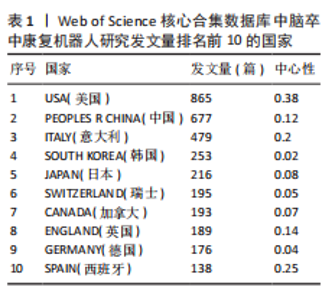
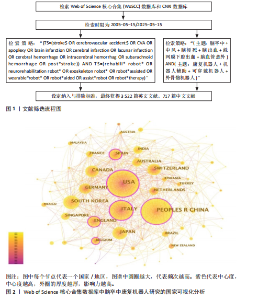
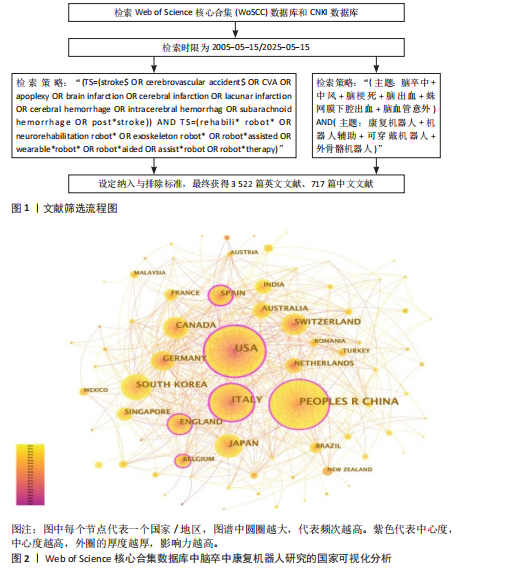
2.1 国家合作可视化分析 基于WoSCC数据库的统计,2005-2025年全球共有81个国家参与了有关脑卒中康复机器人的研究,具有明显的地域集中性,其中以美国、中国和意大利的研究占据主导地位。表1为发文量排名前10的国家,图2为国家合作的可视化谱图分析。美国是目前发文量最多的国家,且在国际合作中具有重要影响力(中心性=0.38);中国在该领域发文量达677篇,位居第二,在国际合作中具有一定的活跃度(中心性=0.12),但影响力较差,可能原因是国内对新技术的应用和推广不足,且缺乏大规模、高质量的临床研究,导致中国康复相关研究在国际上的引用率较低[5];意大利作为欧洲代表国家,发文量和中心性位居第三,与中美的合作较为密切。总体来看,脑卒中康复机器人的研究集中于少数几个科研实力较强的国家,北美洲的美国和加拿大,亚洲的中国、韩国和日本,欧洲的意大利、瑞士等国家合作较多,在该领域的研究中具有突出贡献,体现了跨洲合作的特点。"
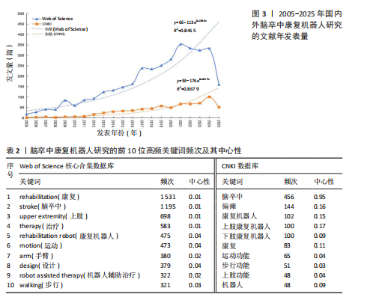
2.2 年发文量对比分析 年发文量及变化趋势可以衡量脑卒中康复机器人领域在特定时间段内研究热度的变化,评价并预测该领域的发展状况[6]。根据年发文量(图3)可知,国内外脑卒中康复机器人相关研究的文献发文量整体呈现逐年增长的趋势。在WoSCC数据库中,国外发文量增长速度较稳定,年增长率约为13.06%,R2=0.846 5,表明趋势线拟合度较高,其中2021年发文量达到高峰,为353篇,可能与COVID-19疫情爆发有关,2021年科研活动逐步恢复并集中发表,此后研究多侧重于远程监控[7]、智能居家康复以及自动化机器人的设计[8-9]。2022年至今,发文量趋于平缓,提示该领域的研究技术和理论趋于完善,正进一步深化人工智能、机器学习等多技术融合的持续发展[10]。相比之下,在CNKI数据库中,国内发文量增长较为迅猛,R2=0.867 9,表明趋势线拟合度较高,年增长率约高达20.17%,增速约为国外研究的1.5倍,体现了国内研究后期具有爆发性突破。国内研究虽起步晚、初始基数低,但在国家政策的扶持和技术的引进与创新推动下,逐渐展现出后发优势[11]。 2.3 关键词对比分析 关键词是文章主题的核心,关键词高频出现可反映相关领域的研究热点。关键词共现分析是揭示学术领域研究热点与发展趋势的重要方法,可直观反映学者们的关注焦点和研究方向[6]。表2列出了脑卒中康复机器人研究领域的前10位高频关键词及中心性。图4展示了高频关键词的共现网络图谱,"
"
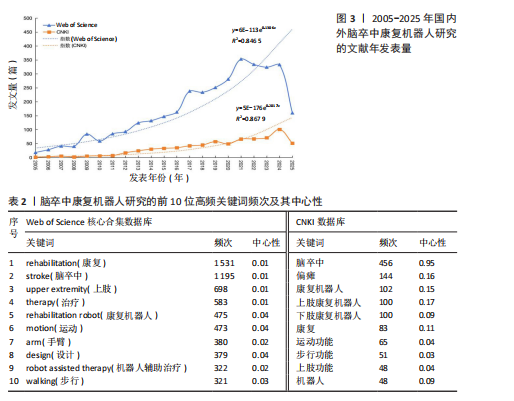
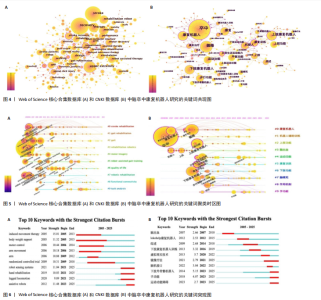
其中节点大小与出现频次呈正相关。“脑卒中”和“康复机器人”是检索主题词,故具有高频次和中心性。对比来看,国外研究热点聚焦于机器人技术的设计优化和临床应用,如高频词“rehabilitation robot”“design”和“motion”的中心性最高为0.04,这一特点在近期发表于《Stroke》期刊上的一篇综述中得到验证,该综述汇总分析了396例关于脑卒中康复机器人应用的随机对照试验研究,结果表明针对不同的机器人类型、脑卒中后不同康复阶段以及治疗方案,机器人在脑卒中患者运动功能改善方面都具有显著疗效[2]。国内研究则侧重于对脑卒中后功能结局的影响,如高频词“上肢功能”“运动功能”“步行功能”和“偏瘫”等,研究的内容和方向更加具体和贴近临床,主要针对不同类型的康复机器人对特定功能结局的疗效[4]。 2.4 脑卒中康复机器人的国内外研究热点分析 为进一步把握国内外有关脑卒中康复机器人的研究热点变化和时序规律,并预测未来研究趋势,需要对关键词进一步挖掘分析[6]。关键词聚类分析是指某领域中具有相似研究主题的主题词所构成的网络集群,图5展示了国内外脑卒中康复机器人研究的关键词聚类时区图谱,以揭示知识结构的演变和热度趋势,各分为10个聚类结果。基于WoSCC数据库,分别是“#0 Stroke rehabilitation(脑卒中后康复)”“#1 Gait rehabilitation(步态康复)”“#2 Gait(步态)”“#3 Rehabilitation robotics(康复机器人技术)”“#4 Motor imagery(运动想象)”“#5 Robot-assisted gait training(机器人辅助步态训练)”“#6 Quality of life(生活质量)”“#7 Robotic rehabilitation (机器人康复)”“#8 Functional connectivity (功能性连接)”“#9 Task analysis(任务分析)”。基于CNKI数据库,分别是“#0康复机器人”“#1机器人辅助训练”“#2上肢功能”“#3脑出血”“#4运动功能”“#5康复训练”“#6下肢功能”“#7脑梗死”“#8作用机制”“#9手功能”。 2.4.1 国外研究的热点和趋势 在关键词共现分析基础上进行突现率检测,图6展示了突现强度最高的前10位关键词。国外脑卒中康复机器人研究技术的发展可总结为以下3个阶段:第一阶段是机制探索期(2005-2009年),以聚类#0、#3和#7为核心,集中于脑卒中、机器人和康复3个方向研究的初步延伸。其中“Induced movement therapy(诱导运动疗法)”“Body weight support(体质量支持)”“Motor control(运动控制)”“Arm movement(手臂运动)”和“Arm(手臂)”是这一阶段的突现关键词,"

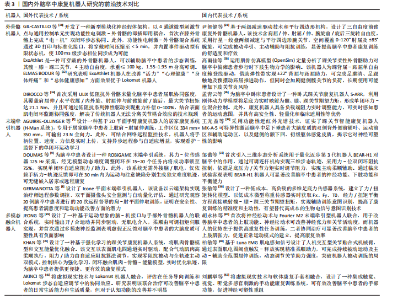
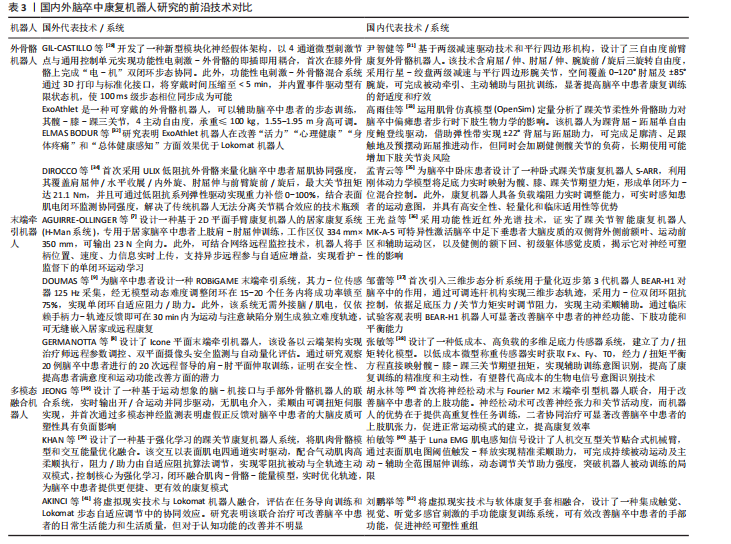
突现强度较高且热度延续至今。诱导运动疗法是指通过限制健侧肢体活动,强制患者使用患侧肢体进行康复训练,已被认定为一种安全有效的治疗方法[12-13]。该技术与康复机器人的联合治疗实现了多模态技术的创新融合,可提供精准控制和实时反馈,有效改善肢体运动功能,并降低对康复治疗师的依赖[12-13]。体质量支持治疗是指通过机械装置支撑患者部分体质量负担,以减轻在步态训练中的负重。外骨骼设备的应用,如Lokomat、Walkbot、RoboGait和GEAR等均具备体质量支撑和跑步机功能,可个性化定制训练任务和体质量支撑基数,是一种新兴的康复疗法[14-15]。此外,上肢功能的康复也是机器人辅助治疗的研究热点,如上肢外骨骼机器人可通过个性化定制多个自由度参数,模拟自然的上肢运动,帮助患者恢复运动控制和协调能力[16]。 第二阶段是临床转化期(2009-2021年),以聚类#1、#2、#5和#6为核心,此阶段研究重心从基础机制向临床应用转化,尤其是机器人辅助治疗脑卒中患者下肢功能,如步态康复,研究的内容更具体和贴近临床。2019年关键词“Randomized controlled trial(随机对照试验)”爆发性突现(强度是10.31),标志着康复机器人在脑卒中研究中的循证医学证据加速积累。机器人辅助步态训练是这一阶段的研究热点。一项Meta分析文献纳入了24项脑卒中机器人辅助步态训练有关的随机对照试验,在下肢功能、平衡功能、步行能力和耐力方面显示出良好的潜力,优于传统的步态训练[17]。在临床转化的同时,支撑性技术的研究也在持续深入,如2019年发表在《Stroke》期刊的可穿戴髋关节辅助机器人技术,通过临床试验证实可有效改善脑卒中患者的运动功能和步行效率,并有助于降低心肺代谢能量,具有可行性和便利性,在居家康复应用中具有重要意义[18]。 第三阶段是智能融合期(2021年至今),以聚类#4、#8、#9为核心,此阶段的基础研究和临床应用更加完善,多学科交叉与多技术融合成为主导趋势。这一阶段的突现关键词有“Robot sensing systems(机器人感知系统)”“Hand rehabilitation(手部康复)”“Legged locomotion(下肢运动)”“Assistive robots(辅助机器人)”,表现为高精度感知反馈[10]、精细手功能康复以及多样性辅助性功能机器人等前沿方向[19-20]。此外,机器学习技术在这一阶段兴起,目前已应用于脑卒中康复机器人的控制、运动分类、患者评估和意图预测,但可解释性和泛化性不足[10]。新旧技术的融合也是这一阶段的重点,如基于水凝胶传感器和柔性印刷电路板的多模态人机交互界面,通过精准采集肌电图和力肌图信号,利用人工智能进行解码,能高效准确地识别脑卒中患者的运动意图,在康复领域展现出应用前景[20]。例如传感系统在手部康复机器人的最新研究中融入了卷积神经网络算法,设计的智能TENG-SPA可用于评估脑卒中后手部痉挛分级,准确率达到了93.3%[19]。 2.4.2 国内研究的热点和趋势 与国外相比,脑卒中康复机器人在国内的研究起步较晚,可分为两个发展阶段。首先是技术引进和临床验证期(2005-2019年),在这一阶段康复机器人技术全面发展,包括肢体功能、康复训练和作用机制等方面研究。值得注意的是,“lokohelp康复机器人”是这一阶段的突现关键词(强度为2.53),是国内的研究热点。lokohelp康复机器人由韩国研发,具有部分体质量支持、末端驱动设计等特点,在改善患者的静态站立和平衡功能方面具有优势,但在精细控制能力方面不足。相较而言,lokomat康复机器人在国外的研究较多,由瑞士研发,采用外骨骼式机械结构,善于高强度、重复性训练以改善患者的行走和跑跳功能,但成本较高且操作复杂,未在国内普及[21-22]。 第二阶段是智能融合和精准康复期(2020至今),聚焦于神经科学、人工智能和机器人技术三方面融合,这一阶段国内外研究虽然在技术方向上同步,但在临床转化深度和技术整合路径上存在差异,如“虚拟现实技术”“镜像疗法”和“脑机接口”等关键词的突现,体现了国内脑卒中康复机器人技术的多模态发展趋势。脑机接口与机器人的融合研究在2022年成为研究热点,技术创新之处在于脑机接口通过采集脑电信号以捕捉神经活动,然后将患者的运动意图转化为指令驱动末端机器人,如腕关节机器人[23]、G-EO下肢机器人等以辅助康复训练[24]。同时,机器人通过执行任务,并整合视觉、本体觉等多模态反馈,也可反向调节大脑的活动[25]。镜像疗法运用镜子反射健侧肢体动作,以通过视觉反馈使患者自觉患侧肢体在进行相同的动作,可以激活大脑皮质相关区域。结合康复机器人治疗可以为患者提供外周的运动刺激和反馈,二者技术的融合可更有效地改善患者的运动控制能力,促进脑功能的重组和恢复[26]。此外,陆蓉蓉等[24]临床观察了脑机接口技术联合不同末端驱动设备(腕关节机器人和虚拟现实反馈)对32例脑卒中患者上肢功能的疗效,研究表明腕关节机器人可显著增强肌肉收缩能力和皮质脊髓束兴奋性,效果优于虚拟现实反馈。近年来国内脑卒中康复机器人的研究发展迅速且全面,但有关长期、大规模的临床疗效验证较少,且缺乏安全性指标和经济效益的评价。 2.4.3 国内外前沿技术对比分析 综上所述,国内外脑卒中康复机器人的研究均呈现多模态智能融合、临床转化增强的趋势,但二者在技术创新、设计优化、临床转化路径等方面存在差异。接下来以图表的形式对国内外的前沿技术进一步对比分析(表3)[7-9,27-41],将康复机器人按照形态学分为外骨骼机器人、末端牵引机器人以及多模态融合机器人。国外侧重于神经生理信号的融合[27]、高级算法和模型的构建[28],而国内则聚集于不同康复技术和疗法与机器人的协同治疗。此外,国内的中医传统疗法与机器人的融合具有一定优势,如头针丛刺留针法结合上肢康复机器人可有效改善脑卒中患者上肢运动功能和肩关节活动度,优于单独的头穴和机器人治疗[29]。因此,国内外的研究虽具有差异性,但都趋向于提高脑卒中康复机器人的轻量化、智能化和实用性,具有互补特征。"
| [1] HILKENS NA, CASOLLA B, LEUNG TW, et al. The Stroke. Lancet. 2024;403(10446):2820-2836. [2] PARK JM, PARK HJ, YOON SY, et al. Effects of Robot-Assisted Therapy for Upper Limb Rehabilitation After Stroke: An Umbrella Review of Systematic Reviews. Stroke. 2025;56(5):1243-1252. [3] WANG J, LI Y, QI L, et al. Advanced rehabilitation in ischaemic stroke research. Stroke Vasc Neurol. 2024;9(4):328-343. [4] 罗胜利,孟巧玲,喻洪流.我国康复机器人技术研究与应用概况[J].中国康复医学杂志, 2023,38(12):1762-1768. [5] 姚婧璠,谢瑀婷,郭双辉,等.中国卒中康复20年[J].中国卒中杂志,2025,20(5):604-614. [6] CHEN CM. CiteSpace II: Detecting and visualizing emerging trends and transient patterns in scientific literature. J Am Soc Inf Sci Technol. 2006;57(3):359-377. [7] AGUIRRE-OLLINGER G, CHUA KSG, ONG PL, et al. Telerehabilitation using a 2-D planar arm rehabilitation robot for hemiparetic stroke: a feasibility study of clinic-to-home exergaming therapy. J Neuroeng Rehabil. 2024;21(1):207. [8] GERMANOTTA M, MAURO MC, FALCHINI F, et al. A robotic rehabilitation intervention in a home setting during the Covid-19 outbreak: a feasibility pilot study in patients with stroke. J Neuroeng Rehabil. 2025;22(1):93. [9] DOUMAS I, LEJEUNE T, EDWARDS M, et al. Clinical validation of an individualized auto-adaptative serious game for combined cognitive and upper limb motor robotic rehabilitation after stroke. J Neuroeng Rehabil. 2025;22(1):10. [10] NICORA G, PE S, SANTANGELO G, et al. Systematic review of AI/ML applications in multi-domain robotic rehabilitation: trends, gaps, and future directions. J Neuroeng Rehabil. 2025;22(1):79. [11] 王虎军,王靖萱,王炳龙,等.我国智能康复发展的文献计量分析[J].中国康复理论与实践, 2024,30(12):1428-1435. [12] XU J, CHEN M, WANG X, et al. Global research hotspots and trends in constraint-induced movement therapy in rehabilitation over the past 30 years: a bibliometric and visualization study. Front Neurol. 2024;15:1375855. [13] HESSE S, WERNER C. Poststroke motor dysfunction and spasticity: novel pharmacological and physical treatment strategies. CNS Drugs. 2003;17(15):1093-1107. [14] ALVARENGA MTM, HASSETT L, ADA L, et al. Mechanically assisted walking with body weight support results in more independent walking and better walking ability compared with usual walking training in non-ambulatory adults early after stroke: a systematic review. J Physiother. 2025;71(1):18-26. [15] YAMAMOTO R, SASAKI S, KUWAHARA W, et al. Effect of exoskeleton-assisted Body Weight-Supported Treadmill Training on gait function for patients with chronic stroke: a scoping review. J Neuroeng Rehabil. 2022;19(1):143. [16] TANG Q, YANG X, SUN M, et al. Research trends and hotspots of post-stroke upper limb dysfunction: a bibliometric and visualization analysis. Front Neurol. 2024;15:1449729. [17] HU MM, WANG S, WU CQ, et al. Efficacy of robot-assisted gait training on lower extremity function in subacute stroke patients: a systematic review and meta-analysis. J Neuroeng Rehabil. 2024;21(1):165. [18] LEE HJ, LEE SH, SEO K, et al. Training for Walking Efficiency With a Wearable Hip-Assist Robot in Patients With Stroke: A Pilot Randomized Controlled Trial. Stroke. 2019;50(12):3545-3552. [19] LI W, LUO F, LIU Y, et al. Bioinspired Smart Triboelectric Soft Pneumatic Actuator-Enabled Hand Rehabilitation Robot. Adv Mater. 2025;37(9):e2419059. [20] WANG H, DING Q, LUO Y, et al. High-Performance Hydrogel Sensors Enabled Multimodal and Accurate Human-Machine Interaction System for Active Rehabilitation. Adv Mater. 2024;36(11):e2309868. [21] WU L, XU G, WU Q. The effect of the Lokomat® robotic-orthosis system on lower extremity rehabilitation in patients with stroke: a systematic review and meta-analysis. Front Neurol. 2023;14:1260652. [22] WANG Y, ZHANG P, LI C. Systematic review and network meta-analysis of robot-assisted gait training on lower limb function in patients with cerebral palsy. Neurol Sci. 2023;44(11):3863-3875. [23] 陆蓉蓉,高天昊,胡义茜,等.基于运动想象的脑机接口系统联合不同末端效应器对慢性期脑卒中患者上肢运动功能改善的初步研究[J].中国康复医学杂志,2024,39(8):1104-1110. [24] 唐欢,苏彬,车培,等.脑机接口联合末端驱动型下肢机器人对脑卒中患者平衡及步行功能的影响[J].中国康复医学杂志,2024,39(6):791-797. [25] 吴何必,陈树耿,贾杰.脑机接口技术在脑卒中患者上肢运动功能康复领域的脑机制研究进展[J].生物医学工程学杂志,2025,42(3):480-487. [26] 张姗姗,缪萍,陈艳,等.镜像理论指导下的运动联合康复机器人对脑卒中患者手功能恢复的影响[J].中国现代医学杂志,2023,33(2):54-59. [27] GIL-CASTILLO J, HERRERA-VALENZUELA D, TORRICELLI D, et al. A new modular neuroprosthesis suitable for hybrid FES-robot applications and tailored assistance. J Neuroeng Rehabil. 2024;21(1):153. [28] KHAN NA, JAMWAL PK, HUSSAIN F, et al. Reinforcement Learning-Driven Path Generation for Ankle Rehabilitation Robot Using Musculoskeletal-Informed Energy Optimization. IEEE Trans Neural Syst Rehabil Eng. 2025;33:1774-1784. [29] 胡永林,华永萍,马颖,等.机器人辅助训练联合神经松动术对脑卒中患者上肢功能的疗效观察[J].实用医学杂志,2025,41(2):225-231. [30] 尹智健,朱胜强,赵子军.三自由度前臂康复外骨骼机构设计与轨迹规划[J].机电工程技术,2024, 53(7):102-106+166. [31] ELMAS BODUR B, ERDOĞANOĞLU Y, ASENA SEL S. Effects of robotic-assisted gait training on physical capacity, and quality of life among chronic stroke patients: A randomized controlled study. J Clin Neurosci. 2024;120:129-137. [32] 高雨佳,林宇峰,王诗潭,等.踝关节助力外骨骼影响脑卒中患者下肢生物力学的肌骨仿真分析[J].医用生物力学,2024,39(S1):640. [33] DIROCCO SJ, CASAS R, CULP SA, et al. Flexor Synergy Assessment and Therapy for Persons With Stroke Using the ULIX Low Impedance Robot. IEEE Trans Neural Syst Rehabil Eng. 2025;33:1509-1518. [34] 孟青云,刘观鑫,许鑫,等.基于力反馈的卧式踝关节康复机器人研究[J].医用生物力学,2024, 39(S1):157. [35] 王光益,张清芳,闫杰,等.任务导向性踝关节康复机器人训练对脑卒中足下垂患者皮质激活特征的研究[J].中国康复医学杂志,2025,40(4):516-521. [36] 邹蕾,邹芸,周昱,等.末端驱动型下肢康复机器人训练对偏瘫患者三维步态、下肢功能及平衡能力的影响[J].中国医学物理学杂志,2025,42(5): 667-672. [37] 张敏,王飞,赵祥欣,等.基于足底力传感器的脑卒中患者下肢运动感知获取方法[J].机械设计与研究,2024,40(3):240-244. [38] JEONG H, SONG M, JANG SH, et al. Investigating the cortical effect of false positive feedback on motor learning in motor imagery based rehabilitative BCI training. J Neuroeng Rehabil. 2025;22(1):61. [39] 柏敏,曹丽华,叶子琦,等.肌电感知机器人辅助训练联合成对关联刺激对脑卒中偏瘫患者上肢功能的影响[J].中国康复理论与实践,2025,31(5): 505-512. [40] AKINCI M, BURAK M, KASAL FZ, et al. The Effects of Combined Virtual Reality Exercises and Robot Assisted Gait Training on Cognitive Functions, Daily Living Activities, and Quality of Life in High Functioning Individuals With Subacute Stroke. Percept Mot Skills. 2024;131(3):756-769. [41] 刘鹏举,杨鑫怡,韩逢霖,等.基于多感官刺激的手功能康复训练系统设计[J].医用生物力学,2024, 39(S1):132. |
| [1] | Xu Canli, He Wenxing, Wang Yuping, Ba Yinying, Chi Li, Wang Wenjuan, Wang Jiajia. Research context and trend of TBK1 in autoimmunity, signaling pathways, gene expression, tumor prevention and treatment [J]. Chinese Journal of Tissue Engineering Research, 2026, 30(在线): 1-11. |
| [2] | Zhu Xiaolong, Zhang Wei, Yang Yang. Visualization analysis of research hotspots and cutting-edge information in the field of intervertebral disc regeneration and repair [J]. Chinese Journal of Tissue Engineering Research, 2026, 30(9): 2391-2402. |
| [3] | Wen Fayan, Li Yan, Qiang Tianming, Yang Chen, Shen Linming, Li Yadong, Liu Yongming. Unilateral biportal endoscopic technology for treatment of lumbar degenerative diseases: global research status and changing trends [J]. Chinese Journal of Tissue Engineering Research, 2026, 30(9): 2380-2390. |
| [4] | Cao Xinyan, Yu Zifu, Leng Xiaoxuan, Gao Shiai, Chen Jinhui, Liu Xihua. Effect of repetitive transcranial magnetic stimulation and transcranial direct current stimulation on motor function and gait in children with cerebral palsy: a network meta-analysis [J]. Chinese Journal of Tissue Engineering Research, 2026, 30(6): 1539-1548. |
| [5] | Huang Jie, Zeng Hao, Wang Wenchi, Lyu Zhucheng, Cui Wei. Visualization analysis of literature on the effect of lipid metabolism on osteoporosis [J]. Chinese Journal of Tissue Engineering Research, 2026, 30(6): 1558-1568. |
| [6] | Zhang Haiwen, Zhang Xian, Xu Taichuan, Li Chao. Bibliometric and visual analysis of the research status and trends of senescence in osteoporosis [J]. Chinese Journal of Tissue Engineering Research, 2026, 30(6): 1580-1591. |
| [7] | Chen Qiang, Wu Wenjuan, Jiang Shuhua, Huang Da. Physical exercise improves physical function in burn patients: a systematic review and meta-analysis [J]. Chinese Journal of Tissue Engineering Research, 2026, 30(5): 1269-1281. |
| [8] | Yang Zeyu, Zhi Liang, Wang Jia, Zhang Jingyi, Zhang Qingfang, Wang Yulong, Long Jianjun. A visualized analysis of research hotspots in high-frequency repetitive transcranial magnetic stimulation from the macroscopic perspective [J]. Chinese Journal of Tissue Engineering Research, 2026, 30(5): 1320-1330. |
| [9] | Zhou Jian, Zhang Tao, Zhou Weili, Zhao Xingcheng, Wang Jun, Shen Jie, Qian Li, Lu Ming. Effects of resistance training on quadriceps mass and knee joint function in patients with osteoporosis and sarcopenia [J]. Chinese Journal of Tissue Engineering Research, 2026, 30(5): 1081-1088. |
| [10] | Liao Guangtao, Feng Ziyu, Fu Xiaoyong, Zhao Qinglan, Chen Chao, Hong Jinsong. Subtalar arthroereisis for treatment of pediatric flexible flatfoot: relationship between radiographic indicators and clinical efficacy [J]. Chinese Journal of Tissue Engineering Research, 2026, 30(3): 661-670. |
| [11] | Peng Hao, Chen Qigang, Shen Zhen. A visual analysis of research hotspots of H-type vessels in various bone diseases [J]. Chinese Journal of Tissue Engineering Research, 2026, 30(3): 760-769. |
| [12] | Zhang Anqi, Hua Haotian, Cai Tianyuan, Wang Zicheng, Meng Zhuo, Zhan Xiaoqian, Chen Guoqian . Pain after total knee arthroplasty: current status and trend analysis [J]. Chinese Journal of Tissue Engineering Research, 2026, 30(3): 795-804. |
| [13] | Zhang Jingyi, Zhi Liang, Yang Zeyu, Li Yaning, Hu Jia, Wang Jia, Wang Yulong, Long Jianjun. Extracorporeal shock wave therapy: current research status, hotspots, and trends [J]. Chinese Journal of Tissue Engineering Research, 2026, 30(28): 7410-7417. |
| [14] | Yue Yuhang, Xie Liangyu, Shi Liupeng, Yin Zuozhen, Cao Shengnan, Shi Bin, Sun Guodong. Bibliometric analysis of application of artificial intelligence in orthopedic imaging diagnosis [J]. Chinese Journal of Tissue Engineering Research, 2026, 30(28): 7418-7427. |
| [15] | Guo Jun, Lu Zheng, Yu Jinling, Hao Yuanyuan, Liu Kaishun, Liu Xuexia, Huang Yourong. Oxidative stress and osteoporosis: a bibliometric analysis of literature from SCI core database [J]. Chinese Journal of Tissue Engineering Research, 2026, 30(28): 7428-7436. |
| Viewed | ||||||
|
Full text |
|
|||||
|
Abstract |
|
|||||