Chinese Journal of Tissue Engineering Research ›› 2026, Vol. 30 ›› Issue (28): 7410-7417.doi: 10.12307/2026.786
Previous Articles Next Articles
Extracorporeal shock wave therapy: current research status, hotspots, and trends
Zhang Jingyi1, Zhi Liang1, Yang Zeyu1, Li Yaning1, Hu Jia1, Wang Jia1, Wang Yulong2, Long Jianjun2
- 1School of Rehabilitation Medicine, Shandong University of Traditional Chinese Medicine, Jinan 250355, Shandong Province, China; 2Department of Rehabilitation, Shenzhen Second People’s Hospital, Shenzhen 518035, Guangdong Province, China
-
Received:2025-09-10Revised:2025-11-15Online:2026-10-08Published:2026-02-25 -
Contact:Long Jianjun, Senior technologist, Master’s supervisor, Department of Rehabilitation, Shenzhen Second People’s Hospital, Shenzhen 518035, Guangdong Province, China -
About author:Zhang Jingyi, MS candidate, School of Rehabilitation Medicine, Shandong University of Traditional Chinese Medicine, Jinan 250355, Shandong Province, China -
Supported by:Construction Plan for International Basic and Applied Basic Research Institutions, No. HTHZQSWS-KCCYB-2023060 (to LJJ); “Nanjing Medical University Li Jian’an Team” Program of Sanming Project of Medicine in Shenzhen, No. SZSM202111010 (to WYL)

CLC Number:
Cite this article
Zhang Jingyi, Zhi Liang, Yang Zeyu, Li Yaning, Hu Jia, Wang Jia, Wang Yulong, Long Jianjun. Extracorporeal shock wave therapy: current research status, hotspots, and trends[J]. Chinese Journal of Tissue Engineering Research, 2026, 30(28): 7410-7417.
share this article
Add to citation manager EndNote|Reference Manager|ProCite|BibTeX|RefWorks
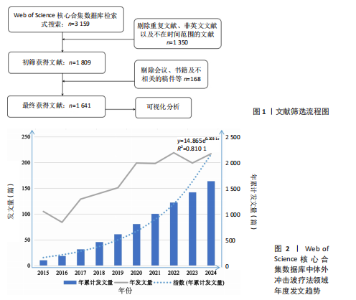
2.1 体外冲击波疗法领域发文趋势 体外冲击波疗法领域的发文数量与时间趋势图可以展现该领域的发展情况,并对未来发展趋势做出预测,见图2。2015-2024年,共有1 641篇文"
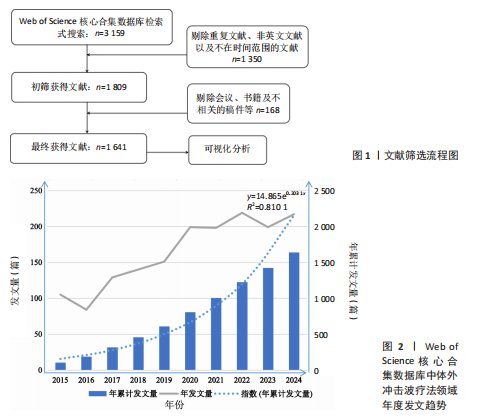
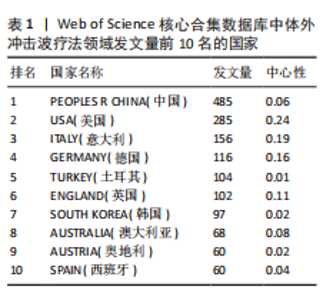
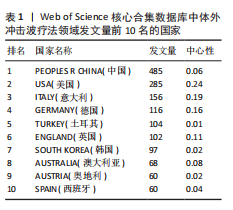
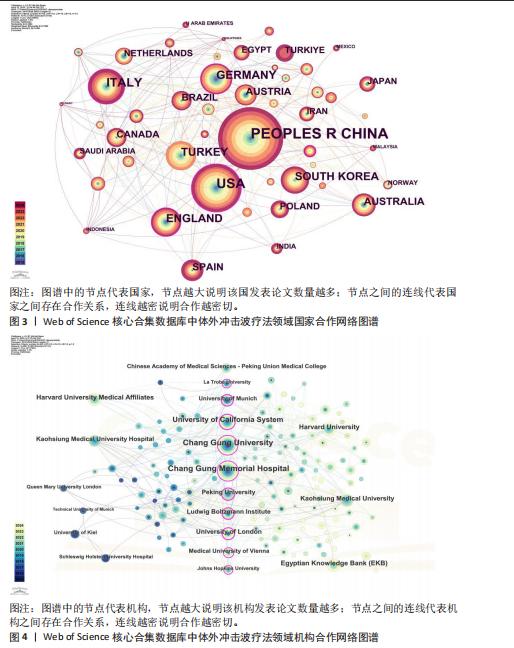
献符合检索筛选条件。从全球范围来看,近10年体外冲击波疗法领域的发文量总体呈上升趋势,从2015年的105篇增加到2024年的217篇,自2018年以后,体外冲击波疗法领域的年发文量均在150篇以上,在2022年达到高峰,为219篇,说明体外冲击波疗法领域的研究具有持续发展的潜力,在未来依旧会有较高的研究热度。发文量指数是根据年累计发文量趋势计算得出的,是对趋势的一种简化,也反映了该领域发文量从指数增长变为稳态。 2.2 体外冲击波疗法领域国家发文量及合作分析 以“国家”为节点,运行CiteSpace软件,得到节点数73、连线数267、网络密度为0.101 6的国家合作网络图谱(图3)。发文频次≥60的国家共有10个,共有73个国家/地区被纳入此次检索。发文量及中心性前10位的国家见图3和表1。结果显示,中国是发文量最多的国家,为485篇,其次为美国,发文量为285篇,意大利排名第三,发文量为156篇。但美国的中心性排名最高,中国中心性排名略低,这可能是因为美国与欧洲国家在国际合作中略占优势,中国需要进一步加强国际上与各国之间的交流与合作。"
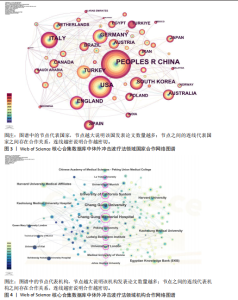
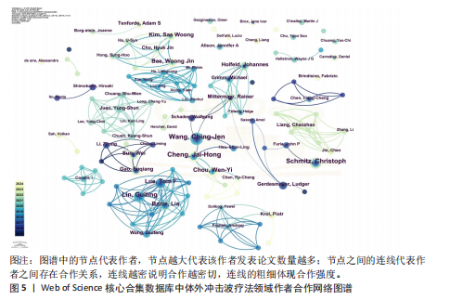
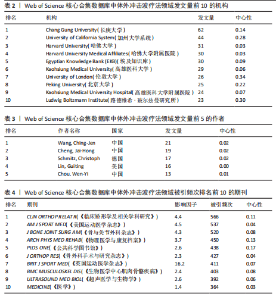
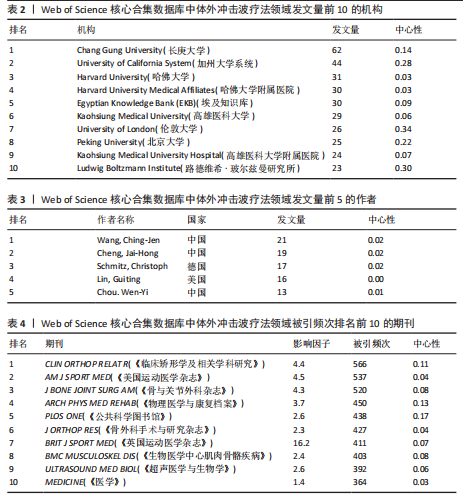
2.3 体外冲击波疗法领域机构发文量及合作分析 以“机构”为节点,运行CiteSpace软件,得到节点数288、连线数469、网络密度为0.011 3的国家合作网络图谱(图4)。共有288个机构发表了体外冲击波疗法相关的文章,其中长庚大学(Chang Gung University)的发文量最高,共发表了62篇文章,其次是加州大学(University of California System(44篇)和哈佛大学(Harvard University)(31篇)。中心性较强的前3个机构分别是伦敦大学(University of London)、路德维西·玻尔兹曼研究所(Ludwig Boltzmann Institute)和加州大学系统(University of California System),详见表2。 2.4 体外冲击波疗法领域作者发文量及合作分析 以“作者”为节点,运行CiteSpace软件,得到节点数288、连线数535、网络密度为0.012 9的作者合作网络图谱(图5)。共有288个作者发表与体外冲击波疗法相关的文章,发文量前5名的作者如表3所示。Wang,Ching-Jen是发文量最多的作者,在体外冲击波疗法领域共发表21篇文章,其次是Cheng,Jai-Hong(19篇)、Schmitz,Christoph(17篇)、Lin,Guiting(16篇)、Chou. Wen-Yi(13篇)。在"
"
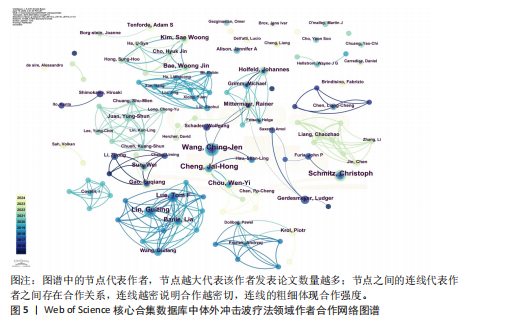
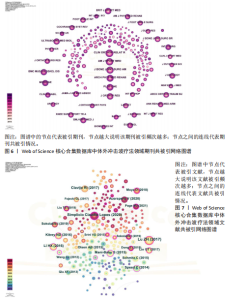
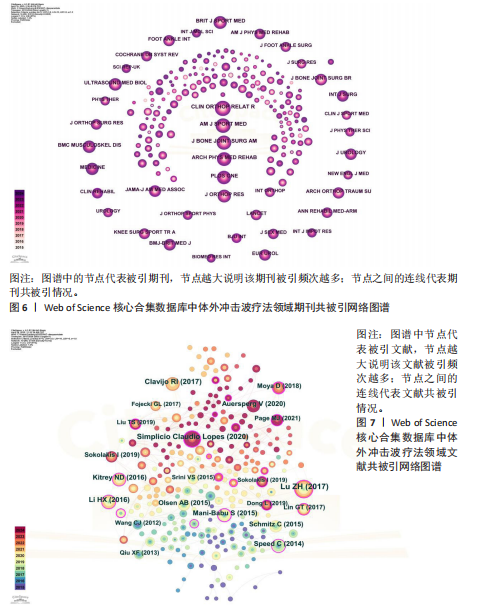
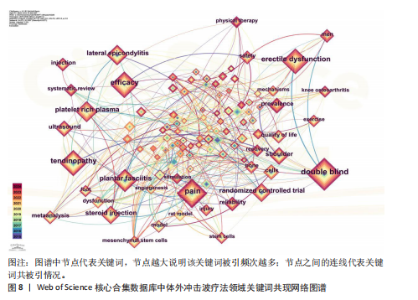
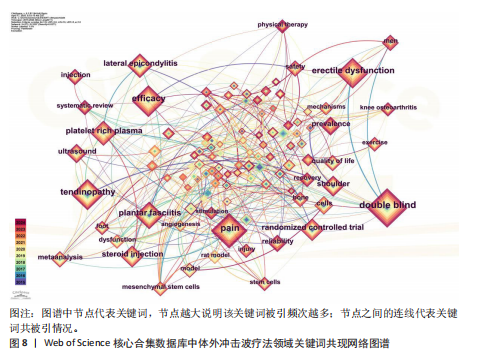
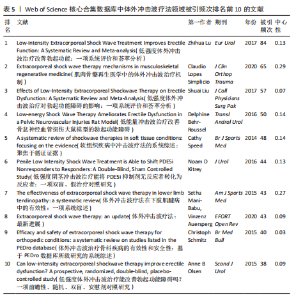
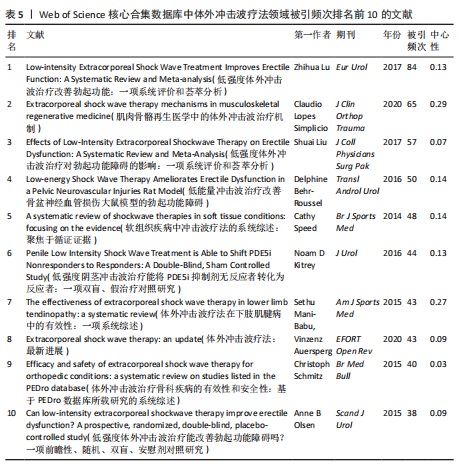
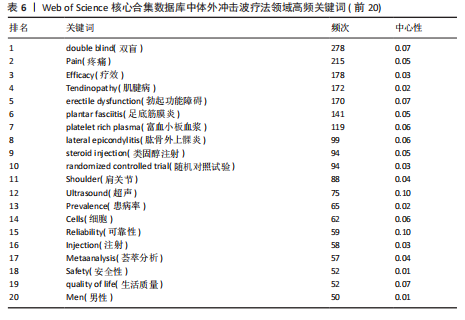
作者合作网络图谱中,节点的大小代表作者发表的文章数量,连线的粗细代表作者之间的合作关系,不同的颜色渐变代表不同年份,并且能体现出形成的作者集群。在体外冲击波疗法领域,已有多个有影响力的研究小组形成,但近2年未出现合作密切的集群。其中发文量前5名的Wang,Ching-Jen、Cheng,Jai-Hong和Chou. Wen-Yi彼此之间交流密切,但与其他作者的交流较少,各研究小组之间交流合作有限,同时还有部分孤立的单色的节点存在,表明他们在体外冲击波疗法领域与其他研究者尚无合作。因此,深化国际合作仍是体外冲击波疗法领域研究者值得关注的问题。 2.5 体外冲击波疗法领域被引期刊分析 以“被引期刊”为节点,运行CiteSpace软件,得到节点数280、连线数812、网络密度为0.020 8的期刊共被引网络图谱(图6)。共有280种期刊发表了体外冲击波疗法相关的文章,被引频次排名前10的期刊如表4所示。其中,《Clinical Orthopaedics and Related Research 》(CLIN ORTHOP RELAT R,影响因子=4.4)是被引频次最多的期刊,《PLoS One》(影响因子=2.564)是中心性最高的期刊。在排名前10的期刊中,有7个美国期刊、2个英国期刊和1个荷兰期刊。《Clinical Orthopaedics and Related Research 》由Springer US出版,是骨科领域的权威期刊,专注于临床骨科研究,涵盖了关节置换、骨折治疗、骨肿瘤等多方面的研究。《PLoS One》由Public Library of Science出版,在医学领域专注于基础医学、临床研究、公共卫生及康复医学等,这可能是其具有较高中心性的原因。 2.6 体外冲击波疗法领域文献共被引分析 作为一种检测研究趋势的统计方法,文献共被引指2篇或更多文章同时被其他文章引用的现象,被引用的文章是当前开展研究的基础,代表了该领域的知识基础[17]。以“被引文献”为节点,运行CiteSpace软件,得到节点数269、连线数434的文献共被引网络图谱(图7)。被引频次排名前10的文献如表5所示。体外冲击波疗法近10年的热点研究主要包括利用体外冲击波疗法改善勃起功能障碍[18]、治疗肌肉骨骼疾病以及慢性疼痛[19-20],并探索相关的潜在机制。Simplicio Claudio Lopes等的《Extracorporeal shock wave therapy mechanisms in musculoskeletal regenerative medicine》是中心性最高的文献,该研究讨论了应用体外冲击波疗法作为再生医学技术治疗肌肉骨骼损伤所引发的主要生物学机制,包括疼痛缓解、组织再生和组织中钙化物的破坏等方面,具有较大的参考价值。 2.7 体外冲击波疗法领域关键词共现分析 关键词共现图谱是基于文献中的高频关键词所绘制,关键词出现的频率和该关键词的研究热度呈正比。以“关键词”为节点,运行CiteSpace软件,得到节点数273、连线数1 007、网络密度为0.027 1的关键词共现网络图谱(图8)。排名前20的高频关键词如表6所示。高频关键词前5名分别为双盲(double blind)、疼痛(pain)、疗效(efficacy)、肌腱病(tendinopathy)、勃起功能障碍(erectile dysfunction)。具有较高中心性和高频率的关键词在一定程度上代表了"
"
"
"
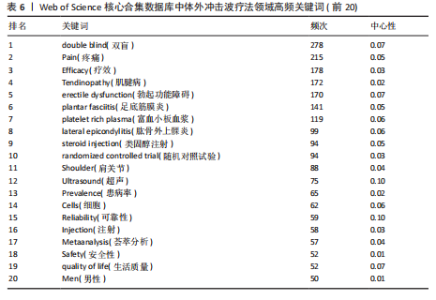
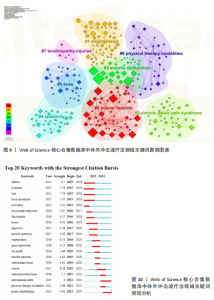
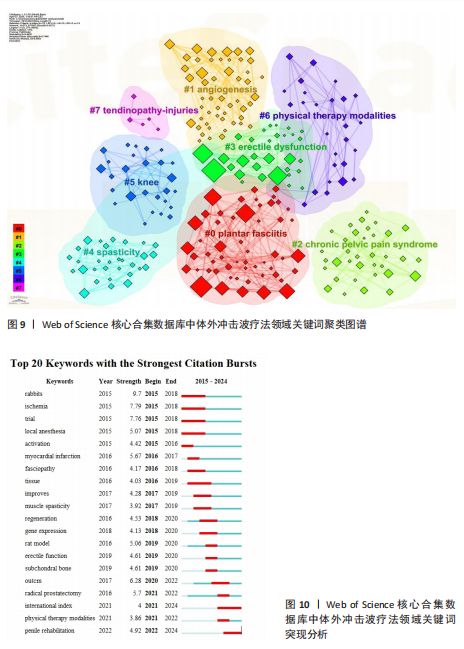
该段时间内的研究热点,因此,除检索词外,双盲(double blind)、疼痛(pain)、勃起功能障碍(erectile dysfunction)、足底筋膜炎(plantar fasciitis)、肱骨外上髁炎(lateral epicondylitis)、超声(ultrasound)、可靠性(reliability)、生活质量(quality of life)等是近几年体外冲击波疗法领域的热点词。 2.8 体外冲击波疗法领域关键词聚类分析 在关键词共现图谱的基础上,通过CiteSpace软件的log-likelihood rate(LLR) 算法实施关键词聚类分析,生成关键词聚类图谱,如图9所示,该聚类模块的值Q为0.443 2,平均轮廓值S为0.746 8,Q > 0.3且S > 0.5,说明关键词聚类结构显著,聚类结果同质性可。聚类标签以最具代表性的关键词命名标签主题,标签数字越小聚类中包含的关键词就越多,通过对关键词的聚类分析发现,#0至#7的聚类标签分别是:#0足底筋膜炎(plantar fasciitis)、#1血管再生(angiogenesis)、#2慢性盆腔疼痛综合征(chronic pelvic pain syndrome)、#3勃起功能障碍(erectile dysfunction)、#4肌痉挛(spasticity)、#5膝关节(knee)、#6物理治疗(physical therapy modalities)、#7肌腱病损伤(tendinopathy-injuries)。 2.9 体外冲击波疗法领域关键词突现分析 关键词突现分析可以通过观察含该关键词的文献在短时间内被大量引用的情况,揭示该段时间内的研究前沿动态,预测未来该领域的未来研究方向。如图10所示,突现强度最大的关键词是兔(rabbits),突现强度为9.7,这可能与体外冲击波疗法的相关机制尚不确定有关。在前20名突现关键词中,缺血(ischemia)、心肌梗死(myocardial infarction)、筋膜病(fasciopathy)、肌肉痉挛(muscle spasticity)、勃起功能(erectile function)、阴茎康复(penile rehabilitation)等词集中出现,进一步印证了体外冲击波疗法应用多元化的发展趋势,这些关键词的相关联提示体外冲击波疗法未来的研究重点应聚焦于基础实验到临床研究的转化,探索体外冲击波发挥临床疗效的潜在机制,为临床工作的积极发展提供理论支持。"
"
| [1] AUERSPERG V, TRIEB K. Extracorporeal shock wave therapy: an update. EFORT Open Rev. 2020;5(10):584-592. [2] DUAN H, LIAN Y, JING Y, et al. Research progress in extracorporeal shock wave therapy for upper limb spasticity after stroke. Front Neurol. 2023;14:1121026. [3] LV F, LI Z, JING Y, et al. The effects and underlying mechanism of extracorporeal shockwave therapy on fracture healing. Front Endocrinol (Lausanne). 2023;14:1188297. [4] MOSTAFA M, HAMADA HA, KADRY AM, et al. Effect of High-Power Laser Therapy Versus Shock Wave Therapy on Pain and Function in Knee Osteoarthritis Patients: A Randomized Controlled Trial. Photobiomodul Photomed Laser Surg. 2022; 40(3):198-204. [5] TOGNOLO L, GIORDANI F, BIZ C, et al. Myofascial points treatment with focused extracorporeal shock wave therapy (f-ESWT) for plantar fasciitis: an open label randomized clinical trial. Eur J Phys Rehabil Med. 2022;58(1):85-93. [6] QIAO HY, XIN L, WU SL. Analgesic effect of extracorporeal shock-wave therapy for frozen shoulder: A randomized controlled trial protocol. Medicine (Baltimore). 2020;99(31):e21399. [7] SEN SB, KOSEHASANOGULLARI M, YILMAZ NO, et al. Comparative analysis of the therapeutic effects of extracorporeal shock wave therapy and high-intensity laser therapy in lateral epicondylitis: a randomised clinical trial. Rheumatol Int. 2024; 44(4):593-602. [8] GESSLBAUER C, MICKEL M, SCHUHFRIED O, et al. Effectiveness of focused extracorporeal shock wave therapy in the treatment of carpal tunnel syndrome : A randomized, placebo-controlled pilot study. Wien Klin Wochenschr. 2021;133(11-12):568-577. [9] GATZ M, SCHWEDA S, BETSCH M, et al. Line- and Point-Focused Extracorporeal Shock Wave Therapy for Achilles Tendinopathy: A Placebo-Controlled RCT Study. Sports Health. 2021;13(5):511-518. [10] YAO H, WANG X, LIU H, et al. Systematic Review and Meta-Analysis of 16 Randomized Controlled Trials of Clinical Outcomes of Low-Intensity Extracorporeal Shock Wave Therapy in Treating Erectile Dysfunction. Am J Mens Health. 2022;16(2):15579883221087532. [11] RAHBAR M, SAMANDARIAN M, SALEKZAMANI Y, et al. Effectiveness of extracorporeal shock wave therapy versus standard care in the treatment of neck and upper back myofascial pain: a single blinded randomised clinical trial. Clin Rehabil. 2021;35(1):102-113. [12] SUN H, CHEN H, MU G, et al. Comparison of Different Treatment Regimens of Extracorporeal Shockwave Therapy in Chronic Low-back Pain: A Randomized Controlled Trial. Pain Physician. 2022;25(8):E1211-E1218. [13] YANG E, LEW H L, ÖZÇAKAR L, et al. Recent Advances in the Treatment of Spasticity: Extracorporeal Shock Wave Therapy. J Clin Med. 2021;10(20):4723. [14] GE Y, CHAO T, SUN J, et al. Frontiers and Hotspots Evolution in Psycho-cardiology: A Bibliometric Analysis From 2004 to 2022. Curr Probl Cardiol. 2022;47(12):101361. [15] ZHOU Y, HU Z, YUAN H, et al. CiteSpace-based visual analysis of hypothermia studies in surgical patients. Nurs Open. 2023;10(9):6228-6236. [16] ZHI L, HOU D, HONG Y, et al. Research on music therapy from 2013 to 2022: a bibliometric and visualized study. Front Psychiatry. 2024;15: 1323794. [17] HE D, CAO S, LE Y, et al. Virtual Reality Technology in Cognitive Rehabilitation Application: Bibliometric Analysis. JMIR Serious Games. 2022; 10(4):e38315. [18] LU Z, LIN G, REED-MALDONADO A, et al. Low-intensity Extracorporeal Shock Wave Treatment Improves Erectile Function: A Systematic Review and Meta-analysis. Eur Urol. 2017;71(2):223-233. [19] SPEED C. A systematic review of shockwave therapies in soft tissue conditions: focusing on the evidence. Br J Sports Med. 2014;48(21):1538-1542. [20] SIMPLICIO CL, PURITA J, MURRELL W, et al. Extracorporeal shock wave therapy mechanisms in musculoskeletal regenerative medicine. J Clin Orthop Trauma. 2020;11(Suppl 3):S309-S318. [21] LIU J, WANG L, FANG H, et al. Home-based cardiac rehabilitation: A review of bibliometric studies and visual analysis of CiteSpace (2012-2021). Medicine (Baltimore). 2022;101(49):e31788. [22] CHENG JH, WANG CJ. Biological mechanism of shockwave in bone. Int J Surg. 2015;24(Pt B):143-146. [23] WANG CJ, WANG FS, YANG KD. Biological effects of extracorporeal shockwave in bone healing: a study in rabbits. Arch Orthop Trauma Surg. 2008; 128(8):879-884. [24] WANG CJ, SUN YC, WONG T, et al. Extracorporeal shockwave therapy shows time-dependent chondroprotective effects in osteoarthritis of the knee in rats. J Surg Res. 2012;178(1):196-205. [25] AUST S, AUER K, BACHMAYR-HEYDA A, et al. Ambivalent role of pFAK-Y397 in serous ovarian cancer--a study of the OVCAD consortium. Mol Cancer. 2014;13:67. [26] LV F, LI Z, JING Y, et al. The effects and underlying mechanism of extracorporeal shockwave therapy on fracture healing. Front Endocrinol (Lausanne). 2023;14:1188297. [27] CHO DH, HWANG YJ, PARK JH, et al. Nucleus-targeted delivery of nitric oxide in human mesenchymal stem cells enhances osteogenic differentiation. Bioorg Chem. 2023;135:106483. [28] JIN Z, KHO J, DAWSON B, et al. Nitric oxide modulates bone anabolism through regulation of osteoblast glycolysis and differentiation. J Clin Invest. 2021;131(5):e138935. [29] JING N, HOU YC, ZHANG JC, et al. Cracking the code: Understanding ESWT’s role in bone fracture healing. J Orthop Translat. 2025;50:403-412. [30] LIU Z, WANG H, HE J, et al. Rictor ablation in BMSCs inhibits bone metastasis of TM40D cells by attenuating osteolytic destruction and CAF formation. Int J Biol Sci. 2019;15(11):2448-2460. [31] CHEN B, LUO Y, ZHANG Z, et al. Extracorporeal shock wave therapy inhibits osteoclast differentiation by targeting NF-κB signaling pathway. J Orthop Surg Res. 2023;18(1):805. [32] HSIAO CC, HUANG WH, CHENG KH, et al. Low-Energy Extracorporeal Shock Wave Therapy Ameliorates Kidney Function in Diabetic Nephropathy. Oxid Med Cell Longev. 2019;2019: 8259645. [33] CHENG YH, TSAI NC, CHEN YJ, et al. Extracorporeal Shock Wave Therapy Combined with Platelet-Rich Plasma during Preventive and Therapeutic Stages of Intrauterine Adhesion in a Rat Model. Biomedicines. 2022;10(2):476. [34] INOUE S, HAYASHI T, TEISHIMA J, et al. Effect of penile rehabilitation with low intensity extracorporeal shock wave therapy on erectile function recovery following robot-assisted laparoscopic prostatectomy. Transl Androl Urol. 2020;9(4):1559-1565. [35] MASON MM, PAI RK, MASTERSON JM, et al. Low-intensity extracorporeal shockwave therapy for diabetic men with erectile dysfunction: A systematic scoping review. Andrology. 2023; 11(2):270-281. [36] KIM KS, CHOI YS, BAE WJ, et al. Efficacy of Low-Intensity Extracorporeal Shock Wave Therapy for the Treatment of Chronic Pelvic Pain Syndrome IIIb: A Prospective-Randomized, Double-Blind, Placebo-Controlled Study. World J Mens Health. 2022;40(3):473-480. [37] 龚璇,王谦,蔺俊斌.体外冲击波治疗疼痛研究进展的可视化分析[J].中国组织工程研究,2024, 28(11):1749-1755. [38] RYSKALIN L, MORUCCI G, NATALE G, et al. Molecular Mechanisms Underlying the Pain-Relieving Effects of Extracorporeal Shock Wave Therapy: A Focus on Fascia Nociceptors. Life (Basel). 2022;12(5):743. [39] HSU CC, WU KLH, PENG JM, et al. Low-energy extracorporeal shockwave therapy improves locomotor functions, tissue regeneration, and modulating the inflammation induced FGF1 and FGF2 signaling to protect damaged tissue in spinal cord injury of rat model: an experimental animal study. Int J Surg. 2024;110(12): 7563-7572. [40] BABA D, EKICI N, TAŞKIRAN AT, et al. Which localization method is optimal in ESWL: fluoroscopy or ultrasonography? BMC Urol. 2025; 25(1):35. [41] 席敬琪,梁恩龙,唐玉萍,等.发散式体外冲击波结合肌筋膜触发点针刺治疗膝骨关节炎疗效观察 [J].现代中西医结合杂志,2024,33(10): 1364-1369. [42] RAI S, RAJAURIA S, KHANDELWAL N, et al. Intralesional Steroid Injection Versus Extracorporeal Shockwave Therapy in the Treatment of Plantar Fasciitis: A Comparative, Prospective, Case Series Study. Cureus. 2023; 15(1):e33593. [43] KO JY, HUANG CC, HUANG PH, et al. Effects of supplementing extracorporeal shockwave therapy to hyaluronic acid injection among patients with rotator cuff lesions without complete tear: a prospective double-blinded randomized study. Int J Surg. 2024;110(12):7421-7433. [44] JHAN SW, WU KT, CHOU WY, et al. A comparative analysis of platelet-rich plasma alone versus combined with extracorporeal shockwave therapy in athletes with patellar tendinopathy and knee pain: a randomized controlled trial. Knee Surg Relat Res. 2024;36(1):47. [45] ZHANG X, MA Y. Global trends in research on extracorporeal shock wave therapy (ESWT) from 2000 to 2021. BMC Musculoskelet Disord. 2023;24(1):312. [46] FERDINANDOV D. Focused extracorporeal shockwave therapy for the treatment of low back pain: a systematic review. Front Med (Lausanne). 2024;11:1435504. |
| [1] | Xu Canli, He Wenxing, Wang Yuping, Ba Yinying, Chi Li, Wang Wenjuan, Wang Jiajia. Research context and trend of TBK1 in autoimmunity, signaling pathways, gene expression, tumor prevention and treatment [J]. Chinese Journal of Tissue Engineering Research, 2026, 30(在线): 1-11. |
| [2] | Zhu Xiaolong, Zhang Wei, Yang Yang. Visualization analysis of research hotspots and cutting-edge information in the field of intervertebral disc regeneration and repair [J]. Chinese Journal of Tissue Engineering Research, 2026, 30(9): 2391-2402. |
| [3] | Lai Yu, Chen Yueping, Zhang Xiaoyun. Research hotspots and frontier trends of bioactive materials in treating bone infections [J]. Chinese Journal of Tissue Engineering Research, 2026, 30(8): 2132-2144. |
| [4] | Zhang Haiwen, Zhang Xian, Xu Taichuan, Li Chao. Bibliometric and visual analysis of the research status and trends of senescence in osteoporosis [J]. Chinese Journal of Tissue Engineering Research, 2026, 30(6): 1580-1591. |
| [5] | Huang Jie, Zeng Hao, Wang Wenchi, Lyu Zhucheng, Cui Wei. Visualization analysis of literature on the effect of lipid metabolism on osteoporosis [J]. Chinese Journal of Tissue Engineering Research, 2026, 30(6): 1558-1568. |
| [6] | Yang Zeyu, Zhi Liang, Wang Jia, Zhang Jingyi, Zhang Qingfang, Wang Yulong, Long Jianjun. A visualized analysis of research hotspots in high-frequency repetitive transcranial magnetic stimulation from the macroscopic perspective [J]. Chinese Journal of Tissue Engineering Research, 2026, 30(5): 1320-1330. |
| [7] | Peng Hao, Chen Qigang, Shen Zhen. A visual analysis of research hotspots of H-type vessels in various bone diseases [J]. Chinese Journal of Tissue Engineering Research, 2026, 30(3): 760-769. |
| [8] | Zhang Anqi, Hua Haotian, Cai Tianyuan, Wang Zicheng, Meng Zhuo, Zhan Xiaoqian, Chen Guoqian . Pain after total knee arthroplasty: current status and trend analysis [J]. Chinese Journal of Tissue Engineering Research, 2026, 30(3): 795-804. |
| [9] | Liu Yan, Zuo Qingchun, Li Weiying, Wu Xubo. Research hotspots and trends of optogenetics in behavioral neuroscience [J]. Chinese Journal of Tissue Engineering Research, 2026, 30(28): 7396-7403. |
| [10] | Wang Xueting, Yang Wei, Wang Pengqin. Post-stroke rehabilitation robotics: current research status and hot topics in and outside China [J]. Chinese Journal of Tissue Engineering Research, 2026, 30(28): 7404-7409. |
| [11] | Yue Yuhang, Xie Liangyu, Shi Liupeng, Yin Zuozhen, Cao Shengnan, Shi Bin, Sun Guodong. Bibliometric analysis of application of artificial intelligence in orthopedic imaging diagnosis [J]. Chinese Journal of Tissue Engineering Research, 2026, 30(28): 7418-7427. |
| [12] | Guo Jun, Lu Zheng, Yu Jinling, Hao Yuanyuan, Liu Kaishun, Liu Xuexia, Huang Yourong. Oxidative stress and osteoporosis: a bibliometric analysis of literature from SCI core database [J]. Chinese Journal of Tissue Engineering Research, 2026, 30(28): 7428-7436. |
| [13] | Xu Canli, He Wenxing, Wang Yuping, Ba Yinying, Chi Li, Wang Wenjuan, Wang Jiajia. Research context and trend of TANK binding kinase 1 in autoimmunity and tumor prevention and treatment [J]. Chinese Journal of Tissue Engineering Research, 2026, 30(28): 7456-7464. |
| [14] | Wang Feifei, Wang Zhennan. Scientometric deconstruction of developmental dynamics in upper-limb rehabilitation robotics: evidence network analysis via CiteSpace [J]. Chinese Journal of Tissue Engineering Research, 2026, 30(24): 6400-6409. |
| [15] | Wang Fei, Wang Hangping, Dai Rongjuan, Gong Lingxuan. Visual analysis of the research literature on plantar fasciitis [J]. Chinese Journal of Tissue Engineering Research, 2026, 30(24): 6410-6420. |
| Viewed | ||||||
|
Full text |
|
|||||
|
Abstract |
|
|||||