Chinese Journal of Tissue Engineering Research ›› 2026, Vol. 30 ›› Issue (24): 6400-6409.doi: 10.12307/2026.202
Previous Articles Next Articles
Scientometric deconstruction of developmental dynamics in upper-limb rehabilitation robotics: evidence network analysis via CiteSpace
Wang Feifei, Wang Zhennan
- Dalian University of Technology, Panjin 124221, Liaoning Province, China
-
Received:2025-06-27Revised:2025-09-19Online:2026-08-28Published:2026-02-05 -
Contact:Wang Zhennan, Associate professor, Master’s supervisor, Dalian University of Technology, Panjin 124221, Liaoning Province, China -
About author:Wang Feifei, Dalian University of Technology, Panjin 124221, Liaoning Province, China -
Supported by:Dalian University of Technology Enterprise-Commissioned Scientific Research Project, No. HX20240114 (to WZN [project participant])

CLC Number:
Cite this article
Wang Feifei, Wang Zhennan. Scientometric deconstruction of developmental dynamics in upper-limb rehabilitation robotics: evidence network analysis via CiteSpace[J]. Chinese Journal of Tissue Engineering Research, 2026, 30(24): 6400-6409.
share this article
Add to citation manager EndNote|Reference Manager|ProCite|BibTeX|RefWorks
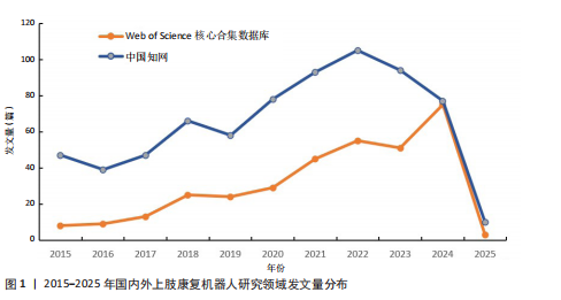
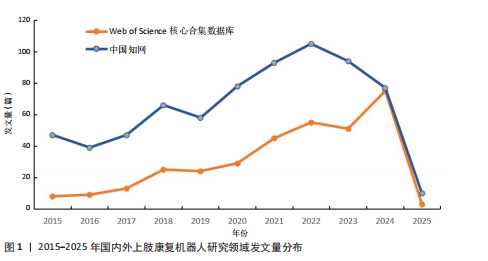
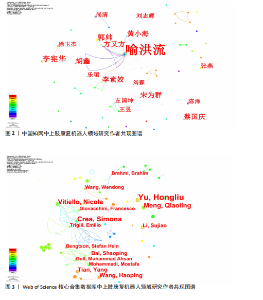
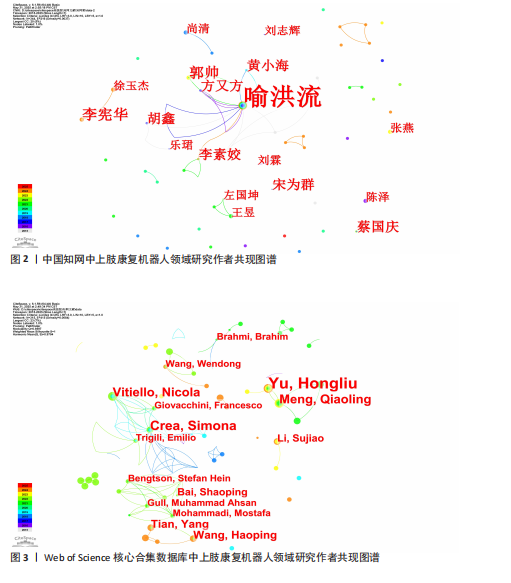
2.1 发文量分析 2015-2025年,上肢康复机器人领域发文量呈显著增长趋势。国内研究产出持续增加,2022年达到峰值,发文量为105篇,随后略有回落。国外的研究趋势类似,从2015年起,国外的发文量同样稳步上升,2024年达到峰值。因检索时间截至2025-03-13,文献未收录完全,基于增长趋势推测2025年及以后国外该领域发文量将继续保持上升趋势。国内方面发文量或有波动,但根据增长曲线预测,国内外在上肢康复机器人领域的发文量将保持相近的水平,体现该领域研究的国际性和普遍性(图1)。 2.2 研究作者共现分析 上肢康复机器人领域作者共现图谱共纳入中文文献717篇,涉及作者344名,连线数为216,密度为0.003 7;英文文献337篇,涉及作者315名,连线数为415,密度为0.008 4。根据普赖斯定律,核心作者发文量计算公式为:M=0.749×[36],Nmax是指2015-2025年发文量最多作者的发表论文篇数,中文文献Nmax=22,M≈3.51,即核心作者为发表≥4篇文献的作者。中文核心作者有9名,依次为喻洪流(22篇)、郭帅(5篇)、李宪华(5篇)、宋为群(4篇)、李素姣(4篇)、黄小海(4篇)、胡鑫(4篇)、方又方(4篇)、蔡国庆(4篇)。英文文献Nmax=15,M≈2.90,即核心作者为发表≥3篇文献的作者。英文核心作者有32名,发文量前8名依次为Yu,Hongliu(15篇)、Crea,Simona(9篇)、Meng,Qiaoling(8篇)、Vitiello,Nicola(8篇)、Wang,Haoping(6篇)、Tian,Yang(6篇)、Bai, Shaoping(5篇)、Li, Sujiao(5篇)。该领域最突出的作者是喻洪流,其团队在上肢康复机器人领域的研究聚焦于结构创新、人机交互优化(如平面游戏引导),旨在提升康复训练的精准性与患者参与度[37-39]。主要研究者团队内的合作关系紧密,带动了上肢康复机器人的研究与发展,但作者合作网络图谱密度均不足0.01,作者之间合作较为松散,大多数研究者合作多在团队内部,这在一定程度上影响了上肢康复机器人领域的发展,因此该领域研究可进一步加强跨团队合作(图2,3)。"
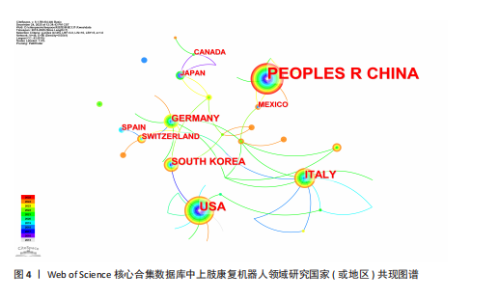
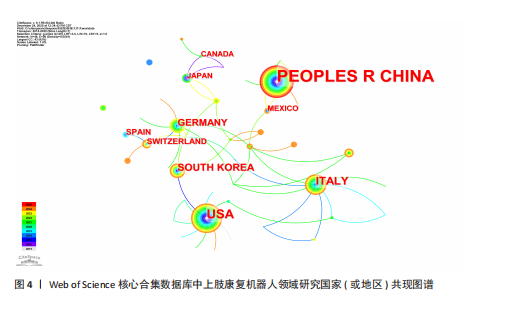
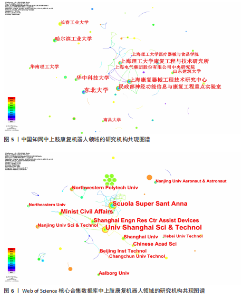
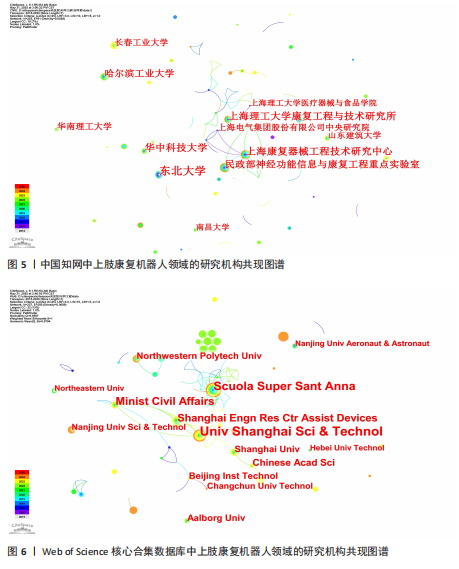
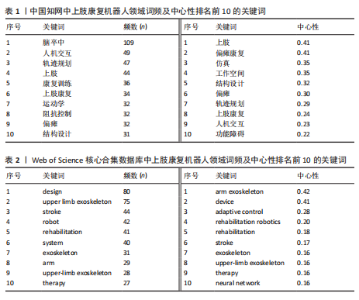
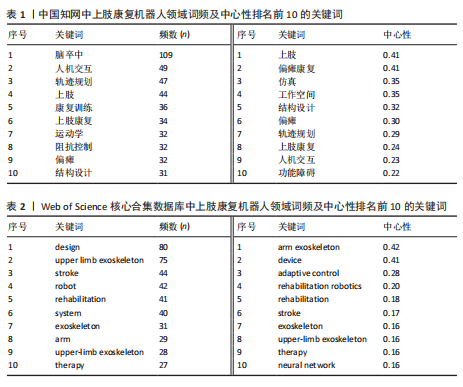
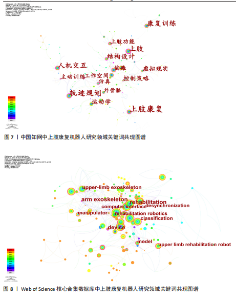
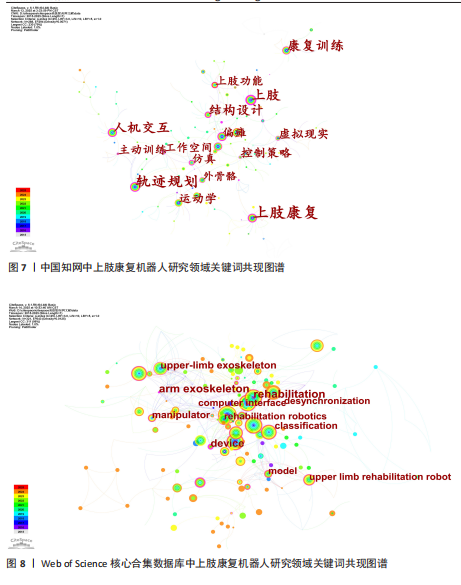
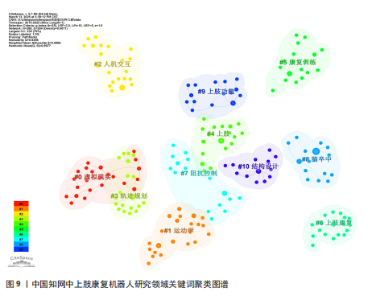
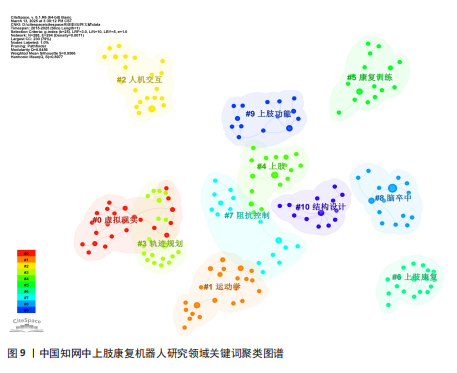
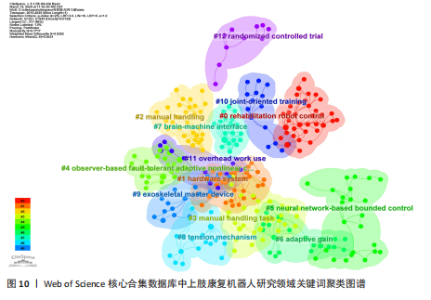
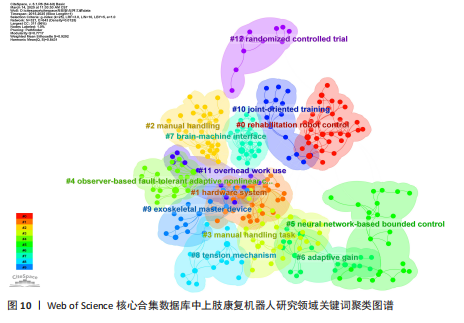
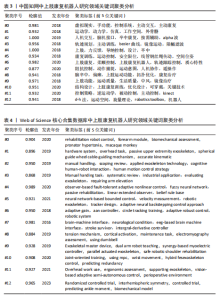
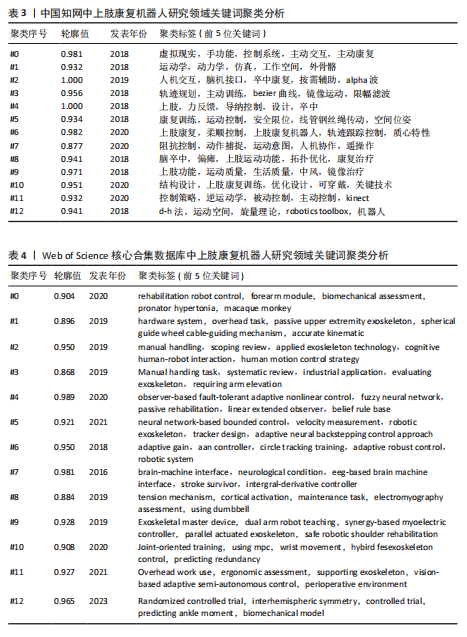
2.3 研究国家和机构分析 对英文文献进行国家(或地区)共现分析显示,国家(或地区)分布图由46个国家(或地区)组成,合作连线数为56,网络密度为0.054 1。其中,发文量最多的国家是中国(158篇),其次是美国(43篇),显著多于其他国家。对节点中心性进行分析,排名前5的国家分别是意大利(1.03)、美国(1.01)、马来西亚(0.87)、澳大利亚(0.86)和法国(0.69),意味着这些国家与其他国家的联系更多(图4)。 机构合作网络分析显示,中文文献涉及255所机构,合作连线数为91,网络密度为0.002 8。 东北大学(18篇)的发文量最多,其次是华中科技大学和上海理工大学康复工程与技术研究所和上海康复器械工程技术研究中心,均为13篇,在合作网络中发挥核心辐射作用(图5)。 英文文献涉及237所机构,合作连线数达250,网络密度(0.008 9)显著高于中文文献,表明国际机构间合作更紧密。发文量较高的机构包括Univ Shanghai Sci&Technol(19篇)、Scuola Super Sant Anna(14篇)、Minist Civil Affairs(12篇)、Shanghai Engn Res Ctr Assist Devices(10篇)和Chinese Acad Sci(8篇),这些机构在推动国际合作方面表现突出(图6)。 2.4 关键词分析 2.4.1 关键词共现分析 文献关键词作为一篇论文核心内容的凝练与精髓所在,其重要性不言而喻。通过提取并分析文献中的高频关键词,能够精准把握某学科领域的研究主题分布特征,进而深入剖析该学科领域的发展重心、研究热点动态以及研究前沿趋势,为学术研究与学科发展提供重要参考[40-41]。对717篇中文文献与337篇英文文献进行关键词共现分析,结果显示:中文文献形成288个关键词节点、294条连线,网络密度为0.007 1;英文文献形成321个关键词节点、643条连线,密度达0.012 5,表明国际研究的概念关联更为紧密。中心性排名,中文文献中“上肢”(0.41)、“偏瘫康复”(0.41)、“仿真”(0.35)位列前3;英文文献中“arm exoskeleton”(0.42)、“device”(0.41)、“adaptive control”(0.28)位列前3 (表1,2)。 综合频数与中心性:“轨迹规划”“人机交互”“脑卒中”“偏瘫”等关键词为跨语言研究的枢纽性节点,集中体现了上肢康复机器人领域的研究热点。中文文献网络呈现以临床康复与技术应用为主的双核结构;英文文献更聚焦硬件开发与智能控制,反映国际研究的技术导向性(图7,8)。 2.4.2 关键词聚类分析 根据关键词聚类图谱可知,中文文献共形成288个节点、294条连线,根据CiteSpace聚类模块值(Q值)和聚类平均轮廓值(S值)评判图谱绘制效果,其中Q=0.845 6(> 0.3),S=0.956 6(> 0.7);外文文献共形成321个节点、643条连线,其中Q=0.771 7 (> 0.3),S=0.929 2(> 0.7)[42],表明该研究关键词聚类结果合理,可信度高,为有效聚类。统计中文文献前11个聚类(图9),英文文献前13个聚类(图10)。依据LIR算法得出前5位关键词可知,目前上肢康复机器人领域的研究热点大体可分为以下5个方面:①核心技术方法;②"
"
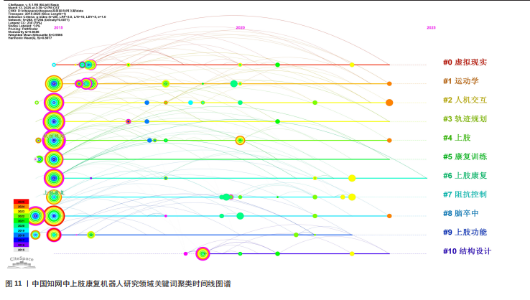
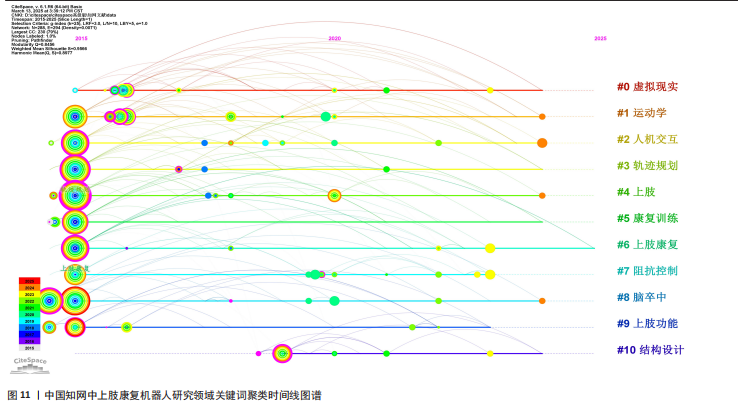
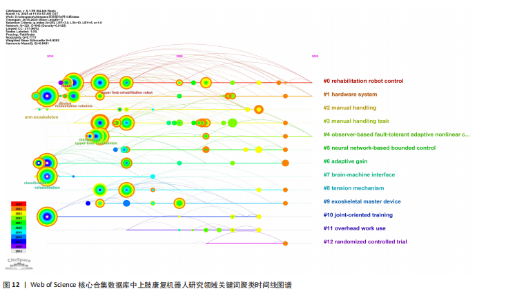
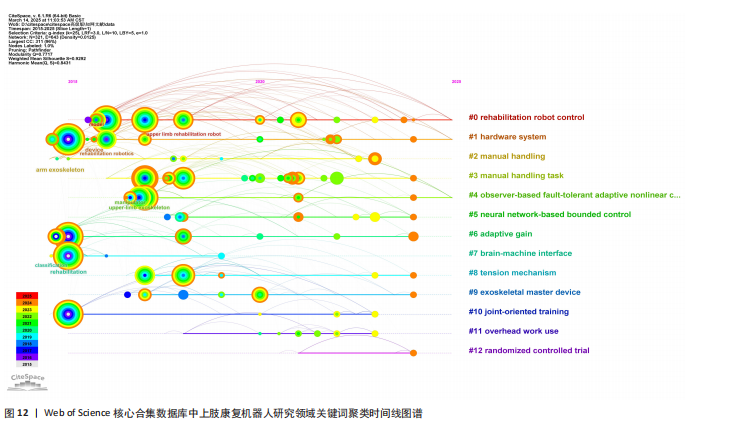
机器人设计与优化;③控制策略与算法;④临床应用与评估;⑤新兴技术与跨学科融合。 上述分类体现了上肢康复机器人领域在技术创新、系统集成、临床转化及多学科交叉方面的研究趋势,展现了从基础理论到工业与医疗场景应用的协同发展特征(表3,4)。 2.4.3 关键词时间线图分析 根据关键词聚类时间线图谱可知,中文文献聚类序号为"
"
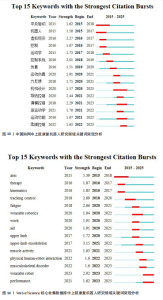
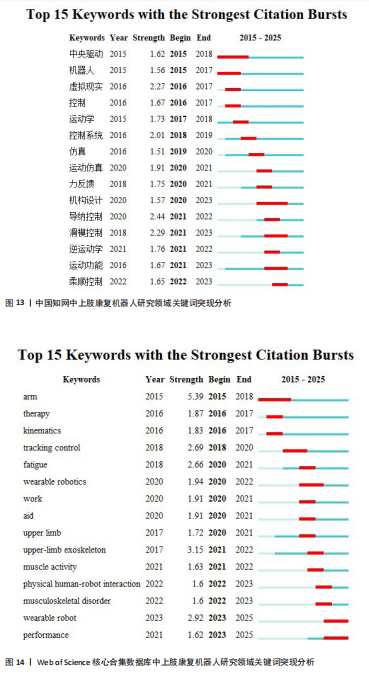
的时间线起始最早,自2015年前即成为国内学者核心研究方向,研究重点聚焦于脑卒中、上肢功能(图11)。英文文献聚类序号为#1、#6、#7、#10的时间线起始最早,表明其自2015年就得到广泛关注,说明硬件系统、自适应增益、脑机接口、关节导向训练的研究是国外学者最早关注的热点。聚类序号为#0、#3、#4、#8、#9的时间轴线随后出现,说明康复机器人控制、人工搬运任务、基于观测器的容错自适应非线性控制、张力机构、外骨骼主控装置的研究热度开始上升。国内早期聚焦临床病理机制,而国际研究更偏重工程技术突破。此后,研究从单一功能实现转向“控制算法优化-临床需求响应-跨场景应用”协同发展(图12)。 2.4.4 关键词突现分析 突现词是指在某段时间内出现频次明显升高的关键词,能够更全面地揭示当前的研究趋势与科学前沿[43-44]。结果显示,国内研究在2015-2018年重点在核心驱动技术,2019-2022年着重于控制系统升级。结合“柔顺控制”与“机构设计”的持续突现,智能化、轻量化外骨骼系统或将成为重点突破领域。国际研究2015-2018年聚焦于早期基础研究和临床需求探索,2019-2020年着重于控制技术和外骨骼开发,2021-2025年以人机交互和临床应用拓展为研究重点。从临床病理机制解析到控制与外骨骼技术融合再到人机交互与跨场景应用,形成“需求驱动-技术迭代-场景适配”的闭环发展逻辑。结合“wearable robot”与“physical human-robot interaction”的持续突现,智能自适应外骨骼、基于肌肉活动的个性化康复方案及工业外骨骼的标准化效能评估体系或将成为关键突破点。国内上肢康复机器人领域中突现强度居前15位的关键词见图13,国际该领域中突现强度居前16位的关键词见图14。"
"
"
"
"
"
"
| [1] XIE G, WANG T, DENG L, et al. Repetitive transcranial magnetic stimulation for motor function in stroke: a systematic review and meta-analysis of randomized controlled studies. Syst Rev. 2025;14(1):47. [2] BIAN M, CHEN F, SU H, et al. Comparison of the effects of different physical stimulation therapies on reducing upper limb spastic paralysis and motor dysfunction in stroke survivors after stroke: a network meta-analysis of randomized controlled trials. Front Neurol. 2025;16:1554583. [3] WANG C, LIU Y, LI L, et al. The efficacy of electroacupuncture for cervical nerve edema and movement disorder caused by the brachial plexus injury: a case report. Front Neurol. 2024; 15:1342844. [4] ZHANG J, LIU M, YUE J, et al. Effects of virtual reality with different modalities on upper limb recovery: a systematic review and network meta-analysis on optimizing stroke rehabilitation. Front Neurol. 2025;16:1544135. [5] SHEN S, CHU T, WANG J, et al. Progress in the application of motor imagery therapy in upper limb motor function rehabilitation of stroke patients with hemiplegia. Front Neurol. 2025;16:1454499. [6] DONATI D, PINOTTI E, MANTOVANI M, et al. The Role of Immersive Virtual Reality in Upper Limb Rehabilitation for Subacute Stroke: A Review. J Clin Med. 2025;14(6):1903. [7] 庄竞翔,陈晓彤,阮传亮,等.针刺夹脊穴对卒中后上肢运动功能障碍的影响[J].中国针灸, 2025,45(8):1037-1041. [8] 杨丛亮.上肢康复机器人系统设计及控制策略研究[D].燕山:燕山大学,2023. [9] FAREH R, ELSABE A, BAZIYAD M, et al. Will Your Next Therapist Be a Robot?-A Review of the Advancements in Robotic Upper Extremity Rehabilitation. Sensors (Basel). 2023; 23(11):5054. [10] 刘京宇,杨延砚,张元鸣飞,等.2023年度国家康复医学专业医疗服务与质量安全报告[J].中国康复理论与实践,2025,31(1):1-20. [11] 张元鸣飞,杨延砚,张娜,等.2021年度国家康复医学专业医疗服务与质量安全报告[J].中国康复理论与实践,2022,28(12):1365-1379. [12] 吕宗龙,王垚垚,马苏常.老龄人群上肢康复训练仪设计[J].科技创新与应用,2023,13(32): 38-41. [13] KREBS HI, HOGAN N, VOLPE BT, et al. Overview of clinical trials with MIT-MANUS: a robot-aided neuro-rehabilitation facility. Technol Health Care. 1999;7(6):419-423. [14] 李燕,余佳蓓,李松昱,等.下肢康复机器人在髋、膝关节置换术后患者早期康复训练的应用进展[J].中国老年保健医学,2024,22(6): 116-119. [15] 杜娜,赵鑫,李红.上肢康复机器人的发展及应用综述[J].医疗卫生装备,2024,45(5):95-103. [16] 袁润萍,汤从智,江勇,等.上肢康复机器人促进卒中后上肢功能恢复的作用和机制研究进展[J].中国脑血管病杂志,2022,19(7):509-513. [17] 李宇淇,黄国志,路鹏程,等.上肢康复机器人联合上肢康复训练对脑卒中恢复期偏瘫患者的影响[J].康复学报,2022,32(2):111-116. [18] 张超,刘璇,侯增广,等.上肢机器人辅助疗法对恢复期脑卒中患者上肢运动功能及日常生活活动能力的效果[J].中国康复理论与实践, 2016,22(12):1365-1370. [19] 邹鸿雁,白定群,杨力凝,等.虚拟现实技术在卒中后上肢康复中的应用现状及可能机制[J].中国康复,2024,39(2):111-115. [20] 严小青,李玉静,李怡璇,等.脑卒中患者上肢机器人辅助训练文献的可视化分析[J].机器人外科学杂志(中英文),2025,6(2):287-292. [21] 徐玉杰,李宪华,林凤涛.基于CNN的康复机器人逆运动学分析与轨迹规划[J].黑龙江工业学院学报(综合版),2024,24(4):115-123. [22] 程督,王昕浩.上肢康复机器人对脑卒中患者上肢功能和日常生活影响的Meta分析[C]//中国体育科学学会.第十三届全国体育科学大会论文摘要集:专题报告(体质与健康分会).河南师范大学体育学院,2023:620-622. [23] COLOMBO R, STERPI I, MAZZONE A, et al. Improving proprioceptive deficits after stroke through robot-assisted training of the upper limb: a pilot case report study. Neurocase. 2016; 22(2):191-200. [24] 钟毓贤,周维金,刘金玉.Athos智能运动服结合MOTOmed智能运动训练系统治疗脑卒中上肢运动功能障碍的临床研究[J].重庆医学, 2018,47(14):1896-1899. [25] FASOLI SE, KREBS HI, STEIN J, et al. Effects of robotic therapy on motor impairment and recovery in chronic stroke. Arch Phys Med Rehabil. 2003;84(4):477-482. [26] 罗盛国,李祥云,陆奇,等.上肢牵引康复训练轨迹规划跟踪控制[J].生物医学工程学杂志, 2025,42(2):318-325. [27] 薛夏利,邓钟义,孙君志,等.康复机器人领域10年研究热点:基于Web of Science数据库的文献计量学分析[J].中国组织工程研究, 2022,26(14):2214-2222. [28] TAŞKIN Z. Forecasting the future of library and information science and its sub-fields. Scientometrics. 2021;126(2):1527-1551. [29] JIANG F, WANG F, ZHANG T, et al. Current Trends and Future Directions of Malignancy After kidney Transplantation: A 1970-2022 Bibliometric Analysis. Ann Transplant. 2024;29: e942074. [30] WANG Y, FAN S, WANG W. Knowledge mapping and visualized analysis of research progress in onconephrology: a bibliometric analysis. Ren Fail. 2025;47(1):2477302. [31] ZHU M, XIANG W, ZHU Z, et al. Bibliometric analysis of autophagy in the diagnosis and treatment of osteosarcoma: a bibliometric analysis (2007-2023). Cancer Biol Ther. 2025;26(1): 2484825. [32] ROMERO L, PORTILLO-SALIDO E. Trends in Sigma-1 Receptor Research: A 25-Year Bibliometric Analysis. Front Pharmacol. 2019;10:564. [33] 高文艳,郑兆燕,潘尚,等.Theta爆发式经颅磁刺激的文献计量学和可视化分析[J].中国组织工程研究,2025,29(20):4389-4400. [34] 周辰鲁,廖喜琳,龙泉滋,等.基于Cite Space中医药领域治疗卒中后睡眠障碍的可视化分析[J].齐齐哈尔医学院学报,2025,46(1):90-96. [35] 夏磊,陈敏,钱君.基于CiteSpace孤独症谱系障碍护理研究的可视化分析[J].循证护理, 2025,11(1):115-121. [36] 祁祥,朱智德,卢健棋,等.基于CiteSpace分析中医药治疗慢性心力衰竭的知识图谱[J].西部中医药,2024,37(6):79-83. [37] 殷音,倪伟,李素姣,等.一种新型床旁上肢康复训练机器人的结构设计与运动分析[J].中国康复医学杂志,2024,39(11):1668-1673. [38] 杜妍辰,程铭,罗胜利,等.基于空间末端引导式上肢康复机器人平面游戏的交互方式研究[J].中国康复医学杂志,2024,39(7):1009-1014. [39] 刘壮,朱纯煜,朱越,等.基于多传感器信息的新型穿戴式上肢外骨骼康复机器人[J].北京生物医学工程,2021,40(3):273-278. [40] 齐东川,邹瑞,刘晋.我国应急管理研究热点和发展趋势的知识图谱分析[J].安全与环境工程,2020,27(2):104-110. [41] 杨泽雨,支亮,王佳,等.高频重复经颅磁刺激研究热点宏观角度的可视化分析[J].中国组织工程研究,2026,30(5):1320-1330. [42] 王贤,曾馨,项杨,等.农文旅融合发展:历史演进、研究热点与发展趋势:基于CiteSpace的可视化知识图谱分析[J].智慧农业导刊,2025, 5(2):34-45. [43] 李杰,陈超美.CiteSpace:科技文本挖掘及可视化[M].北京:首都经济贸易大学出版社, 2016. [44] 赵乾威,孙光源.肠道类器官:组织/器官生物学、疾病建模和临床应用前沿趋势的文献计量学分析[J].中国组织工程研究,2026, 30(1):238-247. [45] 王秋惠,魏玉坤,刘力蒙.康复机器人研究与应用进展[J].包装工程,2018,39(18): 83-89. [46] 冷冰,李旺鑫,刘斌.上肢康复机器人研究及发展[J].科学技术与工程,2021, 21(11):4311-4322. [47] 段志峰.上肢康复机器人设计与研究[D].长春:长春工业大学,2022. [48] 张秀峰,季林红,王景新.辅助上肢运动康复机器人技术研究[J].清华大学学报(自然科学版),2006,46(11):1864-1867. [49] 崔琰琳,沈刘峡.BERTopic模型在产业技术创新分析中的实证研究:以中美外骨骼技术为例[J].中国发明与专利,2025,22(1):16-26. [50] 康治臣,邹晓峰,曲福玲,等.“新医科”背景下康复医学与理疗学专业硕士研究生多学科交叉人才培养的探索与实践[J].中国实验诊断学,2024,28(10):1258-1261. [51] ANGERHÖFER C, COLUCCI A, VERMEHREN M, et al. Post-stroke Rehabilitation of Severe Upper Limb Paresis in Germany - Toward Long-Term Treatment With Brain-Computer Interfaces. Front Neurol. 2021;12:772199. [52] 李翔,陈健尔,张辉煌,等.脑机接口康复训练机器人在脑卒中患者上肢功能康复中的研究进展[J].中国康复医学杂志,2023,38(2): 263-268. [53] 吴军.上肢康复机器人及相关控制问题研究[D].武汉:华中科技大学,2012. [54] 徐浩.基于sEMG的人体上肢运动意图理解与康复应用研究[D].合肥:安徽理工大学,2024. [55] 史珈铭,刘晓婷.老年人社区康复服务需求及其影响因素[J].中国康复理论与实践,2021, 27(3):334-340. [56] 焦宗琪,孟巧玲,邵海存,等.上肢康复训练与生活辅助机器人的设计与研究[J].中国康复医学杂志,2022,37(9):1219-1222. [57] 张伟胜,喻洪流,黄小海,等.一种新型四自由度的上肢康复机器人[J].中国康复理论与实践,2019,25(10):1202-1208. [58] 黄小海,喻洪流,张伟胜,等.索控式中央驱动上肢康复机器人[J].北京生物医学工程,2018, 37(5):467-473. [59] 王露露,胡鑫,曹武警,等.可穿戴上肢康复机器人的设计及其运动仿真和动力学分析[J].北京生物医学工程,2017,36(2):177-185. [60] 聂志洋,孟巧玲,喻洪流,等.上肢康复机器人力交互控制系统设计[J].软件导刊,2021,20(7): 124-128. [61] PAN J, ASTARITA D, BALDONI A, et al. NESM-γ: An upper-limb exoskeleton with compliant actuators for clinical deployment. IEEE Robot Autom Lett. 2022;7(3):7708-7715. [62] NANN M, CORDELLA F, TRIGILI E, et al. Restoring activities of daily living using an EEG/EOG-controlled semiautonomous and mobile whole-arm exoskeleton in chronic stroke. IEEE Sys J. 2020;15(2):2314-2321. [63] ERCOLINI G, TRIGILI E, BALDONI A, et al. A novel generation of ergonomic upper-limb wearable robots: Design challenges and solutions. Robotica. 2019;37(12):2056-2072. [64] TRIGILI E, CREA S, MOISÈ M, et al. Design and experimental characterization of a shoulder-elbow exoskeleton with compliant joints for post-stroke rehabilitation. IEEE ASME Trans Mechatron. 2019;24(4):1485-1496. [65] ZHAO J, GAO H, YANG C, et al. Upper and Lower Limb Training Evaluation System Based on Virtual Reality Technology. Sensors (Basel). 2024;24(21):6909. [66] LIU X, WANG J, LIANG T, et al. SE-TCN network for continuous estimation of upper limb joint angles. Math Biosci Eng. 2023;20(2):3237-3260. [67] 张顺,单泉,黄建聪,等.臂腕混合式上肢康复机器人被动柔顺性控制[J].中国工程机械学报, 2024,22(4):468-473. [68] LYU H, GU YL, LIN G, et al. Research on Compliant Rehabilitation Strategy of Upper Limb Rehabilitation Robot Based on sEMG[C]//International Conference on Intelligent Robotics and Applications. Cham: Springer International Publishing, 2022:400-409. [69] MEHREZ O, EL-AGOUZ SA, BASSUONI MM, et al. Development of an exoskeleton for wrist-joint rehabilitation: modeling, identification, and control. Multibody Syst Dyn. 2025:1-29. [70] MI Y, CALDERON AD. Current Status and Perspectives of Research on Upper Limb Rehabilitation Robots//2024 10th International Conference on Electrical Engineering, Control and Robotics (EECR). IEEE, 2024:129-133. [71] 赵彤彤,章悦,曹港生,等.一种新型7自由度上肢康复外骨骼机器人的结构设计和运动学仿真[J].机械传动,2022,46(2):66-72. [72] 刘斌.上肢康复外骨骼机器人系统关键技术研究[D].合肥:中国科学技术大学,2023. [73] 王立翌,李会军,陆叶,等.基于电机-磁流变阻尼器混合驱动的绳索牵引上肢康复机器人的设计与应用[J].传感技术学报,2024,37(11): 1994-2002. [74] WANG H, LU LY, YANG C, et al. Dynamics analysis and simulation experiments of twist spring drive upper limb rehabilitation robot. J Braz Soc Mech Sci Eng. 2024;46(12):710. [75] 谭荣斌.上肢外骨骼康复机器人控制系统研究[D].济南:山东建筑大学,2021. [76] 郭士杰,宋元昊,王旭升,等.上肢康复机器人主动康复策略的学习及迁移方法[J].机器人, 2024,46(5):562-575. [77] ZHA NG L, YU H, LI D. Reducing Upper-Limb Muscle Effort with Model-Based Gravity Compensation During Robot-Assisted Movement. Sensors (Basel). 2025;25(10):3032. [78] 叶长龙,彭晶鑫,于苏洋,等.桌面式上肢康复机器人自适应柔顺性控制方法[J].沈阳航空航天大学学报,2024,41(5):62-71. [79] NIU W, GUO X, LAN Z, et al. Non-Singular Fast Terminal Sliding Mode Control of 6-PUS Parallel Systems Based on Adaptive Disturbance Estimation. Electronics. 2025;14(6):1111. [80] 杨兰,周小云,许坚,等.等速肌力训练结合上肢康复机器人对脑卒中恢复期偏瘫患者上肢功能恢复、生活质量及神经可塑性的影响[J].机器人外科学杂志(中英文),2024,5(6):1111-1115. [81] 王岩,葛冬冬,刘蓓蓓,等.上肢康复机器人任务导向性训练对肩关节功能障碍患者的疗效观察[J].中国康复,2024,39(11):674-677. [82] PILA O, DURET C. How Can Robotic Devices Help Clinicians Determine the Treatment Dose for Post-Stroke Arm Paresis? Sensors (Basel). 2025;25(5):1612. [83] APRILE IG, GERMANOTTA M, FASANO A, et al. Rehabilitation with and Without Robot and Allied Digital Technologies (RADTs) in Stroke Patients: A Study Protocol for a Multicentre Randomised Controlled Trial on the Effectiveness, Acceptability, Usability, and Economic-Organisational Sustainability of RADTs from Subacute to Chronic Phase (STROKEFIT4). J Clin Med. 2025;14(8):2692. [84] TAN EW, CHAI SC, SANKAI Y, et al. Single Joint Hybrid Assistive Limb (HAL-SJ) robotic exoskeleton therapy in improving functional outcomes among workers with wrist fractures: Study protocol for a randomized controlled trial. PLoS One. 2025; 20(4):e0322191. [85] CARDONE D, PERPETUINI D, DI NICOLA M, et al. Robot-assisted upper limb therapy for personalized rehabilitation in children with cerebral palsy: a systematic review. Front Neurol. 2025;15:1499249. [86] RAJI A, GOPAUL U, BABINEAU J, et al. Industrial-grade collaborative robots for motor rehabilitation after stroke and spinal cord injury: a systematic narrative review. Biomed Eng Online. 2025;24(1): 50. [87] SIDARTA A, LIM YC, KUAH CWK, et al. Relearning Upper Limb Proprioception After Stroke Through Robotic Therapy: A Feasibility Analysis. J Clin Med. 2025;14(7):2189. [88] LI H, GUO S, WANG H, et al.Development of a sEMG-Controlled Portable Exoskeleton System for Home-based Upper Limb Rehabilitation//2024 IEEE International Conference on Mechatronics and Automation (ICMA).[2025-04-14]. [89] 陆蓉蓉,高天昊,胡义茜,等.基于运动想象的脑机接口系统联合不同末端效应器对慢性期脑卒中患者上肢运动功能改善的初步研究[J].中国康复医学杂志,2024,39(8):1104-1110. [90] POBORONIUC MS, IRIMIA DC. FES&BCI based rehabilitation engineered equipment: Clinical tests and perspectives[C]//2017 E-Health and Bioengineering Conference (EHB). IEEE, 2017:77-80. [91] 邹璇.面向偏瘫患者上肢康复的人机协作方法研究[D].成都:电子科技大学,2022. [92] NICORA G, PE S, SANTANGELO G, et al. Systematic review of AI/ML applications in multi-domain robotic rehabilitation: trends, gaps, and future directions. J Neuroeng Rehabil. 2025;22(1):79. [93] 依瑞德集团官网.湖北省高端医疗装备产业发展研究专家组调研依瑞德无创脑机接口与神经调控发展情况[EB/OL]. https://www.yiruide.com/,2025-04-14. [94] 库柏特官网.智能超声机器人[EB/OL].https://cobotsys.com/,2025-04-14. [95] 翔宇医疗官网.尖端科技AI升级翔宇医疗在CMEF释放科技”向新力”[EB/OL].https://www.xyyl.com/,2025-04-14. [96] 邓蓉,刘放,黄陶陶,等.基于人体-外骨骼-负载耦合系统的静态等效串联链的质心估计方法[J].机械传动,2024,48(11):32-36. [97] 秦转萍,赵壮壮,郭庭航,等.基于柔索驱动的手部康复机器人系统设计[J].天津职业技术师范大学学报,2025,35(1):1-6. [98] RODRÍGUEZ-FERNÁNDEZ A, LOBO-PRAT J, FONT-LLAGUNES JM. Systematic review on wearable lower-limb exoskeletons for gait training in neuromuscular impairments. J Neuroeng Rehabil. 2021;18(1):22. [99] 王可心.上肢康复机器人造型设计与研究[D].天津:天津工业大学,2021. [100] 李宇淇,曾庆,黄国志.上肢康复机器人在脑卒中的临床应用进展[J].中国康复理论与实践, 2020,26(3):310-314. |
| [1] | Xu Canli, He Wenxing, Wang Yuping, Ba Yinying, Chi Li, Wang Wenjuan, Wang Jiajia. Research context and trend of TBK1 in autoimmunity, signaling pathways, gene expression, tumor prevention and treatment [J]. Chinese Journal of Tissue Engineering Research, 2026, 30(在线): 1-11. |
| [2] | Zhu Xiaolong, Zhang Wei, Yang Yang. Visualization analysis of research hotspots and cutting-edge information in the field of intervertebral disc regeneration and repair [J]. Chinese Journal of Tissue Engineering Research, 2026, 30(9): 2391-2402. |
| [3] | Wen Fayan, Li Yan, Qiang Tianming, Yang Chen, Shen Linming, Li Yadong, Liu Yongming. Unilateral biportal endoscopic technology for treatment of lumbar degenerative diseases: global research status and changing trends [J]. Chinese Journal of Tissue Engineering Research, 2026, 30(9): 2380-2390. |
| [4] | Lai Yu, Chen Yueping, Zhang Xiaoyun. Research hotspots and frontier trends of bioactive materials in treating bone infections [J]. Chinese Journal of Tissue Engineering Research, 2026, 30(8): 2132-2144. |
| [5] | Huang Jie, Zeng Hao, Wang Wenchi, Lyu Zhucheng, Cui Wei. Visualization analysis of literature on the effect of lipid metabolism on osteoporosis [J]. Chinese Journal of Tissue Engineering Research, 2026, 30(6): 1558-1568. |
| [6] | Wang Fei, Wang Hangping, Dai Rongjuan, Gong Lingxuan. Visual analysis of the research literature on plantar fasciitis [J]. Chinese Journal of Tissue Engineering Research, 2026, 30(24): 6410-6420. |
| [7] | Qu Bolin, Ciren Lunzhu, Guo Jinyang, Meng Hanlu, Ding Guanxiang, Sang Hongpeng. Osteoporotic vertebral compression fractures: a visual analysis of current status and emerging trends [J]. Chinese Journal of Tissue Engineering Research, 2026, 30(23): 6040-6050. |
| [8] | Li Yiguang, Guo Haonan, Ding Xiaotao, Yuan Mengyao, Jiang Lijin, Fan Xinfeng, Feng Yan. Visual analysis of research hotspots in the field of gut microbiota in the elderly at home and abroad [J]. Chinese Journal of Tissue Engineering Research, 2026, 30(23): 6071-6080. |
| [9] | Deng Qing , Zhang Yeting , Mou Xiangqian , Wang Qingjun. Visualization analysis of dynamic evolution of hot topics in the field of physical activity and neural plasticity [J]. Chinese Journal of Tissue Engineering Research, 2026, 30(22): 5859-5866. |
| [10] | Jiang Kan, Alimujiang·Abudourousuli, Shalayiding·Aierxiding, Aikebaierjiang·Aisaiti, Kutiluke·Shoukeer, Aikeremujiang·Muheremu. Biomaterials and bone regeneration: research hotspots and analysis of 500 influential papers [J]. Chinese Journal of Tissue Engineering Research, 2026, 30(2): 528-536. |
| [11] | Yang Jiangxi, Li Huangyan, Zhang Yeting, Yu Zuoyin . Research hotspots and thematic evolution in the field of exercise interventions for multiple sclerosis [J]. Chinese Journal of Tissue Engineering Research, 2026, 30(18): 4771-4781. |
| [12] | Chen Yuanyue, Shen Junfan, Yu Cui, Lu Jianxia, Hu Wenxuan, Zhu Jun, Guo Chuan. Knowledge structure and evolutionary trends in the application of surface electromyography in musculoskeletal pain rehabilitation [J]. Chinese Journal of Tissue Engineering Research, 2026, 30(18): 4791-4801. |
| [13] | Meng Zhuo, Zhao Renghao, Zhang Anqi, Hua Haotian, Wang Zicheng, Xu Yingtian, Tong Peijian. Literature visualization analysis of brain-computer interface applications in stroke rehabilitation [J]. Chinese Journal of Tissue Engineering Research, 2026, 30(18): 4802-4813. |
| [14] | Li Ruiying, Xia Hong. Visual analysis of cuproptosis research: global landscape of hotspots and frontiers [J]. Chinese Journal of Tissue Engineering Research, 2026, 30(17): 4529-4541. |
| [15] | Zou Shunyi, Yi Jin, Zeng Hao, Li Jianqi, Wu Zhongping. Postmenopausal osteoporosis: visualization analysis of related signaling pathways [J]. Chinese Journal of Tissue Engineering Research, 2026, 30(16): 4229-4239. |
| Viewed | ||||||
|
Full text |
|
|||||
|
Abstract |
|
|||||