Chinese Journal of Tissue Engineering Research ›› 2026, Vol. 30 ›› Issue (35): 9316-9326.doi: 10.12307/2026.238
Previous Articles Next Articles
A visualized analysis of vagus nerve stimulation in the field of stroke rehabilitation
Wang Xiaojing1, Wei Jingyi1, Liu Xihua2
- 1School of Rehabilitation Medicine, Shandong University of Traditional Chinese Medicine, Jinan 250355, Shandong Province, China; 2Department of Rehabilitation, Affiliated Hospital of Shandong University of Traditional Chinese Medicine, Jinan 250011, Shandong Province, China
-
Received:2025-09-28Revised:2025-11-14Online:2026-12-18Published:2026-04-30 -
Contact:Liu Xihua, PhD, Chief physician, Doctoral supervisor, Department of Rehabilitation, Affiliated Hospital of Shandong University of Traditional Chinese Medicine, Jinan 250011, Shandong Province, China -
About author:Wang Xiaojing, MS candidate, School of Rehabilitation Medicine, Shandong University of Traditional Chinese Medicine, Jinan 250355, Shandong Province, China -
Supported by:National Natural Science Foundation of China for Young Scientists Project, No. 81802239 (to LXH); General Project of Shandong Province Traditional Chinese Medicine Science and Technology Project, No. M-2023142 (to LXH)

CLC Number:
Cite this article
Wang Xiaojing, Wei Jingyi, Liu Xihua. A visualized analysis of vagus nerve stimulation in the field of stroke rehabilitation[J]. Chinese Journal of Tissue Engineering Research, 2026, 30(35): 9316-9326.
share this article
Add to citation manager EndNote|Reference Manager|ProCite|BibTeX|RefWorks
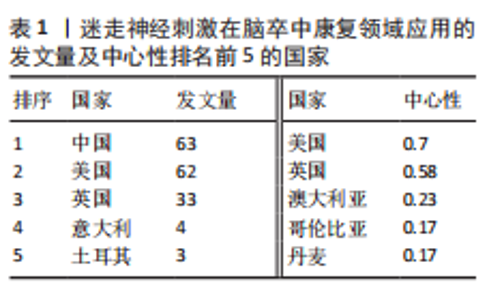
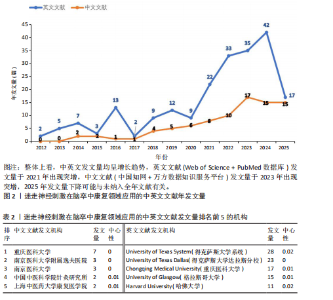
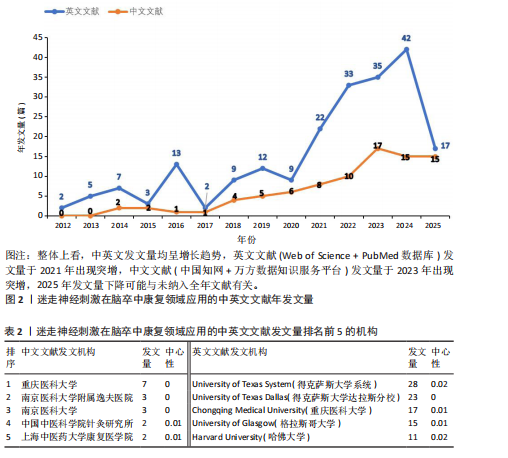
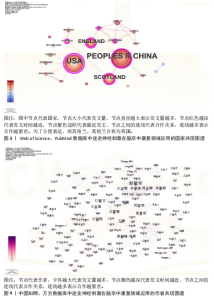
2.1 迷走神经刺激在脑卒中康复应用领域年发文量分析 根据统计结果显示,中英文文献年发文量整体呈增长趋势,英文文献发文量总体多于中文文献发文量。英文文献发文量在2012-2015年仅个位数,在2016年出现第一次突增,随后保持平稳态势,在2021年出现第二次突增,2024年发文量最多(42篇)。中文文献在2012-2013年间并未出版相关主题文献,2014-2021年研究较少,发文仅个位数,2023年出现突增,同年发文量最多(17篇)。从总体发文趋势看,近5年迷走神经刺激在脑卒中康复领域的应用受到热切关注,见图2。 2.2 迷走神经刺激在脑卒中康复应用领域国家分布 对所纳入的文献以“国家”为节点类型进行分析,得到节点数N=22,连线数E=24,网络密度为0.103 9的国家共现图谱,见图3。发文量最多的国家为中国(63篇),其次是美国(62篇)、英国(33篇)。从发文中心性来看,美国位列第一(0.7),其次是英国(0.58)、澳大利亚(0.23)。发文量与中心性排名前5的国家见表1。结果表明,中国虽然是发文量最多的国家,但其中心性只有0.14,较美国有一定的差距,可能与资金投入和人才等因素有关。从图谱上得知,目前迷走神经刺激在脑卒中康复领域方面的研究主要以中国和美国两个国家为主阵营,未来中国应加大与周边国家的交流合作,以提高科研成果的产出率和国际影响力。"
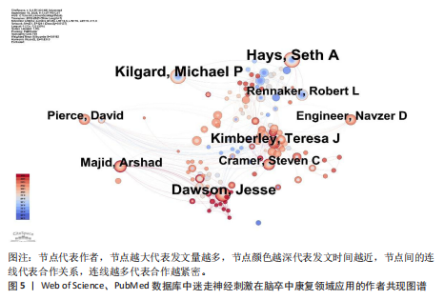
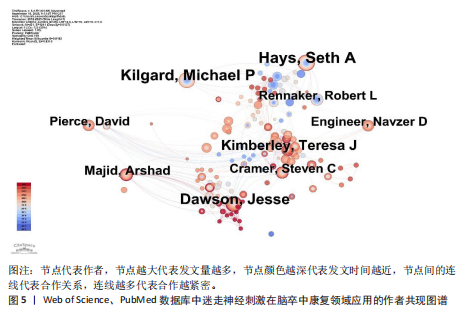
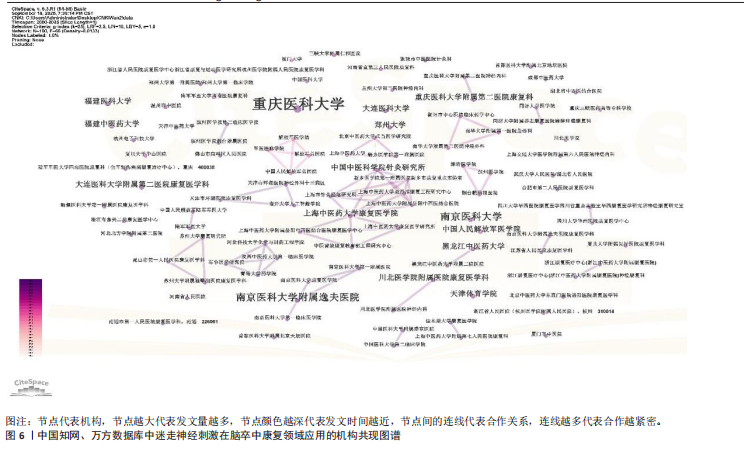
2.3 迷走神经刺激在脑卒中康复领域应用的作者分析 将所纳入的文献以“合作作者”为节点类型对中英文文献进行分析,结果如图4,5所示。中文文献分析得到节点数为160,连线数为303,网络密度为0.023 8的作者共现图谱。其中,赵敬军发文量最多,为3篇,其次是江钟立、章晓峰、王利凯、刘宏亮等,均为2篇。从图中可以看出,发文量较多的作者均形成自己的研究团体,但团体间合作较少。英文文献分析得到节点数为421,连线数为1 211,网络密度为0.013 7的作者共现图谱,发文频次排名前5的作者为HAYS SETH A(17篇)、KILGARD MICHAEL P(16篇)、DAWSON JESSE(14篇)、RENNAKER ROBERT L(12篇)、KIMBERLEY TERESA J(11篇)。发文频次排名第一的作者是来自德克萨斯大学达拉斯分校的HAYS SETH A教授,致力于研究迷走神经刺激技术及其在脑卒中领域的应用,并在该领域研究成果丰厚,从图中可以看出,各个研究团体之间连线较多,表明其合作较为紧密。国内外对比来看,国内研究团体间合作不足,未来应建立开放合作平台,加强团队间的交流合作,共同提高研究成果的国际影响力。 2.4 迷走神经刺激在脑卒中康复领域应用的机构分析 以“机构”作为节点类型,对中英文文献进行分析。中文文献得到得到节点数100,连线数66,网络密度为0.013 3的机构共现图谱,见图6所示,发文量排名前5的机构见表2。中文文献发文量最多的是重庆医科大学(7篇),但除了中国中医科学院针灸研究所和上海中医药大学康复医学院的中心性为0.01,其余发文较多的机构均为0,表明各研究团队为单一群体,并未与其他机构建立相关"
"
"

"
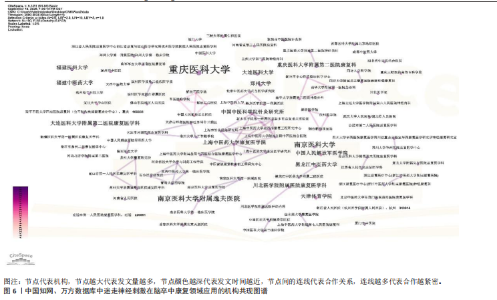
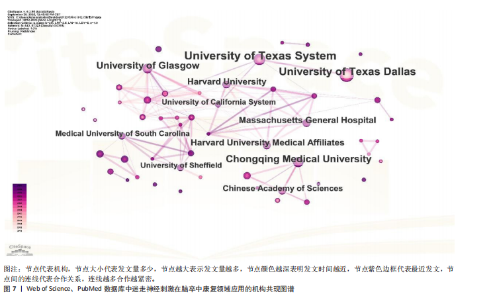
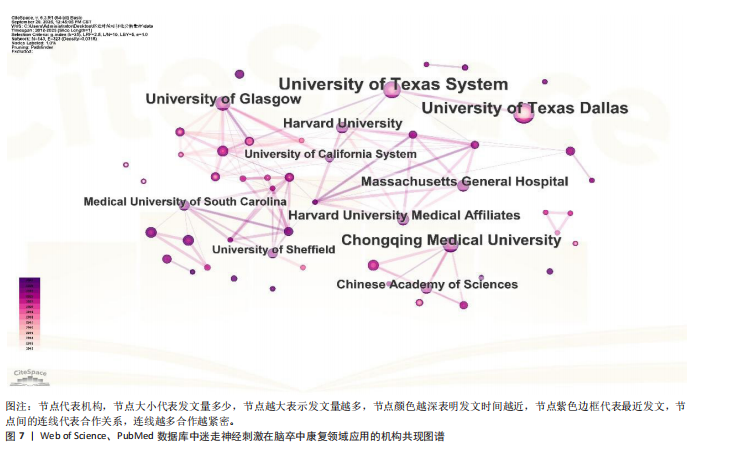
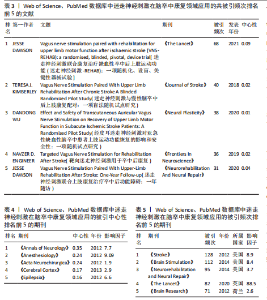
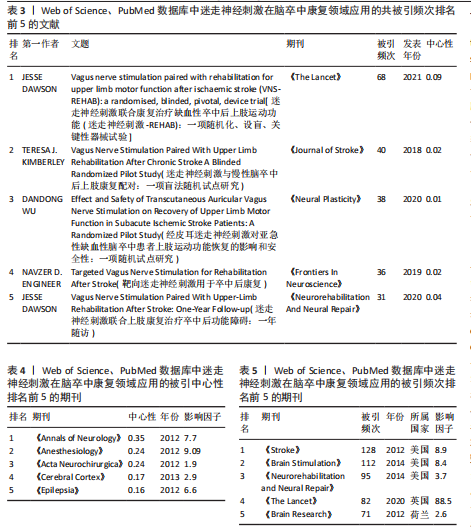
合作联系,可能与国内初期研究较不成熟有关,未来应加大各团队间的学术交流,共同推进科研成果产出与该技术的临床推广与应用。英文文献得到节点数143,连线数323,网络密度为0.031 8的机构共现图谱,如图7所示。通过图谱得知,在该领域的研究大部分集中在各个国家的高校,发文量排名前5的机构中3所来自美国,另外2所来自中国和英国。University of Texas System发文量最多为28篇,其次是University of Texas Dallas为23篇,形成了以德克萨斯大学系统为核心的研究团队。其中,Harvard Medical School(哈佛医学院)中心性排名第一,为0.14。表明其与其他高校的合作交流较多,但总体来看各个机构间合作不足,且研究团队多集中在各高校,临床研究方面可能有欠缺。 2.5 迷走神经刺激在脑卒中康复领域应用的文献共被引分析 以“被引文献”作为节点类型对英文文献进行分析,得到节点数205、连线数367、网络密度0.017 6的文献共被引图谱,见图8。从图谱中得知,发表年份相近的文章间连线较多,表明这些文献在该时期共同获得了学界的关注。共被引频次排名前5的文献如表3所示。其中DAWSON J的文献共被引频次最高,表明其研究存在较高的价值,同时也是该领域的核心人物。DAWSON J团队主要致力于研究迷走神经刺激对脑卒中患者上肢功能的影响,将迷走神经刺激联合康复训练运用于慢性脑卒中(病程大于3年)患者中,提出“迷走神经刺激+任务特异性康复”协同是疗效的关键,并且该研究证明迷走神经刺激对慢性脑卒中功能长期改善仍有可能。此外,该研究团队还将门诊迷走神经刺激联合康复治疗过渡到家庭自主迷走神经刺激结合个性化居家锻炼方案,解决了门诊康复的诸多不便,可作为慢性卒中患者长期居家康复的辅助手段。同时,WU DD团队也出现在高被引频次行列中,该团队验证了经皮耳迷走神经刺激对亚急性缺血性脑卒中患者上肢运动功能恢复的有效性和安全性,也表明在脑卒中康复领域非侵入性迷走神经刺激的研究价值。 2.6 迷走神经刺激在脑卒中康复领域应用的被引期刊分析 以“被引期刊”为节点类型对英文文献进行分析,得到节点数为180,连线数为416,网络密度为0.025 8的被引期刊图谱,见图9。共有47种期刊发表了有关于迷走神经刺激在脑卒中康复领域应用的文献。被引中心性排名前5的期刊如表4所示,其中《Annals of Neurology》杂志(影响因子=7.7)中心性最强,该杂志专注于临床神经病学领域,涉及神经病学的基础研究、临床研究、诊断技术、治疗策略等多个方面,在神经病学领域享有较高的学术声誉和影响力。被引频次排名前5的期刊如表5所示。在被引频次排名前5的期刊中,前3来自美国,剩余2个来自英国和荷兰,表明在该领域中论文发表以欧美国家为主,国内期刊影响力较欧美国家的期刊之间还存在一定的距离,可能与欧美国家科研投入资金较多、经济发达有关。其中,《Stroke》杂志(影响因子=8.9)被引频次最高,该杂志由美国心脏协会主办,专注于脑卒中及脑血管疾病领域的基础、临床和转化研究,其高被引频次也代表了"
"
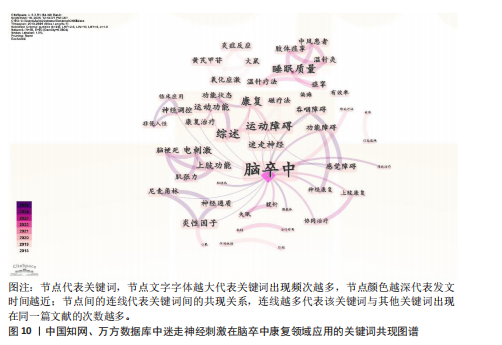
其在该领域的权威地位,一定程度揭示了其受到大多数专家学者的关注和认同。结果显示高被引频次及高中心性的期刊发表文献年份多集中在2012年左右,表明迷走神经刺激在脑卒中康复领域中的应用在过去的10年里得到越来越广泛的关注。此外也揭示了高被引频次的期刊所刊登的该领域的研究成果可能是前沿及可靠的,为研究迷走神经刺激对脑卒中后康复的影响提供有价值的参考。 2.7 迷走神经刺激在脑卒中康复领域应用的关键词共现分析 以“关键词”为节点类型对中英文文献进行分析,结果如图10,11所示。中文文献分析纳入的节点数为56,连线数为93,网络密度为0.060 4;英文文献分析纳入的节点数为328,连线数为894,网络密度为0.016 7。关键词是对一篇文章主要内容和结论的高度概括和浓缩,对关键词进行分析有助于作者快速抓住该领域的研究热点、研究趋势及其内在联系。出现频次和中心性排名前10的中英文关键词如表6所示,排除与检索策略有关的主题词,中文文献代表性关键词有上肢、运动功能、神经调控等;英文文献代表性关键词有electrical stimulation(电刺激)、upper extremity(上肢)、plasticity(可塑性)等,表明国内外的研究方向基本一致,均是主要探究迷走神经刺激对脑卒中后运动功能的影响及探究其对神经可塑性的影响机制。 2.8 迷走神经刺激在脑卒中康复领域应用的关键词聚类分析 利用LLR算法对中英文关键词进行聚类分析,中文文献得到9个聚类群,共纳入92个节点,132条连线,网络密度为0.031 5, 见图12。英文文献得到14个聚类群,共纳入328个节点,894条连线,网络密度为0.016 7,见图13。中文文献(模块值Q=0.752 4 > 0.3,平均轮廓值S=0.941 8 > 0.7)与英文文献(Q=0.759 > 0.3,S=9 192 > 0.7)均可认为所产生的聚类图谱清晰地反映了迷走神经刺激在脑卒中康复领域应用的研究主题分布。中文文献排除检索策略的主题词外,代表性的聚类主要有#3 机制、#4神经保护作用、#6炎性因子、#7吞咽障碍、#8上肢功能等,表明研究重点聚焦于迷走神经的临床应用研究及其改善神经功能的机制研究。英文文献中具有代表性的聚类有#0 non-invasive vagus nerve stimulation (无创迷走神经刺激)、#2 transcutaneous vagus nerve stimulation(经皮迷走神经刺激)、#5 maavns(motor-activated auricular vagus nerve stimulation,运动激活耳迷走神经刺激),表明未来研究重点聚焦在安全性更高的非侵入式迷走神经刺激领域,一定程度上为未来研究方向提供了参考。 2.9 迷走神经刺激在脑卒中康复领域应用的关键词突现分析 关键词突现反映了该领域的研究热点及未来发展趋势,中文文献共得到10个突现词,英文文献共得到15个突现词,关键词突现图谱如图14,15所示。其中,中文文献突现强度最高的是“运动功能”(突现强度1.54),研究主要集中在2023年;近几年研究热点主要集中在上肢功能康复方面。英文文献突现强度最高的是“cortical plasticity”(皮质可塑性)、突现强度为3.03,在2013-2016年间得到众多研究者的关注,这也与关键词共现和聚类结果相一致,表明研究重点聚焦于迷走神经刺激对改善脑卒中患者神经可塑性方面的研究。近几年的突现关键词为“transcranial magnetic stimulation”(经颅磁刺激)、“induced neuroprotection”(诱导神经保护),表明迷走神经刺激与其他技术的联合应用以及机制探讨可能是未来的研究方向。"
"
"
| [1] 熊文婧,徐杰茹,张敏,等.2005-2019年中国脑卒中发病与死亡 趋势及未来十年预测[J]. 现代预防医学,2024,51(1):15-20. [2] 孙辛缘,刘凡杰.神经调控技术改善脑卒中后手功能障碍的研究进展[J].山东第一医科大学(山东省医学科学院)学报,2024,45(10):632-636. [3] 张立新.经皮耳迷走神经刺激在脑卒中后功能障碍的应用[J].康复学报,2024,34(5):417-425. [4] 顾楠楠,李春波.经皮迷走神经刺激术研究进展[J].上海交通大学学报(医学版),2020,40(4): 539-542. [5] FARMER AD, STRZELCZYK A, FINISGUERRA A, et al. International consensus based review and recommendations for minimum reporting standards in research on transcutaneous vagus nerve stimulation (version 2020). Front Hum Neurosci. 2021;14:568051. [6] ZOU N, ZHOU Q, ZHANG Y, et al. Transcutaneous auricular vagus nerve stimulation as a novel therapy connecting the central and peripheral systems: a review. Int J Surg. 2024;110(8):4993-5006. [7] HEIN E,NOWAK M,KIESS O,et al.Auricular trans cutaneous electrical nerve stimulation in depressed patients: a randomized controlled pilot study.J Neural Transm (Vienna).2013;120(5): 821-827. [8] 谢敏,王梦寰,耿宝峰,等.经皮耳迷走神经电刺激联合作业治疗对脑卒中上肢功能的疗效[J].中国康复,2024,39(11):649-654. [9] CHEN C. Searching for intellectual turning points: progressive knowledge domain visualization. Proc Natl Acad Sci USA. 2004;101 (Suppl 1):5303-5310. [10] 赵敬军,王正辉,周立群,等.耳迷走神经刺激改善脑卒中后学习与记忆障碍的作用与机制探析[J].世界科学技术-中医药现代化,2020, 22(7):2135-2139. [11] 赵敬军,李源莉,张金玲,等. 经皮耳迷走神经刺激对大脑中动脉栓塞模型大鼠缺血半暗带胶质纤维酸性蛋白及微管相关蛋白表达的影响[J].针刺研究,2022,47(1):33-38. [12] 黄莉,王嘉,白晓丽,等.基于VOSviewer和CiteSpace对中药配方颗粒研究的可视化分析[J].中医临床研究,2025,17(7):47-53. [13] 贾雯,吕艺兵,张清爽.低频脉冲电刺激结合康复训练对脑卒中患者运动功能障碍的改善作用研究[J].航空航天医学杂志,2025,36(9):1042-1044. [14] 孙倩倩,雷德宝,常虎,等. 国标ICF-RS在脑卒中恢复期患者功能评价中的信效度研究[J]. 中国康复,2025,40(3):135-139. [15] 李海涛,于洋,吴静超,等.迷走神经电刺激联合康复治疗脑卒中后上肢功能障碍1例[J].立体定向和功能性神经外科杂志,2024, 37(2):120-122. [16] KHODAPARAST N, HAYS SA, SLOAN AM, et al. Vagus nerve stimulation delivered during motor rehabilitation improves recovery in a rat model of stroke. Neurorehabil Neural Repair. 2014;28(7):698-706. [17] HAYS SA, KHODAPARAST N, HULSEY DR, et al. Vagus nerve stimulation during rehabilitative training improves functional recovery after intracerebral hemorrhage. Stroke. 2014;45(10):3097-3100. [18] AY I, NASSER R, SIMON B, et al. Transcutaneous Cervical Vagus Nerve Stimulation Ameliorates Acute Ischemic Injury in Rats. Brain Stimul. 2016; 9(2):166-173. [19] WU D, MA J, ZHANG L,et al. Effect and Safety of Transcutaneous Auricular Vagus Nerve Stimulation on Recovery of Upper Limb Motor Function in Subacute Ischemic Stroke Patients: A Randomized Pilot Study. Neural Plast. 2020;2020:8841752. [20] DAWSON J, PIERCE D, DIXIT A, et al. Safety, Feasibility, and Efficacy of Vagus Nerve Stimulation Paired With Upper-Limb Rehabilitation After Ischemic Stroke. Stroke. 2016;47(1):143-150. [21] CAPONE F, MICCINILLI S, PELLEGRINO G, et al. Transcutaneous Vagus Nerve Stimulation Combined with Robotic Rehabilitation Improves Upper Limb Function after Stroke. Neural Plast. 2017;2017:7876507. [22] VAN DER MEIJ A, VAN WALDERVEEN MAA, KRUYT ND, et al. NOn-invasive Vagus nerve stimulation in acute Ischemic Stroke (NOVIS): a study protocol for a randomized clinical trial. Trials. 2020;21(1):878. [23] 黄凤枝,韦江波.基于5E康复模式的延续护理应用于脑卒中合并吞咽障碍患者中的价值探讨[J].中国典型病例大全,2025,19(3):1144-1147. [24] 张雯舒,王宇,吴玉丽,等.电针任督脉经穴治疗缺血性脑卒中合并吞咽功能障碍的临床观察[J].广州中医药大学学报,2025,42(7):1621-1628. [25] 周莉颖,东玫岐,刘彤彤,等.球囊扩张术治疗脑卒中后环咽肌失弛缓型吞咽 障碍的研究进展[J].中国医学创新,2025,22(18):173-178. [26] 乐梦祺,李松,陈旭,等.基于数据挖掘探讨电针治疗中风后吞咽障碍相关参数的规律[J].中医临床研究,2025,17(16):65-75. [27] 陈艳玮,皮睿,冯亚琼.重复经颅磁刺激联合吞咽训练在脑梗死后吞咽障碍患者康复中的应用效果[J].现代医药卫生,2025,41(4):931-934+939. [28] YUAN Y, WANG J, WU D, et al. Effect of Transcutaneous Vagus Nerve Stimulation in Dysphagia After Lateral Medullary Infarction: A Case Report. Am J Speech Lang Pathol. 2019; 28(4):1381-1387. [29] LIN WS, CHOU CL, CHANG MH,et al. Vagus nerve magnetic modulation facilitates dysphagia recovery in patients with stroke involving the brainstem - A proof of concept study. Brain Stimul. 2018;11(2):264-270. [30] WANG Y, HE Y, JIANG L, et al. Effect of transcutaneous auricular vagus nerve stimulation on post-stroke dysphagia. J Neurol. 2023;270(2): 995-1003. [31] LONG L, ZANG Q, JIA G, et al. Transcutaneous Auricular Vagus Nerve Stimulation Promotes White Matter Repair and Improves Dysphagia Symptoms in Cerebral Ischemia Model Rats. Front Behav Neurosci. 2022;16:811419. [32] KHODAPARAST N, HAYS SA, SLOAN AM, et al. Vagus nerve stimulation during rehabilitative training improves forelimb strength following ischemic stroke. Neurobiol Dis. 2013;60:80-88. [33] HAYS SA, KHODAPARAST N, RUIZ A, et al. The timing and amount of vagus nerve stimulation during rehabilitative training affect poststroke recovery of forelimb strength. Neuroreport. 2014;25(9):676-682. [34] PRUITT DT, SCHMID AN, KIM LJ, et al. Vagus Nerve Stimulation Delivered with Motor Training Enhances Recovery of Function after Traumatic Brain Injury. J Neurotrauma. 2016;33(9):871-879. [35] KHEDR EM, ABO-ELFETOH N. Therapeutic role of rTMS on recovery of dysphagia in patients with lateral medullary syndrome and brainstem infarction.J Neurol Neurosurg Psychiatry. 2010;81:495-499. [36] KUMAR S, WAGNER CW, FRAYNE C, et al. Noninvasive brain stimulation may improve stroke-related dysphagia: a pilot study. Stroke. 2011;42(4):1035-1040. [37] THIEL A, HARTMANN A, RUBI-FESSEN I, et al. Effects of noninvasive brain stimulation on language networks and recovery in early poststroke aphasia. Stroke. 2013;44(8):2240-2246. [38] MORRISON RA, HAYS SA, KILGARD MP. Vagus Nerve Stimulation as a Potential Adjuvant to Rehabilitation for Post-stroke Motor Speech Disorders. Front Neurosci. 2021;15:715928. [39] BERTHIER ML. Poststroke aphasia : epidemiology, pathophysiology and treatment.Drugs Aging. 2005;22(2):163-182. [40] GANZER PD, DARROW MJ, MEYERS EC, et al. Closed-loop neuromodulation restores network connectivity and motor control after spinal cord injury. Elife. 2018;7:e32058. [41] BUELL EP, LOERWALD KW, ENGINEER CT, et al. Cortical map plasticity as a function of vagus nerve stimulation rate. Brain Stimul. 2018;11(6): 1218-1224. [42] LOERWALD KW, BORLAND MS, RENNAKER RL 2ND, et al. The interaction of pulse width and current intensity on the extent of cortical plasticity evoked by vagus nerve stimulation. Brain Stimul. 2018;11(2):271-277. [43] 柯超,单生涛,谢峥嵘,等.基于功能性磁共振成像的针刺治疗脑卒中后功能障碍的研究进展[J].湖南中医药大学学报,2024,44(11):2136-2142. [44] 侯敬贤,曲斯伟,宋为群.本体感觉训练在脑卒中患者康复中的研究进展[J].中国康复,2024, 39(10):631-635. [45] RAND D, GOTTLIEB D, (TAMAR) WEISS PL. Recovery of Patients with a Combined Motor and Proprioception Deficit During the First Six Weeks of Post Stroke Rehabilitation. Physical & Occupational Therapy In Geriatrics. Physical & Occupational Therapy In Geriatrics.2001;18(3): 69-87. [46] BAIG SS, FALIDAS K, LAUD PJ, et al. Transcutaneous Auricular Vagus Nerve Stimulation with Upper Limb Repetitive Task Practice May Improve Sensory Recovery in Chronic Stroke. J Stroke Cerebrovasc Dis. 2019;28(12):104348. [47] KILGARD MP, RENNAKER RL, ALEXANDER J, et al. Vagus nerve stimulation paired with tactile training improved sensory function in a chronic stroke patient. NeuroRehabilitation. 2018;42(2):159-165. [48] 邹荣基,喻芳芳,刘腾飞,等.Caveolin-1在氧糖剥夺诱导的人脑微血管内皮细胞铁死亡中的作用 [J]. 山西医科大学学报,2025(9):1016-1024. [49] CHEN YJ, WALLACE BK, YUEN N, et al. Blood-brain barrier KCa3.1 channels: evidence for a role in brain Na uptake and edema in ischemic stroke. Stroke. 2015;46(1):237-244. [50] NEUWELT EA, BAUER B, FAHLKE C, et al. Engaging neuroscience to advance translational research in brain barrier biology. Nat Rev Neurosci. 2011; 12(3):169-182. [51] KRUEGER M, BECHMANN I, IMMIG K, et al. Blood-brain barrier breakdown involves four distinct stages of vascular damage in various models of experimental focal cerebral ischemia. J Cereb Blood Flow Metab. 2015;35(2):292-303. [52] YANG Y, YANG LY, ORBAN L, et al. Non-invasive vagus nerve stimulation reduces blood-brain barrier disruption in a rat model of ischemic stroke. Brain Stimul. 2018;11(4):689-698. [53] DASH PK, ZHAO J, KOBORI N, et al. Activation of Alpha 7 Cholinergic Nicotinic Receptors Reduce Blood-Brain Barrier Permeability following Experimental Traumatic Brain Injury. J Neurosci. 2016;36(9):2809-2818. [54] PAN W, STONE KP, HSUCHOU H, et al. Cytokine signaling modulates blood-brain barrier function. Curr Pharm Des. 2011;17(33):3729-3740. [55] CHEN X, HE X, LUO S, et al. Vagus Nerve Stimulation Attenuates Cerebral Microinfarct and Colitis-induced Cerebral Microinfarct Aggravation in Mice. Front Neurol. 2018;9:798. [56] JIANG Y, LI L, LIU B, et al. Vagus nerve stimulation attenuates cerebral ischemia and reperfusion injury via endogenous cholinergic pathway in rat. PLoS One. 2014;9(7):e102342. [57] ZHANG L, QU Y, TANG J, et al. PI3K/Akt signaling pathway is required for neuroprotection of thalidomide on hypoxic-ischemic cortical neurons in vitro. Brain Res. 2010;1357:157-165. [58] HENRY TR, BAKAY RA, PENNELL PB, et al. Brain blood-flow alterations induced by therapeutic vagus nerve stimulation in partial epilepsy: II. prolonged effects at high and low levels of stimulation. Epilepsia. 2004;45(9):1064-1070. [59] JUEPTNER M, WEILLER C. Review: does measurement of regional cerebral blood flow reflect synaptic activity? Implications for PET and fMRI. Neuroimage. 1995;2(2):148-156. [60] DORR AE, DEBONNEL G. Effect of vagus nerve stimulation on serotonergic and noradrenergic transmission. J Pharmacol Exp Ther. 2006;318(2): 890-898. [61] 李思琦,曾洋菁,王清,等.基于CiteSpace可视化分析生物反馈疗法在脑卒中康复领域的应用[J].循证护理,2025,11(4):677-686. [62] 陈宇,牛陵川.经皮耳迷走神经电刺激对意识障碍患者促醒的临床研究现状[J].现代医药卫生,2025,41(9):2182-2188+2194. [63] 董洪和,齐运卫,王兴源,等.经皮迷走神经耳支电刺激联合虚拟情景训练对脑梗死患者上肢功能的影响[J].中国疗养医学,2024,33(11): 42-46. [64] 王利凯,萧禹,王立童.经皮耳迷走神经电刺激联合经颅直流电刺激对脑卒中患者上肢功能的影响[J].中国康复,2023,38(11):659-663. [65] 郑莉,鲍治诚,张琪,等.经皮耳迷走神经电刺激结合康复机器人训练对脑卒中患者上肢功能的效果[J].中国康复理论与实践,2023, 29(6):691-696. [66] KIMBERLEY TJ, CRAMER SC, WOLF SL, et al. Long-Term Outcomes of Vagus Nerve Stimulation Paired With Upper Extremity Rehabilitation After Stroke. Stroke. 2025;56(8):2255-2265. |
| [1] | Cao Xinyan, Yu Zifu, Leng Xiaoxuan, Gao Shiai, Chen Jinhui, Liu Xihua. Effect of repetitive transcranial magnetic stimulation and transcranial direct current stimulation on motor function and gait in children with cerebral palsy: a network meta-analysis [J]. Chinese Journal of Tissue Engineering Research, 2026, 30(6): 1539-1548. |
| [2] | Zhou Jian, Zhang Tao, Zhou Weili, Zhao Xingcheng, Wang Jun, Shen Jie, Qian Li, Lu Ming. Effects of resistance training on quadriceps mass and knee joint function in patients with osteoporosis and sarcopenia [J]. Chinese Journal of Tissue Engineering Research, 2026, 30(5): 1081-1088. |
| [3] | Chen Qiang, Wu Wenjuan, Jiang Shuhua, Huang Da. Physical exercise improves physical function in burn patients: a systematic review and meta-analysis [J]. Chinese Journal of Tissue Engineering Research, 2026, 30(5): 1269-1281. |
| [4] | Yang Zeyu, Zhi Liang, Wang Jia, Zhang Jingyi, Zhang Qingfang, Wang Yulong, Long Jianjun. A visualized analysis of research hotspots in high-frequency repetitive transcranial magnetic stimulation from the macroscopic perspective [J]. Chinese Journal of Tissue Engineering Research, 2026, 30(5): 1320-1330. |
| [5] | Wu Ruiqi, Dong Panfeng, Zhang Hongrui, Lyu Yongbin, Peng Qinglin, Zhuo Yinghong, Chen Yueping . Different physical factor therapies for knee osteoarthritis: a network meta-analysis of efficacy and safety [J]. Chinese Journal of Tissue Engineering Research, 2026, 30(34): 9056-9066. |
| [6] | He Renda, Ma Wei, Sun Yongsi, Mo Xueni. Future medical research on brain organoids: interdisciplinary training, bioengineering technologies, and optimized model maturity [J]. Chinese Journal of Tissue Engineering Research, 2026, 30(34): 9088-9094. |
| [7] | Meng Yihao, Zhang Shuai. Application of self-healing hydrogels for sports injury prevention and rehabilitation#br# [J]. Chinese Journal of Tissue Engineering Research, 2026, 30(32): 8502-8511. |
| [8] | Liao Guangtao, Feng Ziyu, Fu Xiaoyong, Zhao Qinglan, Chen Chao, Hong Jinsong. Subtalar arthroereisis for treatment of pediatric flexible flatfoot: relationship between radiographic indicators and clinical efficacy [J]. Chinese Journal of Tissue Engineering Research, 2026, 30(3): 661-670. |
| [9] | Tang Ya, Li Long, Huang Du, Huang Zhaolu. Systematic review of the effect of 3D-printed exoskeleton on hand function rehabilitation in stroke patients [J]. Chinese Journal of Tissue Engineering Research, 2026, 30(29): 7648-7653. |
| [10] | Wang Xueting, Yang Wei, Wang Pengqin. Post-stroke rehabilitation robotics: current research status and hot topics in and outside China [J]. Chinese Journal of Tissue Engineering Research, 2026, 30(28): 7404-7409. |
| [11] | Li Sihui, Wang Qin, Cui Shenhong, Cheng Xiaofei, Feng Ziyun, Wang Dehua, Liang Chunting, Leng Jun. A network meta-analysis of effects of non-invasive neuromodulation techniques on language function in patients with aphasia after stroke [J]. Chinese Journal of Tissue Engineering Research, 2026, 30(28): 7485-7493. |
| [12] | Fan Mengmeng, Ding Jiali, Wan Yujie, Huang Hailiang. A systematic review and network meta-analysis of neuromodulation techniques for promoting upper limb motor function after stroke [J]. Chinese Journal of Tissue Engineering Research, 2026, 30(28): 7494-7504. |
| [13] | Liu Meng, Hou Shilun. Effects of blood flow restriction training and aerobic exercise on energy expenditure in young men [J]. Chinese Journal of Tissue Engineering Research, 2026, 30(25): 6603-6609. |
| [14] | Wei Xinyi, Zheng Yan, Chen Qian, Ren Jiajia, Li Jian. Molecular dynamic characteristics of rat gastrocnemius muscle under acute and short-term exercise intervention during the subacute phase of spinal cord injury [J]. Chinese Journal of Tissue Engineering Research, 2026, 30(24): 6196-6206. |
| [15] | Wang Feifei, Wang Zhennan. Scientometric deconstruction of developmental dynamics in upper-limb rehabilitation robotics: evidence network analysis via CiteSpace [J]. Chinese Journal of Tissue Engineering Research, 2026, 30(24): 6400-6409. |
| Viewed | ||||||
|
Full text |
|
|||||
|
Abstract |
|
|||||