Chinese Journal of Tissue Engineering Research ›› 2026, Vol. 30 ›› Issue (25): 6603-6609.doi: 10.12307/2026.486
Previous Articles Next Articles
Effects of blood flow restriction training and aerobic exercise on energy expenditure in young men
Liu Meng1, Hou Shilun2
- 1Pingdingshan University, Pingdingshan 467000, Henan Province, China; 2School of Sports Medicine and Rehabilitation, Beijing Sport University, Beijing 100084, China
-
Received:2025-11-06Revised:2026-03-12Online:2026-09-08Published:2026-04-22 -
Contact:Hou Shilun, PhD, Professor, School of Sports Medicine and Rehabilitation, Beijing Sport University, Beijing 100084, China -
About author:Liu Meng, MS, Assistant teacher, Pingdingshan University, Pingdingshan 467000, Henan Province, China

CLC Number:
Cite this article
Liu Meng, Hou Shilun. Effects of blood flow restriction training and aerobic exercise on energy expenditure in young men[J]. Chinese Journal of Tissue Engineering Research, 2026, 30(25): 6603-6609.
share this article
Add to citation manager EndNote|Reference Manager|ProCite|BibTeX|RefWorks
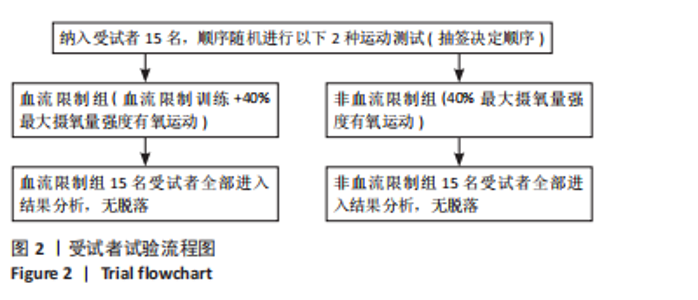
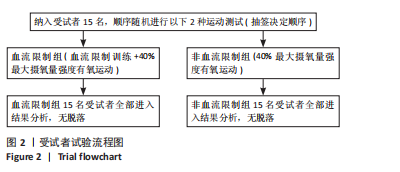
2.1 参与者数量分析 共招募20名受试者,因5名不符合纳入标准,最终纳入15名受试者。15名受试者完成基本的数据收集之后,通过抽签的方式决定2次运动测试的次序。 2.2 试验流程图 见图2。"
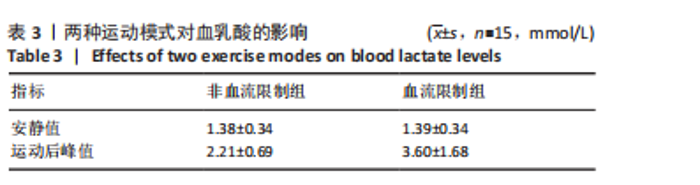
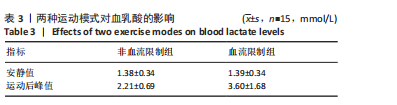
2.3 两种运动模式对能量消耗和各系统贡献的影响 如表3所示,与安静值相比,非血流限制组运动后血乳糖峰值增加了60.14%,血流限制组运动后血乳糖峰值增加了158.99%。与非血流限制组相比,血流限制组运动后血乳糖峰值增加了62.90%。"
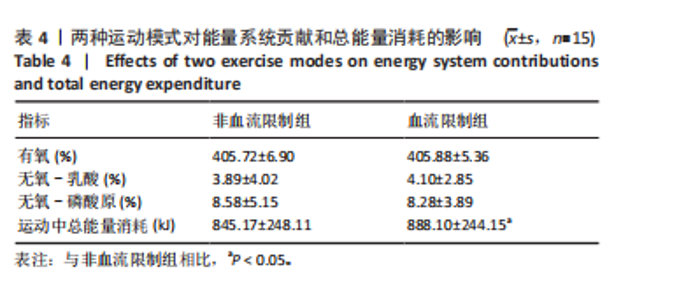
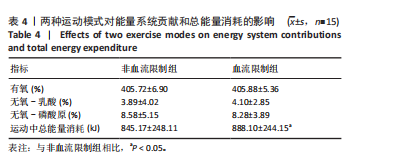
如表4所示,血流限制组的总能量显著高于非血流限制组(P < 0.05),两组之间有氧、无氧-乳酸、无氧-磷酸原系统贡献相比差异无显著性意义(P > 0.05)。"
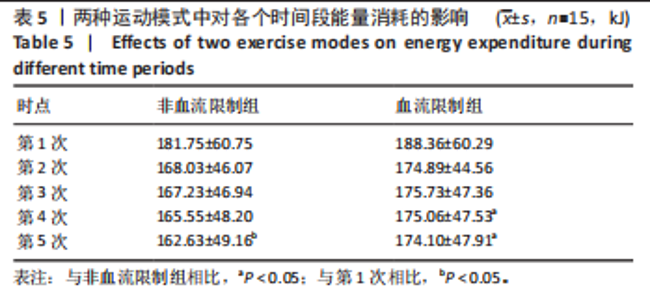
如表5所示,从均值数据来看,血流限制组的每一次运动引起的能量消耗均高于非血流限制组,但是仅第4次和第5次差异有显著性意义(P < 0.05)。与非血流限制组第4次和第5次结果相比,血流限制组在第4次和第5次能量消耗分别增加了5.74%(P < 0.05)和7.05%(P < 0.05)。 此外,运动方式和时间的交互作用的影响有统计学意义(P < 0.05),非血流限制组第1次运动与第5次运动之间受试者的能量消耗差异有显著性意义(P < 0.05);血流限制组时间对于"
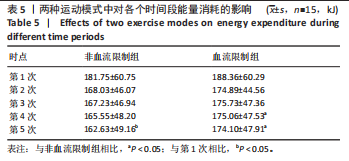
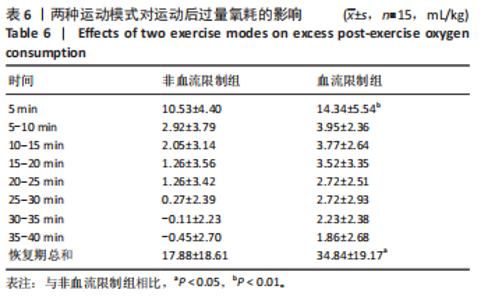
能量消耗的影响无统计学意义。非血流限制组随着运动次数的增加,能量消耗存在降低趋势,且第5次运动的能量消耗显著低于第1次。 2.4 两种运动模式对运动后过量氧耗的影响 不同运动恢复期每千克(kg)体质量每5 min的运动后过量耗氧结果显示,运动恢复期的前5 min内,血流限制组的运动后过量耗氧显著大于非血流限制组(P < 0.01)。恢复期40 min内,血流限制组的总运动后过量耗氧显著大于非血流限制组(P < 0.05)。见表6。 "
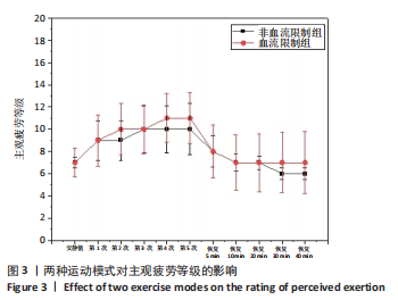
2.5 两种运动模式对主观疲劳等级、心率和血压的影响 与非血流限制组相比,运动过程中血流限制组的主观疲劳等级从第1-5次呈现升高态势,但无统计学意义。与非血流限制组相比,恢复过程中血流限制组的主观疲劳等级在20-40 min之间呈现升高态势,但无统计学意义。见图3。"
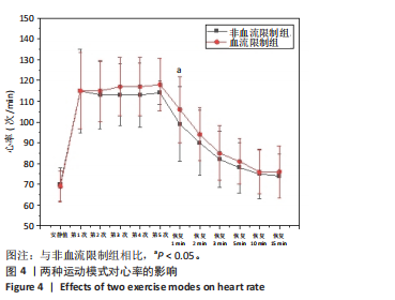
与非血流限制组相比,血流限制组的心率在整个试验过程中呈现升高态势,但无统计学意义。与非血流限制组相比,血流限制组在恢复期1 min的心率显著升高(P < 0.05),其他时间节点两种运动模式心率之间差异无显著性意义。见图4。"
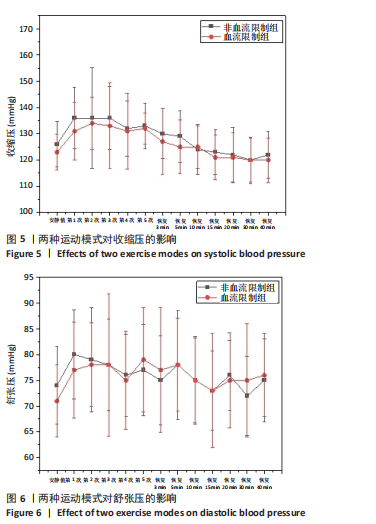
两组运动的志愿者收缩压在整个试验过程中均呈现下降态势,非血流限制组的收缩压高于血流限制组,但无统计学意义(图5)。两组运动的志愿者舒张压在整个试验过程中均呈现波动态势,两组之间差异无统计学意义(图6)。"

2.6 不良事件 此次试验过程中无不良事件发生。"

| [1] ALESSIO B, SILVIA M, FERRUCCIO S, et al. Ketogenic Diet and Weight Loss: Is There an Effect on Energy Expenditure? Nutrients. 2022;14(9):1814. [2] KANG C, ZEWEI S, WEIJUN G, et al. Prevalence of obesity and associated complications in China: A cross-sectional, real-world study in 15.8 million adults. Diabetes Obes Metab. 2023;25(11):3390-3399. [3] GRIBSHOLT S, CRONIN-FENTON D, VERES K, et al. Hospital-diagnosed overweight and obesity related to cancer risk: a 40-year Danish cohort study. J Int Med. 2020; 287(4):435-447. [4] KARABULUT M, GARCIA SD. Hemodynamic responses and energy expenditure during blood flow restriction exercise in obese population. Clin Physiol Funct Imaging. 2017;37(1):1-7. [5] DIKAIOU P, BJÖRCK L, ADIELS M, et al. Obesity, overweight and risk for cardiovascular disease and mortality in young women. Eur J Prev Cardiol. 2021; 28(12):1351-1359. [6] LIM HJ, KANG HT, LEE JW. Recent Trends in Weight Loss Attempts: Data From the Korea National Health and Nutrition Examination Survey. Asia Pac J Public Health. 2018;30(5):447-457. [7] DICKER D, KARPATI T, PROMISLOW S, et al. Implications of the European Association for the Study of Obesity’s New Framework Definition of Obesity: Prevalence and Association With All-Cause Mortality. Ann Intern Med. 2025; 178(8):1065-1072. [8] DONNELLY JE, BLAIR SN, JAKICIC JM, et al. American College of Sports Medicine Position Stand. Appropriate physical activity intervention strategies for weight loss and prevention of weight regain for adults. Med Sci Sports Exerc. 2009; 41(2):459-471. [9] FIONA CB, SALIH SAA, STUART B, et al. World Health Organization 2020 guidelines on physical activity and sedentary behaviour. Br J Sports Med. 2020;54(24): 1451-1462. [10] 胡国鹏, 郑阳, 孟妍, 等. 大强度间歇训练与中等强度持续训练对耗氧量动力学特征影响的比较研究[J]. 体育科学,2017,37(3):58-67+97. [11] 孟宪欣, 管泽毅, 葛吉生, 等. 间歇运动干预自发性高血压大鼠病理性心脏肥大:运动强度与健康效应的关系[J]. 体育科学,2019,39(6):73-82+97. [12] 陶云飞, 彭莉. 血流限制在急性抗阻运动中对内皮功能相关炎性因子的影响[J]. 中国组织工程研究,2026,30(5):1184-1195. [13] LOENNEKE JP, THIEBAUD RS, ABE T, et al. Blood flow restriction pressure recommendations: The hormesis hypothesis. Med Hypotheses. 2014;82(5): 623-626. [14] HAO C, PENG L, YIDI D, et al. The Impact of Blood Flow Restriction Training on Glucose and Lipid Metabolism in Overweight or Obese Adults: A Systematic Review and Meta-Analysis. Life (Basel). 2025;15(8):1245. [15] THOMAS HJ, SCOTT BR, PEIFFER JJ. Acute physiological responses to low-intensity blood flow restriction cycling. J Sci Med Sport. 2018;21(9):969-974. [16] PFEIFFER PDS, CIRILO-SOUSA MS, SANTOS HHD. Effects of Different Percentages of Blood Flow Restriction on Energy Expenditure. Int J Sports Med. 2019;40(3): 186-190. [17] BANE A, WILSON L, JUMPER J, et al. Effects of Blood Flow Restriction Resistance Training on Autonomic and Endothelial Function in Persons with Parkinson’s Disease. J Parkinsons Dis. 2024;14(4):761-775 [18] ISHTIAQ A, RUSTEM M, BELGIN E. The effects of low-intensity resistance training with blood flow restriction versus traditional resistance exercise on lower extremity muscle strength and motor function in ischemic stroke survivors: a randomized controlled trial. Top Stroke Rehabil. 2023;31(4):418-429. [19] DILARA K, LEVENT O, SERDAR D, et al. Blood Flow Restriction Training in Patients With Rotator Cuff Tendinopathy: A Randomized, Assessor-Blinded, Controlled Trial. Clin J Sport Med. 2023;34(1):10-16. [20] ZILIANG W, JIANG Z, XUELIAN W, et al. Effect of Low-Load Blood Flow Restriction Training on Patients With Functional Ankle Instability: A Randomized Controlled Trial. J Sport Rehabil. 2023;32(8):863-872. [21] LANGGÅRD J S, ANDERSEN P, BAGGER MB, et al. The Effect of Blood Flow Restriction Exercise Prior to Total Knee Arthroplasty on Postoperative Physical Function, Lower Limb Strength and Patient-Reported Outcomes: A Randomized Controlled Trial. Scand J Med Sci Sports. 2024;34(11):e14750 [22] EVANS LN, O’MALLEY MK, CARTER KR, et al. The Efficacy of Blood Flow Restriction Training to Improve Quadriceps Muscle Function after Anterior Cruciate Ligament Reconstruction. Med Sci Sports Exerc. 2024;57(2):227-237. [23] BOUCHARD H, PÉNÉLOPE PD, FRANÇOIS B. High-intensity interval training with blood-flow restriction enhances sprint and maximal aerobic power in male endurance athletes. Appl Physiol Nutr Metab. 2024;50:1-11. [24] JI S, FRANZ A, VICAS M, et al. Arterial and Venous Pressure Dynamics in Blood Flow Restriction Versus Traditional Strength Training. Scand J Med Sci Sports. 2025;35(2):e70029. [25] SEAN ML, CHRISTOPER EP, PAOLA MR, et al. Acute Effects of Running and Blood Flow Restriction on Gas Exchange and Perceptual Responses. J Strength Cond Res. 2025;39(3):e436-e443. [26] KORKMAZ DAYICAN D, ULGER EKSI B, YIGIT S, et al. Immediate Effects of High-Intensity Blood Flow Restriction Training on Muscle Performance and Muscle Soreness. Res Q Exerc Sport. 2024;96(1):213-222. [27] DA SILVA JCG, FREITAS EDS, ANICETO RR, et al. Aerobic exercise with blood flow restriction: Energy expenditure, excess postexercise oxygen consumption, and respiratory exchange ratio. Clin Physiol Funct Imaging. 2022;42(4):241-249. [28] FAUL F, ERDFELDER E, LANG AG, et al. G*Power 3: a flexible statistical power analysis program for the social, behavioral, and biomedical sciences. Behav Res Methods. 2007;39(2):175-191. [29] TRAVIS WB. The importance of a priori sample size estimation in strength and conditioning research. J Strength Cond Res. 2013;27(8):2323-2337. [30] ABOYANS V, CRIQUI MH, ABRAHAM P, et al. Measurement and interpretation of the ankle-brachial index: a scientific statement from the American Heart Association. Circulation. 2012;126(24):2890-2909. [31] STAUNTON CA, MAY AK, BRANDNER CR, et al. Haemodynamics of aerobic and resistance blood flow restriction exercise in young and older adults. Eur J Appl Physiol. 2015;115(11):2293-302. [32] LUONG M, IGNASZEWSKI M, TAYLOR C. Stress testing: A contribution from Dr Robert A. Bruce, father of exercise cardiology. Br Columb Med J. 2016;(2):70-76. [33] VIANA AA, FERNANDES B, ALVAREZ C, et al. Prescribing high-intensity interval exercise by RPE in individuals with type 2 diabetes: metabolic and hemodynamic responses. Appl Physiol Nutr Metab. 2019;44(4):348-356. [34] BERTUZZI R, MELEGATI J, BUENO S, et al. GEDAE-LaB: A Free Software to Calculate the Energy System Contributions during Exercise. PLOS ONE. 2016; 11(1):e0145733. [35] EDWARD P, XI MING Z, NOLAN SH, et al. Effects of Blood Flow Restriction Therapy for Muscular Strength, Hypertrophy, and Endurance in Healthy and Special Populations: A Systematic Review and Meta-Analysis. Clin J Sport Med. 2022;32(5):531-545. [36] LAFORGIA J, WITHERS RT, GORE CJ. Effects of exercise intensity and duration on the excess post-exercise oxygen consumption. J Sports Sci. 2006;24(12):1247-1264. [37] MENDONCA GV, VAZ JR, PEZARAT-CORREIA P, et al. Effects of Walking with Blood Flow Restriction on Excess Post-exercise Oxygen Consumption. Int J Sports Med. 2015;36(3):e11-e18. [38] MOUSAVI Z, KARIMI Z, WONG A, et al. Comparison of enjoyment and energy expenditure of exergame with and without blood flow restriction in men and women. Sci Rep. 2024;14(1):9030. [39] LOENNEKE JP, KIM D, FAHS CA, et al. The influence of exercise load with and without different levels of blood flow restriction on acute changes in muscle thickness and lactate. Clin Physiol Funct Imaging. 2017;37(6):734-740. [40] KIM D, LOENNEKE JP, THIEBAUD RS, et al. The acute muscular effects of cycling with and without different degrees of blood flow restriction. Acta Physiol Hung. 2015;102(4):428-441. [41] CHRISTIANSEN D, BISHOP DJ. Aerobic-interval exercise with blood flow restriction potentiates early markers of metabolic health in man. Acta Physiol (Oxf). 2022; 234(2):e13769. [42] 刘晨晨, 刘锐泽, 鲍蒙蒙, 等. 血流限制训练干预老年肌少性肥胖[J]. 中国组织工程研究,2025,29(32):6963-6970. [43] TADASHI S, KOICHI O, SHINGO T, et al. Effect of multiple set on intramuscular metabolic stress during low-intensity resistance exercise with blood flow restriction. Eur J Appl Physiol. 2012;112(11):3915-3920. [44] CONCEIÇÃO MS, GÁSPARI AF, RAMKRAPES APB, et al. Anaerobic metabolism induces greater total energy expenditure during exercise with blood flow restriction. PLoS one. 2018;13(3):e0194776. [45] MENDONCA GV, VAZ JR, TEIXEIRA MS, et al. Metabolic cost of locomotion during treadmill walking with blood flow restriction. Clin Physiol Funct Imaging. 2014;34(4):308-316. [46] KARABULUT M, MCCARRON J, ABE T, et al. The effects of different initial restrictive pressures used to reduce blood flow and thigh composition on tissue oxygenation of the quadriceps. J Sports Sci. 2011;29(9):951-958. [47] MACHEK SB, HARRIS DR, ZAWIEJA EE, et al. The Impacts of Combined Blood Flow Restriction Training and Betaine Supplementation on One-Leg Press Muscular Endurance, Exercise-Associated Lactate Concentrations, Serum Metabolic Biomarkers, and Hypoxia-Inducible Factor-1α Gene Expression. Nutrients. 2022; 14(23):5129. [48] LI S N, IHSAN M, SHAYKEVICH A, et al. Exercise responses to heart rate clamped cycling with graded blood flow restriction. J Sci Med Sport. 2023;26(8):434-439. [49] ICHINOSE M, ISHII-KIZUKA T, KONDO N, et al. Increasing blood flow to exercising muscle attenuates systemic cardiovascular responses during dynamic exercise in humans. Am J Physiol Regul Integr Comp Physiol. 2015;309(10):R1234-R1242. [50] SPRANGER MD, KRISHNAN AC, LEVY PD, et al. Blood flow restriction training and the exercise pressor reflex: a call for concern. Am J Physiol Heart Circ Physiol. 2015;309(9):H1440-H1452. [51] YASUDA T, ABE T, BRECHUE WF, et al. Venous blood gas and metabolite response to low-intensity muscle contractions with external limb compression. Metabolism. 2010;59(10):1510-1519. [52] MICHAEL S, GRAHAM KS, DAVIS GM OAM. Cardiac Autonomic Responses during Exercise and Post-exercise Recovery Using Heart Rate Variability and Systolic Time Intervals-A Review. Front Physiol. 2017;8:301. [53] KACIN A, STRAZAR K. Frequent low-load ischemic resistance exercise to failure enhances muscle oxygen delivery and endurance capacity. Scand J Med Sci Sports. 2011;21(6):e231-e241. [54] INGRAM WJ, BUCKNER LS, DANKEL JS, et al. The Influence Of Time On Determining Blood Flow Restriction Pressure. Med Sci Sports Exerc. 2016;48(5S): 1032. |
| [1] | Liu Yu, Lei Senlin, Zhou Jintao, Liu Hui, Li Xianhui. Mechanisms by which aerobic and resistance exercises improve obesity-related cognitive impairment [J]. Chinese Journal of Tissue Engineering Research, 2026, 30(5): 1171-1183. |
| [2] | Chen Qiang, Wu Wenjuan, Jiang Shuhua, Huang Da. Physical exercise improves physical function in burn patients: a systematic review and meta-analysis [J]. Chinese Journal of Tissue Engineering Research, 2026, 30(5): 1269-1281. |
| [3] | Jiang Yang, Peng Hao, Song Yanping, Yao Na, Song Yueyu, Yin Xingxiao, Li Yanqi, Chen Qigang. Isometric exercise reduces resting blood pressure: a meta-analysis of moderating factors and dose effects [J]. Chinese Journal of Tissue Engineering Research, 2026, 30(4): 975-986. |
| [4] | Wen Fan, Zhu Huan, Hu Qinghua, Tuo Yanfang, Zhou Shufeng, Hu Jiangping, Wang Kangfeng. Eight-week aerobic exercise and aerobic exercise combined with full-body vibration training improve the microcirculation function of obese college students [J]. Chinese Journal of Tissue Engineering Research, 2026, 30(34): 8994-9001. |
| [5] | Chen Ziang, Li Qinlong, Wu Xue, Zhou Yue. Meta-analysis of blood flow restriction training to improve knee function and muscle strength in patients after anterior cruciate ligament reconstruction [J]. Chinese Journal of Tissue Engineering Research, 2026, 30(29): 7680-7687. |
| [6] | Zheng Xing, Zhang Qiang, Ye Guomin, Deng Bin, Chang Sha. Correlation of bone mineral density assessed using quantitative CT with obesity indicators, blood pressure, platelet count, and blood lipids in perimenopausal women [J]. Chinese Journal of Tissue Engineering Research, 2026, 30(29): 7548-7554. |
| [7] | Feng Shuo, Cao Xuan, Guo Xieleiya, Wang Jingfeng, Li Xiaolin. Gut microbiota and short-chain fatty acids: mechanisms of aerobic exercise regulation in type 2 diabetes [J]. Chinese Journal of Tissue Engineering Research, 2026, 30(25): 6592-6602. |
| [8] | Wu Fangjia, Lei Senlin, Li Xianhui, Yang Yang. Aerobic and resistance exercise interventions in a mouse model of nonalcoholic fatty liver disease: correlation between gut microbiota and irisin [J]. Chinese Journal of Tissue Engineering Research, 2026, 30(12): 3029-3043. |
| [9] | Hu Yujie, Xie Ping, , Lu Weijie, Yang Kang, Deng Yaoting, Liu Mengyang. Meta-analysis of the clinical efficacy of high-intensity interval exercise and middle-intensity continuous training in patients with coronary heart disease [J]. Chinese Journal of Tissue Engineering Research, 2026, 30(10): 2584-2593. |
| [10] | Fu Enhong, Yang Hang, Liang Cheng, Zhang Xiaogang, Zhang Yali, Jin Zhongmin. OpenSim-based prediction of lower-limb biomechanical behavior in adolescents with plantarflexor weakness [J]. Chinese Journal of Tissue Engineering Research, 2025, 29(9): 1789-1795. |
| [11] | Zhao Xiaoxuan, Liu Shuaiyi, Li Qi, Xing Zheng, Li Qingwen, Chu Xiaolei. Different exercise modalities promote functional recovery after peripheral nerve injury [J]. Chinese Journal of Tissue Engineering Research, 2025, 29(6): 1248-1256. |
| [12] | Ji Long, Chen Ziyang, , Jin Pan, Kong Xiangkui, Pu Rui, . Lipophagy, exercise intervention and prevention and treatment of nonalcoholic fatty liver disease [J]. Chinese Journal of Tissue Engineering Research, 2025, 29(35): 7611-7619. |
| [13] | Wang Jiaqian, , Jiang Changjun, Peng Yi, Ma Mi, Li Junhan. Study on the role of aerobic exercise in regulating the CNPY2-mediated AKT/GSK3β pathway for improving non-alcoholic fatty liver [J]. Chinese Journal of Tissue Engineering Research, 2025, 29(30): 6441-6448. |
| [14] | He Ningjuan, Li Li, Wang Su, Yang Jianshe, Lei Siyun, Wang Yang. Effects of aerobic or resistance exercise on hippocampal ras/Drebrin dendritic spine plasticity in a mouse model of Alzheimer’s disease [J]. Chinese Journal of Tissue Engineering Research, 2025, 29(26): 5528-5535. |
| [15] | Zhao Peng, Wang Congcong, Wang Chenyu. Effect of aerobic exercise on mobilization and function of endothelial progenitor cells in patients with myocardial infarction [J]. Chinese Journal of Tissue Engineering Research, 2025, 29(23): 4947-4955. |
| Viewed | ||||||
|
Full text |
|
|||||
|
Abstract |
|
|||||