Chinese Journal of Tissue Engineering Research ›› 2026, Vol. 30 ›› Issue (34): 8994-9001.doi: 10.12307/2026.835
Previous Articles Next Articles
Eight-week aerobic exercise and aerobic exercise combined with full-body vibration training improve the microcirculation function of obese college students
Wen Fan1, Zhu Huan1, Hu Qinghua1, Tuo Yanfang1, Zhou Shufeng1, Hu Jiangping2, Wang Kangfeng2
- 1School of Physical Education, Hubei Minzu University, Enshi 445000, Hubei Province, China; 2School of Physical Education, Guangxi Normal University for Nationalities, Chongzuo 532200, Guangxi Zhuang Autonomous Region, China
-
Received:2025-08-20Revised:2025-12-31Online:2026-12-08Published:2026-04-14 -
Contact:Hu Qinghua, MS, Associate professor, School of Physical Education, Hubei Minzu University, Enshi 445000, Hubei Province, China -
About author:Wen Fan, MS candidate, School of Physical Education, Hubei Minzu University, Enshi 445000, Hubei Province, China -
Supported by:Joint Fund Project for Sports Innovation and Development of Hubei Provincial Natural Science Foundation in 2025, No. 2025AFD659 (to ZH); Hubei Minzu University Graduate Research Innovation Project in 2024, No. MYK2024016 (to WF); The 2024 Graduate Education Reform Project of Hubei Minzu University, No. MYG2024006 (to ZH); The Key Project of Organized Teaching and Research Reform of Hubei Minzu University in 2024, No. 2024ZD007 (to HQH)

CLC Number:
Cite this article
Wen Fan, Zhu Huan, Hu Qinghua, Tuo Yanfang, Zhou Shufeng, Hu Jiangping, Wang Kangfeng. Eight-week aerobic exercise and aerobic exercise combined with full-body vibration training improve the microcirculation function of obese college students[J]. Chinese Journal of Tissue Engineering Research, 2026, 30(34): 8994-9001.
share this article
Add to citation manager EndNote|Reference Manager|ProCite|BibTeX|RefWorks
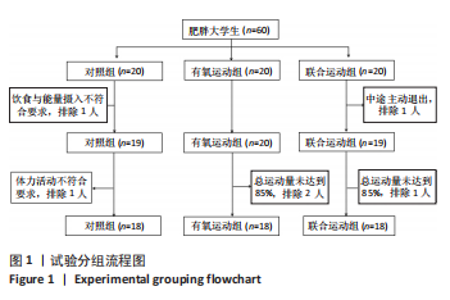
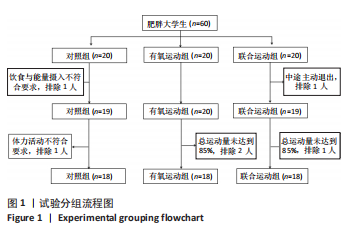
2.1 参与者数量分析 共纳入60名受试者,对照组(n=20)、有氧运动组(n=20)、联合运动组(n=20)各有2名受试者脱落,最终54名受试者进入结果分析。 2.2 试验分组流程 见图1。"
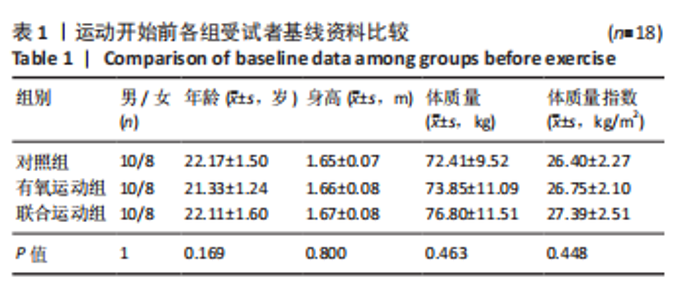
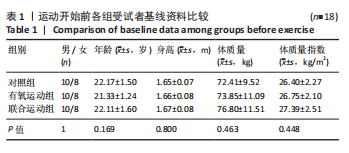
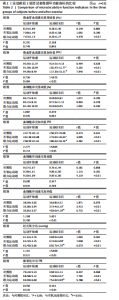
2.3 运动开始前3组受试者基线资料比较 运动开始前,3组受试者的性别构成、年龄、身高、体质量、体质量指数比较差异均无显著性意义(P > 0.05),具有可比性,见表1。"
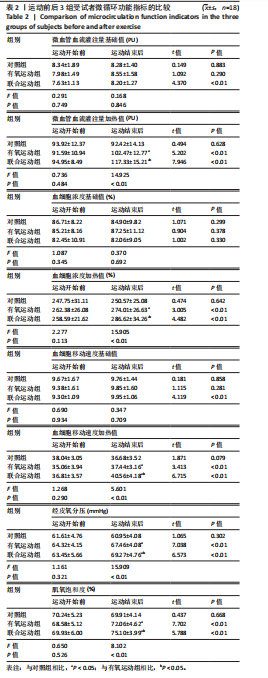
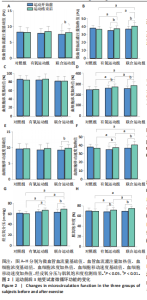
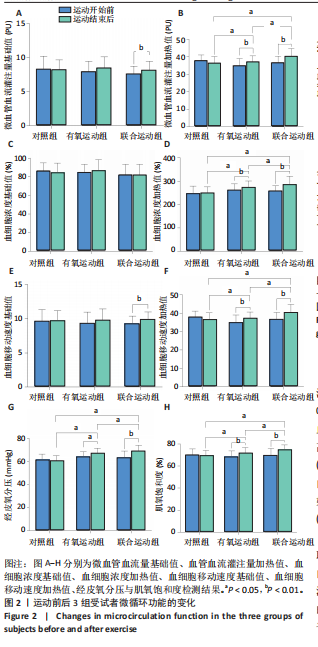
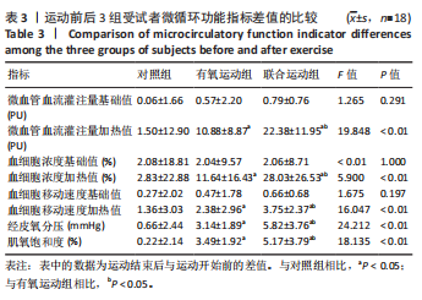
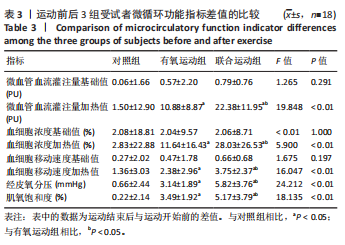
2.4 运动前后3组受试者微循环功能变化 见图2。 运动结束后,有氧运动组、联合运动组微血管血流灌注量加热值、血细胞浓度加热值、血细胞移动速度加热值、经皮氧分压、肌氧饱和度均高于对照组(P < 0.05),联合运动组微血管血流灌注量加热值、血细胞浓度加热值、血细胞移动速度加热值、经皮氧分压、肌氧饱和度高于有氧运动组(P < 0.05),见表2。联合运动组运动结束后的微血管血流灌注量基础值、血细胞移动速度基础值高于运动开始前(P < 0.01),有氧运动组、联合运动组运动结束后的微血管血流灌注量加热值、血细胞浓度加热值、血细胞移动速度加热值、经皮氧分压、肌氧饱和度均高于运动开始前(P < 0.05,P < 0.01),见表2。 运动结束后与运动开始前各指标的差值比较:有氧运动组、联合运动组微血管血流灌注量、血细胞浓度加热值、血细胞移动速度加热值、经皮氧分压、肌氧饱和度的差值均高于对照组(P < 0.05),联合运动组微血管血流灌注量、血细胞浓度加热值、血细胞移动速度加热值、经皮氧分压、肌氧饱和度的差值高于有氧运动组(P < 0.05),见表3。 2.5 运动前后3组受试者微循环功能相关机制指标的变化 见图3。"
"
"
"
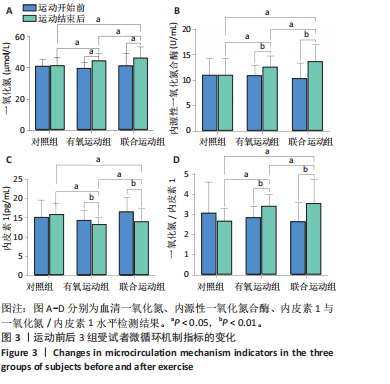
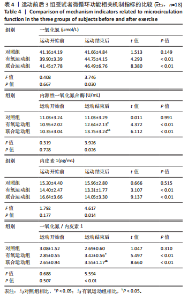
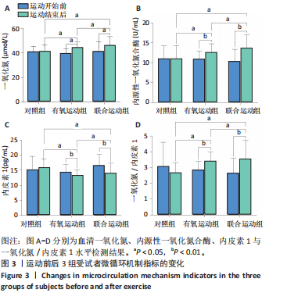
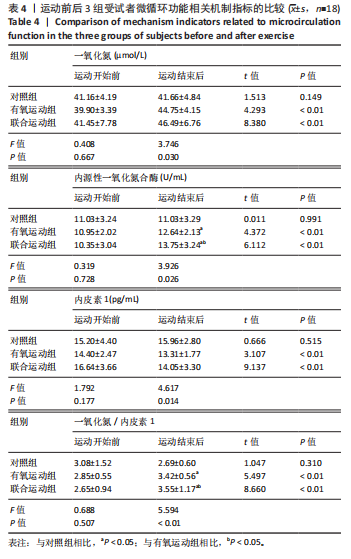
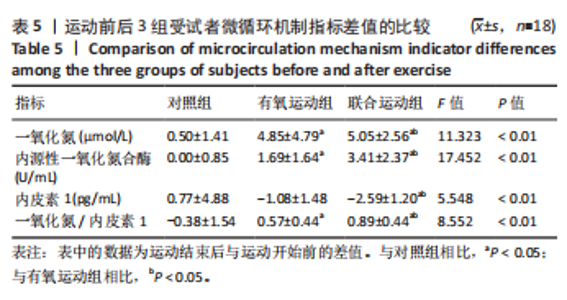
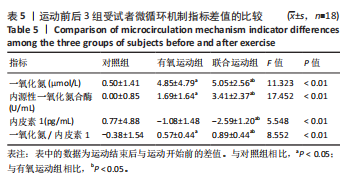
运动结束后,有氧运动组、联合运动组血清一氧化氮、内源性一氧化氮合酶、一氧化氮/内皮素1水平均高于对照组(P < 0.05),血清内皮素1水平均低于对照组(P < 0.05);联合运动组血清一氧化氮、内源性一氧化氮合酶、一氧化氮/内皮素水平高于有氧运动组(P < 0.05),血清内皮素1水平低于有氧运动组(P < 0.05)。有氧运动组、联合运动组运动结束后的血清一氧化氮、内源性一氧化氮合酶、一氧化氮/内皮素1水平高于均运动开始前P < 0.05,P < 0.01),血清内皮素1水平均低于运动开始前(P < 0.01),见表4。 运动结束后与运动开始前各指标的差值比较:有氧运动组、联合运动组血清一氧化氮、内源性一氧化氮合酶、一氧化氮/内皮素1水平的差值显著高于对照组(P < 0.05),联合运动组血清一氧化氮、内源性一氧化氮合酶、一氧化氮/内皮素1水平的差值高于有氧运动组(P < 0.05),联合运动组血清内皮素1水平的差值低于有氧运动组、对照组(P < 0.05),见表5。"
"
| [1] ALFARIS N, ALQAHTANI AM, ALAMUDDIN N, et al. Global impact of obesity. Gastroenterol Clin North Am. 2023;52(2):277-293. [2] 中国营养学会肥胖防控分会,中国营养学会临床营养分会,中华预防医学会行为健康分会,等.中国居民肥胖防治专家共识[J].西安交通大学学报(医学版),2022,43(4):619-631. [3] 中国营养学会肥胖防控分会,中国营养学会临床营养分会,中华预防医学会行为健康分会,等.中国居民肥胖防治专家共识[J].中国预防医学杂志,2022,23(5):321-339. [4] 肖哲,周术锋,朱欢,等.肥胖人群微血管反应性的变化及运动干预[J].中国组织工程研究,2023,27(26):4223-4230. [5] ZHAO L, FU Z, WU J, et al. Inflammation-induced microvascular insulin resistance is an early event in diet-induced obesity. Clin Sci (Lond). 2015;129(12):1025-1036. [6] 朱欢,高炳宏.有氧运动对人体微血管反应性的作用及机制研究进展[J].生命科学,2020, 32(8):855-863. [7] 王成科,朱欢,董徽徽,等.运动对高血压患者微血管反应性的干预效应及可能机制研究进展[J].中国预防医学杂志,2021,22(9):726-731. [8] UGWOKE CK, CVETKO E, UMEK N. Skeletal muscle microvascular dysfunction in obesity-related insulin resistance: pathophysiological mechanisms and therapeutic perspectives. Int J Mol Sci. 2022;23(2):847-868. [9] 肖哲,朱欢,胡江平,等.10周有氧运动和有氧结合抗阻运动对肥胖大学生微循环功能的影响及机制研究[J].中国全科医学,2022,25(19):2349-2355,2362. [10] TANG DH, BAI S, LI XL, et al. Improvement of microvascular endothelial dysfunc on induced by exercise and diet is associated with microRNA-126 in obese adolescents. Microvasc Res. 2019;123:86-91. [11] PASQUALINI L, SCHILLACI G, INNOCENTE S, et al. Lifestyle intervention improves microvascular reactivity and increases serum adiponectin in overweight hypertensive patients. Nutr Metab Cardiovasc Dis. 2010;20(2):87-92. [12] LAMPRECHT M, OBERMAYER G, STEINBAUER K, et al. Supplementation with a juice powder concentrate and exercise decrease oxidation and inflammation,and improve the microcirculation in obese women:randomized controlled trial data. Br J Nutr. 2013;110(09):1685-1695. [13] 冯丽丽,李博文,田振军.振动训练与心血管及脑部疾病防治研究进展[J].生命科学,2021, 33(4):502-511. [14] 谭景旺,韩甲,沈玉芹,等.全身水平振动训练对心血管系统的影响与机制进展[J].中国康复理论与实践,2019,25(4):430-433. [15] SAÑUDO B, ALFONSO-ROSA R, DEL POZO-CRUZ B, et al. Whole body vibration training improves leg blood flow and adiposity in patients with type 2 diabetes mellitus. Eur J Appl Physiol. 2013;113(9):2245-2252. [16] RODRÍGUEZ REYES G, NÚÑEZ CARRERA L, ALESSI MONTERO A, et al. Effect of mechanical vibration on transcutaneous oxygen levels in the feet of type 2 diabetes mellitus patients. Med Clin (Barc). 2017;148(1):16-19. [17] 孙聪帆.高强度间歇训练对高校女生体质健康测试成绩影响的实验研究[D].成都:西南财经大学,2022. [18] 孙托托,方虹,封文平,等.高强度间歇训练和中等强度持续训练对中老年肥胖女性心血管危险生物标记物的影响[J].中国运动医学杂志,2024,43(7):518-526. [19] 曹甍,于丰源,邹昱,等.肥胖青少年间歇训练中的情感反应:一项随机对照研究[J].中国运动医学杂志,2024,43(7):527-536. [20] 王步标,华明.运动生理学[M].2版.北京:高等教育出版社,2011. [21] 常颖,陈磊,朱荣.8周有氧运动对单纯性肥胖患者运动后收缩压恢复、体成分和运动能力的影响[J].体育科学,2013,33(12):65-70. [22] REN W, PU F, LUAN H, et al. Effects of local vibration with different intermittent durations on skin blood Flow responses in diabetic people. Front Bioeng Biotechnol. 2019;7:310-316. [23] 彭永,朱欢,刘尧峰,等.24周太极拳结合弹力带抗阻运动对2型糖尿病患者足背微循环功能的影响[J].首都体育学院学报,2023,35(1):77-85. [24] 周术锋,肖哲,朱欢,等.12周有氧运动对习惯久坐大学生微循环功能的影响[J].中国学校卫生,2021,42(9):1332-1335,1339. [25] 胡庆华,乾佑玲,刘晓丽,等.12周太极拳运动对中老年轻度高血压患者微血管反应性的影响及机制[J].中国应用生理学杂志,2021,37(6):683-687. [26] LA FAVOR JD, DUBIS GS, YAN H, et al. Microvascular endothelial dysfunction in sedentary,obese humans is mediated by nadph oxidase:influence of exercise training. Arterioscler Thromb Vasc Biol. 2016;36(12):2412-2420. [27] WESELER AR, BAST A. Oxidative stress and vascular Function: implications For pharmacologic treatments. Curr Hypertens Rep. 2010;12(3):154-161. [28] PASQUALLINI L, SCHILLACI G, INNOCENTE S, et al. Lifestyle intervention improves microvascular reactivity and increases serum adiponectin in overweight hypertensive patients. Nutr Metab Cardiovasc Dis. 2010;20(2):87-92. [29] LAMPRECHT M, OBERMAYER G, STEINBAUER K, et al. Supplementation with a juice powder concentrate and exercise decrease oxidation and inflammation,and improve the microcirculation in obese women:randomized controlled trial data. Br J Nutr. 2013;110(9):1685-1695. [30] 彭永,胡江平,朱欢.低负荷血流限制和高强度抗阻运动对男性运动青年大腿微循环功能的影响[J].中国组织工程研究,2025,29(2):393-401. [31] 孙晓灿.WBV联合HIIT对NAFLD人群的血管硬度和内皮功能的影响[D].天津:天津体育学院,2023. [32] WEELDREYER NR, DE GUZMAN JC, PATERSON C, et al. Cardiorespiratory fitness, body mass index and mortality: a systematic review and meta-analysis.Br J Sports Med. 2025;59(5):339-346. [33] 时文霞,谢军,何玉凤,等.血管内皮功能障碍运动干预的血流剪切力作用机制研究进展[J].中国体育科技,2024,60(3):51-64. [34] 文凡,向阳,朱欢,等.运动干预改善2型糖尿病患者的微血管功能[J].中国组织工程研究,2026,30(5):1225-1235. [35] 唐东辉,侯玉洁,杨东升,等.有氧运动结合抗阻训练对肥胖青少年微血管内皮功能的影响[C]//中国体育科学学会运动生理与生物化学分会.第四届(2016)全国运动生理与生物化学学术会议:运动·体质·健康论文摘要汇编.北京师范大学体育与运动学院;浙江工业大学体育军训部;泰山医学院运动医学与康复学院,2016:56-57. [36] 宋笑笑,何春风.有氧运动治疗对单纯性肥胖儿童糖脂代谢、胰岛素抵抗和血管内皮功能的影响[J].现代实用医学,2021,33(12):1631-1633. [37] PIENAAR PR, MICKLESFIELD LK, LEVITT NS, et al. Insulin resistance is associated with lower acetylcholine-induced microvascular reactivity in nondiabetic women. Metab Syndr Relat Disord. 2014;12(3):178-184. [38] SYABARIYAH S, NURACHMAH E, WIDJOJO BD ,et al. The effect of vibration on the acceleration of wound healing of diabetic neuropathic foot ulcer: a prospective experimental study on human patients[. Healthcare. 2023;11(2):191-206. [39] JOHNSON PK, FELAND JB, JOHNSON AW, et al. Effect of whole body vibration on skin blood Flow and nitric oxide production. J Diabetes Sci Technol. 2014;8(4):889-894. [40] BEIJER Å, DEGENS H, WEBER T, et al. Microcirculation of skeletal muscle adapts differently to a resistive exercise intervention with and without superimposed whole-body vibrations. Clin Physiol Funct Imaging. 2015;35(6):425-435. [41] HABA D, QIN Q, TAKIZAWA C, et al. Local low-frequency vibration accelerates healing of full-thickness wounds in a hyperglycemic rat model. J Diabetes Investig. 2023;14(12):1356-1367. |
| [1] | Liu Yu, Lei Senlin, Zhou Jintao, Liu Hui, Li Xianhui. Mechanisms by which aerobic and resistance exercises improve obesity-related cognitive impairment [J]. Chinese Journal of Tissue Engineering Research, 2026, 30(5): 1171-1183. |
| [2] | Tao Yunfei, Peng Li. Acute effects of blood flow restriction in low-intensity resistance training on endothelial function-related inflammatory factors [J]. Chinese Journal of Tissue Engineering Research, 2026, 30(5): 1184-1195. |
| [3] | Chen Qiang, Wu Wenjuan, Jiang Shuhua, Huang Da. Physical exercise improves physical function in burn patients: a systematic review and meta-analysis [J]. Chinese Journal of Tissue Engineering Research, 2026, 30(5): 1269-1281. |
| [4] | Feng Shuo, Cao Xuan, Guo Xieleiya, Wang Jingfeng, Li Xiaolin. Gut microbiota and short-chain fatty acids: mechanisms of aerobic exercise regulation in type 2 diabetes [J]. Chinese Journal of Tissue Engineering Research, 2026, 30(25): 6592-6602. |
| [5] | Liu Meng, Hou Shilun. Effects of blood flow restriction training and aerobic exercise on energy expenditure in young men [J]. Chinese Journal of Tissue Engineering Research, 2026, 30(25): 6603-6609. |
| [6] | Zhao Zheng. Diselenium contained polyurethane coatings with dual functions of anticoagulation and drug release [J]. Chinese Journal of Tissue Engineering Research, 2026, 30(2): 414-423. |
| [7] | Wu Fangjia, Lei Senlin, Li Xianhui, Yang Yang. Aerobic and resistance exercise interventions in a mouse model of nonalcoholic fatty liver disease: correlation between gut microbiota and irisin [J]. Chinese Journal of Tissue Engineering Research, 2026, 30(12): 3029-3043. |
| [8] | Xin Xianyang, Liu Longyan, Guo Yongqing, Wang Hai, Xie Jun. Effects of long-term exercise interventions on appetite-regulating hormones in overweight and obese populations: a meta-analysis [J]. Chinese Journal of Tissue Engineering Research, 2026, 30(11): 2858-2869. |
| [9] | Hu Yujie, Xie Ping, , Lu Weijie, Yang Kang, Deng Yaoting, Liu Mengyang. Meta-analysis of the clinical efficacy of high-intensity interval exercise and middle-intensity continuous training in patients with coronary heart disease [J]. Chinese Journal of Tissue Engineering Research, 2026, 30(10): 2584-2593. |
| [10] | Zhao Xiaoxuan, Liu Shuaiyi, Li Qi, Xing Zheng, Li Qingwen, Chu Xiaolei. Different exercise modalities promote functional recovery after peripheral nerve injury [J]. Chinese Journal of Tissue Engineering Research, 2025, 29(6): 1248-1256. |
| [11] | Ji Long, Chen Ziyang, , Jin Pan, Kong Xiangkui, Pu Rui, . Lipophagy, exercise intervention and prevention and treatment of nonalcoholic fatty liver disease [J]. Chinese Journal of Tissue Engineering Research, 2025, 29(35): 7611-7619. |
| [12] | Wang Jiaqian, , Jiang Changjun, Peng Yi, Ma Mi, Li Junhan. Study on the role of aerobic exercise in regulating the CNPY2-mediated AKT/GSK3β pathway for improving non-alcoholic fatty liver [J]. Chinese Journal of Tissue Engineering Research, 2025, 29(30): 6441-6448. |
| [13] | He Ningjuan, Li Li, Wang Su, Yang Jianshe, Lei Siyun, Wang Yang. Effects of aerobic or resistance exercise on hippocampal ras/Drebrin dendritic spine plasticity in a mouse model of Alzheimer’s disease [J]. Chinese Journal of Tissue Engineering Research, 2025, 29(26): 5528-5535. |
| [14] | Zhao Peng, Wang Congcong, Wang Chenyu. Effect of aerobic exercise on mobilization and function of endothelial progenitor cells in patients with myocardial infarction [J]. Chinese Journal of Tissue Engineering Research, 2025, 29(23): 4947-4955. |
| [15] | Peng Yong, Hu Jiangping, Zhu Huan. Effects of low-load blood flow restriction exercise and high-intensity resistance exercise on the thigh microcirculation function of athletic young men [J]. Chinese Journal of Tissue Engineering Research, 2025, 29(2): 393-401. |
| Viewed | ||||||
|
Full text |
|
|||||
|
Abstract |
|
|||||