Chinese Journal of Tissue Engineering Research ›› 2026, Vol. 30 ›› Issue (36): 9604-9612.doi: 10.12307/2026.911
Previous Articles Next Articles
Development and evaluation of a prediction model for functional language communication outcomes in post-stroke aphasia patients
Huang Yunshi, Chai Linsong, Ni Jinglei, Zuo Shuang, Lin Bingbing, Huang Jia
- College of Rehabilitation Medicine, Fujian University of Traditional Chinese Medicine, Fuzhou 350122, Fujian Province, China
-
Received:2025-10-29Online:2026-12-28Published:2026-05-26 -
Contact:Huang Jia, Professor, Doctoral supervisor, College of Rehabilitation Medicine, Fujian University of Traditional Chinese Medicine, Fuzhou 350122, Fujian Province, China -
About author:Huang Yunshi, MS candidate, College of Rehabilitation Medicine, Fujian University of Traditional Chinese Medicine, Fuzhou 350122, Fujian Province, China -
Supported by:National Natural Science Foundation of China, No. 82074512 (to HJ); Fujian Province Science and Technology Planning Project - Social Development Guidance (Key) Project, No. 2023Y0035 (to HJ); Fujian Provincial Natural Science Foundation (Outstanding Youth Project), No. 2024J010033 (to HJ)

CLC Number:
Cite this article
Huang Yunshi, Chai Linsong, Ni Jinglei, Zuo Shuang, Lin Bingbing, Huang Jia. Development and evaluation of a prediction model for functional language communication outcomes in post-stroke aphasia patients[J]. Chinese Journal of Tissue Engineering Research, 2026, 30(36): 9604-9612.
share this article
Add to citation manager EndNote|Reference Manager|ProCite|BibTeX|RefWorks
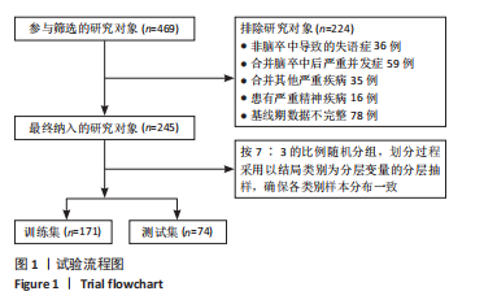
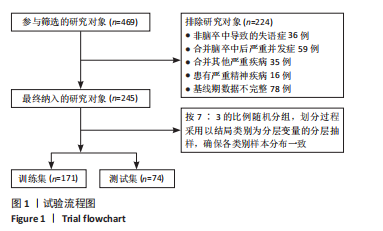
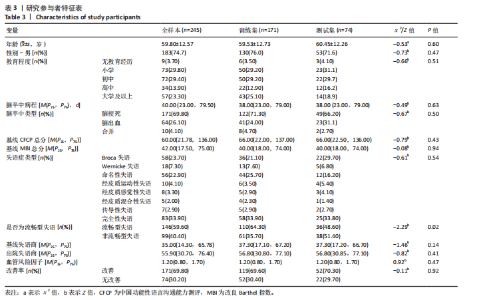
2.1 训练集和测试集患者人口统计学和临床特征比较 共纳入245例脑卒中后失语症受试者,其中20例受试者缺失出院时失语商分数,进行多重插补后纳入分析。数据集按照7∶3的比例随机分为训练集(n=171)和测试集(n=74)。由表3可知,训练集和测试集在年龄、性别、脑卒中病程等特征上的分布均无统计学差异(P > 0.05),但是否为流畅型失语特征的分布有统计学差异(P=0.02)。 2.2 试验流程图 见图1。"
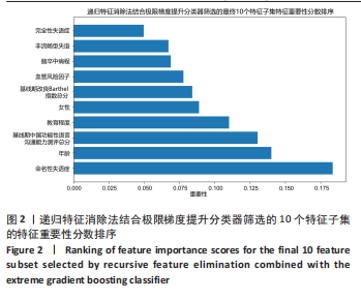
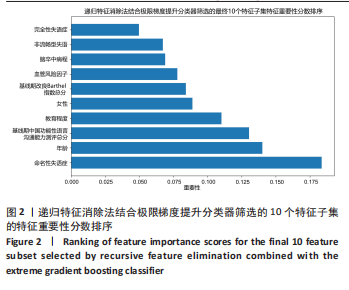
2.3 预测因子选择 通过递归特征消除法结合极限梯度提升分类器对全部特征进行筛选,最终确定10个特征子集用于建模。特征重要性分数排序如图2所示,依次为命名性失语症(0.18)、年龄(0.14)、基线中国功能性语言沟通能力测评总分(0.13)、教育程度(0.11)、女性(0.09)、基线改良Barthel指数总分(0.08)、血管风险因子(0.08)、脑卒中病程(0.07)、非流畅型失语(0.07)、完全性失语症(0.05)。"

"
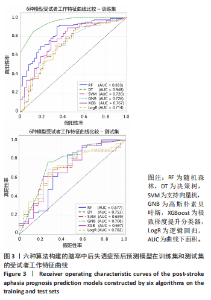
2.4 预测模型的构建 基于上述特征子集,分别构建决策树、支持向量机、高斯朴素贝叶斯、逻辑回归、极限梯度提升分类器、随机森林6种模型。各模型在训练集和测试集的受试者工作特征曲线见图3。决策树模型的受试者工作特征曲线表现最佳,但在测试集下降明显,存在一定过拟合。支持向量机、高斯朴素贝叶斯和逻辑回归训练集与测试集的受试者工作特征曲线差距较小,泛化能力较强。综合结果可见,高斯朴素贝叶斯模型在临床预测中性能较好且稳定性较高。"

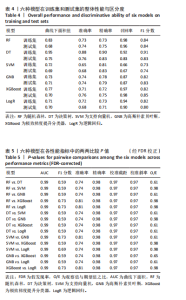
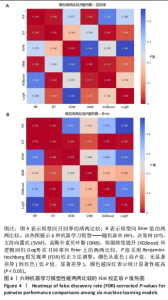
2.5 预测模型的评价 2.5.1 整体性能 6种模型在训练集和测试集上的F1分数、召回率、准确率和精确率见表4。测试集结果显示,各模型整体性能指标接近,F1分数为0.80-0.85,准确率为0.68-0.76,精确率为0.71-0.79,召回率为0.87-0.98。极限梯度提升分类器和高斯朴素贝叶斯模型在F1分数和召回率上略有优势,但差异有限。两两比较结果显示,F1分数、准确率和精确率等主要指标在经假发现率校正后均无统计学差异(P均> 0.05,表5)。仅召回率在随机森林与决策树、随机森林与高斯朴素贝叶斯、决策树与极限梯度提升分类器、高斯朴素贝叶斯与极限梯度提升分类器4组模型间存在统计学显著差异(假发现率校正后P < 0.05),见图4A。效能分析表明,当前样本量可检出F1差值> 0.02、准确率差值> 0.023、精确率差值> 0.014、召回率差值> 0.032的差异(检验效能80%),部分模型间的实测最大差异已超过该阈值,整体提示各模型性能相近。"

"

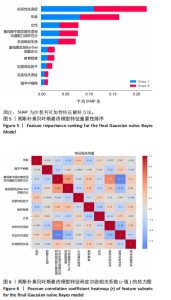
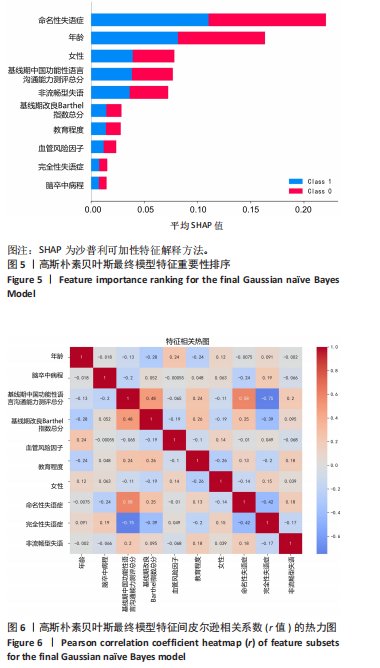
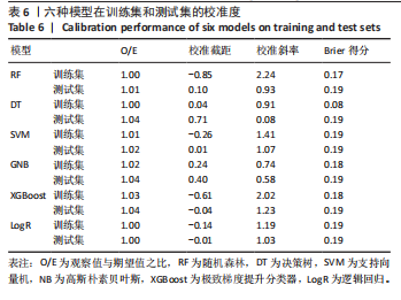
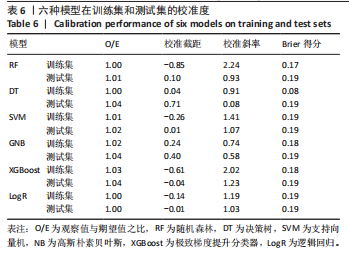
2.5.2 区分度 各模型在训练集与测试集的受试者工作特征曲线下面积见表4。测试集验证显示,6种模型的曲线下面积值介于0.68-0.75之间,表现较为稳定。其中,决策树(曲线下面积=0.75)、极限梯度提升分类器(曲线下面积=0.70)、高斯朴素贝叶斯(曲线下面积=0.71)、逻辑回归(曲线下面积=0.70)、随机森林(曲线下面积=0.68)、支持向量机(曲线下面积=0.69)在测试集上的区分效能相近。两两比较结果显示,各模型间曲线下面积差异均无统计学显著性(假发现率校正后P均> 0.05),最大曲线下面积差值为0.07(决策树与随机森林),低于最小可检出差异(曲线下面积差值=0.03,检验效能80%),提示各模型的区分度无显著差异。 2.5.3 预测模型校准度 6种模型在训练集和测试集的观察值与期望值之比、校准截距、校准斜率和Brier得分见表6。在测试集上,各模型的观察值与期望值之比(1.00-1.04)均接近1.00,校准截距和校准斜率接近理想值(0和1),Brier得分均为0.19,表明模型预测概率与实际发生率较为一致。两两比较结果显示,除Brier得分在随机森林与决策树、决策树与支持向量机、决策树与极致梯度提升分类器、决策树与逻辑回归4组模型间存在统计学显著差异(假发现率校正后 P < 0.05,图4B)外,其余校准度指标在各模型间均无统计学显著差异(假发现率校正后P均> 0.05)。 2.6 临床特征分析 由图5可知,高斯朴素贝叶斯的特征重要性排序前5名分别为:命名性失语症(平均SHAP值=0.24)、年龄(平均SHAP值=0.17)、女性(平均SHAP值=0.08)、基线中国功能性语言沟通能力测评总分(平均SHAP值=0.08)、非流畅性失语(平均SHAP值=0.07)。 最终特征子集间的皮尔逊相关系数热力图见图6。基线中国功能性语言沟通能力测评总分与完全性失语症呈中等负相关(r=-0.75),而与命名性失语症呈中等正相关(r=0.58)。总体而言,部分特征间存在中等程度的相关性,但大多数特征间相关性较低,提示各特征在模型中具有较好的独立性。"
"
| [1] FEIGIN VL, NORRVING B, MENSAH GA. Global Burden of Stroke. Circ Res. 2017; 120(3):439-448. [2] EDMONDS LA, MORGAN J. Two-Year Longitudinal Evaluation of Community Aphasia Center Participation on Linguistic, Functional Communication, and Quality of Life Measures Across People With a Range of Aphasia Presentations. Am J Speech Lang Pathol. 2022;31(5S):2378-2394. [3] PEDERSEN PM, VINTER K, OLSEN TS. Aphasia after stroke: type, severity and prognosis. The Copenhagen aphasia study. Cerebrovasc Dis. 2004;17(1):35-43. [4] TETNOWSKI JT, TETNOWSKI JA, DAMICO JS. Patterns of Conversation Trouble Source and Repair as Indices of Improved Conversation in Aphasia: A Multiple-Case Study Using Conversation Analysis. Am J Speech Lang Pathol. 2021;30(1S): 326-343. [5] MADDEN EB, BUSH EJ, OBERMEYER J, et al. Reading and Writing Rehabilitation With Individuals With Aphasia: A Survey of Speech-Language Pathologists’ Clinical Practice and Perspectives. Am J Speech Lang Pathol. 2025;34(6s):3703-3716. [6] AZIOS JH, ARCHER B, SIMMONS-MACKIE N, et al. Conversation as an Outcome of Aphasia Treatment: A Systematic Scoping Review. Am J Speech Lang Pathol. 2022;31(6):2920-2942. [7] DOEDENS WJ, METEYARD L. What is Functional Communication? A Theoretical Framework for Real-World Communication Applied to Aphasia Rehabilitation. Neuropsychol Rev. 2022;32(4):937-973. [8] PITT R, THEODOROS D, HILL AJ, et al. The impact of the telerehabilitation group aphasia intervention and networking programme on communication, participation, and quality of life in people with aphasia. Int J Speech Lang Pathol. 2019;21(5):513-523. [9] SPIGARELLI M, MACOIR J. Effectiveness of sensorimotor therapy on action naming in post-stroke aphasia: a systematic review. Disabil Rehabil. 2025;47(15): 3753-3772. [10] FILIPSKA-BLEJDER K, ZIELIŃSKA J, ZIELIŃSKI M, et al. How Does Aphasia Affect Quality of Life? Preliminary Reports. J Clin Med. 2023;12(24):7687. [11] BUENO-GUERRA N, PROVENCIO M, TARIFA-RODRÍGUEZ A, et al. Impact of post-stroke aphasia on functional communication, quality of life, perception of health and depression: A case-control study. Eur J Neurol. 2024;31(4):e16184. [12] JÄGER AP, STEELE CJ, DREYER FR, et al. BOLD Long-Range Temporal Correlations Reflect Changes in Language and Depression Across Intensive Aphasia Therapy. Stroke. 2025;56(11):3138-3152. [13] ZINGELMAN S, WALLACE SJ, KIM J, et al. Is communication key in stroke rehabilitation and recovery? National linked stroke data study. Top Stroke Rehabil. 2024;31(4):325-335. [14] WALLACE SJ, WORRALL L, ROSE TA, et al. Measuring communication as a core outcome in aphasia trials: Results of the ROMA-2 international core outcome set development meeting. Int J Lang Commun Disord. 2023;58(4):1017-1028. [15] BULLIER B, CASSOUDESALLE H, VILLAIN M, et al. New factors that affect quality of life in patients with aphasia. Ann Phys Rehabil Med. 2020;63(1):33-37. [16] EL HACHIOUI H, LINGSMA HF, VAN DE SANDT-KOENDERMAN MW, et al. Long-term prognosis of aphasia after stroke. J Neurol Neurosurg Psychiatry. 2013;84(3):310-315. [17] NOUWENS F, VISCH-BRINK EG, EL HACHIOUI H, et al. Validation of a prediction model for long-term outcome of aphasia after stroke. BMC Neurol. 2018; 18(1):170. [18] LEVY DF, ENTRUP JL, SCHNECK SM, et al. Multivariate lesion symptom mapping for predicting trajectories of recovery from aphasia. Brain Commun. 2024;6(1): fcae024. [19] BILLOT A, LAI S, VARKANITSA M, et al. Multimodal Neural and Behavioral Data Predict Response to Rehabilitation in Chronic Poststroke Aphasia. Stroke. 2022; 53(5):1606-1614. [20] JEONG S, LEE EJ, KIM YH, et al. Deep Learning Approach Using Diffusion-Weighted Imaging to Estimate the Severity of Aphasia in Stroke Patients. J Stroke. 2022;24(1):108-117. [21] LI B, DENG S, ZHUO B, et al. Effect of Acupuncture vs Sham Acupuncture on Patients With Poststroke Motor Aphasia: A Randomized Clinical Trial. JAMA Netw Open. 2024;7(1):e2352580. [22] 钟晓云,巩湘红.失语症患者交际能力评估工具研究现状[J].中国康复, 2025,40(8):490-495. [23] CHENG X, XIE L, WANG F, et al. Observations about the effects of compulsory rehabilitation for aphasia patients. Int J Clin Exp Med. 2020;8(13):5815-5822. [24] BRADY MC, KELLY H, GODWIN J, et al. Speech and language therapy for aphasia following stroke. Cochrane Database Syst Rev. 2016;2016(6):CD000425. [25] WU Q, HU X, WEN X, et al. Clinical study of acupuncture treatment on motor aphasia after stroke. Technol Health Care. 2016;24 Suppl 2:S691-S696. [26] DENG S, SANG B, LI B, et al. The efficacy and safety of acupuncture combined with language training for motor aphasia after stroke: study protocol for a multicenter randomized sham-controlled trial. Trials. 2022;23(1):540. [27] BINSON VA, THOMAS S, SUBRAMONIAM M, et al. A Review of Machine Learning Algorithms for Biomedical Applications. Ann Biomed Eng. 2024;52(5):1159-1183. [28] VLACHAS C, DAMIANOS L, GOUSETIS N, et al. Random forest classification algorithm for medical industry data. SHS Web of Conferences. 2022;139:3008. [29] YUAN X, XU Q, DU F, et al. Development and validation of a model to predict cognitive impairment in traumatic brain injury patients: a prospective observational study. EClinicalMedicine. 2025;80:103023. [30] 国家卫生健康委脑卒中防治工程委员会.中国脑卒中防治指导规范[M].北京:人民卫生出版社,2021. [31] JUNGBLUT M, MAIS C, BINKOFSKI FC, et al. The efficacy of a directed rhythmic-melodic voice training in the treatment of chronic non-fluent aphasia-Behavioral and imaging results. J Neurol. 2022;269(9):5070-5084. [32] 张通,李胜利,白玉龙,等.卒中后失语临床管理专家共识[J].中国康复理论与实践,2022,28(1):15-23. [33] WANG R, WEI W, ZHOU J, et al. Clinical assessment and screening of stroke patients with aphasia: a best practice implementation project. JBI Evid Implement. 2022;20(2):144-153. [34] ZHANG Y, SUN C, XIE S, et al. Minimal important change for the aphasia quotient of the Chinese Western Aphasia Battery. Eur J Phys Rehabil Med. 2025;61(2): 221-228. [35] REHABILITATION AND RECOVERY OF PEOPLE WITH APHASIA AFTER STROKE (RELEASE) COLLABORATORS. Predictors of Poststroke Aphasia Recovery: A Systematic Review-Informed Individual Participant Data Meta-Analysis. Stroke. 2021;52(5):1778-1787. [36] LEE S, NA Y, TAE WS, et al. Clinical and neuroimaging factors associated with aphasia severity in stroke patients: diffusion tensor imaging study. Sci Rep. 2020;10(1):12874. [37] LAHIRI D, DUBEY S, ARDILA A, et al. Determinants of aphasia recovery: exploratory decision tree analysis. Lang Cogn Neurosci. 2020;36(1):25-32. [38] XU G, WU Y, QU J, et al. Altered Dynamic Functional Network Connectivity in Post-Stroke Aphasia. Ann Clin Transl Neurol. 2026;13(1):97-107. [39] 焦黛妍,邓海鹏,张若尘,等.脑卒中患者失语症发生的影响因子及预后[J].中国听力语言康复科学杂志,2019,17(5):370-373. [40] SEO KC, KO JY, KIM TU, et al. Post-stroke Aphasia as a Prognostic Factor for Cognitive and Functional Changes in Patients With Stroke: Ischemic Versus Hemorrhagic. Ann Rehabil Med. 2020;44(3):171-180. [41] KANG EK, SOHN HM, HAN MK, et al. Subcortical Aphasia After Stroke. Ann Rehabil Med. 2017;41(5):725-733. [42] FERNANDES A, FRAGA-MAIA H, MASO I, et al. Predictors of functional communication in people with aphasia after stroke. Arq Neuropsiquiatr. 2022; 80(7):681-688. [43] LEE H, LEE Y, CHOI H, et al. Community Integration and Quality of Life in Aphasia after Stroke. Yonsei Med J. 2015;56(6):1694-1702. [44] XU M, LIANG X, OU J, et al. Sex Differences in Functional Brain Networks for Language. Cereb Cortex. 2020;30(3):1528-1537. [45] LI TT, ZHANG PP, ZHANG MC, et al. Meta-analysis and systematic review of the relationship between sex and the risk or incidence of poststroke aphasia and its types. BMC Geriatr. 2024;24(1):220. [46] KACZKURKIN AN, RAZNAHAN A, SATTERTHWAITE TD. Sex differences in the developing brain: insights from multimodal neuroimaging. Neuropsychopharmacology. 2019;44(1):71-85. [47] RELEASE COLLABORATORS, BRADY MC, ALI M, et al. Precision rehabilitation for aphasia by patient age, sex, aphasia severity, and time since stroke? A prespecified, systematic review-based, individual participant data, network, subgroup meta-analysis. Int J Stroke. 2022;17(10):1067-1077. [48] LIU LS, ZHAO JL, HE YL, et al. The 490th case: arthralgia, amenorrhea, aphasia. Zhonghua Nei Ke Za Zhi. 2021;60(12):1189-1192. [49] SHARMA S, BRILEY PM, WRIGHT HH, et al. Gender differences in aphasia outcomes: evidence from the AphasiaBank. Int J Lang Commun Disord. 2019;54(5):806-813. [50] FORKEL SJ, THIEBAUT DE SCHOTTEN M, DELL’ACQUA F, et al. Anatomical predictors of aphasia recovery: a tractography study of bilateral perisylvian language networks. Brain. 2014;137(Pt 7):2027-2039. [51] KIM KA, LEE JS, CHANG WH, et al. Changes in Language Function and Recovery-Related Prognostic Factors in First-Ever Left Hemispheric Ischemic Stroke. Ann Rehabil Med. 2019;43(6):625-634. [52] SULLIVAN JJ, ZEKELMAN LR, ZHANG F, et al. Directionally encoded color track density imaging in brain tumor patients: A potential application to neuro-oncology surgical planning. Neuroimage Clin. 2023;38:103412. [53] LWI SJ, HERRON TJ, CURRAN BC, et al. Auditory Comprehension Deficits in Post-stroke Aphasia: Neurologic and Demographic Correlates of Outcome and Recovery. Front Neurol. 2021;12:680248. [54] GONZÁLEZ-FERNÁNDEZ M, DAVIS C, MOLITORIS JJ, et al. Formal education, socioeconomic status, and the severity of aphasia after stroke. Arch Phys Med Rehabil. 2011;92(11):1809-1813. [55] OLIVA G, MASINA F, HOSSEINKHANI N, et al. Cognitive reserve in the recovery and rehabilitation of stroke and traumatic brain injury: A systematic review. Clin Neuropsychol. 2025;39(6):1450-1486. [56] DUCHARME-LALIBERTÉ G, MELLAH S, BOLLER B, et al. More flexible brain activation underlies cognitive reserve in older adults. Neurobiol Aging. 2022; 113:63-72. [57] MECH EN, KANDHADAI P, FEDERMEIER KD. The last course of coarse coding: Hemispheric similarities in associative and categorical semantic processing. Brain Lang. 2022;229:105123. [58] HILDESHEIM FE, OPHEY A, ZUMBANSEN A, et al. Predicting Language Function Post-Stroke: A Model-Based Structural Connectivity Approach. Neurorehabil Neural Repair. 2024;38(6):447-459. [59] 汉语失语症康复治疗专家共识组.汉语失语症康复治疗专家共识[J].中华物理医学与康复杂志,2019,41(3):161-169. |
| [1] | Lai Jiaming, , Song Yuling, Chen Zixi, Wei Jinghuan, Cai Hao, , Li Guoquan, . Screening of diagnostic markers for endothelial cell Senescence in mice with radiation-induced heart disease and analysis of immune infiltration [J]. Chinese Journal of Tissue Engineering Research, 2026, 30(6): 1450-1463. |
| [2] | Zhang Qian, Huang Dongfeng. Weighted gene co-expression network analysis combined with machine learning to screen and validate biomarkers for osteoarthritis [J]. Chinese Journal of Tissue Engineering Research, 2026, 30(5): 1096-1105. |
| [3] | Gu Fucheng, Yang Meixin, Wu Weixin, Cai Weijun, Qin Yangyi, Sun Mingyi, Sun Jian, Geng Qiudong, Li Nan. Effects of Guilu Erxian Glue on gut microbiota in rats with knee osteoarthritis: machine learning and 16S rDNA analysis [J]. Chinese Journal of Tissue Engineering Research, 2026, 30(4): 1058-1072. |
| [4] | Wang Huaijing, Guo Jinrong, Wan Dongping, Mei Qijie, Yuan Jingzhao, Xu Wenfei, Zeng Chao, Zheng Haijun, Yuan Changshen, Duan Kan. Identification of antimicrobial peptides as key therapeutic targets for necrosis by sodium overload in osteoarthritis using multiple machine learning approaches: cytological validation [J]. Chinese Journal of Tissue Engineering Research, 2026, 30(36): 9413-9422. |
| [5] | Liu Yi, Lu Jiarong, Wu Jianyong. Diabetes prediction and analysis of influencing factors integrating genetic information [J]. Chinese Journal of Tissue Engineering Research, 2026, 30(36): 9589-9596. |
| [6] | Cao Shan, Wang Yanxi, Duan Kaixuan, Qi Xiang, Wang Yuhan. Xiao Ban Tong Mai Fang regulates autophagy via targeting miR-126-3p: bioinformatics analysis for prevention and treatment of atherosclerosis [J]. Chinese Journal of Tissue Engineering Research, 2026, 30(35): 9355-9364. |
| [7] | Yang Huaqun, Abudouainijiang·Abulimiti, Wang Fazheng, Maimaitishawutiaji·Maimaiti, Li Simi, Muhetaer·Maimaitirexiati. Weighted gene co-expression network analysis combined with machine learning identifies autophagy and senescence signature genes in osteoarthritis chondrocytes [J]. Chinese Journal of Tissue Engineering Research, 2026, 30(34): 8889-8898. |
| [8] | Wang Xuecheng, Zhao Liang, Wei Zhoubin. Transforming growth factor-beta regulates oxidative stress and participates in inflammatory process of pulmonary hypertension [J]. Chinese Journal of Tissue Engineering Research, 2026, 30(31): 8165-8173. |
| [9] | Guan Yujie, Zhao Bin. Application and prospect of artificial intelligence in screening and diagnosis of scoliosis [J]. Chinese Journal of Tissue Engineering Research, 2026, 30(3): 721-730. |
| [10] | Wang Zhipeng, Zhang Xiaogang, Zhang Hongwei, Zhao Xiyun, Li Yuanzhen, Guo Chenglong, Qin Daping, Ren Zhen. A systematic review of application value of machine learning to prognostic prediction models for patients with lumbar disc herniation [J]. Chinese Journal of Tissue Engineering Research, 2026, 30(3): 740-748. |
| [11] | Zhao Feifan, Cao Yujing. An artificial neural network model of ankylosing spondylitis and psoriasis shared genes and machine learning-based mining and validation [J]. Chinese Journal of Tissue Engineering Research, 2026, 30(3): 770-784. |
| [12] | Yan Yuge, Wang Yanxi, Qi Xiang, Cao Shan, Zou Xiaoyan, Liu Yujuan. Screening biomarkers for premature ovarian insufficiency based on cellular senescence and endoplasmic reticulum stress with experimental validation [J]. Chinese Journal of Tissue Engineering Research, 2026, 30(28): 7447-7455. |
| [13] | Xu Dongfang, Zhao Kun, Lu Changzhu, Wang Yuge, Bai Lianjie, Meng Fanmou, Wang Yang, , Yao Hongbo. m6A-related ferroptosis gene expression and its association with immune infiltration in Alzheimer’s disease: machine learning and molecular biology validation [J]. Chinese Journal of Tissue Engineering Research, 2026, 30(24): 6421-6432. |
| [14] | Tang Cen, Hu Wanqin. Establishing a diagnostic model for recurrent spontaneous abortion based on the levels of autophagy-related genes in the endometrium [J]. Chinese Journal of Tissue Engineering Research, 2026, 30(22): 5728-5738. |
| [15] | Chen Feijun, Chen Yingguo, Li Zhengyang, Hu Yuan, Li Fang. Predictive efficacy of machine learning models for postoperative prognosis in older adult patients with acute intracerebral hemorrhage [J]. Chinese Journal of Tissue Engineering Research, 2026, 30(16): 4045-4053. |
| Viewed | ||||||
|
Full text |
|
|||||
|
Abstract |
|
|||||