Chinese Journal of Tissue Engineering Research ›› 2026, Vol. 30 ›› Issue (31): 8165-8173.doi: 10.12307/2026.423
Previous Articles Next Articles
Transforming growth factor-beta regulates oxidative stress and participates in inflammatory process of pulmonary hypertension
Wang Xuecheng, Zhao Liang, Wei Zhoubin
- Fifth Affiliated Hospital of Xinjiang Medical University, Urumqi 830011, Xinjiang Uygur Autonomous Region, China
-
Received:2025-09-09Accepted:2026-02-02Online:2026-11-08Published:2026-05-23 -
Contact:Wei Zhoubin, Associate chief physician, Fifth Affiliated Hospital of Xinjiang Medical University, Urumqi 830011, Xinjiang Uygur Autonomous Region, China -
About author:Wang Xuecheng, Attending physician, Fifth Affiliated Hospital of Xinjiang Medical University, Urumqi 830011, Xinjiang Uygur Autonomous Region, China -
Supported by:Natural Science Foundation of Xinjiang Uygur Autonomous Region, No. 2022D01C568 (to WZB)

CLC Number:
Cite this article
Wang Xuecheng, Zhao Liang, Wei Zhoubin. Transforming growth factor-beta regulates oxidative stress and participates in inflammatory process of pulmonary hypertension[J]. Chinese Journal of Tissue Engineering Research, 2026, 30(31): 8165-8173.
share this article
Add to citation manager EndNote|Reference Manager|ProCite|BibTeX|RefWorks
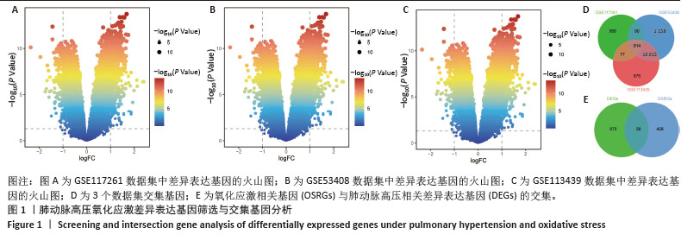
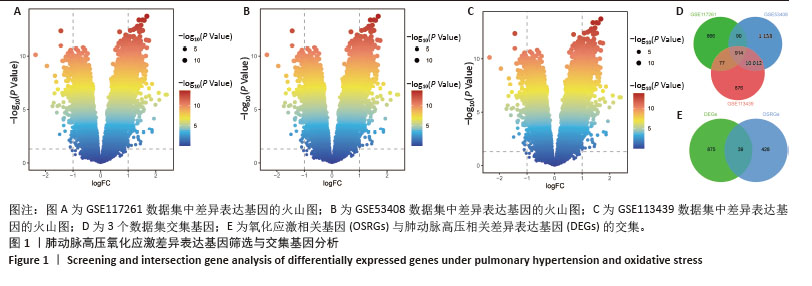
2.1 差异表达基因筛选与交集基因分析 在GSE117261数据集中,通过差异表达分析共鉴定出1 947个差异表达基因,见图1A。在GSE53408数据集中鉴定出12 154个差异表达基因,见图1B。在GSE113439数据集中鉴定出11 879个差异表达基因,见图1C。3组数据集进行交集后共鉴定出914个肺动脉高压相关的差异表达基因,见图1D。进一步与氧化应激相关基因集进行交集鉴定出39个肺动脉高压氧化应激相关核心基因,见图1E。"
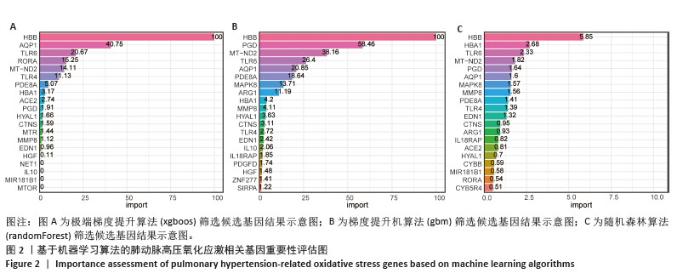
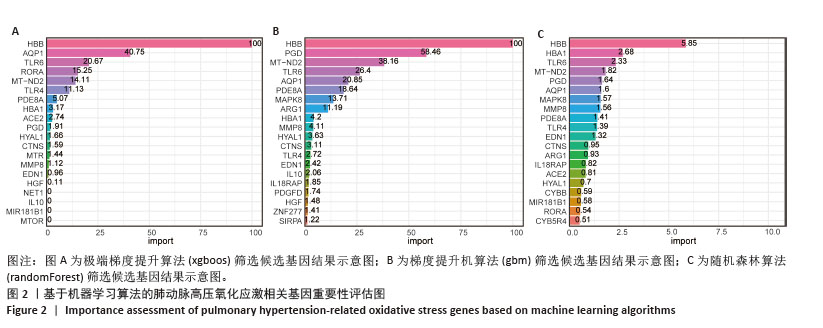
2.2 基于机器学习算法的肺动脉高压氧化应激相关基因重要性评估 利用机器学习算法进一步筛选并确定重要性最高的候选基因,极端梯度提升算法计算结果显示,血红蛋白β链(HBB)基因得分为100,水通道蛋白1(AQP1)基因得分为40.75,见图2A。梯度提升机算法计算结果显示,血红蛋白β链基因得分为100,磷酸葡萄糖酸脱氢酶(PGD)基因得分为58.46,见图2B。随机森林算法计算结果显示,血红蛋白β链基因得分为5.85,α-珠蛋白(HBA1)基因得分为2.68,见图2C。自3个模型中选取得分高且相同的基因,最终确定水通道蛋白、血红蛋白β链、MT-ND2和Toll样受体6为肺动脉高压氧化应激相关候选基因。"
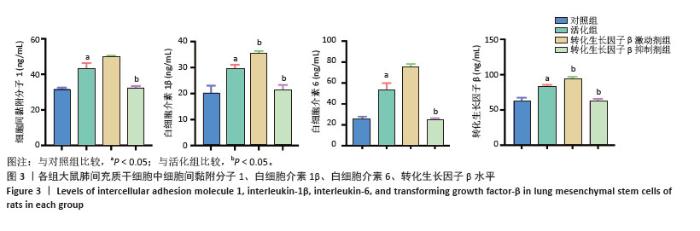
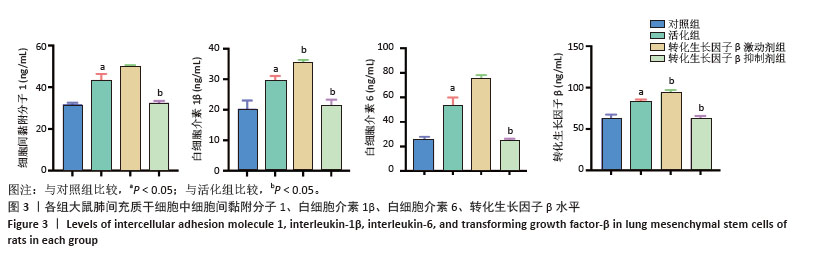
2.3 ELISA法检测各组大鼠肺间充质干细胞培养液中炎症因子水平 与对照组相比,活化组细胞间黏附分子1、白细胞介素1β、白细胞介素6与转化生长因子β水平显著上升。与活化组相比,转化生长因子β激动剂组白细胞介素1β与转化生长因子β水平升高,转化生长因子β抑制剂组细胞间黏附分子1、白细胞介素1β、白细胞介素6与转化生长因子β水平均降低,见图3。"
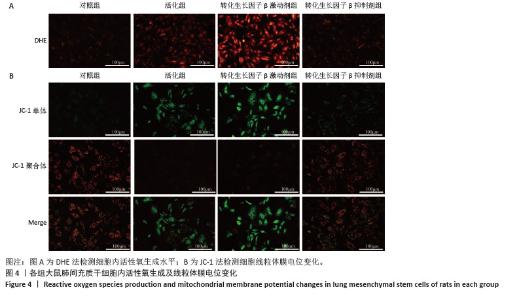
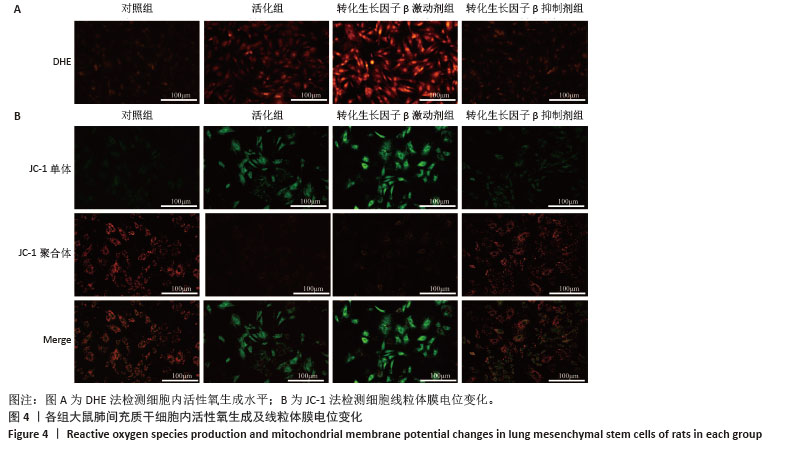
2.4 各组大鼠肺间充质干细胞氧化应激与线粒体功能 DHE检测结果显示,与对照组相比,活化组红色荧光增强,细胞内活性氧生成增加。与活化组相比,转化生长因子β激动剂组红色荧光显著增强,转化生长因子β抑制剂组红色荧光减弱,见图4A。 JC-1检测结果显示,与对照组相比,活化组JC-1单体绿色荧光增强,线粒体膜电位降低。与活化组相比,转化生长因子β激动剂组绿色荧光显著增强,转化生长因子β抑制剂组绿色荧光减弱,接近对照组状态,见图4B。 "
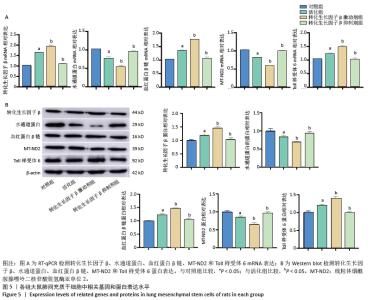
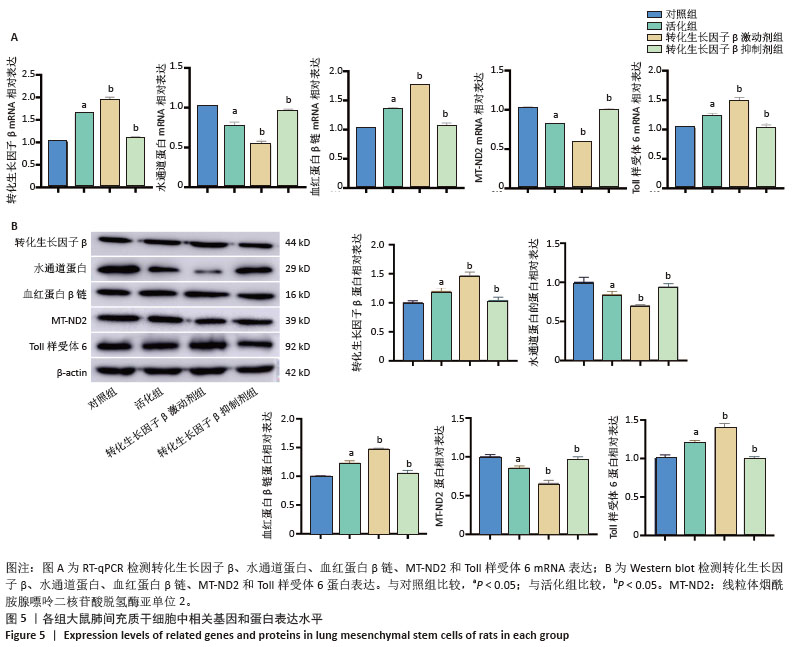
2.5 RT-qPCR与Western blot检测各组大鼠肺间充质干细胞中相关因子表达 RT-qPCR检测结果显示,与对照组相比,活化组转化生长因子β、血红蛋白β链和Toll样受体6 mRNA表达上调,水通道蛋白、MT-ND2 mRNA表达下调。与活化组相比,转化生长因子β激动剂组进一步促进了上述变化,而抑制剂则显著缓解上述变化,见图5A。 Western blot检测与RT-qPCR检测结果一致,活化组和转化生长因子β激动剂组转化生长因子β、血红蛋白β链、Toll样受体6蛋白表达升高,转化生长因子β抑制剂组转化生长因子β、血红蛋白β链、Toll样受体6蛋白表达降低;活化组和转化生长因子β激动剂组水通道蛋白、MT-ND2蛋白表达降低,转化生长因子β抑制剂组水通道蛋白、MT-ND2蛋白表达升高,见图5B。 "
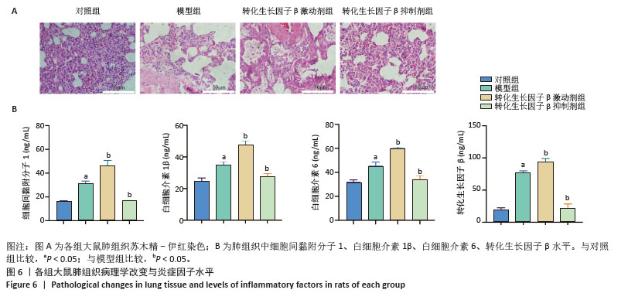
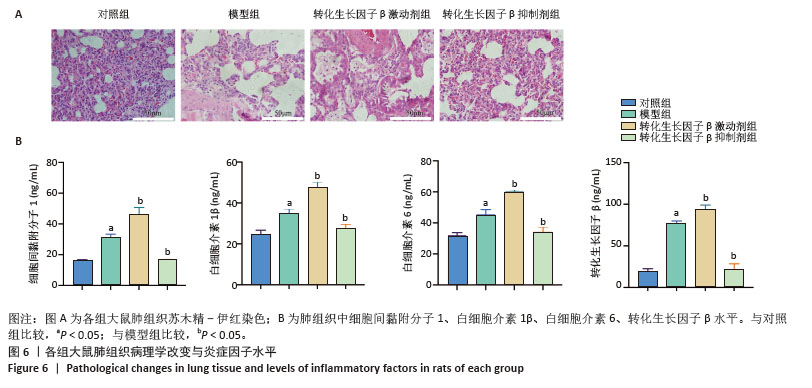
2.6 各组大鼠肺组织病理学改变与炎症因子水平 苏木精-伊红染色显示,与对照组相比,模型组可见明显炎性浸润,细胞排列紊乱,转化生长因子β激动剂组炎性浸润程度较模型组更严重,转化生长因子β抑制剂组炎性浸润程度较模型组有所减轻,见图6A。 ELISA检测结果显示,与对照组相比,模型组肺组织中细胞间黏附分子1、白细胞介素1β、白细胞介素6、转化生长因子β水平升高,转化生长因子β激动剂组肺组织中炎症因子表达水平较模型组进一步升高,转化生长因子β抑制剂组肺组织中炎症因子水平较模型组显著降低,见图6B。 "
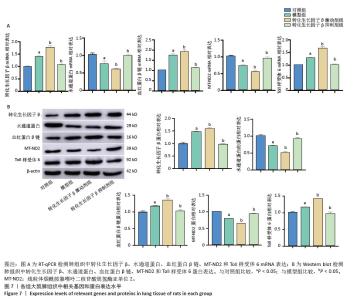
2.7 各组大鼠肺组织中相关因子表达 RT-qPCR检测结果显示,与对照组相比,模型组肺组织中转化生长因子β、血红蛋白β链和Toll样受体6 mRNA表达上调,水通道蛋白、MT-ND2 mRNA表达下调。与模型组相比,转化生长因子β激动剂组进一步加重了肺组织损伤,而抑制剂则显著缓解上述损伤效应,见图7A。 Western blot检测与RT-qPCR检测结果类似,模型组和转化生长因子β激动剂组转化生长因子β、血红蛋白β链、Toll样受体6蛋白表达升高,转化生长因子β抑制剂组转化生长因子β、血红蛋白β链、Toll样受体6蛋白表达降低;模型组和转化生长因子β激动剂组水通道蛋白、MT-ND2蛋白表达降低,转化生长因子β抑制剂组水通道蛋白、MT-ND2蛋白表达升高,见图7B。 "
| [1] BOUCLY A, GERGES C, SAVALE L, et al. Pulmonary arterial hypertension. Presse Med. 2023;52(3):104168. [2] GHOFRANI HA, GOMBERG-MAITLAND M, ZHAO L, et al. Mechanisms and treatment of pulmonary arterial hypertension. Nat Rev Cardiol. 2025; 22(2):105-120. [3] LUNA-LÓPEZ R, RUIZ MARTÍN A, ESCRIBANO SUBÍAS P. Pulmonary arterial hypertension. Med Clin (Barc). 2022;158(12):622-629. [4] REINDERS S, DIDDEN EM, ONG R. Survival, morbidity, and quality of life in pulmonary arterial hypertension patients: a systematic review of outcomes reported by population-based observational studies. Respir Res. 2024;25(1):373. [5] CHIN KM, GAINE SP, GERGES C, et al. Treatment algorithm for pulmonary arterial hypertension. Eur Respir J. 2024;64(4):2401325. [6] PENG D, FU M, WANG M, et al. Targeting TGF-β signal transduction for fibrosis and cancer therapy. Mol Cancer. 2022;21(1):104. [7] DENG Z, FAN T, XIAO C, et al. TGF-β signaling in health, disease, and therapeutics. Signal Transduct Target Ther. 2024;9(1):61. [8] LARSON C, ORONSKY B, CARTER CA, et al. TGF-beta: a master immune regulator. Expert Opin Ther Targets. 2020;24(5):427-438. [9] AASHAQ S, BATOOL A, MIR SA, et al. TGF-β signaling: A recap of SMAD-independent and SMAD-dependent pathways. J Cell Physiol. 2022;237(1): 59-85. [10] WENG L, YE J, YANG F, et al. TGF-β1/SMAD3 Regulates Programmed Cell Death 5 That Suppresses Cardiac Fibrosis Post-Myocardial Infarction by Inhibiting HDAC3. Circ Res. 2023;133(3):237-251. [11] FAN M, YANG K, WANG X, et al. Lactate promotes endothelial-to-mesenchymal transition via Snail1 lactylation after myocardial infarction. Sci Adv. 2023;9(5):eadc9465. [12] GUIGNABERT C, HUMBERT M. Targeting transforming growth factor-β receptors in pulmonary hypertension. Eur Respir J. 2021;57(2):2002341. [13] BOUCHET C, CARDOUAT G, DOUARD M, et al. Inflammation and Oxidative Stress Induce NGF Secretion by Pulmonary Arterial Cells through a TGF-β1-Dependent Mechanism. Cells. 2022;11(18):2795. [14] XIE SS, DENG Y, GUO SL, et al. Endothelial cell ferroptosis mediates monocrotaline-induced pulmonary hypertension in rats by modulating NLRP3 inflammasome activation. Sci Rep. 2022;12(1):3056. [15] MORALES-CANO D, IZQUIERDO-GARCÍA JL, BARREIRA B, et al. Impact of a TAK-1 inhibitor as a single or as an add-on therapy to riociguat on the metabolic reprograming and pulmonary hypertension in the SUGEN5416/hypoxia rat model. Front Pharmacol. 2023;14:1021535. [16] ORNATOWSKI W, LU Q, YEGAMBARAM M, et al. Complex interplay between autophagy and oxidative stress in the development of pulmonary disease. Redox Biol. 2020;36:101679. [17] MARON BA, ABMAN SH, ELLIOTT CG, et al. Pulmonary Arterial Hypertension: Diagnosis, Treatment, and Novel Advances. Am J Respir Crit Care Med. 2021;203(12):1472-1487. [18] HONG J, MEDZIKOVIC L, SUN W, et al. Integrative Multiomics in the Lung Reveals a Protective Role of Asporin in Pulmonary Arterial Hypertension. Circulation. 2024;150(16):1268-1287. [19] WITS M, BECHER C, DE MAN F, et al. Sex-biased TGFβ signalling in pulmonary arterial hypertension. Cardiovasc Res. 2023;119(13):2262-2277. [20] HUMBERT M, MCLAUGHLIN V, GIBBS JSR, et al. Sotatercept for the Treatment of Pulmonary Arterial Hypertension. N Engl J Med. 2021;384(13): 1204-1215. [21] GAO RJ, AIKEREMU N, CAO N, et al. Quercetin regulates pulmonary vascular remodeling in pulmonary hypertension by downregulating TGF-β1-Smad2/3 pathway. BMC Cardiovasc Disord. 2024;24(1):535. [22] SONG Y, WEI J, LI R, et al. Tyrosine kinase receptor B attenuates liver fibrosis by inhibiting TGF-β/SMAD signaling. Hepatology. 2023;78(5):1433-1447. [23] ZHANG T, HE X, CALDWELL L, et al. NUAK1 promotes organ fibrosis via YAP and TGF-β/SMAD signaling. Sci Transl Med. 2022;14(637):eaaz4028. [24] HU HH, CHEN DQ, WANG YN, et al. New insights into TGF-β/Smad signaling in tissue fibrosis. Chem Biol Interact. 2018;292:76-83. [25] HAO M, GUAN Z, ZHANG Z, et al. Atractylodinol prevents pulmonary fibrosis through inhibiting TGF-β receptor 1 recycling by stabilizing vimentin. Mol Ther. 2023;31(10):3015-3033. [26] BAI J, QIAN B, CAI T, et al. Aloin Attenuates Oxidative Stress, Inflammation, and CCl-Induced Liver Fibrosis in Mice: Possible Role of TGF-β/Smad Signaling. J Agric Food Chem. 2023;71(49):19475-19487. [27] PULLAMSETTI SS, SITAPARA R, OSTERHOUT R, et al. Pharmacology and Rationale for Seralutinib in the Treatment of Pulmonary Arterial Hypertension. Int J Mol Sci. 2023;24(16):12653. [28] REDZA-DUTORDOIR M, AVERILL-BATES DA. Activation of apoptosis signalling pathways by reactive oxygen species. Biochim Biophys Acta. 2016;1863(12):2977-2992. [29] YANG DP, DONG WP, YANG YC, et al. Tetramethylpyrazine Improves Monocrotaline-Induced Pulmonary Hypertension through the ROS/iNOS/PKG-1 Axis. J Healthc Eng. 2022;2022:1890892. [30] XU D, HU YH, GOU X, et al. Oxidative Stress and Antioxidative Therapy in Pulmonary Arterial Hypertension. Molecules. 2022;27(12):3724. [31] SUN X, LU Q, YEGAMBARAM M, et al. TGF-β1 attenuates mitochondrial bioenergetics in pulmonary arterial endothelial cells via the disruption of carnitine homeostasis. Redox Biol. 2020;36:101593. [32] TIAN L, WU D, DASGUPTA A, et al. Epigenetic Metabolic Reprogramming of Right Ventricular Fibroblasts in Pulmonary Arterial Hypertension: A Pyruvate Dehydrogenase Kinase-Dependent Shift in Mitochondrial Metabolism Promotes Right Ventricular Fibrosis. Circ Res. 2020;126(12):1723-1745. [33] ŽOLDÁKOVÁ M, NOVOTNÝ M, KHAKUREL KP, et al. Hemoglobin Variants as Targets for Stabilizing Drugs. Molecules. 2025;30(2):385. [34] KATSUMURA KR, DEVILBISS AW, POPE NJ, et al. Transcriptional mechanisms underlying hemoglobin synthesis. Cold Spring Harb Perspect Med. 2013; 3(9):a015412. [35] BUEHLER PW, SWINDLE D, PAK DI, et al. Murine models of sickle cell disease and beta-thalassemia demonstrate pulmonary hypertension with distinctive features. Pulm Circ. 2021;11(4):20458940211055996. [36] JUAITI M, FENG Y, TANG Y, et al. Integrated bioinformatics analysis and experimental animal models identify a robust biomarker and its correlation with the immune microenvironment in pulmonary arterial hypertension. Heliyon. 2024;10(8):e29587. [37] TAKEUCHI O, KAWAI T, SANJO H, et al. TLR6: A novel member of an expanding toll-like receptor family. Gene. 1999;231(1-2):59-65. [38] WANG S, SOLENOV EI, YANG B. Aquaporin Inhibitors. Adv Exp Med Biol. 2023;1398:317-330. [39] GUSDON AM, VOTYAKOVA TV, REYNOLDS IJ, et al. Nuclear and mitochondrial interaction involving mt-Nd2 leads to increased mitochondrial reactive oxygen species production. J Biol Chem. 2007;282(8):5171-5179. |
| [1] | Yang Xuetao, Zhu Menghan, Zhang Chenxi, Sun Yimin, Ye Ling. Applications and limitations of antioxidant nanomaterials in oral cavity [J]. Chinese Journal of Tissue Engineering Research, 2026, 30(8): 2044-2053. |
| [2] |
Dong Chunyang, Zhou Tianen, Mo Mengxue, Lyu Wenquan, Gao Ming, Zhu Ruikai, Gao Zhiwei.
Action mechanism of metformin combined with Eomecon chionantha Hance dressing in treatment of deep second-degree burn wounds#br#
#br#
[J]. Chinese Journal of Tissue Engineering Research, 2026, 30(8): 2001-2013.
|
| [3] | Song Puzhen, Ma Hebin, Chen Hongguang, Zhang Yadong. Effect of bone marrow mesenchymal stem cell-derived exosomes combined with transforming growth factor beta 1 on macrophages [J]. Chinese Journal of Tissue Engineering Research, 2026, 30(7): 1616-1623. |
| [4] | Cai Ziming, Yu Qinghe, Ma Pengfei, Zhang Xin, Zhou Longqian, Zhang Chongyang, Lin Wenping. Heme oxygenase-1 alleviates lipopolysaccharide-induced inflammatory response in nucleus pulposus mesenchymal stem cells [J]. Chinese Journal of Tissue Engineering Research, 2026, 30(7): 1624-1631. |
| [5] | He Jiale, Huang Xi, Dong Hongfei, Chen Lang, Zhong Fangyu, Li Xianhui. Acellular dermal matrix combined with adipose-derived stem cell exosomes promotes burn wound healing [J]. Chinese Journal of Tissue Engineering Research, 2026, 30(7): 1699-1710. |
| [6] | Xia Linfeng, Wang Lu, Long Qianfa, Tang Rongwu, Luo Haodong, Tang Yi, Zhong Jun, Liu Yang. Human umbilical cord mesenchymal stem cell-derived exosomes alleviate blood-brain barrier damage in mice with septic encephalopathy [J]. Chinese Journal of Tissue Engineering Research, 2026, 30(7): 1711-1719. |
| [7] | Cui Lianxu, Li Haomin, Xu Junrong, Tan Baodong, Lu Dahong, Peng Siwei, Wang Jinhui. Effect of umbilical cord mesenchymal stem cell conditioned medium on tissue repair after traumatic craniocerebral injury in miniature pigs [J]. Chinese Journal of Tissue Engineering Research, 2026, 30(7): 1730-1735. |
| [8] | Liu Anting, Lu Jiangtao, Zhang Wenjie, He Ling, Tang Zongsheng, Chen Xiaoling. Regulation of AMP-activated protein kinase by platelet lysate inhibits cadmium-induced neuronal apoptosis [J]. Chinese Journal of Tissue Engineering Research, 2026, 30(7): 1800-1807. |
| [9] | Cao Yong, Teng Hongliang, Tai Pengfei, Li Junda, Zhu Tengqi, Li Zhaojin. Interactions between cytokines and satellite cells in muscle regeneration [J]. Chinese Journal of Tissue Engineering Research, 2026, 30(7): 1808-1817. |
| [10] | You Huijuan, Wu Shuzhen, Rong Rong, Chen Liyuan, Zhao Yuqing, Wang Qinglu, Ou Xiaowei, Yang Fengying. Macrophage autophagy in lung diseases: two-sided effects [J]. Chinese Journal of Tissue Engineering Research, 2026, 30(6): 1516-1526. |
| [11] | Lai Jiaming, , Song Yuling, Chen Zixi, Wei Jinghuan, Cai Hao, , Li Guoquan, . Screening of diagnostic markers for endothelial cell Senescence in mice with radiation-induced heart disease and analysis of immune infiltration [J]. Chinese Journal of Tissue Engineering Research, 2026, 30(6): 1450-1463. |
| [12] | Hou Chaowen, Li Zhaojin, Kong Jianda, Zhang Shuli. Main physiological changes in skeletal muscle aging and the multimechanism regulatory role of exercise [J]. Chinese Journal of Tissue Engineering Research, 2026, 30(6): 1464-1475. |
| [13] | Zhang Di, Zhao Jun, Ma Guangyue, Sun Hui, Jiang Rong. Mechanism of depression-like behavior in chronic social defeat stress mice based on high-throughput sequencing [J]. Chinese Journal of Tissue Engineering Research, 2026, 30(5): 1139-1146. |
| [14] | Li Haojing, Wang Xin, Song Chenglin, Zhang Shengnan, Chen Yunxin. Therapeutic efficacy of extracorporeal shock wave therapy in the upper trapezius muscle area combined with exercise control training in patients with chronic non-specific neck pain [J]. Chinese Journal of Tissue Engineering Research, 2026, 30(5): 1162-1170. |
| [15] | Liu Yu, Lei Senlin, Zhou Jintao, Liu Hui, Li Xianhui. Mechanisms by which aerobic and resistance exercises improve obesity-related cognitive impairment [J]. Chinese Journal of Tissue Engineering Research, 2026, 30(5): 1171-1183. |
| Viewed | ||||||
|
Full text |
|
|||||
|
Abstract |
|
|||||