Chinese Journal of Tissue Engineering Research ›› 2026, Vol. 30 ›› Issue (36): 9519-9525.doi: 10.12307/2026.904
Previous Articles Next Articles
Electroacupuncture regulates mitochondrial copper homeostasis to modulate neuroinflammatory injury in rats with ischemic stroke
Yang Jiao¹, Wang Zhifeng², Shi Ting², Xu Shuangfeng², Tian Daman², Lan Junfeng², He Pengfen², Hao Zhihui², Pan Pan¹, Wang Jian²
- 1Second Clinical Medical College, Yunnan University of Chinese Medicine, Kunming 650500, Yunnan Province, China; 2First Clinical Medical College, Yunnan University of Chinese Medicine, Kunming 650500, Yunnan Province, China
-
Received:2025-10-15Revised:2026-03-06Online:2026-12-28Published:2026-05-22 -
Contact:Wang Jian, PhD, Associate professor, First Clinical Medical College, Yunnan University of Chinese Medicine, Kunming 650500, Yunnan Province, China Co-corresponding author: Pan Pan, PhD, Lecturer, Second Clinical Medical College, Yunnan University of Chinese Medicine, Kunming 650500, Yunnan Province, China -
About author:Yang Jiao, MS candidate, Second Clinical Medical College, Yunnan University of Chinese Medicine, Kunming 650500, Yunnan Province, China -
Supported by:General Program of Yunnan Provincial Applied Basic Research Plan, No. 202201AT070214 (to WJ); Joint Special Fund for Applied Basic Research in Traditional Chinese Medicine, Yunnan Provincial Department of Science and Technology, Nos. 202001AZ070001-020 and 202301AZ070001-016 (both to WJ); Yunnan Provincial Two-Type Talent Project, No. 202205AD160024 (to WJ); Basic Research Program of Yunnan Provincial Department of Science and Technology, Nos. 202101AU070204 and 202301AZ070001-026 (both to PP); Yunnan Provincial Innovation Team for Acupuncture and Tuina in the Prevention and Treatment of Encephalopathy, Nos. ZTNB404 (to WZF) and ZTNB212 (to YJ); National Natural Science Foundation of China, No. 82560932 (to WJ)

CLC Number:
Cite this article
Yang Jiao, Wang Zhifeng, Shi Ting, Xu Shuangfeng, Tian Daman, Lan Junfeng, He Pengfen, Hao Zhihui, Pan Pan, Wang Jian. Electroacupuncture regulates mitochondrial copper homeostasis to modulate neuroinflammatory injury in rats with ischemic stroke[J]. Chinese Journal of Tissue Engineering Research, 2026, 30(36): 9519-9525.
share this article
Add to citation manager EndNote|Reference Manager|ProCite|BibTeX|RefWorks
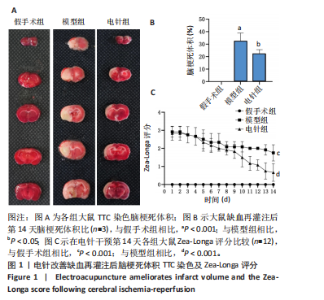
2.1 实验动物数量分析 36只大鼠全部进入结果分析,无脱失。 2.2 各组大鼠神经功能缺损评分及梗死区面积比较 如图1所示,假手术组大鼠未经插栓处理,其行为表现正常,无神经功能损伤。造模24 h后,模型组、电针组Zea-Longa评分高于假手术组(P < 0.05),表明缺血再灌注损伤模型复制成功。在电针干预第14天,与模型组相比,电针组Zea-Longa评分和脑梗体积减少(P < 0.001,P < 0.05)。"
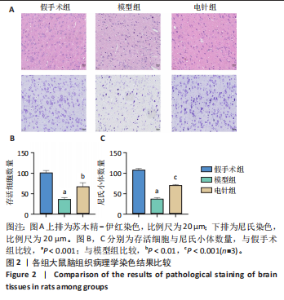
2.3 各组大鼠脑组织病理学染色比较 如图2苏木精-伊红染色结果显示,假手术组大鼠脑组织神经元排列整齐紧密,细胞大小均一,神经结构清晰,细胞膜完整且核膜清晰,胞质感染均匀;与假手术组相比,模型组大鼠脑组织可见明显病理损伤,神经细胞结构疏松,细胞排列紊乱,神经元细胞减少(P < 0.001),神经元核损伤呈固缩、碎裂至溶解的渐进性改变,胞质染色变浅,散在较多胶质细胞,结构模糊伴空泡化;与模型组相比,电针组大鼠脑组织病理损伤明显减轻,组织结构相对致密,仅有少部分神经元坏死及细胞核膜破裂,胞质染色逐渐均匀,神经元细胞数量较模型组增多(P < 0.01)。 尼氏染色显示假手术组大鼠脑组织神经元轮廓清晰,富含丰富的尼氏小体,与假手术组相比,模型组尼氏小体数量明显减少;与模型组比较,电针组干预后尼氏小体数量增多,细胞形态更完整(P < 0.001,P < 0.001)。"
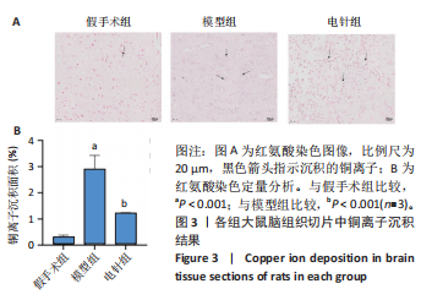
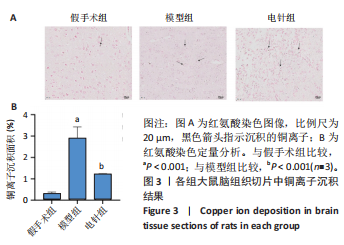
2.4 脑组织中铜离子沉积情况 如图3所示,采用红氨酸染色观察铜离子在脑组织中的沉积情况,含铜离子的结构呈蓝黑色或灰黑色颗粒,细胞核为淡红色。结果显示假手术组大鼠脑组织几乎无铜离子沉积;与假手术组相比,模型组大鼠脑组织铜离子沉积增多;与模型组相比,电针组大鼠脑组织铜离子沉积减少。"
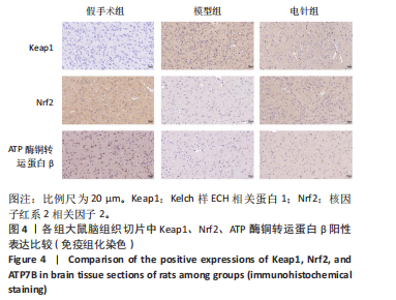
2.5 免疫组化观察脑组织中Keap1、Nrf2、ATP酶铜转运蛋白β蛋白的阳性表达 如图4所示,Nrf2蛋白主要定位于神经元细胞核及细胞质内[18],免疫组化染色呈棕黄色颗粒状分布;模型组大鼠脑组织中Nrf2蛋白阳性表达减弱,阳性颗粒数量减少,染色深度变浅,主要在梗死周边区少量散在分布;电针组大鼠脑组织中Nrf2蛋白阳性表达较模型组增强,阳性颗粒数量增多,染色加深,分布范围扩大,尤其在梗死周边区的表达恢复更显著,提示电针可促进Nrf2蛋白的表达。 ATP酶铜转运蛋白β蛋白主要定位于神经元细胞质[19],免疫组化染色呈棕黄色颗粒状分布;模型组ATP酶铜转运蛋白β蛋白阳性表达降低,仅在梗死灶边缘少量存在,与假手术组差异显著;"
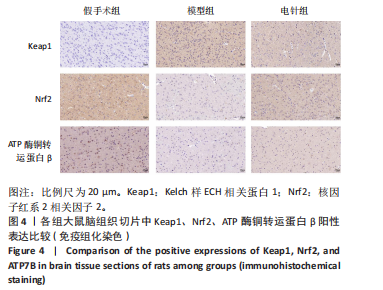

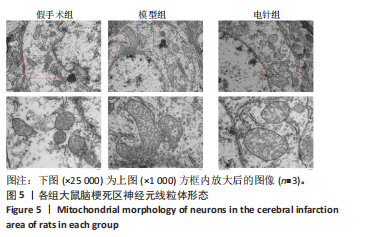
电针组较模型组ATP酶铜转运蛋白β蛋白阳性表达升高,梗死周边区恢复显著,表明电针可上调ATP酶铜转运蛋白β蛋白表达。 Keap1蛋白在大鼠脑组织中定位在神经元细胞质内[20],免疫组化染色呈棕黄色颗粒状分布;模型组Keap1蛋白阳性表达增强,颗粒增多、染色加深且梗死区及周边密集分布,与假手术组差异显著;电针组较模型组Keap1蛋白阳性表达减弱,颗粒减少、染色变浅、分布稀疏,表明电针可抑制脑缺血后Keap1蛋白的过度表达。 2.6 透射电镜观察梗死区神经元超微结构及线粒体形态 如图5所示,干预14 d后,假手术组的梗死区神经元线粒体形态结构完整,轮廓清晰,线粒体膜嵴间分布均匀;模型组梗死区神经元胞膜崩解,胞质内容物外溢,细胞器杂乱分布;核膜断裂或溶解,染色质凝聚成团或完全消散,核仁结构崩解;线粒体呈现典型缺血性损伤,包括显著肿胀、嵴断裂或消失(“气球样”空泡化);粗面内质网扩张脱颗粒,高尔基体囊泡碎裂,溶酶体破裂释放酶体加速细胞自溶。"
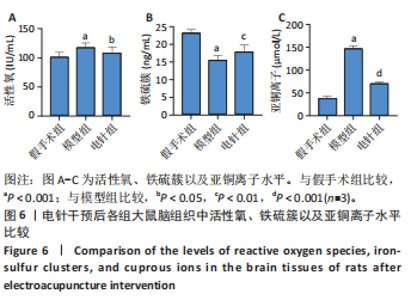
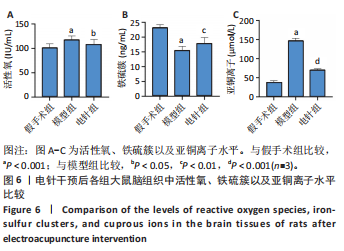
2.7 各组大鼠梗死区活性氧、铁硫簇以及亚铜离子水平比较 如图6所示,通过化学发光试剂盒检测活性氧、铁硫簇以及亚铜离子表达水平,与假手术组相比,模型组大鼠脑组织中活性氧、亚铜离子浓度升高(P < 0.001),铁硫簇质量浓度减少(P < 0.001);与模型组相比,电针组活性氧、亚铜离子浓度降低(P < 0.05,P < 0.001),铁硫簇质量浓度升高(P < 0.01)。"
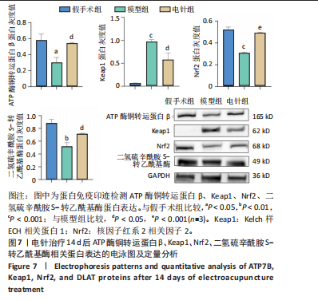
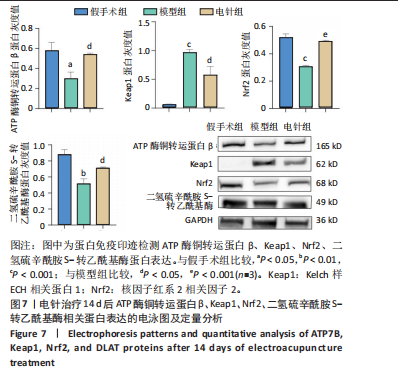
2.8 各组大鼠梗死区脑组织Keap1、Nrf2、ATP酶铜转运蛋白β、二氢硫辛酰胺S-转乙酰基酶蛋白表达水平比较 如图7蛋白免疫印迹结果显示,与假手术组相比,模型组大鼠脑组织中ATP酶铜转运蛋白β、Nrf2、二氢硫辛酰胺S-转乙酰基酶蛋白表达降低(P < 0.05,P < 0.001,P < 0.01),Keap1蛋白表达上升(P < 0.001);与模型组相比,电针组大鼠脑组织中ATP酶铜转运蛋白β、Nrf2、二氢硫辛酰胺S-转乙酰基酶的蛋白表达升高(P < 0.05,P < 0.001,P < 0.05),Keap1蛋白表达下降(P < 0.05)。"
| [1] 《中国脑卒中防治报告》编写组,王陇德.《中国脑卒中防治报告 2021》概要[J]. 中国脑血管病杂志,2023,20(11):783-793. [2] FEIGIN VL, BRAININ M, NORRVING B, et al. World Stroke Organization: Global Stroke Fact Sheet 2025. Int J Stroke. 2025;20(2):132-144. [3] 党超,卢洁,宋海庆,等.急性脑梗死缺血半暗带临床评估和治疗中国专家共识[J]. 中国神经精神疾病杂志,2021,47(6):324-335. [4] JINSHI L, CONG Y, LIANG S, et al. Cuproptosis-related Genes Are Involved In Immunodeficiency Following Ischemic Stroke. Arch Med Sci.2024;20(1):321-325. [5] 吴丹,漆仲文,张伟,等.脑缺血 / 再灌注损伤后线粒体结构与功能稳态失衡机制的研究进展[J]. 中国医药导报,2021,18(31):42-45+66. [6] ZHANG M, LI W, WANG Y, et al. Association Between the Change of Serum Copper and Ischemic Stroke: a Systematic Review and Meta-Analysis. J Mol Neurosci. 2020;70(3):475-480. [7] QIN R, LIANG X, YANG Y, et al. Exploring Cuproptosis-related Molecular Clusters and Immunological Characterization in Ischemic Stroke Through Machine learning. Heliyon. 2024;10(17):e36559. [8] TSVETKOV P, COY S, PETROVA B, et al. Copper Induces Cell Death By Targeting Lipoylated Tca Cycle Proteins. Science. 2022;375(6586):1254-1261. [9] 欧昌泽,陈彬彬,刘新利,等.缺血性脑卒中线粒体损伤的关键靶点及中医药干预机制研究进展[J].中国中药杂志,2025,50(18):5098-5110. [10] 孔文哲,路璐,樊赛军.铜稳态、铜死亡与铜相关抗肿瘤药物研究进展[J].生命科学,2024,36(8):1000-1011. [11] RUTURAJ, MISHRA M, SAHA S, et al. Regulation Of The Apico-Basolateral Trafficking Polarity Of The Homologous Copper-Atpases Atp7A And Atp7B. J Cell Sci. 2024;137(5):jcs261258. [12] ZHU Z, SONG M, REN J, et al. Copper Homeostasis And Cuproptosis In Central Nervous System Diseases. Cell Death Dis. 2024;15(11):850. [13] LOU Q, YU L, LIU S, et al. Calycosin-7-O-β-D-Glucoside Modulates Copper Homeostasis Through Slc31A1 To Mitigate Cuproptosis In Cerebral Ischemia/Reperfusion Injury. Chem Biol Interact.2025;420:111702. [14] 陈莹,郭晓婧,莫雪妮,等.缺血性脑卒中诊断性生物标志物解析及靶向铜死亡相关基因的实验验证[J].中国组织工程研究,2025,29(35):7562-7570. [15] LOCATELLI M, FARINA C. Role Of Copper In Central Nervous System Physiology And Pathology. Neural Regen Res. 2025;20(4):1058-1068. [16] LIU P, SONG XC, YANG XS, et al. A Preclinical Model To Assess Brain Recovery After Acute Stroke In Rats. J Vis Exp. 2019;(153). doi: 10.3791/60166. [17] 中国针灸学会.实验动物常用穴位名称与定位第 2 部分:大鼠[J]. 针刺研究, 2021,46(4):351-352. [18] WEI Y, ZHANG Y, ZHAN B, et al. Asiaticoside Alleviated Nafld By Activating Nrf2 And Inhibiting The Nf-Κb Pathway. Phytomedicine. 2025;136:156317. [19] WANG C, WANG H, WANG C, et al. Plumbagin Triggers Cuproptosis In Hepatocellular Carcinoma (Hcc) Via The Dna-Methyltransferase 1 (Dnmt1)/Microrna-302a-3p (Mir-302a-3p)/Atpase Copper Transporting Beta (Atp7B) Axis. Medcomm (2020). 2025;6(8):e70312. [20] HIROSE W, HORIUCHI M, LI D, et al. Selective Elimination Of Nrf2-Activated Cells By Competition With Neighboring Cells In The Esophageal Epithelium. Cell Mol Gastroenterol Hepatol. 2023;15(1):153-178. [21] 吴日辉,胡方竹,谢丽,等.电针心包经穴对缺血性脑卒中模型大鼠氧化应激相关蛋白的影响[J/OL].中国针灸,1-14[2025-09-07]. doi: 10.13703/j.0255-2930.20250327-0006 [22] 包伟伟,罗文君,张小强,等.电头针调控PPARγ/NF-κB信号通路诱导小胶质细胞极化减轻缺血性脑卒中大鼠炎性损伤[J].针刺研究, 2025,50(10):1152-1160. [23] 张君宇,张利达,胡滟琦,等.“通督调神”电针预处理大鼠缺血半暗带区miR-124和皮质区蛋白的表达[J].中国组织工程研究,2023,27(26):4139-4146. [24] 程志清,潘录录,林苏进,等.针刺“百会、大椎”穴联合机器人训练对帕金森病平衡功能影响[J].中国现代医生,2023,61(35):9-12+41. [25] 张晓蒙,汪节,孙进,等.百会久留针联合低频重复经颅磁刺激治疗缺血性脑卒中认知障碍的临床观察[J].安徽中医药大学学报,2025,44(6):55-59. [26] 王贵千,余沛豪,黄海,等.电针百会和大椎调控小胶质细胞活化介导的HIF-1α、VEGF、IL-1β和TNF-α促进缺血性脑卒中大鼠神经功能恢复[J]. 广州中医药大学学报,2025,42(5):1195-1202. [27] WANG Z, XI Y, LAN J, et al. Effects of electroacupuncture on neural function and the expression of inflammation-related proteins NLRP3/caspase-1 in rats with ischemic stroke. Neuroreport. 2025;36(9):456-466. [28] 裴彩霞,贾楠,刘俊伶,等.细胞死亡的多种方式及其机制研究进展[J].解放军医学杂志,2026,51(1):132-142. [29] BOMER N, PAVEZ-GIANI MG, GROTE BEVERBORG N, et al. Micronutrient Deficiencies In Heart Failure: Mitochondrial Dysfunction As a Common Pathophysiological Mechanism? J Intern Med. 2022;291(6):713-731. [30] YUAN HJ, XUE YT, LIU Y. Cuproptosis, The Novel Therapeutic Mechanism For Heart Failure: a Narrative Review. Cardiovasc Diagn Ther. 2022;12(5):681-692. [31] ZHOU QY, REN C, LI JY, et al. The Crosstalk Between Mitochondrial Quality Control And Metal-Dependent Cell Death. Cell Death Dis. 2024;15(4):299. [32] 周天,张栋,周刚,等.铜代谢和铜死亡在心血管疾病中的分子机制与治疗新进展[J].中华老年心脑血管病杂志,2025,27(7):965-968. [33] PETER T, ALEXANDRE D, KAI C, et al. Mitochondrial Metabolism Promotes Adaptation To Proteotoxic Stress. Nat Chem Biol. 2019;15(7):681-689. [34] BITTER RM, OH S, DENG Z, et al. Structure Of The Wilson Disease Copper Transporter Atp7B. Sci Adv. 2022;8(9):Eabl5508. [35] 李金贤,温鼎声,李雄.基于铜代谢的肝豆状核变性相关分子机制的研究进展[J].中国病理生理杂志,2024,40(9):1751-1757. [36] ORÄDD F, STEFFEN JH, GOURDON P, et al. Copper Binding Leads To Increased Dynamics In The Regulatory N-Terminal Domain Of Full-Length Human Copper Transporter Atp7B. Plos Comput Biol. 2022;18(9):e1010074. [37] YANG Y, WU J, WANG L, et al. Copper Homeostasis And Cuproptosis In Health And Disease. Medcomm (2020). 2024;5(10):e724. [38] 李晟,秦莉花,曹曦,等.缺血性脑卒中疾病铜稳态失衡与铜死亡的研究进展[J].中国老年学杂志,2025,45(13):3302-3307. [39] 梁新妹,王云平,李丹,等.Keap1-Nrf2信号通路在机体氧化应激损伤防护中的研究进展[J].中国医药导报,2022,19(35):40-44. [40] 周文艳,胡珊珊,张万年,等.Keap1-Nrf2通路在炎症疾病中的研究进展[J].药学实践与服务,2025,43(3):97-108+116. [41] 朱莉,幸佳佳,魏娟芳,等.短链脂肪酸在神经退行性疾病中的相关机制研究进展[J].中国全科医学,2023,26(24):3061-3066. [42] 闫健羽,刘国栋,缪震元,等.Keap1-Nrf2蛋白相互作用小分子抑制剂及降解剂研究进展[J].药学学报,2022,57(10):2932-2948. [43] 乔颖,袁月,徐三鹏,等.破血化瘀、填精补髓方对脑出血模型小鼠脑组织TLR4/NF-κB/NLRP3信号通路的影响[J].中医药学报,2023,51(11):36-42. [44] ULASOV AV, ROSENKRANZ AA, GEORGIEV GP, et al. Nrf2/Keap1/Are Signaling: Towards Specific Regulation. Life Sci. 2022;291:120111. [45] DU M, FU J, ZHANG J, et al. Circspna2 Attenuates Cuproptosis By Mediating Ubiquitin Ligase Keap1 To Regulate The Nrf2-Atp7b Signalling Axis In Depression After Traumatic Brain Injury In a Mouse Model. Clin Transl Med. 2024;14(11):e70100. [46] 薛静,高莹,王舒.针刺调控缺血性卒中后铁死亡的作用机制研究进展[J].中国比较医学杂志,2024,34(4):129-138. [47] DEV S, MUCHENDITSI A, GOTTLIEB A, et al. Oxysterol Misbalance Critically Contributes To Wilson Disease Pathogenesis. Sci Adv. 2022;8(42):Eadc9022. [48] 朱健平,李运曼.Nrf2在缺血性脑损伤中的关键性作用[J].医学研究与教育, 2022,39(2):1-9. [49] 刘圆圆,彭婷,姚娟,等.基于Keap1/Nrf2/ARE信号通路的天然产物在神经保护方面的研究进展[J].中国实验方剂学杂志,2023,29(7):262-273. [50] DONG J, XIANG G, XIA X, et al. Aberrant Copper Metabolism And Hepatic Inflammation Cause Neurological Manifestations In a Mouse Model Of Wilson’s Disease. J Neuroinflammation. 2024;21(1):235. |
| [1] | Wang Zheng, Cheng Ji, Yu Jinlong, Liu Wenhong, Wang Zhaohong, Zhou Luxing. Progress and future perspectives on the application of hydrogel materials in stroke therapy [J]. Chinese Journal of Tissue Engineering Research, 2026, 30(8): 2081-2090. |
| [2] | Tao Daiju, Su Haiyu, Wang Yuqi, Shen Zhiqiang, He Bo . Construction and identification of stable PC12 cell lines with high/low expression of miR-122-5p [J]. Chinese Journal of Tissue Engineering Research, 2026, 30(7): 1790-1799. |
| [3] | Wen Xing, Li Mengmeng, Jia Feiyang, Qu Mengjian, Sun Guanghua, Liu Jing, Huang Xiarong, Zhong Peirui, Wang Jinling, Zhou Jun. Transcriptomic analysis of the mechanism of electroacupuncture in alleviating early synovial inflammation in a rat model of knee osteoarthritisbr# [J]. Chinese Journal of Tissue Engineering Research, 2026, 30(35): 9198-9205. |
| [4] | Su Xu, Zhang Xiaoxi, Yang Yaqing, Fu Zhenyi, Liu Jiaxin. Mechanism by which non-apoptotic regulated cell death induces neuronal injury in ischemic stroke [J]. Chinese Journal of Tissue Engineering Research, 2026, 30(35): 9281-9293. |
| [5] | . Regional specificity of brain organoids and their application in ischemic stroke modeling and drug development [J]. Chinese Journal of Tissue Engineering Research, 2026, 30(34): 9008-9016. |
| [6] | Li Huaying, Li Hao, Peng Wuxun, Dong Wentao. Mechanism of cuproptosis in the diagnosis and treatment of orthopedic-related diseases [J]. Chinese Journal of Tissue Engineering Research, 2026, 30(24): 6275-6281. |
| [7] | Gao Hongmei, Zhang Kun, Xiao Dongjie, Liu Hua. Human adipose multilineage-differentiating stress-enduring cells on treatment of ischemic stroke in rats [J]. Chinese Journal of Tissue Engineering Research, 2026, 30(19): 4853-4859. |
| [8] | Wu Xue, Zhang Linao, Luo Shifang, Liu Feifan, Wan Yan, Bai Yuanmei, Cao Julin, Xie Yuhuan, Guo Peixin. Dandeng Tongnao soft capsules against ischemic stroke: fingerprinting and network pharmacological analysis of efficacy and mechanism of action [J]. Chinese Journal of Tissue Engineering Research, 2026, 30(17): 4517-4528. |
| [9] |
Zhang Yueting, Li Jinglin, Fu Zhenyi, Yan Fei, Gao Yu, Liu Jiaxin.
Endoplasmic reticulum stress promotes ferroptosis and aggravates cerebral ischemia-reperfusion injury#br#
#br#
[J]. Chinese Journal of Tissue Engineering Research, 2026, 30(11): 2806-2813.
|
| [10] | Zhou Xinying, Sun Xinyue, Zhu Wenhao. Insulin-like growth factors and ischemic stroke: a genome-wide association analysis in European populations [J]. Chinese Journal of Tissue Engineering Research, 2026, 30(11): 2909-2919. |
| [11] | Liu Tongyan, Li Yuan, Sun Wei, Yao Bing, Fang Shanshan, Zhou Lingyun. Current status and hotspot analysis of experimental research on electroacupuncture intervention for peripheral nerve regeneration: electroacupuncture parameters, acupuncture effects and molecular mechanisms [J]. Chinese Journal of Tissue Engineering Research, 2026, 30(10): 2608-2617. |
| [12] | Wang Zheng, Cheng Ji, Yu Jinlong, Liu Wenhong, Wang Zhaohong, Zhou Luxing. Progress and future perspectives on the application of hydrogel materials in stroke therapy [J]. Chinese Journal of Tissue Engineering Research, 2025, 29(在线): 1-10. |
| [13] | Wang Mi, Ma Shujie, Liu Yang, Qi Rui. Identification and validation of characterized gene NFE2L2 for ferroptosis in ischemic stroke [J]. Chinese Journal of Tissue Engineering Research, 2025, 29(7): 1466-1474. |
| [14] | Gao Yang, Qin Hewei, Liu Dandan. ACSL4 mediates ferroptosis and its potential role in atherosclerotic cardiovascular disease [J]. Chinese Journal of Tissue Engineering Research, 2025, 29(6): 1239-1247. |
| [15] | Yang Bo, Pan Xinfang, Chang Liuhui, Ni Yong. Correlation of echocardiographic parameters with disability at 3 months after acute ischemic stroke [J]. Chinese Journal of Tissue Engineering Research, 2025, 29(35): 7544-7551. |
| Viewed | ||||||
|
Full text |
|
|||||
|
Abstract |
|
|||||