Chinese Journal of Tissue Engineering Research ›› 2026, Vol. 30 ›› Issue (35): 9198-9205.doi: 10.12307/2026.466
Previous Articles Next Articles
Transcriptomic analysis of the mechanism of electroacupuncture in alleviating early synovial inflammation in a rat model of knee osteoarthritisbr#
Wen Xing1, 2, 3, Li Mengmeng1, 2, 3, Jia Feiyang4, Qu Mengjian1, 2, 3, Sun Guanghua1, 2, 3, Liu Jing1, 2, 3, Huang Xiarong1, 2, 3, Zhong Peirui1, 2, 3, #br# Wang Jinling1, 2, 3, Zhou Jun1, 2, 3 #br#
- 1Rehabilitation Center, 2Department of Rehabilitation Medicine, 3Laboratory of Rehabilitation Medicine, the First Affiliated Hospital of Nanhua University, Hengyang 421001, Hunan Province, China; 4Department of Rehabilitation, The Affiliated Nanhua Hospital, University of South China, Hengyang 421001, Hunan Province, China
-
Received:2025-09-18Revised:2026-02-24Online:2026-12-18Published:2026-04-28 -
Contact:Zhou Jun, MD, Chief physician, Professor, Doctoral supervisor, Rehabilitation Center, the First Affiliated Hospital of Nanhua University, Hengyang 421001, Hunan Province, China; Department of Rehabilitation Medicine, the First Affiliated Hospital of Nanhua University, Hengyang 421001, Hunan Province, China; Laboratory of Rehabilitation Medicine, the First Affiliated Hospital of Nanhua University, Hengyang 421001, Hunan Province, China -
About author:Wen Xing, MS candidate, Rehabilitation Center, the First Affiliated Hospital of Nanhua University, Hengyang 421001, Hunan Province, China; Department of Rehabilitation Medicine, the First Affiliated Hospital of Nanhua University, Hengyang 421001, Hunan Province, China; Laboratory of Rehabilitation Medicine, the First Affiliated Hospital of Nanhua University, Hengyang 421001, Hunan Province, China -
Supported by:Hunan Provincial Natural Science Foundation Project, Nos. 2024JJ5361 (to ZJ), 2023JJ30543 (to LJ), and 2025JJ50662 (to HXR); 4310 Program of the First Affiliated Hospital of Nanhua University, No. 20214310NHYCG07 (to ZJ)

CLC Number:
Cite this article
Wen Xing, Li Mengmeng, Jia Feiyang, Qu Mengjian, Sun Guanghua, Liu Jing, Huang Xiarong, Zhong Peirui, Wang Jinling, Zhou Jun. Transcriptomic analysis of the mechanism of electroacupuncture in alleviating early synovial inflammation in a rat model of knee osteoarthritisbr#[J]. Chinese Journal of Tissue Engineering Research, 2026, 30(35): 9198-9205.
share this article
Add to citation manager EndNote|Reference Manager|ProCite|BibTeX|RefWorks

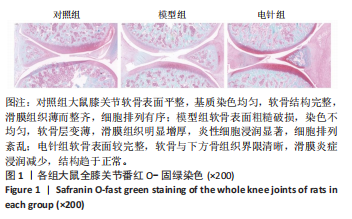
2.1 实验动物数量分析 实验共纳入健康雄性SD大鼠24只,实验过程中所有动物均顺利完成造模、电针干预及组织采集,无动物死亡或脱落。所有24只大鼠均进入后续组织学评分与转录组学分析。转录组测序分析中,每组随机选取6只大鼠的滑膜组织进行mRNA测序,其余样本用于后续验证实验。 2.2 膝关节软骨及滑膜组织形态学 对照组大鼠关节软骨表面平整,基质染色均匀,滑膜组织质薄柔顺;模型组大鼠软骨表面破损,染色不均,炎症浸润明显,滑膜细胞排列紊乱,提示造模成功;电针组软骨表面较为完整,软骨与骨界限清晰,滑膜组织炎症浸润较少。见图1。"
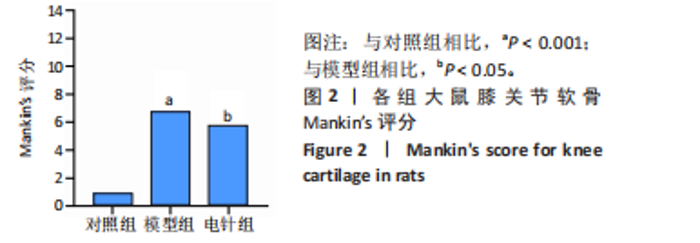
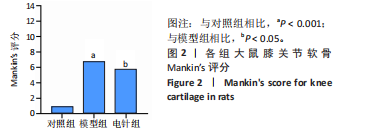
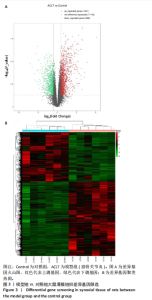
2.3 膝关节软骨退变评分 模型组Mankin’s评分较对照组显著升高(P < 0.001);与模型组相比,电针组Mankin’s评分显著降低,差异有显著性意义(P < 0.05),见图2。 2.4 模型组膝骨关节炎大鼠与对照组健康大鼠差异基因分析 设定阈值为1.5倍差异,P ≤ 0.05且组内FPKM均值≥ 0.5筛选差异表达基因。与对照组相比,模型组大鼠滑膜中筛选出2 449个显著性差异表达基因,1 465个基因上调,984个基因下调,见图3。"
"
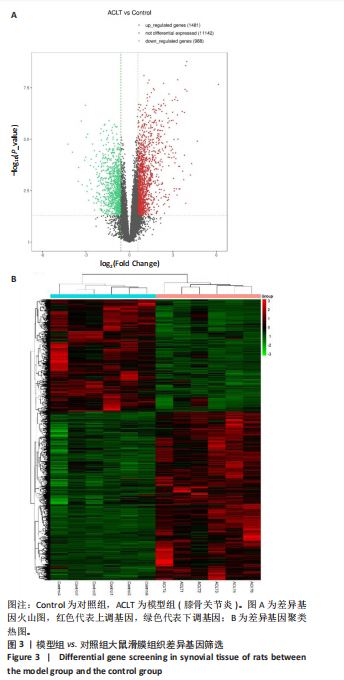
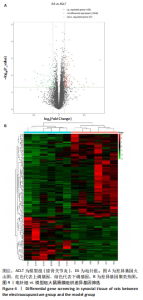
上调基因中差异最为显著的是Sparc、Col1a1、Col3a1、Pik3cd、Pik3r2等,下调基因中差异最为显著的是Mettl7a、Gpx3、Mapk1ip1等。 2.5 电针组膝骨关节炎大鼠与模型组膝骨关节炎大鼠差异基因分析 设定阈值为1.5倍差异,P ≤ 0.05且组内FPKM均值≥ 0.5来筛选差异表达基因。与模型组比较,电针组大鼠滑膜中筛选出186个显著性差异表达基因,123个基因上调,63个基因下调,见图4。上调基因中差异最为显著的是Spp1、Acp5、Matk等,下调基因中差异最为显著的是Acly、Nampt、Apod等。"

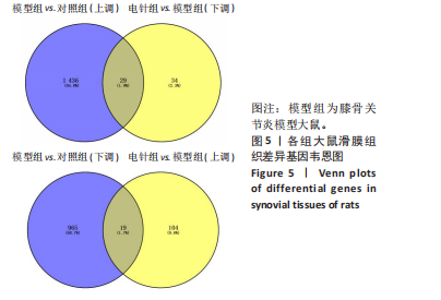
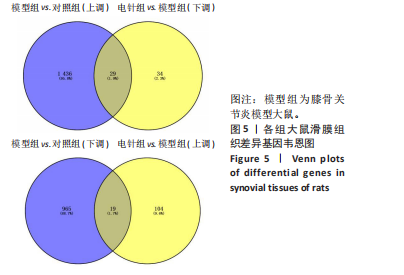
2.6 各组大鼠滑膜组织差异基因交集 基于上述结果,利用韦恩图筛选与电针干预骨关节炎相关的基因,在模型组表达上调且在电针组表达下调的基因有29个,主要有Myh9、Hmox1、S100a8等;在模型组表达下调且在电针组表达上调的基因有19个,主要有Rack1、Ddit3、Dlx5等,见图5。"

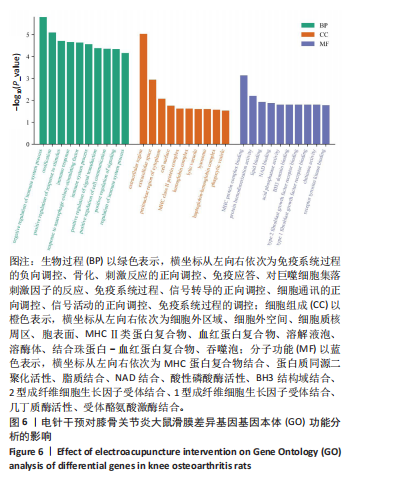
2.7 差异基因的GO功能分析 将差异表达基因比对到GO数据库中进行功能富集分析,主要分为生物过程、细胞组成和分子功能3个方面。在生物过程方面,主要富集在对刺激反应的正向调节、免疫反应、对巨噬细胞集落刺激因子的反应、免疫系统过程、信号转导的正向调节;在细胞组成方面,差异基因主要富集在细胞外区域、细胞质核周区、MHCⅡ类蛋白复合物、血红蛋白复合物、溶酶体、吞噬泡等;在分子功能方面,差异基因主要富集在MHC蛋白复合物结合、蛋白质同源二聚化活性、BH3结构域结合、2 型成纤维细胞生长因子受体结合、1型成纤维细胞生长因子受体结合、受体酪氨酸激酶结合,见图6。"
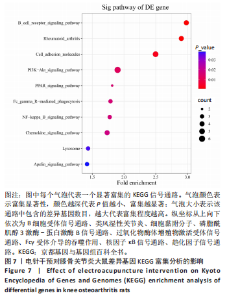
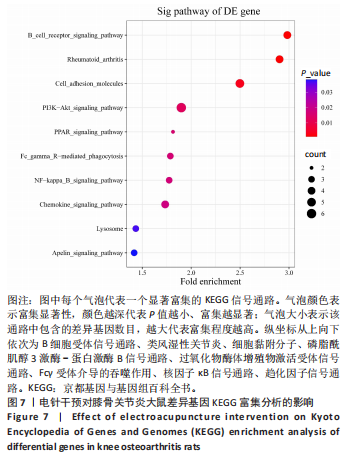
2.8 差异基因的KEGG通路分析 电针干预膝骨关节炎大鼠的上调差异表达基因主要富集在B细胞受体信号传导途径、细胞黏附分子、磷脂酰肌醇3激酶-蛋白激酶B信号传导途径、Fc_gamma_R(FcγR)介导的吞噬作用、核因子κB信号途径、溶酶体、凋亡素信号途径、PPAR 信号途径,见图7。"
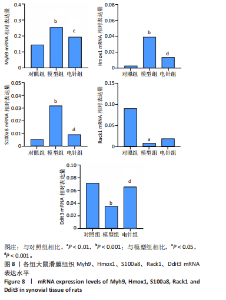
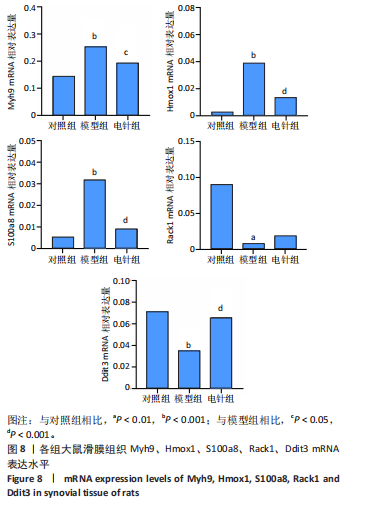
2.9 各组大鼠滑膜组织Myh9、Hmox1、S100a8、Rack1、Ddit3表达水平比较 与对照组相比,模型组大鼠滑膜组织Myh9、Hmox1、S100a8 mRNA表达水平显著升高(P < 0.001,P < 0.001,P < 0.001),Rack1、Ddit3 mRNA表达水平显著降低(P < 0.01, P < 0.001);与模型组相比,电针组大鼠滑膜组织Myh9、Hmox1、S100a8 mRNA表达水平显著降低(P < 0.05,P < 0.001,P < 0.001),Ddit3 mRNA表达水平显著升高(P < 0.001),Rack1 mRNA表达水平有升高趋势,但差异无显著性意义(P > 0.05)。上述指标组间变化趋势与测序结果变化趋势一致,见图8。"
| [1] HUNTER DJ, BIERMA-ZEINSTRA S. Osteoarthritis. Lancet. 2019;393(10182): 1745-1759. [2] LEE K, NIKU S, KOO SJ, et al. Molecular imaging for evaluation of synovitis associated with osteoarthritis: a narrative review. Arthritis Res Ther. 2024; 26(1):25. [3] THOENEN J, MACKAY JW, SANDFORD HJC, et al. Imaging of Synovial Inflammation in Osteoarthritis, From the AJR Special Series on Inflammation. AJR Am J Roentgenol. 2022;218(3):405-417. [4] LUO H, ZHANG R. Icariin enhances cell survival in lipopolysaccharide-induced synoviocytes by suppressing ferroptosis via the Xc-/GPX4 axis. Exp Ther Med. 2021;21(1):72. [5] TU JF, YANG JW, SHI GX, et al. Efficacy of Intensive Acupuncture Versus Sham Acupuncture in Knee Osteoarthritis: A Randomized Controlled Trial. Arthritis Rheumatol. 2021;73(3):448-458. [6] 刘媛,屈萌艰,谭金曲,等.电针通过己糖激酶2介导的Warburg效应抑制急性肺损伤大鼠的炎性反应[J].针刺研究,2024,49(12):1289-1295. [7] 郑祥,高颂爱,尤浩,等.电针可改善骨关节炎大鼠的关节炎症和运动功能:基于调控Wnt-Wnt-7B/β-catenin信号通路[J].南方医科大学学报, 2023,43(4):590-596. [8] WEIWEI M, MEI D, JUAN L, et al. Electroacupuncture improves articular microcirculation and attenuates cartilage hypoxia in a male rabbit model of knee osteoarthritis. J Tradit Complement Med. 2024;14(4):414-423. [9] OZSOLAK F, MILOS PM. RNA sequencing: advances, challenges and opportunities. Nat Rev Genet. 2011;12(2):87-98. [10] 刘静,孙智路,周君,等.机械应力失衡对大鼠软骨及软骨下骨的影响[J].风湿病与关节炎,2019,8(6):5-8+16. [11] 黄夏荣,胡莉芝,王金玲,等.电针对KOA大鼠关节软骨及软骨下骨降解相关蛋白表达的影响[J].中医康复,2024,1(5):10-15. [12] 实验动物常用穴位名称与定位第2部分:大鼠[J].针刺研究,2021, 46(4):351-352. [13] LONG H, LIU Q, YIN H, et al. Prevalence Trends of Site-Specific Osteoarthritis From 1990 to 2019: Findings From the Global Burden of Disease Study 2019. Arthritis Rheumatol. 2022;74(7):1172-1183. [14] ARDEN NK, PERRY TA, BANNURU RR, et al. Non-surgical management of knee osteoarthritis: comparison of ESCEO and OARSI 2019 guidelines. Nat Rev Rheumatol. 2021;17(1):59-66. [15] KATZ JN, ARANT KR, LOESER RF. Diagnosis and Treatment of Hip and Knee Osteoarthritis: A Review. JAMA. 2021;325(6):568-578. [16] KNIGHTS AJ, REDDING SJ, MAERZ T. Inflammation in osteoarthritis: the latest progress and ongoing challenges. Curr Opin Rheumatol. 2023;35(2):128-134. [17] NEDUNCHEZHIYAN U, VARUGHESE I, SUN AR, et al. Obesity, Inflammation, and Immune System in Osteoarthritis. Front Immunol. 2022;13:907750. [18] SANCHEZ-LOPEZ E, CORAS R, TORRES A, et al. Synovial inflammation in osteoarthritis progression. Nat Rev Rheumatol. 2022;18(5):258-275. [19] YANG X, THUDIUM CS, BAY-JENSEN AC, et al. Association between Markers of Synovial Inflammation, Matrix Turnover and Symptoms in Knee Osteoarthritis: A Cross-Sectional Study. Cells. 2021;10(7):1826. [20] PERRY TA, YANG X, VAN SANTEN J, et al. Quantitative and semi-quantitative assessment of synovitis on MRI and the relationship with symptoms in symptomatic knee osteoarthritis. Rheumatology (Oxford). 2021;60(4):1763-1773. [21] RAMEZANPOUR S, KANTHAWANG T, LYNCH J, et al. Impact of Sustained Synovitis on Knee Joint Structural Degeneration: 4-Year MRI Data from the Osteoarthritis Initiative. J Magn Reson Imaging. 2023;57(1):153-164. [22] 李楠雁,谭萍娟,卢芸,等.基于R语言探索灸法治疗膝骨关节炎的临床应用特点[J].上海针灸杂志,2025,44(5):618-624. [23] 杨和亮,谌松霖,李金波.基于数据挖掘的针灸治疗膝关节骨性关节炎取穴规律研究[J].中国中医药信息杂志,2017,24(1):95-98. [24] 黄夏荣,胡莉芝,孙光华,等.电针干预老年膝骨关节炎大鼠关节软骨及软骨下骨P53、P21的表达[J].中国组织工程研究,2024,28(8):1174-1179. [25] 贾飞阳,李萌萌,王金玲,等.电针对前交叉韧带断裂大鼠炎症反应及cGAS/STING信号通路的影响[J].中医药导报,2024,30(5):1-6+12. [26] 朱翔鸿,丁秦超,赖尚磊,等.激活自噬改善炎性因子诱导的血管细胞粘附分子1的表达[J].现代预防医学,2019,46(13):2419-2423. [27] CHENG BF, LIAN JJ, YANG HJ, et al. Neural cell adhesion molecule regulates chondrocyte hypertrophy in chondrogenic differentiation and experimental osteoarthritis. Stem Cells Transl Med. 2020;9(2):273-283. [28] ZHANG H, CAI D, BAI X. Macrophages regulate the progression of osteoarthritis. Osteoarthritis Cartilage. 2020;28(5):555-561. [29] HERNANDEZ-QUILES M, BROEKEMA MF, KALKHOVEN E. PPARgamma in Metabolism, Immunity, and Cancer: Unified and Diverse Mechanisms of Action. Front Endocrinol (Lausanne). 2021;12:624112. [30] EMING SA, WYNN TA, MARTIN P. Inflammation and metabolism in tissue repair and regeneration. Science. 2017;356(6342):1026-1030. [31] NELSON VL, NGUYEN HCB, GARCÌA-CAÑAVERAS JC, et al. PPARγ is a nexus controlling alternative activation of macrophages via glutamine metabolism. Genes Dev. 2018;32(15-16):1035-1044. [32] ABDALLA HB, NAPIMOGA MH, LOPES AH, et al. Activation of PPAR-γ induces macrophage polarization and reduces neutrophil migration mediated by heme oxygenase 1. Int Immunopharmacol. 2020;84:106565. [33] WCULEK SK, DUNPHY G, HERAS-MURILLO I, et al. Metabolism of tissue macrophages in homeostasis and pathology. Cell Mol Immunol. 2022;19(3): 384-408. [34] LEE S, CHOI E, CHAE S, et al. Identification of MYH9 as a key regulator for synoviocyte migration and invasion through secretome profiling. Ann Rheum Dis. 2023;82(8):1035-1048. [35] 顾思源,陈晔,施晓健,等.铁死亡相关基因HMOX1在骨关节炎软骨中的初步研究[J].南通大学学报(医学版),2021,41(5):422-424. [36] SPRENKELER EGG, ZANDSTRA J, VAN KLEEF ND, et al. S100A8/A9 Is a Marker for the Release of Neutrophil Extracellular Traps and Induces Neutrophil Activation. Cells. 2022;11(2):236. [37] DI CEGLIE I, KRUISBERGEN NNL, VAN DEN BOSCH MHJ, et al. Fc-gamma receptors and S100A8/A9 cause bone erosion during rheumatoid arthritis. Do they act as partners in crime? Rheumatology (Oxford). 2019;58(8):1331-1343. [38] HUANG Y, HUANG Q, SU H, et al. TAR DNA-binding protein 43 inhibits inflammatory response and protects chondrocyte function by modulating RACK1 expression in osteoarthritis. Biomed Pharmacother. 2017;85:362-371. [39] QIN J, ZHANG J, WU JJ, et al. Identification of autophagy-related genes in osteoarthritis articular cartilage and their roles in immune infiltration. Front Immunol. 2023;14:1263988. |
| [1] | Chen Qiuhan, Yang Long, Yuan Daizhu, Wu Zhanyu, Zou Zihao, Ye Chuan. Peri-knee osteotomy for treatment of knee osteoarthritis: optimization of treatment strategies [J]. Chinese Journal of Tissue Engineering Research, 2026, 30(9): 2303-2312. |
| [2] | Li Linzhen, Jiao Hongzhuo, Chen Weinan, Zhang Mingzhe, Wang Jianlong, Zhang Juntao. Effect of icariin-containing serum on lipopolysaccharide-induced inflammatory damage in human chondrocytes [J]. Chinese Journal of Tissue Engineering Research, 2026, 30(6): 1368-1374. |
| [3] | Liu Kexin, , Hao Kaimin, Zhuang Wenyue, , Li Zhengyi. Autophagy-related gene expression in pulmonary fibrosis models: bioinformatic analysis and experimental validation [J]. Chinese Journal of Tissue Engineering Research, 2026, 30(5): 1129-1138. |
| [4] | Yang Xiao, Bai Yuehui, Zhao Tiantian, Wang Donghao, Zhao Chen, Yuan Shuo. Cartilage degeneration in temporomandibular joint osteoarthritis: mechanisms and regenerative challenges [J]. Chinese Journal of Tissue Engineering Research, 2026, 30(4): 926-935. |
| [5] | Gu Fucheng, Yang Meixin, Wu Weixin, Cai Weijun, Qin Yangyi, Sun Mingyi, Sun Jian, Geng Qiudong, Li Nan. Effects of Guilu Erxian Glue on gut microbiota in rats with knee osteoarthritis: machine learning and 16S rDNA analysis [J]. Chinese Journal of Tissue Engineering Research, 2026, 30(4): 1058-1072. |
| [6] | Zhao Canbin, Zeng Ping, Shi Weiqi, Liu Jinfu, Ding Qiang, Guo Liang, Wang Weiwei, Tao Hongcheng, Guo Yafeng, Qin Ying. Mechanism by which luteolin regulates macrophage polarization in the treatment of knee osteoarthritis [J]. Chinese Journal of Tissue Engineering Research, 2026, 30(34): 8868-8877. |
| [7] | Chen Cai, Hong Zhongyuan, Deng Huaidong, Zeng Qin, Chen Jiancong. Therapeutic targets for knee osteoarthritis: identification via a bioinformatics approach [J]. Chinese Journal of Tissue Engineering Research, 2026, 30(34): 8878-8888. |
| [8] | Wang Yanfei, Jin Lianhai, Li Qingya, Fu Yuanfei, Tan Huangsheng, Deng Pengwei, Gao Kun. Synovial fluid exosome-mediated crosstalk between synoviocytes and chondrocytes in development and progression of knee osteoarthritis [J]. Chinese Journal of Tissue Engineering Research, 2026, 30(34): 9032-9040. |
| [9] | Wu Ruiqi, Dong Panfeng, Zhang Hongrui, Lyu Yongbin, Peng Qinglin, Zhuo Yinghong, Chen Yueping . Different physical factor therapies for knee osteoarthritis: a network meta-analysis of efficacy and safety [J]. Chinese Journal of Tissue Engineering Research, 2026, 30(34): 9056-9066. |
| [10] | Li Xiaomin, Tian Xiangdong, Wang Chaolu. High tibial osteotomy on a single plane: femorofibular angle as a reference marker for mechanical axis correction [J]. Chinese Journal of Tissue Engineering Research, 2026, 30(3): 570-576. |
| [11] | Yong Qiao, Sun Xin, Wang Guoyou, Zhang Lei, Shen Huarui, Liu Huan, Guan Taiyuan. Shaoyang Shenggu Fang inhibits oxidative stress and delays cartilage aging in rats with knee osteoarthritis [J]. Chinese Journal of Tissue Engineering Research, 2026, 30(28): 7251-7259. |
| [12] | Bai Xue, Tian Yukui, Guo Lei, Shi Mengni, Cui Xiaofeng, Wang Cheng, Li Jingxian, Zhu Qingguang, Liu Junchang. Construction of an early knee osteoarthritis rat model: CatWalk-based gait analysis and evaluation [J]. Chinese Journal of Tissue Engineering Research, 2026, 30(28): 7280-7286. |
| [13] | Peng Shijing, Jiang Tong, Zhao Wenjie, Wang Hui, Yang Wenqing, Kan Dongfang. Transcriptomic analysis of potential targets of protocatechualdehyde in treatment of atherosclerosis [J]. Chinese Journal of Tissue Engineering Research, 2026, 30(28): 7297-7306. |
| [14] | Chen Ping, Lu Hongxu, Xilinbaoleri. Finite element analysis of effects of opening wedge high tibial osteotomy on knee joint and internal fixation stress [J]. Chinese Journal of Tissue Engineering Research, 2026, 30(27): 6969-6977. |
| [15] | Wang Ziqi, Bu Xianzhong, Guo Xiaohui, Li Hanxi, Qian Yuhao, Wang Yixin, Bu Baoxian. Integrated proteomics and transcriptomics analysis of the mechanism of Buyang Huanwu Tang in protecting the acute spinal cord injury rat model [J]. Chinese Journal of Tissue Engineering Research, 2026, 30(25): 6472-6488. |
| Viewed | ||||||
|
Full text |
|
|||||
|
Abstract |
|
|||||