Chinese Journal of Tissue Engineering Research ›› 2026, Vol. 30 ›› Issue (36): 9479-9487.doi: 10.12307/2026.909
Previous Articles Next Articles
Effects of low-frequency pulsed electromagnetic fields on skeletal muscle structure in post-stroke hemiplegic patients and the potential mechanism for health promotion
Li Wenhao1, Sun Tai2, Li Boyang3, Sun Shiqiang1, Du Xinran1, Wang Youpeng1, Bai Shi4, Li Zhongshan1, 5
- 1Department of Physical Education, Northeastern University, Shenyang 110819, Liaoning Province, China; 2Liaoning Provincial Sports Development Center, Shenyang 110170, Liaoning Province, China; 3School of Physical Education, Yanbian University, Yanbian 133000, Jilin Province, China; 4School of Physical Education Sciences, Fujian Normal University, Fuzhou 350117, Fujian Province, China; 5School of Information Science and Engineering, Shenyang University of Technology, Shenyang 111003, Liaoning Province, China
-
Received:2025-11-29Revised:2026-03-10Online:2026-12-28Published:2026-05-22 -
Contact:Li Zhongshan, Associate professor, Department of Physical Education, Northeastern University, Shenyang 110819, Liaoning Province, China; School of Physical Education Sciences, Fujian Normal University, Fuzhou 350117, Fujian Province, China -
About author:Li Wenhao, MS candidate, Department of Physical Education, Northeastern University, Shenyang 110819, Liaoning Province, China -
Supported by:Liaoning Provincial Science and Technology Plan Joint Program (Technology Breakthrough Program Project), No. 173165312852 (to LZS); Liaoning Provincial International Cooperation Project, No. 2023JH2/10700004 (to BS); National Natural Science Foundation of China, No. 62471320 (to BS); Xing Liao Talent Program Project, No. XLYC2203046 (to BS)

CLC Number:
Cite this article
Li Wenhao, Sun Tai, Li Boyang, Sun Shiqiang, Du Xinran, Wang Youpeng, Bai Shi, Li Zhongshan. Effects of low-frequency pulsed electromagnetic fields on skeletal muscle structure in post-stroke hemiplegic patients and the potential mechanism for health promotion[J]. Chinese Journal of Tissue Engineering Research, 2026, 30(36): 9479-9487.
share this article
Add to citation manager EndNote|Reference Manager|ProCite|BibTeX|RefWorks
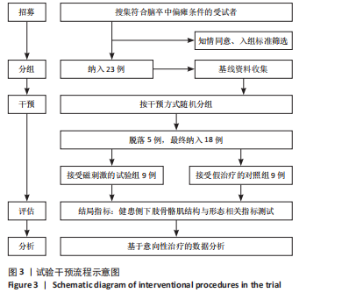
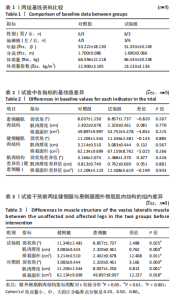
2.1 试验对象数量分析 按照该研究排除标准,该试验中共有5例因事或因病脱组,其中试验组脱落3例,对照组脱离2例,最终18例 (每组各9例)纳入试验数据分析。 2.2 试验干预流程 具体的试验流程示意图,见图3。 2.3 试验对象数量及基础指标分析结果 两组患者年龄、性别、身高、体质量指数及偏瘫侧比较差异无显著性意义 (P > 0.05),有可比性,见表1。各组受试健患侧腿下肢羽状角、肌肉厚度及横截面积的相关指标差异无显著性意义,说明各组受试不同指标所测试水平一致,组间具有可比性,见表2。 通过对试验前两组健侧腿与患侧腿下肢肌肉结构组内t检验分析发现,在试验组中,羽状角、肌肉厚度、横截面积均呈现显著性差异(P < 0.05,见表3)。在对照组中,健侧腿与患侧"

"

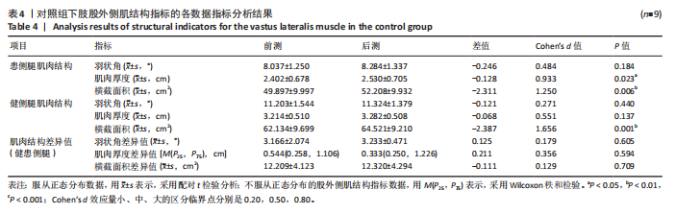
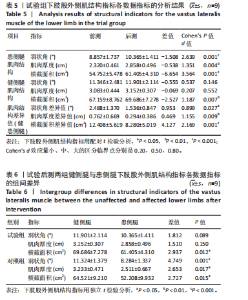
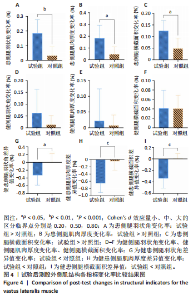
腿的羽状角、肌肉厚度 、横截面积也均呈现显著性差异(P < 0.05,见表3)。 2.4 对照组各数据指标分析结果 通过对试验组试验前测与后测数据各分类指标采集观察发现,患侧腿横截面积 、健侧腿横截面积相比试验前测呈现显著性差异(P < 0.05);患侧腿羽状角、健侧腿羽状角、健患侧腿羽状角差异值、患侧腿肌肉厚度、健侧腿肌肉厚度、健患侧腿肌肉厚度差异值、健患侧腿横截面积差异值试验后测与前测数据差异无显著性意义,见表4。 2.5 试验组各数据指标分析结果 通过对试验组试验前测与后测数据各分类指标采集观察发现,健侧腿羽状角、患侧腿羽状角、羽状角健患侧腿差异值、健侧腿横截面积、患侧腿横截面积 、横截面积健患侧腿差异值、相比试验前测肌肉厚度和肌肉厚度差异值呈现显著性差异(P < 0.05),见表5。 2.6 两组组内股外侧肌结构指标变化率独立样本t检验分析结果 通过对试验后两组健侧腿与患侧腿下肢肌肉结构组内t检验分析发现,试验组中横截面积指标呈现显著性差异(P < 0.05),羽状角、肌肉厚度试差异无显著性意义。对照组中羽状角、肌肉厚度、横截面积指标均呈现显著性差异(P < 0.05),见表6。 通过对试验组与对照组的肌肉结构组内相关指标的提升率对比发现,健患侧腿羽状角差异率的提升率、患侧腿羽状角的提升率、羽状角健患侧腿差异值的提升率、患侧腿肌肉厚度的提升率、肌肉厚度健患侧腿差异值的提升率、患侧腿横截面积的提升率、横截面积健患侧腿差异值的提升率、两组组间数据呈现显著性差异(P < 0.05);健侧腿羽状角、健侧腿肌肉厚度、健侧腿横截面积试验两组组间数据差异无显著性意义,见图4。 2.7 不良反应分析 所有进入结果分析的18例患者在试验过程中均未出现不良反应。"

"

"

"
| [1] SEMINOG OO, SCARBOROUGH P, WRIGHT FL, et al. Determinants of the decline in mortality from acute stroke in England: linked national database study of 795 869 adults. BMJ. 2019;365:l1778. [2] SAYED RKA, HIBBERT J, JORGENSON KW, et al. The structural adaptations that mediate disuse-induced atrophy of skeletal muscle. Cells. 2023;12(24):2811. [3] PRIOR SJ, MCKENZIE MJ, JOSEPH LJ, et al. Reduced skeletal muscle capillarization and glucose intolerance. Microcirculation. 2009;16(3):203-212. [4] SHERBAKOV N, DOEHNER W. Sarcopenia in stroke—facts and numbers on muscle loss accounting for disability after stroke. J Cachexia Sarcopenia Muscle. 2011;2(1):5-8. [5] BALLESTER BR, ANTENUCCI F, MAIER M, et al. Estimating upper-extremity function from kinematics in stroke patients following goal-oriented computer-based training. J Neuroeng Rehabil. 2021;18(1):186. [6] 周永战,陈佩杰,郑莉芳,等.废用性肌萎缩的发生机制及治疗策略[J].中国康复医学杂志, 2017,32(11):1307-1313. [7] SHAO C, WANG Y, GOU H, et al. Strength training of the nonhemiplegic side promotes motor function recovery in patients with stroke: a randomized controlled trial. Arch Phys Med Rehabil. 2023;104(2):188-194. [8] BILLINGER SA, COUGHENOUR E, MACKAY-LYONS MJ, et al. Reduced cardiorespiratory fitness after stroke: biological consequences and exercise-induced adaptations. Stroke Res Treat. 2012;2012:959120. [9] MAJE AU, IBRAHIM AA. Effectiveness of an 8-week overground walking with paretic lower limb loading on spatiotemporal gait parameters and motor function among chronic stroke survivors: a protocol for randomised controlled trial. Trials. 2023;24(1):124. [10] MORRIS SL, DODD KJ, MORRIS ME. Outcomes of progressive resistance strength training following stroke: a systematic review. Clin Rehabil. 2004;18(1):27-39. [11] LI S. Stroke recovery is a journey: prediction and potentials of motor recovery after a stroke from a practical perspective. Life. 2023;13(10):2061. [12] FRANCO-OBREGÓN A, TAI YK, WU KY, et al. The developmental implications of muscle-targeted magnetic mitohormesis: a human health and longevity perspective. Bioengineering. 2023;10(8):956. [13] 李伟,厉中山,白石. TRPC1钙离子通道在骨骼肌收缩功能中的作用及磁诱导激活效应在训练中的应用探索方向[J].体育科技文献通报,2023,31: 257-261. [14] YAP JLY, TAI YK, FRÖHLICH J, et al. Ambient and supplemental magnetic fields promote myogenesis via a TRPC1-mitochondrial axis: evidence of a magnetic mitohormetic mechanism. FASEB J. 2019;33(11):12853-12872. [15] 厉中山,白石,刘洁,等.短期低频脉冲磁场诱导经典瞬时感受器电位通道1对局部肌肉肌力提升后的保持与衰减变化轨迹[J].中国组织工程研究, 2023,27(23):3721-3727. [16] 厉中山,包义君,刘洁,等.低频脉冲磁场诱导TRPC1改善COVID-19患者康复期下肢的肌肉无力症状[J].中国组织工程研究,2024,28(16):2605-2612. [17] 王选强,张文洋,李阳,等.低频脉冲磁场慢性暴露对健康成年股四头肌收缩力及形态的影响[J].中国组织工程研究,2025,29(8):1634-1642. [18] 李文昊,杨玺,杜欣冉,等.磁场线粒体调控技术联合低负荷血流限制对下肢肌群力量的影响[J].中国组织工程研究,2026,30(29):7555-7564. [19] OGAWA M, KAGAYA H, NAGASHIMA Y, et al. Repetitive peripheral magnetic stimulation for strengthening of the suprahyoid muscles: a randomized controlled trial. Neuromodulation. 2020;23(6):778-783. [20] PFEIFER LI, SILVA DBR, FUNAYAMA CAR, et al. Classification of cerebral palsy: association between gender, age, motor type, topography and gross motor function. Arq Neuropsiquiatr. 2009;67(4):1057-1061. [21] SILVA CRS, COSTA ADS, ROCHA T, et al. Quadriceps muscle architecture ultrasonography of individuals with type 2 diabetes: reliability and applicability. PLoS One. 2018;13(10):e0205724. [22] 厉中山,王春露,刘洁,等.短期低频脉冲磁场诱导经典瞬时感受器电位通道1对肱二头肌最大自主收缩力与力量耐力的影响[J].中国组织工程研究, 2023,27(11):1796-1804. [23] PARATE D, FRANCO-OBREGÓN A, FRÖHLICH J, et al. Enhancement of mesenchymal stem cell chondrogenesis with short-term low intensity pulsed electromagnetic fields. Sci Rep. 2017;7(1):9421. [24] TAI YK, NG C, PURNAMAWATI K, et al. Magnetic fields modulate metabolism and gut microbiome in correlation with Pgc-1α expression: follow-up to an in vitro magnetic mitohormetic study. FASEB J. 2020;34(8):11143-11167. [25] SARITAS EU, GOODWILL PW, ZHANG GZ, et al. Magnetostimulation limits in magnetic particle imaging. IEEE Trans Med Imag. 2013;32(9):1600-1610. [26] LEE KL, OH TW, GIL YC, et al. Correlation between muscle architecture and anaerobic power in athletes involved in different sports. Sci Rep. 2021;11(1): 13332. [27] RYAN AS, DOBROVOLNY CL, SMITH GV, et al. Hemiparetic muscle atrophy and increased intramuscular fat in stroke patients. Arch Phys Med Rehabil. 2002; 83(12):1703-1707. [28] GOODE JM, PEAREN MA, TUONG ZK, et al. The nuclear receptor, NOR-1, induces the physiological responses associated with exercise. Mol Endocrinol. 2016;30(6):660-676. [29] YANG J, ROTHERMEL B, VEGA RB, et al. Independent signals control expression of the calcineurin inhibitory proteins MCIP1 and MCIP2 in striated muscles. Circ Res. 2000;87(12):E61-68. [30] YANG J, SUN L, FAN X, et al. Pulsed electromagnetic fields alleviate streptozotocin-induced diabetic muscle atrophy. Mol Med Rep. 2018;18(1):1127-1133. [31] YOSHIKO A, YAMAUCHI K, KATO T, et al. Effects of post-fracture non-weight-bearing immobilization on muscle atrophy, intramuscular and intermuscular adipose tissues in the thigh and calf. Skeletal Radiol. 2018;47(11):1541-1549. [32] LIU C, MCNITT-GRAY JL, FINLEY JM. Impairments in the mechanical effectiveness of reactive balance control strategies during walking in people post-stroke. Front Neurol. 2022;13:1032417. [33] 蒋祥龙,厉中山,车同同.低频脉冲电磁场在肌肉修复与增长中的应用效果和作用机制[J].中国组织工程研究,2026,30(9):2350-2360. [34] TIPPETS TS, HOLLAND WL, SUMMERS SA. Cholesterol - the devil you know; ceramide - the devil you don’t. Trends Pharmacol Sci. 2021;42(12):1082-1095. [35] MEMME JM, SLAVIN M, MORADI N, et al. Mitochondrial bioenergetics and turnover during chronic muscle disuse. Int J Mol Sci. 2021;22(10):5179. [36] LAWLER JM, RODRIGUEZ DA, HORD JM. Mitochondria in the middle: exercise preconditioning protection of striated muscle. J Physiol. 2016;594(18):5161-5183. [37] LOUZADA RA, BOUVIERE J, MATTA LP, et al. Redox signaling in widespread health benefits of exercise. Antioxid Redox Signal. 2020. doi: 10.1089/ars.2019.7949. [38] WONG CJK, TAI YK, YAP JLY, et al. Brief exposure to directionally-specific pulsed electromagnetic fields stimulates extracellular vesicle release and is antagonized by streptomycin: a potential regenerative medicine and food industry paradigm. Biomaterials. 2022;287:121658. [39] PILEGAARD H, SALTIN B, NEUFER PD. Exercise induces transient transcriptional activation of the PGC-1alpha gene in human skeletal muscle. J Physiol. 2003; 546(Pt 3):851-858. [40] WANG FS, WU RW, CHEN YS, et al. Biophysical modulation of the mitochondrial metabolism and redox in bone homeostasis and osteoporosis: how biophysics converts into bioenergetics. Antioxid (Basel). 2021;10(9):1394. [41] VAINSHTEIN A, DESJARDINS EM, ARMANI A, et al. PGC-1α modulates denervation-induced mitophagy in skeletal muscle. Skelet Muscle. 2015;5:9. [42] Konopka AR, Harber MP. Skeletal muscle hypertrophy after aerobic exercise training. Exerc Sport Sci Rev. 2014;42(2):53-61. [43] QI Z, ZHAI X, DING S. How to explain exercise-induced phenotype from molecular data: rethink and reconstruction based on AMPK and mTOR signaling. Springerplus. 2013;2:693. [44] PRADO-MEDEIROS CL, SILVA MP, LESSI GC, et al. Muscle atrophy and functional deficits of knee extensors and flexors in people with chronic stroke. Phys Ther. 2012;92(3):429-439. [45] CALVO JA, DANIELS TG, WANG X, et al. Muscle-specific expression of PPARgamma coactivator-1alpha improves exercise performance and increases peak oxygen uptake. J Appl Physiol. 2008;104(5):1304-1312. [46] HÉNIQUE C, MANSOURI A, VAVROVA E, et al. Increasing mitochondrial muscle fatty acid oxidation induces skeletal muscle remodeling toward an oxidative phenotype. FASEB J. 2015;29(6):2473-2483. [47] SUPRUNIUK E, MIKŁOSZ A, CHABOWSKI A. The implication of PGC-1α on fatty acid transport across plasma and mitochondrial membranes in the insulin sensitive tissues. Front Physiol. 2017;8:923. [48] PEDERSEN BK, FEBBRIO MA. Muscles, exercise and obesity: skeletal muscle as a secretory organ. Nat Rev Endocrinol. 2012;8(8):457-465. [49] GONZALEZ-GIL AM, ELIZONDO-MONTEMAYOR L. The role of exercise in the interplay between myokines, hepatokines, osteokines, adipokines, and modulation of inflammation for energy substrate redistribution and fat mass loss: a review. Nutrients. 2020;12(6):1899. [50] LIU S, CUI F, NING K, et al. Role of irisin in physiology and pathology. Front Endocrinol. 2022;13:962968. [51] MULYA A, KIRWAN JP. Brown and beige adipose tissue: therapy for obesity and its comorbidities? Endocrinol Metab Clin North Am. 2016;45(3):605-621. [52] 厉中山,李文昊,杜欣冉,等.青少年磁性钙调线粒体敏感性:骨骼肌功能及身体成分评估[J].中国组织工程研究,2026,30(25):6496-6505. [53] THYAGARAJAN B, FOSTER MT. Beiging of white adipose tissue as a therapeutic strategy for weight loss in humans. Horm Mol Biol Clin Investig. 2017. doi: 10.1515/hmbci-2017-0016. [54] KRAUSE MP, MILNE KJ, HAWKE TJ. Adiponectin-consideration for its role in skeletal muscle health. Int J Mol Sci. 2019;20(7):1528. [55] WALOWSKI CO, HERPICH C, ENDERLE J, et al. Determinants of bone mass in older adults with normal- and overweight derived from the crosstalk with muscle and adipose tissue. Sci Rep. 2023;13(1):5030. [56] PARATE D, KADIR ND, CELIK C, et al. Pulsed electromagnetic fields potentiate the paracrine function of mesenchymal stem cells for cartilage regeneration. Stem Cell Res Ther. 2020;11(1):46. [57] 傅勤慧,裴建,佳奇,等.针刺治疗脑卒中后偏瘫的临床转化研究方案[J].中西医结合学报,2012,10(5):516-524. [58] TOK F, OZÇAKAR L, SAFAZ I, et al. Effects of botulinum toxin-a on the muscle architecture of stroke patients: the first ultrasonographic study. J Rehabil Med. 2011;43(11):1016-1019. [59] BODINE SC, STITT TN, GONZALEZ M, et al. Akt/mTOR pathway is a crucial regulator of skeletal muscle hypertrophy and can prevent muscle atrophy in vivo. Nat Cell Biol. 2001;3(11):1014-1019. [60] YOON MS. mTOR as a key regulator in maintaining skeletal muscle mass. Front Physiol. 2017;8:788. [61] SCHIAFFINO S, REGGIANI C, AKIMOTO T, et al. Molecular mechanisms of skeletal muscle hypertrophy. J Neuromuscul Dis. 2021;8(2):169-183. [62] ZANOU N, SCHAKMAN O, LOUIS P, et al. Trpc1 ion channel modulates phosphatidylinositol 3-kinase/Akt pathway during myoblast differentiation and muscle regeneration. J Biol Chem. 2012;287(18):14524-14534. [63] MA R, RUNDLE D, JACKS J, et al. Inhibitor of myogenic family, a novel suppressor of store-operated currents through an interaction with TRPC1. J Biol Chem. 2003;278(52):52763-52772. |
| [1] | Wang Zheng, Cheng Ji, Yu Jinlong, Liu Wenhong, Wang Zhaohong, Zhou Luxing. Progress and future perspectives on the application of hydrogel materials in stroke therapy [J]. Chinese Journal of Tissue Engineering Research, 2026, 30(8): 2081-2090. |
| [2] | Gao Feng, Zhang Jun, Yu Wenjun, Chanyu Yujing, Zhao Le, Hu Yuting, Wang Junhua, Liu Yongfu. Effects of wrist-hand orthosis on hand dysfunction in stroke patients: a meta-analysis [J]. Chinese Journal of Tissue Engineering Research, 2026, 30(8): 2124-2131. |
| [3] | Tao Daiju, Su Haiyu, Wang Yuqi, Shen Zhiqiang, He Bo . Construction and identification of stable PC12 cell lines with high/low expression of miR-122-5p [J]. Chinese Journal of Tissue Engineering Research, 2026, 30(7): 1790-1799. |
| [4] | Yang Yuanyuan, Zhou Shanshan, Cheng Xiaofei, Feng Luye, Tang Jiqin. Network meta-analysis of non-invasive brain stimulation in the treatment of lower limb motor dysfunction after stroke [J]. Chinese Journal of Tissue Engineering Research, 2026, 30(4): 1008-1018. |
| [5] | Huang Yunshi, Chai Linsong, Ni Jinglei, Zuo Shuang, Lin Bingbing, Huang Jia. Development and evaluation of a prediction model for functional language communication outcomes in post-stroke aphasia patients [J]. Chinese Journal of Tissue Engineering Research, 2026, 30(36): 9604-9612. |
| [6] | Yang Jiao, Wang Zhifeng, Shi Ting, Xu Shuangfeng, Tian Daman, Lan Junfeng, He Pengfen, Hao Zhihui, Pan Pan, Wang Jian. Electroacupuncture regulates mitochondrial copper homeostasis to modulate neuroinflammatory injury in rats with ischemic stroke [J]. Chinese Journal of Tissue Engineering Research, 2026, 30(36): 9519-9525. |
| [7] | Su Xu, Zhang Xiaoxi, Yang Yaqing, Fu Zhenyi, Liu Jiaxin. Mechanism by which non-apoptotic regulated cell death induces neuronal injury in ischemic stroke [J]. Chinese Journal of Tissue Engineering Research, 2026, 30(35): 9281-9293. |
| [8] | Wang Xiaojing, Wei Jingyi, Liu Xihua. A visualized analysis of vagus nerve stimulation in the field of stroke rehabilitation [J]. Chinese Journal of Tissue Engineering Research, 2026, 30(35): 9316-9326. |
| [9] | Sun Shiqiang, Bai Shi, Li Wenhao, Wang Youpeng, Du Xinran, Zhang Hao, Li Zhongshan. Exercise combined with magnetic stimulation improves muscle strength and gait speed in patients with disuse-induced muscle atrophy of the lower limbs [J]. Chinese Journal of Tissue Engineering Research, 2026, 30(35): 9189-9197. |
| [10] | . Regional specificity of brain organoids and their application in ischemic stroke modeling and drug development [J]. Chinese Journal of Tissue Engineering Research, 2026, 30(34): 9008-9016. |
| [11] | Tang Ya, Li Long, Huang Du, Huang Zhaolu. Systematic review of the effect of 3D-printed exoskeleton on hand function rehabilitation in stroke patients [J]. Chinese Journal of Tissue Engineering Research, 2026, 30(29): 7648-7653. |
| [12] | Wang Xueting, Yang Wei, Wang Pengqin. Post-stroke rehabilitation robotics: current research status and hot topics in and outside China [J]. Chinese Journal of Tissue Engineering Research, 2026, 30(28): 7404-7409. |
| [13] | Li Sihui, Wang Qin, Cui Shenhong, Cheng Xiaofei, Feng Ziyun, Wang Dehua, Liang Chunting, Leng Jun. A network meta-analysis of effects of non-invasive neuromodulation techniques on language function in patients with aphasia after stroke [J]. Chinese Journal of Tissue Engineering Research, 2026, 30(28): 7485-7493. |
| [14] | Fan Mengmeng, Ding Jiali, Wan Yujie, Huang Hailiang. A systematic review and network meta-analysis of neuromodulation techniques for promoting upper limb motor function after stroke [J]. Chinese Journal of Tissue Engineering Research, 2026, 30(28): 7494-7504. |
| [15] | Ren Pengbo, Li Tingwen, Cai Feng, Zhang Jianhua. Low-frequency repetitive transcranial magnetic stimulation improves limb motor function and upper limb muscles in stroke patients: a meta-analysis [J]. Chinese Journal of Tissue Engineering Research, 2026, 30(27): 7176-7181. |
| Viewed | ||||||
|
Full text |
|
|||||
|
Abstract |
|
|||||