Chinese Journal of Tissue Engineering Research ›› 2018, Vol. 22 ›› Issue (7): 985-990.doi: 10.3969/j.issn.2095-4344.0106
Dynamic simulation of the edge load caused by the separation of the ceramic cup and femoral head
Feng Li, Wang Jun-yuan, Liu Feng, Cheng Bo
- School of Mechanical Engineering, North University of China, Taiyuan 030051, Shanxi Province, China
-
Online:2018-03-08Published:2018-03-08 -
Contact:Liu Feng, Professor, School of Mechanical Engineering, North University of China, Taiyuan 030051, Shanxi Province, China -
About author:Feng Li, Master, School of Mechanical Engineering, North University of China, Taiyuan 030051, Shanxi Province, China -
Supported by:the National Natural Science Foundation of China, No. 21604074

CLC Number:
Cite this article
Feng Li, Wang Jun-yuan, Liu Feng, Cheng Bo. Dynamic simulation of the edge load caused by the separation of the ceramic cup and femoral head [J]. Chinese Journal of Tissue Engineering Research, 2018, 22(7): 985-990.
share this article
Add to citation manager EndNote|Reference Manager|ProCite|BibTeX|RefWorks
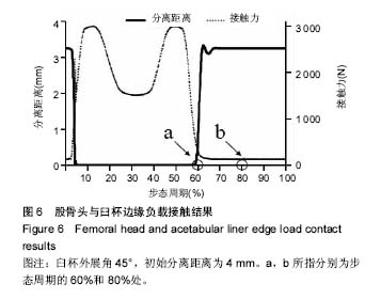
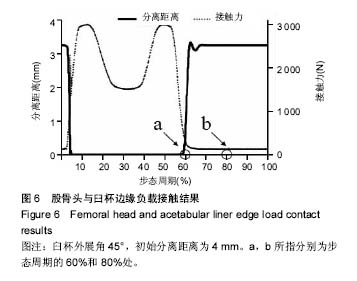
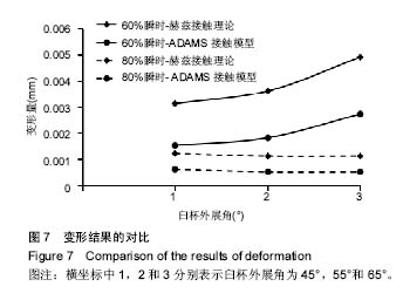
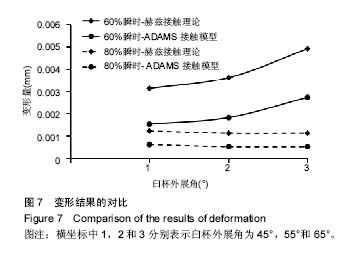
2.1 步态条件下股骨头-臼杯动态分离及边缘接触力 在图6中,初始分离距离代表手术安装位置误差(如图1A)。图6所示为动态仿真下股骨头与臼杯分离距离和接触力在一个稳定周期内的变化结果。当分离距离为0 mm时(髋关节负重阶段),股骨头在臼杯内部接触,接触力大小以及变化趋势与外载荷一致,接触力的两次峰值为3 000 N,与外载相同。当动态分离距离大于0 mm时(摆动阶段),外载荷迅速减小,股骨头与臼杯开始分离,产生边缘接触,当初始分离距离为4 mm时,产生的最大动态分离距离为3.4 mm。结果还显示,当人体脚后跟着地时,股骨头将从臼杯的边缘快速滑进臼窝中(在循环周期的3%-5%),该过程中接触力值快速增大,说明当股骨头从边缘滑进臼窝时,臼杯边缘容易产生应力集中。同时说明了条纹磨损的形成以及高磨损量的产生与股骨头与臼杯的边缘接触密切相关,且其主要发生在股骨头从臼杯边缘快速回到臼窝的过程中。减少股骨头与臼杯之间的边缘接触现象,可以减少接触力在臼杯边缘的集中,对假体起到一定的保护作用。 2.2 臼杯边缘接触变形验证 选取步态周期的60%(0.6 s)和80%处(0.8 s)(图6a,b分别选取了股骨头与臼杯发生边缘接触的两个瞬时位置的变形)来计算变形,图7为对比结果。如图7所示,在步态周期60%处,随着臼杯外展角的增加,赫兹接触与ADAMS接触模型所计算的臼杯边缘变形都在增大,而在步态周期80%处,随着臼杯外展角的增加,臼杯边缘变形都在减小,在不同外展角和不同接触瞬时,仿真模型与理论模型的计算值呈现出一致的变化趋势。该验证结果表明,仿真模型中的接触刚度系数设置较好地反映了理论模型的结果。"
"
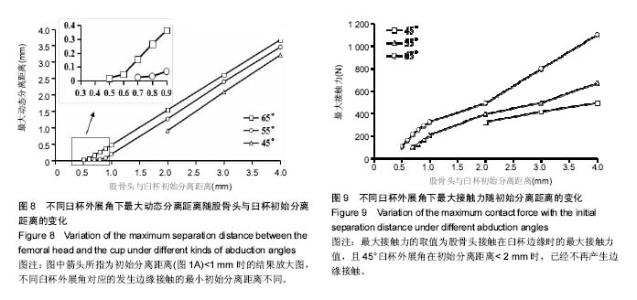
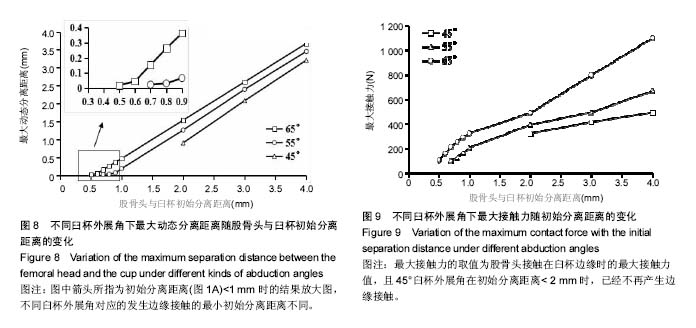
2.3 臼杯外展角和初始分离距离对边缘负载接触的影响 图8中,随着股骨头与臼杯初始分离距离的增加,最大动态分离距离呈线性增加的趋势,最大动态分离距离均小于初始分离距离。对于一个给定的初始分离距离,最大动态分离距离随着臼杯外展角的增大而增加。对于45°臼杯外展角,当初始分离距离< 2 mm时,股骨头与臼杯不产生边缘接触。当臼杯外展角增加到55°与65°时,产生边缘接触的最小初始分离距离分别为0.7 mm和0.5 mm。上述结果说明臼杯外展角和初始分离距离是影响边缘接触的两个重要因素。 图9中,臼杯边缘产生的最大接触力随股骨头与臼杯初始分离距离增加而增大,对于一个给定的初始分离距离,最大接触力随臼杯外展角增加而增大。对于45°臼杯外展角,2-4 mm的初始分离距离,产生的边缘最大接触力为300-400 N。当臼杯外展角为55°时,对应初始分离距离0.7-4 mm,边缘最大接触力为100-600 N。当臼杯外展角增加到65°时,对应初始分离距离0.5-4 mm,边缘最大接触力为100-1 100 N。 "
| [1] 戴尅戎. 金属对金属人工髋关节假体的昔与今[A]. 中华医学会、中华医学会骨科学分会、中国工程院医药卫生学部.中华医学会第十二届骨科学术会议暨第五届COA国际学术大会教程汇编[C].中华医学会、中华医学会骨科学分会、中国工程院医药卫生学部,2010:2.[2] Martin Ihle, Sabine Mai,Werner E.Siebert,等. 陶瓷球头和金属球头配伍聚乙烯臼杯的20年长期对比磨损研究[J].中华关节外科,2010 ,4 (3) :63-65[3] 程倩,王慧妍,田波,等.非球面人工髋关节接触力学[J].医用生物力学, 2012,27(5):534-541. [4] Komistek R, Dennis D, Ochoa J, et al. In vivo comparison of hip separation after metal-on-metal or metal-on-polyethylene total hip arthroplasty. J Bone Jt Surg Am. 2002;84-A (10):1836-1841.[5] Lombardi A, Mallory T, Dennis D, et al. An in vivo determination of total hip arthroplasty pistoning during activity. J Arthroplasty. 2000;15(6):702-709.[6] 程倩,王元培,田波,等.金属对金属髋关节动态边缘接触力学行为[J].医用生物力学,2012,27(2):186-191.[7] 程倩,田波,王元培.等.金属对金属人工髋关节边缘接触效应[J] .医用生物力学,2011,26(6):508-513.[8] Brodner W, Grubl A, Jankovsky R, et al.Cup inclination and serum concentration of cobalt and chromium after metal-on-metal total hip arthroplasty. J Arthroplasty. 2004;19:66-70.[9] O'Dwyer Lancaster-Jones O. The combined effect of head and cup centres mismatch and different cup inclination angles on the occurrence and severity of edge loading and wear in hip replacement. Orthopaedic Research Society. Orlando,USA, 2016.[10] Mak MM, Besong AA, Jin ZM, et al. Effect of microseparation on contact mechanics in ceramic-on-ceramic hip joint replacements. Proc Inst Mech Eng H. 2002;216(6):403-408.[11] Liu F, Williams S, Fisher J. Effect of microseparation on contact mechanics in metal-on-metal hip replacements—A finite element analysis.J Biomed Mater Res Part B. 2015;103(6):1312.[12] Mak M, Jin Z, Fisher J, et al. Influence of acetabular cup rim design on the contact stress during edge loading in ceramic-on-ceramic hip prostheses. J Arthroplasty. 2011;26(1):131-136.[13] Dennis DA, Komistek RD, Northcut EJ, et al. In vivo determination of hip joint separation and the forces generated due to impact loading conditions.J Biomech. 2001;34 (5):623-629.[14] Lombardi AV Jr, Mallory TH, Dennis DA, et al. An in vivo determination of total hip arthroplasty pistoning during activity. J Arthroplasty. 2000; 15 (6):702-709.[15] Nevelos J, Ingham C, Doyle R, et al. Micro-separation of the centers of alumina–alumina artificial hip joints during simulator testing produces clinically relevant wear rates and patterns. J Arthroplasty. 2000;15(6): 793-795.[16] Fisher J. Bioengineering reasons for the failure of metal-on-metal hip prostheses: An engineer’s perspective. J Bone Joint Surg Br. 2011;93: 1001-1004.[17] 周海,季文婷,增祥森,等.髋关节假体脱位与日常行为关系[J]上海交通大学学报,2012, 46(11) :1857-1861.[18] Hua X, Hi J,Wang L,et al.Contact mechanics of modular metal-on-polyethylene total hip replacement under adverse edge loading conditions.J Biomech. 2014;47(13) :3303.[19] Al-Hajjar M, Fisher J, Williams S, et al. Effect of femoral head size on the wear of metal on metal bearings in total hip replacements under adverse edge-loading conditions. J Biomed Mater Res B Appl Biomater. 2013;101(2):213-222.[20] Williams S, Butterfield M, Stewart T, et al. Wear and deformation of ceramic-on-polyethylene total hip replacements with joint laxity and swing phase microseparation. Proc Inst Mech Eng [H]. 2003;217:147-153.[21] Al-Hajjar M, Fisher J, Tipper J, et al. Wear of 36-mm BIOLOX® delta ceramic-on-ceramic bearing in total hip replacements under edge loading conditions. Proc Inst Mech Eng H. 2013;227(5):535-542. [22] Al-Hajjar M, Leslie IJ, Tipper J, et al. Effect of cup inclination angle during microseparation and rim loading on the wear of BIOLOX(R) delta ceramic-on-ceramic total hip replacement. J Biomed Mater Res B Appl Biomater. 2010; 95(2): 263-268.[23] Leslie I, Williams S, Isaac G, et al. High cup angle and microseparation increase the wear of hip surface replacements. Clin Orthop Relat Res. 2009; 467: 2259-2265.[24] Hart AJ, Muirhead-Allwood S, Porter M, et al. Which factors determine the wear rate of large-diameter metal-on-metal hip replacements? J Bone Joint Surg Am. 2013; 95A: 678-685.[25] Stewart T, Tipper J, Insley G, et al. Severe wear and fracture of zirconia heads against alumina inserts in hip simulator studies with micro-separation. J Arthroplasty.2003;18(6): 726-734.[26] Stewart T, Williams S, Tipper J, et al. Advances in simulator testing of orthopaedic joint prostheses. Tribol Res Des Eng Syst. 2003;291-296.[27] Sariali E, Stewart T, Jin Z, et al.Three-dimensional modeling of in vitro hip kinematics under micro-separation regime for ceramic on ceramic total hip prosthesis:An analysis of vibration and noise. J Biomech. 2010;43(2):326-333.[28] Leng J, Al-Hajjar M, Wilcox R, et al. Dynamic virtual simulation of the occurrence and severity of edge loading in hip replacements associated with variation in the rotational and translational surgical position. Proc Inst Mech Eng H. 2017;231(4):299-306.[29] 谢龙汉,蔡明京,苏延全,等.SolidWorks2013三维设计全解视频讲解[M].北京:电子工业出版社,2013:1-167.[30] Al Hajjar M. Wear of hard-on-hard hip prostheses:influence of head size ,surgical position,material and function.Leeds UK,2012.[31] ISO14242-1Implants for surgery-wear of total hip-joint prostheses-Part1:Loading and displacement parameters for wear-testing machines and corresponding environmental conditions for test. ISO 14242-1:2012.[32] 裴未迟,李耀刚,李运红.基于虚拟样机技术-ADAMS的冲击力模型[J].河北理工大学学报,2008,30(4):59-63.[33] 李增刚.ADAMS入门详解与实例[M].北京:国防工业出版社,2014: 126-130.[34] Boer A, Ellenbroek MHM, Hemmes HK, et al.Contact mechanics in MSC Adams - A technical evaluation of the contact models in multibody dynamics software MSC Adams. Twente, 2011. [35] Johnson K. Contact Mechanics. Cambridge University Press, Cambridge, 1985.[36] Sanders AP, Brannon RM. Assessment of the applicability of the Hertzian Contact theory to edge-loaded prosthetic hip bearings. J Biomech. 2011;44(16):2802-2808.[37] Antoine JF, Visa C, Abba G. Approximate analytical model for hertzian elliptical contact problem. Ttibol Int. 2006;128(3):660-664. |
| [1] | Zhang Tongtong, Wang Zhonghua, Wen Jie, Song Yuxin, Liu Lin. Application of three-dimensional printing model in surgical resection and reconstruction of cervical tumor [J]. Chinese Journal of Tissue Engineering Research, 2021, 25(9): 1335-1339. |
| [2] | Zhang Chao, Lü Xin. Heterotopic ossification after acetabular fracture fixation: risk factors, prevention and treatment progress [J]. Chinese Journal of Tissue Engineering Research, 2021, 25(9): 1434-1439. |
| [3] | Chen Junming, Yue Chen, He Peilin, Zhang Juntao, Sun Moyuan, Liu Youwen. Hip arthroplasty versus proximal femoral nail antirotation for intertrochanteric fractures in older adults: a meta-analysis [J]. Chinese Journal of Tissue Engineering Research, 2021, 25(9): 1452-1457. |
| [4] | Zeng Yanhua, Hao Yanlei. In vitro culture and purification of Schwann cells: a systematic review [J]. Chinese Journal of Tissue Engineering Research, 2021, 25(7): 1135-1141. |
| [5] | Xu Dongzi, Zhang Ting, Ouyang Zhaolian. The global competitive situation of cardiac tissue engineering based on patent analysis [J]. Chinese Journal of Tissue Engineering Research, 2021, 25(5): 807-812. |
| [6] | Wu Zijian, Hu Zhaoduan, Xie Youqiong, Wang Feng, Li Jia, Li Bocun, Cai Guowei, Peng Rui. Three-dimensional printing technology and bone tissue engineering research: literature metrology and visual analysis of research hotspots [J]. Chinese Journal of Tissue Engineering Research, 2021, 25(4): 564-569. |
| [7] | Chang Wenliao, Zhao Jie, Sun Xiaoliang, Wang Kun, Wu Guofeng, Zhou Jian, Li Shuxiang, Sun Han. Material selection, theoretical design and biomimetic function of artificial periosteum [J]. Chinese Journal of Tissue Engineering Research, 2021, 25(4): 600-606. |
| [8] | Liu Fei, Cui Yutao, Liu He. Advantages and problems of local antibiotic delivery system in the treatment of osteomyelitis [J]. Chinese Journal of Tissue Engineering Research, 2021, 25(4): 614-620. |
| [9] | Li Xiaozhuang, Duan Hao, Wang Weizhou, Tang Zhihong, Wang Yanghao, He Fei. Application of bone tissue engineering materials in the treatment of bone defect diseases in vivo [J]. Chinese Journal of Tissue Engineering Research, 2021, 25(4): 626-631. |
| [10] | Zhang Zhenkun, Li Zhe, Li Ya, Wang Yingying, Wang Yaping, Zhou Xinkui, Ma Shanshan, Guan Fangxia. Application of alginate based hydrogels/dressings in wound healing: sustained, dynamic and sequential release [J]. Chinese Journal of Tissue Engineering Research, 2021, 25(4): 638-643. |
| [11] | Chen Jiana, Qiu Yanling, Nie Minhai, Liu Xuqian. Tissue engineering scaffolds in repairing oral and maxillofacial soft tissue defects [J]. Chinese Journal of Tissue Engineering Research, 2021, 25(4): 644-650. |
| [12] | Chen Lu, Zhang Jianguang, Deng Changgong, Yan Caiping, Zhang Wei, Zhang Yuan. Finite element analysis of locking screw assisted acetabular cup fixation [J]. Chinese Journal of Tissue Engineering Research, 2021, 25(3): 356-361. |
| [13] | Fan Yinuo, Guan Zhiying, Li Weifeng, Chen Lixin, Wei Qiushi, He Wei, Chen Zhenqiu. Research status and development trend of bibliometrics and visualization analysis in the assessment of femoroacetabular impingement [J]. Chinese Journal of Tissue Engineering Research, 2021, 25(3): 414-419. |
| [14] | Xing Hao, Zhang Yonghong, Wang Dong. Advantages and disadvantages of repairing large-segment bone defect [J]. Chinese Journal of Tissue Engineering Research, 2021, 25(3): 426-430. |
| [15] | Cheng Chongjie, Yan Yan, Zhang Qidong, Guo Wanshou. Diagnostic value and accuracy of D-dimer in periprosthetic joint infection: a systematic review and meta-analysis [J]. Chinese Journal of Tissue Engineering Research, 2021, 25(24): 3921-3928. |
| Viewed | ||||||
|
Full text |
|
|||||
|
Abstract |
|
|||||