中国组织工程研究 ›› 2026, Vol. 30 ›› Issue (35): 9113-9119.doi: 10.12307/2026.430

• 骨组织构建 bone tissue construction •    下一篇

积雪草苷促进骨质疏松大鼠的成骨分化

徐洪涛1,王建平1,徐月红2,李  琴3,漆启华4,夏琪鹏1   

  1. 鹰潭市人民医院,1骨科,2护理部,江西省鹰潭市   335000;3鹰潭市中医院药剂科,江西省鹰潭市   335000;4南昌大学第一附属医院骨科,江西省南昌市   330000
  • 收稿日期:2025-10-16 修回日期:2026-01-10 出版日期:2026-12-18 发布日期:2026-04-24
  • 通讯作者: 王建平,主任医师,鹰潭市人民医院骨科,江西省鹰潭市 335000
  • 作者简介:徐洪涛,男,1988年生,江西省上饶市人,汉族,主治中医师,主要从事骨科临床研究。
  • 基金资助:
    江西省鹰潭市科技计划项目(2022SYD002),项目负责人:王建平

Asiaticoside promotes osteogenic differentiation in osteoporotic rats

Xu Hongtao1, Wang Jianping1, Xu Yuehong2, Li Qin3, Qi Qihua4, Xia Qipeng1   

  1. 1Department of Orthopedics, 2Department of Nursing, Yingtan People’s Hospital, Yingtan 335000, Jiangxi Province, China; 3Department of Pharmacy, Yingtan Hospital of Traditional Chinese Medicine, Yingtan 335000, Jiangxi Province, China; 4Department of Orthopedics, The First Affiliated Hospital of Nanchang University, Nanchang 330000, Jiangxi Province, China
  • Received:2025-10-16 Revised:2026-01-10 Online:2026-12-18 Published:2026-04-24
  • Contact: Wang Jianping, Chief physician, Department of Orthopedics, Yingtan People’s Hospital, Yingtan 335000, Jiangxi Province, China
  • About author:Xu Hongtao, Attending physician, Department of Orthopedics, Yingtan People’s Hospital, Yingtan 335000, Jiangxi Province, China
  • Supported by:
    Science and Technology Program Project of Yingtan City, Jiangxi Province, No. 2022SYD002 (to WJP) 

摘要:


文题释义:
NLRP3:由一个氨基末端Pyrin结构域、一个中央核苷酸结合和寡聚化结构域和一个C端富含亮氨酸重复序列结构域组成,与宿主对细菌、真菌和病毒感染的免疫防御至关重要,与炎症性疾病的发病机制有关。
积雪草苷:是一种从积雪草中提取的三萜类衍生物,具有广泛的药理活性,包括血管生成、抗炎、成骨分化和神经保护。近年来发现积雪草苷对细胞成骨分化具有积极影响,可能在骨质疏松治疗中发挥作用。

背景:研究表明,积雪草苷具有抗炎、抗氧化等多种药理功能,对细胞成骨分化具有积极影响,可能成为治疗骨质疏松的潜在药物。
目的:探讨积雪草苷对骨质疏松大鼠成骨分化的影响。
方法:①切除52只雌性SD大鼠双侧卵巢建立骨质疏松模型,同时切除10只雌性SD大鼠双侧卵巢附近等体积脂肪组织作为假手术组。造模8周后,将造模成功的50只大鼠随机分为5组干预:模型组(n=10)灌胃给予生理盐水,积雪草苷低剂量组(n=10)灌胃给予积雪草苷16 mg/(kg·d),积雪草苷高剂量组(n=10)灌胃给予积雪草苷32 mg/(kg·d),阳性药组(n=10)灌胃给予阿仑膦酸钠片7.35 mg/(kg·d),积雪草苷高剂量+激活剂组(n=10)同时灌胃给予32 mg/(kg·d)+NLRP3激活剂300 mg/(kg·d),1次/d,连续给药6周。给药结束后取材,检测血清中白细胞介素1β、白细胞介素18水平,Micro-CT扫描股骨远端,苏木精-伊红染色观察股骨组织学形态变化,免疫印迹检测股骨中三基序蛋白24、NLRP3、cleaved caspase-1蛋白表达。②将对数生长期的大鼠骨髓间充质干细胞分4组处理:空白组不进行任何处理,积雪草苷组加入20 µmol/L 积雪草苷处理48 h,积雪草苷+空载体组空载体质粒转染48 h后加入20 µmol/L 积雪草苷处理48 h,积雪草苷+NLRP3过表达组NLRP3过表达质粒转染48 h后加入20 µmol/L 积雪草苷处理48 h。成骨诱导分化7 d后,检测碱性磷酸酶活性与骨桥蛋白、骨钙蛋白、三基序蛋白24、NLRP3 mRNA表达。
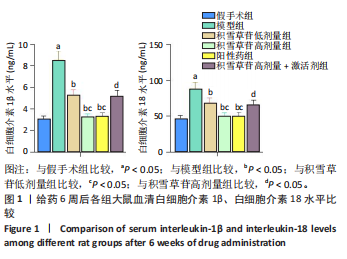
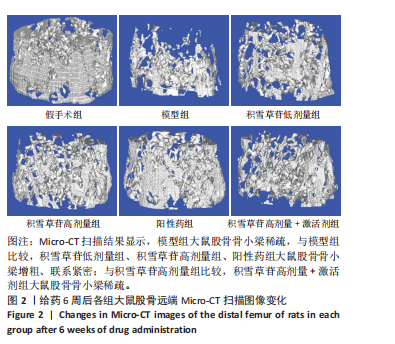
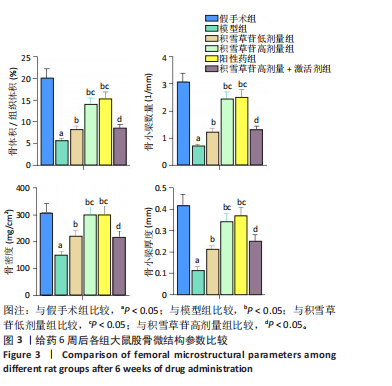
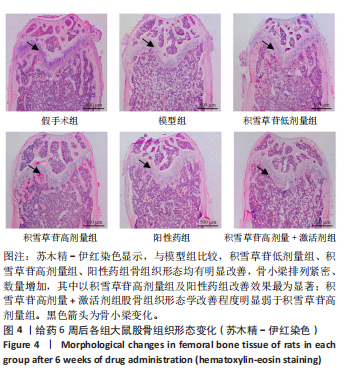
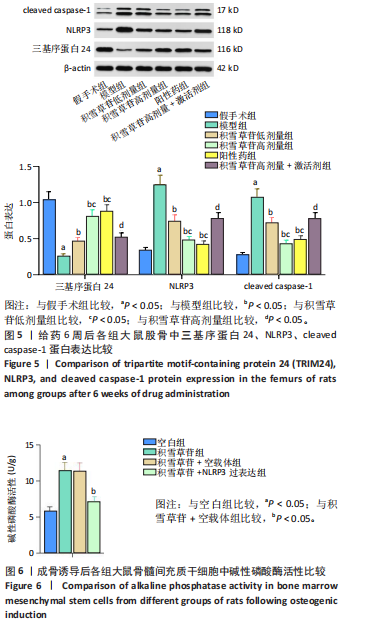
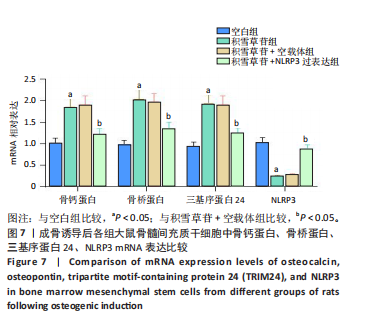
结果与结论:①动物实验:积雪草苷低剂量组、积雪草苷高剂量组、阳性药组白细胞介素1β、白细胞介素18水平均低于模型组(P < 0.05),积雪草苷高剂量+激活剂组白细胞介素1β、白细胞介素18水平高于积雪草苷高剂量组(P < 0.05)。Micro-CT扫描与苏木精-伊红染色结果显示,相较于模型组,积雪草苷低剂量组、积雪草苷高剂量组、阳性药组股骨微结构与组织学形态明显改善,而NLRP3激活剂可部分抑制高剂量积雪草苷的作用效果。与模型组比较,积雪草苷低剂量组、积雪草苷高剂量组、阳性药组三基序蛋白24蛋白表达升高(P < 0.05),NLRP3、cleaved caspase-1蛋白表达降低(P < 0.05);积雪草苷高剂量+激活剂组三基序蛋白24蛋白表达低于积雪草苷高剂量组(P < 0.05),NLRP3、cleaved caspase-1蛋白高于积雪草苷高剂量组(P < 0.05)。②细胞实验:积雪草苷组碱性磷酸酶活性高于空白组、积雪草苷+NLRP3过表达组(P < 0.05)。RT-PCR检测显示,积雪草苷组骨桥蛋白、骨钙蛋白、三基序蛋白24 mRNA表达高于空白组、积雪草苷+NLRP3过表达组(P < 0.05),NLRP3 mRNA表达低于空白组、积雪草苷+NLRP3过表达组(P < 0.05)。③结果表明:积雪草苷可能通过上调三基序蛋白24表达、抑制NLRP3表达促进骨质疏松大鼠的成骨分化,延缓骨质疏松的发展。
https://orcid.org/0009-0008-3364-6672 (徐洪涛) 


中国组织工程研究杂志出版内容重点:干细胞;骨髓干细胞;造血干细胞;脂肪干细胞;肿瘤干细胞;胚胎干细胞;脐带脐血干细胞;干细胞诱导;干细胞分化;组织工程

关键词: 积雪草苷, 骨质疏松, 成骨分化, 三基序蛋白24, NLRP3, 骨髓间充质干细胞, 股骨, 组织构建

Abstract: BACKGROUND: Studies have indicated that asiaticoside possesses multiple pharmacological functions, including anti-inflammatory and antioxidant properties, and exerts a positive effect on osteogenic differentiation. It may serve as a potential therapeutic agent for osteoporosis.
OBJECTIVE: To investigate the effects of asiaticoside on osteogenic differentiation in osteoporotic rats. 
METHODS: (1) Animal models of osteoporosis were established by removing both ovaries in 52 female Sprague-Dawley rats. Simultaneously, equivalent volumes of adipose tissue near the ovaries were removed bilaterally from 10 female Sprague-Dawley rats as the sham operation group. At 8 weeks after modeling, 50 model rats were randomly divided into five intervention groups: model group (n=10) was administered saline via oral gavage; low-dose asiaticoside group (n=10) was administered 16 mg/(kg·d) asiaticoside via oral gavage; high-dose asiaticoside group (n=10) was administered 32 mg/(kg·d) asiaticoside via oral gavage; positive control group (n=10) was subjected to oral administration of sodium alendronate tablets at 7.35 mg/(kg·d); and high-dose asiaticoside + activator group (n=10) received concurrent oral administration of 32 mg/(kg·d) asiaticoside + 300 mg/(kg·d) NLRP3 activator, once daily for 6 consecutive weeks. After drug administration, tissue samples were collected. Serum levels of interleukin-1β and interleukin-18 were measured. Micro-CT scans were performed on the distal femur. Hematoxylin-eosin staining was used to observe histological changes in the femur. Western blot assay was conducted to detect the expression of tripartite motif-containing protein 24 (TRIM24), NLRP3, and cleaved caspase-1 in the femur. (2) Rat bone marrow mesenchymal stem cells at the logarithmic growth stage were divided into four groups: blank group with no treatment, asiaticoside group treated with 20 µmol/L asiaticoside, asiaticoside+empty carrier group treated with 20 µmol/L asiaticoside for 48 hours after transfection with the empty vector plasmid for 48 hours, and asiaticoside+NLRP3 overexpression group treated with 20 µmol/L asiaticoside for 48 hours after transfection with the NLRP3 overexpression plasmid for 48 hours. After 7 days of inducing osteogenic differentiation, the activity of alkaline phosphatase and mRNA expression of osteopontin, osteocalcin, TRIM24, and NLRP3 were detected. 
RESULTS AND CONCLUSION: (1) Animal experiment: The levels of interleukin-1β and interleukin-18 in the low-dose asiaticoside group, high-dose asiaticoside group, and positive control group were all lower than those in the model group (P < 0.05). The levels of interleukin-1β and interleukin-18 in the high-dose asiaticoside + activator group were higher than those in the high-dose asiaticoside group (P < 0.05). Micro-CT scans and hematoxylin-eosin staining revealed that compared with the model group, the microstructure and histomorphology of the femur were significantly improved in the low-dose and high-dose asiaticoside groups as well as in the positive control group. However, NLRP3 activator partially inhibited the effects of high-dose asiaticoside. Compared with the model group, the low-dose asiaticoside group, high-dose asiaticoside group, and positive control group showed increased expression of TRIM24 protein (P < 0.05) and decreased expression of NLRP3 and cleaved caspase-1 protein (P < 0.05). Compared with the high-dose asiaticoside group, the high-dose asiaticoside + activator group showed lower protein expression of TRIM24 (P < 0.05), but higher protein expression of NLRP3 and cleaved caspase-1 (P < 0.05). (2) Cell experiment: The alkaline phosphatase activity in the asiaticoside group was higher than that in the blank group and the asiaticoside + NLRP3 overexpression group (P < 0.05). RT-PCR revealed that the asiaticoside group showed higher mRNA expression levels of osteopontin, osteocalcin, and TRIM24 but lower NLRP3 mRNA expression compared with the control group and the asiaticoside + NLRP3 overexpression group (all P < 0.05). To conclude, asiaticoside may promote osteogenic differentiation of bone marrow mesenchymal stem cells and delay osteoporosis progression in osteoporotic rats by upregulating TRIM24 and inhibiting NLRP3 expression.


Key words: asiaticoside, osteoporosis, osteogenic differentiation, tripartite motif-containing protein 24, NLRP3, bone marrow mesenchymal stem cells, femur, tissue construction

中图分类号: