Chinese Journal of Tissue Engineering Research ›› 2026, Vol. 30 ›› Issue (19): 4972-4982.doi: 10.12307/2026.793
Previous Articles Next Articles
Rutin promotes osteogenic differentiation of MC3T3-E1 cells: regulating the formation of neutrophil extracellular traps
Li Jie1, Liu Yang2, Wang Dayu3, Wan Qiang3, Zhu Jiayi3, Feng Wenjun1, Chen Jinlun1, Jie Ke4, Huang Yiwei5, Xin Pengfei6, Zeng Jianchun1, Zeng Yirong1, Zhang Haitao1
- 1The First Affiliated Hospital of Guangzhou University of Chinese Medicine, Guangzhou 510405, Guangdong Province, China; 2Fudan University, Shanghai 200433, China; 3Guangzhou University of Chinese Medicine, Guangzhou 510405, Guangdong Province, China; 4Foshan Hospital of Traditional Chinese Medicine, Foshan 528000, Guangdong Province, China; 5Zhongshan Hospital of Traditional Chinese Medicine, Zhongshan 528400, Guangdong Province, China; 6Guanghua Hospital Affiliated to Shanghai University of Traditional Chinese Medicine, Shanghai 200052, China
-
Received:2025-08-09Accepted:2025-12-24Online:2026-07-08Published:2026-02-24 -
Contact:Zhang Haitao, MD, Physician, The First Affiliated Hospital of Guangzhou University of Chinese Medicine, Guangzhou 510405, Guangdong Province, China; Co-corresponding author: Zeng Yirong, MD, Chief physician, Doctoral supervisor, The First Affiliated Hospital of Guangzhou University of Chinese Medicine, Guangzhou 510405, Guangdong Province, China -
About author:Li Jie, MD, Associate chief physician, Master’s supervisor, The First Affiliated Hospital of Guangzhou University of Chinese Medicine, Guangzhou 510405, Guangdong Province, China; Liu Yang, Doctoral candidate, Fudan University, Shanghai 200433, China; Li Jie and Liu Yang contributed equally to this article. -
Supported by:National Natural Science Foundation of China - Youth Project, No. 82104882 (to FWJ); National Natural Science Foundation of China - General Project, No. 82374484 (to ZYR); National Research Project for the Transmission and Innovation of Traditional Chinese Medicine at Guangzhou University of Chinese Medicine, No. 2022QN16 (to LJ); Guangzhou University of Chinese Medicine School-University Joint Innovation Science and Technology Fund, No. GZYZS2024G42 (to HYW); Guangzhou University of Chinese Medicine School-University Joint Innovation Science and Technology Fund, No. GZYFS2024Y08 (to JK); Guangdong Provincial Department of Traditional Chinese Medicine Research Project, No. 20254038 (to CJL); Guangzhou Science and Technology Plan Project, No. 2025A04J2851 (to CJL)

CLC Number:
Cite this article
Li Jie, Liu Yang, Wang Dayu, Wan Qiang, Zhu Jiayi, Feng Wenjun, Chen Jinlun, Jie Ke, Huang Yiwei, Xin Pengfei, Zeng Jianchun, Zeng Yirong, Zhang Haitao. Rutin promotes osteogenic differentiation of MC3T3-E1 cells: regulating the formation of neutrophil extracellular traps[J]. Chinese Journal of Tissue Engineering Research, 2026, 30(19): 4972-4982.
share this article
Add to citation manager EndNote|Reference Manager|ProCite|BibTeX|RefWorks
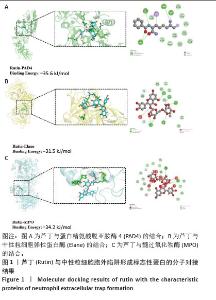
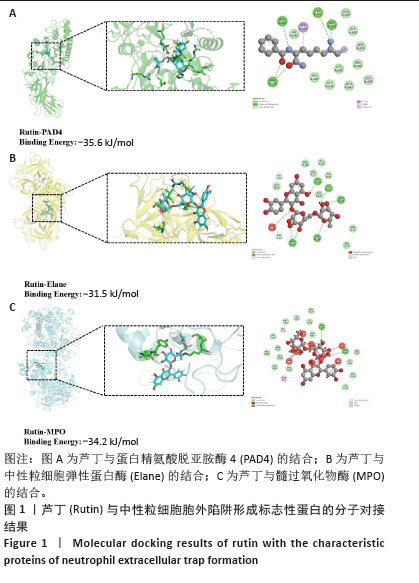
2.1 分子对接结果 如图1所示,芦丁与蛋白精氨酸脱亚胺酶4、中性粒细胞弹性蛋白酶、髓过氧化物酶的结合能分别为-35.6,-31.5,-34.2 kJ/mol,均小于-29.29 kJ/mol,说明芦丁与中性粒细胞胞外陷阱形成的标志性蛋白具有较好的结合能力,其中芦丁与蛋白精氨酸脱亚胺酶4的结合效果最好。"
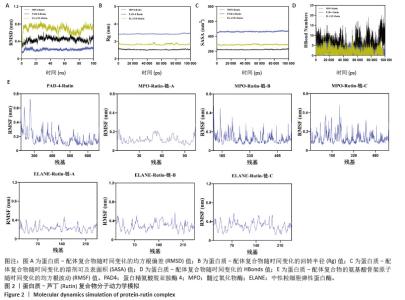
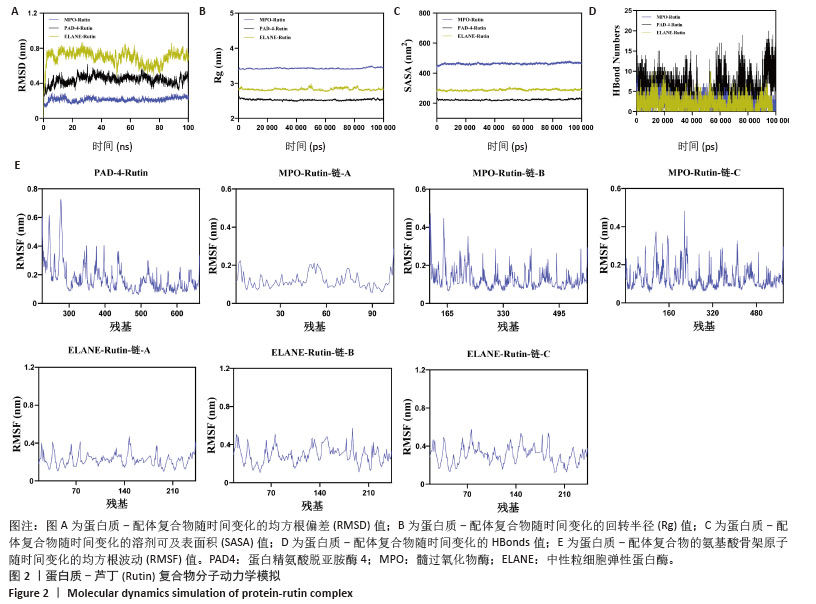
2.2 分子动力学模拟结果 均方根偏差(RMSD)是衡量蛋白质和配体构象稳定性的良好指标,也是衡量原子位置与起始位置偏差程度的指标。偏差越小,构象稳定性越好。因此,利用均方根偏差对仿真系统的平衡性进行评估。如图2A所示,髓过氧化物酶-芦丁复合物体系在20 ns后达到平衡,最终在0.23 nm上下波动。中性粒细胞弹性蛋白酶-芦丁复合物体系在85 ns后达到平衡,最终在0.67 nm上下波动。蛋白精氨酸脱亚胺酶4-芦丁复合物体系在25 ns后达到平衡,最终在0.36 nm上下波动。其中,髓过氧化物酶-芦丁复合物体系具有最低的均方根偏差值,因此芦丁小分子与髓过氧化物酶靶蛋白结合时表现出较高稳定性。进一步分析发现,髓过氧化物酶-芦丁、中性粒细胞弹性蛋白酶-芦丁、蛋白精氨酸脱亚胺酶4-芦丁复合物体系的回转半径值(Rg)和溶剂可及表面积(SASA)在运动过程中呈现轻微波动,说明复合物体系在运动过程中发生了构象变化(图2B,C)。 氢键在配体与蛋白的结合中起着重要的作用。动力学过程中的小分子与靶蛋白之间的氢键数量如图2D所示,髓过氧化物酶-芦丁复合物体系之间的氢键数量为0-9,在大多数情况下,复合物大约有4个氢键。蛋白精氨酸脱亚胺酶4-芦丁复合物体系之间的氢键数量为0-20,在大多数情况下,复合物大约有12个氢键。中性粒细胞弹性蛋白酶-芦丁复合物体系之间的氢键数量为0-10,在大多数情况下,复合物大约有4个氢键。因此,芦丁和不同靶蛋白之间均具有良好的氢键相互作用。 均方根波动(RMSF)可以表示蛋白质中氨基酸残基的柔性大小。如图2E所示,髓过氧化物酶-芦丁、中性粒细胞弹性蛋白酶-芦丁和蛋白精氨酸脱亚胺酶4-芦丁复合物体系的均方根波动值相对较低(大多在0.4 nm以下),因此其灵活性较低,稳定性较高。 总体而言,髓过氧化物酶-芦丁、中性粒细胞弹性蛋白酶-芦丁和蛋白精氨酸脱亚胺酶4-芦丁复合物体系结合稳定,且复合物具有良好的氢键作用。因此,芦丁小分子与髓过氧化物酶、中性粒细胞弹性蛋白酶和蛋白精氨酸脱亚胺酶4靶蛋白结合作用良好。"
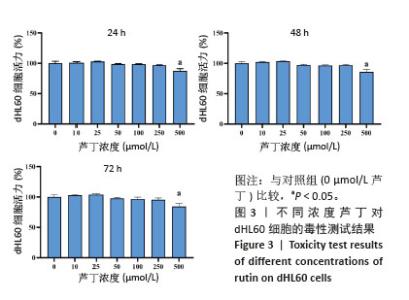
2.3 芦丁对dHL60细胞的毒性测试结果 如图3所示,0-250 μmol/L芦丁浓度对dHL60细胞无明显毒性,相对于0 μmol/L芦丁而言,500 μmol/L芦丁开始对dHL60细胞具有显著的毒性作用(P < 0.05)。结果说明,500 μmol/L及以上浓度的芦丁对dHL60细胞存在细胞毒性,因此采用250 μmol/L作为芦丁干预dHL60细胞的浓度。"
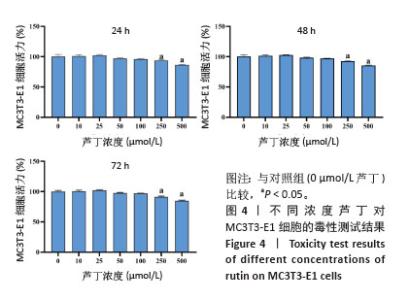
2.4 芦丁对MC3T3-E1细胞的毒性测试结果 如图4所示,0-100 μmol/L芦丁对MC3T3-E1细胞无明显毒性,相对于0 μmol/L芦丁而言,250 μmol/L和500 μmol/L芦丁开始对MC3T3-E1细胞具有显著的毒性作用(P < 0.05)。结果说明,250 μmol/L及以上浓度的芦丁对MC3T3-E1细胞存在细胞毒性,因此采用100 μmol/L作为芦丁干预MC3T3-E1细胞的浓度。"
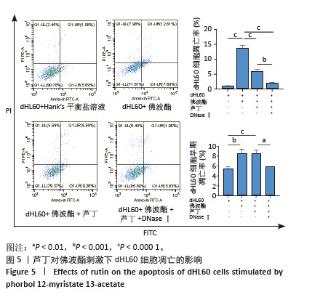
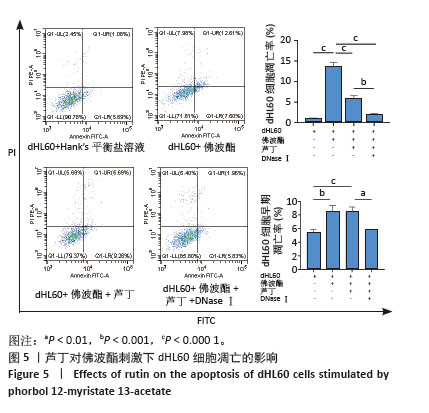
2.5 芦丁对佛波酯刺激下的dHL60细胞凋亡的影响 如图5所示,与空白对照组比较,佛波酯组的dHL60细胞凋亡率显著升高(P < 0.000 1);与佛波酯组比较,芦丁干预组和芦丁联合DNaseⅠ干预组的dHL60细胞凋亡率显著降低(P < 0.000 1)。此外,与芦丁干预组比较,芦丁联合DNaseⅠ干预组的dHL60细胞凋亡率显著降低(P < 0.001)。"
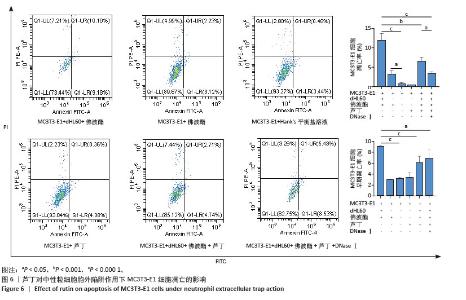
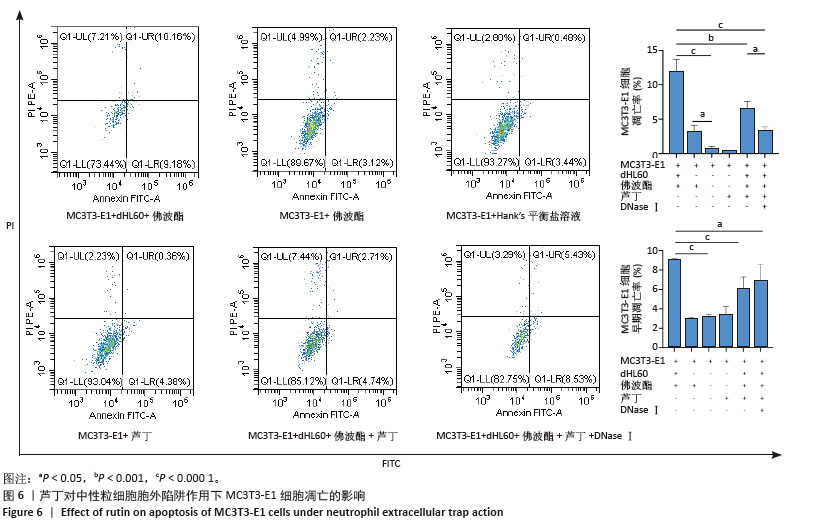
2.6 芦丁对中性粒细胞胞外陷阱作用下MC3T3-E1细胞凋亡的影响 如图6所示,与空白对照组比较,佛波酯对照组MC3T3-E1细胞凋亡率轻度升高(P < 0.05)。与空白对照组比较,中性粒细胞胞外陷阱诱导组MC3T3-E1细胞凋亡率显著升高(P < 0.000 1)。与空白对照组比较,芦丁对照组的MC3T3-E1细胞凋亡率无统计学差异。与中性粒细胞胞外陷阱诱导组比较,芦丁干预组的MC3T3-E1细胞凋亡率显著降低(P < 0.001)。与中性粒细胞胞外陷阱诱导组比较,芦丁联合DNaseⅠ组的MC3T3-E1细胞凋亡率显著降低(P < 0.000 1)。此外,与芦丁干预组比较,芦丁联合DNaseⅠ组的MC3T3-E1细胞凋亡率显著降低(P < 0.05)。"
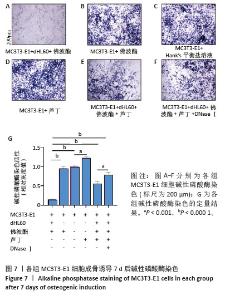
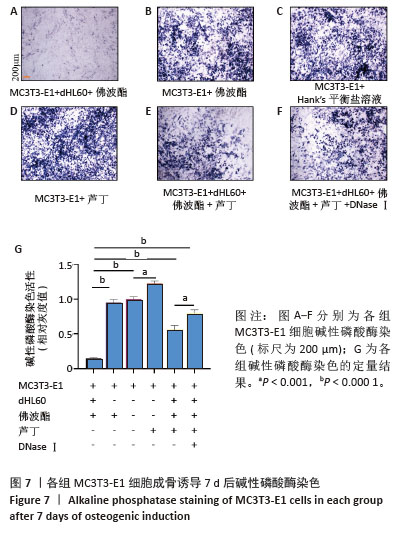
2.7 芦丁对中性粒细胞胞外陷阱作用下MC3T3-E1细胞成骨分化的影响 (1)碱性磷酸酶染色结果:如图7所示,各组MC3T3-E1细胞成骨诱导7 d后,芦丁对照组较空白对照组染色活性增强(P < 0.001),中性粒细胞胞外陷阱诱导组较佛波酯对照组和空白对照组染色活性减弱(P < 0.000 1),芦丁干预组和芦丁联合DNaseⅠ干预组较中性粒细胞胞外陷阱诱导组染色活性增强(P < 0.000 1),此外,芦丁联合DNaseⅠ干预组较芦丁干预组染色活性更强(P < 0.001)。"
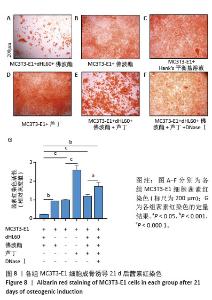
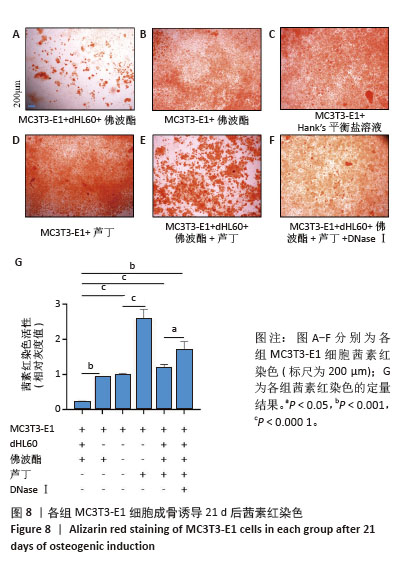
(2)茜素红染色结果:如图8所示,各组MC3T3-E1细胞成骨诱导21 d后,芦丁对照组较空白对照组染色活性增强,钙盐沉积明显(P < 0.000 1),中性粒细胞胞外陷阱诱导组较佛波酯对照组和空白对照组染色活性减弱(P < 0.001,P < 0.000 1),芦丁干预组和芦丁联合DNaseⅠ干预组较中性粒细胞胞外陷阱诱导组染色活性增强(P < 0.001,P < 0.000 1),此外,芦丁联合DNaseⅠ干预组较芦丁干预组染色活性更强(P < 0.05)。"
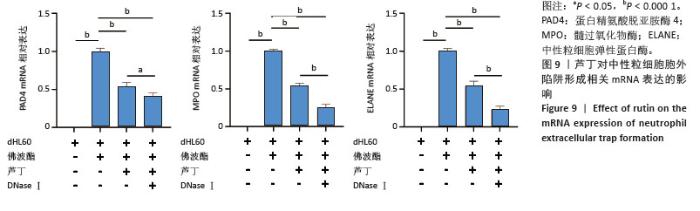
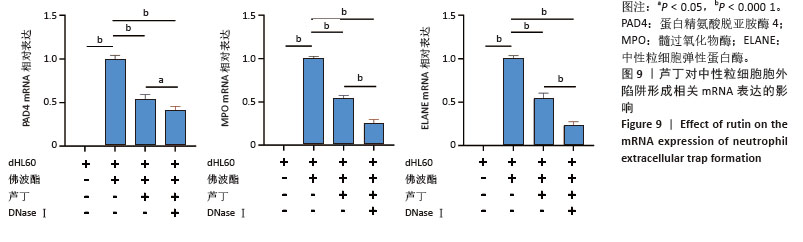
2.8 RT-qPCR检测mRNA表达 2.8.1 芦丁对中性粒细胞胞外陷阱形成基因mRNA表达的影响 如图9所示,与空白对照组比较,佛波酯组dHL60细胞中髓过氧化物酶、中性粒细胞弹性蛋白酶和蛋白精氨酸脱亚胺酶4 mRNA表达明显提高(P < 0.000 1);与佛波酯组比较,芦丁干预组、芦丁联合DNaseⅠ干预组dHL60细胞中髓过氧化物酶、中性粒细胞弹性蛋白酶和蛋白精氨酸脱亚胺酶4 mRNA表达明显下调(P < 0.000 1);此外,与芦丁干预组比较,芦丁联合DNaseⅠ干预组dHL60细胞中蛋白精氨酸脱亚胺酶4 mRNA表达量稍下降(P < 0.05),髓过氧化物酶、中性粒细胞弹性蛋白酶 mRNA表达显著下降(P < 0.000 1 )。"
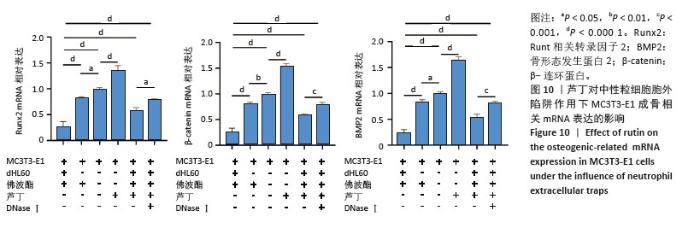
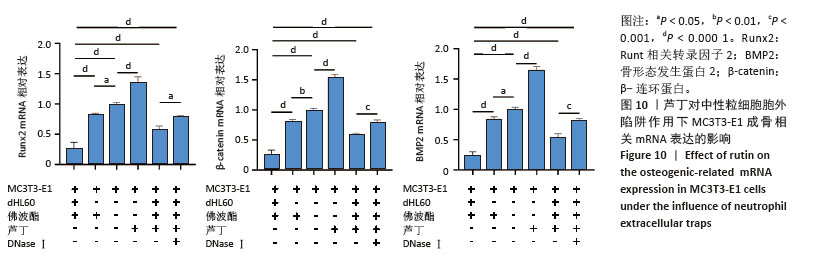
2.8.2 芦丁对中性粒细胞胞外陷阱作用下MC3T3-E1成骨相关基因mRNA表达的影响 如图10所示,与空白对照组比较,佛波酯对照组MC3T3-E1细胞中Runt相关转录因子2(P < 0.05)、骨形态发生蛋白2(P < 0.05)和β-连环蛋白(P < 0.01)的mRNA表达稍下降;与空白对照组比较,芦丁对照组MC3T3-E1细胞中Runt相关转录因子2、骨形态发生蛋白2和β-连环蛋白的mRNA表达显著提高(P < 0.000 1)。与空白对照组和佛波酯对照组比较,中性粒细胞胞外陷阱诱导组MC3T3-E1细胞中Runt相关转录因子2、骨形态发生蛋白2和β-连环蛋白的mRNA表达显著下调(P < 0.000 1)。与中性粒细胞胞外陷阱诱导组比较,芦丁干预组、芦丁联合DNaseⅠ干预组MC3T3-E1细胞中Runt相关转录因子2、骨形态发生蛋白2和β-连环蛋白的mRNA表达显著上调(P < 0.000 1)。此外,与芦丁干预组比较,芦丁联合DNaseⅠ干预组MC3T3-E1细胞中Runt相关转录因子2(P < 0.05)、骨形态发生蛋白2(P < 0.001)和β-连环蛋白(P < 0.001)的mRNA表达上调。"
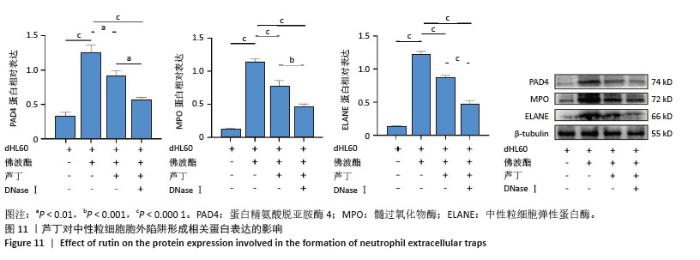
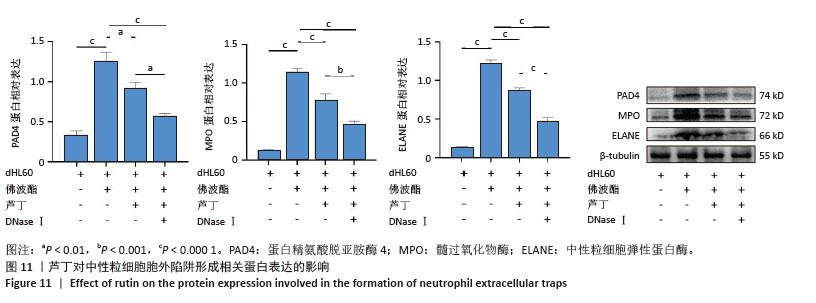
2.9 Western blot检测蛋白表达 2.9.1 芦丁对中性粒细胞胞外陷阱形成蛋白表达的影响 如图11所示,与空白对照组比较,佛波酯组dHL60细胞中髓过氧化物酶、中性粒细胞弹性蛋白酶和蛋白精氨酸脱亚胺酶4蛋白表达明显提高(P < 0.000 1);与佛波酯组比较,芦丁干预组dHL60细胞中髓过氧化物酶(P < 0.000 1)、中性粒细胞弹性蛋白酶(P < 0.000 1)和蛋白精氨酸脱亚胺酶4(P < 0.01)蛋白明显下调;与佛波酯组比较,芦丁联合DNaseⅠ干预组dHL60细胞中髓过氧化物酶、中性粒细胞弹性蛋白酶和蛋白精氨酸脱亚胺酶4蛋白表达明显下调(P < 0.000 1)。此外,与芦丁干预组比较,芦丁联合DNaseⅠ干预组中蛋白精氨酸脱亚胺酶4(P < 0.01)、髓过氧化物酶(P < 0.001)、中性粒细胞弹性蛋白酶(P < 0.000 1)蛋白表达显著下降。"
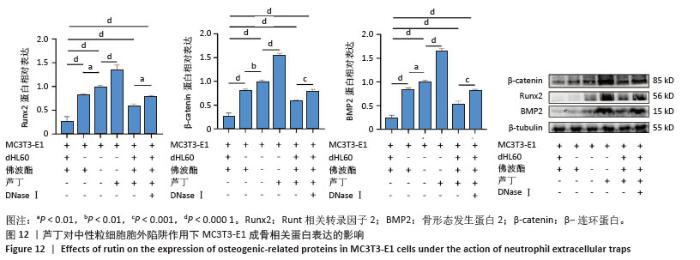
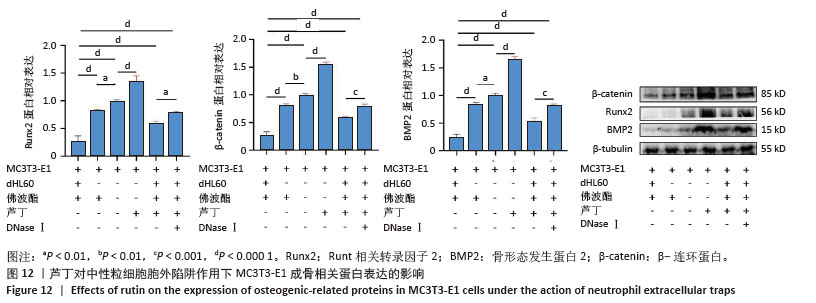
2.9.2 芦丁对中性粒细胞胞外陷阱作用下MC3T3-E1成骨相关蛋白表达的影响 如图12所示,与空白对照组比较,佛波酯对照组MC3T3-E1细胞中Runt相关转录因子2 (P < 0.05)、骨形态发生蛋白2 (P < 0.01)和β-连环蛋白(P < 0.05)表达下降;与空白对照组比较,芦丁对照组MC3T3-E1细胞中Runt相关转录因子2、骨形态发生蛋白2和β-连环蛋白表达显著提高 (P < 0.000 1)。 与空白对照组和佛波酯对照组比较,中性粒细胞胞外陷阱诱导组MC3T3-E1细胞中Runt相关转录因子2、骨形态发生蛋白2和β-连环蛋白表达显著下调(P < 0.000 1)。与中性粒细胞胞外陷阱诱导组比较,芦丁干预组、芦丁联合DNaseⅠ干预组MC3T3-E1细胞中Runt相关转录因子2、骨形态发生蛋白2和β-连环蛋白表达显著上调 (P < 0.000 1)。此外,与芦丁干预组比较,芦丁联合DNaseⅠ干预组MC3T3-E1细胞中Runt相关转录因子2 (P < 0.05)、骨形态发生蛋白2 (P < 0.001)和β-连环蛋白(P < 0.001)表达显著上调。"
| [1] KHOSLA S, MELTON LJ 3RD, RIGGS BL. The unitary model for estrogen deficiency and the pathogenesis of osteoporosis: is a revision needed? J Bone Miner Res. 2011;26(3):441-451. [2] ZHANG YW, WU Y, LIU XF, et al. Targeting the gut microbiota-related metabolites for osteoporosis: The inextricable connection of gut-bone axis. Ageing Res Rev. 2024;94:102196. [3] 袁金秋.中国人群骨质疏松症风险管理公众指南(2024)[J].中华骨质疏松和骨矿盐疾病杂志,2024,17(6):533-548. [4] MUÑOZ M, ROBINSON K, SHIBLI-RAHHAL A. Bone Health and Osteoporosis Prevention and Treatment. Clin Obstet Gynecol. 2020;63(4):770-787. [5] DAMASCENA HL, SILVEIRA WAA, CASTRO MS, et al. Neutrophil Activated by the Famous and Potent PMA (Phorbol Myristate Acetate). Cells. 2022;11(18):2889. [6] CASTANHEIRA FVS, KUBES P. Neutrophils and NETs in modulating acute and chronic inflammation. Blood. 2019;133(20):2178-2185. [7] GUO Y, ZHOU H, WANG Y, et al. Activated NETosis of bone marrow neutrophils up-regulates macrophage osteoclastogenesis via cGAS-STING/AKT2 pathway to promote osteoporosis. Exp Cell Res. 2025;446(2):114477. [8] 张敏,梁凤妮,孙延文,等.杜仲化学成分、药理作用和临床应用研究进展[J].中草药,2023,54(14):4740-4761. [9] 肖玉红.芦丁通过抑制骨髓间充质干细胞中FNDC1表达抗骨质疏松的作用及机制研究[D].南昌:南昌大学,2021. [10] 耿壮,徐丽丽,张晓英,等.芦丁对去卵巢骨质疏松症大鼠的防治作用[J]. 中国骨质疏松杂志,2019,25(4):497-501. [11] XIAO Y, WEI R, YUAN Z, et al. Rutin suppresses FNDC1 expression in bone marrow mesenchymal stem cells to inhibit postmenopausal osteoporosis. Am J Transl Res. 2019;11(10):6680-6690. [12] HU Y, LIANG X, LI X, et al. Rutin ameliorates imiquimod-induced psoriasis-like skin lesions by inhibiting oxidative stress injury and the inflammatory response in mice via the Keap1/Nrf2 signaling pathway. Sci Rep. 2025;15(1):20712. [13] WU Y, WANG Y, CHEN F, et al. Loading rutin on surfaces by the layer-by-layer assembly technique to improve the oxidation resistance and osteogenesis of titanium implants in osteoporotic rats. Biomed Mater. 2024;19(4):10. [14] GERA S, POOLADANDA V, GODUGU C, et al. Rutin nanosuspension for potential management of osteoporosis: effect of particle size reduction on oral bioavailability, in vitro and in vivo activity. Pharm Dev Technol. 2020;25(8): 971-988. [15] DADGAR A, MALEKI DIZAJ S, ALIZADEH OSKOEE P, et al. Gelatin nanofibrous scaffolds containing rutin nanoparticles: physicochemical properties, antibacterial action, and anti-inflammatory effect on dental pulp stem cells. BMC Oral Health. 2025;25(1):1129. [16] KIRCHNER T, HERMANN E, MÖLLER S, et al. Flavonoids and 5-aminosalicylic acid inhibit the formation of neutrophil extracellular traps. Mediators Inflamm. 2013;2013:710239. [17] COSTA MF, JESUS TI, LOPES BR, et al. Eugenia aurata and Eugenia punicifolia HBK inhibit inflammatory response by reducing neutrophil adhesion, degranulation and NET release. BMC Complement Altern Med. 2016;16(1):403. [18] WU Y, LI J, LIU M, et al. Deciphering the Pharmacological Potential of Kouqiangjie Formula for the Treatment of Diabetic Periodontitis Based on Network Pharmacology, Machine Learning, Molecular Dynamics, and Animal Experiments. Drug Des Devel Ther. 2025;19:2103-2129. [19] JO S, KIM T, IYER VG, et al. CHARMM-GUI: a web-based graphical user interface for CHARMM. J Comput Chem. 2008;29(11):1859-1865. [20] MARK P, NILSSON L. Structure and dynamics of the TIP3P, SPC, and SPC/E water models at 298 K. J Phys Chem. 2001;105: 9954-9960. [21] PENG B, YAN MY, CHEN YR, et al. The methyl-CpG binding domain 2 regulates peptidylarginine deiminase 4 expression and promotes neutrophil extracellular trap formation via the Janus kinase 2 signaling pathway in experimental severe asthma. Ann Med. 2025;57(1):2458207. [22] GUO Y, GAO F, WANG Q, et al. Differentiation of HL-60 cells in serum-free hematopoietic cell media enhances the production of neutrophil extracellular traps. Exp Ther Med. 2021;21(4):353. [23] MA X, LI M, WANG X, et al. Dihydromyricetin ameliorates experimental ulcerative colitis by inhibiting neutrophil extracellular traps formation via the HIF-1α/VEGFA signaling pathway. Int Immunopharmacol. 2024;138:112572. [24] XU J, YU L, LIU F, et al. The effect of cytokines on osteoblasts and osteoclasts in bone remodeling in osteoporosis: a review. Front Immunol. 2023;14:1222129. [25] 王栋梁,方凡夫,刘昌胜,等.骨质疏松性骨折中西医协同诊疗专家共识[J].中国骨伤,2024,37(3):242-250. [26] 肖姚,刘颖,吴惠一,等.绝经后骨质疏松症临床实践指南和专家共识的质量评价[J].现代预防医学,2023,50(8):1516-1523. [27] SU P, LI M, XIAO J, et al. Effectiveness of anabolic and anti-resorptive agents for preventing postmenopausal osteoporosis fractures: a systematic review and network meta-analysis. J Orthop Surg Res. 2025;20(1):645. [28] BRENT MB. Pharmaceutical treatment of bone loss: From animal models and drug development to future treatment strategies. Pharmacol Ther. 2023;244:108383. [29] LANGDAHL BL. Overview of treatment approaches to osteoporosis. Br J Pharmacol. 2021;178(9):1891-1906. [30] LEE SH, RYU SY, PARK J, et al. The Relationship of Neutrophil-Lymphocyte Ratio and Platelet-Lymphocyte Ratio with Bone Mineral Density in Korean Postmenopausal Women. Chonnam Med J. 2019;55(3):150-155. [31] TAKEI H, ARAKI A, WATANABE H, et al. Rapid killing of human neutrophils by the potent activator phorbol 12-myristate 13-acetate (PMA) accompanied by changes different from typical apoptosis or necrosis. J Leukoc Biol. 1996;59(2):229-240. [32] BRINKMANN V, REICHARD U, GOOSMANN C, et al. Neutrophil extracellular traps kill bacteria. Science. 2004;303(5663):1532-1535. [33] SHAHBAZ M, AL-MALEKI AR, CHEAH CW, et al. Connecting the dots: NETosis and the periodontitis-rheumatoid arthritis nexus. Int J Rheum Dis. 2024; 27(11):e15415. [34] WANG H, YAN A, XIA C, et al. Fe-Doped Carbon Dots Alleviated Rheumatoid Arthritis by Inhibiting Neutrophil NETosis and Autophagy. ACS Biomater Sci Eng. 2025;11(6):3666-3681. [35] LIU Y, QU Y, LIU C, et al. Neutrophil extracellular traps: Potential targets for the treatment of rheumatoid arthritis with traditional Chinese medicine and natural products. Phytother Res. 2024;38(11):5067-5087. [36] ZHONG W, WANG Q, SHEN X, et al. The emerging role of neutrophil extracellular traps in cancer: from lab to ward. Front Oncol. 2023;13:1163802. [37] SONG D, YIN X, CHE C. Distinct Gene Expression and Immune Features Between Different Neutrophil Extracellular Trap-Related Osteosarcoma Subtypes. Appl Biochem Biotechnol. 2025;197(1):55-72. [38] DEMKOW U. Molecular Mechanisms of Neutrophil Extracellular Trap (NETs) Degradation. Int J Mol Sci. 2023;24(5):4896. [39] SHAO Y, LI L, YANG Y, et al. DNase aggravates intestinal microvascular injury in IBD patients by releasing NET-related proteins. FASEB J. 2024;38(1):e23395. [40] WANG CJ, KO GR, LEE YY, et al. Polymeric DNase-I nanozymes targeting neutrophil extracellular traps for the treatment of bowel inflammation. Nano Converg. 2024;11(1):6. |
| [1] | Chen Huiting, Zeng Weiquan, Zhou Jianhong, Wang Jie, Zhuang Congying, Chen Peiyou, Liang Zeqian, Deng Weiming. Tail anchoring technique of vertebroplasty in treatment of osteoporotic vertebral compression fractures with intravertebral cleft: a finite element analysis [J]. Chinese Journal of Tissue Engineering Research, 2026, 30(9): 2145-2152. |
| [2] | Zeng Xuan, Weng Rui, Ye Shicheng, Tang Jiadong, Mo Ling, Li Wenchao. Two lumbar rotary manipulation techniques in treating lumbar disc herniation: a finite element analysis of biomechanical differences [J]. Chinese Journal of Tissue Engineering Research, 2026, 30(9): 2153-2161. |
| [3] | Cheng Qisheng, Julaiti·Maitirouzi, Xiao Yang, Zhang Chenwei, Paerhati·Rexiti. Finite element analysis of novel variable-diameter screws in modified cortical bone trajectory of lumbar vertebrae [J]. Chinese Journal of Tissue Engineering Research, 2026, 30(9): 2162-2171. |
| [4] | Liu Wenlong, Dong Lei, Xiao Zhengzheng, Nie Yu. Finite element analysis of tibial prosthesis loosening after fixed-bearing unicompartmental knee arthroplasty for osteoporosis [J]. Chinese Journal of Tissue Engineering Research, 2026, 30(9): 2191-2198. |
| [5] | Chen Long, Wang Xiaozhen, Xi Jintao, Lu Qilin. Biomechanical performance of short-segment screw fixation combined with expandable polyetheretherketone vertebral body replacement in osteoporotic vertebrae [J]. Chinese Journal of Tissue Engineering Research, 2026, 30(9): 2226-2235. |
| [6] | Sun Lei, Zhang Qi, Zhang Yu. Pro-osteoblastic effect of chlorogenic acid protein microsphere/polycaprolactone electrospinning membrane [J]. Chinese Journal of Tissue Engineering Research, 2026, 30(8): 1877-1884. |
| [7] | Hu Xiongke, Liu Shaohua, Tan Qian, Liu Kun, Zhu Guanghui. Shikonin intervention with bone marrow mesenchymal stem cells improves microstructure of femur in aged mice [J]. Chinese Journal of Tissue Engineering Research, 2026, 30(7): 1609-1615. |
| [8] | Ding Yifan, Yin Wenjie, Zhang Li, Yuan Shuya, Sun Guoju, Zhang Naili, Zhao Dongmei, Ma Lina. Repair of segmental bone defect of rabbit radius by decalcified bone matrix loaded with adipose-derived stem cells [J]. Chinese Journal of Tissue Engineering Research, 2026, 30(7): 1679-1686. |
| [9] | Wu Zhilin, , He Qin, Wang Pingxi, Shi Xian, Yuan Song, Zhang Jun, Wang Hao . DYRK2: a novel therapeutic target for rheumatoid arthritis combined with osteoporosis based on East Asian and European populations [J]. Chinese Journal of Tissue Engineering Research, 2026, 30(6): 1569-1579. |
| [10] | Zhang Haiwen, Zhang Xian, Xu Taichuan, Li Chao. Bibliometric and visual analysis of the research status and trends of senescence in osteoporosis [J]. Chinese Journal of Tissue Engineering Research, 2026, 30(6): 1580-1591. |
| [11] | Wen Guangwei, Zhen Yinghao, Zheng Taikeng, Zhou Shuyi, Mo Guoye, Zhou Tengpeng, Li Haishan, Lai Yiyi. Effects and mechanisms of isoginkgetin on osteoclastogenesis [J]. Chinese Journal of Tissue Engineering Research, 2026, 30(6): 1348-1358. |
| [12] | Huang Jie, Zeng Hao, Wang Wenchi, Lyu Zhucheng, Cui Wei. Visualization analysis of literature on the effect of lipid metabolism on osteoporosis [J]. Chinese Journal of Tissue Engineering Research, 2026, 30(6): 1558-1568. |
| [13] | Yang Zhijie, Zhao Rui, Yang Haolin, Li Xiaoyun, Li Yangbo, Huang Jiachun, Lin Yanping, Wan Lei, HuangHongxing. Postmenopausal osteoporosis: predictive values of muscle mass, grip strength, and appendicular skeletal muscle index [J]. Chinese Journal of Tissue Engineering Research, 2026, 30(5): 1073-1080. |
| [14] | Zhou Jian, Zhang Tao, Zhou Weili, Zhao Xingcheng, Wang Jun, Shen Jie, Qian Li, Lu Ming. Effects of resistance training on quadriceps mass and knee joint function in patients with osteoporosis and sarcopenia [J]. Chinese Journal of Tissue Engineering Research, 2026, 30(5): 1081-1088. |
| [15] | Cao Wenqi, Feng Xiuzhi, Zhao Yi, Wang Zhimin, Chen Yiran, Yang Xiao, Ren Yanling. Effect of macrophage polarization on osteogenesis-angiogenesis coupling in type 2 diabetic osteoporosis [J]. Chinese Journal of Tissue Engineering Research, 2026, 30(4): 917-925. |
| Viewed | ||||||
|
Full text |
|
|||||
|
Abstract |
|
|||||