Chinese Journal of Tissue Engineering Research ›› 2026, Vol. 30 ›› Issue (24): 6365-6372.doi: 10.12307/2026.167
Previous Articles Next Articles
Network meta-analysis of different virtual reality devices for treating upper limb motor dysfunction after stroke
Nie Yue1, Song Shuhua1, Zhao Shengting2, Dong Yangyang1, Yang Bingxin3
- 1School of Physical Education, Yunnan Normal University, Kunming 650500, Yunnan Province, China; 2Department of Rehabilitation Medicine, Kunming Tongren Hospital, Kunming 650033, Yunnan Province, China; 3Yunnan Xinxing Occupations Institute, Kunming 650217, Yunnan Province, China
-
Received:2025-04-08Revised:2026-08-06Online:2026-08-28Published:2026-02-04 -
Contact:Zhao Shengting, Associate chief technician, Department of Rehabilitation Medicine, Kunming Tongren Hospital, Kunming 650033, Yunnan Province, China -
About author:Nie Yue, MS candidate, School of Physical Education, Yunnan Normal University, Kunming 650500, Yunnan Province, China -
Supported by:Scientific Research Fund Project of Yunnan Department of Education, No. 2023J2138 (to YBX)

CLC Number:
Cite this article
Nie Yue, Song Shuhua, Zhao Shengting, Dong Yangyang, Yang Bingxin. Network meta-analysis of different virtual reality devices for treating upper limb motor dysfunction after stroke[J]. Chinese Journal of Tissue Engineering Research, 2026, 30(24): 6365-6372.
share this article
Add to citation manager EndNote|Reference Manager|ProCite|BibTeX|RefWorks
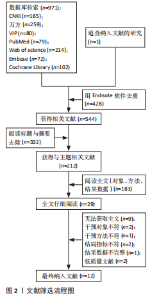
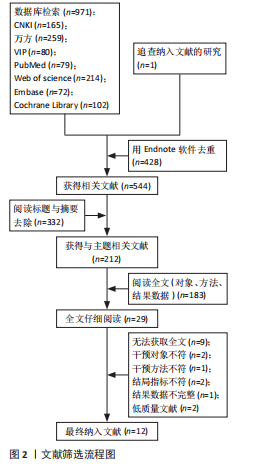
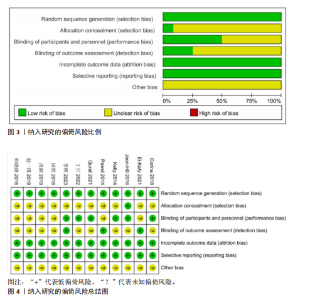
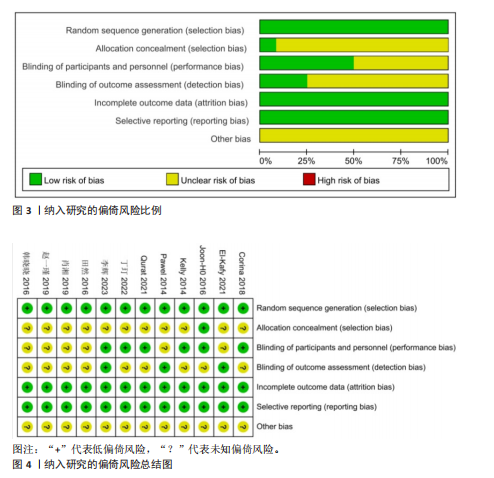
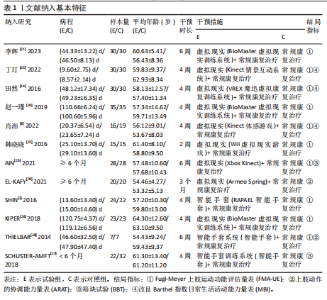
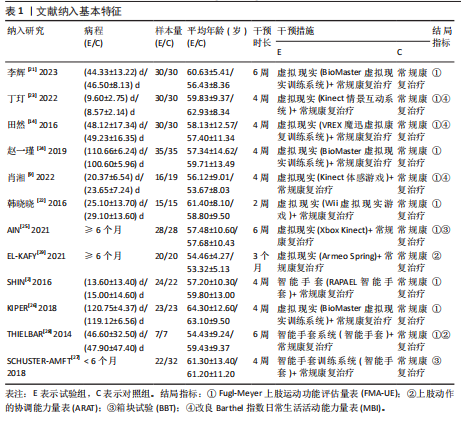
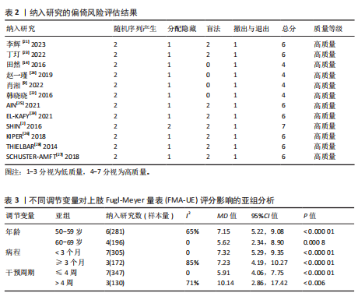
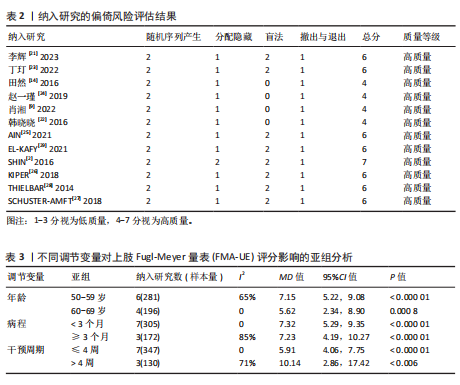
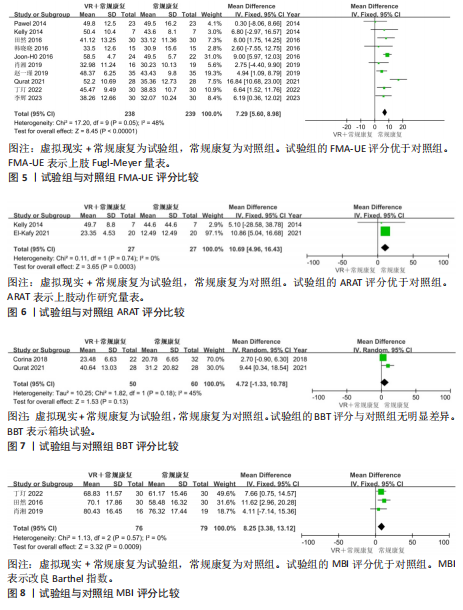
2.1 文献检索结果 初步检索共获得文献972篇,包括504篇中文文献,467篇英文文献,1篇其他来源文献。经逐层筛选,最终纳入12篇文献。详细筛选流程及排除原因见图2。 2.2 纳入文献的基本特征和质量评价 2.2.1 纳入文献的基本特征 共纳入12篇文献[2,9,14,21-29],571例脑卒中偏瘫患者。其中虚拟现实技术共纳入了6种,包括BioMaster虚拟情景互动训练系统3篇、Kinect体感交互技术3篇、智能手套3篇、Wii虚拟现实游戏1篇、VREX魔迅虚拟康复训练系统1篇、Armeo Spring虚拟康复训练系统1篇。纳入研究的基本特征见表1。 2.2.2 纳入文献的质量评价 12篇文献均使用Cochrane风险偏倚评估工具和方法进行质量评估,具体信息见表2及图3,4。 2.3 Meta分析结果 2.3.1 上肢运动功能(FMA-UE) 包括10篇文献[2,9,14,21-26,28],共477例脑卒中患者采用FMA-UE进行上肢运动功能评定,其中试验组和对照组分别有238例、239例。各文献间异质性小(I2=48%,P≥0.05),采用固定效应模型分析。结果显示,虚拟现实训练组更能改善患者的上肢运动功能(MD=7.29,95%CI:5.60-8.98,P < 0.05),见图5。 调节变量亚组检验结果:通过设置调节变量(年龄、病程、干预周期)对FMA-UE评分的效应量进行亚组分析。结果显示,在年龄方面,2个年龄段的FMA-UE评分均优于对照组(P < 0.05),其中50-59岁的患者干预效果最佳;在病程方面,两段病程的FMA-UE评分均优于对照组(P < 0.05),其中病程为3个月以内的患者干预效果最佳;在干预周期方面,2个周期段的FMA-UE评分均优于对照组(P < 0.05),其中4周以上的患者干预效果最佳。见表3。 2.3.2 上肢动作研究量表(ARAT) 包括2篇文献[28-29],共54例患者采用ARAT量表对其上肢功能的恢复情况进行评估,其中试验组和对照组分别有27例、27例。2篇文献间无异质性(I2=0%,P≥0.05),采用固定效应模型分析。结果显示,虚拟现实训练组更能改善患者的上肢动作协调能力(MD=10.69,95%CI:4.96-16.43,P < 0.05)。见图6。 2.3.3 箱块试验(BBT) 包括2篇文献[25,27],110例患者采用箱块试验进行手部灵巧度评定,其中试验组和对照组分别有50例、60例。2篇文献间异质性小(I2=45%,P≥0.05),采用固定效应模型分析。结果显示,虚拟现实组与"
"
"
"
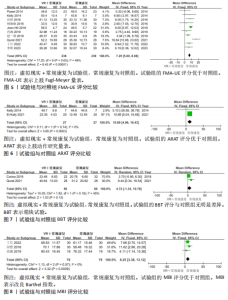
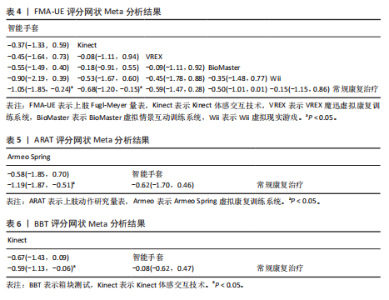
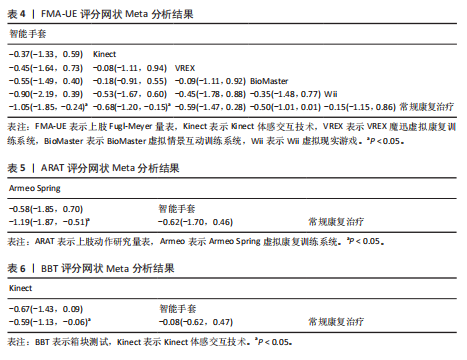
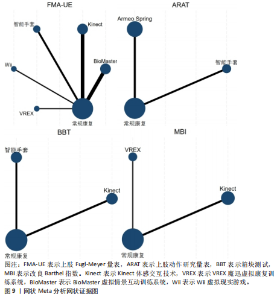
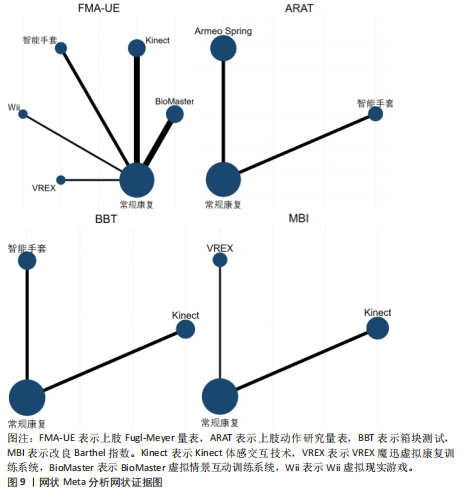
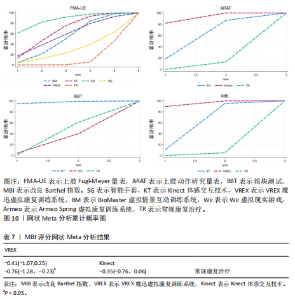
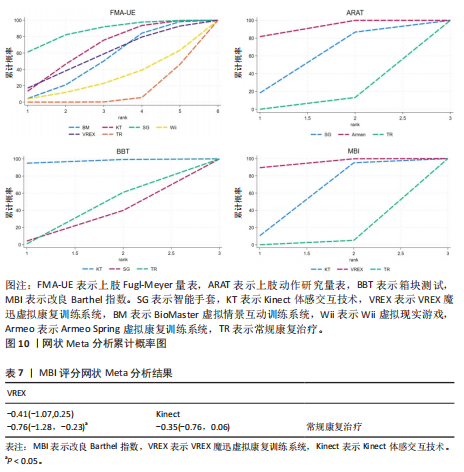
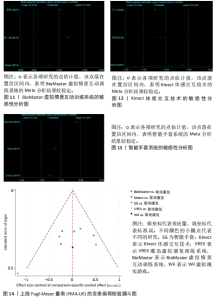
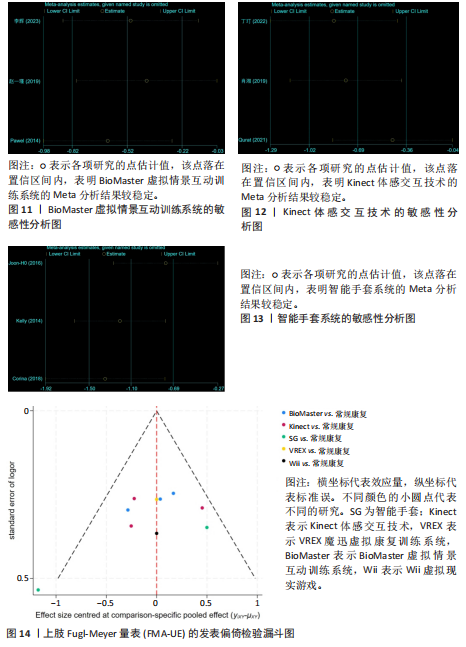
常规治疗组的BBT得分无明显差异(MD=4.72,95%CI:-1.33-10.78,P > 0.05)。见图7。 2.3.4 改良Barthel指数(MBI) 包括3篇文献[9,14,23],共155例患者采用改良Barthel指数进行生活活动能力评估,其中试验组和分别有76例、79例。各文献间无异质性(I2=0%,P≥0.05),采用固定效应模型分析。结果显示,虚拟现实训练组更能改善患者的日常生活能力(MD=8.25,95%CI:3.38-13.12,P < 0.05)。见图8。 2.4 网状Meta分析 2.4.1 网状证据关系图 各结局指标的证据关系见图9。圆点代表干预措施,圆点大小代表该干预措施所涉及的病例数。圆点之间的连线代表两种干预措施之间存在直接比较的证据,实线越粗,表明直接比较的证据越多,反之越少。 2.4.2 网状Meta分析结果 (1) FMA-UE评分:共10项研究采用了FMA-UE评分[2,9,14,21-26,28],涉及5种虚拟现实设备。在提高FMA-UE方面,智能手套和Kinect体感交互技术优于常规康复治疗,差异有显著性意义(P < 0.05),见表4。 (2) ARAT评分:共2项研究采用了ARAT评分[28-29],涉及2种虚拟现实设备。在提高ARAT方面,Armeo Spring虚拟康复训练系统优于常规康复治疗,差异有显著性意义(P < 0.05),见表5。 (3) BBT评分:共2项研究采用了BBT评分[25,27],涉及2种虚拟现实设备。在提高BBT方面Kinect体感交互技术优于常规康复治疗,差异有显著性意义(P < 0.05),见表6。 (4) MBI评分:共3项研究采用了MBI评分[9,14,23],涉及2种虚拟现实设备。在提高MBI方面VREX魔迅虚拟康复训练系统优于常规康复治疗,差异有显著性意义(P < 0.05),见表7。 2.4.3 累计概率排序结果 在各结局指标种,累计概率图的曲线下面积越大代表疗效越好,累计概率见图10。 ①在FMA-UE评分中,优先概率排名结果为智能手套(86.6%) > Kinect体感交互技术(65.8%) > VREX魔迅虚拟康复训练系统(58.0%) > BioMaster虚拟情景互动训练系统(51.4%) > Wii虚拟现实游戏(27.6%) > 常规康复治疗(10.6%);②在ARAT评分中,优先概率排名为Armeo Spring虚拟康复训练系统(90.1%) >智能手套(53.4%) > 常规康复治疗(6.5%);③在BBT评分中,优先概率排名为Kinect体感交互技术(97.4%) > 常规康复治疗(30.6%) > 智能手套(22.0%);④在MBI评分中,优先概率排名为VREX魔迅虚拟康复训练系统(94.2%) > Kinect体感交互技术(53.3%) > 常规康复治疗(2.5%)。 2.5 敏感性分析 因Wii虚拟现实游戏、VREX魔迅虚拟康复训练系统、Armeo Spring虚拟康复训练系统3个虚拟现实设备所涉及文献仅各1篇,因而此次研究仅对BioMaster虚拟情景互动训练系统、Kinect体感交互技术、智能手套系统进行敏感性分析。通过逐一剔除每项研究的方法,观察剔除后研究异质性的变化。结果显示,在逐步剔除各项研究后,3个虚拟现实设备所涉及研究的异质性无明显变化,表明结果稳定可靠,见图11-13。 2.6 发表偏倚检验 鉴于纳入的文献数量有限,此次研究仅对FMA-UE结局指标进行发表偏倚的评估。分析结果显示,各研究基本以漏斗图中零位线对称,提示文章的发表偏倚风险较低,见图14。"
"
"
"
"
| [1] ALAWIEH A, ZHAO J, FENG W. Factors affecting post-stroke motor recovery: implications on neurotherapy after brain injury. Behav Brain Res. 2018;340:94-101. [2] SHIN JH, KIM MY, LEE JY, et al. Effects of virtual reality-based rehabilitation on distal upper extremity function and health-related quality of life: a single-blinded, randomized controlled trial. J Neuroeng Rehabil. 2016;24(13):17. [3] 彭广帅,樊星雨,刘笑宇,等. 柔性可穿戴康复手套的设计与控制[J]. 医用生物力学,2019, 34(6):637-643. [4] FRENCH B, THOMAS LH, COUPE J, et al. Repetitive task training for improving functional ability after stroke. Cochrane Database Syst Rev. 2016; 11(11):CD006073. [5] BURKHART PV, SABATÉ E. Adherence to long-term therapies: evidence for action. J Nurs Scholarsh. 2003;35(3):207. [6] SIEKIERKA EM, ENG K, BASSETTI C, et al. New technologies and concepts for rehabilitation in the acute phase of stroke: a collaborative matrix. Neurodegenerative Dis. 2007;4(1):57-69. [7] HENDERSON A, KORNER-BITENSKY N, LEVIN M. Virtual Reality in Stroke Rehabilitation: A Systematic Review of its Effectiveness for Upper Limb Motor Recovery. Top Stroke Rehabil. 2007; 24(6):e24111. [8] 肖倩,余赛英,孙沛. 虚拟现实技术在医疗护理领域中的应用与研究进展[J]. 中国护理管理, 2020,20(2):165-170. [9] 肖湘,黄东锋. 虚拟现实训练改善脑卒中患者上肢运动功能的经颅磁刺激评估[J]. 中国组织工程研究,2022,26(17):2756-2761. [10] MERIANS AS, FLUET GG, QIU Q, et al. Robotically Facilitated Virtual Rehabilitation of Arm Transport Integrated With Finger Movement in Persons with Hemiparesis. J Neuroeng Rehabil. 2011;8(8):27. [11] 容小川,张盘德,刘翠华,等. 虚拟现实技术治疗对脑卒中患者上肢功能障碍的疗效[J]. 实用医学杂志,2015,33(11):1807-1809. [12] 陈晨,孟兆祥,杨康,等. 智能镜像手套任务导向性训练联合低频重复经颅磁刺激对脑卒中患者手功能效果的随机对照试验[J]. 中国康复理论与实践,2024,30(7):831-838. [13] MOUAWAD MR, DOUST CG, MAX MD, et al. Wii-based movement therapy to promote improved upper extremity function post-stroke: a pilot study. J Rehabil Med. 2011;43(6):527-533. [14] 田然,柏敏,马腾. 虚拟现实技术对脑卒中患者上肢功能及日常生活活动能力的效果[J]. 中国康复理论与实践,2016,22(12):1371-1374. [15] GIJBELS D, LAMERS I, KERKHOFS L, et al. The Armeo Spring as training tool to improve upper limb functionality in multiple sclerosis: a pilot study. J Neuroeng Rehabil. 2011;8(1):1-24. [16] 钟迪,张舒婷,吴波. 《中国急性缺血性脑卒中诊治指南2018》解读[J]. 中国现代神经疾病杂志,2019,19(11):897-901. [17] FUGL-MEYER AR, JÄÄSKÖ L, LEYMAN I, et al. The post-stroke hemiplegic patient. 1. a method for evaluation of physical performance. Scand J Rehabil Med. 1975;7(1):13-31. [18] 赵江莉,毛玉瑢,徐智勤,等. 中文版上肢动作研究量表在早期脑梗死患者中的效度[J]. 中国康复理论与实践,2019,258(8):946-955. [19] LIANG KJ, CHEN HJ, SHIEH JY, et al. Measurement properties of the box and block test in children with unilateral cerebral palsy. Sci Rep. 2021;11(1): 20955. [20] 王赛华,施加加,孙莹,等. 简体版改良Barthel指数在脑卒中恢复期中的信度与效度研究[J]. 中国康复,2020,35(4):179-182. [21] 李辉,劳方金,顾旭东,等. 基于虚拟现实的肩前屈特定角度训练对脑卒中偏瘫患者上肢功能恢复的影响[J]. 中华物理医学与康复杂志, 2023,45(2):134-136. [22] 韩晓晓,柯将琼,蒋松鹤,等. 虚拟现实游戏训练对脑卒中患者偏瘫上肢功能恢复的影响[J]. 中华物理医学与康复杂志,2016,38(6):401-405. [23] 丁玎,谢瑛,刘元旻. 虚拟情景互动训练对注意障碍脑卒中患者上肢运动功能的影响[J]. 中国康复,2022,37(4):204-208. [24] 赵一瑾,余彬,何龙龙,等. 虚拟现实技术结合作业治疗训练对脑卒中偏瘫患者上肢功能影响的临床研究[J]. 中国康复医学杂志,2019, 34(6):661-666. [25] AIN QU, KHAN S, ILYAS S, et al. Additional Effects of Xbox Kinect Training on Upper Limb Function in Chronic Stroke Patients: A Randomized Control Tria. Healthcare. 2021;9(3):242. [26] KIPER P, SZCZUDLIK A, AGOSTINI M, et al. Virtual Reality for Upper Limb Rehabilitation in Subacute and Chronic Stroke: A Randomized Controlled Trial. Arch Phys Med Rehabil. 2018;99(5):834-842.e4. [27] SCHUSTER-AMFT C, ENG K, SUICA Z, et al. Effect of a four-week virtual reality-based training versus conventional therapy on upper limb motor function after stroke: A multicenter parallel group randomized trial. Plos One. 2018; 13(10):e0204455. [28] THIELBAR KO, LORD TJ, FISCHER HC, et al. Training finger individuation with a mechatronic-virtual reality system leads to improved fine motor control post-stroke. J Neuroeng Rehabil. 2014;11:171. [29] EL-KAFY EMA, ALSHEHRI MA, EL-FIKY AA, et al. The Effect of Virtual Reality-Based Therapy on Improving Upper Limb Functions in Individuals With Stroke: A Randomized Control Tria. Front Aging Neurosci. 2021;13:731343. [30] CHEN J, OR CK, CHEN T. Effectiveness of Using Virtual Reality Supported Exercise Therapy for Upper Extremity Motor Rehabilitation in Patients With Stroke: Systematic Review and Meta-analysis of Randomized Controlled Trials. J Med Int Res. 2022;24(6):e24111. [31] CHAU PH, YAN YJK, CHAN MKM, et al. Feasibility, acceptability, and efficacy of virtual reality training for older adults and people with disabilities: A single-armed pretest-posttest design study (Preprint). J Med Int Res. 2021;23(5):e27640. [32] 王宏图. 虚拟现实技术在脑卒中运动康复中的应用现状[J]. 中国康复理论与实践,2014,20(10): 911-915. [33] 邹鸿雁,白定群,杨力凝,等. 虚拟现实技术在卒中后上肢康复中的应用现状及可能机制[J]. 中国康复,2024,39(2):111-112. [34] 黄晓娇,周柯冰,闫凤侠. 脑卒中患者康复动机的研究进展[J]. 护理学杂志,2024,39(12): 116-120. [35] 吉凤,王世民. 卒中后神经可塑性与运动功能恢复[J]. 国际脑血管病杂志,2006,14(6):446-447. [36] 梁明,窦祖林,王清辉,等. 虚拟现实技术在脑卒中患者偏瘫上肢功能康复中的应用[J]. 中国康复医学杂志,2013,28(2):114-118. [37] 张星星,段宏为,周晨,等. 虚拟现实技术应用于脑卒中康复的有效性及安全性的系统评价再评价[J]. 中国全科医学, 2020,23(5):566-572. [38] 蔡丹娴. 虚拟现实辅助训练对卒中亚急性期偏瘫上肢运动功能康复的临床研究[D]. 广州:南方医科大学,2020. [39] 王佳乐,杨巧红. 虚拟现实技术在脑卒中患者康复中的应用进展[J].2021,21(1): 54-57. [40] 胡艳,陈子雯. 虚拟现实康复对脑卒中患者情绪及生活质量影响的Meta分析[J]. 现代实用医学,2022,34(8):1028-1031. [41] 陈颖. 用于康复训练的虚拟上肢及运动控制设计[D]. 重庆:重庆大学,2018. [42] KANG MG, YUN SJ, SANG YL, et al. Effects of Upper-Extremity Rehabilitation Using Smart Glove in Patients With Subacute Stroke: Results of a Prematurely Terminated Multicenter Randomized Controlled Trial. Front Neurol. 2020;9(11): 580393. [43] 徐洋凡. 基于Kinect虚拟现实下肢游戏的临床设计及应用[D]. 广州:暨南大学, 2016. [44] 朱俊志,危昔均,于丁,等. 虚拟环境训练(XBOX Kinect)对促进卒中患者上肢协调功能恢复效果的研究:初期报告. 中国康复医学会第九届全国康复治疗学术年会,2012. [45] FLORIAN G, ALIREZA G. Closed-Loop Neuroprosthesis for Reach-to-Grasp Assistance: Combining Adaptive Multi-channel Neuromuscular Stimulation with a Multi-joint Arm Exoskeleton. Front Neurosci. 2016;(10):284. [46] PARKER SM, RICKS B, ZUNIGA J, et al. Comparison of virtual reality to physical box and blocks on cortical an neuromuscualar activations in young adults. Sci Rep. 2023;13(1):16567. [47] ALVAREZ-RODRÍGUEZ M, LÓPEZ-DOLADO E, SALAS-MONEDERO M, et al. Concurrent Validity of a Virtual Version of Box and Block Test for Patients with Neurological Disorders. World J Neurosci. 2020;10(1):79. [48] JARDÓN A, CUESTA-GÓMEZ A, OÑA ED, et al. Validity of a fully-immersive VR-based version of the box and blocks test for upper limb function assessment in Parkinson’s disease. Sensors. 2020; 20(10):2773. [49] 徐建光,王彤,单春雷,等. 虚拟现实技术应用于感觉-运动功能康复的专家共识[J]. 中国康复医学杂志,2024,39(4):461-470. |
| [1] | Cao Xinyan, Leng Xiaoxuan, Gao Shiai, Chen Jinhui, Liu Xihua. Analysis of influencing factors and risk prediction model for spasticity severity in stroke patients with hemiplegia [J]. Chinese Journal of Tissue Engineering Research, 2026, 30(23): 6092-6098. |
| [2] | Chen Feijun, Chen Yingguo, Li Zhengyang, Hu Yuan, Li Fang. Predictive efficacy of machine learning models for postoperative prognosis in older adult patients with acute intracerebral hemorrhage [J]. Chinese Journal of Tissue Engineering Research, 2026, 30(16): 4045-4053. |
| [3] | Cao Lifang, Chen Tao, Shou Jiayin, Fan Fangfang. Hot spot and current status of single-cell RNA sequencing in stroke field [J]. Chinese Journal of Tissue Engineering Research, 2026, 30(13): 3446-3457. |
| [4] | Cheng Le, Zhu Caifeng, Zhou Bingyuan, Gao Dahong, Cui Xiaoya, Li Jing, Wang Xuewei, Yang Gaoshang, Chen Xiyang. Mechanisms of stroke therapy targeting inflammatory cytokines: a big data analysis based on the IEU Open GWAS [J]. Chinese Journal of Tissue Engineering Research, 2026, 30(12): 3198-3216. |
| [5] | Yu Hui, Yang Yang, Wei Ting, Li Wenli, Luo Wenqian, Liu Bin. Gadd45b alleviates white matter damage in chronic ischemic rats by modulating astrocyte phenotype [J]. Chinese Journal of Tissue Engineering Research, 2025, 29(36): 7797-7803. |
| [6] | Wang Jiaru, Zhang Ying, Yang Yong, Qi Wen, Xiao Huaye, Ma Qiuping, Yang Lianzhao, Luo Ziwei, He Yaqing, Zhang Jiangyin, Wei Jiawen, Meng Yuan, Tan Silian. Systematic review of machine learning models for predicting functional recovery and prognosis in stroke [J]. Chinese Journal of Tissue Engineering Research, 2025, 29(29): 6317-6325. |
| [7] | Deng Yiran, Wang Xianliang, Li Dandan. Meta-analysis of exercise intervention on cardiopulmonary function in stroke patients [J]. Chinese Journal of Tissue Engineering Research, 2025, 29(24): 5203-5211. |
| [8] | Zhang Shuo, Cui Yinglin, Zhou Panpan, Li Yile, Wang Lei, Zou Qianqian. Role of endoplasmic reticulum stress-autophagy in cerebral ischemia-reperfusion injury and the regulatory mechanism of traditional Chinese medicine [J]. Chinese Journal of Tissue Engineering Research, 2025, 29(20): 4325-4332. |
| [9] | Wang Huanhuan, Liang Panpan, Yang Jinshui, Jia Shuxian, Zhao Jiajia, Chen Yuanyuan, Xue Qian, Song Aixia. Effect of wogonin on nerve injury in rats with diabetic cerebral infarction [J]. Chinese Journal of Tissue Engineering Research, 2025, 29(11): 2327-2333. |
| [10] | Duan Yanzhe, Hua Jianlin, Ding Zhibin, Jiang Nan, Song Lijuan, Yan Yuqing, Ma Cungen. Visual analysis of the effect of apoptosis on ischemic stroke [J]. Chinese Journal of Tissue Engineering Research, 2024, 28(26): 4145-4150. |
| [11] | Niu Yuqing, Qin Hewei, Li Yanjie, Song Xuemei, Wang Mengnan, Sun Mengyan. Eye acupuncture can promote angiogenesis by regulating the expression of angiogenic factors in cerebral ischemia model rats [J]. Chinese Journal of Tissue Engineering Research, 2023, 27(23): 3674-3681. |
| [12] | Sun Ruihua, Du Yu, Bao Qiaoling, Liu Tao. Effect of heat shock protein on neurological function and heme oxygenase-1 protein expression in a rat model of cerebral ischemia and hypoxia [J]. Chinese Journal of Tissue Engineering Research, 2023, 27(14): 2146-2151. |
| [13] | Li Yong, Yuan Jianmei, Lu Danni, Ren Mihong, Deng Bowen, Wang Jiajun, Ma Rong, Xie Qian, Li Jinxiu, Xu Zhuo, Wang Jian. Comparison of cerebral microcirculation perfusion in rat models of middle cerebral artery occlusion prepared through common carotid artery insertion and external carotid artery insertion [J]. Chinese Journal of Tissue Engineering Research, 2023, 27(11): 1683-1691. |
| [14] | Hua Xiaoqiong, Li Yanjie, Li Sijin, Zhang Shuqin, Liu Haoyuan, Ding Huimin, Zhao Nannan. Suture-occluded method versus chemical destruction method to induce swallowing disorders in model rats [J]. Chinese Journal of Tissue Engineering Research, 2023, 27(11): 1708-1714. |
| [15] | Nie Chenchen, Su Kaiqi, Gao Jing, Fan Yongfu, Ruan Xiaodi, Yuan Jie, Duan Zhaoyuan, Feng Xiaodong. The regulatory role of circular RNAs in cerebral ischemia-reperfusion injury [J]. Chinese Journal of Tissue Engineering Research, 2023, 27(8): 1286-1291. |
| Viewed | ||||||
|
Full text |
|
|||||
|
Abstract |
|
|||||