Chinese Journal of Tissue Engineering Research ›› 2026, Vol. 30 ›› Issue (24): 6354-6364.doi: 10.12307/2026.234
Previous Articles Next Articles
Traditional Chinese sports intervene in sarcopenia and its complications in the elderly: a meta-analysis on improving muscle strength, mass, and physical function
Chu Rui1, Li Mingming1, Xie Yeshou1, Ni Tao2, Du Yinuo1
- 1School of Physical Education, Anhui Polytechnic University, Wuhu 241000, Anhui Province, China; 2Physical Education College of Changzhou University, Changzhou 213000, Jiangsu Province, China
-
Received:2025-09-04Revised:2025-10-19Online:2026-08-28Published:2026-02-04 -
Contact:Xie Yeshou, PhD, Professor, Master’s supervisor, School of Physical Education, Anhui Polytechnic University, Wuhu 241000, Anhui Province, China -
About author:Chu Rui, MS, School of Physical Education, Anhui Polytechnic University, Wuhu 241000, Anhui Province, China -
Supported by:Anhui Philosophy and Social Sciences Planning Project, No. AHSKY2023D076 (to XYS)

CLC Number:
Cite this article
Chu Rui, Li Mingming, Xie Yeshou, Ni Tao, Du Yinuo. Traditional Chinese sports intervene in sarcopenia and its complications in the elderly: a meta-analysis on improving muscle strength, mass, and physical function[J]. Chinese Journal of Tissue Engineering Research, 2026, 30(24): 6354-6364.
share this article
Add to citation manager EndNote|Reference Manager|ProCite|BibTeX|RefWorks
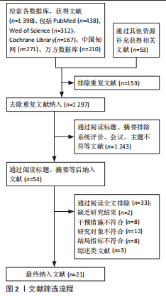
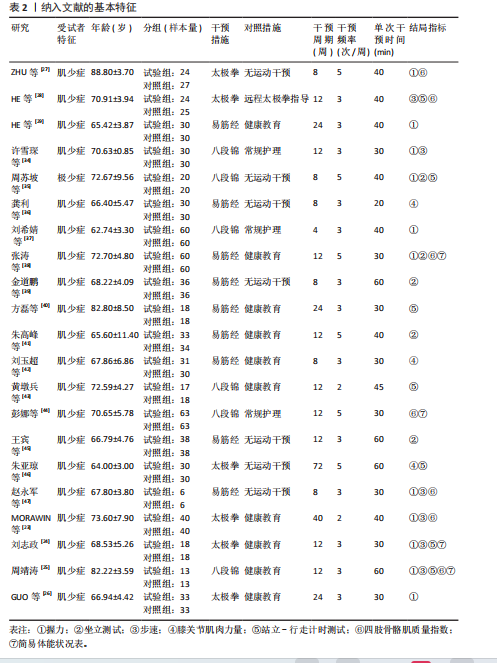
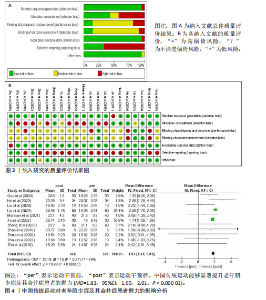
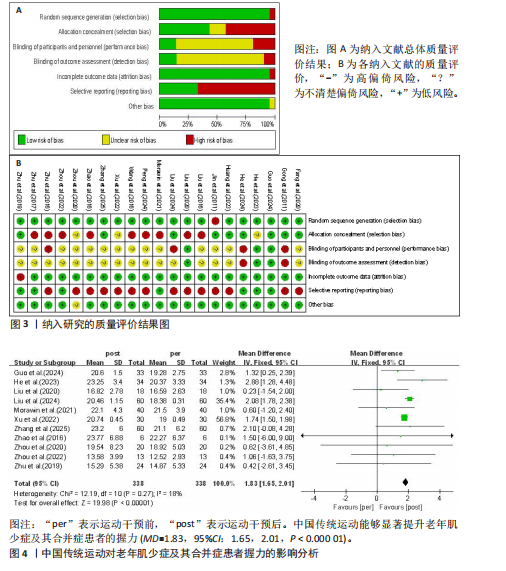
2.1 文献检索结果 此次研究全面检索多个国内外电子数据库,初检出相关文献1 451篇,首先运用EndNote进行查重处理,剔除重复文献154篇,剩余有效文献1 297篇;通过阅读标题与摘要进行初筛,依据研究主题和关键词共排除不相关文献1 243篇;按照预先制定的纳入与排除标准对剩余文献进行全文精读评估,最终纳入21项符合要求的研究[23-29,34-47]。 文献筛选流程详见图2。 2.2 纳入文献的特征 表2系统归纳了纳入文献的受试者特征、试验分组设计、运动干预方案以及用于评估老年肌少症及其合并症干预效果的结局指标。21项研究均为随机对照试验,试验受试者均为患有肌少症或合并骨质疏松的肌少骨质疏松症、合并肥胖的肌少症性肥胖与同时出现肥胖并伴有骨量减少的骨肌少症性肥胖的老年人,平均年龄70.3岁,符合老年肌少症研究对象的典型年龄特征;其中有19项研究所纳入的受试者年龄在65-75岁之间,表明该年龄段肌少症及其合并症患者是当前中国传统运动干预研究的主要人群。 纳入文献的运动干预方案主要包含运动方式、干预周期、运动频率和运动时间4个方面,"
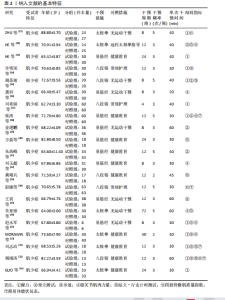
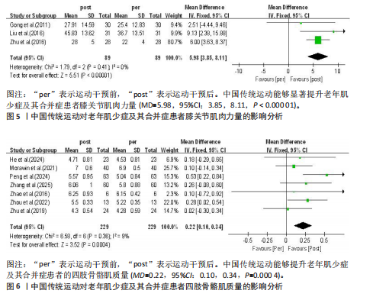
仅有少量研究对运动干预所采用的强度进行了说明。6项研究采用太极拳[23-24,26-28,46]、9项研究采用易筋经[29,36,38-42,45,47]、6项研究采用八段锦作为运动干预手段[25,34-35,37,43-44];干预周期介于4-72周,其中12周的运动周期占比最高,达45.5%(10项);每周运动频率为2-5次,每周3次的运动频率占比达63.6%(14项);单次运动干预时长为20-60 min,每次30 min的运动时长占比为40.9%(9项)。 2.3 纳入研究的偏倚风险 纳入文献的偏倚风险评估结果见图3,其中1篇文献判定为A级,21篇文献判定为B级,文献总体质量良好。 2.4 Meta分析结果 2.4.1 中国传统运动对老年肌少症及其合并症患者握力的影响 有11项随机对照试验报告了中国传统运动对老年肌少症及其合并症患者握力的干预效果,共纳入研究对象338例[23-27,29,34-35,37-38,47]。异质性检验结果显示各研究间的异质性较低(I2=18%,P=0.27),采用固定效应模型;采用Egger’s检验评估所纳入研究的发表偏倚,结果显示P=0.203,表明此次纳入的研究不存在发表偏倚,结果具有可靠性。Meta分析结果显示,中国传统运动能够显著提升老年肌少症及其合并症患者的握力(MD=1.83,95%CI:1.65,2.01,P < 0.000 01),见图4。 针对中国传统运动在不同干预参数条件下对患者握力的干预效应,亚组分析结果显示:根据效应值与P值比较,在不同的中国传统运动中,易筋经的改善效果最佳(MD=2.58,95%CI:1.30,3.85,P < 0.001);在运动周期方面,≤8周的干预效果最佳(MD=2.06,95%CI:1.76,2.35,P < 0.001),每周干预≤3次的改善"
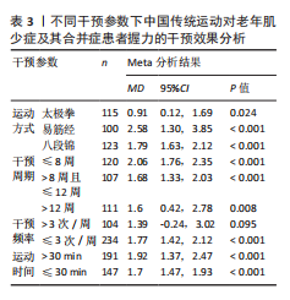
效果最佳(MD=1.77,95%CI:1.42,2.12,P < 0.001),单次运动> 30 min的改善效果最佳(MD=1.92,95%CI:1.37,2.47,P < 0.001),见表3。"
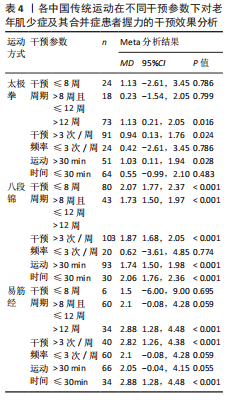
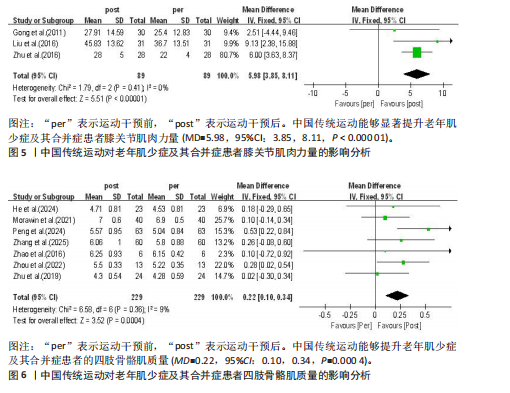
为进一步提高运动处方制定的针对性,此次研究对各类中国传统运动在不同干预参数条件下对患者握力改善的效应量进行了亚组分析,结果显示:对于太极拳,干预> 12周、每周干预> 3次且单次运动> 30 min的改善效果最佳;对于八段锦,干预≤8周、每周干预> 3次且单次运动≤30 min的改善效果最佳;对于易筋经,干预> 12周、每周干预> 3次且单次运动≤30 min的改善效果最佳,见表4。 2.4.2 中国传统运动对老年肌少症及其合并症患者膝关节肌肉力量的影响 有3项随机对照试验报告了中国传统运动对老年肌少症及其合并症患者膝关节肌肉力量的干预效果,共纳入研究对象89例[36,42,46]。 异质性检验结果显示各研究间不存在异质性(I2=0%,P=0.41),采用固定效应模型;采用Egger’s检验评估所纳入研究的发表偏倚,结果显示P=0.970,表明此次纳入的"
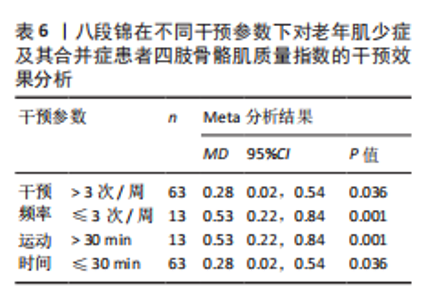
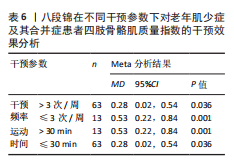
研究不存在发表偏倚,结果具有可靠性。Meta分析结果显示,中国传统运动能够显著提升老年肌少症及其合并症患者膝关节肌肉力量(MD=5.98,95%CI:3.85,8.11,P < 0.000 01),见图5。鉴于纳入研究在干预参数方面具有较高的同质性,故未对该指标进行亚组分析。 2.4.3 中国传统运动对老年肌少症及其合并症患者四肢骨骼肌质量指数的影响 7项随机对照试验报告了中国传统运动对老年肌少症及其合并症患者四肢骨骼肌质量指数的影响,共纳入研究对象229例[23,25,27-28,38,44,47]。异质性检验结果显示各研究间异质性较低(I2=9%,P=0.36),采用固定效应模型;采用Egger’s检验评估所纳入研究的发表偏倚,结果显示P=0.961,表明此次纳入的研究不存在发表偏倚,结果具有可靠性。Meta分析结果显示,中国传统运动能够提升老年肌少症及其合并症患者的四肢骨骼肌质量(MD=0.22,95%CI:0.10,0.34,P=0.000 4),见图6。 初步对中国传统运动整体在不同干预参数下对老年肌少症及其合并症患者四肢骨骼肌质量指数的干预效果进行比对,亚组分析结果显示:根据效应值与P值比较结果,在各类中国传统运动中八段锦的改善效果最佳(MD=0.38,95%CI:0.18,0.58,P < 0.001);运动> 8周且≤12周(MD=0.33,95%CI:0.17,0.49,P < 0.001)、每周干预≤3次(MD=0.27,95%CI:0.09,0.46,P=0.004)、单次运动> 30 min (MD=0.38,95%CI:0.16-0.60,P < 0.001)提升患者四肢骨骼肌质量的效果最佳,见表5。 由于太极拳与易筋经在初步亚组分析中显示对患者四肢骨骼肌质量指数的改善并不显著,因此,亚组分析仅针对八段锦在不同干预"
"
"
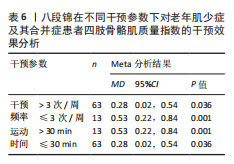
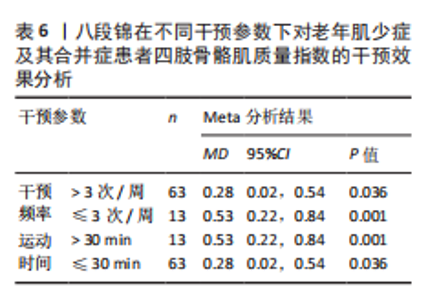
参数下产生的效应量进行分析,结果显示:运动干预12周、每周干预≤3次及单次运动> 30 min对患者四肢骨骼肌质量指数的改善效果最佳,见表6。需注意的是,由于相关研究数量较少,此次研究纳入的八段锦干预周期均为12周,因此无法比较不同运动干预周期下的效果差异。"
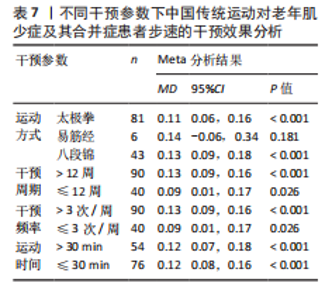
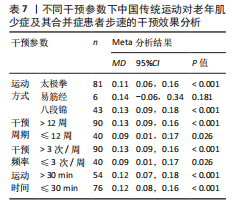
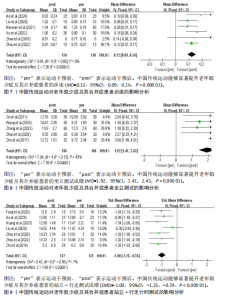
2.4.4 中国传统运动对老年肌少症及其合并症患者步速的影响 有6项随机对照试验报告了中国传统运动对老年肌少症及其合并症患者步速的干预效果,共纳入研究对象130例[23-25,28,34,47]。异质性检验结果显示各研究间存在中等异质性(I2=0%,P=0.60),采用固定效应模型;采用Egger’s检验评估所纳入研究的发表偏倚,结果显示P=0.504,表明此次纳入的研究不存在发表偏倚,结果具有可靠性。Meta分析结果显示,中国传统运动能够显著提升老年肌少症及其合并症患者的步速(MD=0.12,95%CI:0.09,0.16,P < 0.000 01),见图7。 初步对中国传统运动整体在不同干预参数下对老年肌少症及其合并症患者步速的干预效果进行比对,亚组分析结果显示,根据效应值与P值,在不同的中国传统运动中,太极拳(MD=0.11,95%CI:0.06,0.16,P < 0.001)与八段锦(MD=0.13,95%CI:0.09,0.18,P < 0.001)均可显著提升患者步速;运动> 12周(MD=0.13,95%CI:0.09,0.16,P < 0.001)、每周> 3次(MD=0.13,95%CI:0.09,0.16,P < 0.001)、单次运动> 30 min(MD=0.12,95%CI:0.07,0.18,P < 0.001)与≤30 min(MD=0.12,95%CI:0.08,0.16,P < 0.001)的干预效果最佳,见表7。"
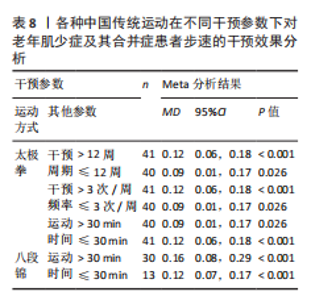
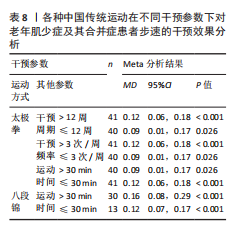
由于易筋经在初步亚组分析中显示对患者步速的改善并不显著,因此亚组分析仅针对八段锦与太极拳在不同干预参数下产生的效应量进行分析,结果显示:八段锦运动干预12周、每周干预3次及单次运动> 30 min对患者步速的改善效果最佳;太极拳干预> 12周、每周干预> 3次、单次运动≤30 min对患者步速的改善效果最佳,见表8。需注意的是,由于相关研究数量较少,此次研究纳入的八段锦干预周期均为12周,干预频率均为每周3次,因此无法比较不同运动干预周期与频率下的效果差异。"
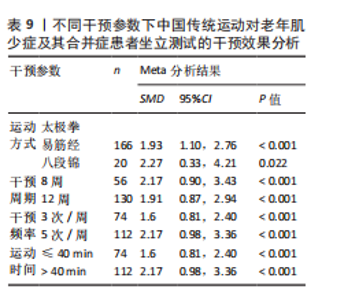
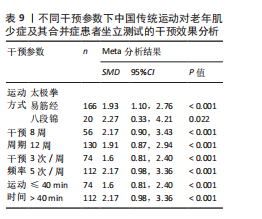
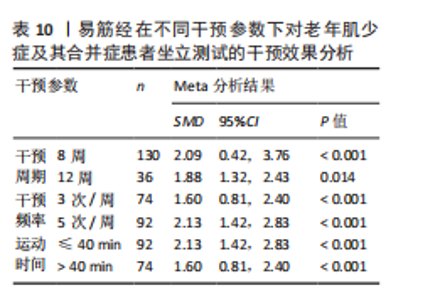
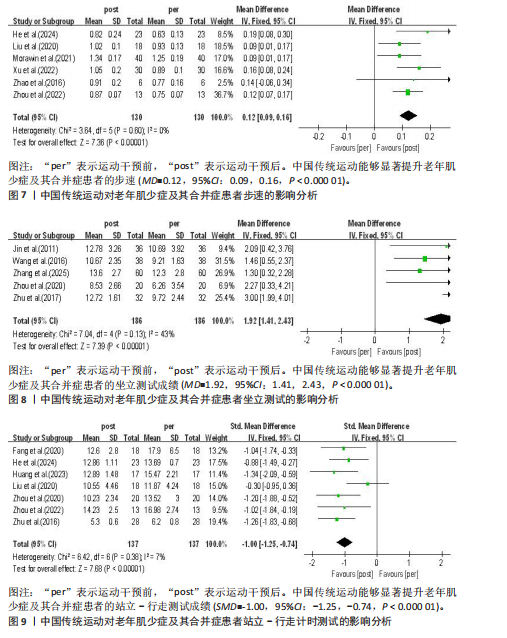
2.4.5 中国传统运动对老年肌少症及其合并症患者坐立测试的影响 有5项随机对照试验报告了中国传统运动对老年肌少症及其合并症患者坐立测试的干预效果,共纳入研究对象186例[35,38-39,41,45]。异质性检验结果显示各研究间存在中等异质性(I2=43%,P=0.13),采用固定效应模型;采用Egger’s检验评估所纳入研究的发表偏倚,结果显示P=0.691,表明此次纳入的研究不存在发表偏倚,结果具有可靠性。Meta分析结果显示,中国传统运动能够显著提升老年肌少症及其合并症患者的坐立测试成绩(MD=1.92,95%CI:1.41,2.43,P < 0.000 01),见图8。 初步对中国传统运动整体在不同干预参数下对老年肌少症及其合并症患者坐立测试的干预效果进行比对,亚组分析结果显示,根据效应值与P值,在不同的中国传统运动中,易筋经(MD=1.93,95%CI:1.10,2.76,P < 0.001)八段锦(MD=2.27,95%CI:0.33,4.21,P=0.022)均可显著提升老年肌少症及其合并症患者的坐立测试成绩;8周干预周期(MD=2.17,95%CI:0.90,3.43,P < 0.001)、每周干预5次(MD=2.17,95%CI:0.98,3.36,P < 0.001)与单次运动> 40 min(MD=2.17,95%CI:0.98,3.36,P < 0.001)对老年肌少症及其合并症坐立测试成绩效果的改善效果最佳,见表9。"
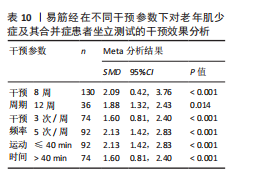
由于相关研究数量受限,在分析中国传统运动对老年肌少症及其合并症患者坐立测试成绩的效应量时,仅成功纳入1项采用八段锦进行干预的研究,未纳入采用太极拳进行干预的研究,因此亚组分析仅针对易筋经在不同干预参数下产生的效应量进行分析,结果显示:易筋经干预8周、每周干预5次及单次运动≤40 min对老年肌少症及其合并症患者坐立测试成绩的改善效果最佳,见表10。"
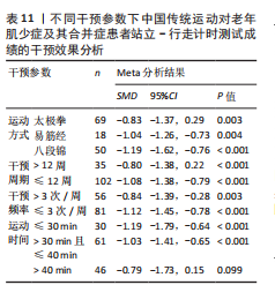
2.4.6 中国传统运动对老年肌少症及其合并症患者站立-行走计时测试的影响 有7项随机对照试验报告了中国传统运动对老年肌少症及其合并症患者站立-行走测试的干预效果,共纳入研究对象137例[24-25,28,35,40,43,46]。由于所纳入的研究测试中对站立-行走测试所采用的计量单位不同,因此该项分析采用SMD计算效应量。异质性检验结果显示各研究间的异质性较低(I2=7%,P=0.38),采用固定效应模型;采用Egger’s检验评估纳入研究的发表偏倚,结果显示P=0.874,表明此次纳入研究不存在发表偏倚,结果具有可靠性。Meta分析结果显示,中国传统运动能够显著提升老年肌少症及其合并症患者的站立-行走测试成绩(SMD=-1.00,95%CI:-1.25,-0.74,P < 0.000 01),见图9。 初步对中国传统运动整体在不同干预参数下对老年肌少症及其合并症患者站立-行走测试成绩的干预效果进行比对,亚组分析结果显示,根据效应值与P值,在不同的中国传统运动中,八段锦(SMD=-1.19,95%CI:-1.62,-0.76,P < 0.001)可显著提升老年肌少症及其合并症患者的站立-行走测试成绩;干预≤12周(SMD=-1.08,95%CI:-1.38,-0.79,P < 0.001)、每周干预≤3次(SMD=-1.12,95%CI:-1.45,-0.78,P < 0.001)与单次运动时间≤30 min(SMD=-1.19,95%CI:-1.79,-0.64, P < 0.001)改善老年肌少症及其合并症患者站立-行走测试成绩的效果最佳,见表11。"
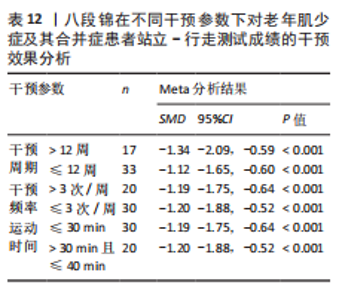
由于太极拳在初步亚组分析中对老年肌少症及其合并症患者站立-行走测试成绩的改善并不显著,并且仅纳入了一项采用易筋经作为干预手段的相关研究,因此亚组分析仅针对八段锦在不同干预参数下产生的效应量进行分析,结果显示:八段锦干预> 12周、每周干 预≤3次及单次运动> 30 min且≤40 min对老年肌少症及其合并症患者站立-行走测试成绩的改善效果最佳,见表12。"
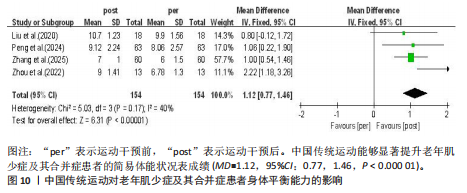
2.4.7 中国传统运动对老年肌少症及其合并症患者简易体能状况表成绩的影响 4项随机对照试验系统探讨了中国传统运动对老年肌少症及其合并症患者简易机体功能评估成绩的干预效果,涉及研究对象154例[24-25,38,44]。 异质性检验结果显示各研究间存在中等异质性(I2=40%,P=0.17),采用固定效应模型;采用"
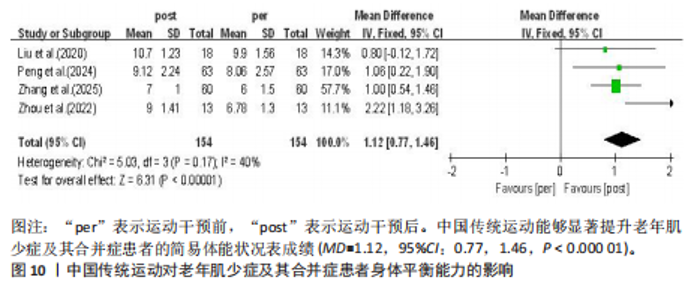
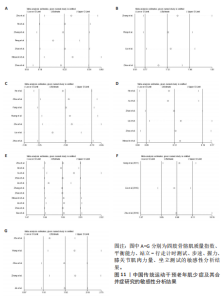
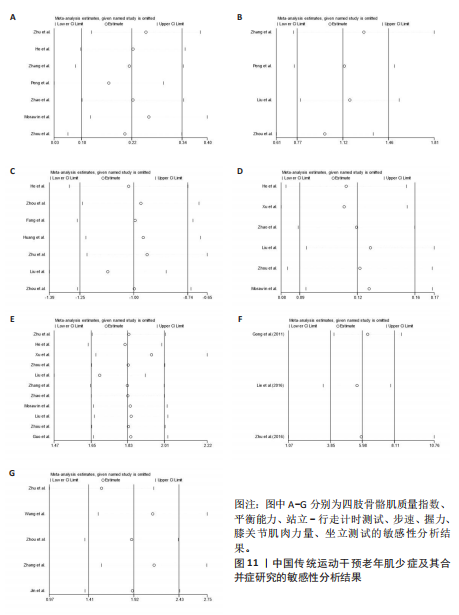
Egger’s检验评估所纳入研究的发表偏倚,结果显示P=0.496,表明各研究不存在发表偏倚,结果具有可靠性。Meta分析结果显示,中国传统运动能够显著提升老年肌少症及其合并症患者的简易体能状况表成绩(MD=1.12,95%CI:0.77,1.46,P < 0.000 01),见图10。 鉴于纳入研究在干预参数方面具有较高的同质性,故未对该指标进行亚组分析。 2.5 敏感性分析 采用逐一剔除法对各项结局指标进行敏感性分析,结果显示各研究的合并效应量未发生显著变化(图11),表明此次Meta分析的结果具有较高的稳健性。"
"
| [1] CRUZ-JENTOFT AJ, BAEYENS JP, BAUER JM, et al. Sarcopenia: European consensus on definition and diagnosis: Report of the European Working Group on Sarcopenia in Older People. Age Ageing. 2010;39(4):412-423. [2] CAO L, MORLEY JE. Sarcopenia Is Recognized as an Independent Condition by an International Classification of Disease, Tenth Revision, Clinical Modification (ICD-10-CM) Code. J Am Med Dir Assoc. 2016;17(8):675-677. [3] GAO Y, LIU D, XIAO Q, et al. Exploration of Pathogenesis and Cutting-Edge Treatment Strategies of Sarcopenia: A Narrative Review. Clin Interv Aging. 2025;20:659-684. [4] LIU P, HAO Q, HAI S, et al. Sarcopenia as a predictor of all-cause mortality among community-dwelling older people: A systematic review and meta-analysis. Maturitas. 2017;103:16-22. [5] NIELSON CM, SRIKANTH P, ORWOLL ES. Obesity and fracture in men and women: an epidemiologic perspective. J Bone Miner Res. 2012;27(1):1-10. [6] ORMSBEE MJ, PRADO CM, ILICH JZ, et al. Osteosarcopenic obesity: the role of bone, muscle, and fat on health. J Cachexia Sarcopenia Muscle. 2014;5(3):183-192. [7] 孙嘉禾,史冀鹏,朱天瑞,等.运动对肌少症及其合并症老年人影响的Meta分析[J].中国组织工程研究,2026,30(4):997-1007. [8] KIM TN, PARK MS, YANG SJ, et al. Prevalence and determinant factors of sarcopenia in patients with type 2 diabetes: the Korean Sarcopenic Obesity Study. Diabetes Care. 2010;33(7):1497-1499. [9] ZHANG H, WANG J, XI J, et al. Functional fitness and risk factors of older patients with diabetes combined with sarcopenia and/or frailty: A cross-sectional study. Nursing open. 2024;11(1): e2042-e2042. [10] PÉREZ-ZEPEDA MU, SGARAVATTI A, DENT E. Sarcopenia and post-hospital outcomes in older adults: A longitudinal study. Arch Gerontol Geriatr. 2017;69:105-109. [11] GASKIN FS, FARR SA, BANKS WA, et al. Ghrelin-induced feeding is dependent on nitric oxide. Peptides. 2003;24(6):913-918. [12] WU PY, HUANG KS, CHEN KM, et al. Exercise, Nutrition, and Combined Exercise and Nutrition in Older Adults with Sarcopenia: A Systematic Review and Network Meta-analysis. Maturitas. 2021;145:38-48. [13] CHEN HT, CHUNG YC, CHEN YJ, et al. Effects of Different Types of Exercise on Body Composition, Muscle Strength, and IGF-1 in the Elderly with Sarcopenic Obesity. J Am Geriatr Soc. 2017;65(4): 827-832. [14] HASSAN BH, HEWITT J, KEOGH JW, et al. Impact of resistance training on sarcopenia in nursing care facilities: A pilot study. Geriatr Nurs. 2016;37(2):116-121. [15] DE SÁ SOUZA H, DE MELO CM, PIOVEZAN RD, et al. Resistance Training Improves Sleep and Anti-Inflammatory Parameters in Sarcopenic Older Adults: A Randomized Controlled Trial. Int J Environ Res Public Health. 2022;19(23):16322. [16] ZHANG Y, HUANG L, SU Y, et al. The Effects of Traditional Chinese Exercise in Treating Knee Osteoarthritis: A Systematic Review and Meta-Analysis. PLoS One. 2017;12(1):e0170237. [17] 贾冕,王正珍,李博文.中医运动处方的起源与发展[J].体育科学,2017,37(10):65-71,89. [18] ZHOU Z, ZHOU R, LI K, et al. Effects of tai chi on physiology, balance and quality of life in patients with type 2 diabetes: A systematic review and meta-analysis. J Rehabil Med. 2019;51(6):405-417. [19] ZHANG Y, LIU H, ZHOU L, et al. Applying Tai Chi as a rehabilitation program for stroke patients in the recovery phase: study protocol for a randomized controlled trial. Trials. 2014;15:484. [20] WU S, LU Z, LI Z, et al. The efficacy of Tai Chi for intervention treatment of myocardial infarction: A protocol for systematic review and meta-analysis. Medicine (Baltimore). 2021;100(46):e27584. [21] ZHENG G, CHEN B, FANG Q, et al. Primary prevention for risk factors of ischemic stroke with Baduanjin exercise intervention in the community elder population: study protocol for a randomized controlled trial. Trials. 2014;15:113. [22] BARRADO-MARTÍN Y, HEWARD M, POLMAN R, et al. People living with dementia and their family carers’ adherence to home-based Tai Chi practice. Dementia (London). 2021;20(5):1586-1603. [23] MORAWIN B, TYLUTKA A, CHMIELOWIEC J, et al. Circulating Mediators of Apoptosis and Inflammation in Aging; Physical Exercise Intervention. Int J Environ Res Public Health. 2021; 18(6):3165. [24] 刘志政.太极拳对增龄性肌肉减少症的干预效果研究[D].济宁:曲阜师范大学,2020. [25] 周靖涛.八段锦对老年肌少症的干预效果研究[D].湘潭:湖南科技大学,2022. [26] GUO H, CAO J, HE S, et al. Quantifying the Enhancement of Sarcopenic Skeletal Muscle Preservation Through a Hybrid Exercise Program: Randomized Controlled Trial. JMIR Aging. 2024;7: e58175. [27] ZHU YQ, PENG N, ZHOU M, et al. Tai Chi and whole-body vibrating therapy in sarcopenic men in advanced old age: a clinical randomized controlled trial. Eur J Ageing. 2019;16(3):273-282. [28] HE S, MENG D, WEI M, et al. Proposal and validation of a new approach in tele-rehabilitation with 3D human posture estimation: a randomized controlled trial in older individuals with sarcopenia. BMC Geriatr. 2024;24(1):586. [29] HE S, WEI M, MENG D, et al. Self-determined sequence exercise program for elderly with sarcopenia: A Randomized controlled trial with clinical assistance from explainable artificial intelligence. Arch Gerontol Geriatr. 2024;119: 105317. [30] HUANG CY, MAYER PK, WU MY, et al. The effect of Tai Chi in elderly individuals with sarcopenia and frailty: A systematic review and meta-analysis of randomized controlled trials. Ageing Res Rev. 2022;82:101747. [31] NIU K, LIU YL, YANG F, et al. Efficacy of traditional Chinese exercise for sarcopenia: A systematic review and meta-analysis of randomized controlled trials. Front Neurosci. 2022;16:1094054. [32] LIBERATI A, ALTMAN DG, TETZLAFF J, et al. The PRISMA statement for reporting systematic reviews and meta-analyses of studies that evaluate healthcare interventions: Explanation and elaboration. BMJ. 2009;339:b2700. [33] HIGGINS JP, ALTMAN DG, GØTZSCHE PC, et al. The Cochrane Collaboration’s tool for assessing risk of bias in randomised trials. BMJ. 2011;343:d5928. [34] 许雪琛,郭恒群,林健.八段锦联合抗阻运动干预老年肌少症30例[J].福建中医药,2022, 53(11):60-62. [35] 周苏坡,邹颖,孙小斐,等.八段锦预防老年肌少症人群跌倒的研究[J].体育科技,2020,41(6): 27-28+30. [36] 龚利,严隽陶,刘玉超,等.推拿功法易筋经对老年骨骼肌减少症患者等速肌力的影响[J].上海中医药大学学报,2011,25(3):55-58. [37] 刘希婧,华馨,严莉,等.以护理为导向的八段锦联合杵针八阵穴疗法对肝硬化肌少症病人的干预效果[J].循证护理,2024,10(12):2177-2180. [38] 张涛,马天翼,骆丽,等.易筋经对老年肌少症患者肌肉力量及慢性炎症的影响[J].南京中医药大学学报,2025,41(3):399-404. [39] 金道鹏,徐俊,赵吉忠,等.推拿功法易筋经对骨骼肌减少症患者日常活动能力及体质的影响[J].中国中医药信息杂志,2011,18(1):14-16. [40] 方磊,李振瑞,陶旭辰,等.易筋经对老年骨骼肌减少症平衡障碍患者跌倒风险影响的临床研究[J].中国康复医学杂志,2020,35(3):319-323. [41] 朱高峰,沈志方,沈清河,等.易筋经对老年人骨骼肌肌力的影响(英文)[J].Journal of Acupuncture and Tuina Science. 2017,15(6):434-439. [42] 刘玉超,严隽陶,王振裕,等.易筋经对老年骨骼肌减少症骨骼肌收缩功能的影响[J].上海中医药大学学报,2016,30(5):42-45. [43] 黄墩兵,林忠华,姜财,等.全身振动训练联合八段锦运动对老年肌少症患者姿势稳定性的影响[J].中国康复,2023,38(7):430-433. [44] 彭娜,苗笛,王红,等.八段锦联合血流限制训练对老年肌少症的应用效果研究[J].中华保健医学杂志,2024,26(3):332-335. [45] 王宾,马士荣,胡莺.健身气功易筋经锻炼对骨骼肌减少症患者康复效果的影响[J].中国老年学杂志,2016,36(4):898-899. [46] 朱亚琼,彭楠,周明.太极拳对老年人下肢肌力及功能的影响[J].中国中西医结合杂志,2016, 36(1):49-53. [47] 赵永军,张育民,郭艳花,等.推拿结合抗阻运动对骨骼肌衰减症患者日常生活活动能力的影响[J].中国康复医学杂志,2016,31(9):989-994. [48] PAPADOPOULOU SK. Sarcopenia: A Contemporary Health Problem among Older Adult Populations. Nutrients. 2020;12(5):1293. [49] YU X, CHAU JPC, HUO L. The effectiveness of traditional Chinese medicine-based lifestyle interventions on biomedical, psychosocial, and behavioral outcomes in individuals with type 2 diabetes: A systematic review with meta-analysis. Int J Nurs Stud. 2018;80:165-180. [50] CHEN J, ZHOU R, FENG Y, et al. Molecular mechanisms of exercise contributing to tissue regeneration. Signal Transduct Target Ther. 2022; 7(1):383. [51] JÄGER S, HANDSCHIN C, ST-PIERRE J, et al. AMP-activated protein kinase (AMPK) action in skeletal muscle via direct phosphorylation of PGC-1alpha. Proc Natl Acad Sci U S A. 2007;104(29):12017-12022. [52] JUNG S, KIM K. Exercise-induced PGC-1α transcriptional factors in skeletal muscle. Integr Med Res. 2014;3(4):155-160. [53] ZHOU M, LIAO H, SREEPADA LP, et al. Tai Chi Improves Brain Metabolism and Muscle Energetics in Older Adults. J Neuroimaging. 2018;28(4):359-364. [54] 史仍飞.骨骼肌生长与适应的机械信号与途径[J].中国组织工程研究与临床康复,2010,14(24): 4507-4511. [55] ZHU WG, THOMAS AC, WILSON GM, et al. Identification of a resistance-exercise-specific signalling pathway that drives skeletal muscle growth. Nat Metab. 2025;7(7):1404-1423. [56] FENG L, LI B, YONG SS, et al. Exercise and nutrition benefit skeletal muscle: From influence factor and intervention strategy to molecular mechanism. Sports Med Health Sci. 2024;6(4):302-314. [57] LAI CC, TU YK, WANG TG, et al. Effects of resistance training, endurance training and whole-body vibration on lean body mass, muscle strength and physical performance in older people: a systematic review and network meta-analysis. Age Ageing. 2018;47(3):367-373. [58] LU L, MAO L, FENG Y, et al. Effects of different exercise training modes on muscle strength and physical performance in older people with sarcopenia: a systematic review and meta-analysis. BMC Geriatr. 2021;21(1):708. [59] MALICDAN MC, NOGUCHI S, NONAKA I, et al. Lysosomal myopathies: an excessive build-up in autophagosomes is too much to handle. Neuromuscul Disord. 2008;18(7):521-529. [60] BAMMAN MM, SHIPP JR, JIANG J, et al. Mechanical load increases muscle IGF-I and androgen receptor mRNA concentrations in humans. Am J Physiol Endocrinol Metab. 2001;280(3):E383-390. [61] SOMMER A, KORDOWSKI F, BÜCH J, et al. Phosphatidylserine exposure is required for ADAM17 sheddase function. Nat Commun. 2016;7:11523. [62] ZADA FSM, NASERI K, ZALMAI MR. Effects of exercise training on blood circulation system. Sprin J Arts Humanit Soc Sci. 2024;3(5):87-90. [63] SCHOENFELD BJ. Science and development of muscle hypertrophy. Human Kinetics; 2020. [64] CUI H, WANG Z, WU J, et al. Chinese expert consensus on prevention and intervention for elderly with sarcopenia (2023). Aging Med (Milton). 2023;6(2):104-115. [65] HÄKKINEN K, ALEN M, KALLINEN M, et al. Neuromuscular adaptation during prolonged strength training, detraining and re-strength-training in middle-aged and elderly people. Eur J Appl Physiol. 2000;83(1):51-62. [66] LEMMER JT, HURLBUT DE, MARTEL GF, et al. Age and gender responses to strength training and detraining. Med Sci Sports Exerc. 2000;32(8): 1505-1512. [67] 周明,彭楠,黎春华,等.太极拳训练对老年人下肢骨骼肌肌力的影响趋势分析[J].中国康复医学杂志,2014,29(11):1050-1054. [68] MARX W, VERONESE N, KELLY JT, et al. The Dietary Inflammatory Index and Human Health: An Umbrella Review of Meta-Analyses of Observational Studies. Adv Nutr. 2021;12(5):1681-1690. [69] PAN L, XIE W, FU X, et al. Inflammation and sarcopenia: A focus on circulating inflammatory cytokines. Exp Gerontol. 2021;154:111544. [70] 周术锋,王芳,彭永,等.12周太极拳联合渐进抗阻运动对膝关节骨性关节炎患者微循环功能及炎性因子的影响[J].中国体育科技,2023, 59(3):44-49. [71] 陈辉,周亚娜.太极拳锻炼对老年高血压患者血清TNF-α和IL-6水平的影响[J].中国老年学杂志,2012,32(11):2361-2362. [72] LADAWAN S, KLAROD K, PHILIPPE M, et al. Effect of Qigong exercise on cognitive function, blood pressure and cardiorespiratory fitness in healthy middle-aged subjects. Complement Ther Med. 2017;33:39-45. [73] LAURENT MR, DUBOIS V, CLAESSENS F, et al. Muscle-bone interactions: From experimental models to the clinic? A critical update. Mol Cell Endocrinol. 2016;432:14-36. [74] 刘魏,童培建,肖鲁伟,等.益骨汤口服联合太极拳锻炼治疗老年性骨质疏松症肾阳虚证[J].中医正骨,2018,30(11):6-12. [75] CHO MR, LEE S, SONG SK. A Review of Sarcopenia Pathophysiology, Diagnosis, Treatment and Future Direction. J Korean Med Sci. 2022;37(18):e146. [76] 王素素,李丽凤,张一民.运动干预老年人肌少症近10年研究进展及国际热点可视化分析[J].中国组织工程研究,2022,26(14):2223-2230. [77] COCHET C, BELLONI G, BUONDONNO I, et al. The Role of Nutrition in the Treatment of Sarcopenia in Old Patients: From Restoration of Mitochondrial Activity to Improvement of Muscle Performance, a Systematic Review. Nutrients. 2023;15(17):3703. [78] CAVALLUCCI V, PANI G. The Leucine Catabolite and Dietary Supplement β-Hydroxy-β-Methyl Butyrate (HMB) as an Epigenetic Regulator in Muscle Progenitor Cells. Metabolites. 2021; 11(8):512. [79] ERICKSON KI, VOSS MW, PRAKASH RS, et al. Exercise training increases size of hippocampus and improves memory. Proc Natl Acad Sci U S A. 2011;108(7):3017-3022. [80] 欧春影,李传玲,安晓雷,等.急性脑梗死患者血清BDNF、IL-6和TNF-α含量与血管性认知障碍关系的临床分析[J].中华脑科疾病与康复杂志(电子版),2019,9(3):163-167. [81] DICKSTEIN R, DEUTSCH JE. Motor imagery in physical therapist practice. Phys Ther. 2007;87(7): 942-953. [82] TAO J, CHEN X, EGOROVA N, et al. Tai Chi Chuan and Baduanjin practice modulates functional connectivity of the cognitive control network in older adults. Sci Rep. 2017;7:41581. [83] GUO LY, YANG CP, YOU YL, et al. Underlying mechanisms of Tai-Chi-Chuan training for improving balance ability in the elders. Chin J Integr Med. 2014;20(6):409-415. [84] 刘玉超,王振裕,方磊,等.易筋经对老年骨骼肌减少症者动态平衡能力的影响[J].河北中医药学报,2014,29(4):9-11. [85] XIAO Y, LUO Q, YU Y, et al. Effect of baduanjin on the fall and balance function in middle-aged and elderly people: A protocol for systematic review and meta-analysis. Medicine (Baltimore). 2021;100(37):e27250. [86] 翟凤鸣,陈玉娟,黄志芳,等.八段锦运动对老年人生理功能的影响[J].中国老年学杂志, 2013,33(6):1402-1404. [87] 王利凯,萧禹,王立童.经皮耳迷走神经电刺激联合经颅直流电刺激对脑卒中患者上肢功能的影响[J].中国康复,2023,38(11):659-663. [88] NIU Y, BURANARUGSA R, KUHIRUNYARATN P. Comparing the Effects of Bafa Wubu Tai Chi and Traditional He-Style Tai Chi Exercises on Physical Health Risk Factors in Overweight Male College Students: A Randomized Controlled Trial. Int J Environ Res Public Health. 2023;20(14):6323. [89] AN B, DAI K, ZHU Z, et al. Baduanjin alleviates the symptoms of knee osteoarthritis. J Altern Complement Med. 2008;14(2):167-174. [90] WANG C, LIANG J, SI Y, et al. The effectiveness of traditional Chinese medicine-based exercise on physical performance, balance and muscle strength among older adults: a systematic review with meta-analysis. Aging Clin Exp Res. 2022;34(4):725-740. [91] DE ANGELIS C, DRAZEN JM, FRIZELLE FA, et al. Clinical trial registration: a statement from the International Committee of Medical Journal Editors. Lancet. 2004;364(9438):911-912. |
| [1] | He Yixiang, Qiao Wanjia, Wang Wenji. Effectiveness and safety of tranexamic acid versus epsilon-aminocaproic acid in total hip and knee arthroplasties: a meta-analysis [J]. Chinese Journal of Tissue Engineering Research, 2026, 30(9): 2361-2369. |
| [2] | Liu Jinlong, Abuduwupuer·Haibier, Bai Zhen, Su Danyang, Miao Xin, Li Fei, Yang Xiaopeng. Efficacy of different nonsurgical treatments for adolescent idiopathic scoliosis: a systematic review and network meta-analysis [J]. Chinese Journal of Tissue Engineering Research, 2026, 30(9): 2370-2379. |
| [3] | Wang Zheng, Cheng Ji, Yu Jinlong, Liu Wenhong, Wang Zhaohong, Zhou Luxing. Progress and future perspectives on the application of hydrogel materials in stroke therapy [J]. Chinese Journal of Tissue Engineering Research, 2026, 30(8): 2081-2090. |
| [4] | Gao Feng, Zhang Jun, Yu Wenjun, Chanyu Yujing, Zhao Le, Hu Yuting, Wang Junhua, Liu Yongfu. Effects of wrist-hand orthosis on hand dysfunction in stroke patients: a meta-analysis [J]. Chinese Journal of Tissue Engineering Research, 2026, 30(8): 2124-2131. |
| [5] | Wang Zhenze, Liu Fende, Zhang Rui, Li Wujun. Mesenchymal stem cells in treatment of arteriosclerosis obliterans of lower extremities: systematic review and meta-analysis [J]. Chinese Journal of Tissue Engineering Research, 2026, 30(7): 1869-1876. |
| [6] | Xu Hao, Ding Lu, Li Xiao. Mechanical effect of mechanical wear of abutment screws on the Morse taper connection implant system: a three-dimensional finite element analysis [J]. Chinese Journal of Tissue Engineering Research, 2026, 30(6): 1375-1383. |
| [7] | Zhong Caihong, Xiao Xiaoge, Li Ming, Lin Jianhong, Hong Jing. Biomechanical mechanism of sports-related patellar tendinitis [J]. Chinese Journal of Tissue Engineering Research, 2026, 30(6): 1417-1423. |
| [8] | Zheng Yin, Wu Zhenhua, Zhang Cheng, Ruan Kexin, Gang Xiaolin, Ji Hong. Safety and efficacy of immunoadsorption therapy for rheumatoid arthritis: a network meta-analysis and systematic review [J]. Chinese Journal of Tissue Engineering Research, 2026, 30(5): 1260-1268. |
| [9] | Chen Qiang, Wu Wenjuan, Jiang Shuhua, Huang Da. Physical exercise improves physical function in burn patients: a systematic review and meta-analysis [J]. Chinese Journal of Tissue Engineering Research, 2026, 30(5): 1269-1281. |
| [10] | Leng Xiaoxuan, Zhao Yuxin, Liu Xihua. Effects of different neuromodulatory stimulation modalities on non-motor symptoms in Parkinson’s patients: a network meta-analysis [J]. Chinese Journal of Tissue Engineering Research, 2026, 30(5): 1282-1293. |
| [11] | Wen Xiaolong, Weng Xiquan, Feng Yao, Cao Wenyan, Liu Yuqian, Wang Haitao. Effects of inflammation on serum hepcidin and iron metabolism related parameters in patients with type 2 diabetes mellitus: a meta-analysis [J]. Chinese Journal of Tissue Engineering Research, 2026, 30(5): 1294-1301. |
| [12] | Wei Bo, Qiu Jiangang. Double lactate threshold exercise training: development context, basic connotation, application effect and mechanism of action [J]. Chinese Journal of Tissue Engineering Research, 2026, 30(4): 964-974. |
| [13] | Jiang Yang, Peng Hao, Song Yanping, Yao Na, Song Yueyu, Yin Xingxiao, Li Yanqi, Chen Qigang. Isometric exercise reduces resting blood pressure: a meta-analysis of moderating factors and dose effects [J]. Chinese Journal of Tissue Engineering Research, 2026, 30(4): 975-986. |
| [14] | Li Hanyue, Li Yini, Xiang Linmei, Li Sen. Effects of resistance exercise therapy on pain and function in patients with cervical spondylotic radiculopathy: a meta-analysis [J]. Chinese Journal of Tissue Engineering Research, 2026, 30(4): 987-996. |
| [15] | Sun Jiahe, Shi Jipeng, Zhu Tianrui, Quan Helong, Xu Hongqi. Effect of exercise intervention in elderly individuals with sarcopenia and its comorbidities: a meta-analysis [J]. Chinese Journal of Tissue Engineering Research, 2026, 30(4): 997-1007. |
| Viewed | ||||||
|
Full text |
|
|||||
|
Abstract |
|
|||||