Chinese Journal of Tissue Engineering Research ›› 2026, Vol. 30 ›› Issue (24): 6182-6188.doi: 10.12307/2026.166
Previous Articles Next Articles
Mechanical loading of the patellofemoral joint and its correlation with various body mass indices in older adults practicing Tai Chi exercises
Li Guangmin1, Wang Jiangna2
- 1Public Basic Education Department (Sports Department), Zhejiang Industry Polytechnic College, Shaoxing 312000, Zhejiang Province, China; 2College of Sports and Health, Shandong Institute of Physical Education, Jinan 250102, Shandong Province, China
-
Received:2025-06-06Revised:2025-09-06Online:2026-08-28Published:2026-01-28 -
Contact:Wang Jiangna, MS, Associate professor, College of Sports and Health, Shandong Institute of Physical Education, Jinan 250102, Shandong Province, China -
About author:Li Guangmin, MS, Lecturer, Public Basic Education Department (Sports Department), Zhejiang Industry Polytechnic College, Shaoxing 312000, Zhejiang Province, China

CLC Number:
Cite this article
Li Guangmin, Wang Jiangna. Mechanical loading of the patellofemoral joint and its correlation with various body mass indices in older adults practicing Tai Chi exercises[J]. Chinese Journal of Tissue Engineering Research, 2026, 30(24): 6182-6188.
share this article
Add to citation manager EndNote|Reference Manager|ProCite|BibTeX|RefWorks
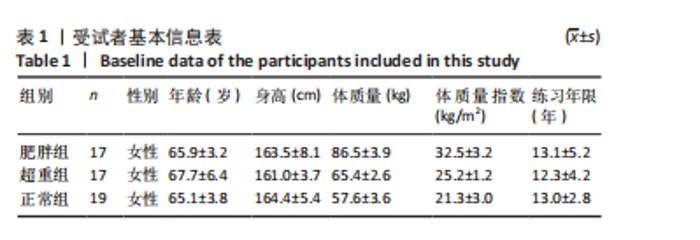
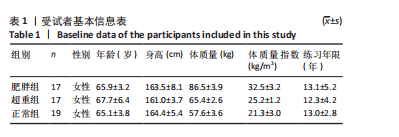
2.1 参与者数量分析 参加试验的53名受试者在整个研究中无脱落,所有测试数据均进入结果分析。 2.2 各组基线资料比较 各组受试者基本资料经统计学分析,年龄、身高、练习年限差异无显著性意义(P > 0.05),体质量、体质量指数差异有显著性意义(P < 0.05),见表1。"
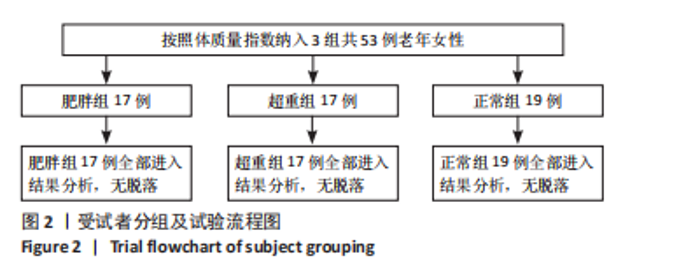
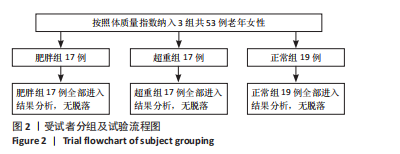
2.3 试验流程图 见图2。"
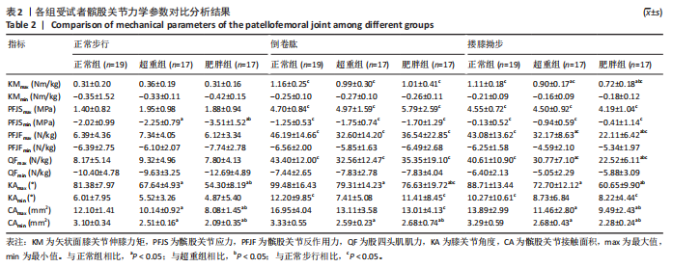
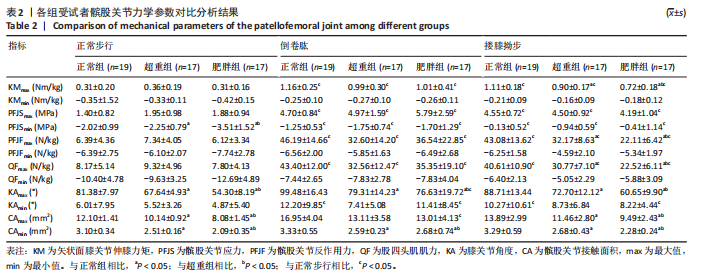
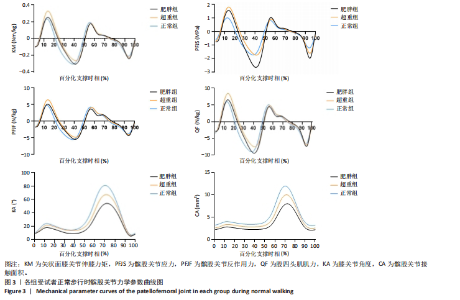
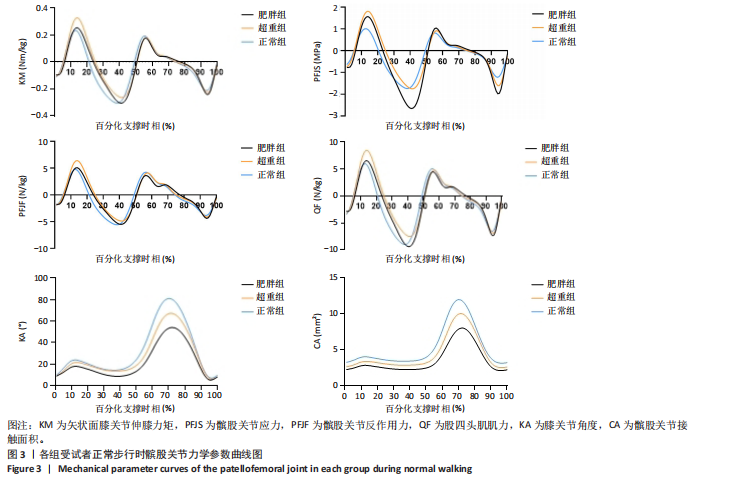
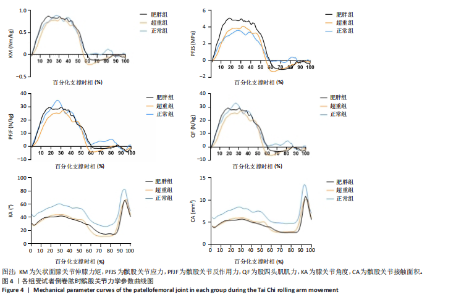
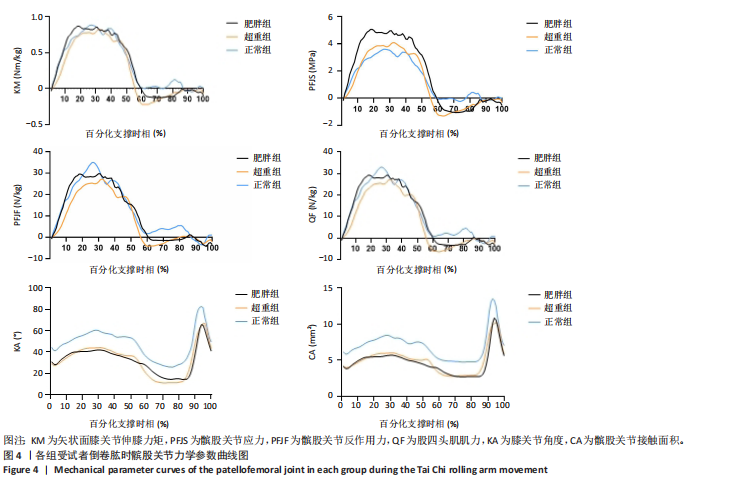
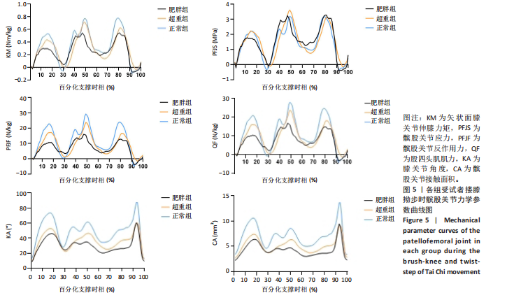
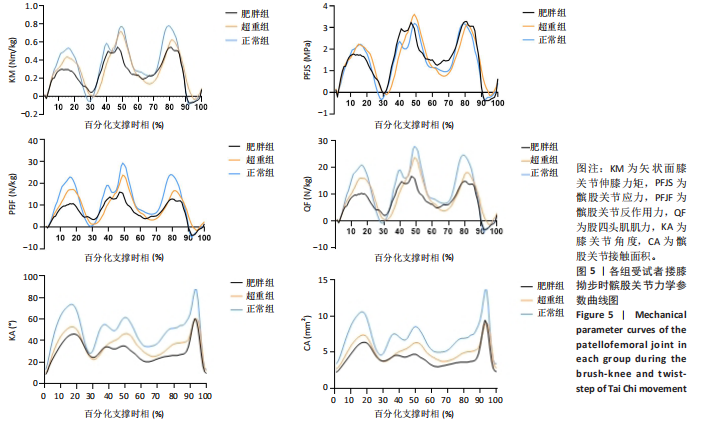
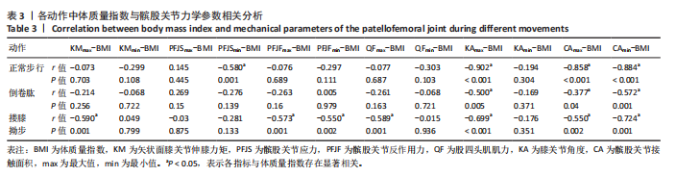
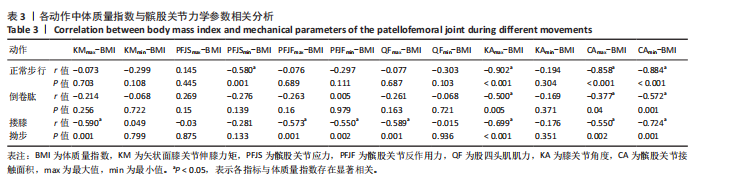
2.4 髌股关节动态载荷 在正常步行中,超重组、肥胖组的膝关节角度最大值(P < 0.05)、髌股关节接触面积最大值(P < 0.05)、髌股关节应力最小值(P < 0.05)、髌股关节接触面积最小值(P < 0.05)均显著小于正常组。在倒卷肱动作中,超重组、肥胖组的膝关节角度最大值(P < 0.05)、髌股关节接触面积最小值(P < 0.05)显著小于正常组。在搂膝拗步动作中,超重组、肥胖组的矢状面膝关节伸膝力矩最大值(P < 0.05)、髌股关节应力最大值(P < 0.05)、髌股关节反作用力最大值(P < 0.05)、股四头肌肌力最大值 (P < 0.05)、膝关节角度最大值(P < 0.05)、髌股关节接触面积最大值(P < 0.05)、髌股关节接触面积最小值均显著小于正常组(表2)。 相比于步行,正常组与肥胖组人群倒卷肱、搂膝拗步动作中矢状面膝关节伸膝力矩最大值(P < 0.001)、髌股关节应力最大值(P < 0.05)、髌股关节应力最小值(P < 0.05)、髌股关节反作用力最大值(P < 0.05)、股四头肌肌力最大值(P < 0.05)、膝关节角度最小值(P < 0.05)均显著增大;超重组人群倒卷肱、搂膝拗步动作中矢状面膝关节伸膝力矩最大值(P < 0.001)、髌股关节应力最大值(P < 0.05)、髌股关节应力最小值(P < 0.05)、髌股关节反作用力最大值(P < 0.05)、股四头肌肌力最大值(P < 0.05)均显著增大(表2)。 3组老年人在正常步行、倒卷肱、搂膝拗步3个动作中,矢状面膝关节伸膝力矩、髌股关节应力、髌股关节反作用力、股四头肌肌力指标的各曲线呈现出相同的趋势,膝关节角度、髌股关节接触面积曲线趋势一致。在正常步行中,3组老年人矢状面膝关节伸膝力矩、髌股关节应力、髌股关节反作用力、股四头肌肌力曲线均呈现出“双峰双谷”的趋势,双峰分别出现在步行周期约15%,55%,双谷分别出现在步行周期约40%,95%;膝关节角度、髌股关节接触面积也呈现出“双峰一谷”的趋势,第一峰值出现在步行周期的15%,第二峰值非常突出,在步行周期70%;谷值与矢状面膝关节伸膝力矩、髌股关节应力、髌股关节反作用力、股四头肌肌力大致相同,分别出现在步行周期约40%,95%(图3)。倒卷肱动作中,3组老年人矢状面膝关节伸膝力矩、髌股关节应力、髌股关节反作用力、股四头肌肌力曲线均呈现出“前高后低”的趋势,在倒卷肱动作周期的20%-40%呈现出一个“峰值期”,在动作周期的60%-100%呈现大致平滑的“谷值期”;膝关节角度、髌股关节接触面积则呈现出“双峰一谷”趋势,峰值约出现在倒卷肱动作周期的30%,95%,“谷值期”则在倒卷肱动作周期的70%-85%(图4)。搂膝拗步动作中,矢状面膝关节伸膝力矩、髌股关节应力、髌股关节反作用力、股四头肌肌力均呈现“三峰三谷”趋势,其3个峰值分别出现在动作周期的15%,50%,85%,3个谷值分别出现在动作周期的30%,65%,90%;膝关节角度、髌股关节接触面积则呈现出“三峰两谷”趋势,3个峰值分别出现在动作周期的18%,50%,95%,两谷值约在动作周期的30%,65%;股四头肌肌力呈现出“前高后低”的趋势,在动作周期的20%-40%呈现出 “峰值期”,在动作周期的60%-100%呈现为“谷值期”(图5)。 2.5 髌股关节动态载荷与体质量指数的相关性 相关分析结果显示,体质量指数与正常步行的膝关节角度最大值、髌股关节接触面积最大值、髌股关节接触面积最小值、髌股关节应力最小值,与倒卷肱动作的膝关节角度最大值、髌股关节接触面积最大值、髌股关节接触面积最小值,与搂膝拗步动作的矢状面膝关节伸膝力矩最大值、髌股关节反作用力最大值、髌股关节反作用力最小值、股四头肌肌力最大值、膝关节角度最大值、髌股关节接触面积最大值、髌股关节接触面积最小值均呈显著负相关(P < 0.05) (表3)。 2.6 不良事件 试验过程中未发生不良事件。"
"
"
"
"
| [1] YILDIZ Ç, KÜÇÜKALI B, KUTLAR M, et al. The impact of BMI on disease activity and growth outcomes in juvenile idiopathic arthritis. Eur J Pediatr. 2025;184(4):259. [2] 秦华.老年人习练太极拳膝关节疼痛产生原因及预防[J].渭南师范学院学报,2012,27(2):92-95. [3] TODA H, HOBARA H, TADA M. Sex differences in dynamic joint stiffness during walking in older adults. Gait Posture. 2024;108:50-55. [4] KALEBOTA N, LAKTAŠIĆ ŽERJAVIĆ N, KOVAČ DURMIŠ K, et al. Effects of Tai Chi exercise on pain, functional status, and quality of life in patients with osteoarthritis or inflammatory arthritis. Turk J Phys Med Rehabil. 2024;70(3):300-308. [5] BAI X, XIAO W, SOH KG, et al. 12-week concurrent brisk walking and Taijiquan (Tai Chi) improve balance, flexibility, and muscular strength of Chinese older women. PLoS One. 2023;18(10):e0293483. [6] LOU L, XIANG C, HU Y, et al. Tai Chi improves balance, mobility and gait function of the lower limbs in patients with Parkinson’s disease: a systematic review and meta-analysis. Eur J Med Res. 2025;30(1):107. [7] SUN W, WANG L, ZHANG C, et al. Detraining effects of regular Tai Chi exercise on postural control ability in older women: A randomized controlled trial. J Exerc Sci Fit. 2018;16(2):55-61. [8] BAI X, XIAO W, SOH KG, et al. A 12-week Taijiquan practice improves balance control and functional fitness in fall-prone postmenopausal women. Front Public Health. 2024;12:1415477. [9] SUN W, MA X, WANG L, et al. Effects of Tai Chi Chuan and Brisk Walking Exercise on Balance Ability in Elderly Women: A Randomized Controlled Trial. Motor Control. 2019;23(1):100-114. [10] SONG Q, TIAN X, WONG D, et al. Effects of Tai Chi Exercise on body stability among the elderly during stair descent under different levels of illumination. Res Sports Med. 2017;25(2):197-208. [11] LI JX, XU DQ, HONG Y. Effects of 16-week Tai Chi intervention on postural stability and proprioception of knee and ankle in older people. Age Ageing. 2008;37(5):575-578. [12] 侯来永,贺春,王思远,等.太极拳练习者膝关节疼痛调查研究[J].中国康复医学杂志,2017,32(5):554-559. [13] 汪晓瑞,吴晓杰.太极拳引起膝关节损伤及预防的生物力学分析[J].辽宁体育科技,2012,34(3):32-35. [14] WU G, MILLON D. Joint kinetics during Tai Chi gait and normal walking gait in young and elderly Tai Chi Chuan practitioners. Clin Biomech (Bristol). 2008; 23(6):787-795. [15] BESIER TF, GOLD GE, BEAUPRÉ GS, et al. A modeling framework to estimate patellofemoral joint cartilage stress in vivo. Med Sci Sports Exerc. 2005;37(11): 1924-1930. [16] 范婷,张美珍,张力文,等.不同认知任务跑步时髌股关节痛患者下肢运动学和动力学特征[J].体育学刊,2023,30(3):136-144. [17] HEINO BRECHTER J, POWERS CM. Patellofemoral stress during walking in persons with and without patellofemoral pain. Med Sci Sports Exerc. 2002;34(10):1582-1593. [18] 王勇,梁雷超,王东海,等.鞍座高度对骑行时髌股关节力学特征影响的研究[J].体育科学,2018,38(6):60-66. [19] BRECHTER JH, POWERS CM. Patellofemoral joint stress during stair ascent and descent in persons with and without patellofemoral pain. Gait Posture. 2002;16(2):115-123. [20] RUNHAAR J, KOES BW, CLOCKAERTS S, et al. A systematic review on changed biomechanics of lower extremities in obese individuals: a possible role in development of osteoarthritis. Obes Rev. 2011;12(12): 1071-1082. [21] 中国营养学会肥胖防控分会.中国居民肥胖防治专家共识[J].中华流行病学杂志,2022,43(5):321-339. [22] LI JX, LAW NY. Kinetics of the lower limb during two typical Tai Chi movements in the elderly. Res Sports Med. 2018;26(1):112-123. [23] 薛仕阳,闫晓芹,马刚,等.不同鞋跟高度对青年女性下楼梯行走髌股关节应力的影响[J].医用生物力学,2024,39(S1):319. [24] 王疆娜,郑慧芬,孙威.下楼梯行走执行手机任务时下肢动态稳定性、运动协调性及关节力学的变化[J].中国组织工程研究,2021,25(6):837-843. [25] 王疆娜,孙威.老年女性太极拳锻炼者行走楼梯时身体姿势控制特征:双任务范式的生物力学分析[J].中国组织工程研究,2022,26(3):383-389. [26] XUE S, YAN X, MAO D, et al. Effect of heel height on patellofemoral joint stress during stair descent. Sci Rep. 2025;15(1):14474. [27] BRESSEL E. The influence of ergometer pedaling direction on peak patellofemoral joint forces. Clin Biomech (Bristol). 2001;16(5):431-437. [28] VANNATTA CN, KERNOZEK TW. Patellofemoral joint stress during running with alterations in foot strike pattern. Med Sci Sports Exerc. 2015;47(5):1001-1008. [29] PENG D, TANG H, MAO M, et al. Correlations of strength, proprioception, and dynamic balance to the Cumberland Ankle Instability Tool Score among patients with chronic ankle instability: a cross-sectional study. BMC Musculoskelet Disord. 2024;25(1):970. [30] DEVITA P, HORTOBÁGYI T. Obesity is not associated with increased knee joint torque and power during level walking. J Biomech. 2003;36(9):1355-1362. [31] 刘辉,尹航,梅博威,等.24式简化太极拳野马分鬃动作导致膝关节损伤的风险评估[J].中国康复理论与实践,2022,28(6):690-695. [32] SINGH B, YACK HJ, FRANCIS SL, et al. Biomechanical loads during common rehabilitation exercises in obese individuals. Int J Sports Phys Ther. 2015;10(2): 189-196. [33] 高巧英,苏静,苏丽,等.老年人腰臀比和身体质量指数与握力的相关性分析[J].当代体育科技,2025,15(1):14-18. [34] WADA O, KURITA N, KAMITANI T, et al. Implications of evaluating leg muscle mass and fat mass separately for quadriceps strength in knee osteoarthritis: the SPSS-OK study. Clin Rheumatol. 2020;39(5):1655-1661. [35] 李庆.太极拳、快步走与瑜伽对绝经后妇女下肢运动能力的影响[J].中国老年学杂志,2016,36(10):2457-2459. [36] YU H, WANG J, MAO M, et al. Muscle co-contraction and pre-activation in knee and ankle joint during a typical Tai Chi brush-knee twist-step. Res Sports Med. 2023;31(5):628-637. [37] AMIN S, GOGGINS J, NIU J, et al. Occupation-related squatting, kneeling, and heavy lifting and the knee joint: a magnetic resonance imaging-based study in men. J Rheumatol. 2008;35(8):1645-1649. |
| [1] | Zhang Zihua. Simulation and force characterization of the lower limbs in elderly people from sitting to standing [J]. Chinese Journal of Tissue Engineering Research, 2026, 30(6): 1407-1416. |
| [2] | Zhu Kuicheng, Du Chunyan, Zhang Jintao. Mechanism by which hairless gene mutation promotes white adipose tissue browning in hairless mice [J]. Chinese Journal of Tissue Engineering Research, 2026, 30(6): 1424-1430. |
| [3] | Liu Yu, Lei Senlin, Zhou Jintao, Liu Hui, Li Xianhui. Mechanisms by which aerobic and resistance exercises improve obesity-related cognitive impairment [J]. Chinese Journal of Tissue Engineering Research, 2026, 30(5): 1171-1183. |
| [4] | Tao Yunfei, Peng Li. Acute effects of blood flow restriction in low-intensity resistance training on endothelial function-related inflammatory factors [J]. Chinese Journal of Tissue Engineering Research, 2026, 30(5): 1184-1195. |
| [5] | Hu Zhe, Sun Yuxiang, Han Xiao, Liu Yabin, Si Luyao, Li Zhouyu, Jia Yi. Stroboscopic visual interference combined with balance training improves the balance ability of older adults [J]. Chinese Journal of Tissue Engineering Research, 2026, 30(24): 6267-6274. |
| [6] | Du Xingbin, Jiang Fugao, Kong Jianda. Traditional Chinese sports in the treatment of osteoporosis: potential biological mechanisms and clinical application progress [J]. Chinese Journal of Tissue Engineering Research, 2026, 30(23): 5943-5953. |
| [7] | Li Yiguang, Guo Haonan, Ding Xiaotao, Yuan Mengyao, Jiang Lijin, Fan Xinfeng, Feng Yan. Visual analysis of research hotspots in the field of gut microbiota in the elderly at home and abroad [J]. Chinese Journal of Tissue Engineering Research, 2026, 30(23): 6071-6080. |
| [8] | Liang Tianqi, Zhang Xiaoquan. Control strategies during gait termination in older adults under cognitive-motor dual-task conditions [J]. Chinese Journal of Tissue Engineering Research, 2026, 30(17): 4390-4399. |
| [9] | Yao Lijuan, Wang Yinfeng, Ma Zhennan, Chen Leqin. Exercise-induced extracellular vesicles: action and mechanisms in occurrence and development of insulin resistance [J]. Chinese Journal of Tissue Engineering Research, 2026, 30(13): 3412-3423. |
| [10] | Xin Xianyang, Liu Longyan, Guo Yongqing, Wang Hai, Xie Jun. Effects of long-term exercise interventions on appetite-regulating hormones in overweight and obese populations: a meta-analysis [J]. Chinese Journal of Tissue Engineering Research, 2026, 30(11): 2858-2869. |
| [11] | Zhang Yuxin, Yu Cong, Zhang Cui, Ding Jianjun, Chen Yan. Differences in postural control ability between older adults with mild cognitive impairment and those with normal cognition under different single-task and dual-task conditions [J]. Chinese Journal of Tissue Engineering Research, 2025, 29(8): 1643-1649. |
| [12] | Li Huijun, Li Huangyan, Zhang Yeting. Physical activity and cognition in older adults: research hotspot and topic evolution [J]. Chinese Journal of Tissue Engineering Research, 2025, 29(5): 1073-1080. |
| [13] | Liu Chenchen, Liu Ruize, Bao Mengmeng, Fang Li, Cao Liquan, Wu Jiangbo. Blood flow restriction training intervention in the elderly with sarcopenic obesity [J]. Chinese Journal of Tissue Engineering Research, 2025, 29(32): 6963-6970. |
| [14] | Liu Haowei, Tian Haodong, Huang Li, Yu Hanglin, Peng Li. Acute effects of blood flow restriction resistance exercise on serum metabolites in obese young men [J]. Chinese Journal of Tissue Engineering Research, 2025, 29(29): 6249-6259. |
| [15] | Wang Jinfu, Yang Guan. Meta-analysis of wearable device interventions to promote physical activity in older adults [J]. Chinese Journal of Tissue Engineering Research, 2025, 29(28): 6146-6160. |
| Viewed | ||||||
|
Full text |
|
|||||
|
Abstract |
|
|||||