Chinese Journal of Tissue Engineering Research ›› 2026, Vol. 30 ›› Issue (24): 6174-6181.doi: 10.12307/2026.178
Previous Articles Next Articles
Characteristics of lower limb muscle motor activation in patients with unilateral knee osteoarthritis
Shao Yunbo, Guo Jiayi, Li Feng
- Luoyang Orthopedic-Traumatological Hospital of Henan Province (Henan Provincial Orthopedic Hospital), Luoyang 471002, Henan Province, China
-
Received:2025-06-06Revised:2026-09-26Online:2026-08-28Published:2026-01-28 -
Contact:Guo Jiayi, MS, Chief physician, Luoyang Orthopedic-Traumatological Hospital of Henan Province (Henan Provincial Orthopedic Hospital), Luoyang 471002, Henan Province, China -
About author:Shao Yunbo, MS, Luoyang Orthopedic-Traumatological Hospital of Henan Province (Henan Provincial Orthopedic Hospital), Luoyang 471002, Henan Province, China -
Supported by:Key Project of State Administration of Traditional Chinese Medicine of China in 2023, No. GZY-KJS-2023-012 (to GJY)

CLC Number:
Cite this article
Shao Yunbo, Guo Jiayi, Li Feng. Characteristics of lower limb muscle motor activation in patients with unilateral knee osteoarthritis[J]. Chinese Journal of Tissue Engineering Research, 2026, 30(24): 6174-6181.
share this article
Add to citation manager EndNote|Reference Manager|ProCite|BibTeX|RefWorks
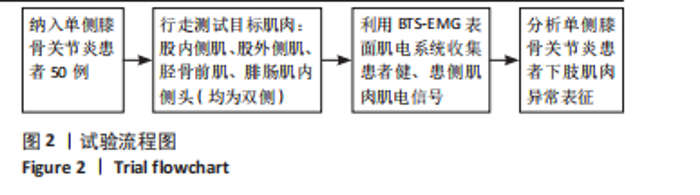
2.1 参与者数量分析 参与此次研究的膝骨关节炎患者为50例,均进入结果分析,无脱落。 2.2 试验流程图 见图2。"
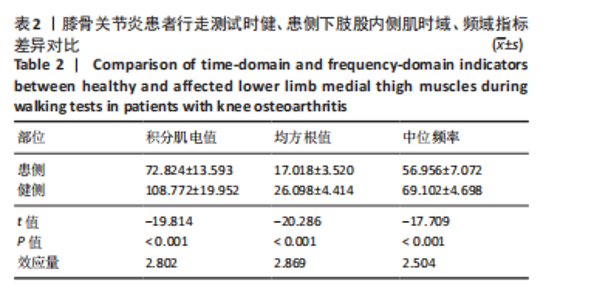
2.3 股内侧肌时域、频域参数 单侧膝骨关节炎患者的患侧股内侧肌在行走过程中积分肌电值显著低于健侧(P < 0.001),见图3A;均方根值显著低于健侧(P < 0.001),见图3B;患侧中位频率值显著低于健侧(P < 0.001),见图3C,中位频率向低频偏移更显著,疲劳风险较健侧显著。数据详见表2。"
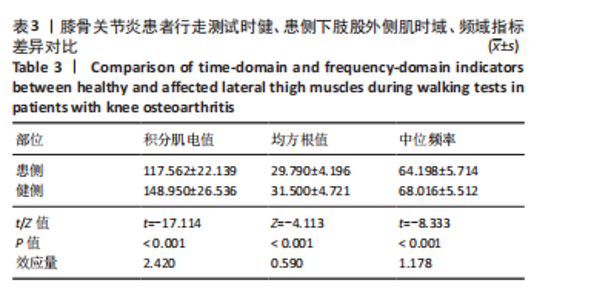
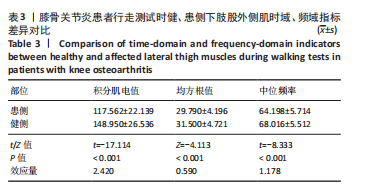
2.4 股外侧肌时域、频域参数 单侧膝骨关节炎患者的患侧股外侧肌在行走过程中的积分肌电值显著低于健侧(P < 0.001),见图4A;均方根值低于健侧(P < 0.001),见图4B;患侧中位频率值显著低于健侧(P < 0.001),见图4C,中位频率向低频偏移较多,疲劳风险较健侧增加。数据详见表3。"
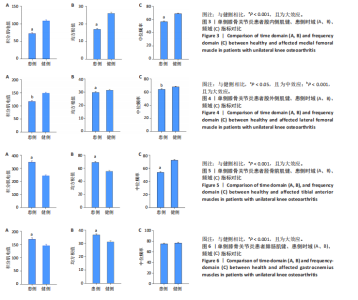
2.5 胫骨前肌时域、频域参数 单侧膝骨关节炎患者的患侧胫骨前肌在行走过程中的积分肌电值显著高于健侧(P < 0.001),见图5A;均方根值显著高于健侧(P < 0.001),见图5B;患侧胫骨前肌的中位频率值显著低于健侧(P < 0.001),见图5C,中位频率向低频偏移较健侧显著,疲劳风险较健侧显著增加。数据详见表4。 2.6 腓肠肌时域、频域参数 单侧膝骨关节炎患者的患侧腓肠肌在行走过程中的积分肌电值显著高于健侧(P < 0.001),见图6A;均方根值显著高于健侧(P < 0.001),见图6B;患侧腓肠肌中位频率值与健侧相比未出现明显的过度偏移(P > 0.05),见图"
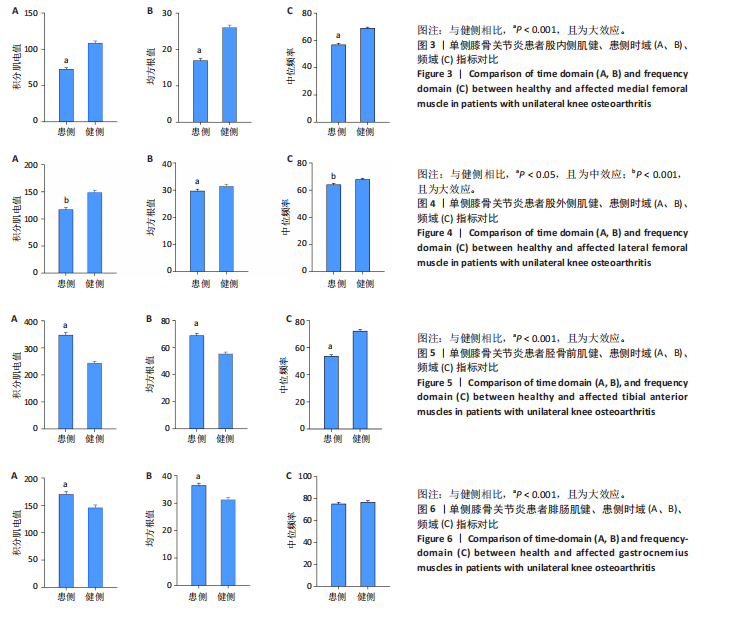
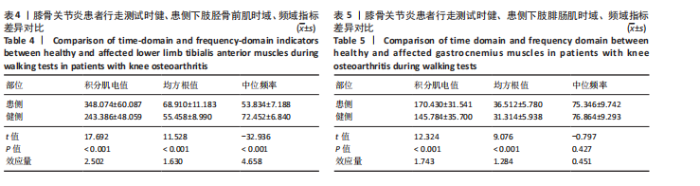
"
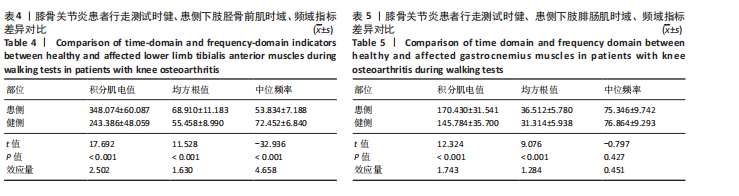
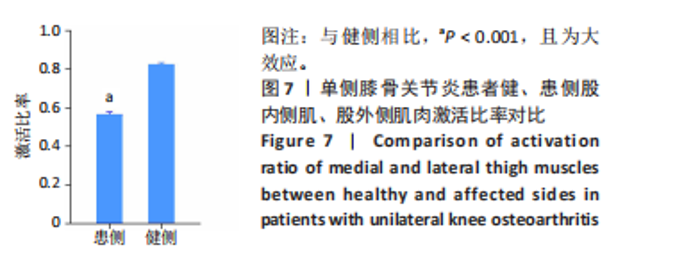
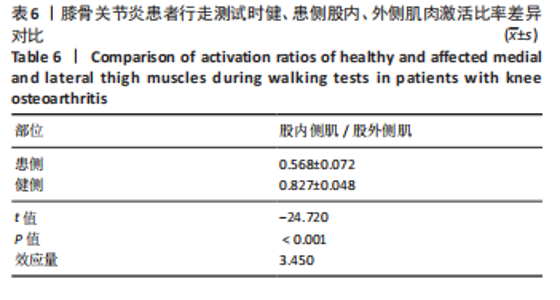
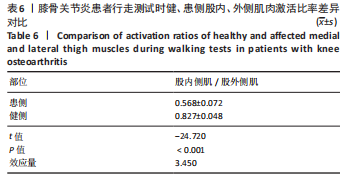
6C,健、患侧疲劳程度较一致,数据无统计学意义。数据详见表5。 2.7 肌肉激活比率(股内侧肌/股外侧肌) 在行走测试下,单侧膝骨关节炎患者的患侧肌肉激活比率显著低于健侧(P < 0.001),见图7,患侧股内侧肌与股外侧肌激活相较于健侧出现显著不平衡。数据详见表6。"
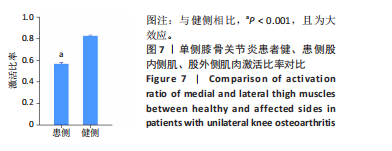
"
| [1] SHARMA L. Osteoarthritis of the Knee. N Engl J Med. 2021;384(1):51-59. [2] 冯晓晴,蔡道章,余星磊,等.基于GBD大数据中国膝骨关节炎疾病负担现状与趋势分析[J].现代预防医学,2022,49(10):1753-1760. [3] 中华医学会物理医学与康复学分会,四川大学华西医院.中国膝骨关节炎康复治疗指南(2023版)[J].中国循证医学杂志,2024,24(1):1-14. [4] 李雪松,蔡春江,马虹宇,等.影响膝骨关节炎病情进展的危险因素分析[J].风湿病与关节炎,2023,12(6):31-33+49. . [5] 陈泽华,王毅,陈伟健,等.股四头肌肌内脂肪含量与膝骨关节炎患者临床严重程度之间的关系[J].中国骨伤,2023,36(12):1147-1152. [6] JEON H, LEE SU, LIM JY, et al. Low skeletal muscle mass and radiographic osteoarthritis in knee, hip, and lumbar spine: a cross-sectional study. Aging Clin Exp Res. 2019;31(11):1557-1562. [7] YAMAUCHI K, SUZUKI S, KATO C, et al. Atrophy of individual thigh muscles measured by MRI in older adults with knee osteoarthritis: A cross-sectional study. Ann Phys Rehabil Med. 2020;63(1):38-45. [8] DE CEUNINCK F, FRADIN A, PASTOUREAU P. Bearing arms against osteoarthritis and sarcopenia: when cartilage and skeletal muscle find common interest in talking together. Drug Discov Today. 2014;19(3):305-311. [9] KRISHNASAMY P, HALL M, ROBBINS SR. The role of skeletal muscle in the pathophysiology and management of knee osteoarthritis. Rheumatology (Oxford). 2018;57(suppl_4):iv124. [10] LARSSON L, DEGENS H, LI M, et al. Sarcopenia: Aging-Related Loss of Muscle Mass and Function. Physiol Rev. 2019;99(1):427-511. [11] SHORTER E, SANNICANDRO AJ, POULET B, et al. Skeletal Muscle Wasting and Its Relationship With Osteoarthritis: a Mini-Review of Mechanisms and Current Interventions. Curr Rheumatol Rep. 2019;21(8):40. [12] MERLETTI R, MUCELI S. Tutorial. Surface EMG detection in space and time: Best practices. J Electromyogr Kinesiol. 2019;49:102363. [13] 徐明伟,金龙哲,于露,等.长时间颈部前屈对颈部肌肉疲劳的影响[J].工程科学学报,2019,41(11):1493-1500. [14] ÖZÜDOĞRU A, GELECEK N. Effects of closed and open kinetic chain exercises on pain, muscle strength, function, and quality of life in patients with knee osteoarthritis. Rev Assoc Med Bras (1992). 2023;69(7):e20230164. [15] 李永杰,刘梦玲,张达宽,等.单侧膝骨关节炎对老年女性步态动力学和肌肉激活不对称性的影响[J].中国组织工程研究,2025,29(27):5750-5756. [16] WANG M, ZHANG C, YANG Z, et al. Muscle activation patterns and gait changes in unilateral knee osteoarthritis patients: a comparative study with healthy controls. Clin Rheumatol. 2024;43(9):2963-2972. [17] PAL S, DRAPER CE, FREDERICSON M, et al. Patellar maltracking correlates with vastus medialis activation delay in patellofemoral pain patients. Am J Sports Med. 2011;39(3):590-598. [18] 中华医学会骨科学分会关节外科学组,中国医师协会骨科医师分会骨关节炎学组,国家老年疾病临床医学研究中心(湘雅医院),等.中国骨关节炎诊疗指南(2021年版)[J].中华骨科杂志,2021,41(18):1291-1314. [19] 中国老年保健协会骨关节分会.早期膝骨关节炎诊断与非手术治疗指南(2024版)[J].中华医学杂志,2024,104(31):2895-2909. [20] 辛运胜,白伟,金泓懿,等.基于肌电实验的挖掘机驾驶员上肢肌肉疲劳分析[J].科学技术与工程,2024,24(26):11393-11400. [21] KIADALIRI AA, LOHMANDER LS, MORADI-LAKEH M, et al. High and rising burden of hip and knee osteoarthritis in the Nordic region, 1990-2015. Acta Orthop. 2018;89(2):177-183. [22] BRISSON NM, GATTI AA, STRATFORD PW, et al. Self-efficacy, pain, and quadriceps capacity at baseline predict changes in mobility performance over 2 years in women with knee osteoarthritis. Clin Rheumatol. 2018; 37(2):495-504. [23] KIM JR, PHAM THN, KIM WU, et al. A causative role for periarticular skeletal muscle weakness in the progression of joint damage and pain in OA. Sci Rep. 2023;13(1):21349. [24] 罗宇,周平.肌肉减少症与骨关节炎之间的联系及共同发病机制[J].现代医学与健康研究电子杂志,2020,4(24):107-111. [25] 谢晓婷,郑拥军.MiR-29b参与大鼠膝骨关节炎引起的软骨退变和股四头肌萎缩[J].中国疼痛医学杂志,2022,28(4):249-257. [26] 李肖伟,陈嘉杰,舒玉铃,等.基于表面肌电图观察针刺对急性期贝尔氏面瘫患者的影响[J].针刺研究,2025,50(3):327-333. [27] SOUISSI H, ZORY R, BREDIN J, et al. Comparison of methodologies to assess muscle co-contraction during gait. J Biomech. 2017;57:141-145. [28] 马淑敏,高谦,徐峰,等.膝骨关节炎患者股四头肌功能水平及髋关节步态运动学特征分析[J].中国康复,2023,38(6):345-349. [29] MILLS K, HUNT MA, LEIGH R, et al. A systematic review and meta-analysis of lower limb neuromuscular alterations associated with knee osteoarthritis during level walking. Clin Biomech (Bristol). 2013;28(7):713-724. [30] 贾谊,薛瑞婷,魏亮.人体快速起跳动作的下肢表面肌电信号特征研究[J].中国体育科技,2017,53(2):64-70. [31] 李丹,王剑雄,黄茂茂,等.健康中老年女性上下楼梯时下肢肌肉的表面肌电图表现[J].中国康复理论与实践,2023,29(6):731-737. [32] LIM SH, HONG BY, OH JH, et al. Relationship between knee alignment and the electromyographic activity of quadriceps muscles in patients with knee osteoarthritis. J Phys Ther Sci. 2015;27(4):1261-1265. [33] LIU S, AMIRI P, MCGREGOR AH, et al. Bilateral Asymmetry in Knee and Hip Musculoskeletal Loading During Stair Ascending/Descending in Individuals with Unilateral Mild-to-Moderate Medial Knee Osteoarthritis. Ann Biomed Eng. 2023;51(11):2490-2503. [34] WU SH, CHU NK, LIU YC, et al. Relationship between the EMG ratio of muscle activation and bony structure in osteoarthritic knee patients with and without patellar malalignment. J Rehabil Med. 2008;40(5):381-386. [35] 徐欢欢,何育民,孙朝阳,等.AnyBody环境下人体步态的逆向动力学研究[J].机械科学与技术,2019,38(12):1819-1824. [36] 何兵,张永辉,石建伟,等.髋关节外展肌联合股四头肌功能锻炼在早期膝关节骨性关节炎治疗中应用效果观察[J].中国骨与关节损伤杂志, 2022,37(12):1253-1256. [37] CHILDS JD, SPARTO PJ, FITZGERALD GK, et al. Alterations in lower extremity movement and muscle activation patterns in individuals with knee osteoarthritis. Clin Biomech (Bristol). 2004;19(1):44-49. [38] KUITUNEN S, KOMI PV, KYRÖLÄINEN H. Knee and ankle joint stiffness in sprint running. Med Sci Sports Exerc. 2002;34(1):166-173. [39] FALK J, STRANDKVIST V, PAUELSEN M, et al. Increased co-contraction reaction during a surface perturbation is associated with unsuccessful postural control among older adults. BMC Geriatr. 2022;22(1):438. [40] KITATANI R, OHATA K, SATO S, et al. Ankle muscle coactivation and its relationship with ankle joint kinematics and kinetics during gait in hemiplegic patients after stroke. Somatosens Mot Res. 2016;33(2):79-85. [41] PAN J, FU W, LV J, et al. Biomechanics of the lower limb in patients with mild knee osteoarthritis during the sit-to-stand task. BMC Musculoskelet Disord. 2024;25(1):268. [42] 安丙辰,郑洁皎,沈利岩.膝骨关节炎与膝关节伸、屈肌群肌力的相关性研究[J].医用生物力学,2015,30(2):174-178. [43] 李捷婷,陈耿钊,方倩颖,等.基于多通道表面肌电探讨不同角速度下膝骨关节炎患者生物力学基础的研究[J].中国康复医学杂志,2024, 39(2):218-225. [44] TANKISI H, VERSACE V, KUPPUSWAMY A, et al. The role of clinical neurophysiology in the definition and assessment of fatigue and fatigability. Clin Neurophysiol Pract. 2023;9:39-50. [45] 方博儒,仇大伟,白洋,等.表面肌电信号在肌肉疲劳研究中的应用综述[J].计算机科学与探索,2024,18(9):2261-2275. [46] 周军,胡霓嘉,夏楠,等.老年人力量训练的神经肌肉适应研究进展[J].体育科学,2024,44(11):87-97. [47] 杨雪,王彤,王春久,等.针刀松解腘绳肌对膝骨性关节炎兔膝周肌群表面张力的影响[J].世界中医药,2020,15(12):1705-1709. |
| [1] | Wang Lejun, Chi Wenxin, Song Xiaoqian, Li Qian, Qiao Minjie, Tao Haifeng. Performance of unstable barbell bench press and changes in electromyographic activity after transcranial direct current stimulation [J]. Chinese Journal of Tissue Engineering Research, 2026, 30(23): 6099-6109. |
| [2] | Yu Yueyue, Zhang Xu, Liu Yiwei, Meng Zihan, Hao Xinyue, Tian Chunyu, Li Ji’an, Zhang Yixin . Lipid types and knee osteoarthritis: a genome-wide association study in European populations [J]. Chinese Journal of Tissue Engineering Research, 2026, 30(18): 4763-4770. |
| [3] | Chen Yuanyue, Shen Junfan, Yu Cui, Lu Jianxia, Hu Wenxuan, Zhu Jun, Guo Chuan. Knowledge structure and evolutionary trends in the application of surface electromyography in musculoskeletal pain rehabilitation [J]. Chinese Journal of Tissue Engineering Research, 2026, 30(18): 4791-4801. |
| [4] | Fu Yingxue, Wang Xianbin, Chen Xingyu, Wu Shuang. Hind limb muscle atrophy in rats with spinal cord injury: effects of different rehabilitation therapy strategies [J]. Chinese Journal of Tissue Engineering Research, 2026, 30(17): 4357-4365. |
| [5] | Peng Siwei, Yang Ruifang, Chen Xiaohua, Zheng Zhuoming, Chen Peng, Xiao Yan, Su Youxin, Guo Jiemei. The mechanism by which Zhuanggu Jianxi Decoction inhibits inflammatory response of human synovial macrophages [J]. Chinese Journal of Tissue Engineering Research, 2026, 30(17): 4400-4406. |
| [6] | Wang Jingyi, An Shuai, Li Daoqin, He Tao, Feng Mingli, La Gaoyan, Li Zheng, Cheng Jingbo. Stepwise surgical treatment of knee osteoarthritis and the application trends of three surgical procedures: a bibliometric analysis [J]. Chinese Journal of Tissue Engineering Research, 2026, 30(15): 4010-4020. |
| [7] | Zheng Rongfa, Mo Weibin, Huang Peng, Chen Junji, Liang Ting, Zi Fangyu, Li Guofeng. Effects of electroacupuncture on the expression of metabolic enzymes and autophagy genes in gastrocnemius muscle tissues of exercising rats [J]. Chinese Journal of Tissue Engineering Research, 2025, 29(6): 1127-1136. |
| [8] | Gao Yuan, Xiong Zheyu, Zheng Wei, Chen Haonan, Chen Fangyuqing. Lower extremity biomechanical characterization during step-down test in patients with patellofemoral pain [J]. Chinese Journal of Tissue Engineering Research, 2025, 29(32): 6913-6919. |
| [9] | Wang Wanchun, , Yi Jun, Yan Zhangren, Yang Yue, Dong Degang, Li Yumei. 717 Jiedu Decoction remodels homeostasis of extracellular matrix and promotes repair of local injured tissues in rats after Agkistrodon halys bite [J]. Chinese Journal of Tissue Engineering Research, 2025, 29(30): 6457-6465. |
| [10] | Li Yongjie, Liu Mengling, Zhang Dakuan, Fu Shenyu, Liu Hongju. Effect of unilateral knee osteoarthritis on gait dynamics and muscle activation asymmetry in elderly women [J]. Chinese Journal of Tissue Engineering Research, 2025, 29(27): 5750-5756. |
| [11] | Dong Youqing, Wei Zixuan, Wu Haiou, Chen Ruixiong, Duan Peng, Chen Nan, Lin Xikai. Biomechanical characteristics of lower limbs in female patients with different types of patellofemoral pain syndrome [J]. Chinese Journal of Tissue Engineering Research, 2025, 29(21): 4458-4468. |
| [12] | Li Zhenzhen, Zhen Qiaoxia, Chen Keke, Fang Boyan. Effects of different forms of shaker exercises on hyoid muscles activation in healthy adults [J]. Chinese Journal of Tissue Engineering Research, 2025, 29(18): 3791-3797. |
| [13] | Li Kaiying , Wei Xiaoge, Zhao Zhenning , Song Fei, Yang Nan, Wang Yan, Mu Jing, Ma Huisheng . Lijin manipulation alleviates fibrosis of injured skeletal muscle in rabbits [J]. Chinese Journal of Tissue Engineering Research, 2025, 29(14): 2914-2921. |
| [14] | Dong Hongming, Li Jianping, Liu Chao, Zhang Honghao, Li Guqiang. Relationship between muscle activation characterization and fall risk in older adults during walking up and down stairs [J]. Chinese Journal of Tissue Engineering Research, 2024, 28(34): 5419-5424. |
| [15] | Li Zhenzhen, Zhou Zhipeng. Effects of dry swallowing and swallowing tasks of varying consistencies and volumes on the hyoid muscles in healthy adults [J]. Chinese Journal of Tissue Engineering Research, 2024, 28(20): 3117-3122. |
| Viewed | ||||||
|
Full text |
|
|||||
|
Abstract |
|
|||||