Chinese Journal of Tissue Engineering Research ›› 2023, Vol. 27 ›› Issue (32): 5184-5190.doi: 10.12307/2023.534
Previous Articles Next Articles
Mechanism of paroxetine on osteoclast differentiation
Mo Yaomin1, Liu Pan1, Ma Ruixin2, Zeng Gaofeng3, Zong Shaohui1
- 1Department of Spine Surgery, the First Affiliated Hospital of Guangxi Medical University, Nanning 530000, Guangxi Zhuang Autonomous Region, China; 2Collaborative Innovation Centre of Regenerative Medicine and Medical BioResource Development and Application Co-constructed by the Province and Ministry, 3School of Public Health, Guangxi Medical University, Nanning 530000, Guangxi Zhuang Autonomous Region, China
-
Received:2022-06-28Accepted:2022-09-02Online:2023-11-18Published:2023-03-23 -
Contact:Zong Shaohui, Professor, Chief physician, Doctoral supervisor, Department of Spine Surgery, the First Affiliated Hospital of Guangxi Medical University, Nanning 530000, Guangxi Zhuang Autonomous Region, China Zeng Gaofeng, Professor, Doctoral supervisor, School of Public Health, Guangxi Medical University, Nanning 530000, Guangxi Zhuang Autonomous Region, China -
About author:Mo Yaomin, Master candidate, Department of Spine Surgery, the First Affiliated Hospital of Guangxi Medical University, Nanning 530000, Guangxi Zhuang Autonomous Region, China -
Supported by:the National Natural Science Foundation of China, No. 81860402 (to ZSH); Guangxi Medical High-level Backbone Talents Training "139" Program, No. [2020]15 (to ZSH)

CLC Number:
Cite this article
Mo Yaomin, Liu Pan, Ma Ruixin, Zeng Gaofeng, Zong Shaohui. Mechanism of paroxetine on osteoclast differentiation[J]. Chinese Journal of Tissue Engineering Research, 2023, 27(32): 5184-5190.
share this article
Add to citation manager EndNote|Reference Manager|ProCite|BibTeX|RefWorks
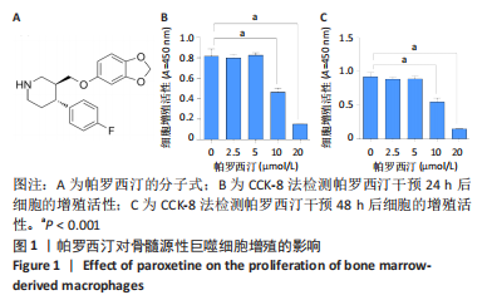
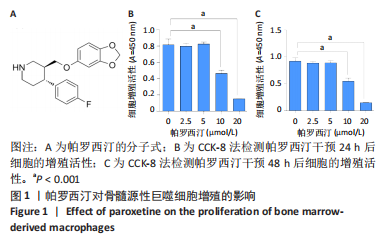
2.1 帕罗西汀对骨髓源性巨噬细胞殖活性的影响 帕罗西汀干预24,48 h后,当浓度> 10 μmol/L时,帕罗西汀对骨髓源性巨噬细胞有明显的抑制作用,并呈浓度依赖性(P < 0.05);在浓度≤5 μmol/L时,帕罗西汀对骨髓源性巨噬细胞无毒性作用(P > 0.05),见图1。"
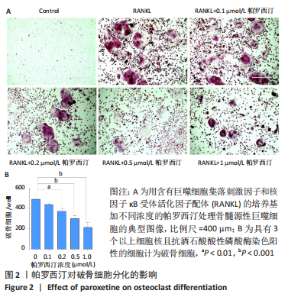
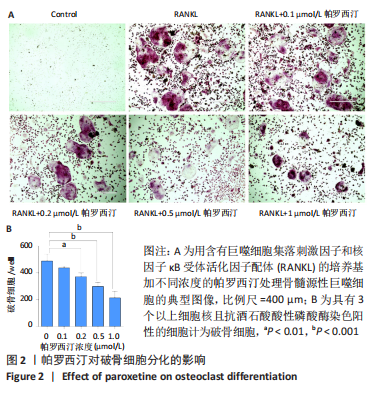
2.2 帕罗西汀对破骨细胞分化的影响 骨髓源性巨噬细胞在含有巨噬细胞集落刺激因子和 RANKL的完全培养基中诱导破骨细胞,同时加入不同浓度的帕罗西汀干预。干预5 d后,抗酒石酸酸性磷酸酶染色显示,0.5 μmol/L及以上浓度的帕罗西汀对破骨细胞分化的数量及形态有明显的抑制作用,见图2。"
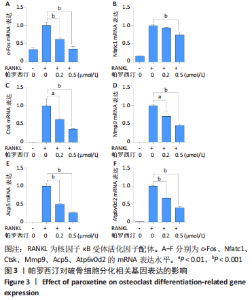
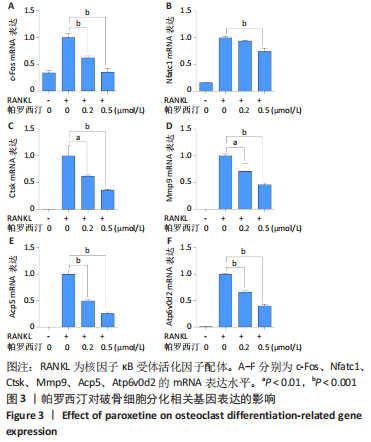
2.3 帕罗西汀破骨细胞相关基因表达的影响 RT-qPCR检测结果显示,使用0.2 μmol/L帕罗西汀干预后,c-Fos、Ctsk、Acp5、Mmp9、Atp6v0d2的mRNA表达量低于对照组,Nfatc1表达水平无明显变化;当帕罗西汀浓度提高到0.5 μmol/L后,c-Fos、Nfatc1、Ctsk、Acp5、Mmp9、Atp6v0d2的mRNA表达量均明显低于对照组(P < 0.05),见图3。提示帕罗西汀以剂量依赖方式对破骨细胞分化过程起抑制作用。"
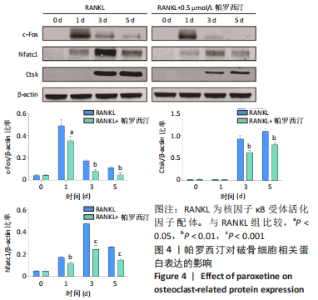
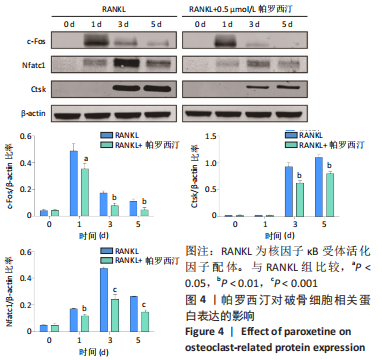
2.4 帕罗西汀对破骨细胞相关蛋白表达的影响 Western Blot检测结果显示,RANKL刺激1,3,5 d后,对照组c-Fos、Nfatc1、Ctsk蛋白表达呈时间依赖性;与对照组比较,帕罗西汀组3,5 d的c-Fos、Nfatc1、Ctsk蛋白表达降低(P < 0.05),见图4。提示帕罗西汀能够抑制Nfatc1及其下游蛋白的表达,从而抑制破骨细胞的形成和功能。"
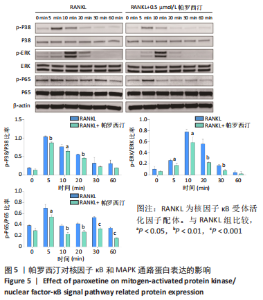
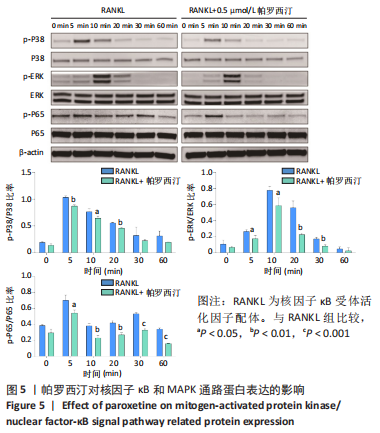
2.5 帕罗西汀对核因子κB、MAPK信号通路相关蛋白表达的影响 Western Blot检测结果显示,在RANKL刺激5,10,20 min时,与对照组相比,帕罗西汀组p-p38/p38比率明显降低(P < 0.05);在RANKL刺激5,10,20,30 min时,与对照组相比,帕罗西汀组p-ERK1/2/ERK1/2比率明显降低(P < 0.05);在RANKL刺激5,10,20,30,60 min时,与对照组相比,帕罗西汀组p-p65/p65比率明显降低(P < 0.05),见图5。提示帕罗西汀有抑制核因子κB、MAPK信号通路激活的作用。"
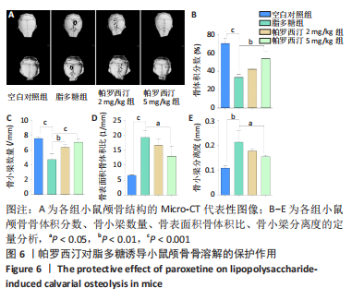
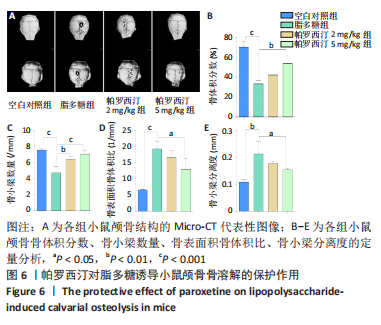
2.6 帕罗西汀对多糖诱导小鼠颅骨骨溶解模型骨丢失的影响 14 d后,通过Micro-CT扫描显示骨丢失情况,脂多糖组>帕罗西汀2 mg/kg组>帕罗西汀5 mg/kg组>空白对照组,见图6A,表明帕罗西汀具有减少脂多糖诱导的颅骨骨丢失的效果。通过Micro-CT对颅骨骨溶解区域进行统计分析,骨小梁数量、骨体积分数大小顺序为:空白对照组>帕罗西汀5 mg/kg组>帕罗西汀2 mg/kg组>脂多糖组,骨表面积骨体积比、骨小梁分离度大小顺序为:脂多糖组>帕罗西汀2 mg/kg组>帕罗西汀5 mg/kg组>空白对照组,见图6B-E,证明帕罗西汀处理组小鼠骨丢失情况受到抑制。"
| [1] BIJLSMA AY, MESKERS CG, WESTENDORP RG, et al. Chronology of age-related disease definitions: Osteoporosis and sarcopenia. Ageing Res Rev. 2012;11(2):320-324. [2] ASPRAY TJ, HILL TR. Osteoporosis and the ageing skeleton. Subcell Biochem. 2019;91:453-476. [3] HASEGAWA T, KIKUTA J, SUDO T, et al. Identification of a novel arthritis-associated osteoclast precursor macrophage regulated by foxm1. Nat Immunol. 2019;20(12):1631-1643. [4] BROWN JP. Long-term treatment of postmenopausal osteoporosis. Endocrinol Metab (Seoul). 2021;36(3):544-552. [5] SHANE E, BURR D, ABRAHAMSEN B, et al. Atypical subtrochanteric and diaphyseal femoral fractures: Second report of a task force of the american society for bone and mineral research. J Bone Miner Res. 2014;29(1):1-23. [6] LANGDAHL B. Treatment of postmenopausal osteoporosis with bone-forming and antiresorptive treatments: Combined and sequential approaches. Bone. 2020;139:115516. [7] ZHAO X, PATIL S, XU F, et al. Role of biomolecules in osteoclasts and their therapeutic potential for osteoporosis. Biomolecules. 2021; 11(5):747. [8] UDAGAWA N, KOIDE M, NAKAMURA M, et al. Osteoclast differentiation by rankl and opg signaling pathways. J Bone Miner Metab. 2021;39(1): 19-26. [9] KIM JH, KIM K, KIM I, et al. Bcap promotes osteoclast differentiation through regulation of the p38-dependent creb signaling pathway. Bone. 2018;107:188-195. [10] CHAWEEWANNAKORN W, ARIYOSHI W, OKINAGA T, et al. Ameloblastin attenuates rankl-mediated osteoclastogenesis by suppressing activation of nuclear factor of activated t-cell cytoplasmic 1 (nfatc1). J Cell Physiol. 2019;234(2):1745-1757. [11] KOWALSKA M, NOWACZYK J, FIJALKOWSKI L, et al. Paroxetine-overview of the molecular mechanisms of action. Int J Mol Sci. 2021;22(4):1662. [12] LIU RP, ZOU M, WANG JY, et al. Paroxetine ameliorates lipopolysaccharide-induced microglia activation via differential regulation of mapk signaling. J Neuroinflammation. 2014;11:47. [13] ZHANG X, ZHU LB, HE JH, et al. Paroxetine suppresses reactive microglia-mediated but not lipopolysaccharide-induced inflammatory responses in primary astrocytes. J Neuroinflammation. 2020;17(1):50. [14] XIE H, CHUNG DY, KURA S, et al. Differential effects of anesthetics on resting state functional connectivity in the mouse. J Cereb Blood Flow Metab. 2020;40(4):875-884. [15] CARLSON EL, KARUPPAGOUNDER V, PINAMONT WJ, et al. Paroxetine-mediated grk2 inhibition is a disease-modifying treatment for osteoarthritis. Sci Transl Med. 2021;13(580):eaau8491. [16] VERDELIS K, SALMON P. Microcomputed tomography imaging in odontogenesis studies. Methods Mol Biol. 2019;1922:309-324. [17] JOHNSTON CB, DAGAR M. Osteoporosis in older adults. Med Clin North Am. 2020;104(5):873-884. [18] KANIS JA, COOPER C, RIZZOLI R, et al. European guidance for the diagnosis and management of osteoporosis in postmenopausal women. Osteoporos Int. 2019;30(1):3-44. [19] REID IR. A broader strategy for osteoporosis interventions. Nat Rev Endocrinol. 2020;16(6):333-339. [20] FISCHER V, HAFFNER-LUNTZER M. Interaction between bone and immune cells: Implications for postmenopausal osteoporosis. Semin Cell Dev Biol. 2022;123:14-21. [21] DA W, TAO L, ZHU Y. The role of osteoclast energy metabolism in the occurrence and development of osteoporosis. Front Endocrinol (Lausanne). 2021;12:675385. [22] AMIN N, BOCCARDI V, TAGHIZADEH M, et al. Probiotics and bone disorders: The role of rankl/rank/opg pathway. Aging Clin Exp Res. 2020;32(3):363-371. [23] HUANG L, CHEN W, WEI L, et al. Lonafarnib inhibits farnesyltransferase via suppressing erk signaling pathway to prevent osteoclastogenesis in titanium particle-induced osteolysis. Front Pharmacol. 2022;13:848152. [24] XIAN Y, SU Y, LIANG J, et al. Oroxylin a reduces osteoclast formation and bone resorption via suppressing rankl-induced ros and nfatc1 activation. Biochem Pharmacol. 2021;193:114761. [25] XU W, CHEN X, WANG Y, et al. Chitooligosaccharide inhibits rankl-induced osteoclastogenesis and ligation-induced periodontitis by suppressing mapk/ c-fos/nfatc1 signaling. J Cell Physiol. 2020;235(3): 3022-3032. [26] CONG Q, JIA H, LI P, et al. P38alpha mapk regulates proliferation and differentiation of osteoclast progenitors and bone remodeling in an aging-dependent manner. Sci Rep. 2017;7:45964. [27] LEE S, RAUCH J, KOLCH W. Targeting mapk signaling in cancer: Mechanisms of drug resistance and sensitivity. Int J Mol Sci. 2020; 21(3):1102. [28] KANG JY, KANG N, YANG YM, et al. The role of ca(2+)-nfatc1 signaling and its modulation on osteoclastogenesis. Int J Mol Sci. 2020;21(10): 3646. [29] YANG Y, CHUNG MR, ZHOU S, et al. Stat3 controls osteoclast differentiation and bone homeostasis by regulating nfatc1 transcription. J Biol Chem. 2019;294(42):15395-15407. [30] XIAO L, ZHONG M, HUANG Y, et al. Puerarin alleviates osteoporosis in the ovariectomy-induced mice by suppressing osteoclastogenesis via inhibition of traf6/ros-dependent mapk/nf-kappab signaling pathways. Aging (Albany NY). 2020;12(21):21706-21729. [31] KOGA Y, TSURUMAKI H, AOKI-SAITO H, et al. Roles of cyclic amp response element binding activation in the erk1/2 and p38 mapk signalling pathway in central nervous system, cardiovascular system, osteoclast differentiation and mucin and cytokine production. Int J Mol Sci. 2019;20(6):1346. [32] YU H, LIN L, ZHANG Z, et al. Targeting nf-kappab pathway for the therapy of diseases: Mechanism and clinical study. Signal Transduct Target Ther. 2020;5(1):209. [33] BARNABEI L, LAPLANTINE E, MBONGO W, et al. Nf-kappab: At the borders of autoimmunity and inflammation. Front Immunol. 2021; 12:716469. [34] LAMPIASI N, RUSSO R, ZITO F. The alternative faces of macrophage generate osteoclasts. Biomed Res Int. 2016;2016:9089610. [35] YASUDA H. Discovery of the rankl/rank/opg system. J Bone Miner Metab. 2021;39(1):2-11. [36] SUL OJ, PARK HJ, SON HJ, et al. Lipopolysaccharide (lps)-induced autophagy is responsible for enhanced osteoclastogenesis. Mol Cells. 2017;40(11):880-887. [37] CARR HS, CHANG JT, FROST JA. The pdz domain protein synj2bp regulates grk-dependent sst2a phosphorylation and downstream mapk signaling. Endocrinology. 2021;162(2):bqaa229. [38] SUN X, ZHOU M, WEN G, et al. Paroxetine attenuates cardiac hypertrophy via blocking grk2 and adrb1 interaction in hypertension. J Am Heart Assoc. 2021;10(1):e016364. [39] HU K, OLSEN BR. Osteoblast-derived vegf regulates osteoblast differentiation and bone formation during bone repair. J Clin Invest. 2016;126(2):509-526. [40] CHEN X, WANG Z, DUAN N, et al. Osteoblast-osteoclast interactions. Connect Tissue Res. 2018;59(2):99-107. |
| [1] | Li Xiaomin, Tian Xiangdong, Tan Yetong, Zhu Guangyu, Wang Rongtian, Wang Jian, Xue Zhipeng, Ma Sheng, Hu Yuanyi, Huang Ye, Ding Tiansong. Changes of lower limb force line and knee function after high tibial osteotomy in osteoporotic medial ventricular knee osteoarthritis [J]. Chinese Journal of Tissue Engineering Research, 2023, 27(9): 1325-1329. |
| [2] | Dang Yi, Du Chengyan, Yao Honglin, Yuan Nenghua, Cao Jin, Xiong Shan, Zhang Dingmei, Wang Xin. Hormonal osteonecrosis and oxidative stress [J]. Chinese Journal of Tissue Engineering Research, 2023, 27(9): 1469-1476. |
| [3] | Jiang Xiaocheng, Shi Lu, Wang Yinbin, Li Qiujiang, Xi Chuangzhen, Ma Zefeng, Cai Lijun. Systematical evaluation of bone fusion rate after interbody fusion in patients with osteoporosis and lumbar degenerative disease treated with teriparatide [J]. Chinese Journal of Tissue Engineering Research, 2023, 27(9): 1427-1433. |
| [4] | Yang Zhishan, Tang Zhenglong. YAP/TAZ, a core factor of the Hippo signaling pathway, is involved in bone formation [J]. Chinese Journal of Tissue Engineering Research, 2023, 27(8): 1264-1271. |
| [5] | Sun Jiajia, Zhu Haidi, Lu Yun, Zhang Kai. Comparison of bone metabolism markers between type 2 diabetes mellitus and non-type 2 diabetes mellitus patients with hip fracture [J]. Chinese Journal of Tissue Engineering Research, 2023, 27(8): 1156-1160. |
| [6] | Long Guiyue, Li Dongdong, Liao Hongbing. Calcium phosphate cement/poly(lactic-co-glycolic acid) degradation products promote osteoclast differentiation of mouse monocytes [J]. Chinese Journal of Tissue Engineering Research, 2023, 27(8): 1193-1198. |
| [7] | Huang Linke, Wei Linhua, Jiang Jie, Liu Qian, Chen Weiwei. Effects of estrogen combined with treadmill exercise on bone mass and articular cartilage in ovariectomized mice [J]. Chinese Journal of Tissue Engineering Research, 2023, 27(8): 1166-1171. |
| [8] | Long Yanming, Xie Mengsheng, Huang Jiajie, Xue Wenli, Rong Hui, Li Xiaojie. Casein kinase 2-interaction protein-1 regulates the osteogenic ability of bone marrow mesenchymal stem cells in osteoporosis rats [J]. Chinese Journal of Tissue Engineering Research, 2023, 27(6): 878-882. |
| [9] | Zhang Min, Zhang Xiaoming, Liu Tongbin. Application potential of naringin in bone tissue regeneration [J]. Chinese Journal of Tissue Engineering Research, 2023, 27(5): 787-792. |
| [10] | Wang Jinling, Huang Xiarong, Qu Mengjian, Huang Fujin, Yin Lingwei, Zhong Peirui, Liu Jin, Sun Guanghua, Liao Yang, Zhou Jun. Effects of exercise training on bone mass and bone microstructure in aged osteoporotic rats [J]. Chinese Journal of Tissue Engineering Research, 2023, 27(5): 676-682. |
| [11] | Cheng Yunzhong, Liu Yuzeng, Hai Yong, Guan Li, Pan Aixing, Zhang Xinuo, Tao Luming, Li Yue. Bibliometric and visual analysis of the research status and development trend of cortical bone trajectory screws [J]. Chinese Journal of Tissue Engineering Research, 2023, 27(4): 513-519. |
| [12] | Liu Hao, Yang Hongsheng, Zeng Zhimou, Wang Liping, Yang Kunhai, Hu Yongrong, Qu Bo. Lumbar MRI vertebral bone quality score to evaluate the severity of osteoporosis in postmenopausal women [J]. Chinese Journal of Tissue Engineering Research, 2023, 27(4): 606-611. |
| [13] | Liu Chunli, Yan Yujuan, Mo Liwen, Wu Zhijie, Zhang Li. Effects of puerarin on osteoclast differentiation of RAW264.7 cells [J]. Chinese Journal of Tissue Engineering Research, 2023, 27(32): 5114-5119. |
| [14] | Huang Haozhe, Zheng Min, Li Na, Sun Libo, Lan Yuyan, Liu Min. Effects of naringin on healing of tooth extraction wound in osteoporotic rats [J]. Chinese Journal of Tissue Engineering Research, 2023, 27(32): 5144-5149. |
| [15] | Maihemutijiang · Muhaimaiti, Maimaitishawutiaji · Maimaiti, Tang Junwei, Zhang Yuxin. Has-miR-100-5p targeting zinc finger and BTB domain containing 7A is a potential target for postmenopausal osteoporosis [J]. Chinese Journal of Tissue Engineering Research, 2023, 27(32): 5168-5172. |
| Viewed | ||||||
|
Full text |
|
|||||
|
Abstract |
|
|||||