Chinese Journal of Tissue Engineering Research ›› 2026, Vol. 30 ›› Issue (19): 4867-4872.doi: 10.12307/2026.250
Previous Articles Next Articles
Inhibitory effect of complement 1q/tumor necrosis factor-related protein 4 on 3T3-L1 preadipocyte differentiation
Maireyanmu·Rozi, Wang Hongping, Zhang Cuiping, Xia Juan, Shen Tian, Lei Tao, Lu Jun, Gao Jie
- Putuo Hospital Affiliated to Shanghai University of Traditional Chinese Medicine, Shanghai 200062, China
-
Received:2025-09-05Accepted:2025-11-28Online:2026-07-08Published:2026-02-13 -
Contact:Gao Jie, MS, Attending physician, Putuo Hospital Affiliated to Shanghai University of Traditional Chinese Medicine, Shanghai 200062, China -
About author:Maireyanmu·Rozi, MS, Putuo Hospital Affiliated to Shanghai University of Traditional Chinese Medicine, Shanghai 200062, China -
Supported by:Putuo District Health System Science and Technology Innovation Project, No. ptkwws202417 (to GJ); Putuo District Health System Science and Technology Innovation Project, No. ptkwws202003 (to LT); Putuo District Health System Science and Technology Innovation Project, No. ptkwws202302 (to LJ); Putuo District Clinical Specialty, No. 2024tszk02 (to LJ); Putuo District Clinical Specialty, No. 2020tszk01 (to LT); Shanghai Municipal Health Commission Scientific Research Project, No. 202240309 (to LJ)

CLC Number:
Cite this article
Maireyanmu·Rozi, Wang Hongping, Zhang Cuiping, Xia Juan, Shen Tian, Lei Tao, Lu Jun, Gao Jie. Inhibitory effect of complement 1q/tumor necrosis factor-related protein 4 on 3T3-L1 preadipocyte differentiation[J]. Chinese Journal of Tissue Engineering Research, 2026, 30(19): 4867-4872.
share this article
Add to citation manager EndNote|Reference Manager|ProCite|BibTeX|RefWorks
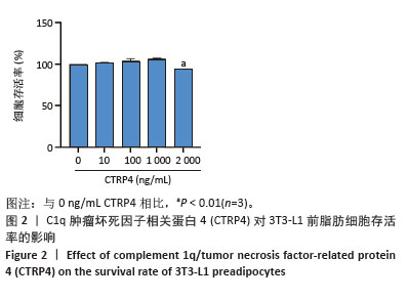
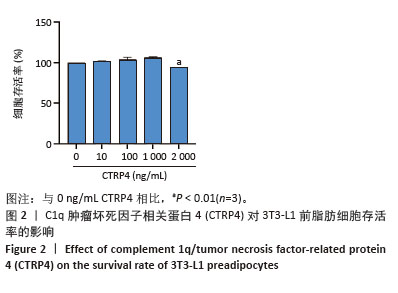
2.1 C1q肿瘤坏死因子相关蛋白4对3T3-L1前脂肪细胞存活率的影响 采用CCK-8试剂盒检测细胞存活率。图2结果显示:与对照组相比,10,100,1 000 ng/mL C1q肿瘤坏死因子相关蛋白4重组蛋白没有对细胞产生毒性(P > 0.05),而2 000 ng/mL C1q肿瘤坏死因子相关蛋白4重组蛋白对细胞产生毒性(P < 0.01)。因此选择1 000 ng/mL最高有效质量浓度C1q肿瘤坏死因子相关蛋白4重组蛋白进行后续实验。"

2.2 C1q肿瘤坏死因子相关蛋白4对3T3-L1细胞分化和脂质积累的影响 油红O染色显示:对照组没有明显的成熟脂肪细胞;与对照组相比,诱导剂组油红O染色颜色强度深,说明前脂肪细胞分化为成熟的脂肪细胞数量较多;与诱导剂组相比,C1q肿瘤坏死因子相关蛋白4组油红O染色颜色强度变弱,说明前脂肪细胞分化为成熟的脂肪细胞数量变少,C1q肿瘤坏死因子相关蛋白4抑制前脂肪细胞分化;萃取油红O染料进行半定量分析,结果同样证实C1q肿瘤坏死因子相关蛋白4抑制前脂肪细胞分化(P < 0.001),见图3。"

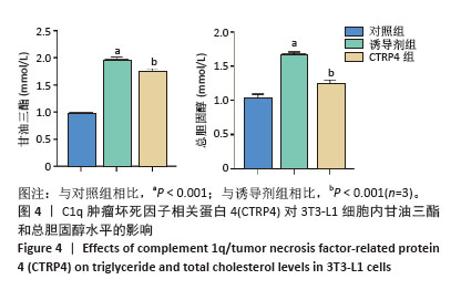
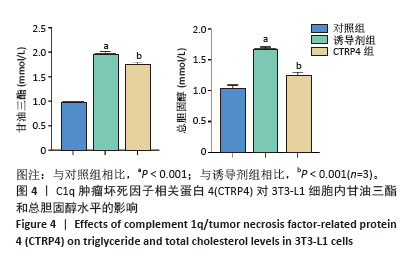
2.3 C1q肿瘤坏死因子相关蛋白4对3T3-L1细胞内甘油三酯和总胆固醇水平的影响 对照组甘油三酯和总胆固醇水平最低,与对照组相比,诱导剂组甘油三酯和总胆固醇水平明显上升(P < 0.001);与诱导剂组相比,C1q肿瘤坏死因子相关蛋白4组甘油三酯和总胆固醇水平明显减少(P < 0.001),说明C1q肿瘤坏死因子相关蛋白4抑制了脂代谢指标甘油三酯和总胆固醇表达水平,见图4。"
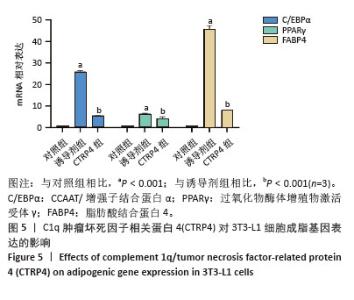
2.4 C1q肿瘤坏死因子相关蛋白4对3T3-L1细胞成脂基因mRNA表达的影响 如图5所示,对照组CCAAT/增强子结合蛋白α、过氧化物酶体增殖物激活受体γ、脂肪酸结合蛋白4 mRNA表达最低;与对照组相比,诱导剂组CCAAT/增强子结合蛋白α、过氧化物酶体增殖物激活受体γ、脂肪酸结合蛋白4 mRNA表达均明显上升(P < 0.001);与诱导剂组相比,C1q肿瘤坏死因子相关蛋白4组CCAAT/增强子结合蛋白α、过氧化物酶体增殖物激活受体γ、脂肪酸结合蛋白4 mRNA表达均明显下降(P < 0.001),说明C1q肿瘤坏死因子相关蛋白4抑制成脂基因的表达。"

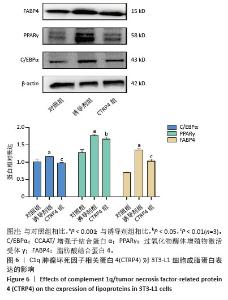
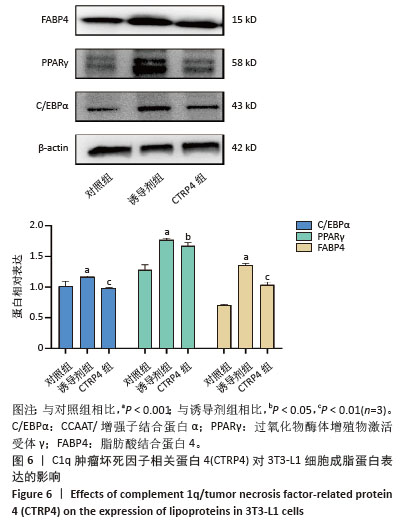
2.5 C1q肿瘤坏死因子相关蛋白4对3T3-L1细胞成脂蛋白表达的影响 如图6所示,对照组CCAAT/增强子结合蛋白α、过氧化物酶体增殖物激活受体γ、脂肪酸结合蛋白4蛋白表达水平均最低;与对照组相比,诱导剂组CCAAT/增强子结合蛋白α、过氧化物酶体增殖物激活受体γ、脂肪酸结合蛋白4蛋白表达水平均明显上升(P < 0.001);与诱导剂组相比,C1q肿瘤坏死因子相关蛋白4组CCAAT/增强子结合蛋白α、过氧化物酶体增殖物激活受体γ、脂肪酸结合蛋白4蛋白表达水平均明显下降(P < 0.05,P < 0.01),同样说明C1q肿瘤坏死因子相关蛋白4抑制成脂蛋白的表达。"
| [1] AHMED B, SULTANA R, GREENE MW. Adipose tissue and insulin resistance in obese. Biomed Pharmacother. 2021;137:111315. [2] 温润芝,王丽,赵乃倩.盐皮质激素受体过度活化诱导肥胖脂肪组织重塑[J].新医学,2025,56(6):621-626. [3] CHAN PC, LIAO MT, HSIEH PS. The Dualistic Effect of COX-2-Mediated Signaling in Obesity and Insulin Resistance. Int J Mol Sci. 2019;20(13):3115. [4] KUSMINSKI CM, BICKEL PE, SCHERER PE. Targeting adipose tissue in the treatment of obesity-associated diabetes. Nat Rev Drug Discov. 2016;15(9):639-660. [5] IOANNIDOU A, ALATAR S, SCHIPPER R, et al. Hypertrophied human adipocyte spheroids as in vitro model of weight gain and adipose tissue dysfunction. J Physiol. 2022;600(4):869-883. [6] RUBAN A, STOENCHEV K, ASHRAFIAN H, et al. Current treatments for obesity. Clin Med (Lond). 2019;19(3):205-212. [7] SARVER DC, XU C, CHENG Y, et al. CTRP4 ablation impairs associative learning and memory. FASEB J. 2021;35(11):e21910. [8] ZHANG H, ZHANG-SUN ZY, XUE CX, et al. CTRP family in diseases associated with inflammation and metabolism: molecular mechanisms and clinical implication. Acta Pharmacol Sin. 2023;44(4):710-725. [9] WANG L. CTRP4: a new member of the adipocytokine family. Cell Mol Immunol. 2017;14(10):868-870. [10] LIANG C, SHEN L, ZHAO H, et al. Research advances in structure and functions of complement C1q/tumor necrosis factor-related protein 4: A review. Int J Biol Macromol. 2025;320(Pt 1):145852. [11] SARVER DC, STEWART AN, RODRIGUEZ S, et al. Loss of CTRP4 alters adiposity and food intake behaviors in obese mice. Am J Physiol Endocrinol Metab. 2020; 319(6):E1084-E1100. [12] HAN J, FAN H, DAI Y, et al. Serum C1q/TNF-Related Protein 4 Levels are Associated with Nonalcoholic Fatty Liver Disease in Type 2 Diabetic Patients. Metab Syndr Relat Disord. 2023;21(3):163-168. [13] LIU Z, LU J, ZHANG D, et al. Decreased serum C1Q/TNF-related protein 4 concentrations are associated with type 2 diabetes mellitus. Ther Adv Endocrinol Metab. 2021;12:20420188211059884. [14] ZHU Y, WAN F, LIU J, et al. The Critical Role of Lipid Metabolism in Health and Diseases.Nutrients. 2024;16(24):4414. [15] LEE HY, MIN KJ. Dietary Restriction and Lipid Metabolism: Unveiling Pathways to Extended Healthspan. Nutrients. 2024;16(24):4424. [16] 张彦康,张婷,邱瑾,等.脂肪衰老与代谢紊乱[J].中国科学:生命科学,2024, 54(5):789-804. [17] WANG S, SONI KG, SEMACHE M, et al. Lipolysis and the integrated physiology of lipid energy metabolism. Mol Genet Metab. 2008;95(3):117-126. [18] 宇文雅,王西强,刘静,等.脂肪酸代谢紊乱与糖尿病血管微循环障碍[J].心血管病学进展,2024,45(2):168-173. [19] KAN S, LI R, TAN Y, et al. Latexin deficiency attenuates adipocyte differentiation and protects mice against obesity and metabolic disorders induced by high-fat diet. Cell Death Dis. 2022;13(2):175. [20] 李青,刘自州,孙晓楠,等.肥胖的病因、流行病学与心血管风险因素[J]. 临床内科杂志,2025,42(1):1-4. [21] HACZEYNI F, BELL-ANDERSON KS, FARRELL GC. Causes and mechanisms of adipocyte enlargement and adipose expansion. Obes Rev. 2018;19(3):406-420. [22] KAWAI T, AUTIERI MV, SCALIA R. Adipose tissue inflammation and metabolic dysfunction in obesity. Am J Physiol Cell Physiol. 2021;320(3):C375-C391. [23] GÓMEZ-AMBROSI J. Adipose Tissue Inflammation. Cells. 2023;12(11):1484. [24] CHO W, OH H, CHOI SW, et al. CTRP4 attenuates apoptosis and epithelial-mesenchymal transition markers in podocytes through an AMPK/autophagy-dependent pathway. Biochem Biophys Res Commun. 2023;682:104-110. [25] SUN JL, RYU JH, CHO W, et al. CTRP4 ameliorates inflammation, thereby attenuating the interaction between HUVECs and THP-1 monocytes through SIRT6/Nrf2 signaling. Biochem Biophys Res Commun. 2024;691:149293. [26] GAO J, ROUZI MRY, ZHANG H, et al. Association of serum CTRP4 levels with vascular endothelial function in patients with type 2 diabetes mellitus: CTRP4 ameliorating inflammation, proliferation and migration in human umbilical vein endothelial cells. Acta Diabetol. 2024;61(5):565-575. [27] YE L, JIA G, LI Y, et al. C1q/TNF-related protein 4 restores leptin sensitivity by downregulating NF-κB signaling and microglial activation. J Neuroinflammation. 2021;18(1):159. [28] BYERLY MS, PETERSEN PS, RAMAMURTHY S, et al. C1q/TNF-related protein 4 (CTRP4) is a unique secreted protein with two tandem C1q domains that functions in the hypothalamus to modulate food intake and body weight. J Biol Chem. 2014;289(7):4055-4069. [29] 胡乃华.Coelin通过调节脂肪生成和增加脂肪组织的能量消耗来改善代谢失调[J].天然产物研究与开发,2021,33(9):1469. [30] RUHL T, SESSLER TM, KEIMES JM, et al. ITIH5 inhibits proliferation, adipogenic differentiation, and secretion of inflammatory cytokines of human adipose stem cells-A new key in treating obesity? FASEB J. 2024;38(1):e23352. [31] ZENG S, LI Z, LI X, et al. Inhibition of triglyceride metabolism-associated enhancers alters lipid deposition during adipocyte differentiation. FASEB J. 2025;39(2): e70347. [32] PALLIO G. New Insights into Adipose Tissue Metabolic Function and Dysfunction. Int J Mol Sci. 2023;24(12):9953. [33] ZHANG S, JI B, LI J, et al. FBXL5 promotes lipid accumulation in alcoholic fatty liver disease by promoting the ubiquitination and degradation of TFEB. Cell Signal. 2023;112:110905. [34] REN L, CUI H, WANG Y, et al. The role of lipotoxicity in kidney disease: From molecular mechanisms to therapeutic prospects. Biomed Pharmacother. 2023; 161:114465. [35] ZHAO MJ, WANG SS, JIANG Y, et al. Hypolipidemic effect of XH601 on hamsters of Hyperlipidemia and its potential mechanism. Lipids Health Dis. 2017;16(1):85. [36] ROSHANZADEH A, YADAV AK, PYDI SP, et al. Expression and Role of β3-Adrenergic Receptor during the Differentiation of 3T3-L1 Preadipocytes into Adipocytes. Biology (Basel). 2022;11(5):772. [37] XU D, ZHUANG S, CHEN H, et al. IL-33 regulates adipogenesis via Wnt/β-catenin/PPAR-γ signaling pathway in preadipocytes. J Transl Med. 2024;22(1):363. [38] 张会会.C1q肿瘤坏死因子相关蛋白4通过PI3K/AKT信号通路调控脂肪分化的研究[D].成都:成都中医药大学,2024. |
| [1] | Zhu Kuicheng, Du Chunyan, Zhang Jintao. Mechanism by which hairless gene mutation promotes white adipose tissue browning in hairless mice [J]. Chinese Journal of Tissue Engineering Research, 2026, 30(6): 1424-1430. |
| [2] | Liu Yu, Lei Senlin, Zhou Jintao, Liu Hui, Li Xianhui. Mechanisms by which aerobic and resistance exercises improve obesity-related cognitive impairment [J]. Chinese Journal of Tissue Engineering Research, 2026, 30(5): 1171-1183. |
| [3] | Tao Yunfei, Peng Li. Acute effects of blood flow restriction in low-intensity resistance training on endothelial function-related inflammatory factors [J]. Chinese Journal of Tissue Engineering Research, 2026, 30(5): 1184-1195. |
| [4] | Li Guangmin, Wang Jiangna. Mechanical loading of the patellofemoral joint and its correlation with various body mass indices in older adults practicing Tai Chi exercises [J]. Chinese Journal of Tissue Engineering Research, 2026, 30(24): 6182-6188. |
| [5] | Yao Lijuan, Wang Yinfeng, Ma Zhennan, Chen Leqin. Exercise-induced extracellular vesicles: action and mechanisms in occurrence and development of insulin resistance [J]. Chinese Journal of Tissue Engineering Research, 2026, 30(13): 3412-3423. |
| [6] | Pan Li, Zhu Zhou, Yan Zhaobo, Zhang Ning, Yang Zhihong, Xiong Jiaojiao, Yang Xiaofang. Moxibustion improves endothelial function in atherosclerotic mice by regulating fatty acid oxidation through mediating mitochondrial autophagy [J]. Chinese Journal of Tissue Engineering Research, 2026, 30(11): 2764-2773. |
| [7] | Xin Xianyang, Liu Longyan, Guo Yongqing, Wang Hai, Xie Jun. Effects of long-term exercise interventions on appetite-regulating hormones in overweight and obese populations: a meta-analysis [J]. Chinese Journal of Tissue Engineering Research, 2026, 30(11): 2858-2869. |
| [8] | Liu Chenchen, Liu Ruize, Bao Mengmeng, Fang Li, Cao Liquan, Wu Jiangbo. Blood flow restriction training intervention in the elderly with sarcopenic obesity [J]. Chinese Journal of Tissue Engineering Research, 2025, 29(32): 6963-6970. |
| [9] | Liu Haowei, Tian Haodong, Huang Li, Yu Hanglin, Peng Li. Acute effects of blood flow restriction resistance exercise on serum metabolites in obese young men [J]. Chinese Journal of Tissue Engineering Research, 2025, 29(29): 6249-6259. |
| [10] |
Yang Fengying, Zhao Yuqing, You Huijuan, Zhang Pengyi, Chen Yan, Wang Qinglu, Liu Yingying .
Macrophage efferocytosis: a new target for the treatment of obesity-related metabolic diseases #br#
#br#
[J]. Chinese Journal of Tissue Engineering Research, 2025, 29(2): 430-440.
|
| [11] | Chen Cong, , , Wu Huijuan, , Hu Yue, , Zhou Huanghao, , Huang Chunxiu. Aerobic exercise promotes remodeling of the energy metabolism network in the skeletal muscle of mice with sarcopenic obesity [J]. Chinese Journal of Tissue Engineering Research, 2025, 29(17): 3596-3604. |
| [12] | Kong Luming, Zhao Diqian, Bai Wenzhe, Li Nianhu. Association between obesity and diffuse idiopathic skeletal hyperostosis [J]. Chinese Journal of Tissue Engineering Research, 2025, 29(17): 3705-3712. |
| [13] | Zhao Yanan, Lu Donglei, Tan Sijie, . Exercise intervention for sarcopenic obesity in older adults [J]. Chinese Journal of Tissue Engineering Research, 2025, 29(17): 3657-3667. |
| [14] | Zhao Yuqing, Wang Wei, You Huijuan, Chen Liyuan, Chen Yan, Wang Qinglu, Yang Fengying. Relationship between macrophage subtypes in obese adipose tissue and metabolic diseases [J]. Chinese Journal of Tissue Engineering Research, 2025, 29(13): 2832-2841. |
| [15] | Zhu Peng, Li Yingyu, Lu Xiaoqian, Wu Qiong. Anti-obesity effect of insulin-like growth factor 1 in naturally aging mice [J]. Chinese Journal of Tissue Engineering Research, 2025, 29(12): 2536-2543. |
| Viewed | ||||||
|
Full text |
|
|||||
|
Abstract |
|
|||||