[1] KWON DG, KIM MK, JEON YS, et al. State of the Art: The Immunomodulatory Role of MSCs for Osteoarthritis. Int J Mol Sci. 2022;23(3):1618.
[2] ZHANG P, DONG B, YUAN P, et al. Human umbilical cord mesenchymal stem cells promoting knee joint chondrogenesis for the treatment of knee osteoarthritis: a systematic review. J Orthop Surg Res. 2023;18(1):639.
[3] XIANG XN, ZHU SY, HE HC, et al. Mesenchymal stromal cell-based therapy for cartilage regeneration in knee osteoarthritis. Stem Cell Res Ther. 2022;13(1):14.
[4] ZHU Y, YE L, CAI X, et al. Icariin-Loaded Hydrogel Regulates Bone Marrow Mesenchymal Stem Cell Chondrogenic Differentiation and Promotes Cartilage Repair in Osteoarthritis. Front Bioeng Biotechnol. 2022;10:755260.
[5] HE L, HE T, XING J, et al. Bone marrow mesenchymal stem cell-derived exosomes protect cartilage damage and relieve knee osteoarthritis pain in a rat model of osteoarthritis. Stem Cell Res Ther. 2020;11(1):276.
[6] CARNEIRO DC, ARAÚJO LT, SANTOS GC, et al. Clinical Trials with Mesenchymal Stem Cell Therapies for Osteoarthritis: Challenges in the Regeneration of Articular Cartilage. Int J Mol Sci. 2023;24(12):9939.
[7] HAMDALLA HM, AHMED RR, GALALY SR, et al. Assessment of the Efficacy of Bone Marrow-Derived Mesenchymal Stem Cells against a Monoiodoacetate-Induced Osteoarthritis Model in Wistar Rats. Stem Cells Int. 2022;2022:1900403.
[8] COPP G, ROBB KP, VISWANATHAN S. Culture-expanded mesenchymal stromal cell therapy: does it work in knee osteoarthritis? A pathway to clinical success. Cell Mol Immunol. 2023;20(6):626-650.
[9] 陈驹,郑锦畅,梁振,等.β-石竹烯对小鼠膝骨关节炎的作用及机制[J].中国组织工程研究,2026,30(6):1341-1347.
[10] DE SOUSA VALENTE J. The Pharmacology of Pain Associated With the Monoiodoacetate Model of Osteoarthritis. Front Pharmacol. 2019;10:974.
[11] PAN X, LI X, ZHANG L, et al. Umbilical cord mesenchymal stem cells relieve osteoarthritis in rats through immunoregulation and inhibition of chondrocyte apoptosis. Sci Rep. 2023;13(1):14975.
[12] LIU X, LIU Y, HE H, et al. Human adipose and synovial mesenchymal stem cells improve osteoarthritis in rats by reducing chondrocyte reactive oxygen species and inhibiting inflammatory response. J Clin Lab Anal. 2022;36(5):e24353.
[13] WANG G, XING D, LIU W, et al. Preclinical studies and clinical trials on mesenchymal stem cell therapy for knee osteoarthritis: A systematic review on models and cell doses. Int J Rheum Dis. 2022;25(5):532-562.
[14] MOHAND-KACI F, ASSOUL N, MARTELLY I, et al. Optimized hyaluronic acid-hydrogel design and culture conditions for preservation of mesenchymal stem cell properties. Tissue Eng Part C Methods. 2013;19(4):288-298.
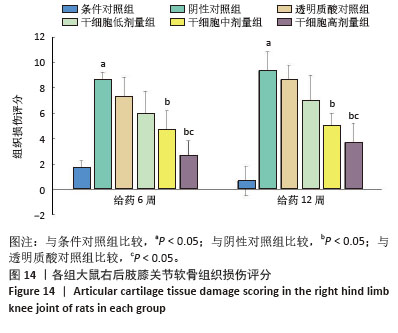
[15] GERWIN N, BENDELE AM, GLASSON S, et al. The OARSI histopathology initiative - recommendations for histological assessments of osteoarthritis in the rat. Osteoarthritis Cartilage. 2010;18 Suppl 3:S24-34.
[16] COURTIES A, KOUKI I, SOLIMAN N, et al. Osteoarthritis year in review 2024: Epidemiology and therapy. Osteoarthritis Cartilage. 2024;32(11):1397-1404.
[17] GIORGINO R, ALBANO D, FUSCO S, et al. Knee Osteoarthritis: Epidemiology, Pathogenesis, and Mesenchymal Stem Cells: What Else Is New? An Update. Int J Mol Sci. 2023;24(7):6405.
[18] WATSON N, DIVERS R, KEDAR R, et al. Discarded Wharton jelly of the human umbilical cord: a viable source for mesenchymal stromal cells. Cytotherapy. 2015;17(1):18-24.
[19] WU C, XU H, WU Z, et al. Subchondral injection of human umbilical cord mesenchymal stem cells ameliorates knee osteoarthritis by inhibiting osteoblast apoptosis and TGF-beta activity. Stem Cell Res Ther. 2025;16(1):235.
[20] PERRY J, MENNAN C, COOL P, et al. Intra-Articular Injection of Human Umbilical Cord-Derived Mesenchymal Stromal Cells Reduces Radiographic Osteoarthritis in an Ovine Model. Cartilage. 2024:19476035241287832.
[21] AO Y, DUAN J, XIONG N, et al. Repeated intra-articular injections of umbilical cord-derived mesenchymal stem cells for knee osteoarthritis: a phase I, single-arm study. BMC Musculoskelet Disord. 2023;24(1):488.
[22] PICO OA, ESPINOZA F, CÁDIZ MI, et al. Efficacy of a single dose of cryopreserved human umbilical cord mesenchymal stromal cells for the treatment of knee osteoarthritis:a randomized, controlled, double-blind pilot study. Cytotherapy. 2025;27(2):188-200.
[23] SONG Y, ZHANG J, XU H, et al. Mesenchymal stem cells in knee osteoarthritis treatment: A systematic review and meta-analysis. J Orthop Translat. 2020;24:121-130.
[24] YU H, HUANG T, LU WW, et al. Osteoarthritis Pain. Int J Mol Sci. 2022;23(9):4642.
[25] KUAH D, SIVELL S, LONGWORTH T, et al. Safety, tolerability and efficacy of intra-articular Progenza in knee osteoarthritis: a randomized double-blind placebo-controlled single ascending dose study. J Transl Med. 2018;16(1):49.
[26] GUPTA PK, CHULLIKANA A, RENGASAMY M, et al. Efficacy and safety of adult human bone marrow-derived, cultured, pooled, allogeneic mesenchymal stromal cells (Stempeucel®): preclinical and clinical trial in osteoarthritis of the knee joint. Arthritis Res Ther. 2016;18(1):301.
[27] HO KK, LEE WY, GRIFFITH JF, et al. Randomized control trial of mesenchymal stem cells versus hyaluronic acid in patients with knee osteoarthritis - A Hong Kong pilot study. J Orthop Translat. 2022;37:69-77.
[28] JIN WS, YIN LX, SUN HQ, et al. Mesenchymal Stem Cells Injection Is More Effective Than Hyaluronic Acid Injection in the Treatment of Knee Osteoarthritis With Similar Safety: A Systematic Review and Meta-analysis. Arthroscopy. 2025;41(2):318-332.
[29] COACCIOLI S, SARZI-PUTTINI P, ZIS P, et al. Osteoarthritis: New Insight on Its Pathophysiology. J Clin Med. 2022;11(20):6013.
[30] ABDEL JALEEL GA, SALEH DO, AL-AWDAN SW, et al. Impact of type III collagen on monosodium iodoacetate-induced osteoarthritis in rats. Heliyon. 2020;6(6):e04083.
[31] SAMARA O, JAFAR H, HAMDAN M, et al. Ultrasound-guided intra-articular injection of expanded umbilical cord mesenchymal stem cells in knee osteoarthritis: a safety/efficacy study with MRI data. Regen Med. 2022;17(5):299-312.
[32] GÜNAY AE, KARAMAN I, GUNEY A, et al. Assessment of clinical, biochemical, and radiological outcomes following intra-articular injection of Wharton jelly-derived mesenchymal stromal cells in patients with knee osteoarthritis: A prospective clinical study. Medicine (Baltimore). 2022;101(37):e30628.
[33] LIM HC, PARK YB, HA CW, et al. Allogeneic Umbilical Cord Blood-Derived Mesenchymal Stem Cell Implantation Versus Microfracture for Large, Full-Thickness Cartilage Defects in Older Patients: A Multicenter Randomized Clinical Trial and Extended 5-Year Clinical Follow-up. Orthop J Sports Med. 2021;9(1):2325967120973052.
[34] MATAS J, GARCÍA C, POBLETE D, et al. A Phase I Dose-Escalation Clinical Trial to Assess the Safety and Efficacy of Umbilical Cord-Derived Mesenchymal Stromal Cells in Knee Osteoarthritis. Stem Cells Transl Med. 2024;13(3):193-203.
[35] 闫文鑫,张烨,郭景玥,等.间充质干细胞注射液对大鼠膝骨关节炎的影响[J].药物评价研究,2023,46(10):2179-2185.
[36] CHEN CF, HU CC, WU CT, et al. Treatment of knee osteoarthritis with intra-articular injection of allogeneic adipose-derived stem cells (ADSCs) ELIXCYTE®: a phase I/II, randomized, active-control, single-blind, multiple-center clinical trial. Stem Cell Res Ther. 2021;12(1):562.
[37] NAIR AB, JACOB S. A simple practice guide for dose conversion between animals and human. J Basic Clin Pharm. 2016;7(2):27-31.
[38] FANG Z, LI X, LEI S, et al. Protective effects of Pudilan Tablets against osteoarthritis in mice induced by monosodium iodoacetate. Sci Rep. 2023;13(1):2760.
[39] SAMVELYAN HJ, HUGHES D, STEVENS C, et al. Models of Osteoarthritis: Relevance and New Insights. Calcif Tissue Int. 2021;109(3):243-256.
[40] KWON M, NAM D, KIM J. Pathological Characteristics of Monosodium Iodoacetate-Induced Osteoarthritis in Rats. Tissue Eng Regen Med. 2023;20(3):435-446.
[41] ENOMOTO T, AKAGI R, OGAWA Y, et al. Timing of Intra-Articular Injection of Synovial Mesenchymal Stem Cells Affects Cartilage Restoration in a Partial Thickness Cartilage Defect Model in Rats. Cartilage. 2020;11(1):122-129.
[42] SATUÉ M, SCHÜLER C, GINNER N, et al. Intra-articularly injected mesenchymal stem cells promote cartilage regeneration, but do not permanently engraft in distant organs. Sci Rep. 2019;9(1):10153.
[43] TOUPET K, MAUMUS M, LUZ-CRAWFORD P, et al. Survival and biodistribution of xenogenic adipose mesenchymal stem cells is not affected by the degree of inflammation in arthritis. PLoS One. 2015;10(1):e0114962.
[44] TOUPET K, MAUMUS M, PEYRAFITTE JA, et al. Long-term detection of human adipose-derived mesenchymal stem cells after intraarticular injection in SCID mice. Arthritis Rheum. 2013;65(7):1786-1794.
[45] SHIM G, LEE S, HAN J, et al. Pharmacokinetics and in vivo fate of intra-articularly transplanted human bone marrow-derived clonal mesenchymal stem cells. Stem Cells Dev. 2015;24(9):1124-1132. |