[1] DE KATER EP, SAKES A, EDSTRÖM E, et al. Beyond the pedicle screw-a patent review. Eur Spine J. 2022;31(6):1553-1565.
[2] GALBUSERA F, VOLKHEIMER D, REITMAIER S, et al. Pedicle screw loosening: a clinically relevant complication? Eur Spine J. 2015;24(5):1005-1016.
[3] 占旭强,余海鑫,西信,等. 腰椎椎弓根螺钉矢状面方向与螺钉松动的相关性研究[J]. 医用生物力学,2024,39(5):910-915.
[4] PENG SB, YUAN XC, LU WZ, et al. Application of the cortical bone trajectory technique in posterior lumbar fixation. World J Clin Cases. 2023;11(2):255-267.
[5] GUO S, ZHU K, YAN MJ, et al. Cortical bone trajectory screws in the treatment of lumbar degenerative disc disease in patients with osteoporosis. World J Clin Cases. 2022;10(36):13179-13188.
[6] SANTONI BG, HYNES RA, MCGILVRAY KC, et al. Cortical bone trajectory for lumbar pedicle screws. Spine J. 2009;9(5):366-373.
[7] REXITI P, ABUDUREXITI T, ABUDUWALI N, et al. Measurement of lumbar isthmus parameters for novel starting points for cortical bone trajectory screws using computed radiography. Am J Transl Res. 2018;10(8):2413-2423.
[8] LIU D, KAHAER A, WANG Y, et al. Comparison of CT values in traditional trajectory, traditional cortical bone trajectory, and modified cortical bone trajectory. BMC Surg. 2022;22(1):441.
[9] KAHAER A, ZHANG R, WANG Y, et al. Hybrid pedicle screw and modified cortical bone trajectory technique in transforaminal lumbar interbody fusion at L4-L5 segment: finite element analysis. BMC Musculoskelet Disord. 2023;24(1):288.
[10] 张连鹏,居来提·买提肉孜,张治豪,等. 有限元分析改良皮质骨轨迹置钉在腰椎翻修术中的力学性能[J]. 医用生物力学,2024,39(3):413-420.
[11] 李克鹏,苗军.椎弓根双螺钉技术在腰椎椎间融合术后邻椎病翻修术中的应用[J].中华骨与关节外科杂志,2024,17(2):97-103.
[12] RODRIGUEZ A, NEAL MT, LIU A, et al. Novel placement of cortical bone trajectory screws in previously instrumented pedicles for adjacent-segment lumbar disease using CT image-guided navigation. Neurosurg Focus. 2014;36(3):E9.
[13] UENO M, IMURA T, INOUE G, et al. Posterior corrective fusion using a double-trajectory technique (cortical bone trajectory combined with traditional trajectory) for degenerative lumbar scoliosis with osteoporosis: technical note. J Neurosurg Spine. 2013;19(5):600-607.
[14] TAN QC, WANG D, YANG Z, et al. Implant Preservation versus Implant Replacement in Revision Surgery for Adjacent Segment Disease After Thoracolumbar Instrumentation: A Retrospective Study of 43 Patients. World Neurosurg. 2021;150:e511-e519.
[15] HAN J, GUO J, MA X, et al. The Cortical Bone Trajectory Screw Technique Assisted by the Mazor Renaissance Robotic System as a Salvage Strategy for Failed Lumbar Spine Surgery: Technical Note and Case Series. J Pain Res. 2023;16:2971-2980.
[16] HE K, DONG C, WEI H, et al. A Minimally Invasive Technique Using Cortical Bone Trajectory Screws Assisted by 3D-Printed Navigation Templates in Lumbar Adjacent Segment Degeneration. Clin Interv Aging. 2021;16:1403-1413.
[17] 张希诺,刘玉增,李越,等. 骨科手术机器人辅助与X线透视辅助下徒手皮质骨轨迹螺钉置入治疗单节段退行性腰椎疾病的临床对比研究[J]. 首都医科大学学报,2023,44(5): 836-844.
[18] 盛伟斌. 3D 导板与机器人辅助腰椎皮质骨轨迹置钉技术研究进展[J]. 临床医学进展,2024,14(3):1349-1355.
[19] 亚库普江·亚森, 王浩. 斜外侧腰椎椎间融合术在成人退变性脊柱侧凸中的应用进展[J]. 中国医学创新,2025,22(3):165-170.
[20] WANG Z, FU R, MA Y, et al. Macroscopic and mesoscopic biomechanical analysis of the bone unit in idiopathic scoliosis. Sheng Wu Yi Xue Gong Cheng Xue Za Zhi. 2023;40(2):303-312.
[21] 张晗硕,丁宇,李土胜,等. 内镜下经椎板间联合椎间孔入路减压治疗腰椎管狭窄症生物力学评价[J]. 科学技术与工程,2023,23(23):9843-9849.
[22] 胡亚兰,陈明惠. 基于ABAQUS的三段式螺钉的力学性能研究[J]. 建模与仿真,2024,13(6):5800-5807.
[23] MATSUKAWA K, YATO Y, IMABAYASHI H, et al. Biomechanical evaluation of the fixation strength of lumbar pedicle screws using cortical bone trajectory: a finite element study. J Neurosurg Spine. 2015;23(4):471-478.
[24] 王轶希,居来提·买提肉孜,王水泉,等. 有限元分析腰椎传统椎弓根钉道和改良皮质骨钉道的生物力学性能[J]. 医用生物力学,2022,37(3):485-491.
[25] 吴晓宇,王哲,甘浩然,等. 皮质骨轨迹螺钉技术应用于骨质疏松患者腰椎固定的有限元分析[J]. 中国矫形外科杂志,2018,26(12):1126-1131.
[26] 王晓博,刘艳成,马信龙,等. 腰椎弓根双通道螺钉固定的可行性和准确性研究[J]. 中华骨科杂志,2020,40(15):1019-1029.
[27] 刘艳成,苗军,马信龙,等. 双椎弓根螺钉固定技术治疗腰椎融合术后相邻节段病变[J]. 中国脊柱脊髓杂志,2019,29(10):888-894.
[28] 程旗圣,居来提·买提肉孜,肖扬,等. 新型变径螺钉在腰椎改良皮质骨轨迹中的有限元分析[J]. 中国组织工程研究,2026,30(9):2162-2171.
[29] TUOHETI A, XIAO Y, WANG Y, et al. Biomechanical evaluation of modified and traditional cortical bone trajectory technique on adjacent segment degeneration in transforaminal lumbar interbody fusion-finite element analysis. BMC Musculoskelet Disord. 2024;25(1):7.
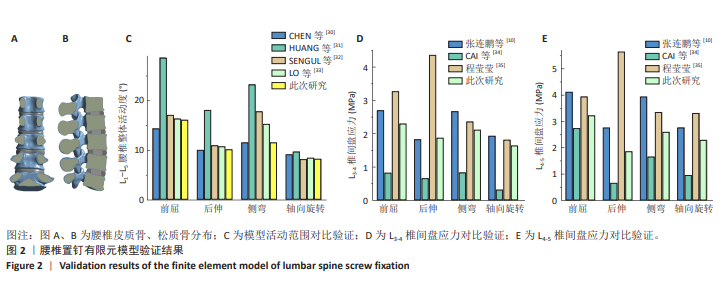
[30] CHEN CS, CHENG CK, LIU CL, et al. Stress analysis of the disc adjacent to interbody fusion in lumbar spine. Med Eng Phys. 2001;23(7):483-491.
[31] HUANG YP, DU CF, CHENG CK, et al. Preserving Posterior Complex Can Prevent Adjacent Segment Disease following Posterior Lumbar Interbody Fusion Surgeries: A Finite Element Analysis. PLoS One. 2016;11(11):e0166452.
[32] SENGUL E, OZMEN R, YAMAN ME, et al. Influence of posterior pedicle screw fixation at L4-L5 level on biomechanics of the lumbar spine with and without fusion: a finite element method. Biomed Eng Online. 2021;20(1):98.
[33] LO CC, TSAI KJ, CHEN SH, et al. Biomechanical effect after Coflex and Coflex rivet implantation for segmental instability at surgical and adjacent segments: a finite element analysis. Comput Methods Biomech Biomed Engin. 2011;14(11):969-978.
[34] CAI XY, SUN MS, HUANG YP, et al. Biomechanical Effect of L4 -L5 Intervertebral Disc Degeneration on the Lower Lumbar Spine: A Finite Element Study. Orthop Surg. 2020;12(3):917-930.
[35] 程莹莹. 基于有限元模拟的腰椎生物力学研究及内固定分析[D]. 北京: 北京化工大学,2024.
[36] FARAJ AA, WEBB JK. Early complications of spinal pedicle screw. Eur Spine J. 1997;6(5):324-326.
[37] CHEN CH, HUANG HM, CHEN DC, et al. Cortical bone trajectory screws fixation in lumbar adjacent segment disease: A technique note with case series. J Clin Neurosci. 2018;48:224-228.
[38] KOTHEERANURAK V, LIN GX, MAHATTHANATRAKUL A, et al. Endoscope-Assisted Anterior Lumbar Interbody Fusion with Computed Tomography-Guided, Image-Navigated Unilateral Cortical Bone Trajectory Screw Fixation in Managing Adjacent Segment Disease in L5/S1: Technical Note. World Neurosurg. 2019;122:469-473.
[39] 章仁杰,申才良. 腰椎椎弓根双螺钉技术的研究现状及其存在的问题[J]. 中华医学杂志,2023,103(9):635-639.
[40] ZHU G, WU Z, FANG Z, et al. Effect of the In Situ Screw Implantation Region and Angle on the Stability of Lateral Lumbar Interbody Fusion: A Finite Element Study. Orthop Surg. 2022;14(7):1506-1517.
[41] LI JR, YAN Y, WU XG, et al. Biomechanical evaluation of Percutaneous endoscopic posterior lumbar interbody fusion and minimally invasive transforaminal lumbar interbody fusion: a biomechanical analysis. Comput Methods Biomech Biomed Engin. 2024;27(3):285-295.
[42] 黄帅. 单椎弓根双螺钉技术治疗不稳定性胸腰椎爆裂骨折的数字化模拟置钉与生物力学研究[D]. 沈阳:中国医科大学,2023.
[43] TILAVERIDIS P, ILIOPOULOS E, GEORGOULAS P, et al. Treating peri-trochanteric hip fractures with intramedullary nail, when a second anti-rotational screw is necessary? BMC Musculoskelet Disord. 2023;24(1):787.
[44] 吴真,郭海龙.腰椎融合术后发生邻椎病的相关危险因素研究进展[J].中国医学创新, 2025,22(10):170-174.
[45] 阿卜杜萨拉木·托合提,肖扬,王轶希,等.三种内固定技术在腰椎间融合中对邻近节段退变生物力学的影响[J].中国组织工程研究,2026,30(3): 586-595.
[46] WU J, YANG D, HAN Y, et al. Application of dual-trajectory screws in revision surgery for lumbar adjacent segment disease: a finite element study. J Orthop Surg Res. 2022;17(1):427.
[47] HUANG X, CAI Y, CHEN K, et al. Risk factors and treatment strategies for adjacent segment disease following spinal fusion (Review). Mol Med Rep. 2025;31(2):33.
[48] 王超,石志才,李明. 应力对椎间盘细胞调控作用的研究进展[J]. 中国矫形外科杂志,2021,29(7):624-627.
[49] LOTZ JC, CHIN JR. Intervertebral disc cell death is dependent on the magnitude and duration of spinal loading. Spine (Phila Pa 1976). 2000;25(12):1477-1483.
[50] 程莹莹,梁畅,许鹏,等.不同固定方案的腰椎后路椎间融合术生物力学有限元分析[J]. 北京化工大学学报(自然科学版),2024,51(3):88-97.
[51] 陈学英,杨婷,马绍英,等.不同方法处理人类皮质骨材料的力学性能比较[J]. 辐射防护通讯,2012,32(3):22-25.
[52] 裴卉宁,陈允峰,白仲航,等.弹射救生过程飞行员胸腰椎高负荷损伤分析[J].北京航空航天大学学报,2025,51(5):102-112.
[53] FAN W, GUO LX. A comparison of the influence of three different lumbar interbody fusion approaches on stress in the pedicle screw fixation system: Finite element static and vibration analyses. Int J Numer Method Biomed Eng. 2019;35(3):e3162.
[54] ZHANG G, DU Y, JIANG G, et al. Biomechanical evaluation of different posterior fixation techniques for treating thoracolumbar burst fractures of osteoporosis old patients: a finite element analysis. Front Bioeng Biotechnol. 2023;11:1268557.
[55] MULLIN JP, PERLMUTTER B, SCHMIDT E, et al. Radiographic feasibility study of cortical bone trajectory and traditional pedicle screw dual trajectories. J Neurosurg Spine. 2016;25(6):727-732.
[56] HYUN SJ, LENKE LG, KIM YC, et al. Comparison of standard 2-rod constructs to multiple-rod constructs for fixation across 3-column spinal osteotomies. Spine (Phila Pa 1976). 2014;39(22): 1899-1904.
[57] 周志豪.改良皮质骨轨迹置钉技术生物力学性能有限元分析研究[D].乌鲁木齐:新疆医科大学,2022. |