中国组织工程研究 ›› 2026, Vol. 30 ›› Issue (33): 8695-8702.doi: 10.12307/2026.487

• 肌肉肌腱韧带组织构建 tissue construction of the muscle, tendon and ligament • 上一篇    下一篇

黄精多糖改善肌少症模型小鼠骨骼肌衰老的机制

赵  亮1,赵荣灿2,石  龙3,陈  刚1,袁超农1,邓致远1,彭  怡1,雷  杰4,5,6,文  峰4,5,6,李  扬4,5,6   

  1. 1武汉市中医医院/湖北中医药大学附属国医医院,湖北省武汉市   430006;2湖北中医药大学第一临床学院,湖北省武汉市   430065;3湖北中医药大学针灸骨伤学院,湖北省武汉市   430061;4湖北省中医院/湖北中医药大学附属医院,湖北省武汉市   430061;5中医肝肾研究及应用湖北省重点实验室(湖北省中医院),湖北省武汉市   430061;6湖北时珍实验室,湖北省武汉市   430061
  • 收稿日期:2025-11-11 修回日期:2026-03-11 出版日期:2026-11-28 发布日期:2026-06-13
  • 通讯作者: 李扬,博士,主治医师,湖北省中医院/湖北中医药大学附属医院,湖北省武汉市 430061;中医肝肾研究及应用湖北省重点实验室(湖北省中医院),湖北省武汉市 430061;湖北时珍实验室,湖北省武汉市 430061
  • 作者简介:赵亮,男,1985年生,硕士,副主任医师,主要从事中西医结合防治急慢性疼痛的研究。
  • 基金资助:
    湖北省中医药管理局联合基金项目(ZY2025L053),项目负责人:赵亮;湖北省中医药管理局中医药科研项目重点项目(ZY2025D007),项目参与人:李扬;湖北省自然科学基金中医药创新发展联合基金项目(2024AFD332),项目负责人:文峰;湖北省重点研发计划项目(2024BCB035),项目参与人:李扬

Mechanisms by which polygonatum sibiricum polysaccharides ameliorate skeletal muscle senescence in a mouse model of sarcopenia

Zhao Liang1, Zhao Rongcan2, Shi Long3, Chen Gang1, Yuan Chaonong1, Deng Zhiyuan1, Peng Yi1, Lei Jie4, 5, 6, Wen Feng4, 5, 6, Li Yang4, 5, 6   

  1. 1Wuhan Hospital of Traditional Chinese Medicine/Affiliated Hospital of Hubei University of Chinese Medicine, Wuhan 430006, Hubei Province, China; 2The First Clinical College, Hubei University of Chinese Medicine, Wuhan 430065, Hubei Province, China; 3School of Acupuncture and Orthopedics, Hubei University of Chinese Medicine, Wuhan 430061, Hubei Province, China; 4Hubei Provincial Hospital of Traditional Chinese Medicine/Affiliated Hospital of Hubei University of Chinese Medicine, Wuhan 430061, Hubei Province, China; 5Hubei Key Laboratory of Theory and Application Research of Liver and Kidney in Traditional Chinese Medicine (Hubei Province Hospital of Traditional Chinese Medicine), Wuhan 430061, Hubei Province, China; 6Hubei Shizhen Laboratory, Wuhan 430061, Hubei Province, China 
  • Received:2025-11-11 Revised:2026-03-11 Online:2026-11-28 Published:2026-06-13
  • Contact: Li Yang, PhD, Attending physician, Hubei Provincial Hospital of Traditional Chinese Medicine/Affiliated Hospital of Hubei University of Chinese Medicine, Wuhan 430061, Hubei Province, China; Hubei Key Laboratory of Theory and Application Research of Liver and Kidney in Traditional Chinese Medicine (Hubei Province Hospital of Traditional Chinese Medicine), Wuhan 430061, Hubei Province, China; Hubei Shizhen Laboratory, Wuhan 430061, Hubei Province, China
  • About author:Zhao Liang, MS, Associate chief physician, Wuhan Hospital of Traditional Chinese Medicine/Affiliated Hospital of Hubei University of Chinese Medicine, Wuhan 430006, Hubei Province, China
  • Supported by:
    Joint Fund Project of Hubei Provincial Administration of Traditional Chinese Medicine, No. ZY2025L053 (to ZL); Key Project of Traditional Chinese Medicine Scientific Research of Hubei Provincial Administration of Traditional Chinese Medicine, No. ZY2025D007 (to LY [project participant]); Joint Fund Project for Traditional Chinese Medicine Innovation and Development of Hubei Provincial Natural Science Foundation, No. 2024AFD332 (to WF); Key Research and Development Program of Hubei Province, No. 2024BCB035 (to LY [project participant])

摘要:


文题释义:
黄精多糖:是指天门冬科黄精中含量最大、最主要的多糖类化合物,具有抗氧化、抗炎、调节免疫等药理活性。中医上起到健脾益肾、强筋壮骨的功效。现代研究表明,多糖类可通过调控信号通路(如Wnt/β-catenin、磷脂酰肌醇3-激酶/蛋白激酶)缓解骨骼肌萎缩改善肌少症。
肌少症:是一种进行性、广泛性骨骼肌疾病,与老年人骨关节炎、骨折、肢体残疾和死亡的发生密切相关,其特征表现为肌量减少、肌力下降和肌功能减退等,严重影响患者的生活质量。

背景:磷脂酰肌醇3-激酶/丝氨酸蛋白激酶B信号通路与细胞增殖、生长与代谢的调控都有着密切的关系。黄精作为健脾益肾中药,其有效成分黄精多糖具有潜在改善骨骼肌衰老治疗肌少症的作用,但具体分子机制尚未明确。
目的:探讨黄精多糖通过调控磷脂酰肌醇3-激酶/丝氨酸蛋白激酶B信号通路对肌少症小鼠骨骼肌衰老的保护作用及机制。
方法:将40只雄性C57BL/6小鼠随机分为对照组、模型组及黄精多糖低、中、高剂量组,后4组使用400 mg/kg的D-半乳糖隔日腹腔注射1次建立肌少症模型,持续12周。造模与给药同时进行,黄精多糖低、中、高剂量组灌胃剂量分别为30,60,120 mg/kg,
对照组与模型组分别灌胃与药物干预组等量的生理盐水,隔日给药1次,连续干预12周。通过体质量、握力和耐力评估小鼠生理功能;采用Western blot、实时荧光定量PCR检测骨骼肌磷脂酰肌醇3-激酶/蛋白激酶B通路相关蛋白(磷酸化磷脂酰肌醇3-激酶、磷脂酰肌醇3-激酶、磷酸化蛋白激酶B、蛋白激酶B)及衰老相关p21、p53蛋白与mRNA表达;免疫荧光染色法检测衰老相关蛋白p21的表达;苏木精-伊红染色与天狼猩红染色观察肌纤维病理及纤维化程度。
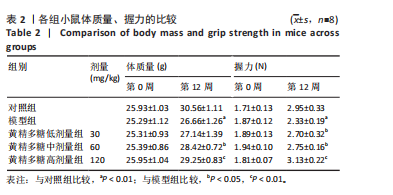
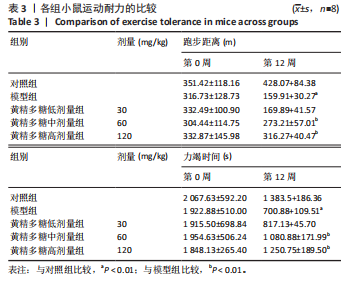
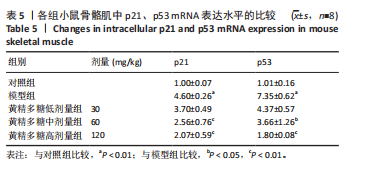
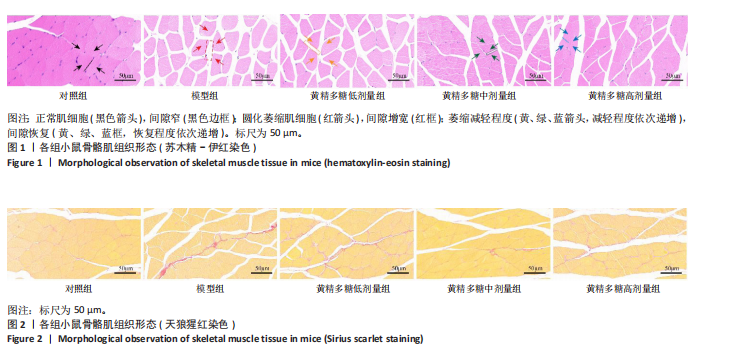
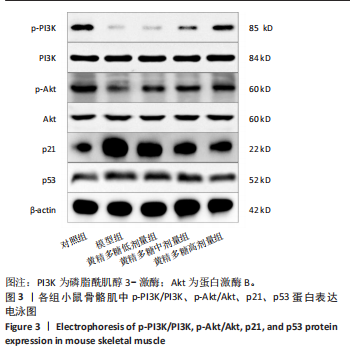
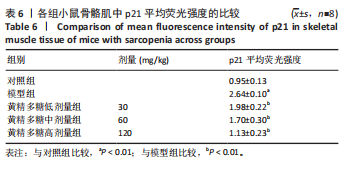
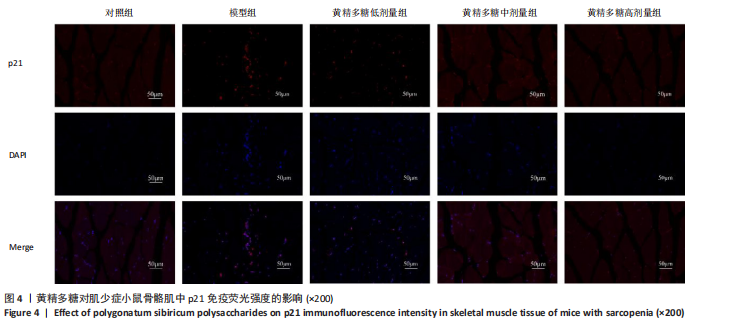
结果与结论:①黄精多糖干预12周后,与对照组相比,模型组小鼠体质量、握力、耐力显著降低(P < 0.01);与模型组相比,黄精多糖低剂量组握力呈上升趋势(P < 0.05),黄精多糖中、高剂量组小鼠体质量、握力、耐力均上升(P < 0.05或P < 0.01);②Western blot结果显示,与对照组比较,模型组磷酸化磷脂酰肌醇3-激酶/磷脂酰肌醇3-激酶、磷酸化蛋白激酶B/蛋白激酶B蛋白表达量降低(P < 0.01);与模型组比较,黄精多糖低剂量组磷酸化磷脂酰肌醇3-激酶/磷脂酰肌醇3-激酶、磷酸化蛋白激酶B/蛋白激酶B蛋白表达量无明显变化,黄精多糖中、高剂量组磷酸化磷脂酰肌醇3-激酶/磷脂酰肌醇3-激酶、磷酸化蛋白激酶B/蛋白激酶B蛋白表达量显著升高(P < 0.01);与对照组比较,模型组p21、p53蛋白表达量升高(P < 0.01);与模型组比较,黄精多糖低剂量组p21、p53蛋白表达量无明显变化,黄精多糖中、高剂量组p21、p53蛋白表达量显著降低(P < 0.01);③实时荧光定量PCR结果显示,与对照组比较,模型组p21、p53 mRNA表达量增加(P < 0.01);与模型组比较,黄精多糖低剂量组p21、p53 mRNA表达量无明显变化,中、黄精多糖高剂量组p21、p53 mRNA表达量显著降低(P < 0.05或P < 0.01);④免疫荧光染色结果显示,与对照组相比,模型组平均荧光强度显著上升(P < 0.01);与模型组比较,各剂量黄精多糖组p21平均荧光强度显著降低(P < 0.01);⑤苏木精-伊红染色结果显示,与模型组对比,不同剂量黄精多糖组均能改善骨骼肌细胞萎缩及退变程度;⑥天狼猩红染色显示,与模型组对比,低、中、高剂量黄精多糖干预后能改善骨骼肌纤维化。提示黄精多糖可改善肌少症模型小鼠骨骼肌衰老的生理功能、病理变化及纤维化程度,其机制与调控磷脂酰肌醇3-激酶/蛋白激酶信号通路有关。
https://orcid.org/0009-0003-8753-5904 (赵亮) 


中国组织工程研究杂志出版内容重点:干细胞;骨髓干细胞;造血干细胞;脂肪干细胞;肿瘤干细胞;胚胎干细胞;脐带脐血干细胞;干细胞诱导;干细胞分化;组织工程

关键词: 黄精多糖, 肌少症, 骨骼肌衰老, 磷脂酰肌醇3-激酶/蛋白激酶B通路

Abstract: BACKGROUND: The phosphatidylinositol 3-kinase/serine protein kinase B signaling pathway is closely related to the regulation of cell proliferation, growth, and metabolism. As a traditional Chinese medicine for invigorating the spleen and tonifying the kidney, the active ingredient of Polygonatum sibiricum, Polygonatum sibiricum polysaccharide, has the potential to improve skeletal muscle aging and treat sarcopenia, but the specific molecular mechanism remains unclear.
OBJECTIVE: To investigate the protective effect and mechanism of Polygonatum sibiricum polysaccharide on skeletal muscle aging in sarcopenia mice by regulating the phosphatidylinositol 3-kinase/serine protein kinase B signaling pathway.
METHODS: Forty C57BL/6 male mice were randomly divided into control group, model group, and low-, medium-, and high-dose Polygonatum sibiricum polysaccharide groups. The latter four groups received intraperitoneal injections of 400 mg/kg D-galactose every other day for 12 weeks to establish a sarcopenia model. Modeling and drug administration were performed simultaneously. The low-, medium-, and high-dose Polygonatum sibiricum polysaccharide groups were administered 30, 60, and 120 mg/kg by gavage, respectively, while the control and model groups received an equal volume of normal saline by gavage every other day for 12 consecutive weeks. Physiological functions were assessed by body mass, grip strength, and endurance. Western blot and real-time quantitative PCR were used to detect the expression of phosphatidylinositol 3-kinase/protein kinase B pathway proteins (phosphorylated phosphatidylinositol 3-kinase, phosphatidylinositol 3-kinase, phosphorylated serine protein kinase B, and protein kinase B) and aging-related p21 and p53 proteins and mRNAs in skeletal muscle. Immunofluorescence staining was used to detect the expression of aging-related protein p21. Hematoxylin-eosin staining and Sirius red staining were used to observe myofiber pathology and fibrosis degree.
RESULTS AND CONCLUSION: (1) After 12 weeks of intervention, compared with the control group, body mass, grip strength, and endurance were significantly reduced in the model group (P < 0.01). Compared with the model group, only grip strength showed an upward trend in the low-dose Polygonatum sibiricum polysaccharide group (P < 0.05), while body mass, grip strength, and endurance were all increased in the medium- and high-dose Polygonatum sibiricum polysaccharide groups (P < 0.05 or P < 0.01). (2) Western blot results showed that compared with the control group, the expression levels of phosphorylated phosphatidylinositol 3-kinase/phosphatidylinositol 3-kinase and phosphorylated protein kinase B/protein kinase B proteins were decreased in the model group (P < 0.01). Compared with the model group, there were no significant changes in the low-dose Polygonatum sibiricum polysaccharide group, but these indexes were significantly increased in the medium- and high-dose Polygonatum sibiricum polysaccharide groups (P < 0.01). Compared with the control group, p21 and p53 protein expression was increased in the model group (P < 0.01). Compared with the model group, there was no significant change in p21 and p53 protein expression in the low-dose Polygonatum sibiricum polysaccharide group, but p21 and p53 protein expression was significantly decreased in the medium- and high-dose Polygonatum sibiricum polysaccharide groups (P < 0.01). (3) Real-time quantitative PCR results showed that compared with the control group, p21 and p53 mRNA expression was increased in the model group (P < 0.01). Compared with the model group, there was no significant change in p21 and p53 mRNA expression in the low-dose Polygonatum sibiricum polysaccharide group, but p21 and p53 mRNA expression was significantly decreased in the medium- and high-dose Polygonatum sibiricum polysaccharide groups (P < 0.05 or P < 0.01). (4) Immunofluorescence staining showed that compared with the control group, the mean fluorescence intensity was significantly increased in the model group (P < 0.01). Compared with the model group, the mean fluorescence intensity of p21 was significantly decreased in all Polygonatum sibiricum polysaccharide groups (P < 0.01). (5) Hematoxylin-eosin staining showed that compared with the model group, all doses of Polygonatum sibiricum polysaccharide improved the degree of skeletal muscle cell atrophy and degeneration. (6) Sirius red staining showed that compared with the model group, low-, medium-, and high-dose Polygonatum sibiricum polysaccharide interventions improved skeletal muscle fibrosis. To conclude, these findings indicate that Polygonatum sibiricum polysaccharides can improve the physiological function, pathological changes, and fibrosis degree of skeletal muscle aging in sarcopenia model mice, and its mechanism is related to the regulation of the phosphatidylinositol 3-kinase/protein kinase B signaling pathway.

Key words: polygonatum sibiricum polysaccharide, sarcopenia, skeletal muscle aging, phosphatidylinositol 3-kinase/protein kinase B signaling pathway

中图分类号: