[1] DI MARTINO A, CESCON M, D’AGOSTINO C, et al. Collagen VI in the Musculoskeletal System. Int J Mol Sci. 2023;24(6):5095.
[2] KOMORI T, JI Y, PHAM H, et al. Type VI Collagen Regulates Endochondral Ossification in the Temporomandibular Joint. JBMR Plus. 2022;6(5): e10617.
[3] NISSEN NI, KARSDAL M, WILLUMSEN N. Collagens and Cancer associated fibroblasts in the reactive stroma and its relation to Cancer biology. J Exp Clin Cancer Res. 2019;38(1):115.
[4] AHMED S, NOWLAN NC. Initiation and emerging complexity of the collagen network during prenatal skeletal development. Eur Cell Mater. 2020;39:136-155.
[5] WANG PP, DING SY, SUN YY, et al. MYCT1 Inhibits the Adhesion and Migration of Laryngeal Cancer Cells Potentially Through Repressing Collagen VI. Front Oncol. 2021;10:564733.
[6] GREGORY CA, MA J, LOMELI S. The coordinated activities of collagen VI and XII in maintenance of tissue structure, function and repair: evidence for a physical interaction. Front Mol Biosci. 2024; 11:1376091.
[7] SOLOMON-DEGEFA H, GEBAUER JM, JEFFRIES CM, et al. Structure of a collagen VI α3 chain VWA domain array: adaptability and functional implications of myopathy causing mutations. J Biol Chem. 2020;295(36):12755-12771.
[8] ZANOTTI S, MAGRI F, SALANI S, et al. Extracellular Matrix Disorganization and Sarcolemmal Alterations in COL6-Related Myopathy Patients with New Variants of COL6 Genes. Int J Mol Sci. 2023;24(6):5551.
[9] NALLANTHIGHAL S, HEISERMAN JP, CHEON DJ. Collagen Type XI Alpha 1 (COL11A1): A Novel Biomarker and a Key Player in Cancer. Cancers (Basel). 2021;13(5):935.
[10] MERENESS JA, MARIANI TJ. The critical role of collagen VI in lung development and chronic lung disease. Matrix Biol Plus. 2021;10:100058.
[11] LAMANDÉ SR, BATEMAN JF. Collagen VI disorders: Insights on form and function in the extracellular matrix and beyond. Matrix Biol. 2018;71-72:348-367.
[12] ANTONIEL M, TRAINA F, MERLINI L, et al. Tendon Extracellular Matrix Remodeling and Defective Cell Polarization in the Presence of Collagen VI Mutations. Cells. 2020;9(2):409.
[13] LEIPHART RJ, PHAM H, HARVEY T, et al. Coordinate roles for collagen VI and biglycan in regulating tendon collagen fibril structure and function. Matrix Biol Plus. 2021;13:100099.
[14] CENNI V, SABATELLI P, DI MARTINO A, et al. Collagen VI Deficiency Impairs Tendon Fibroblasts Mechanoresponse in Ullrich Congenital Muscular Dystrophy. Cells. 2024;13(5):378.
[15] WANG X, JIA Q, YU L, et al. Filamin B knockdown impairs differentiation and function in mouse pre-osteoblasts via aberrant transcription and alternative splicing. Heliyon. 2024;10(20):e39334.
[16] IZU Y, EZURA Y, KOCH M, et al. Collagens VI and XII form complexes mediating osteoblast interactions during osteogenesis. Cell Tissue Res. 2016;364(3):623-635.
[17] KOMORI T, PHAM H, JANI P, et al. The Role of Type VI Collagen in Alveolar Bone. Int J Mol Sci. 2022;23(22):14347.
[18] IZU Y, EZURA Y, MIZOGUCHI F, et al. Type VI collagen deficiency induces osteopenia with distortion of osteoblastic cell morphology. Tissue Cell. 2012;44(1):1-6.
[19] CHRISTENSEN SE, COLES JM, ZELENSKI NA, et al. Altered trabecular bone structure and delayed cartilage degeneration in the knees of collagen VI null mice. PLoS One. 2012;7(3):e33397.
[20] PHAM HT, KRAM V, DAR QA, et al. Collagen VIα2 chain deficiency causes trabecular bone loss by potentially promoting osteoclast differentiation through enhanced TNFα signaling. Sci Rep. 2020; 10(1):13749.
[21] KOMORI T, KRAM V, PERRY S, et al. Type VI Collagen Deficiency Causes Enhanced Periodontal Tissue Destruction. J Dent Res. 2024;103(9):878-888.
[22] MARGIOTTA A. Coupling of Intracellular Calcium Homeostasis and Formation and Secretion of Matrix Vesicles: Their Role in the Mechanism of Biomineralization. Cells. 2025;14(10):733.
[23] HASEGAWA T, YAMAMOTO T, TSUCHIYA E, et al. Ultrastructural and biochemical aspects of matrix vesicle-mediated mineralization. Jpn Dent Sci Rev. 2017;53(2):34-45.
[24] MONDRAGÓN E, COWDIN M, TARABALLI F, et al. Mimicking the Organic and Inorganic Composition of Anabolic Bone Enhances Human Mesenchymal Stem Cell Osteoinduction and Scaffold Mechanical Properties. Front Bioeng Biotechnol. 2020;8:753.
[25] NUDELMAN F, PIETERSE K, GEORGE A, et al. The role of collagen in bone apatite formation in the presence of hydroxyapatite nucleation inhibitors. Nat Mater. 2010;9(12):1004-1009.
[26] DU T, NIU X, HOU S, et al. Apatite minerals derived from collagen phosphorylation modification induce the hierarchical intrafibrillar mineralization of collagen fibers. J Biomed Mater Res A. 2019; 107(11):2403-2413.
[27] OGURA H, NAKAMURA T, ISHII T, et al. Mechanical stress-induced FGF-2 promotes proliferation and consequently induces osteoblast differentiation in mesenchymal stem cells. Biochem Biophys Res Commun. 2023;684:149145.
[28] ZHANG N, JIANG H, BAI Y, et al. The molecular mechanism study of insulin on proliferation and differentiation of osteoblasts under high glucose conditions. Cell Biochem Funct. 2019;37(5):385-394.
[29] KOHARA Y, SOETA S, IZU Y, et al. Distribution of type VI collagen in association with osteoblast lineages in the groove of Ranvier during rat postnatal development. Ann Anat. 2016;208:58-68.
[30] NICOL L, SRIKANTH P, HENRIKSEN K, et al. Widespread disturbance in extracellular matrix collagen biomarker responses to teriparatide therapy in osteogenesis imperfecta. Bone. 2021; 142:115703.
[31] LIU K, LIU Y, XU Y, et al. Asperosaponin VI protects against bone destructions in collagen induced arthritis by inhibiting osteoclastogenesis. Phytomedicine. 2019;63:153006.
[32] LU L, WANG L, WANG H, et al. Regulatory role of miR-128-2-5p in serum exosomes on COL6A2 expression and postmenopausal osteoporosis. Hum Mol Genet. 2025;34(7):563-576.
[33] WANG K, PENG X, ZHANG R, et al. COL6A3 enhances the osteogenic differentiation potential of BMSCs by promoting mitophagy in the osteoporotic microenvironment. Mol Biol Rep. 2024;51(1):206.
[34] CHU WC, ZHANG S, SNG TJ, et al. Distribution of pericellular matrix molecules in the temporomandibular joint and their chondroprotective effects against inflammation. Int J Oral Sci. 2017;9(1):43-52.
[35] PULLIG O, WESELOH G, SWOBODA B. Expression of type VI collagen in normal and osteoarthritic human cartilage. Osteoarthritis Cartilage. 1999; 7(2):191-202.
[36] NUGENT AE, SPEICHER DM, GRADISAR I, et al. Advanced osteoarthritis in humans is associated with altered collagen VI expression and upregulation of ER-stress markers Grp78 and bag-1. J Histochem Cytochem. 2009;57(10):923-931.
[37] MCDEVITT CA, PAHL JA, AYAD S, et al. Experimental osteoarthritic articular cartilage is enriched in guanidine soluble type VI collagen. Biochem Biophys Res Commun. 1988;157(1):250-255.
[38] DANALACHE M, ERLER AL, WOLFGART JM, et al. Biochemical changes of the pericellular matrix and spatial chondrocyte organization-Two highly interconnected hallmarks of osteoarthritis. J Orthop Res. 2020;38(10):2170-2180.
[39] DANALACHE M, UMRATH F, RIESTER R, et al. Proteolysis of the pericellular matrix: Pinpointing the role and involvement of matrix metalloproteinases in early osteoarthritic remodeling. Acta Biomater. 2024;181:297-307.
[40] YOTSUYA M, BERTAGNA AE, HASAN N, et al. Neuron/Glial Antigen 2-Type VI Collagen Interactions During Murine Temporomandibular Joint Osteoarthritis. Sci Rep. 2019;9(1):56.
[41] XU Q, FENG G, TANG Z, et al. Mechanistic study of COL6A1-mediated subchondral bone remodeling in osteoarthritis via the EPAC/RAP1 axis. FASEB J. 2025;39(6):e70473.
[42] FLIES DB, LANGERMANN S, JENSEN C, et al. Regulation of tumor immunity and immunotherapy by the tumor collagen extracellular matrix. Front Immunol. 2023;14: 1199513.
[43] LI X, LI Z, GU S, et al. A pan-cancer analysis of collagen VI family on prognosis, tumor microenvironment, and its potential therapeutic effect. BMC Bioinformatics. 2022;23(1):390.
[44] ZHANG Y, LIU Z, YANG X, et al. H3K27 acetylation activated-COL6A1 promotes osteosarcoma lung metastasis by repressing STAT1 and activating pulmonary cancer-associated fibroblasts. Theranostics. 2021;11(3):1473-1492.
[45] SUGITA S, TAKENAMI T, KIDO T, et al. Diagnostic utility of CSF1 immunohistochemistry in tenosynovial giant cell tumor for differentiating from giant cell-rich tumors and tumor-like lesions of bone and soft tissue. Diagn Pathol. 2022;17(1):88.
[46] GUO HL, CHEN G, SONG ZL, et al. COL6A3 promotes cellular malignancy of osteosarcoma by activating the PI3K/AKT pathway. Rev Assoc Med Bras (1992). 2020;66(6):740-745.
[47] FERTALA A. Three Decades of Research on Recombinant Collagens: Reinventing the Wheel or Developing New Biomedical Products? Bioengineering (Basel). 2020;7(4):155.
[48] GODWIN ARF, STARBORG T, SHERRATT MJ, et al. Defining the hierarchical organisation of collagen VI microfibrils at nanometre to micrometre length scales. Acta Biomater. 2017;52:21-32.
[49] CESCON M, GATTAZZO F, CHEN P, et al. Collagen VI at a glance. J Cell Sci. 2015;128(19):3525-3531.
[50] ABBONANTE V, MALARA A, CHRISAM M, et al. Lack of COL6/collagen VI causes megakaryocyte dysfunction by impairing autophagy and inducing apoptosis. Autophagy. 2023;19(3):984-999.
[51] LIU C. Application of marine collagen for stem-cell-based therapy and tissue regeneration (Review). Med Int (Lond). 2021;1(3):6.
[52] ULLAH S, ZAINOL I. Fabrication and applications of biofunctional collagen biomaterials in tissue engineering. Int J Biol Macromol. 2025;298: 139952.
[53] DONG C, LV Y. Application of Collagen Scaffold in Tissue Engineering: Recent Advances and New Perspectives. Polymers (Basel). 2016;8(2):42.
[54] 侯建明,李琦.生物活性支架材料修复骨质疏松性骨缺损[J].中国组织工程研究,2023,27(21): 3423-3429.
[55] NEDERGAARD A, SUN S, KARSDAL MA, et al. Type VI collagen turnover-related peptides-novel serological biomarkers of muscle mass and anabolic response to loading in young men. J Cachexia Sarcopenia Muscle. 2013;4(4):267-275.
[56] JUHL P, BAY-JENSEN AC, KARSDAL M, et al. Serum biomarkers of collagen turnover as potential diagnostic tools in diffuse systemic sclerosis: A cross-sectional study. PLoS One. 2018;13(12):e0207324.
[57] WILLIAMS L, LAYTON T, YANG N, et al. Collagen VI as a driver and disease biomarker in human fibrosis. FEBS J. 2022;289(13):3603-3629.
[58] KWONG AK, ZHANG Y, HO RS, et al. Collagen VI-related myopathies: clinical variability, phenotype-genotype correlation and exploratory transcriptome study. Neuromuscul Disord. 2023; 33(5):371-381.
[59] BRULL A, SARATHY A, BOLDUC V, et al. Optimized allele-specific silencing of the dominant-negative COL6A1 G293R substitution causing collagen VI-related dystrophy. Mol Ther Nucleic Acids. 2024;35(2):102178.
[60] MARROSU E, ALA P, MUNTONI F, et al. Gapmer Antisense Oligonucleotides Suppress the Mutant Allele of COL6A3 and Restore Functional Protein in Ullrich Muscular Dystrophy. Mol Ther Nucleic Acids. 2017;8:416-427.
[61] GUALANDI F, MANZATI E, SABATELLI P, et al. Antisense-induced messenger depletion corrects a COL6A2 dominant mutation in Ullrich myopathy. Hum Gene Ther. 2012;23(12):1313-1318.
[62] AGUTI S, BOLDUC V, ALA P, et al. Exon-Skipping Oligonucleotides Restore Functional Collagen VI by Correcting a Common COL6A1 Mutation in Ullrich CMD. Mol Ther Nucleic Acids. 2020; 21:205-216.
[63] HARADA A, GOTO M, KATO A, et al. Systemic Supplementation of Collagen VI by Neonatal Transplantation of iPSC-Derived MSCs Improves Histological Phenotype and Function of Col6-Deficient Model Mice. Front Cell Dev Biol. 2021; 9:790341.
[64] MOHASSEL P, HEARN H, ROONEY J, et al. Collagen type VI regulates TGF-β bioavailability in skeletal muscle in mice. J Clin Invest. 2025; 135(9):e173354.
[65] IRWIN WA, BERGAMIN N, SABATELLI P, et al. Mitochondrial dysfunction and apoptosis in myopathic mice with collagen VI deficiency. Nat Genet. 2003;35(4):367-371.
[66] CASTAGNARO S, GAMBAROTTO L, CESCON M, et al. Autophagy in the mesh of collagen VI. Matrix Biol. 2021;100-101:162-172.
[67] CEYHAN AB, KAYNAR A, ALTAY O, et al. Identifying Hub Genes and Metabolic Pathways in Collagen VI-Related Dystrophies: A Roadmap to Therapeutic Intervention. Biomolecules. 2024;14(11):1376.
[68] METTI S, GAMBAROTTO L, CHRISAM M, et al. The Polyphenol Pterostilbene Ameliorates the Myopathic Phenotype of Collagen VI Deficient Mice via Autophagy Induction. Front Cell Dev Biol. 2020;8:580933.
[69] WILLIAMS LM, MCCANN FE, CABRITA MA, et al. Identifying collagen VI as a target of fibrotic diseases regulated by CREBBP/EP300. Proc Natl Acad Sci U S A. 2020;117(34):20753-20763.
|


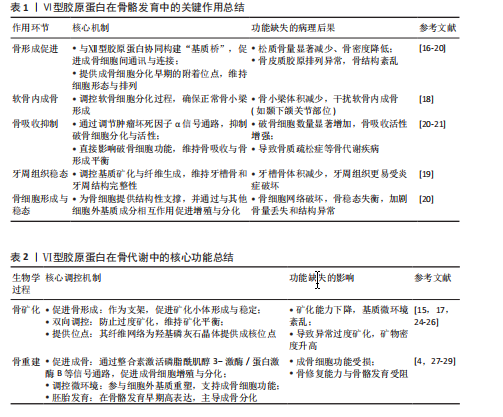
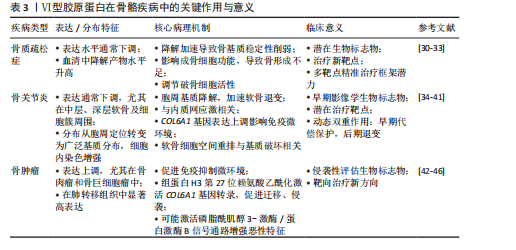


 期降解是骨关节炎的生物学标志;而Ⅵ型胶原蛋白α1链的高表达(受表观遗传调控)可通过外泌体诱导癌症相关成纤维细胞活化,并激活磷脂酰肌醇3-激酶/蛋白激酶B通路,促进骨肿瘤的侵袭与转移。在转化应用层面,Ⅵ型胶原蛋白不仅可作为提升骨组织工程支架力学性能与成骨活性的关键组分,Ⅵ型胶原蛋白衍生的血清标志物亦为无创诊断提供了新策略,而基因治疗、干细胞移植及靶向通路抑制剂则为疾病干预开辟了新途径。综上,Ⅵ型胶原蛋白通过整合结构支撑功能与多条信号通路的调控作用维系骨稳态,对Ⅵ型胶原蛋白功能网络的深入解析为骨骼疾病的精准诊疗与再生修复奠定了分子基础。
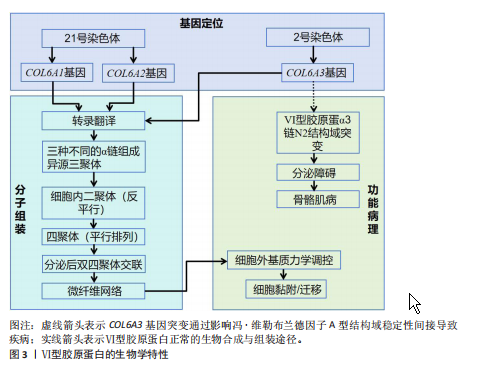
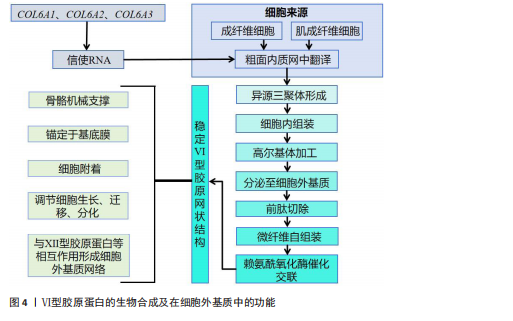
3.3 既往他人在该领域研究的贡献和存在的问题 既往研究系统解析了Ⅵ型胶原蛋白的三维结构特征(如VWA结构域的构象可塑性)及其在细胞外基质中的组装机制,明确了Ⅵ型胶原蛋白通过调控成骨细胞与破骨细胞之间的平衡以维持骨稳态的核心功能,并建立了Ⅵ型胶原蛋白基因突变与乌尔里希型先天性肌营养不良等骨骼肌肉疾病的因果关联。然而,现有研究仍存在3个方面局限:① Ⅵ型胶原蛋白在不同骨相关细胞类型(如骨细胞、软骨细胞)中的特异性调控机制尚未阐明;②Ⅵ型胶原蛋白在骨矿化过程中发挥双向调控作用(抑制过度矿化与促进有序矿化)的分子开关尚未明确;③基于动物模型所得结论向临床转化的有效性仍需进一步验证。
期降解是骨关节炎的生物学标志;而Ⅵ型胶原蛋白α1链的高表达(受表观遗传调控)可通过外泌体诱导癌症相关成纤维细胞活化,并激活磷脂酰肌醇3-激酶/蛋白激酶B通路,促进骨肿瘤的侵袭与转移。在转化应用层面,Ⅵ型胶原蛋白不仅可作为提升骨组织工程支架力学性能与成骨活性的关键组分,Ⅵ型胶原蛋白衍生的血清标志物亦为无创诊断提供了新策略,而基因治疗、干细胞移植及靶向通路抑制剂则为疾病干预开辟了新途径。综上,Ⅵ型胶原蛋白通过整合结构支撑功能与多条信号通路的调控作用维系骨稳态,对Ⅵ型胶原蛋白功能网络的深入解析为骨骼疾病的精准诊疗与再生修复奠定了分子基础。
3.3 既往他人在该领域研究的贡献和存在的问题 既往研究系统解析了Ⅵ型胶原蛋白的三维结构特征(如VWA结构域的构象可塑性)及其在细胞外基质中的组装机制,明确了Ⅵ型胶原蛋白通过调控成骨细胞与破骨细胞之间的平衡以维持骨稳态的核心功能,并建立了Ⅵ型胶原蛋白基因突变与乌尔里希型先天性肌营养不良等骨骼肌肉疾病的因果关联。然而,现有研究仍存在3个方面局限:① Ⅵ型胶原蛋白在不同骨相关细胞类型(如骨细胞、软骨细胞)中的特异性调控机制尚未阐明;②Ⅵ型胶原蛋白在骨矿化过程中发挥双向调控作用(抑制过度矿化与促进有序矿化)的分子开关尚未明确;③基于动物模型所得结论向临床转化的有效性仍需进一步验证。