中国组织工程研究 ›› 2026, Vol. 30 ›› Issue (33): 8811-8821.doi: 10.12307/2026.392
• 组织构建循证医学 evidence-based medicine in tissue construction • 上一篇 下一篇
运动强度对不同年龄段人群认知功能影响的Meta分析
李 兵1,苏 煜1,全家霖2,袁玉峰1,王全军1,谢 科1,王平安1,余嵩元1
- 1韶关学院体育学院体质与健康工作室,广东省韶关市 512005;2广州体育学院研究生院,广东省广州市 510500
-
收稿日期:2024-07-09修回日期:2025-10-22出版日期:2026-11-28发布日期:2026-06-18 -
通讯作者:苏煜,教授,博士,韶关学院体育学院体质与健康工作室,广东省韶关市 512005 通讯作者:全家霖,硕士,广州体育学院研究生院,广东省广州市 510500 -
作者简介:李兵,男,1979年生,山东省邹平市人,汉族,硕士,主要从事体育锻炼与身心健康方面的研究。 -
基金资助:广东省哲学社会科学规划项目(GD20YDXZTY27),项目负责人:苏煜;韶关市哲学社会科学规划基础教育特别委托课题(W2022018),项目负责人:苏煜;韶关市哲学社会科学规划课题(G2022018),项目负责人:李兵
Effects of exercise intensity on cognitive function in different age groups: a meta-analysis
Li Bing1, Su Yu1, Quan Jialin2, Yuan Yufeng1, Wang Quanjun1, Xie Ke1, Wang Ping'an1, Yu Songyuan1
- 1Physical Fitness and Health Studio, College of Physical Education, Shaoguan University, Shaoguan 512005, Guangdong Province, China; 2Graduate School of Guangzhou Sport University, Guangzhou 510500, Guangdong Province China
-
Received:2024-07-09Revised:2025-10-22Online:2026-11-28Published:2026-06-18 -
Contact:Su Yu, PhD, Professor, Physical Fitness and Health Studio, College of Physical Education, Shaoguan University, Shaoguan 512005, Guangdong Province, China Co-corresponding author: Quan Jialin, MS, Graduate School of Guangzhou Sport University, Guangzhou 510500, Guangdong Province China -
About author:Li Bing, MS, Physical Fitness and Health Studio, College of Physical Education, Shaoguan University, Shaoguan 512005, Guangdong Province, China -
Supported by:Guangdong Provincial Philosophy and Social Sciences Planning Project, No. GD20YDXZTY27 (to SY); Shaoguan Municipal Philosophy and Social Sciences Planning Special Commissioned Project on Basic Education, No. W2022018 (to SY); Shaoguan Municipal Philosophy and Social Sciences Planning Project, No. G2022018 (to LB)

摘要:

文题释义:
运动强度:是指单位时间内完成练习所用的力量大小和机体的紧张程度,影响运动强度的主要因素是练习时的速度和负重量。
认知功能:是指人类大脑在接受外界信息后,通过加工、储存以及提取信息,从而实现获取知识或者应用知识的过程,包括整体认知、记忆表现、执行功能、抑制控制和认知灵活性等多个方面。
目的:探讨运动干预对不同年龄段人群认知功能的影响以及改善认知功能的最适强度。
方法:基于PRISMA规范,检索PubMed、Web of Science、Cochrane Library、Embase、中国知网5个数据库自建库以来至2024年12月收录的不同运动强度对认知功能影响的随机对照试验。通过偏倚风险评估工具ROB2对所纳入文献进行偏倚风险评估,采用R 4.2.0软件及JAGS 4.3.0软件进行贝叶斯网状Meta分析,采用随机效应模型,并以标准化均数差(SMD)作为合并效应量,探讨改善结局指标(整体认知、记忆表现、抑制控制和认知灵活性)的最佳运动强度。
结果:共纳入63篇文献,4 167名参与者。①整体认知:对于年龄>45岁人群,中等强度运动(SMD=1.34,95%CI=0.83-1.85,P < 0.05)和高强度运动(SMD=1.30,95%CI=0.29-2.33,P < 0.05)能显著提高整体认知水平,中等强度运动优于高强度运动;②记忆表现:对于年龄< 18岁人群,中等强度运动(SMD=0.68,95%CI=0.29-1.09,P < 0.05)显著提高记忆表现水平;对于年龄≤45岁人群,中等强度运动(SMD=0.60,95%CI=0.33-0.89,P < 0.05)能显著提高记忆表现水平;对于年龄> 45岁人群,高强度运动(SMD=0.40,95%CI=0.06-0.75,P < 0.05)能显著提高记忆表现水平;③抑制控制:对于年龄< 18岁人群,中等强度运动(SMD=0.56,95%CI=0.31-0.81,P < 0.05)和高强度运动(SMD=0.43,95%CI=0.05-0.83,P < 0.05)能显著提高抑制控制水平,中等强度运动优于高强度运动;对于年龄≤45岁人群,中等强度运动(SMD=0.55,95%CI=0.35-0.77,P < 0.05)和高强度运动(SMD=0.51,95%CI=0.19-0.85,P < 0.05)能显著提高抑制控制水平,中等强度运动优于高强度运动;对于年龄> 45岁人群,3种运动强度均不存在显著影响(P > 0.05);④认知灵活性:对于年龄≤18岁人群,中等强度运动(SMD=0.62,95%CI=0.25-1.01,P < 0.05)能显著提高认知灵活性;对于年龄>18岁人群,中等强度运动(SMD=0.47,95%CI=0.01-1.03,P < 0.05)能显著提高认知灵活性。
结论:相较于其他运动强度,中等强度在改善儿童青少年与青年人的记忆表现、抑制控制和认知灵活性方面表现出较优的效果。高强度运动能有效改善儿童青少年和青年人的抑制控制、中老年人的整体认知和记忆表现,且记忆表现的改善效果较优。实践过程中应综合考虑运动类型、周期、年龄等要素的影响,选取最适运动强度。
https://orcid.org/0009-0008-1270-0182 (李兵)
中国组织工程研究杂志出版内容重点:干细胞;骨髓干细胞;造血干细胞;脂肪干细胞;肿瘤干细胞;胚胎干细胞;脐带脐血干细胞;干细胞诱导;干细胞分化;组织工程
中图分类号:
引用本文
李 兵, 苏 煜, 全家霖, 袁玉峰, 王全军, 谢 科, 王平安, 余嵩元. 运动强度对不同年龄段人群认知功能影响的Meta分析[J]. 中国组织工程研究, 2026, 30(33): 8811-8821.
Li Bing, Su Yu, Quan Jialin, Yuan Yufeng, Wang Quanjun, Xie Ke, Wang Ping'an, Yu Songyuan. Effects of exercise intensity on cognitive function in different age groups: a meta-analysis[J]. Chinese Journal of Tissue Engineering Research, 2026, 30(33): 8811-8821.
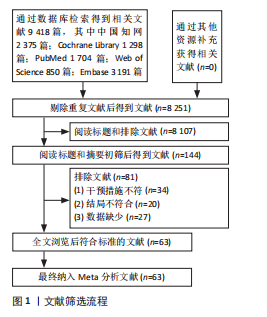
2.2 纳入文献的基本特征 纳入63篇文献[34-96],共包括4 167名受试者,男女不限,所有受试者均按照随机原则进行分组。年龄范围为5-83岁。结局指标方面,21项研究报告整体认知[34-36,38,42-44,49-50,55,57,61,63,66-67,73,75,81,85-86,88],35项研究报告记忆表现[34,36-37,39,41-42,45-49,51,53-54,56,58-60,62,64,68-71,73,76-78,82,88-89,91-94],34项研究报告抑制控制[36,39-42,45-49,53-54,58,64-65,68,70,72,74-75,77,79-80,82-84,87-90,92,94-96],22项研
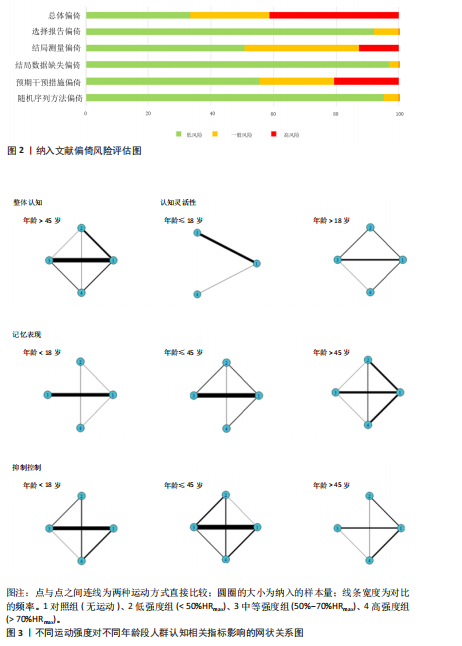
2.3 纳入文献的研究偏倚风险评价结果 采用ROB2风险偏倚评估工具对纳入的63项研究进行偏倚风险评价。在随机序列方法方面,3项研究并未具体描述随机序列方法[38,41,67],其余研究都描述了产生随机分配序列方法,为低风险偏倚。35项研究具体描述了预期干预措施[34-36,39-40,45,51-52,56,59-61,63-65,69-71,73,75-77,79,81-83,85-88,90,92-93,95-96],偏倚风险较低,15项研究信息模糊[37,41-44,46-48,53-54,58,62,72,78,80],被定义为一般风险偏倚,13项研究未描述预期干预措施[38,49-50,55,57,66-68,74,84,89,91,94],被定义为高风险偏倚。在数据完整性方面,2项研究数据不完整[54,66],其余研究都为低风险偏倚。在结局测量的偏倚方面,23项研究为一般风险[34,40-41,46,49-50,52,57-58,62-66,69,72,74,77,81-82,84,92,95],8项研究为高风险[36,38-39,54-55,67,80,94],其余均为低风险。在选择报告偏倚方面,5项研究为一般风险[39,48,54,71,77],其余均为低风险。在总体偏倚上,21项研究为低风险,16项研究为一般风险,26项研究为高风险(图2)。
2.4 Meta分析网络关系结果 共纳入63项研究进行分析,包含4个认知相关的结局指标,分别为整体认知、认知灵活性、记忆表现、抑制控制。由图3可见,整体认知网状关系图显示,对照组、低强度运动组、中等强度运动组和高强度运动组形成了5个闭合环。认知灵活性网状关系图显示,年龄≤18岁群体不成网状,年龄> 18岁人群中4种强度间形成3个闭合环。记忆表现网状关系图显示,年龄< 18岁人群中对照组、低强度运动、高强度运动3种强度间形成1个闭合环,年龄≤45岁人群4种强度间形成2个闭合环,年龄> 45岁人群则形成5个闭合环。抑制控制网状关系图显示,年龄< 18岁人群中4种强度间形成2个闭合环,年龄≤45岁人群形成4个闭合环,年龄> 45岁人群形成2个闭合环。
2.5 网状Meta分析结果
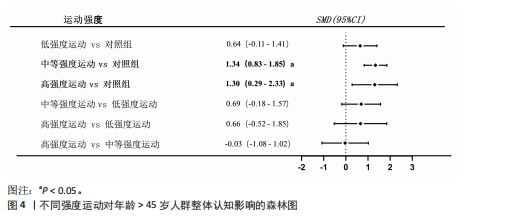
2.5.1 整体认知 由图4可见,对于年龄> 45岁人群,与对照组相比,中等强度运动(SMD=1.34,95%CI= 0.83-1.85,P < 0.05)和高强度运动(SMD=1.30,95%CI=0.29-2.33,P < 0.05)能显著提高整体认知水平。通过效应值发现,中等强度运动的影响优于高强度运动。各运动强度间的两两比较不存在显著性差异(P > 0.05)。SUCAR值概率排序从高到低为:中等强度运动(SUCAR=0.86)、高强度运动(SUCAR=0.83)、低强度运动(SUCAR=0.53)、对照组(SUCAR=0.26)。
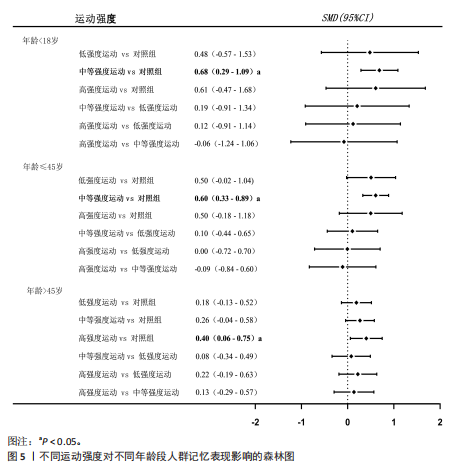
2.5.2 记忆表现 由图5可见,对于年龄< 18岁人群,与对照组相比,中等强度运动(SMD=0.68,95%CI=0.29-1.09,P < 0.05)显著提高记忆表现水平。SUCAR值概率排序从高到低为:中等强度运动(SUCAR=0.76)、高强度运动(SUCAR=0.73)、低强度运动(SUCAR=0.64)、对照组(SUCAR=0.32)。
由图5可见,对于年龄≤45岁人群,与对照组相比,中等强度运动(SMD=0.60,95%CI=0.33-0.89,P < 0.05)能显著提高记忆表现水平。各运动强度间两两比较不存在显著性差异(P > 0.05)。SUCAR值概率排序从高到低为:中等强度运动(SUCAR=0.81)、高强度运动(SUCAR=0.71)、低强度运动(SUCAR=0.70) 、对照组(SUCAR=0.27)。
由图5可见,对于年龄> 45岁人群,与对照组相比,高强度运动(SMD=0.40,95%CI=0.06-0.75,P < 0.05)能显著提高记忆表现水平。各运动强度间两两比较不存在显著性差异(P > 0.05)。SUCAR值概率排序从高到低为:高强度运动(SUCAR=0.90)、中等强度运动(SUCAR=0.72)、低强度运动(SUCAR=0.58)、对照组(SUCAR= 0.29)。
2.5.3 抑制控制结果 由图6可见,对于年龄< 18岁人群,与对照组相比,中等强度运动(SMD=0.56,95%CI= 0.31-0.81,P < 0.05)和高强度运动(SMD=0.43,95%CI=0.05-0.83,P < 0.05)能显著提高抑制控制水平。各运动强度间两两比较不存在显著性差异(P > 0.05)。SUCAR值概率排序从高到低为:中等强度运动(SUCAR=0.92)、高强度运动(SUCAR=0.79)、低强度运动(SUCAR=0.44)、对照组(SUCAR=0.32)。
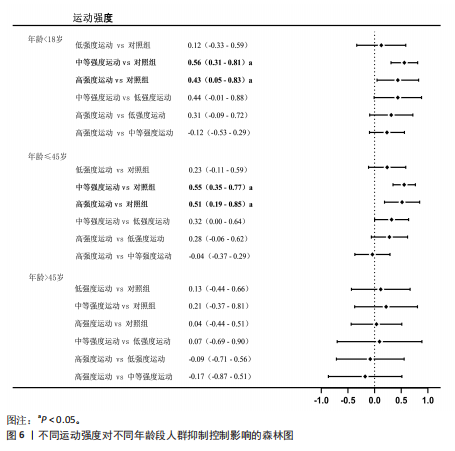
由图6可见,对于年龄≤45岁人群,与对照组相比,中等强度运动(SMD=0.55,95%CI=0.35-0.77,P < 0.05)和高强度运动(SMD=0.51,95%CI=0.19-0.85,P < 0.05)能显著提高抑制控制水平。各运动强度间两两比较不存在显著性差异(P > 0.05)。SUCAR值概率排序从高到低为:中等强度运动(SUCAR=0.89)、高强度运动(SUCAR=0.83)、低强度运动(SUCAR=0.49)、对照组(SUCAR=0.27)。
由图6可见,对于年龄> 45岁人群,与对照组相比,3种运动强度均不存在显著影响(P > 0.05)。各运动强度间两两比较同样不存在显著性差异(P > 0.05)。SUCAR值概率排序从高到低为:中等强度运动(SUCAR=0.76)、低强度运动(SUCAR=0.69)、高强度运动(SUCAR=0.55)、对照组(SUCAR= 0.47)。
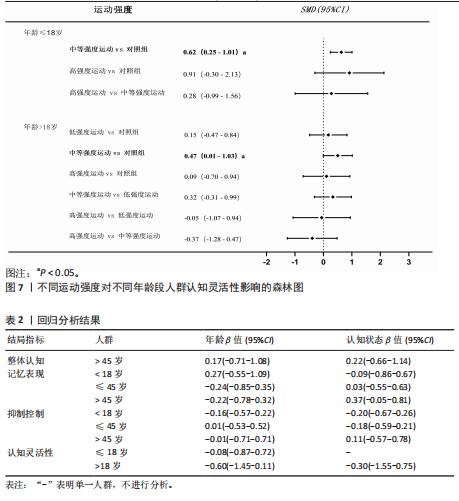
2.5.4 认知灵活性结果 由图7可见,对于年龄≤18岁人群,与对照组相比,中等强度运动(SMD=0.62,95%CI=0.25-1.01,P < 0.05)能显著提高认知灵活性水平。各运动强度间两两比较不存在显著性差异(P > 0.05)。SUCAR值概率排序从高到低为:高强度运动(SUCAR=0.87)、中等强度运动(SUCAR=0.77)、对照组(SUCAR=0.35)。
由图7可见,对于年龄> 18岁人群,与对照组相比,中等强度运动(SMD=0.47,95%CI=0.01-1.03,P < 0.05)能显著提高认知灵活性水平。各运动强度间两两比较不存在显著性差异(P > 0.05)。SUCAR值概率排序从高到低为:中等强度运动(SUCAR=0.92)、低强度运动(SUCAR=0.59)、高强度运动(SUCAR=0.55)、对照组(SUCAR= 0.42)。
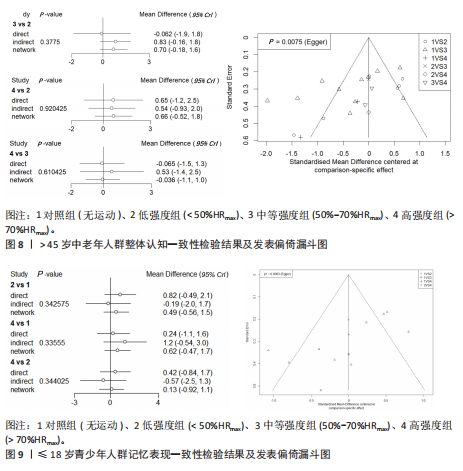
2.6 回归分析 由表2可见,年龄对于整体认知、记忆表现、抑制控制和认知灵活性的干预效果不存在显著的调节作用。认知状态(认知障碍和认知健康)对整体认知、记忆表现、抑制控制和认知灵活性的干预效果同样不存在显著的调节作用。
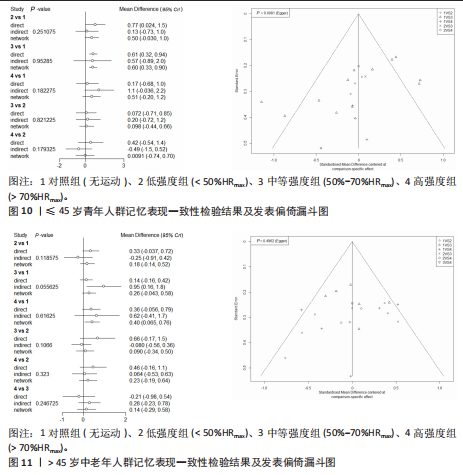
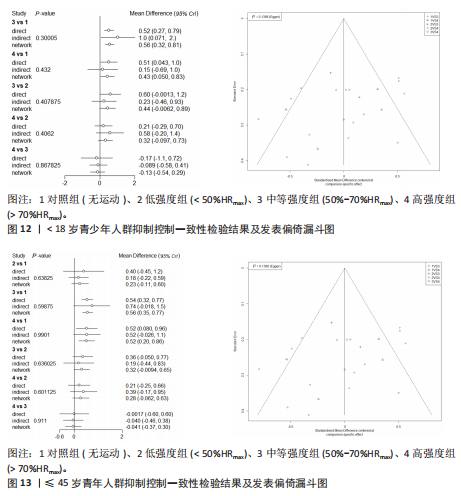
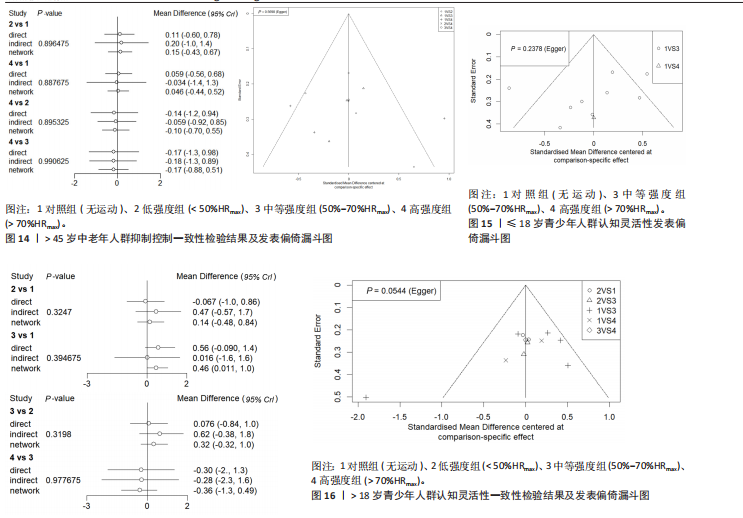
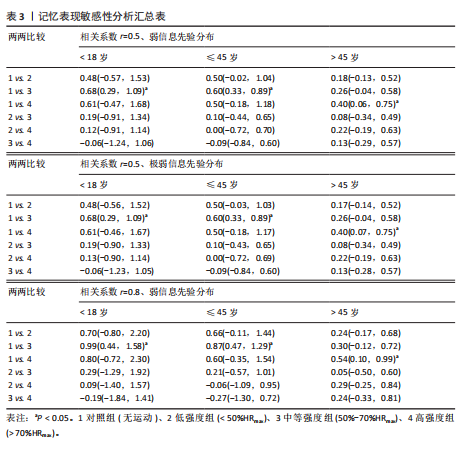
2.7 一致性检验、收敛诊断、发表偏倚分析和敏感性分析结果 计算偏差信息准则值来判断模型拟合优度,结果发现一致性模型的偏差信息准则值与不一致性模型没有显著差异,提示纳入研究不存在明显的全局不一致性,使用一致性模型来分析数据是合理的。同时采用节点劈裂法对纳入的研究进行不一致性检验,检验各运动强度组与对照组之间的直接比较与间接比较是否具有一致性,结果发现,所有比较均P > 0.05,表明纳入研究具有较好的一致性,适合采用一致性模型进行数据分析。由于年龄≤18岁群体认知灵活性的网状关系图未成环,故不进行一致性检验。
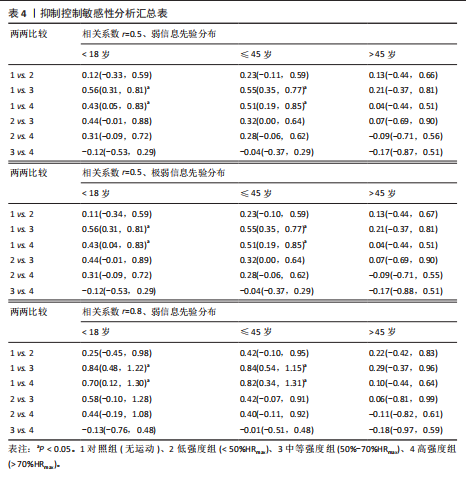
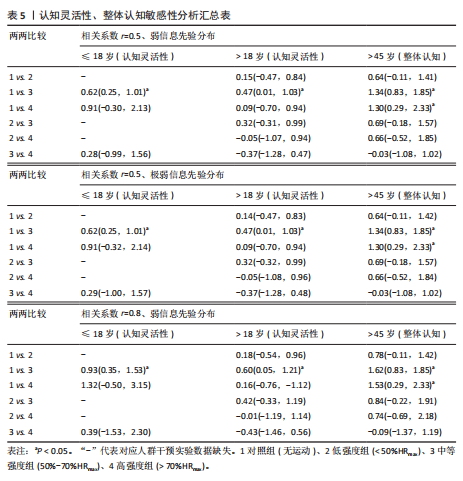
在一致性模型中各结局指标密度图的Bandwidth值均趋向于0,PSRF均趋向1,表明模型的收敛效能较好,结果可靠。对所有纳入的研究进行发表偏倚分析发现,整体认知(t=-2.28,P < 0.05)以及< 18岁人群(t=-3.16,P < 0.05)和< 45岁人群(t=-2.96,P < 0.05)的记忆表现相关研究存在一定的发表偏倚,在其他研究中均未发现显著性的发表偏倚(P > 0.05)。研究采用两种相关系数(r=0.5,r=0.8)
和两种先验分布(极弱信息先验、弱信息先验)来进行敏感性分析,所得结论均保持一致。
一致性检验图和漏斗图见图8-16。敏感性分析结果见表3-5。
| [1] Risk Reduction of Cognitive Decline and Dementia: WHO Guidelines. Geneva: World Health Organization, 2019. [2] BIDZAN-BLUMA I, LIPOWSKA M. Physical Activity and Cognitive Functioning of Children: A Systematic Review. Int J Environ Res Public Health. 2018;15(4):800. [3] EVANS JJ. Basic concepts and principles of neuropsychological assessment//HALLIGAN PW, KISCHKA U, MARSHALL JC. Handbook of Clinical Neuropsychology. Oxford, UK:University Press, 2003:15-26. [4] 2023 Alzheimer’s disease facts and figures. Alzheimers Dement. 2023;19(4):1598-1695. [5] WORLD HEALTH ORGANIZATION (2022). Global status report on the public health response to dementia. https://www.who.int/publications/i/item/9789240033245 [6] LIVINGSTON G, HUNTLEY J, SOMMERLAD A, et al. Dementia prevention, intervention, and care: 2020 report of the Lancet Commission. Lancet. 2020;396(10248):413-446. [7] IZQUIERDO M, DUQUE G, MORLEY JE. Physical activity guidelines for older people: knowledge gaps and future directions. Lancet Healthy Longev. 2021;2(6):e380-e383. [8] ZHANG M, JIA J, YANG Y, et al. Effects of exercise interventions on cognitive functions in healthy populations: A systematic review and meta-analysis. Ageing Res Rev. 2023;92:102116. [9] DE SOUSA FERNANDES MS, ORDÔNIO TF, SANTOS GCJ, et al. Effects of Physical Exercise on Neuroplasticity and Brain Function: A Systematic Review in Human and Animal Studies. Neural Plast. 2020; 2020:8856621. [10] BULL FC, AL-ANSARI SS, BIDDLE S, et al. World Health Organization 2020 guidelines on physical activity and sedentary behaviour. Br J Sports Med. 2020;54(24):1451-1462. [11] CHAN YS, JANG JT, HO CS. Effects of physical exercise on children with attention deficit hyperactivity disorder. Biomed J. 2022;45(2):265-270. [12] STRAIN T, FLAXMAN S, GUTHOLD R, et al. National, regional, and global trends in insufficient physical activity among adults from 2000 to 2022: a pooled analysis of 507 population-based surveys with 5·7 million participants. Lancet Glob Health. 2024;12(8):e1232-e1243. [13] CONTRERAS-OSORIO F, RAMIREZ-CAMPILLO R, CERDA-VEGA E, et al. Effects of Physical Exercise on Executive Function in Adults with Depression: A Systematic Review and Meta-Analysis. Int J Environ Res Public Health. 2022;19(22):15270. [14] XU L, GU H, CAI X, et al. The Effects of Exercise for Cognitive Function in Older Adults: A Systematic Review and Meta-Analysis of Randomized Controlled Trials. Int J Environ Res Public Health. 2023;20(2):1088. [15] CHEN HY, HUNG CS, WU TT, et al. The Combined Impact of Physical Activity and Sedentary Behavior on Executive Functions in Older Adults: A Cross-Sectional Study. Psychol Res Behav Manag. 2024; 17:3851-3861. [16] PIERCY KL, TROIANO RP, BALLARD RM, et al. The Physical Activity Guidelines for Americans. JAMA. 2018;320(19):2020-2028. [17] HUANG X, ZHAO X, LI B, et al. Comparative efficacy of various exercise interventions on cognitive function in patients with mild cognitive impairment or dementia: A systematic review and network meta-analysis. J Sport Health Sci. 2022;11(2):212-223. [18] DEMURTAS J, SCHOENE D, TORBAHN G, et al. Physical Activity and Exercise in Mild Cognitive Impairment and Dementia: An Umbrella Review of Intervention and Observational Studies. J Am Med Dir Assoc. 2020;21(10):1415-1422.e6. [19] LÓPEZ-ORTIZ S, VALENZUELA PL, SEISDEDOS MM, et al. Exercise interventions in Alzheimer’s disease: A systematic review and meta-analysis of randomized controlled trials. Ageing Res Rev. 2021;72:101479. [20] GALLARDO-GÓMEZ D, DEL POZO-CRUZ J, NOETEL M, et al. Optimal dose and type of exercise to improve cognitive function in older adults: A systematic review and bayesian model-based network meta-analysis of RCTs. Ageing Res Rev. 2022;76:101591. [21] ZHU F, ZHU X, BI X, et al. Comparative effectiveness of various physical exercise interventions on executive functions and related symptoms in children and adolescents with attention deficit hyperactivity disorder: A systematic review and network meta-analysis. Front Public Health. 2023; 11:1133727. [22] KIM R, LEE TL, LEE H, et al. Effects of physical exercise interventions on cognitive function in Parkinson’s disease: An updated systematic review and meta-analysis of randomized controlled trials. Parkinsonism Relat Disord. 2023;117:105908. [23] LIANG X, LI R, WONG SHS, et al. The Effects of Exercise Interventions on Executive Functions in Children and Adolescents with Autism Spectrum Disorder: A Systematic Review and Meta-analysis. Sports Med. 2022;52(1):75-88. [24] HUANG Y, OU H, ZHAO W, et al. The effects of moderate-intensity aerobic exercise on cognitive function in individuals with stroke-induced mild cognitive impairment: a randomized controlled pilot study. J Rehabil Med. 2024;56:jrm33001. [25] COSTIGAN SA, EATHER N, PLOTNIKOFF RC, et al. High-Intensity Interval Training for Cognitive and Mental Health in Adolescents. Med Sci Sports Exerc. 2016;48(10):1985-1993. [26] LAMB SE, SHEEHAN B, ATHERTON N, et al. Dementia And Physical Activity (DAPA) trial of moderate to high intensity exercise training for people with dementia: randomised controlled trial. BMJ. 2018;361:k1675. [27] ANSAI JH, AURICHIO TR, GONÇALVES R, et al. Effects of two physical exercise protocols on physical performance related to falls in the oldest old: A randomized controlled trial. Geriatr Gerontol Int. 2016;16(4):492-499. [28] RICO-GONZÁLEZ M, GONZÁLEZ-DEVESA D, GÓMEZ-CARMONA CD, et al. Exercise as Modulator of Brain-Derived Neurotrophic Factor in Adolescents: A Systematic Review of Randomized Controlled Trials. Sports (Basel). 2025;13(8):253. [29] PAGE MJ, MCKENZIE JE, BOSSUYT PM, et al. The PRISMA 2020 statement: an updated guideline for reporting systematic reviews. BMJ. 2021;372:n71. [30] CUMPSTON M, LI T, PAGE MJ, et al. Updated guidance for trusted systematic reviews: a new edition of the Cochrane Handbook for Systematic Reviews of Interventions. Cochrane Database Syst Rev. 2019;10(10):ED000142. [31] YIN M, DENG S, DENG J, et al. Physiological adaptations and performance enhancement with combined blood flow restricted and interval training: A systematic review with meta-analysis. J Sport Health Sci. 2025;14:101030. [32] CUMPSTON MS, MCKENZIE JE, WELCH VA, et al. Strengthening systematic reviews in public health: guidance in the Cochrane Handbook for Systematic Reviews of Interventions, 2nd edition. J Public Health (Oxf). 2022;44(4):e588-e592. [33] 张天嵩.Stata软件network组命令在网状meta分析中的应用[J].中国循证医学杂志,2015, 15(11):1352-1356. [34] LAUTENSCHLAGER NT, COX KL, FLICKER L, et al. Effect of physical activity on cognitive function in older adults at risk for Alzheimer disease: a randomized trial. JAMA. 2008;300(9):1027-1037. [35] HÖTTING K, REICH B, HOLZSCHNEIDER K, et al. Differential cognitive effects of cycling versus stretching/coordination training in middle-aged adults. Health Psychol. 2012;31(2):145-155. [36] SUZUKI T, SHIMADA H, MAKIZAKO H, et al. Effects of multicomponent exercise on cognitive function in older adults with amnestic mild cognitive impairment: a randomized controlled trial. BMC Neurol. 2012;12:128. [37] NAGAMATSU LS, CHAN A, DAVIS JC, et al. Physical activity improves verbal and spatial memory in older adults with probable mild cognitive impairment: a 6-month randomized controlled trial. J Aging Res. 2013;2013:861893. [38] 王英,沈飞飞,朱奕,等.中高强度有氧运动干预阿尔茨海默病的临床研究[J].中国临床神经科学,2014,22(5):504-509. [39] NOUCHI R, TAKI Y, TAKEUCHI H, et al. Four weeks of combination exercise training improved executive functions, episodic memory, and processing speed in healthy elderly people: evidence from a randomized controlled trial. Age (Dordr). 2014;36(2):787-799. [40] KRAFFT CE, SCHWARZ NF, CHI L, et al. An 8-month randomized controlled exercise trial alters brain activation during cognitive tasks in overweight children. Obesity (Silver Spring). 2014;22(1):232-242. [41] 陈爱国,蒋任薇,吉晓海,等.8周中等强度的花样跳绳运动对聋哑儿童执行功能的影响[J].体育与科学,2015,36(4):105-109. [42] 江大雷,曾从周.8周中等强度足球运动游戏对学龄前儿童执行功能发展的影响[J].中国体育科技,2015,51(2):43-50. [43] 王晨宇.3个月有氧训练改善老年高血压患者血流动力学、运动能力和认知功能研究[J].沈阳体育学院学报,2015,34(6): 91-96. [44] ANSAI JH, REBELATTO JR. Effect of two physical exercise protocols on cognition and depressive symptoms in oldest-old people: A randomized controlled trial. Geriatr Gerontol Int. 2015;15(9):1127-1134. [45] SCHMIDT M, JÄGER K, EGGER F, et al. Cognitively Engaging Chronic Physical Activity, But Not Aerobic Exercise, Affects Executive Functions in Primary School Children: A Group-Randomized Controlled Trial. J Sport Exerc Psychol. 2015;37(6):575-591. [46] LIN J, CHAN SK, LEE EH, et al. Aerobic exercise and yoga improve neurocognitive function in women with early psychosis. NPJ Schizophr. 2015; 1(0):15047. [47] 陈爱国,朱丽娜,金柳,等.运动干预对聋哑儿童执行控制及其脑网络功能连接的影响[J].体育与科学,2016,37(6):94-101. [48] 潘家礼,殷恒婵,陈爱国,等.运动干预对学习困难、正常小学生执行功能影响的实验研究[J].体育科学,2016,36(6):84-91+97. [49] ALBINET CT, ABOU-DEST A, ANDRÉ N, et al. Executive functions improvement following a 5-month aquaerobics program in older adults: Role of cardiac vagal control in inhibition performance. Biol Psychol. 2016;115:69-77. [50] ALGHADIR AH, GABR SA, AL-EISA ES. Effects of Moderate Aerobic Exercise on Cognitive Abilities and Redox State Biomarkers in Older Adults. Oxid Med Cell Longev. 2016;2016:2545168. [51] LIU-AMBROSE T, BEST JR, DAVIS JC, et al. Aerobic exercise and vascular cognitive impairment: A randomized controlled trial. Neurology. 2016; 87(20):2082-2090. [52] CHEN SR, TSENG CL, KUO SY, et al. Effects of a physical activity intervention on autonomic and executive functions in obese young adolescents: A randomized controlled trial. Health Psychol. 2016;35(10):1120-1125. [53] 陈爱国,陈丽萍,颜军.8周足球运动改善留守儿童执行功能的实验研究[J].山东体育学院学报,2017,33(1):85-89. [54] MOREAU D, KIRK IJ, WALDIE KE. High-intensity training enhances executive function in children in a randomized, placebo-controlled trial. Elife. 2017;6:e25062. [55] YOON DH, KANG D, KIM HJ, et al. Effect of elastic band-based high-speed power training on cognitive function, physical performance and muscle strength in older women with mild cognitive impairment. Geriatr Gerontol Int. 2017; 17(5):765-772. [56] IULIANO E, FIORILLI G, AQUINO G, et al. Twelve-Week Exercise Influences Memory Complaint but not Memory Performance in Older Adults: A Randomized Controlled Study. J Aging Phys Act. 2017;25(4):612-620. [57] JONASSON LS, NYBERG L, KRAMER AF, et al. Aerobic Exercise Intervention, Cognitive Performance, and Brain Structure: Results from the Physical Influences on Brain in Aging (PHIBRA) Study. Front Aging Neurosci. 2017;8:336. [58] 陈爱国,熊轩,朱丽娜,等.运动干预对聋哑儿童执行功能及脑灰质体积的影响[J].体育科学,2018,38(1):42-48. [59] BAQUET L, HASSELMANN H, PATRA S, et al. Short-term interval aerobic exercise training does not improve memory functioning in relapsing-remitting multiple sclerosis-a randomized controlled trial. PeerJ. 2018;6:e6037. [60] LUDYGA S, GERBER M, KAMIJO K, et al. The effects of a school-based exercise program on neurophysiological indices of working memory operations in adolescents. J Sci Med Sport. 2018; 21(8):833-838. [61] SONG D, YU DSF. Effects of a moderate-intensity aerobic exercise programme on the cognitive function and quality of life of community-dwelling elderly people with mild cognitive impairment: A randomised controlled trial. Int J Nurs Stud. 2019;93:97-105. [62] ALLENDORFER JB, BROKAMP GA, NENERT R, et al. A pilot study of combined endurance and resistance exercise rehabilitation for verbal memory and functional connectivity improvement in epilepsy. Epilepsy Behav. 2019;96:44-56. [63] BADEMLI K, LOK N, CANBAZ M, et al. Effects of Physical Activity Program on cognitive function and sleep quality in elderly with mild cognitive impairment: A randomized controlled trial. Perspect Psychiatr Care. 2019;55(3):401-408. [64] BO W, LEI M, TAO S, et al. Effects of combined intervention of physical exercise and cognitive training on cognitive function in stroke survivors with vascular cognitive impairment: a randomized controlled trial. Clin Rehabil. 2019;33(1):54-63. [65] CHOU CC, CHEN KC, HUANG MY, et al. Can movement games enhance executive function in overweight children? A randomized controlled trial. J Teach Phys Educ. 2019;39(4):527-535. [66] HUANG N, LI W, RONG X, et al. Effects of a Modified Tai Chi Program on Older People with Mild Dementia: A Randomized Controlled Trial. J Alzheimers Dis. 2019;72(3):947-956. [67] 陈啸,丁兆生,张嘉玮,等.有氧运动干预对老年稳定性冠心病患者认知功能损伤改善作用[J].中国循证心血管医学杂志,2020,12(9):1084-1086. [68] 戴朝.足球锻炼及停练对10~11岁儿童执行功能的影响[J].成都体育学院学报,2020, 46(5):109-113. [69] 赵梅玲.两种训练干预方案对学龄前儿童体质与不同认知任务的影响[J].北京体育大学学报, 2020,43(5):89-97. [70] IMBODEN C, GERBER M, BECK J, et al. Aerobic exercise or stretching as add-on to inpatient treatment of depression: Similar antidepressant effects on depressive symptoms and larger effects on working memory for aerobic exercise alone. J Affect Disord. 2020;276:866-876. [71] MASSA N, ALROHAIBANI A, MAMMINO K, et al. The Effect of Aerobic Exercise on Physical and Cognitive Outcomes in a Small Cohort of Outpatients with Schizophrenia. Brain Plast. 2020;5(2):161-174. [72] MEKARI S, EARLE M, MARTINS R, et al. Effect of High Intensity Interval Training Compared to Continuous Training on Cognitive Performance in Young Healthy Adults: A Pilot Study. Brain Sci. 2020;10(2):81. [73] SANDERS LMJ, HORTOBÁGYI T, KARSSEMEIJER EGA, et al. Effects of low- and high-intensity physical exercise on physical and cognitive function in older persons with dementia: a randomized controlled trial. Alzheimers Res Ther. 2020;12(1):28. [74] ADCOCK M, FANKHAUSER M, POST J, et al. Effects of an In-home Multicomponent Exergame Training on Physical Functions, Cognition, and Brain Volume of Older Adults: A Randomized Controlled Trial. Front Med (Lausanne). 2020;6:321. [75] ENETTE L, VOGEL T, MERLE S, et al. Effect of 9 weeks continuous vs. interval aerobic training on plasma BDNF levels, aerobic fitness, cognitive capacity and quality of life among seniors with mild to moderate Alzheimer’s disease: a randomized controlled trial. Eur Rev Aging Phys Act. 2020;17:2. [76] LI M, FANG J, GAO Y, et al. Baduanjin mind-body exercise improves logical memory in long-term hospitalized patients with schizophrenia: A randomized controlled trial. Asian J Psychiatr. 2020;51:102046. [77] FROST NJ, WEINBORN M, GIGNAC GE, et al. A Randomized Controlled Trial of High-Intensity Exercise and Executive Functioning in Cognitively Normal Older Adults. Am J Geriatr Psychiatry. 2021; 29(2):129-140. [78] CARTA MG, COSSU G, PINTUS E, et al. Moderate Exercise Improves Cognitive Function in Healthy Elderly People: Results of a Randomized Controlled Trial. Clin Pract Epidemiol Ment Health. 2021;17:75-80. [79] ZHU L, YU Q, HEROLD F, et al. Brain Structure, Cardiorespiratory Fitness, and Executive Control Changes after a 9-Week Exercise Intervention in Young Adults: A Randomized Controlled Trial. Life (Basel). 2021;11(4):292. [80] MARTIN-WILLETT R, MORRIS B, WILCOX R, et al. The influence of a 16-week exercise program, APOE status, and age on executive function task performance: A randomized trial. Exp Gerontol. 2021;152:111431. [81] LI L, LIU M, ZENG H, et al. Multi-component exercise training improves the physical and cognitive function of the elderly with mild cognitive impairment: a six-month randomized controlled trial. Ann Palliat Med. 2021;10(8): 8919-8929. [82] LIU J, CHEN C, LIU M, et al. Effects of Aerobic Exercise on Cognitive Function in Women With Methamphetamine Dependence in a Detoxification Program in Tianjin, China: A Randomized Controlled Trial. J Nurs Res. 2021; 29(4):e164. [83] LOGAN NE, RAINE LB, DROLLETTE ES, et al. The differential relationship of an afterschool physical activity intervention on brain function and cognition in children with obesity and their normal weight peers. Pediatr Obes. 2021;16(2):e12708. [84] AMORIM OLIVEIRA GT, ELSANGEDY HM, PEREIRA DC, et al. Effects of 12 weeks of high-intensity interval, moderate-intensity continuous and self-selected intensity exercise training protocols on cognitive inhibitory control in overweight/obese adults: A randomized trial. Eur J Sport Sci. 2022;22(11):1724-1733. [85] DEIJLE IA, HEMMES R, BOSS HM, et al. Effect of an exercise intervention on global cognition after transient ischemic attack or minor stroke: the MoveIT randomized controlled trial. BMC Neurol. 2022;22(1):289. [86] KUREBAYASHI Y, MORI K, OTAKI J. Effects of mild-intensity physical exercise on neurocognition in inpatients with schizophrenia: A pilot randomized controlled trial. Perspect Psychiatr Care. 2022; 58(3):1037-1047. [87] ORTEGA FB, MORA-GONZALEZ J, CADENAS-SANCHEZ C, et al. Effects of an Exercise Program on Brain Health Outcomes for Children With Overweight or Obesity: The ActiveBrains Randomized Clinical Trial. JAMA Netw Open. 2022;5(8):e2227893. [88] YU AP, CHIN EC, YU DJ, et al. Tai Chi versus conventional exercise for improving cognitive function in older adults: a pilot randomized controlled trial. Sci Rep. 2022;12(1):8868. [89] 刘智妹,蔡可龙,朱丽娜,等.运动干预对孤独症伴有智力低下儿童执行功能及默认网络功能连接的影响[J].首都体育学院学报,2023, 35(5):493-502. [90] CHOU CC, KAO SC, PAN CC, et al. Cognitively engaging movement games improve interference control and academic performance in overweight children: A randomized control trial. Scand J Med Sci Sports. 2023;33(4):521-534. [91] WANG L, GUO F, ZHAO C, et al. The effect of aerobic dancing on physical fitness and cognitive function in older adults during the COVID-19 pandemic-a natural experiment. Sports Med Health Sci. 2023;5(3):196-204. [92] 毕存箭,尹小俭,施利娟,等.中高强度课堂体育锻炼对藏族初一年级学生心肺耐力和执行功能的干预效果[J].中国学校卫生,2024,45(3):322-325. [93] 蔡治东,江婉婷,王兴.弹力带抗阻运动对高龄老年人工作记忆的影响:来自fNIRS的证据[J].上海体育大学学报,2024,48(3):65-74. [94] 李良,黄孜耘,杨益成,等.球类身体活动干预对注意缺陷多动障碍儿童基本动作技能和执行功能的效果[J].中国康复理论与实践,2024, 30(4):479-486. [95] BYUN K, HYODO K, SUWABE K, et al. Mild exercise improves executive function with increasing neural efficiency in the prefrontal cortex of older adults. Geroscience. 2024;46(1):309-325. [96] GEJL AK, BUGGE A, ERNST MT, et al. Effects of 9 Weeks of High- or Moderate-Intensity Training on Cardiorespiratory Fitness, Inhibitory Control, and Plasma Brain-Derived Neurotrophic Factor in Danish Adolescents-A Randomized Controlled Trial. Scand J Med Sci Sports. 2024;34(8):e14703. [97] BIAZUS-SEHN LF, SCHUCH FB, FIRTH J, et al. Effects of physical exercise on cognitive function of older adults with mild cognitive impairment: A systematic review and meta-analysis. Arch Gerontol Geriatr. 2020;89:104048. [98] YANG J, DONG Y, YAN S, et al. Which Specific Exercise Models Are Most Effective on Global Cognition in Patients with Cognitive Impairment? A Network Meta-Analysis. Int J Environ Res Public Health. 2023;20(4):2790. [99] HOFFMANN K, SOBOL NA, FREDERIKSEN KS, et al. Moderate-to-High Intensity Physical Exercise in Patients with Alzheimer’s Disease: A Randomized Controlled Trial. J Alzheimers Dis. 2016;50(2):443-453. [100] 蔡春先,张运亮.运动改善大脑执行功能机制的研究进展[J].成都体育学院学报,2019,45(6): 120-126. [101] VERRET C, GUAY MC, BERTHIAUME C, et al. A physical activity program improves behavior and cognitive functions in children with ADHD: an exploratory study. J Atten Disord. 2012;16(1):71-80. [102] 史鹏,辛飞,张丁毅,等.体育运动促进儿童青少年执行功能效益的理论探新[J].武汉体育学院学报,2023,57(11):75-83. [103] SINK KM, ESPELAND MA, CASTRO CM, et al. Effect of a 24-Month Physical Activity Intervention vs Health Education on Cognitive Outcomes in Sedentary Older Adults: The LIFE Randomized Trial. JAMA. 2015;314(8):781-790. [104] RENTERÍA I, GARCÍA-SUÁREZ PC, MARTÍNEZ-CORONA DO, et al. Short-term high-Intensity interval training increases systemic brain-derived neurotrophic factor (BDNF) in healthy women. Eur J Sport Sci. 2020;20(4):516-524. [105] DE FREITAS MC, GEROSA-NETO J, ZANCHI NE, et al. Role of metabolic stress for enhancing muscle adaptations: Practical applications. World J Methodol. 2017;7(2):46-54. [106] FENG X, ZHANG Z, JIN T, et al. Effects of open and closed skill exercise interventions on executive function in typical children: a meta-analysis. BMC Psychol. 2023;11(1):420. [107] CHENG A, ZHAO Z, LIU H, et al. The physiological mechanism and effect of resistance exercise on cognitive function in the elderly people. Front Public Health. 2022;10:1013734. [108] GILSON ND, ANDERSSON D, PAPINCZAK ZE, et al. High intensity and sprint interval training, and work-related cognitive function in adults: A systematic review. Scand J Med Sci Sports. 2023;33(6):814-833. [109] MÜLLER P, DUDERSTADT Y, LESSMANN V, et al. Lactate and BDNF: Key Mediators of Exercise Induced Neuroplasticity? J Clin Med. 2020;9(4):1136. [110] RESALAND GK, AADLAND E, MOE VF, et al. Effects of physical activity on schoolchildren’s academic performance: The Active Smarter Kids (ASK) cluster-randomized controlled trial. Prev Med. 2016;91:322-328. [111] WANG H, YANG Y, XU J, et al. Meta-analysis on the effects of moderate-intensity exercise intervention on executive functioning in children. PLoS One. 2023;18(2):e0279846. [112] CONTRERAS-OSORIO F, RAMIREZ-CAMPILLO R, CERDA-VEGA E, et al. Effects of Sport-Based Exercise Interventions on Executive Function in Older Adults: A Systematic Review and Meta-Analysis. Int J Environ Res Public Health. 2022;19(19):12573. [113] HILLMAN CH, ERICKSON KI, KRAMER AF. Be smart, exercise your heart: exercise effects on brain and cognition. Nat Rev Neurosci. 2008;9(1):58-65. [114] LUDYGA S, GERBER M, BRAND S, et al. Acute effects of moderate aerobic exercise on specific aspects of executive function in different age and fitness groups: A meta-analysis. Psychophysiology. 2016;53(11):1611-1626. [115] VERONESE N, FACCHINI S, STUBBS B, et al. Weight loss is associated with improvements in cognitive function among overweight and obese people: A systematic review and meta-analysis. Neurosci Biobehav Rev. 2017;72:87-94. [116] FJELL AM, WALHOVD KB. Structural brain changes in aging: courses, causes and cognitive consequences. Rev Neurosci. 2010;21(3):187-221. |
| [1] | 郑 银, 吴振桦, 张 成, 阮可馨, 刚骁琳, 汲 泓. 免疫吸附治疗类风湿关节炎的安全性和有效性:网状Meta分析和系统评价[J]. 中国组织工程研究, 2026, 30(5): 1260-1268. |
| [2] | 王德花, 梁春婷, 成小菲, 李思慧, 姚筱朵, 汤继芹. 不同非侵入性脑刺激方案对脑卒中后单侧忽略患者影响的网状Meta分析[J]. 中国组织工程研究, 2026, 30(33): 8802-8810. |
| [3] | 李思慧, 王 芹, 崔慎红, 成小菲, 冯梓芸, 王德花, 梁春婷, 冷 军. 非侵入性神经调控技术对脑卒中后失语患者言语功能影响的网状Meta分析[J]. 中国组织工程研究, 2026, 30(28): 7485-7493. |
| [4] | 范萌萌, 丁嘉莉, 万宇杰, 黄海量. 神经调控技术促进脑卒中后上肢运动功能的系统评价与网状Meta分析[J]. 中国组织工程研究, 2026, 30(28): 7494-7504. |
| [5] | 房恩慧, 管 惠, 马丽虹. 非侵入性脑刺激改善孤独症谱系障碍儿童核心症状的网状Meta分析[J]. 中国组织工程研究, 2026, 30(24): 6373-6381. |
| [6] | 陈 萍, 杜锦超, 王宏英, 张 慧, 王海霞. 不同吸气肌训练方式改善心脏外科术后患者运动及心肺功能的网状Meta分析[J]. 中国组织工程研究, 2026, 30(12): 3134-3144. |
| [7] | 王 娟, 王广兰, 左会武. 运动疗法对前交叉韧带重建后康复疗效影响的网状Meta分析[J]. 中国组织工程研究, 2025, 29(8): 1714-1726. |
| [8] | 田金鑫, 赵玉欣, 胡 通, 崔甜甜, 马丽虹. 经颅磁刺激不同模式干预成人难治性抑郁症的网状Meta分析[J]. 中国组织工程研究, 2025, 29(35): 7639-7648. |
| [9] | 胡 通, 李 萱, 袁 静, 王 伟. 不同电磁刺激方案改善脑卒中后吞咽障碍的网状Meta分析[J]. 中国组织工程研究, 2025, 29(24): 5224-5236. |
| [10] | 廖帅雄, 邓 开, 白 楠, 杨文亮, 王 丰, 郝宗继, 李雪莹. 运动改善甲基苯丙胺戒断者抑制控制和药物渴求的机制[J]. 中国组织工程研究, 2024, 28(27): 4390-4396. |
但运动处方要素中运动强度的影响存在诸多不同意见,因此研究运动强度对认知功能的影响具有积极意义。
世界卫生组织已经为不同人群提供了改善认知能力的定期身体活动指南[10],研究表明,运动干预对儿童青少年、成年人和老年人等不同年龄阶段人群的认知功能均有积极影响[11-15]。运动处方的基本原则即FITT-VP原则,包括运动的频率(Frequency)、强度(Intensity)、时间(Timing)和类型(Type)等身体活动4个基本要素(即FITT),以及运动量也即身体活动量(Volume)和进度(Progress)2个要素[16]。不同运动干预措施对不同年龄段人群认知功能的影响效果也不尽相同。研究表明,在运动类型对认知功能的影响中,抗阻、有氧、慢性运动等运动类型均能改善和维持不同年龄段人群的整体认知和执行功能[8,17-21];每周多次、且每次不低于60 min的中等强度运动对帕金森病患者整体认知功能有积极效果[22]。另外,有研究表明,低强度运动对注意力缺陷多动障碍儿童青少年的执行功能有积极影响[23],中等强度运动可增强认知障碍患者的工作记忆、视觉空间、执行和延迟回忆功能[24],高强度运动可以改善青少年的认知功能[25],还有研究显示,中等至高强度有氧和力量运动训练计划并不能延缓轻度至中度痴呆症患者的认知障碍[26],中等强度运动干预对老年人的认知功能没有改善[27],以及对青少年施加高强度或中等强度运动干预后也没观察到认知表现改善[28]。综上所述,当前在运动干预认知功能的研究中,对运动类型、运动频率和运动时间的研究较多,也提供了有效证据,然而,关于运动强度对不同人群认知功能影响的研究结果存在矛盾,没有明确定论。
以此提出研究设计:通过贝叶斯网状Meta分析,综合现有运动强度对认知功能影响的随机对照试验研究结果,分析不同强度运动干预对不同年龄段人群认知功能的影响,探讨适宜不同年龄段人群的运动干预强度,对运动干预认知功能提出相关见解。
中国组织工程研究杂志出版内容重点:干细胞;骨髓干细胞;造血干细胞;脂肪干细胞;肿瘤干细胞;胚胎干细胞;脐带脐血干细胞;干细胞诱导;干细胞分化;组织工程
1.1 文献检索 研究遵循《系统综述和荟萃分析优先报告的条目》(Preferred Reporting Items for Systematic Reviews and Meta-analyses,PRISMA指南)[29],系统检索了PubMed、Web of Science、Cochrane Library、Embase、中国知网等5个数据库。检索文献的发表时间为各数据库建库至2024年12月,文献检索策略见表1,初步确定纳入文献后,对纳入文献进行逐步筛选,以保证纳入文献的全面性,研究已在PROSPERO平台注册,注册号:CRD420251001673。
1.2 纳入与排除标准 基于PICOS框架确定纳入与排除标准。
1.2.1 纳入标准 ①研究对象为全年龄段人群,包括健康与认知障碍群体;②研究类型为随机对照试验;③干预措施:在文中描述详细运动方案,干预周期≥4周,且存在不同干预强度组;④对照组为无干预措施;⑤结局指标为与认知表现相关的指标,如整体认知水平、记忆表现、抑制控制和认知灵活性或是采用其他表述的认知相关结局。
1.2.2 排除标准 ①横断面研究和综述性研究:非随机对照试验、病例报告、试验方案、动物实验、会议摘要、审查;②数据无法获取或不完整的文献;③发表在会议上的文献;④重复发表、数据表述不清晰或数据重复的文献;⑤非单纯运动干预措施,如运动联合认知、饮食等混合干预。
1.3 文献的筛选与资料提取 由1位研究者使用EndNote 20.0软件对检索文献进行重复筛查,随后另外2位研究者根据纳入和排除标准,基于阅读文献标题与摘要部分进行初步筛选,随后通过阅读全文进一步筛选,排除不符合纳入标准的文献,确定最终纳入文献。如2位研究者对于文献纳入有分歧,需第3位研究者一起讨论决定是否纳入此文献。
由2名研究者独立进行资料提取并进行交叉核对,提取内容包括:标题、作者(年份)、样本量(试验组/对照组)、性别(男/女)、年龄(试验组/对照组)、干预措施(强度、时

间、频率、周期、测试方法)、干预前后结局指标数据等信息。如2位研究者意见有分歧时,需第3位研究者一起讨论决定。如数据缺失,首先联系作者索取信息,如联系失败则排除。由于无法获取原始数据计算相关系数,因此采用《Cochrane手册》推荐的相关系数r=0.50计算差值标准差[30-31],同时采用r=0.8计算差值标准差,以进行敏感性分析保证结果的稳健性。
综合世界卫生组织身体活动和久坐行为指南、中国全民健身指南以及美国身体活动指南对运动强度的评价标准,由3名研究者独立对纳入研究的运动强度进行分类,划分为对照组(无运动)、低强度组(<50%HRmax)、中等强度组(50%-70%HRmax)、高强度组(> 70%HRmax)[10,23,27]。此外,根据受试者的认知状态,划分为认知障碍群体与健康群体。
1.4 偏倚风险与方法学质量 研究通过偏倚风险评估工具Revised Cochrane risk-of-bias tool for randomized trials (ROB2)对所纳入文献进行偏倚风险评估。评估内容如下:①随机化过程产生的偏倚;②偏离预期干预措施产生的偏倚;③缺少研究结果数据而导致的偏倚;④结局测量的偏倚;⑤选择性报告结果的偏倚。由2位研究者根据每一项目下的每一个信号问题独立作出“是”“可能是”“否”“可能否”“未报告”的评价,所包含研究的质量评估基于3个选项:高风险、低风险和有一定风险。将各维度的偏倚风险归纳总结,得出纳入文献的总偏倚风险。鉴于认知测试工具受到主观因素的影响,在评估过程中对ROB2评估工具进行了适应性调整,着重盲法对总体偏倚的影响。
1.5 统计学分析 采用R 4.2.0 软件中的“gemtc”“ggplot2”“netmeta”和“reshape2”程序包及JAGS 4.3.0进行贝叶斯网状Meta分析。结局指标均为连续型数值,采用标准化均数差(standardized mean difference,SMD)结合95%置信区间(confidence interval,CI)为效应指标进行合并效应量。异质性标准差(τ)采用弱信息半柯西先验分布,干预效应(d)采用弱信息正态先验分布dnorm(0,0.01),在避免不合理估计的同时确保后验分布由数据主导[32]。通过构建贝叶斯马尔科夫链-蒙特卡罗模型,比较不同运动强度的干预效果,预先设置4条链和一致性模型进行网状Meta分析和概率排序,初始值设置为0.5,步进大小为10,迭代次数为50 000次。前20 000次迭代用于退火,以消除初始值的影响,最后30 000次迭代用于采样。绘制轨迹密度图并计算规模缩减因子(potiential scale reduction facter,PSRF)分析模型的收敛程度,若密度图的Bandwidth值趋向于0,PSRF值接近1则表明一致性模型分析具有良好的收敛性和更可靠的结果[33]。计算偏差信息准则(deviance information criterion,DIC)值和通过节点劈裂法来判断直接比较与间接比较的一致性,以选择最优模型。计算累计概率排名曲线下面积(surface under the cumulative ranking curve,SUCRA)评估干预措施的排序。将受试者年龄与认知状态(存在认知障碍为1,健康为2)纳入网状Meta回归模型,探讨二者对干预效果的调节作用。绘制漏斗图和采用Egger’s检验进行发表偏倚分析。敏感性分析采用相关系数r=0.8计算的差值标准差进行重新建模,此外保持异质性先验不变,但将效应量先验替换为极弱信息先验dnorm(0,0.001)。检验水准α=0.05。文章统计学方法已通过韶关学院统计学专家审核。
整体认知研究结果表明,中等和高强度运动干预能显著改善中老年人的整体认知水平,且中等强度运动干预效果优于高强度运动。有研究表明,高强度运动可以改善50岁以上认知障碍中老年人的整体认知[97-98],另一项研究则认为中等强度运动对60岁以上健康老年人的整体认知有益[8],与研究结果一致。对于中老年人群中高强度运动干预能改善神经精神状况,从而改善认知功能[99]。长期运动能改变大脑结构和可塑性以及提高认知相关脑区的激活能力[100-101],产生适应性变化则是认知能力提高的主要原因之一[102]。但SINK 等[103]研究发现,中高强度运动干预未能显著改善整体认知功能,这可能是干预对象为高龄老年人群所致。高强度运动虽可快速提升脑源性神经营养因子水平[104],但会伴随剧烈代谢压力,抵消部分脑源性神经营养因子的作用[105],这可能是中等强度运动干预效果优于高强度运动的原因之一。
记忆表现研究结果表明,中等强度运动干预能显著改善儿童青少年以及成年人的记忆表现,高强度运动能显著改善中老年人的记忆表现。有研究指出,运动干预对于改善老年人的记忆有积极作用[8],中等强度运动干预对儿童和青少年的工作记忆最有益[106],以及中高强度抗阻运动能改善老年人的工作记忆[107],此外,还有一项研究提出了急性和慢性高强度间歇训练对成年人记忆的积极影响[108],研究结果一致。中高强度运动干预使人体产生的乳酸和脑源性神经营养因子与神经可塑性有关,中高强度运动后,乳酸水平会促进脑源性神经营养因子分泌,增强神经可塑性,从而改善记忆表现[109]。但RESALAND等[110]研究发现情景记忆和视觉记忆未能显著改善,这可能由于对特定记忆无效,还与测试方法、干预时间以及样本的异质性有关。此外,在45岁以下人群中,高强度运动并不具有显著影响,这可能是受到测试工具多样化的影响。高强度运动显示出较大的标准化均数差点估计值,但置信区间较宽,这表明虽然观察到的改善效果较强,但效应量的估计存在较高的不确定性。因此,未来研究可能需要探讨标准统一的测量工具以及增加更多的高质量研究。
抑制控制研究结果表明,中等和高强度运动干预能显著改善儿童青少年以及成年人的抑制控制水平,对于中老年人的抑制控制水平均没有显著改善。有研究指出,中等强度运动对儿童和青少年的抑制控制有显著影响[111],中高强度对健康老年人的抑制控制影响不显著[112],研究结果一致。运动能够提升脑源性神经营养因子水平,从而增强前额叶皮质的可塑性,优化脑血管功能[113]。相较于高强度运动,中等强度运动对45岁以下人群的抑制控制具有更好的改善效果,LUDYGA等[114]研究发现12周的中等强度持续训练干预比高强度间歇训练更能改善脑血流量和抑制控制表现,且中等强度运动更有利于前额叶皮质维持稳定的神经信号传递,提高抑制控制任务的表现。此外,中等强度运动促进脑源性神经营养因子的平缓释放更利于海马体-前额叶环路的突触可塑性长期优化和提高抑制控制能力,而高强度运动虽短期增幅较大,但伴随皮质醇剧增可能反向抑制脑源性神经营养因子的保护作用[105]。与此研究矛盾的是,研究发现12周高强度间歇运动在改善超重或肥胖成年人的认知抑制控制方面比中等强度运动更有效[84],这可能与高强度间歇运动更强的减脂效果有关[115]。未来需深入探究高强度运动间歇时间的影响,以及肥胖、糖尿病等慢病人群的运动强度特异性。该研究结果发现,在45岁以上中老年人群中,不同运动强度对抑制控制水平的改善效果均不显著,这与CONTRERAS-OSORIO
等[112]研究结果一致。未出现改善的原因可能是受到神经可塑阈值的影响,有研究发现45岁后前额叶灰质以每年0.5%-1%速度萎缩,尤其背外侧前额叶(抑制控制的核心脑区)[116]。
认知灵活性研究结果表明,中等强度运动干预能显著改善所有年龄段人群的认知灵活性。有研究指出,中等强度运动对儿童以及患有注意力缺陷多动障碍的儿童青少年和患有抑郁症的成年人的认知灵活性有积极影响[23,111],对老年人的认知灵活性没有显著影响[112]。综上所述,出现不一致结果,可能是由于运动类型、测试方法以及干预时间的差异所致。
该研究存在一些局限性:首先,纳入研究中存在较多的高风险偏倚,主要受到盲法影响,一方面是运动干预试验的特性难以设盲,另一方面由于认知测量的主观性,因此未来需要增加双盲试验和降低认知测量工具的主观性;其次,不同研究使用的认知评估工具存在差异,即便采用标准化均数差作为效应量,但这也无法完全消除由于工具多样化所带来的偏倚;另一个局限性是有些认知功能变量纳入相关研究较少,无法进行分析,对于无法获得全文的文献也没有纳入,存在一定的遗漏。
该研究同样具有一些优势:首先,研究样本量较大,保证了足够的统计效力;其次,该研究采用较为先进的贝叶斯模型,同时还进行了回归分析和敏感性分析,提高了结果的稳健性;此外,该研究探讨了改善不同年龄段人群认知相关指标的最适运动强度,具有一定的应用价值。
结论:相较于其他运动强度,中等强度在改善儿童青少年与青年人的记忆表现、抑制控制和认知灵活性方面表现出较优的效果。高强度运动能有效改善儿童青少年和青年人的抑制控制、中老年人整体认知和记忆表现,且记忆表现的改善效果较优。实践过程中应综合考虑运动类型、运动周期、年龄等要素的影响,选取最适运动强度。
中国组织工程研究杂志出版内容重点:干细胞;骨髓干细胞;造血干细胞;脂肪干细胞;肿瘤干细胞;胚胎干细胞;脐带脐血干细胞;干细胞诱导;干细胞分化;组织工程
当前运动改善认知领域的研究热点聚焦于多尺度机制解析与精准干预策略:在微观层面,深入探索运动对特定神经细胞的影响、认知改善的生物机制;在宏观层面,明确不同运动类型的认知靶向性,如抗阻训练提高整体认知与抑制控制、中等强度有氧改善记忆水平等。另外,部分研究关注人群特征,如超重肥胖、注意力缺陷障碍、低心肺适能、基因型(如APOE ε4)、基线认知状态等因素与认知改善的关系。为此,探讨运动干预改善不同年龄人群认知功能的最适强度,为制定运动处方以及开展精准干预提供循证依据。
中国组织工程研究杂志出版内容重点:干细胞;骨髓干细胞;造血干细胞;脂肪干细胞;肿瘤干细胞;胚胎干细胞;脐带脐血干细胞;干细胞诱导;干细胞分化;组织工程
| 阅读次数 | ||||||
|
全文 |
|
|||||
|
摘要 |
|
|||||