中国组织工程研究 ›› 2026, Vol. 30 ›› Issue (16): 4038-4044.doi: 10.12307/2026.335

• 神经组织构建 nerve tissue construction • 上一篇    下一篇

脑卒中患者步态时空特征与跌倒风险的关系

许  峰1,古冬阳1,朱梓豪2,3,李秋捷2,3,万祥林2,3   

  1. 1确山县人民医院康复科,河南省驻马店市   463200;2北京体育大学运动人体科学学院,北京市   100084;3国家体育总局体能训练与身体机能恢复实验室,北京市   100084
  • 收稿日期:2025-06-06 接受日期:2025-08-27 出版日期:2026-06-08 发布日期:2025-11-26
  • 通讯作者: 万祥林,博士,副教授,博士生导师,北京体育大学运动人体科学学院,北京市 100084;国家体育总局体能训练与身体机能恢复实验室,北京市 100084
  • 作者简介:许峰,男,1978年生,副主任医师,主要从事脑卒中康复治疗研究。
  • 基金资助:
    中央高校基本科研业务费专项资金资助课题(2024TNJN008),项目负责人:李秋捷

Relationship between spatio-temporal gait characteristics and fall risk in stroke patients

Xu Feng1, Gu Dongyang1, Zhu Zihao2, 3, Li Qiujie2, 3, Wan Xianglin2, 3   

  1. 1Department of Rehabilitation, People’s Hospital of Queshan, Zhumadian 463200, Henan Province, China; 2School of Sport Science, Beijing Sport University, Beijing 100084, China; 3Key Laboratory for Performance Training & Recovery of General Administration of Sport of China, Beijing 100084, China
  • Received:2025-06-06 Accepted:2025-08-27 Online:2026-06-08 Published:2025-11-26
  • Contact: Wan Xianglin, MD, Associate professor, Doctoral supervisor, School of Sport Science, Beijing Sport University, Beijing 100084, China; Key Laboratory for Performance Training & Recovery of General Administration of Sport of China, Beijing 100084, China
  • About author:Xu Feng, Associate chief physician, Department of Rehabilitation, People’s Hospital of Queshan, Zhumadian 463200, Henan Province, China
  • Supported by:
    Fundamental Research Funds for the Central Universities of China, No. 2024TNJN008 (to LQJ)

摘要:


文题释义:
步态时空特征:是指在行走过程中,从时间和空间2个维度提取的用于描述步态模式的特征,能够反映步态的动态信息,主要涵盖步长、步宽、步速、步态周期等关键指标。
跌倒风险:是指个体在特定环境中由于平衡能力下降、环境因素或个人状况等原因导致意外跌倒的可能性。

背景:脑卒中患者步态时空特征的异常表现与其跌倒风险密切相关。
目的:基于步态时空参数构建一个评估脑卒中患者跌倒风险的模型,为完善患者跌倒风险评估体系及优化防跌倒策略提供依据。
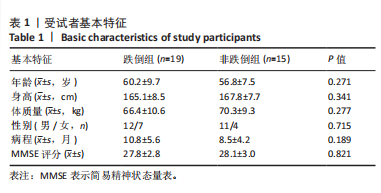
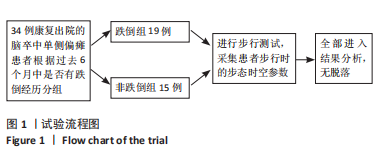
方法:招募34例康复出院的脑卒中单侧偏瘫患者,根据测试前6个月内患者是否有跌倒史分为跌倒组(有跌倒史)和非跌倒组(无跌倒史)。采用Qualisys红外动作捕捉系统采集患者步行时的体表标志点坐标,并计算步态时空参数。采用单因素分析对两组患者的步态时空参数进行比较,采用logistic回归分析建立评估患者跌倒风险的回归模型。
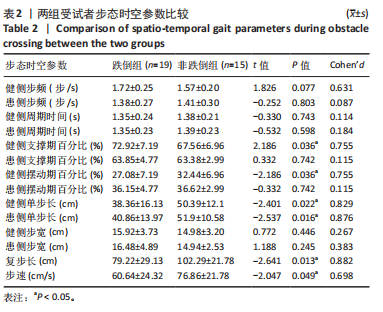
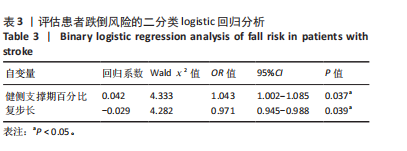
结果与结论:①共纳入34例符合标准的受试者,其中跌倒组19例,非跌倒组15例;②跌倒组的健侧支撑期百分比显著大于非跌倒组(P < 0.05);跌倒组的健侧摆动期百分比、健侧单步长、患侧单步长、复步长以及步速均显著小于非跌倒组(P < 0.05);③最终纳入logistic回归模型的变量包括健侧支撑期百分比和复步长(P < 0.05),该模型的总体评估正确率为79.4%,敏感度为73.7%,特异性为86.7%;④脑卒中患者步行过程中的健侧支撑期百分比以及复步长能够有效评估跌倒风险。基于步态时空参数构建的脑卒中患者跌倒风险评估模型,可为临床医生筛查高跌倒风险患者及实施早期预防治疗提供依据。
https://orcid.org/0000-0002-2140-3656 (万祥林) 

中国组织工程研究杂志出版内容重点:干细胞;骨髓干细胞;造血干细胞;脂肪干细胞;肿瘤干细胞;胚胎干细胞;脐带脐血干细胞;干细胞诱导;干细胞分化;组织工程

关键词: 脑卒中, 步态时空特征, 跌倒史, 危险因素, 回归模型, 步态, 跌倒预防, 回顾性研究

Abstract: BACKGROUND: Abnormalities in the spatio-temporal gait characteristics of stroke patients are closely associated with their risk of falling.
OBJECTIVE: To construct a model for assessing the fall risk of stroke patients based on spatio-temporal gait parameters, thereby providing a foundation for refining the fall risk assessment system and optimizing fall prevention strategies for such patients.
METHODS: Thirty-four stroke patients with unilateral hemiplegia who were discharged after recovery were recruited. These patients were divided into two groups based on whether they had a history of falls within 6 months prior to testing: the faller group (with a history of falls) and the non-faller group (without a history of falls). The Qualisys infrared motion capture system was employed to collect the coordinates of surface markers on the patients’ bodies during walking, from which temporal-spatial gait parameters were calculated. Univariate analysis was used to compare the spatio-temporal gait parameters between the two groups, and logistic regression analysis was conducted to establish a regression model for assessing the fall risk of patients.
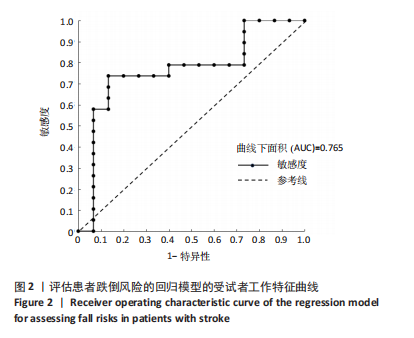
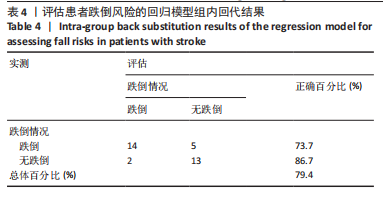
RESULTS AND CONCLUSION: (1) A total of 34 eligible participants were included in the study, comprising 19 individuals in the faller group and 15 in the non-faller group. (2) The faller group exhibited a significantly higher percentage of stance phase on the unaffected side compared with the non-faller group (P < 0.05). Additionally, the faller group had significantly lower values for the percentage of swing phase on the unaffected side, stride length on the unaffected side, stride length on the affected side, double support time, and walking speed compared with the non-faller group (P < 0.05). (3) The variables ultimately included in the logistic regression model were the percentage of stance phase on the unaffected side and double support time (P < 0.05). The overall accuracy of this model was 79.4%, with a sensitivity of 73.7% and specificity of 86.7%. To conclude, the percentage of stance phase on the unaffected side and double support time during walking in stroke patients can effectively assess fall risks. The fall risk assessment model for stroke patients constructed based on spatio-temporal gait parameters can provide clinicians with a basis for screening patients at high risk of falls and implementing early preventive treatments.

Key words: stroke, spatio-temporal gait characteristics, fall history, risk factors, regression model, gait, fall prevention, retrospective study


中图分类号: