Chinese Journal of Tissue Engineering Research ›› 2026, Vol. 30 ›› Issue (33): 8778-8784.doi: 10.12307/2026.489
Previous Articles Next Articles
Effects of 12-week blood flow restriction training combined with aerobic exercise on cardiorespiratory endurance and cardiovascular function in overweight and obese individuals
Hao Yilin, Bao Chunyu
- Sports Training College, Tianjin Sport University, Tianjin 301617, China
-
Received:2025-11-13Revised:2026-03-14Online:2026-11-28Published:2026-06-16 -
Contact:Bao Chunyu, PhD, Professor, Sports Training College, Tianjin Sport University, Tianjin 301617, China -
About author:Hao Yilin, MS, Sports Training College, Tianjin Sport University, Tianjin 301617, China -
Supported by:Science and Technology Innovation Project of the General Administration of Sport of China, No. 22KJCX077 (to BCY)

CLC Number:
Cite this article
Hao Yilin, Bao Chunyu. Effects of 12-week blood flow restriction training combined with aerobic exercise on cardiorespiratory endurance and cardiovascular function in overweight and obese individuals[J]. Chinese Journal of Tissue Engineering Research, 2026, 30(33): 8778-8784.
share this article
Add to citation manager EndNote|Reference Manager|ProCite|BibTeX|RefWorks
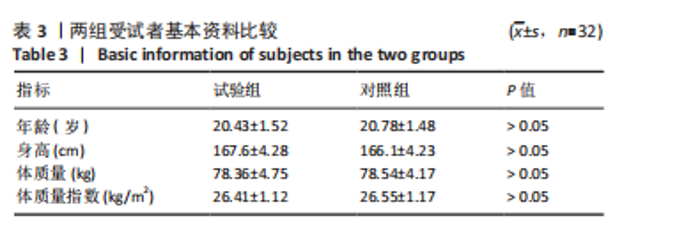
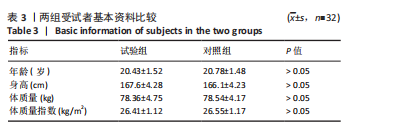
2.1 参与者数量分析 受试者试验过程无脱落,进入结果分析共64人,其中试验组32人(男16人,女16人)、对照组32人 (男16人,女16人)。 2.2 受试者基本资料 见表3。"
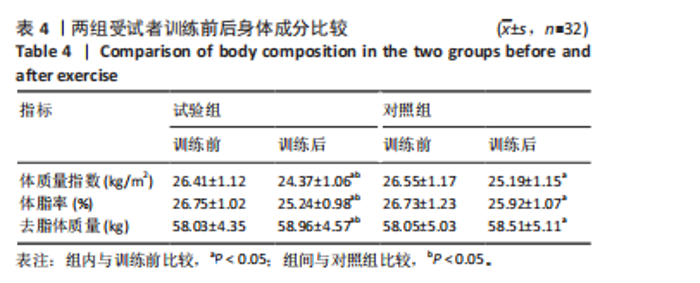
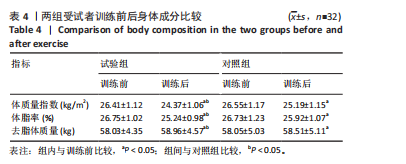
2.3 身体成分测试结果 12周低强度血流限制性有氧训练后,试验组受试者体脂率降低1.51%,显著低于对照组(P < 0.05);去脂体质量增加0.93 kg,显著高于对照组(P < 0.05),具体见表4。"
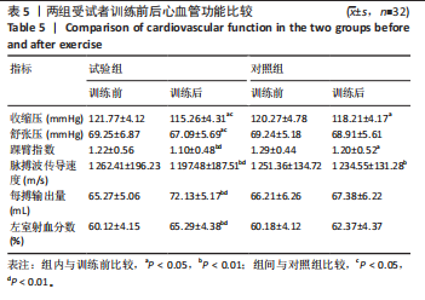
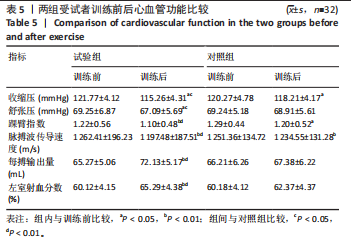
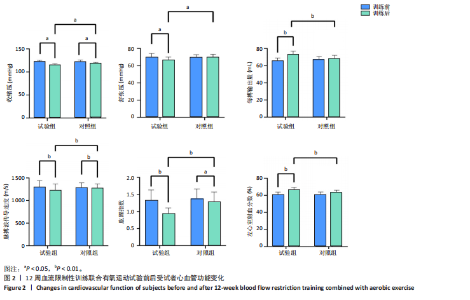
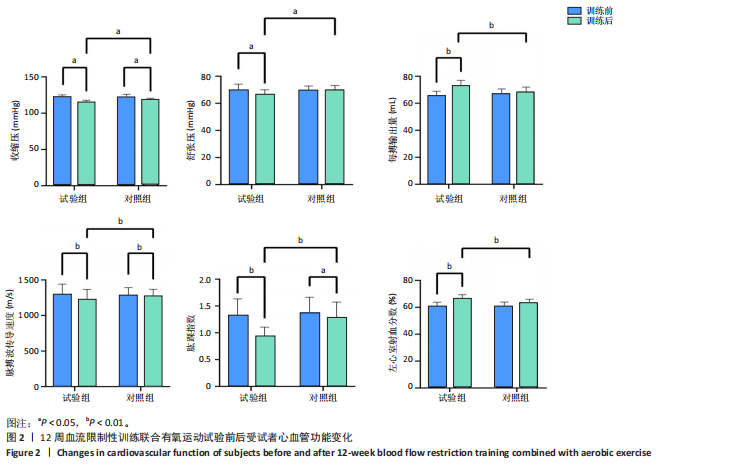
2.4 心血管功能测试结果 受试者心血管功能提高,训练后试验组受试者安静心率降低3.05 次/min,收缩压下降6.51 mmHg,舒张压下降2.16 mmHg,踝臂指数降低0.12个单位,臂踝脉搏波传导速度降低64.93 m/s,均显著低于对照组(P < 0.05);每博输出量增加6.86 mL,左室射血分数增加5.17%,显著高于对照组,具体见表5,图2。"
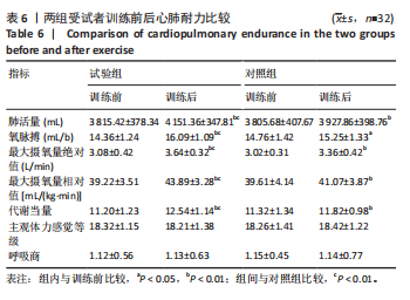
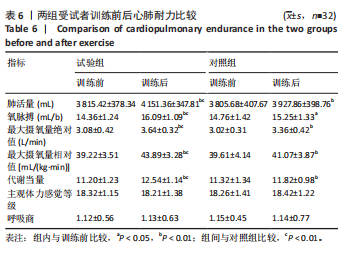
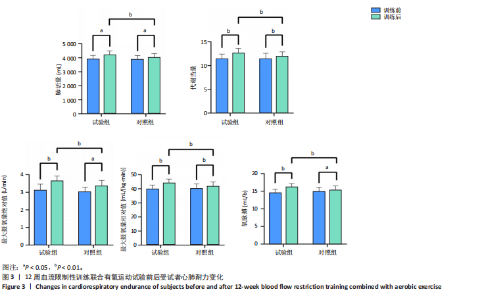
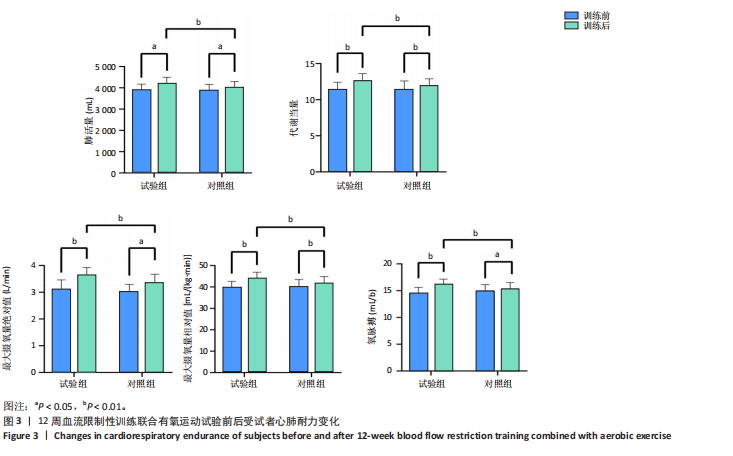
2.5 心肺耐力测试结果 受试者心肺耐力提高,训练后试验组受试者肺活量增加335.94 mL,VO2 max增加4.67 mL/(kg·min),氧脉搏增加1.73 mL/b,代谢当量增加1.34个单位,显著高于对照组,具体见表6,图3。"
2.6 不良事件 试验组受试者在血流限制性训练联合有氧远动中以及对照组受试者在普通训练过程中均无运动损伤与不良反应发生。"
"
| [1] MCCRONE JC, PIGNANELLI C, LYDIATE GC, et al. The effects of body hydration on perceptual responses during blood flow restriction exercise. Physiol Rep. 2025;13(8):171-179. [2] ESERHAUT DA, DELEO JM, FRY AC. Blood Flow Restricted Resistance Exercise in Well-Trained Men: Salivary Biomarker Responses and Oxygen Saturation Kinetics. J Strength Cond Res. 2024;38(12):716-726. [3] YAMADA Y, HAMMERT W, KATAOKA R, et al. The role of the muscle metaboreflex on cardiovascular responses to submaximal resistance exercise with different pressures and modes of blood flow restriction. Appl Physiol Nutr Metab. 2025; 50:1-9. [4] MONDAL S, BASU C, ALKHAWAITRI M, et al. Obesity among college students in Oman: implications for health and academic performance. BMC Public Health. 2025;25(1):11-19. [5] KRISHNA S, OLICKAL JJ, SARMA PS, et al. Prevalence and Factors Associated With Eating Disorder Risk Among College Students in Kerala, India: A Cross-Sectional Study. Cureus. 2025;17(3):180-192. [6] 中国居民营养与慢性病状况报告(2020年)[J]. 营养学报,2020,42(6):521-530. [7] GOTO C, MARUYA K, MORITA Y, et al. Prevalence and coexistence of locomotive syndrome with reduced mobility and metabolic syndrome: a cross-sectional study of 35,059 Japanese adults. Sci Rep. 2025;15(1):135-147. [8] CHENG C, LI Z, SU Y, et al. Obesity, Visceral Adipose Tissue, and Essential Hypertension: Evidence From a Mendelian Randomization Study and Mediation Analysis. J Clin Hypertens (Greenwich). 2025;27(4):170-185. [9] NISHIO M, YAMAGUCHI K, OTANI J, et al. MOB1 deletion in murine mature adipocytes ameliorates obesity and diabetes. Proc Natl Acad Sci U S A. 2025; 122(17):242-249. [10] MU FZ, ZHOU BW, LI B, et al. The chain mediating effect of emotional regulation ability and exercise persistence on college students’ sleep and cardiopulmonary endurance. Sci Rep. 2025;15(1):97-108. [11] PUN DB, JHA J P, MAGAR BP, et al. Assessment of Cardiopulmonary Fitness and Physical Activity in Health Science Students. Kathmandu Univ Med J (KUMJ). 2024;22(86):132-138. [12] TANASHAT M, AL-AJLOUNI YA, ABUELAZM M, et al. The Efficacy and Safety of GLP-1 RAs in the Modification of Cardiovascular Morbidity in Patients with Obesity Without Diabetes Mellitus: A Systematic Review and Meta-analysis of Randomized Controlled Trials Involving 32,884 Patients. Am J Cardiovasc Drugs. 2025;14(8):137-148. [13] LENG M, GUO X, WEI C, et al.Progressive Weight Loss-Induced Remission of Insulin Resistance/Hyperinsulinemia and Improvements in Cardiovascular Risk Factors. Diabetes Metab Syndr Obes. 2025;18:1099-1110. [14] DI ODOARDO LAF, ZUCCHETTI O, SCIATTI E, et al. Obesity update: cardiovascular risk and therapeutic innovations (focus on semaglutide and tirzepatide). Eur Heart J Suppl. 2025;27(Suppl 3):137-142. [15] GHOLIPOUR MA, HAMEDI H, SEYEDHOSEINPOOR T. Effects of exercise therapy with blood flow restriction on shoulder strength: protocol for a systematic review and meta-analysis. BMJ Open. 2025;15(4):97-115. [16] VECHIN FC, LIBARDI CA, CONCEIÇÃO MS, et al. Comparisons between low-intensity resistance training with blood flow restriction and high-intensity resistance training on quadriceps muscle mass and strength in elderly. J Strength Cond Res. 2015;29(4):1071-1086. [17] LEE J, JUNG K, LEE Y. Proximal Effects of Blood Flow Restriction on Shoulder Muscle Function and Discomfort During Low-Intensity Exercise. Sports (Basel). 2025;13(10):1348-1357. [18] 贾月新, 田赛赛, 祁晓红, 等. 低强度抗阻结合血流限制训练12周青年人体成分、肌肉力量及动脉弹性功能[J]. 中国组织工程研究,2025,29(12): 2521-2527. [19] CHO C, LEE S. The Effects of Blood Flow Restriction Aerobic Exercise on Body Composition, Muscle Strength, Blood Biomarkers, and Cardiovascular Function: A Narrative Review. Int J Mol Sci. 2024;25(17):1573-1584. [20] BOMMASAMUDRAM T, MORRELL ZG, CLARKSON MJ, et al. Chronic adaptations to blood flow restriction aerobic or bodyweight resistance training: A systematic review. J Sports Sci. 2025;43(19):2241-2255. . [21] HAMMERT WB, KANG A, YAMADA Y, et al. Inter-Individual Variability of Acute Cardiovascular Responses to Low-Load Resistance Exercise with Different Methods of Blood Flow Restriction. Med Sci Sports Exerc. 2025;42(7):358-367. [22] YEŞILYAPRAK SS, DERE D. Elbow flexion training with blood flow restriction improves strength, proprioception, and performance in healthy individuals: a randomized controlled trial. BMC Musculoskelet Disord. 2025;26(1):976-985. [23] 于亮, 赵泽铭, 王政淞, 等. 短期加压力量训练对成年男性身体成分及心血管功能的影响[J].北京体育大学学报,2020,43(6):132-139. [24] KARATAŞ L, ORBAK YENIDÜNYA ES, DEMIRSOY N. Treadmill-based submaximal VO(2) estimation in patients with coronary artery disease: can a model derived from healthy individuals be valid?. Turk J Med Sci. 2025;55(4):930-939. [25] WANG T, LIU Y, WANG X, et al. Effect of blood-flow restricted vs heavy-load resistance training on strength, power, and speed for healthy volunteers: a systematic review and meta-analysis. PeerJ. 2025;13:e19110. [26] 杨勇涛, 万敏, 万贤齐. 大强度间歇运动与中等强度持续有氧运动对大学生执行功能的影响[J]. 天津体育学院学报,2021,36(6):733-738. [27] 许文鑫, 王纹纹, 周钧毅. 中等强度配速跑对大学生烟草依赖的影响[J]. 福建师范大学学报(自然科学版),2025,41(3):129-137+148. [28] NÚÑEZ-CORTÉS R, SUSO-MARTÍ L, ALMONACID-LLEIDA J, et al. Optimal Dose of Aerobic Exercise Programs to Reduce Pain Intensity and Improve Health Status in Patients With Fibromyalgia: A Dose-Response Meta-Analysis. Phys Ther. 2025; 105(6):1478-1498. [29] HU X, WANG L, MIN S, et al. Associations Between the Triglyceride-Glucose Index Along with Its Combinations with Obesity Indicators and Kidney Stone Among American Adults. J Multidiscip Healthc. 2025;18:6233-6244. [30] ADHITYA I, ARYANA I, KURNIAWATI I, et al. Effect of Low-Load Blood Flow Restriction Training and High-Load Resistance Training on Quadriceps Strength, Dynamic Stability, and Functional Performance. Clin J Sport Med. 2025;12(1): 1579-1588. [31] GAO Z, LI Y, ZHANG J, et al. Effects of aerobic training with blood flow restriction on aerobic capacity, muscle strength, and hypertrophy in young adults: a systematic review and meta-analysis. Front Physiol. 2024;15:150-163. [32] HATA K, YANAGIYA T, NORO H, et al. Hata-Yanagiya physical activity calculation system: a novel global positioning system-based method for accurate estimation of oxygen consumption during walking and running. Front Sports Act Living. 2024; 6(1):152-164. [33] KAIKKONEN P, PASANEN K, PARKKARI J, et al. Recovery of heart rate and heart rate variability after a maximal cardiopulmonary exercise test in novice female runners. Eur J Appl Physiol. 2025;125(1):71-79. [34] LUM D, BARBOSA TM, AZIZ AR, et al. Effects of Isometric Strength and Plyometric Training on Running Performance: A Randomized Controlled Study. Res Q Exerc Sport. 2023;94(1):263-271. [35] PATEL H, ALKHAWAM H, MADANIEH R, et al. Aerobic vs anaerobic exercise training effects on the cardiovascular system. World J Cardiol. 2017;9(2):134-138. [36] CHEN L, ZHANG Z, QU W, et al. Effects of blood flow restriction moderate intensity interval training on aerobic and anaerobic capabilities and lower extremity performance in male college basketball players. BMC Sports Sci Med Rehabil. 2025;17(1):44-56. [37] LIANG J, XIE Y, LI P, et al. The non-high-density lipoprotein cholesterol to high-density lipoprotein cholesterol ratio and its combination with obesity indicators as a predictor of all cause and cardiovascular mortality in non-diabetic individuals. BMC Public Health. 2025;25(1):1513-1524. [38] 许汪宇, 陈文鹤, 沈勋章. 中低强度有氧运动结合饮食控制对肥胖青少年血脂和肝脏功能的影响[J]. 中国运动医学杂志,2011,30(8):706-711. [39] 杨文礼, 高艳敏, 翟丰. 高强度间歇训练与中等强度持续运动对肥胖女大学生糖脂代谢及炎性因子的影响[J]. 中华物理医学与康复杂志,2024,46(2): 156-159. [40] 张明月, 张林. 加压肌力锻炼对肌少症老年人肌肉质量与肌肉力量的影响[J]. 中国体育科技,2024,60(6):51-60. [41] ROLNICK N, DE QUEIROS VS, FEDORKO B, et al. Impact of blood flow restriction cuff design on upper body exercise: A randomized crossover trial in resistance-trained adults. Physiol Rep. 2025;13(7):703-714. [42] GONZALEZ-DIAZ G, DEMETRIOU ZJ, MUÑIZ-HERNANDEZ J, et al. Impact of Aerobic Exercise on Oxygenation, Pulmonary Function, and Nasal Nitric Oxide in Primary Ciliary Dyskinesia. Open Respir Med J. 2025;19(2):187-195. [43] GRIFT GO, DUNSFORD JR, DHALIWAL JK, et al. Sex differences in the work of breathing during exercise are independent of forced vital capacity in healthy adults. Exp Physiol. 2025;18(6):117-129. [44] DAVIS BH, SPIELMANN G, JOHANNSEN NM, et al. Effect of training status on muscle excitation and neuromuscular fatigue with resistance exercise with and without blood flow restriction in young men. Physiol Rep. 2025;13(6): 702-714. [45] DONG K, TANG J, XU C, et al. The effects of blood flow restriction combined with endurance training on athletes’ aerobic capacity, lower limb muscle strength, anaerobic power and sports performance: a meta-analysis. BMC Sports Sci Med Rehabil. 2025;17(1):24-33. [46] YIN M, DENG S, DENG J, et al. Physiological adaptations and performance enhancement with combined blood flow restricted and interval training: A systematic review with meta-analysis. J Sport Health Sci. 2025;14:101030. [47] ZHANG Y, XU K, YIN M, et al. Effects of blood flow restriction training in athletes: a systematic review and meta-analysis. Int J Sports Med. 2025;12(7):237-249. [48] LANDERS JB, ALLEN M, OLADELE I, et al. Serum tissue plasminogen activator after cycling with blood flow restriction. Vasc Biol. 2025;7(1):369-378. [49] PARK CH. Effects of Acute Upper and Lower Body Resistance Exercise on Cardiovascular Response in Adult Women Through Blood Flow Restriction. J Sports Sci Med. 2025;24(1):187-194. [50] JI S, FRANZ A, VICAS M, et al. Arterial and Venous Pressure Dynamics in Blood Flow Restriction Versus Traditional Strength Training. Scand J Med Sci Sports. 2025;35(2):7002-7019. [51] MLADEN SPS, FORBES SPA, ZEDIC AK, et al. Leg blood flow during exercise with blood flow restriction: evidence for and implications of compensatory cardiovascular mechanisms. J Appl Physiol (1985). 2025;138(2):492-507. [52] JAGIM AR, SCHULER J, SZYMANSKI E, et al. Acute Responses of Low-Load Resistance Exercise with Blood Flow Restriction. J Funct Morphol Kinesiol. 2024; 9(4):278-292. [53] PRZYBYSZ GMP, GEISEL PP, DE OLIVEIRA NASCIMENTO I, et al. Muscle tissue oxygenation in individuals with peripheral arterial disease of different walking abilities: An exploratory study. Microvasc Res. 2025;158:104778. [54] JØNSSON AB, KROGH S, LILLELUND S, et al. Efficacy of Blood Flow Restriction Exercise for Improving Lower Limb Muscle Strength and Function in Chronic Spinal Cord Injury: A Randomized Controlled Trial. Scand J Med Sci Sports. 2024; 34(12):147-159. [55] WONG V, SPITZ RW, BENTLEY JP, et al. Investigating the Influence of Limb Blood Flow on Contraction-Induced Muscle Growth and the Impact of That Growth on Changes in Maximal Strength. Med Sci Sports Exerc. 2025;57(4):867-875. [56] DE QUEIROS VS, ANICETO RR, ROLNICK N, et al. Commentary: Blood flow restriction combined with resistance training on muscle strength and thickness improvement in young adults: a systematic review, meta-analysis, and meta-regression. Front Physiol. 2024;15:148-159. [57] SEO D, SONG DS, BOYER W, et al. Effect of Aerobic Exercise with Blood Flow Restriction on Postexercise Hypotension in Young Adults: The Role of Histamine Receptors. J Cardiovasc Dev Dis. 2024;11(10):1266-1275. |
| [1] | Zhu Kuicheng, Du Chunyan, Zhang Jintao. Mechanism by which hairless gene mutation promotes white adipose tissue browning in hairless mice [J]. Chinese Journal of Tissue Engineering Research, 2026, 30(6): 1424-1430. |
| [2] | Liu Yu, Lei Senlin, Zhou Jintao, Liu Hui, Li Xianhui. Mechanisms by which aerobic and resistance exercises improve obesity-related cognitive impairment [J]. Chinese Journal of Tissue Engineering Research, 2026, 30(5): 1171-1183. |
| [3] | Tao Yunfei, Peng Li. Acute effects of blood flow restriction in low-intensity resistance training on endothelial function-related inflammatory factors [J]. Chinese Journal of Tissue Engineering Research, 2026, 30(5): 1184-1195. |
| [4] | Chen Qiang, Wu Wenjuan, Jiang Shuhua, Huang Da. Physical exercise improves physical function in burn patients: a systematic review and meta-analysis [J]. Chinese Journal of Tissue Engineering Research, 2026, 30(5): 1269-1281. |
| [5] | Ye Shicheng, Liu Yuxin, Zeng Xuan, Sui Lili, Liu Jiao, Chen Yuting, Qu Chongzheng. Epidemiological association between metabolic health obesity phenotype and chronic low back pain: a cross-sectional analysis based on the NHANES database [J]. Chinese Journal of Tissue Engineering Research, 2026, 30(35): 9365-9374. |
| [6] | Wen Fan, Zhu Huan, Hu Qinghua, Tuo Yanfang, Zhou Shufeng, Hu Jiangping, Wang Kangfeng. Eight-week aerobic exercise and aerobic exercise combined with full-body vibration training improve the microcirculation function of obese college students [J]. Chinese Journal of Tissue Engineering Research, 2026, 30(34): 8994-9001. |
| [7] | Zheng Xing, Zhang Qiang, Ye Guomin, Deng Bin, Chang Sha. Correlation of bone mineral density assessed using quantitative CT with obesity indicators, blood pressure, platelet count, and blood lipids in perimenopausal women [J]. Chinese Journal of Tissue Engineering Research, 2026, 30(29): 7548-7554. |
| [8] | Chen Ziang, Li Qinlong, Wu Xue, Zhou Yue. Meta-analysis of blood flow restriction training to improve knee function and muscle strength in patients after anterior cruciate ligament reconstruction [J]. Chinese Journal of Tissue Engineering Research, 2026, 30(29): 7680-7687. |
| [9] | Feng Shuo, Cao Xuan, Guo Xieleiya, Wang Jingfeng, Li Xiaolin. Gut microbiota and short-chain fatty acids: mechanisms of aerobic exercise regulation in type 2 diabetes [J]. Chinese Journal of Tissue Engineering Research, 2026, 30(25): 6592-6602. |
| [10] | Liu Meng, Hou Shilun. Effects of blood flow restriction training and aerobic exercise on energy expenditure in young men [J]. Chinese Journal of Tissue Engineering Research, 2026, 30(25): 6603-6609. |
| [11] | Li Guangmin, Wang Jiangna. Mechanical loading of the patellofemoral joint and its correlation with various body mass indices in older adults practicing Tai Chi exercises [J]. Chinese Journal of Tissue Engineering Research, 2026, 30(24): 6182-6188. |
| [12] | Maireyanmu·Rozi, Wang Hongping, Zhang Cuiping, Xia Juan, Shen Tian, Lei Tao, Lu Jun, Gao Jie. Inhibitory effect of complement 1q/tumor necrosis factor-related protein 4 on 3T3-L1 preadipocyte differentiation [J]. Chinese Journal of Tissue Engineering Research, 2026, 30(19): 4867-4872. |
| [13] | Yao Lijuan, Wang Yinfeng, Ma Zhennan, Chen Leqin. Exercise-induced extracellular vesicles: action and mechanisms in occurrence and development of insulin resistance [J]. Chinese Journal of Tissue Engineering Research, 2026, 30(13): 3412-3423. |
| [14] | Wu Fangjia, Lei Senlin, Li Xianhui, Yang Yang. Aerobic and resistance exercise interventions in a mouse model of nonalcoholic fatty liver disease: correlation between gut microbiota and irisin [J]. Chinese Journal of Tissue Engineering Research, 2026, 30(12): 3029-3043. |
| [15] | Xin Xianyang, Liu Longyan, Guo Yongqing, Wang Hai, Xie Jun. Effects of long-term exercise interventions on appetite-regulating hormones in overweight and obese populations: a meta-analysis [J]. Chinese Journal of Tissue Engineering Research, 2026, 30(11): 2858-2869. |
| Viewed | ||||||
|
Full text |
|
|||||
|
Abstract |
|
|||||