Chinese Journal of Tissue Engineering Research ›› 2026, Vol. 30 ›› Issue (35): 9143-9150.doi: 10.12307/2026.284
Previous Articles Next Articles
Effects of physiological osmotic pressure on chondrocyte differentiation and extracellular matrix metabolism
Chen Yida, Cheng Xinyi, Zhao Huan, Zhou Xichao, Gu Qiaoli, Lin Xiao, Shi Qin
- Department of Orthopedics, The First Affiliated Hospital of Soochow University, Institute of Orthopedics of Soochow University, Suzhou 215006, Jiangsu Province, China
-
Received:2025-11-04Revised:2026-03-18Online:2026-12-18Published:2026-04-25 -
Contact:Shi Qin, MD, Professor, Department of Orthopedics, The First Affiliated Hospital of Soochow University, Institute of Orthopedics of Soochow University, Suzhou 215006, Jiangsu Province, China -
About author:Chen Yida, Department of Orthopedics, The First Affiliated Hospital of Soochow University, Institute of Orthopedics of Soochow University, Suzhou 215006, Jiangsu Province, China -
Supported by:National Natural Science Foundation of China (General Program), No. 82172485 (to SQ); National Natural Science Foundation of China (General Program), No. 32371385 (to LX)

CLC Number:
Cite this article
Chen Yida, Cheng Xinyi, Zhao Huan, Zhou Xichao, Gu Qiaoli, Lin Xiao, Shi Qin. Effects of physiological osmotic pressure on chondrocyte differentiation and extracellular matrix metabolism[J]. Chinese Journal of Tissue Engineering Research, 2026, 30(35): 9143-9150.
share this article
Add to citation manager EndNote|Reference Manager|ProCite|BibTeX|RefWorks
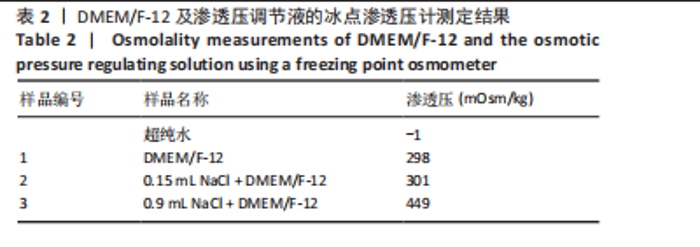
2.1 渗透压调节液的渗透压测定结果 通过冰点渗透压计测得的溶液渗透压值见表2,2号样品渗透压为301 mOsm/kg,与关节液骨关节炎病理渗透压相近,3号样品渗透压为449 mOsm/kg,与关节液生理渗透压相近。"
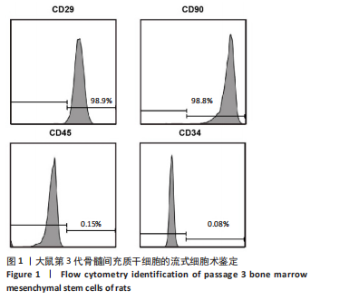
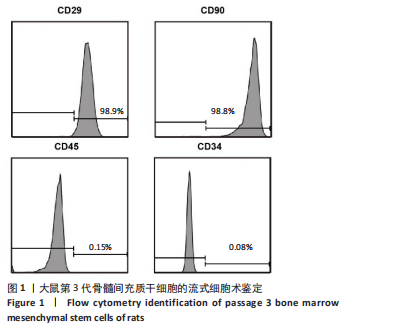
2.2 骨髓间充质干细胞和软骨细胞的鉴定结果 2.2.1 骨髓间充质干细胞的鉴定结果 流式细胞术结果显示,第3代骨髓间充质干细胞阳性指标CD29的阳性百分比分别为(98.9±0.02)%,CD90的阳性百分比分别为(98.74±0.06)%;阴性指标CD45的阳性百分比分别为(0.15±0.08)%,CD34的阳性百分比分别为(0.07±0.10)%,均< 5%。该鉴定结果说明提取培养的骨髓间充质干细胞纯度达到90%以上,见图1。"
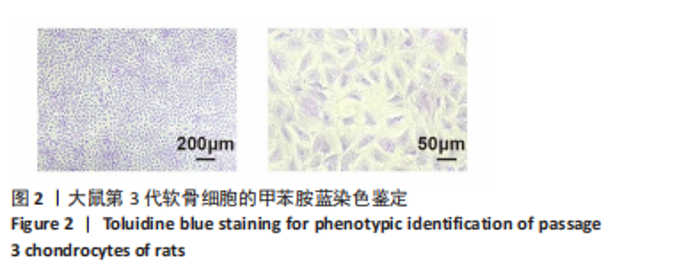
2.2.2 软骨细胞鉴定结果 通过甲苯胺蓝染色对大鼠第3代软骨细胞进行鉴定,其形态规则,主要为圆形和椭圆形,细胞核清晰,胞浆丰富,边缘明显,符合正常软骨细胞的典型形态,见图2。"
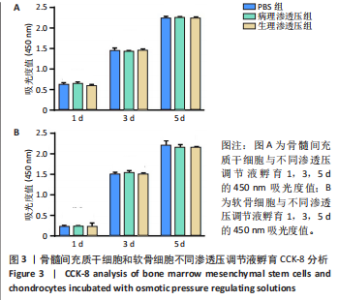
2.3 渗透压调节液的生物相容性检测 CCK-8检测显示,大鼠骨髓间充质干细胞和软骨细胞接种培养1,3,5 d后均能够正常增殖,PBS组、病理渗透压组和生理渗透压组的增殖活性均未产生显著变化。这些结果证明渗透压调节液具有良好的生物相容性,见图3。"
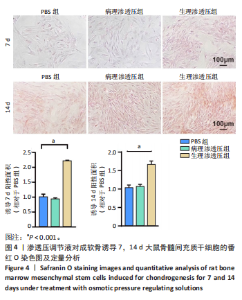
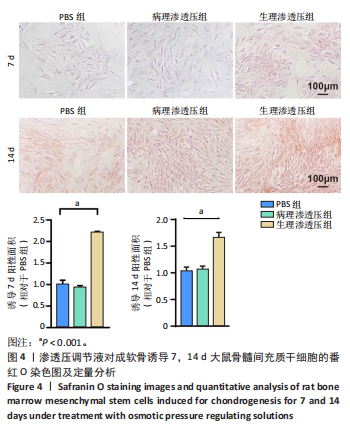
2.4 渗透压调节液对骨髓间充质干细胞成软骨分化能力的影响 2.4.1 番红O染色检测 将渗透压调节液与骨髓间充质干细胞在成软骨诱导培养基中共培养,观察其促进骨髓间充质干细胞增殖和软骨分化的能力。7 d时,应用番红O染色检测细胞的形态学变化和软骨基质的分泌。与病理渗透压组相比,生理渗透压组具有显著的促进骨髓间充质干细胞软骨分化的能力。骨髓间充质干细胞逐渐失去其特有的纤维结构,并开始形成单层簇状。成软骨诱导分化干预14 d,可见骨髓间充质干细胞成软骨现象越加明显,与PBS组及病理渗透压组相比,生理渗透压组的番红O染色强度显著增强,表明细胞在分泌糖胺聚糖,在向软骨细胞分化,见图4。"
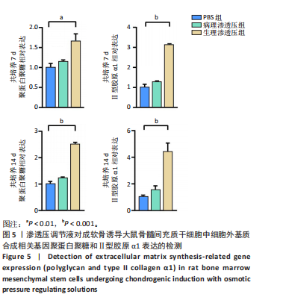
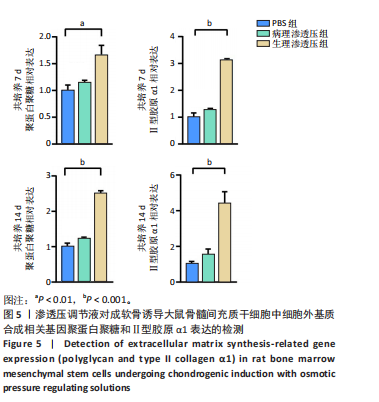
2.4.2 qRT-PCR检测 采用qRT-PCR检测骨髓间充质干细胞与渗透压调节液在成软骨分化诱导培养基中共培养7 d和14 d后的软骨合成代谢相关基因的表达情况(聚蛋白聚糖和Ⅱ型胶原α1)。其中,生理渗透压组展现最强的促软骨分化效果。与PBS组相比,7 d 生理渗透压组的聚蛋白聚糖和Ⅱ型胶原α1表达量分别是PBS组的1.77倍、3.02倍,在14 d其表达量分别是PBS组的2.48倍和4.34倍,见图5。"
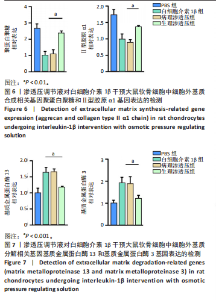
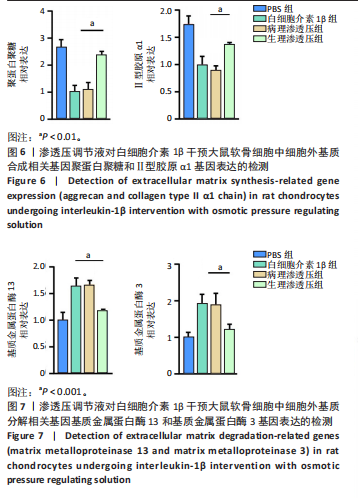
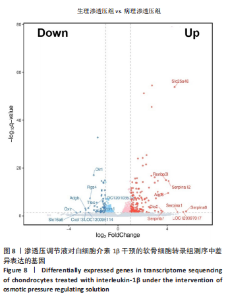
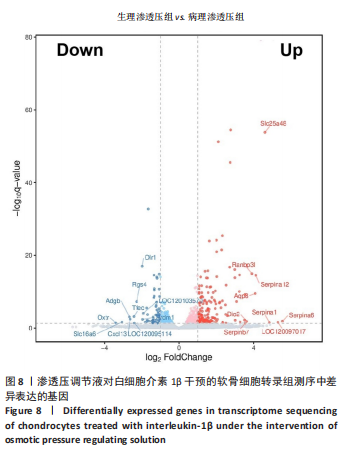
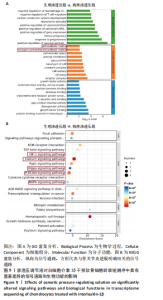
2.5 渗透压调节液对软骨细胞代谢的影响 白细胞介素1β是骨关节炎的关键炎症细胞因子,被用于模拟炎症环境。采用qRT-PCR检测细胞外基质分解代谢相关基因表达水平,评估软骨细胞的分解代谢情况。结果显示,与白细胞介素1β组和病理渗透压组比较,生理渗透压组能够显著提高聚蛋白聚糖和Ⅱ型胶原α1的表达,降低基质金属蛋白酶13和基质金属蛋白酶3的表达,从而促进软骨细胞合成代谢,抑制软骨细胞分解代谢,见图6,7。 2.6 渗透压调节液对白细胞介素1β干预的软骨细胞转录组测序的差异表达基因分析 2.6.1 差异表达基因分析 为了进一步探索恢复生理渗透压对软骨细胞影响的作用机制,将软骨细胞与10 ng/mL的白细胞介素1β和生理渗透压调节液(生理渗透压组)孵育,病理渗透压组加入相同体积的白细胞介素1β和PBS,孵育48 h,采用RNA-seq 分析2组样本之间上调和下调的差异表达基因。火山图显示,与病理渗透压组相比生理渗透压组中表达上调的基因有309个,下调的基因有210个,见图8。 2.6.2 富集分析 (1) GO富集分析:结果显示,2组细胞的差异表达基因分布于多个细胞外基质相关行为,见图9A。"
"
"
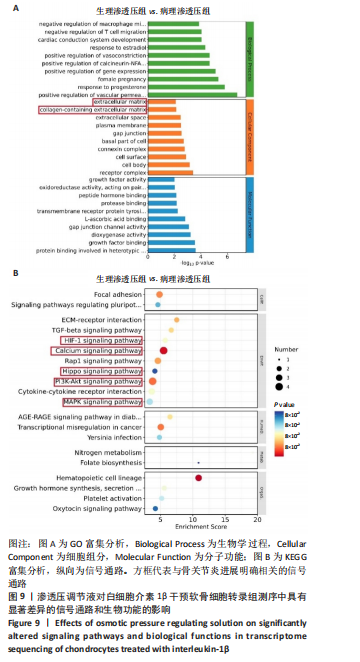
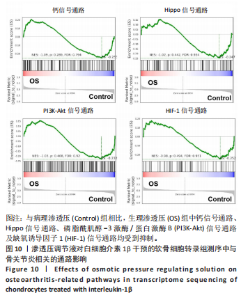
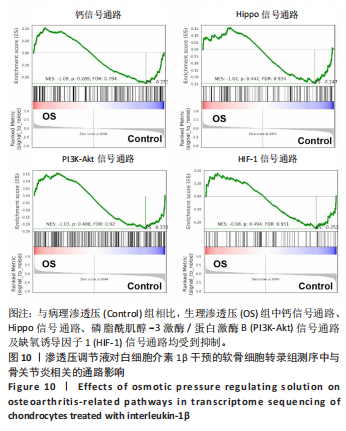
(2) KEGG富集分析:结果显示,在缺氧诱导因子1信号通路,钙信号通路,Hippo信号通路,磷脂酰肌醇-3激酶/蛋白激酶B信号通路等多个与骨关节炎明确有关的信号通路中存在着差异表达基因的富集,见图9B。 (3)基因集富集分析(Gene Set Enrichment Analysis,GSEA):研究表明,钙信号通路、Hippo信号通路、磷脂酰肌醇-3激酶/蛋白激酶B信号通路及缺氧诱导因子1信号通路的激活均能不同程度促进骨关节炎的进展[38-41]。基因集富集分析显示,与病理渗透压组相比,生理渗透压组中以上4条信号通路均受到抑制,见图10。"
| [1] YAO Q, WU X, TAO C, et al. Osteoarthritis: pathogenic signaling pathways and therapeutic targets. Signal Transduct Target Ther. 2023;8(1):56. [2] GLYN-JONES S, PALMER AJ, AGRICOLA R, et al. Osteoarthritis. Lancet. 2015; 386(9991):376-387. [3] BIJLSMA JW, BERENBAUM F, LAFEBER F P. Osteoarthritis: an update with relevance for clinical practice. Lancet. 2011;377(9783):2115-2126. [4] ALEXANDER PG, GOTTARDI R, LIN H, et al. Three-dimensional osteogenic and chondrogenic systems to model osteochondral physiology and degenerative joint diseases. Exp Biol Med (Maywood). 2014;239(9):1080-1095. [5] SACITHARAN PK. Ageing and Osteoarthritis. Subcell Biochem.2019; 91:123-159. [6] 谢俊雄, 邓志钦, 张宁峰, 等. 关节腔渗透压调控骨关节炎的研究进展 [J]. 生物骨科材料与临床研究,2021,18(1):55-58. [7] LIN Z, DENG Z, LIU J, et al. Chloride Channel and Inflammation-Mediated Pathogenesis of Osteoarthritis. J Inflamm Res. 2022;15:953-964. [8] OROZCO GA, TANSKA P, FLOREA C, et al. A novel mechanobiological model can predict how physiologically relevant dynamic loading causes proteoglycan loss in mechanically injured articular cartilage. Sci Rep. 2018;8(1):15599. [9] ZIMMERMAN BK, NIMS RJ, CHEN A, et al. Direct Osmotic Pressure Measurements in Articular Cartilage Demonstrate Nonideal and Concentration-Dependent Phenomena. J Biomech Eng. 2021;143(4):041007. [10] STEINECKER-FROHNWIESER B, LOHBERGER B, TOEGEL S, et al. Activation of the Mechanosensitive Ion Channels Piezo1 and TRPV4 in Primary Human Healthy and Osteoarthritic Chondrocytes Exhibits Ion Channel Crosstalk and Modulates Gene Expression. Int J Mol Sci. 2023;24(9):7868. [11] WANG S, LI W, ZHANG P, et al. Mechanical overloading induces GPX4-regulated chondrocyte ferroptosis in osteoarthritis via Piezo1 channel facilitated calcium influx. J Adv Res. 2022;41:63-75. [12] QUATMAN CE, HARRIS JD, HEWETT T E. Biomechanical outcomes of cartilage repair of the knee. J Knee Surg. 2012;25(3):197-206. [13] HUANG X, DAS R, PATEL A, et al. Physical Stimulations for Bone and Cartilage Regeneration. Regen Eng Transl Med. 2018;4(4):216-237. [14] DENG Z, CHEN X, LIN Z, et al. The Homeostasis of Cartilage Matrix Remodeling and the Regulation of Volume-Sensitive Ion Channel. Aging Dis. 2022;13(3):787-800. [15] CHEN S, HE T, ZHONG Y, et al. Roles of focal adhesion proteins in skeleton and diseases. Acta Pharm Sin B. 2023;13(3):998-1013. [16] SUMSUZZMAN DM, KHAN ZA, CHOI J, et al. Assessment of functional roles and therapeutic potential of integrin receptors in osteoarthritis: A systematic review and meta-analysis of preclinical studies. Ageing Res Rev. 2022;81:101729. [17] PROFF A, NAZET U, SCHRÖDER A, et al. Mechanical Stress Induces Sodium Entry and Osmoprotective Responses in Murine Synovial Fibroblasts. Cells. 2024; 13(6):496. [18] FU S, MENG H, INAMDAR S, et al. Activation of TRPV4 by mechanical, osmotic or pharmaceutical stimulation is anti-inflammatory blocking IL-1β mediated articular cartilage matrix destruction. Osteoarthritis Cartilage. 2021;29(1):89-99. [19] MOORE A C, BURRIS D L. Tribological rehydration of cartilage and its potential role in preserving joint health. Osteoarthritis Cartilage. 2017;25(1):99-107. [20] SZAFRANSKI JD, GRODZINSKY AJ, BURGER E, et al. Chondrocyte mechanotransduction: effects of compression on deformation of intracellular organelles and relevance to cellular biosynthesis. Osteoarthritis Cartilage. 2004; 12(12):937-946. [21] WESTLUND KN, KOCHUKOV MY, LU Y, et al. Impact of central and peripheral TRPV1 and ROS levels on proinflammatory mediators and nociceptive behavior. Mol Pain. 2010;6:46. [22] COPP G, ROBB KP, VISWANATHAN S. Culture-expanded mesenchymal stromal cell therapy: does it work in knee osteoarthritis? A pathway to clinical success. Cell Mol Immunol. 2023;20(6):626-650. [23] LI Q, YU H, ZHAO F, et al. 3D Printing of Microenvironment-Specific Bioinspired and Exosome-Reinforced Hydrogel Scaffolds for Efficient Cartilage and Subchondral Bone Regeneration. Adv Sci (Weinh). 2023;10(26):e2303650. [24] LEE MS, LIN EC, SIVAPATHAM A, et al. Autologous iPSC- and MSC-derived chondrocyte implants for cartilage repair in a miniature pig model. Stem Cell Res Ther. 2025;16(1):86. [25] YOU B, ZHOU C, YANG Y. MSC-EVs alleviate osteoarthritis by regulating microenvironmental cells in the articular cavity and maintaining cartilage matrix homeostasis. Ageing Res Rev. 2023;85:101864. [26] HWANG JJ, RIM YA, NAM Y, et al. Recent Developments in Clinical Applications of Mesenchymal Stem Cells in the Treatment of Rheumatoid Arthritis and Osteoarthritis. Front Immunol. 2021;12:631291. [27] WANG W, CAO W. Treatment of osteoarthritis with mesenchymal stem cells. Sci China Life Sci. 2014;57(6):586-595. [28] VANGSNESS CT JR, FARR J 2ND, BOYD J, et al. Adult human mesenchymal stem cells delivered via intra-articular injection to the knee following partial medial meniscectomy: a randomized, double-blind, controlled study. J Bone Joint Surg Am. 2014;96(2):90-98. [29] ENGLER AJ, SEN S, SWEENEY HL, et al. Matrix elasticity directs stem cell lineage specification. Cell. 2006;126(4):677-689. [30] 张晓梅, 彭旭, 魏诗航, 等. 力学刺激调控骨髓间充质细胞向软骨的分化 [J]. 中国组织工程研究,2016,20(45):6834-6840. [31] NEUHOFER W, KüPER C, LICHTNEKERT J, et al. Focal adhesion kinase regulates the activity of the osmosensitive transcription factor TonEBP/NFAT5 under hypertonic conditions. Front Physiol. 2014;5:123. [32] LóPEZ-RODRíGUEZ C, ARAMBURU J, JIN L, et al. Bridging the NFAT and NF-kappaB families: NFAT5 dimerization regulates cytokine gene transcription in response to osmotic stress. Immunity. 2001;15(1):47-58. [33] VAICIULEVICIUTE R, BIRONAITE D, UZIELIENE I, et al. Cardiovascular Drugs and Osteoarthritis: Effects of Targeting Ion Channels. Cells. 2021;10(10):2572. [34] SCHUIRINGA G H, PASTRAMA M, ITO K, et al. Towards a load bearing hydrogel: A proof of principle in the use of osmotic pressure for biomimetic cartilage constructs. J Mech Behav Biomed Mater. 2023;137:105552. [35] SAVADIPOUR A, NIMS RJ, KATZ DB, et al. Regulation of chondrocyte biosynthetic activity by dynamic hydrostatic pressure: the role of TRP channels. Connect Tissue Res. 2022;63(1):69-81. [36] 张熊劲夫, 陈奕达, 程歆怡, 等. 年轻大鼠骨髓间充质干细胞来源外泌体逆转老龄大鼠骨髓间充质干细胞衰老[J]. 中国组织工程研究,2025,29(36):7709-7718. [37] MIAO K, ZHOU Y, HE X, et al. Microenvironment-responsive bilayer hydrogel microspheres with gelatin-shell for osteoarthritis treatment. Int J Biol Macromol. 2024;261(Pt 2):129862. [38] SUN K, ZHANG X, HOU L, et al. TRPM2-mediated feed-forward loop promotes chondrocyte damage in osteoarthritis via calcium-cGAS-STING-NF-κB pathway.J Adv Res. 2024:S2090-1232(24)00499-5. doi: 10.1016/j.jare.2024.11.007. [39] ZHANG S, ZHANG B, LIAO Z, et al. Hnrnpk protects against osteoarthritis through targeting WWC1 mRNA and inhibiting Hippo signaling pathway. Mol Ther. 2024; 32(5):1461-1478. [40] LI G, LIU S, CHEN Y, et al. An injectable liposome-anchored teriparatide incorporated gallic acid-grafted gelatin hydrogel for osteoarthritis treatment. Nat Commun. 2023;14(1):3159. [41] LI X, MEI W, HUANG Z, et al. Casticin suppresses monoiodoacetic acid-induced knee osteoarthritis through inhibiting HIF-1α/NLRP3 inflammasome signaling. Int Immunopharmacol. 2020;86:106745. [42] HUANGFU WC, MATSUMOTO K, NINOMIYA-TSUJI J. Osmotic stress blocks NF-kappaB-dependent inflammatory responses by inhibiting ubiquitination of IkappaB. FEBS Lett. 2007;581(29):5549-5554. [43] ZHANG Y, CHEN H, WU J, et al. Deficiency of Cbfβ in articular cartilage leads to osteoarthritis-like phenotype through Hippo/Yap, TGFβ, and Wnt/β-catenin signaling pathways. Int J Biol Sci. 2024;20(6):1965-1977. [44] LEE J, LEE J, LEE S, et al. Genetic deficiency of nuclear factor of activated T cells 5 attenuates the development of osteoarthritis in mice. Joint Bone Spine. 2022;89(1):105273. [45] JEVOTOVSKY DS, ALFONSO AR, EINHORN TA, et al. Osteoarthritis and stem cell therapy in humans: a systematic review. Osteoarthritis Cartilage. 2018;26(6): 711-729. [46] HUANG K, LI Q, LIN H, et al. Cartilage-Penetrating Framework Nucleic Acid Nanoparticles Ameliorate Osteoarthritis by Promoting Drug Delivery and Chondrocyte Uptake. Adv Sci (Weinh). 2025;12(26):e2502661. [47] JIA Y, LE H, WANG X, et al. Double-edged role of mechanical stimuli and underlying mechanisms in cartilage tissue engineering. Front Bioeng Biotechnol. 2023;11:1271762. [48] KATZ JN, ARANT KR, LOESER RF. Diagnosis and Treatment of Hip and Knee Osteoarthritis: A Review. Jama. 2021;325(6):568-578. [49] GAZENDAM A, EKHTIARI S, BOZZO A, et al. Intra-articular saline injection is as effective as corticosteroids, platelet-rich plasma and hyaluronic acid for hip osteoarthritis pain: a systematic review and network meta-analysis of randomised controlled trials. Br J Sports Med. 2021;55(5):256-261. [50] SOHN HS, CHOI JW, JHUN J, et al. Tolerogenic nanoparticles induce type II collagen-specific regulatory T cells and ameliorate osteoarthritis. Sci Adv. 2022; 8(47):eabo5284. [51] MIAO MZ, LEE JS, YAMADA KM, et al. Integrin signalling in joint development, homeostasis and osteoarthritis. Nat Rev Rheumatol. 2024;20(8):492-509. [52] DAI B, ZHU Y, LI X, et al. Blockage of Osteopontin-Integrin β3 Signaling in Infrapatellar Fat Pad Attenuates Osteoarthritis in Mice. Adv Sci (Weinh). 2023; 10(22):e2300897. [53] BAI H, ZHANG Q. Activation of NLRP3 Inflammasome and Onset of Alzheimer’s Disease. Front Immunol. 2021;12:701282. [54] ZHOU R, FU W, VASYLYEV D, et al. Ion channels in osteoarthritis: emerging roles and potential targets. Nat Rev Rheumatol. 2024;20(9):545-564. [55] LI W, ZHONG Y, LIN Z, et al. Forsythoside A mitigates osteoarthritis and inhibits chondrocyte senescence by promoting mitophagy and suppressing NLRP3 inflammasome via the Nrf2 pathway. Phytomedicine. 2024;135:156052. [56] ZUO G, ZHUANG P, YANG X, et al. Regulating Chondro-Bone Metabolism for Treatment of Osteoarthritis via High-Permeability Micro/Nano Hydrogel Microspheres. Adv Sci (Weinh). 2024;11(5):e2305023. [57] LEI Y, WANG X, LIAO J, et al. Shear-responsive boundary-lubricated hydrogels attenuate osteoarthritis. Bioact Mater. 2022;16:472-484. |
| [1] | Lyu Guoqing, Aizimaitijiang·Rouzi, Xiong Daohai. Irisin inhibits ferroptosis in human articular chondrocytes: roles and mechanisms [J]. Chinese Journal of Tissue Engineering Research, 2026, 30(6): 1359-1367. |
| [2] | Zhang Qian, Huang Dongfeng. Weighted gene co-expression network analysis combined with machine learning to screen and validate biomarkers for osteoarthritis [J]. Chinese Journal of Tissue Engineering Research, 2026, 30(5): 1096-1105. |
| [3] | Bu Yangyang, Ning Xinli, Zhao Chen. Intra-articular injections for the treatment of osteoarthritis of the temporomandibular joint: different drugs with multiple combined treatment options [J]. Chinese Journal of Tissue Engineering Research, 2026, 30(5): 1215-1224. |
| [4] | Xu Hongtao, Wang Jianping, Xu Yuehong, Li Qin, Qi Qihua, Xia Qipeng. Asiaticoside promotes osteogenic differentiation in osteoporotic rats [J]. Chinese Journal of Tissue Engineering Research, 2026, 30(35): 9113-9119. |
| [5] | Zhao Minjun, , Wu Xubo, , Yin Jianli, , Ge Yangshuo, Ding Jiaying, Huang Chunmeng, Meng Tingting, Wang Xuezong, Liu Zhenfeng, Ding Daofang. Effects of cobimetinib versus combination of dasatinib and quercetin on stress-induced chondrocyte senescence [J]. Chinese Journal of Tissue Engineering Research, 2026, 30(35): 9151-9158. |
| [6] | Yang Huaqun, Abudouainijiang·Abulimiti, Wang Fazheng, Maimaitishawutiaji·Maimaiti, Li Simi, Muhetaer·Maimaitirexiati. Weighted gene co-expression network analysis combined with machine learning identifies autophagy and senescence signature genes in osteoarthritis chondrocytes [J]. Chinese Journal of Tissue Engineering Research, 2026, 30(34): 8889-8898. |
| [7] | Wang Yanfei, Jin Lianhai, Li Qingya, Fu Yuanfei, Tan Huangsheng, Deng Pengwei, Gao Kun. Synovial fluid exosome-mediated crosstalk between synoviocytes and chondrocytes in development and progression of knee osteoarthritis [J]. Chinese Journal of Tissue Engineering Research, 2026, 30(34): 9032-9040. |
| [8] | Zhou Zixiang, Zhao Baoxiang. Research progress in the relationship between nontraumatic necrosis of the femoral head and lipid metabolism and its treatment [J]. Chinese Journal of Tissue Engineering Research, 2026, 30(3): 680-690. |
| [9] | Wei Bingqi, Zhang Xinyue, Ren Xingyue, Sun Jiahui, Chen Liu, Li Yijing, Qi Yifan, Wang Shangzeng. Zinc finger DHHC-type containing 2 emerges as a novel therapeutic target in osteoarthritis pathogenesis: genome-wide data analysis in European populations [J]. Chinese Journal of Tissue Engineering Research, 2026, 30(29): 7715-7723. |
| [10] | Li Zhengpeng, Shao Weigang, Zeng Hao, Xiang Kelin, Zhang Botao, Zou Shunyi, Chen Sheng, Qi Wen. Osteoarthritis characteristic genes and prediction of targeted food-medicine homology traditional Chinese medicine: bioinformatics analysis and kinetic simulation [J]. Chinese Journal of Tissue Engineering Research, 2026, 30(29): 7739-7748. |
| [11] | Hu Yingnan, Shi Wanwan, Wang Datao. Blood cells and the occurrence and progression of osteoporosis: biomarkers and emerging therapeutic strategies [J]. Chinese Journal of Tissue Engineering Research, 2026, 30(29): 7632-7638. |
| [12] | Guo Shanshan, Ma Ding, Dong Bingchen. Metabolic dysregulation in osteoarthritis: mechanisms and targeted therapeutic strategies [J]. Chinese Journal of Tissue Engineering Research, 2026, 30(29): 7654-7662. |
| [13] | Su Jiemao, Qi Yansong, Kong Keyu, Zhai Zanjing, Xu Yongsheng. Role of chondrocyte ferroptosis in the pathogenesis of osteoarthritis [J]. Chinese Journal of Tissue Engineering Research, 2026, 30(24): 6282-6288. |
| [14] | Xu Peng, Jiang Wei, Yu You, Lei Zhengliang, Tian Yang, Zhang Jie, Liu Luchang. Cobalt chloride-induced hypoxic environment accelerates knee cartilage degeneration in New Zealand rabbits [J]. Chinese Journal of Tissue Engineering Research, 2026, 30(22): 5650-5658. |
| [15] | Zhong Zhuolan, Peng Zhina, Tian Xiaohong, Han Cuifei, Zhang Zihan, Chu Jiaqi. Acanthopanax exosome-like nanovesicles promote osteogenic differentiation of human bone marrow mesenchymal stem cells [J]. Chinese Journal of Tissue Engineering Research, 2026, 30(19): 4825-4835. |
| Viewed | ||||||
|
Full text |
|
|||||
|
Abstract |
|
|||||