Chinese Journal of Tissue Engineering Research ›› 2026, Vol. 30 ›› Issue (34): 8921-8929.doi: 10.12307/2026.896
Previous Articles Next Articles
Effects of Gushukang Granules on the expression of myogenic and osteogenic factors in the muscles and bones of sarcopenic osteoporosis rats
Wei Wei1, Wang Deyu2, Yu Zhitong2, Qiao Chunlin1, Cui Xiangran2, Liu Hongfei2, Wang Chengbo1, Wang Shixuan1, Teng Hai1
- 1The Second Affiliated Hospital of Liaoning University of Traditional Chinese Medicine, Shenyang 110034, Liaoning Province, China; 2Liaoning University of Traditional Chinese Medicine, Shenyang 110847, Liaoning Province, China
-
Received:2025-09-24Revised:2026-02-16Online:2026-12-08Published:2026-04-13 -
Contact:Teng Hai, MS, Chief physician, The Second Affiliated Hospital of Liaoning University of Traditional Chinese Medicine, Shenyang 110034, Liaoning Province, China -
About author:Wei Wei, PhD, Lecturer, The Second Affiliated Hospital of Liaoning University of Traditional Chinese Medicine, Shenyang 110034, Liaoning Province, China

CLC Number:
Cite this article
Wei Wei, Wang Deyu, Yu Zhitong, Qiao Chunlin, Cui Xiangran, Liu Hongfei, Wang Chengbo, Wang Shixuan, Teng Hai. Effects of Gushukang Granules on the expression of myogenic and osteogenic factors in the muscles and bones of sarcopenic osteoporosis rats[J]. Chinese Journal of Tissue Engineering Research, 2026, 30(34): 8921-8929.
share this article
Add to citation manager EndNote|Reference Manager|ProCite|BibTeX|RefWorks
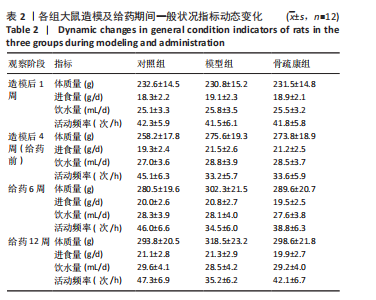
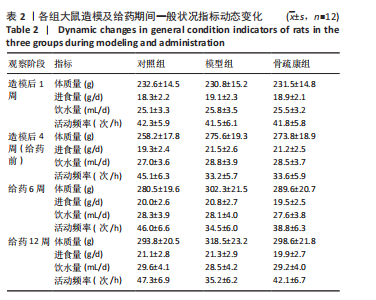
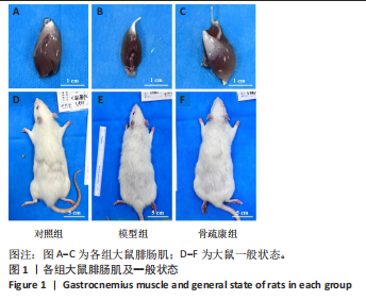
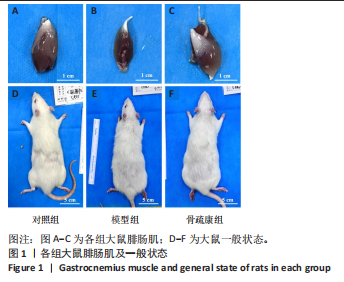
2.1 实验动物数量分析 此次实验共纳入36只大鼠,随机分为对照组、模型组、骨疏康组,每组 12只。所有大鼠均完成造模及12周给药干预,无脱失,最终全部进入结果分析。 2.2 各组大鼠一般状况及腓肠肌形态观察 如图1、表2所示,连续给药 12 周后观察各组大鼠一般状况,对照组大鼠体质量呈持续增长的趋势,符合正常的生长发育规律,大鼠活动频繁,反应灵敏,毛发光滑、紧致,皮肤呈健康的粉红色,排泄正常,精神状态良好;模型组体质量增长较快,毛发较为粗糙、失去光泽,食欲减退,饮水量增加,排泄减少,精神萎靡,反应迟钝;骨疏康组体质量呈持续增长的趋势,活动度一般,毛发和皮肤状态有所改善,精神状态一般,排泄情况趋于正常。分别取各组大鼠右侧腓肠肌,观察可见对照组腓肠肌通常较饱满、轮廓清晰、体积正常,颜色多为淡红色,较为紧实、有弹性;模型组肌肉体积明显缩小,较为瘦弱或萎缩,颜色略带灰色,肌肉质地软塌,缺乏正常的弹性;骨疏康组腓肠肌体积正常但略松弛,轮廓略微塌陷,不够饱满,接近正常的粉红色,但稍显暗淡。"
"
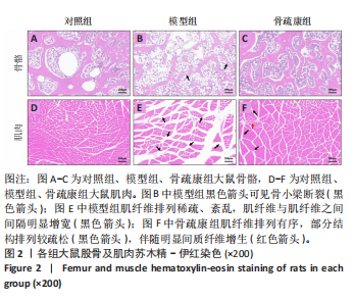
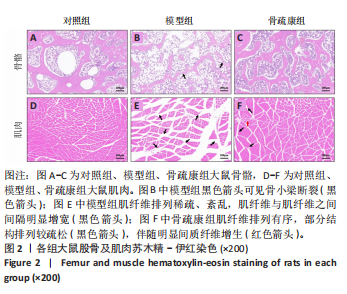
2.3 各组大鼠骨骼和肌肉组织形态学改变 骨骼:对照组在光学显微镜下观察到对照组股骨骨小梁丰富、致密、连接性好(图2A);模型组骨小梁数量明显减少,排列稀疏、间距增宽,可见骨小梁断裂(黑色箭头),连接性差(图2B);骨疏康组骨小梁丰富,排列较疏松。连接性好(图2C)。 肌肉:在光学显微镜下观察到对照组肌肉组织肌纤维结构正常,排列紧密有序,未见明显异常增生(图2D);模型组肌纤维排列稀疏、紊乱,肌纤维与肌纤维之间间隔明显增宽(黑色箭头),出现肌肉萎缩现象,未见明显异常增生(图2E);骨疏康组肌纤维排列有序,部分结构排列较疏松(黑色箭头),伴随明显间质纤维增生(红色箭头)(图2F)。"
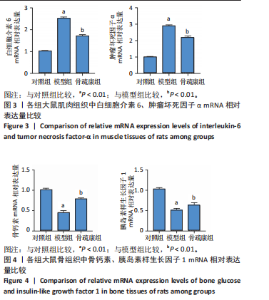
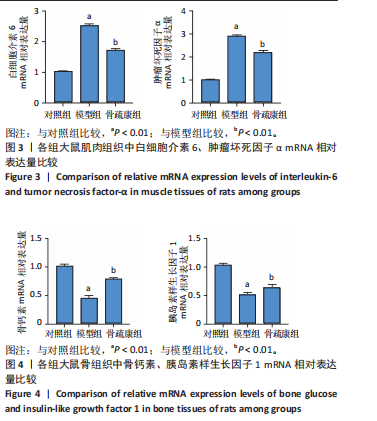
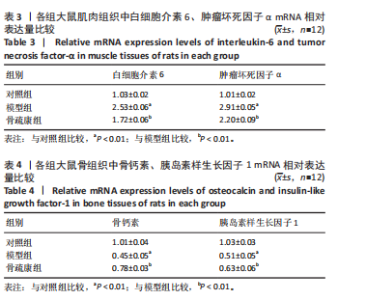
2.4 各组大鼠肌肉组织中白细胞介素6、肿瘤坏死因子α mRNA表达水平 如图3、表3所示,与对照组相比,模型组大鼠肌肉组织中白细胞介素6、肿瘤坏死因子α mRNA表达水平显著升高(P < 0.01);与模型组相比,骨疏康组大鼠肌肉组织中白细胞介素6、肿瘤坏死因子α mRNA表达水平显著降低(P < 0.01)。 2.5 各组大鼠骨组织中骨钙素、胰岛素样生长因子1 mRNA表达水平 如图4、表4所示,与对照组相比,模型组大鼠骨组织中"
"
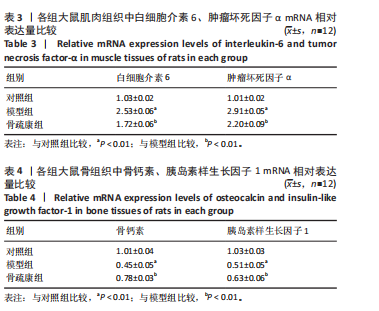
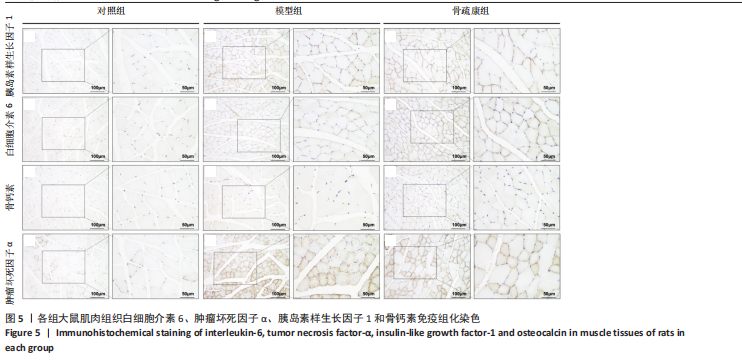
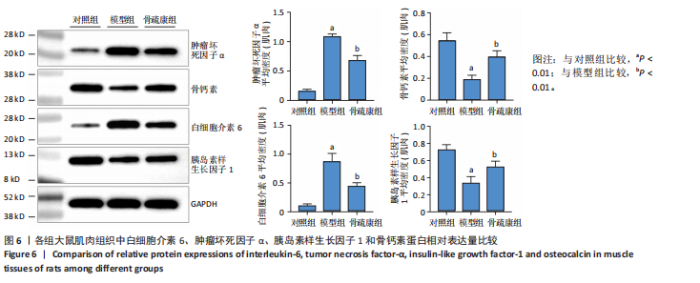
骨钙素、胰岛素样生长因子1 mRNA表达水平显著降低(P < 0.01);与模型组相比,骨疏康组大鼠骨组织中骨钙素、胰岛素样生长因子1 mRNA表达水平显著升高(P < 0.01)。 2.6 各组大鼠肌肉组织中白细胞介素6、肿瘤坏死因子α、胰岛素样生长因子1和骨钙素的蛋白表达变化 如图5所示,与对照组相比,模型组大鼠肌肉组织中白细胞介素6和肿瘤坏死因子α的表达显著增强,胰岛素样生长因子1和骨钙素的表达显著减弱(P < 0.01)。骨疏康组大鼠肌肉组织中白细胞介素6和肿瘤坏死因子α的表达较模型组显著减弱,胰岛素样生长因子1和骨钙素的表达较模型组显著增强(P < 0.01)。Western blot实验结果与免疫组化结果一致(图6)。"
"
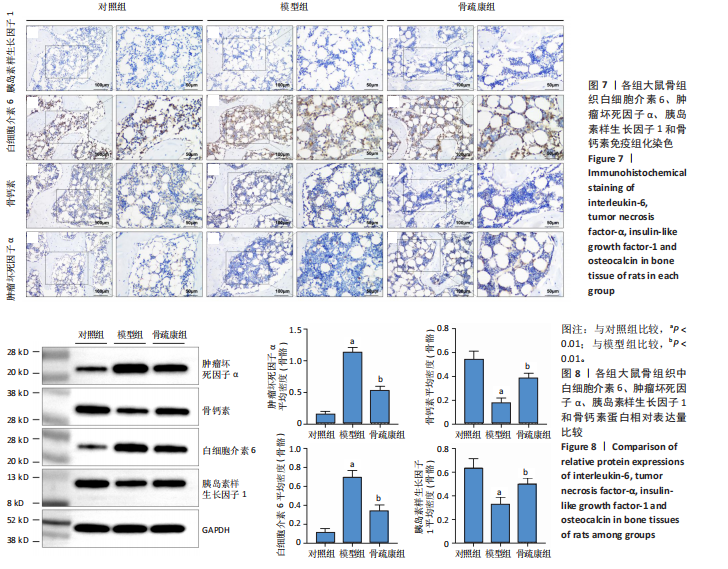
2.7 各组大鼠骨组织中白细胞介素6、肿瘤坏死因子α、胰岛素样生长因子1和骨钙素的蛋白表达变化 如图7所示,与对照组相比,模型组大鼠骨组织中白细胞介素6和肿瘤坏死因子α的表达显著增强,胰岛素样生长因子1和骨钙素的表达显著减弱 (P < 0.01)。骨疏康组大鼠骨组织中白细胞介素6和肿瘤坏死因子α的表达较模型组显著减弱,胰岛素样生长因子1和骨钙素的表达较模型组显著增强(P < 0.01)。Western blot实验结果与免疫组化结果一致(图8)。"
"
| [1] YU X, SUN S, ZHANG S, et al. A pooled analysis of the association between sarcopenia and osteoporosis. Medicine (Baltimore). 2022;101(46):e31692. [2] 李磊,秦大平,郑礼,等.从先后天之本探讨肌少-骨质疏松症的中医药防治策略[J]. 中华中医药杂志,2024,39(3):1391-1394. [3] ZHU C, DING X, CHEN M, et al. Exercise-Mediated Skeletal Muscle-Derived IL-6 Regulates Bone Metabolism: A New Perspective on Muscle-Bone Crosstalk. Biomolecules. 2025;15(6):893. [4] NUSRAT S, DIN RU, TARIQ MA, et al. Epigenetic Dysregulation and Osteocyte Senescence: Convergent Drivers of Osteosarcopenia in Aging Bone and Muscle. Aging Dis. 2025. doi: 10.14336/AD.2025.0370. [5] RIBEIRO LB, MACHADO PG, REIS-CANAAN JC, et al. Effects of aerobic and resistance training on bone, muscle hypertrophy and inflammation in OVX mice. Climacteric. 2025;18:1-8. [6] RASHID A, CHAUDHARY HAUGE S, SUETTA C, et al. Sarcopenia and risk of osteoporosis, falls and bone fractures in patients with chronic kidney disease: A systematic review. PLoS One. 2022;17(1):e0262572. [7] YANG W, LI G, CAO K, et al. Exogenous insulin-like growth factor 1 attenuates acute ischemic stroke-induced spatial memory impairment via modulating inflammatory response and tau phosphorylation. Neuropeptides. 2020;83: 102082. [8] TANAKA K, TANIMOTO K, HASEGAWA Y, et al. Association of osteoglycin and FAM5C with bone turnover markers, bone mineral density, and vertebral fractures in postmenopausal women with type 2 diabetes mellitus. Bone. 2017;95:5-10. [9] 郑志坚,舒冰,赵世天,等.骨疏康颗粒对去卵巢小鼠骨质疏松模型骨丢失和破骨细胞凋亡的影响[J]. 中华中医药杂志,2020,35(7):3647-3651. [10] 杨梦晓,付常喜.力量训练改善去卵巢模型大鼠骨损伤的作用机制[J]. 中国组织工程研究,2024,28(20):3150-3156. [11] 鞠大宏,张春英,王安民,等.温补肾阳方对去卵巢所致骨质疏松大鼠 IL-1 和 IL-6 活性的影响[J]. 中国中医基础医学杂志,2000,10(10):5-9. [12] CAMARA C, ZHOU L Y, MA Y, et al. Effect of ovariectomy on serum adiponectin levels and visceral fat in rats. J Huazhong Univ Sci Technolog Med Sci. 2014; 34(6):825-829. [13] 刘小琴,梁清芝,蒋薇,等.“痰 - 湿” 证动物模型的构建策略与评价体系[J/OL]. 中国实验方剂学杂志:1-16 [2025-08-09]. doi: 10.13422/j.cnki.syfjx.20250816 [14] 刘沛,蒋宜伟,周玉英,等.Nrf2 调控网络与骨质疏松症的相关性及中医药干预研究 [J]. 中国骨质疏松杂志,2024,30(2):240-245+256. [15] 刘康,周航,惠明大,等.酪蛋白激酶-2 相互作用蛋白-1介导的自噬通路与骨质疏松症的关系探讨[J]. 中医正骨,2022,34(6):57-61. [16] YAO Q, HE L, BAO C, et al. The role of TNF-α in osteoporosis, bone repair and inflammatory bone diseases: A review. Tissue Cell. 2024;89:102422. [17] 罗程,宋忱,龚健,等.基于网络药理学探究自噬、衰老与骨质疏松的关系及潜在治疗靶点 [J]. 中国煤炭工业医学杂志,2024,27(5):439-447. [18] 闫秀锋,杨旸,段子强,等. SUCNR1 在肌肉生理及病理生理中的作用及机制[J]. 生命科学,2026,38(1):82-98. [19] DONG Y, YANG X, ZHANG Y, et al. Bone-muscle crosstalk under physiological and pathological conditions. Cell Mol Life Sci. 2024;81(1):310. [20] SEVERINSEN MCK, PEDERSEN BK. Muscle-Organ Crosstalk: The Emerging Roles of Myokines. Endocr Rev. 2020;41(4):594-609. [21] SWAROOP AK, NEGI P, KAR A, et al. Navigating IL-6: From molecular mechanisms to therapeutic breakthroughs. Cytokine Growth Factor Rev. 2024;76:48-76. [22] PELOSI L, GUALANDI A, MARABESE M, et al. Sustained Systemic Levels of IL-6 Impinge Early Muscle Growth and Induce Muscle Atrophy and Wasting in Adulthood. Cells. 2021;10(7):1816. [23] MCGREGOR NE, MURAT M, ELANGO J, et al. IL-6 exhibits both cis- and trans-signaling in osteocytes and osteoblasts, but only trans-signaling promotes bone formation and osteoclastogenesis. J Biol Chem. 2019;294(19):7850-7863. [24] OMMA T, TUZCUOGLU S, KOCAKOC E, et al. The role of IL-6 and osteoprotegerin in bone metabolism in patients with Graves’ disease. Turkish J Med Sci. 2022; 52(2):338-345. [25] WANG T, HE C. TNF-α and IL-6: The Link between Immune and Bone System. Current Drug Targets. 2020;21(3):213-227. [26] CROFT M, SALEK-ARDAKANI S, WARE CF, et al. Targeting the TNF and TNFR superfamilies in autoimmune disease and cancer. Nat Rev Drug Discov. 2024; 23(12):939-961. [27] XIANCHU L, ZHIYONG Z, MENG L, et al. Sinapic acid attenuates muscle atrophy in streptozotocin-induced diabetic mice. Iranian Journal of Basic Medical Sciences. 2021;24(12):1695-1701. [28] KIM JS, JEONG JH, PARK HJ, et al. Gromwell (Lithospermum erythrorhizon) Attenuates High-Fat-Induced Skeletal Muscle Wasting by Increasing Protein Synthesis and Mitochondrial Biogenesis. J Microbiol Biotechnol. 2024;34(3): 495-505. [29] YAO Z, GETTING SJ, LOCKE IC, et al. Regulation of TNF-Induced Osteoclast Differentiation. Cells. 2021;11(1):132. [30] QIU X, ZHANG Y, ZHANG Y, et al. Melatonin Rescued Reactive Oxygen Species-Impaired Osteogenesis of Human Bone Marrow Mesenchymal Stem Cells in the Presence of Tumor Necrosis Factor-Alpha. Stem Cells International. 2019; 2019:6403967. [31] YANG K, HU Y, FENG Y, et al. IGF-1R mediates crosstalk between nasopharyngeal carcinoma cells and osteoclasts and promotes tumor bone metastasis. J Exp Clin Cancer Res. 2024;43(1):46. [32] SPRADLIN RA, LEMOS MC, LIU Y, et al. Deletion of muscle Igf1 exacerbates disuse atrophy weakness in mice. J Appl Physiol. 2021;131(3):881-894. [33] MARTÍN A, MUÑOZ M, RIVAS-RUIZ M, et al. Time-Dependent Changes in Muscle IGF1-IGFBP5-PAPP System after Sciatic Denervation. Int J Mol Sci. 2023; 24(18):14112. [34] KHAN MZ, ZUGAZA JL, TORRES ALEMAN I. The signaling landscape of insulin-like growth factor 1. J Biol Chem. 2025;301(1):108047. [35] WANG J, ZHANG X, ZHANG Y, et al. Bone marrow-derived IGF-1 orchestrates maintenance and regeneration of the adult skeleton. Proc Natl Acad Sci U S A. 2023;120(1):e2203779120. [36] FANG J, WANG Y, ZHANG X, et al. The role of insulin-like growth factor-1 in bone remodeling: A review. Int J Biol Macromol. 2023;238:124125. [37] KOLTUN KJ, HEYDARI S, SCHABORT EJ, et al. Effect of acute resistance exercise on bone turnover in young adults before and after concurrent resistance and interval training. Physiol Rep. 2024;12(3):e15906. [38] ZHENG H, AIHAITI Y, CAI Y, et al. The m6A/m1A/m5C-Related Methylation Modification Patterns and Immune Landscapes in Rheumatoid Arthritis and Osteoarthritis Revealed by Microarray and Single-Cell Transcriptome. J Inflamm Res. 2023;16:5001-5025. [39] GONZÁLEZ-SALVATIERRA S, ARANDA P, BARRIOS-MAYA MA, et al. Osteoglycin as a Potential Biomarker of Mild Kidney Function Impairment in Type 2 Diabetes Patients. J Clin Med. 2021;10(10):2209. [40] WOESSNER MN, BANDEIRA F, MANSON JE, et al. Osteoglycin Across the Adult Lifespan. J Clin Endocrinol Metabol. 2022;107(4):e1426-e1433. [41] WEN J, GUAN Z, YU B, et al. Circular RNA hsa_circ_0076906 competes with OGN for miR-1305 biding site to alleviate the progression of osteoporosis. Int J Biochem Cell Biol. 2020;122:105719. [42] 林燕平,黄佳纯,郭海威,等.原发性骨质疏松症患者中医证型分布规律与肌-骨-脂关系研究[J/OL]. 中国全科医学,1-6[2025-08-09].https://kns.cnki.net/kcms2/article/abstract?v=9oxawJFDgQWT6a93 [43] 刘晏东,邓强,彭冉东,等. 基于“肝-脾-肾”轴探讨中医药防治肌少-骨质疏松[J]. 中国老年学杂志,2024,44(23):5878-5883. |
| [1] | Guo Jiachen, Gao Jun, Dai Wenhao, Liao Huayuan, Jiang You, Zhang Xi . Effect of compressive stress microenvironment on cytokines during fracture healing [J]. Chinese Journal of Tissue Engineering Research, 2026, 30(4): 908-916. |
| [2] | Li Tianbo, Yu Zeyang, Qin Xinyuan, Wang Jiangning, Gao Lei. Exosomes derived from human umbilical cord mesenchymal stem cells in treatment of diabetic foot ulcers [J]. Chinese Journal of Tissue Engineering Research, 2026, 30(19): 4897-4901. |
| [3] | Xu Sheng, Zhang Wenwen, Zhang Weiwei, Wang Hongtao, Zhang Jun, Yang Ruisheng, Yuan Yuan, Wang Li, Hao Haihu. Network pharmacological analysis and experimental verification of semen cuscutae in treating postmenopausal osteoporosis [J]. Chinese Journal of Tissue Engineering Research, 2026, 30(11): 2702-2711. |
| [4] | Tian Sheng, Wang Xi, Wang Yongcheng, Liu Yaning, Yang Hongquan. Mechanism underlying microRNA-214 regulation of cartilage and subchondral bone metabolism in osteoarthritis [J]. Chinese Journal of Tissue Engineering Research, 2025, 29(12): 2466-2474. |
| [5] | Li Yuxuan, Yuan Lingli, Xu Zhiyuan, Yan Tao, Zhang Zhongchuan, Xu Wendi, Zhu Xunbing. Unicompartmental knee arthroplasty in treatment of medial compartment osteoarthritis of knee joint: joint function and changes in inflammatory cytokines [J]. Chinese Journal of Tissue Engineering Research, 2024, 28(36): 5828-5832. |
| [6] | Zhang Yuchang, Chen Xiang, He Bo, Li Shenghua, Mu Xiangqian, Sun Weiqiang, Zhang Li, Chen Jie. Role of inflammatory factors in diabetic ulcers and prospects of traditional Chinese medicine intervention [J]. Chinese Journal of Tissue Engineering Research, 2024, 28(34): 5544-5551. |
| [7] | Li Ruibo, Kong Ning, Sun Lei, Ma Baodong, Jin Ranran, Zhang Wenjin, Yue Han, Zhang Hui. Erythropoietin-overexpressed umbilical cord mesenchymal stem cells inhibit neuroapoptosis in ischemic-hypoxic SH-SY5Y and its mechanism [J]. Chinese Journal of Tissue Engineering Research, 2024, 28(31): 4937-4944. |
| [8] | Ma Liangchen, Tian Fubao, Xu Yujuan, Tian Xinbao, Tao Ying, Chen Mengying, Lian Jiawei, Lin Ruizhu, Zhu Ning. Mechanisms underlying internal heat-type acupuncture in the treatment of steroid-induced osteonecrosis of the femoral head in rabbits [J]. Chinese Journal of Tissue Engineering Research, 2024, 28(27): 4353-4359. |
| [9] | Zhu Yongzhao, Fang Chao, Zhao Fang, Zhang Qing, Zhao Dan. Mechanism by which lycium barbarum polysaccharides inhibit keratinocyte apoptosis in burn wounds via autophagy [J]. Chinese Journal of Tissue Engineering Research, 2024, 28(23): 3686-3691. |
| [10] | Wang Xin, Wubulikasimu·Mijiti, Huang Jinyong, Xie Zengru. Regulation of bone tissue cells by tumor necrosis factor-alpha [J]. Chinese Journal of Tissue Engineering Research, 2024, 28(21): 3400-3406. |
| [11] | Yan Le, Zhang Huiping, Dai Lintong. Mesenchymal stem cells for allergic rhinitis: a meta-analysis based on animal experiments [J]. Chinese Journal of Tissue Engineering Research, 2023, 27(6): 977-984. |
| [12] | Zhang Xuebin, Ao Wenjun, Jiang Xin, Song Chenglin. Improvement of delayed-onset muscle soreness by pre-exercise whole-body vibration at 50 Hz [J]. Chinese Journal of Tissue Engineering Research, 2023, 27(32): 5085-5090. |
| [13] | Li Qingru, Wang Yifan, Chen Guanting, Shi Ruoyu, Zhang Linqi. Extracellular vesicles for acute kidney injury in preclinical research: a meta-analysis [J]. Chinese Journal of Tissue Engineering Research, 2023, 27(24): 3926-3936. |
| [14] | Zhang Houjun, Jiang Shengyuan, Deng Bowen, Liu Gang, Bai Huizhong, Tao Jingwei, Fan Xiao, Zhao Yi, Ren Jingpei, Xu Lin, Mu Xiaohong. Mechanism by which tetramethylpyrazine improves inflammatory microenvironment after spinal cord injury in rats [J]. Chinese Journal of Tissue Engineering Research, 2023, 27(11): 1701-1707. |
| [15] | Liu Yiyi, Qiu Junqiang, Yi Longyan, Zhou Cailiang. Effect of resistance training on interleukin-6 and C-reactive protein in middle-age and elderly people: a Meta-analysis [J]. Chinese Journal of Tissue Engineering Research, 2022, 26(5): 804-812. |
| Viewed | ||||||
|
Full text |
|
|||||
|
Abstract |
|
|||||