Chinese Journal of Tissue Engineering Research ›› 2026, Vol. 30 ›› Issue (21): 5468-5476.doi: 10.12307/2026.221
Previous Articles Next Articles
Relationship between gait parameter characteristics and joint function recovery after arthroscopic minimally invasive surgery in patients with knee osteoarthritis
Fang Chao, Deng Miao, Wang Yang, Gao Fei, Li Jiahang, Yu Fangfang
- Department of Orthopedics, Chongqing Armed Police Corps Hospital, Chongqing 400061, China
-
Accepted:2025-08-04Online:2026-07-28Published:2026-03-04 -
Contact:Deng Miao, MS, Associate chief physician, Department of Orthopedics, Chongqing Armed Police Corps Hospital, Chongqing 400061, China -
About author:Fang Chao, Attending physician, Department of Orthopedics, Chongqing Armed Police Corps Hospital, Chongqing 400061, China

CLC Number:
Cite this article
Fang Chao, Deng Miao, Wang Yang, Gao Fei, Li Jiahang, Yu Fangfang. Relationship between gait parameter characteristics and joint function recovery after arthroscopic minimally invasive surgery in patients with knee osteoarthritis[J]. Chinese Journal of Tissue Engineering Research, 2026, 30(21): 5468-5476.
share this article
Add to citation manager EndNote|Reference Manager|ProCite|BibTeX|RefWorks
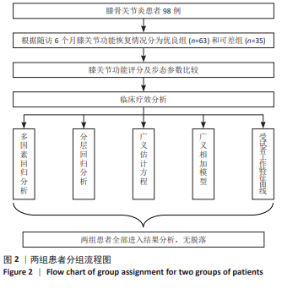
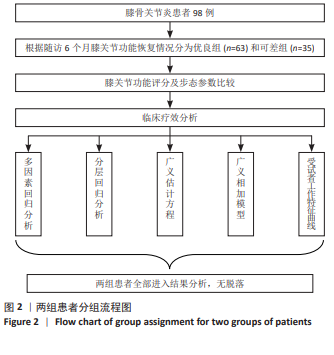
2.1 参与者数量分析 根据纳入排除标准,共98例患者入组,均为单人单膝,其中优良组63例,可差组35例。 2.2 试验流程图 见图2。"
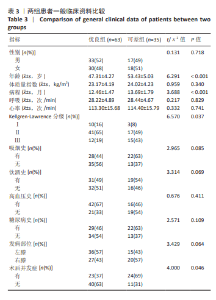
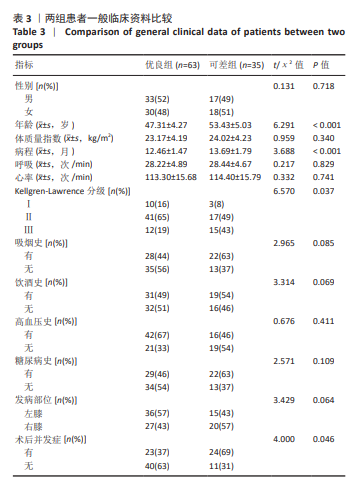
2.3 一般资料比较 表3结果显示,优良组和可差组在年龄、病程、Kellgren-Lawrence分级和术后并发症等方面,差异有显著性意义(P < 0.05),其余指标两组相比差异无显著性意义(P > 0.05)。"
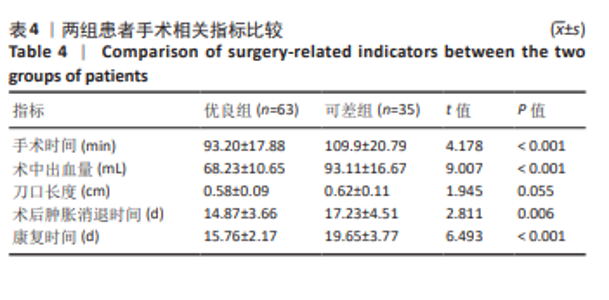
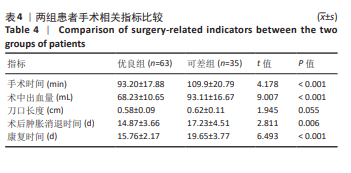
2.4 两组患者手术相关指标比较 与优良组比较,可差组手术时间、术中出血量、术后肿胀消退时间、康复时间均显著增加,差异有显著性意义(P < 0.05),见表4。"
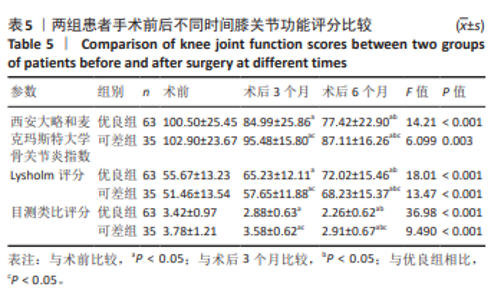
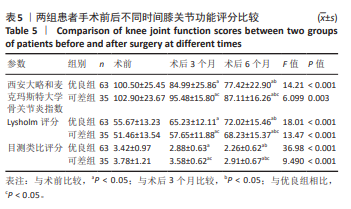
2.5 两组患者手术前后不同时间膝关节功能评分的比较 结果表明,术后可差组西安大略和麦克玛斯特大学骨关节炎指数和目测类比评分显著高于优良组(P < 0.05);Lysholm评分显著低于优良组(P < 0.05),见表5。"
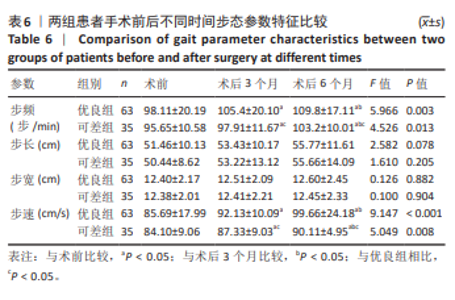
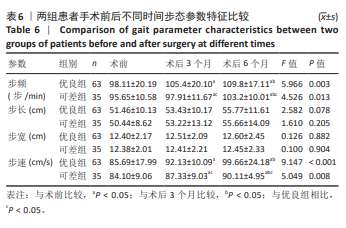
2.6 两组患者手术前后不同时间步态参数特征比较 结果表明,两组患者术前步频、步长、步宽和步速比较差异均无显著性意义(P > 0.05),术后可差组的步频和步速均低于优良组,差异有显著性意义(P < 0.05),见表6。"
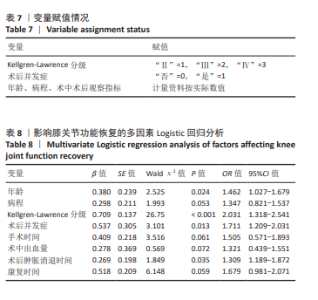
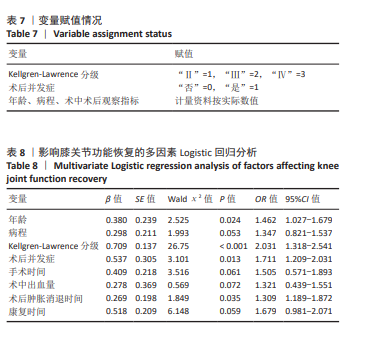
2.7 影响膝关节功能恢复的多因素Logistic回归分析 将表7中具有统计学差异的因素作为自变量,将膝关节功能作为因变量(是=1,否=0),纳入Logistic多因素回归分析模型,结果显示,年龄、Kellgren-Lawrence分级、术后并发症、术后肿胀消退时间均是影响膝关节功能恢复的独立危险因素(P < 0.05),见表8。"
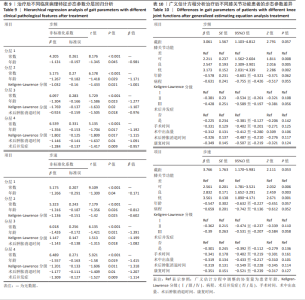
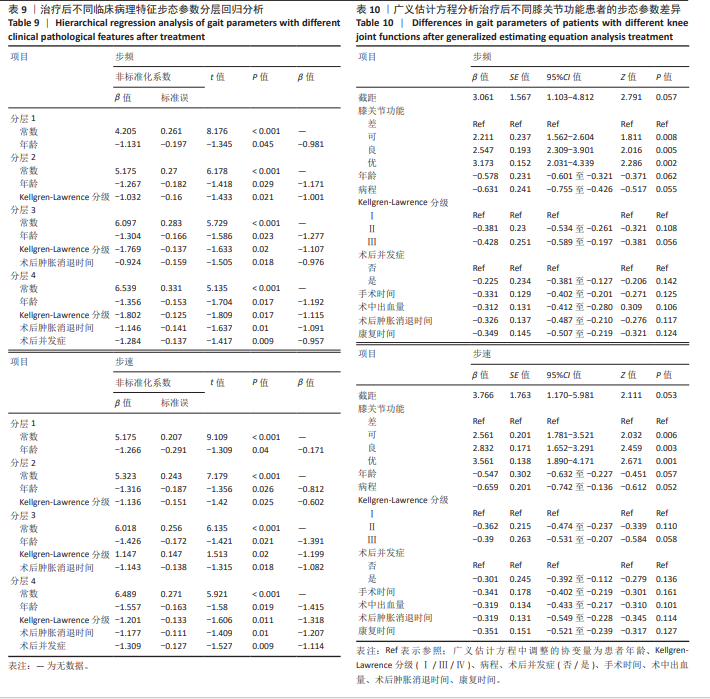
2.8 治疗后不同临床病理特征步态参数分层回归分析 结果显示,年龄、Kellgren-Lawrence分级、术后肿胀消退时间、术后并发症均对步频、步速产生显著的负向影响(β < 0,P < 0.05),见表9。 2.9 广义估计方程分析治疗后不同膝关节功能患者步态参数差异 膝关节功能恢复程度与步态特征存在显著关联。相较于膝关节功能恢复不良患者,当患者关节功能改善时,其步频与步速显著升高(β > 0,P < 0.05),见表10。"
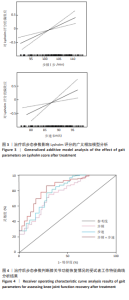
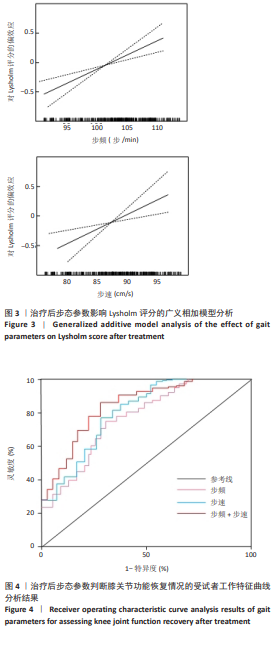
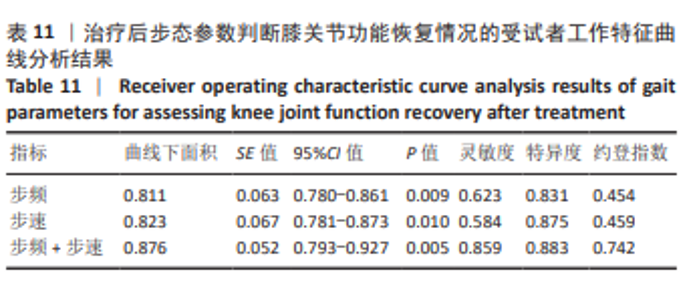
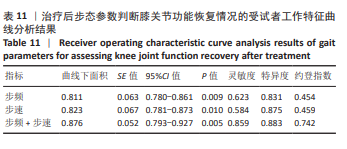
2.10 治疗后步态参数影响Lysholm评分的广义相加模型分析 结果显示,治疗后步频和步速对Lysholm评分的影响表现为直线关系,步频和步速与Lysholm评分显著正相关(P < 0.05),见图3。 2.11 治疗后步态参数判断膝关节功能恢复情况的价值分析 步频与步速单独预测时均具有良好的诊断价值(曲线下面积> 0.80,P < 0.05),而二者联合检测时预测效能进一步提升(曲线下面积> 0.85,P < 0.05),表明联合指标可更有效地区分膝关节功能恢复水平,见图4,表11。 "
"
| [1] GBD 2021 Osteoarthritis Collaborators. Global, regional, and national burden of osteoarthritis, 1990-2020 and projections to 2050: a systematic analysis for the Global Burden of Disease Study 2021. Lancet Rheumatol. 2023;5(9):e508-e522. [2] ZHU S, QU W, HE C. Evaluation and management of knee osteoarthritis. J Evid Based Med. 2024;17(3):675-687. [3] CLARK GP. Treatment options for symptomatic knee osteoarthritis in adults. JAAPA. 2023;36(11):1-6. [4] KATZ JN, ARANT KR, LOESER RF. Diagnosis and Treatment of Hip and Knee Osteoarthritis: A Review. JAMA. 2021;325(6):568-578. [5] 张超, 冯汇川, 刘爱峰, 等. 超声引导下射频针刀治疗对早中期膝骨性关节炎步态分析的影响[J]. 中华中医药杂志,2025,40(3): 1493-1497. [6] 刘俊. 关节镜联合开放楔形胫骨高位截骨术治疗膝关节骨性关节炎对患者疼痛和近期关节功能恢复的作用[J]. 黑龙江医学,2023, 47(9):1066-1068. [7] KONNYU KJ, THOMA LM, CAO W, et al. Rehabilitation for Total Knee Arthroplasty: A Systematic Review. Am J Phys Med Rehabil. 2023; 102(1): 19-33. [8] DEFRANCE MJ, SCUDERI GR. Are 20% of Patients Actually Dissatisfied Following Total Knee Arthroplasty? A Systematic Review of the Literature. J Arthroplasty. 2023;38(3):594-599. [9] LEE Y, SHIN YS, KIM HJ, et al. Effectiveness and methods of cryotherapy in reducing swelling after total knee arthroplasty: A systematic review on randomized controlled trials. Nurs Open. 2023;10(9):5989-5998. [10] TAMPERE T, ARNOUTT N, VICTOR J. Total knee arthroplasty: The need for better patient selection. Knee Surg Sports Traumatol Arthrosc. 2025;33(3):784-788. [11] OZEKI N, SEIL R, KRYCH AJ, et al. Surgical treatment of complex meniscus tear and disease: state of the art. J ISAKOS. 2021;6(1):35-45. [12] LI Q, WANG H, WANG D. Effects of high tibial osteotomy combined with arthroscopy on local inflammation degree and gait activity index in patients with medial knee osteoarthritis. Pak J Med Sci. 2023;39(1): 161-165. [13] 夏宝剑, 张达夫, 王峰, 等. 银苓消肿丸联合关节镜清理术对膝骨性关节炎患者膝肿胀程度及关节活动度的影响[J]. 中国中西医结合外科杂志,2025,31(2):208-212. [14] 黄海东. 关节镜微创手术联合玻璃酸钠、塞来昔布对老年膝关节骨性关节炎患者关节功能的影响[J]. 贵州医药,2024,48(12): 1931-1932. [15] ROTINI M, PAPALIA G, SETARO N, et al. Arthroscopic surgery or exercise therapy for degenerative meniscal lesions: a systematic review of systematic reviews. Musculoskelet Surg. 2023;107(2): 127-141. [16] BELK JW, LIM JJ, KEETER C, et al. Patients With Knee Osteoarthritis Who Receive Platelet-Rich Plasma or Bone Marrow Aspirate Concentrate Injections Have Better Outcomes Than Patients Who Receive Hyaluronic Acid: Systematic Review and Meta-analysis. Arthroscopy. 2023;39(7): 1714-1734. [17] ROMANDINI I, GRASSI A, ANDREA LUCIDI G, et al. 10-Year Survival and Clinical Improvement of Meniscal Allograft Transplantation in Early to Moderate Knee Osteoarthritis. Am J Sports Med. 2024;52(8): 1997-2007. [18] REICHENBACH S, JUNI P, HINCAPIE CA, et al. Effect of transcutaneous electrical nerve stimulation (TENS) on knee pain and physical function in patients with symptomatic knee osteoarthritis: the ETRELKA randomized clinical trial. Osteoarthritis Cartilage. 2022; 30(3):426-435. [19] BARAI NK, MITTAL R, ANSARI MT, et al. Gait Analysis and Functional Knee Scores in Primary Knee Osteoarthritis and Their Correlation with Progression of the Disease in the Indian Population. Indian J Orthop. 2024;58(4):424-432. [20] YOON JY, SHIN SS. Impact of step width on trunk motion and gait adaptation in elderly women with knee osteoarthritis. J Back Musculoskelet Rehabil. 2024;37(4):989-996. [21] BACON KL, FELSON DT, JAFARZADEH SR, et al. Gait Alterations and Association With Worsening Knee Pain and Physical Function: A Machine Learning Approach With Wearable Sensors in the Multicenter Osteoarthritis Study. Arthritis Care Res (Hoboken). 2024;76(7): 984-992. [22] 何金龙, 余俊, 杨海波, 等. 三维步态分析系统在膝骨性关节炎患者中的临床研究[J]. 宁夏医学杂志,2021,43(8):721-724. [23] 张昊, 靳勇. 经导管动脉栓塞术治疗膝骨关节炎临床应用及进展[J]. 介入放射学杂志,2025,34(2):206-212. [24] GELBER AC. Knee Osteoarthritis. Ann Intern Med. 2024;177(9): ITC129-ITC144. [25] SIMENTAL-MENDIA M, ORTEGA-MATA D, ACOSTA-OLIVO CA, et al. Effect of collagen supplementation on knee osteoarthritis: an updated systematic review and meta-analysis of randomised controlled trials. Clin Exp Rheumatol. 2025;43(1):126-134. [26] 王宝辉, 王暄齐, 樊晓晨, 等. 膝关节镜手术联合矫形支具治疗对膝关节骨性关节炎患者围手术期指标、膝关节功能和关节活动度的影响[J]. 现代生物医学进展,2024,24(12):2259-2263. [27] DUONG V, OO WM, DING C, et al. Evaluation and Treatment of Knee Pain: A Review. JAMA. 2023;330(16):1568-1580. [28] PERRUCCIO AV, YOUNG JJ, WILFONG JM, et al. Osteoarthritis year in review 2023: Epidemiology & therapy. Osteoarthritis Cartilage. 2024; 32(2):159-165. [29] JIN Q, CHEN M, KONG J, et al. Clinical and Animal Studies of Waist and Knee Scraping Therapy for Knee Osteoarthritis. Comb Chem High Throughput Screen. 2024;27(15):2278-2294. [30] LIEW JW, KING LK, MAHMOUDIAN A, et al. A scoping review of how early-stage knee osteoarthritis has been defined. Osteoarthritis Cartilage. 2023;31(9):1234-1241. [31] 刘欣悦, 孙旭, 李佼徽, 等. 扬刺法治疗膝骨关节炎的研究进展[J]. 广州中医药大学学报,2025,42(2):425-429. [32] EGGELING L, KLEPSCH L, AKOTO R, et al. Clinical results after very early, early and late arthroscopic arthrolysis of the knee. Int Orthop. 2022;46(2):265-271. [33] 林伟明, 孙剑光, 梁传兴, 等. 自体富血小板血浆注射联合关节镜清理术治疗膝关节骨性关节炎患者的临床效果[J]. 医药前沿,2025, 15(2):10-13. [34] HOHMANN E. Treatment of Degenerative Meniscus Tears. Arthroscopy. 2023;39(4):911-912. [35] MENG J, TANG H, XIAO Y, et al. Long-term effects of exercise therapy versus arthroscopic partial meniscectomy for degenerative meniscal tear: A meta-analysis of randomized controlled trials. Asian J Surg. 2024;47(6):2566-2573. [36] 田鑫铎, 缪祎, 刘欣, 等. 关节镜下All-inside单针垂直缝合技术治疗膝关节半月板完全性放射状撕裂[J]. 中国修复重建外科杂志, 2025,39(5):550-555. [37] 王猛, 姚五平, 柳直, 等. 关节镜辅助下关节腔滑膜清理术治疗布鲁氏菌感染后单侧膝骨关节炎2例报道[J]. 中华骨与关节外科杂志,2025,18(3):286-288. [38] SALEHI R, VALIZADEH L, NEGAHBAN H, et al. The Western Ontario and McMaster Universities Osteoarthritis, Lequesne Algofunctional index, Arthritis Impact Measurement Scale-short form, and Visual Analogue Scale in patients with knee osteoarthritis: responsiveness and minimal clinically important differences. Disabil Rehabil. 2023;45(13): 2185-2191. [39] KIM KI, LEE MC, LEE JH, et al. Clinical Efficacy and Safety of the Intra-articular Injection of Autologous Adipose-Derived Mesenchymal Stem Cells for Knee Osteoarthritis: A Phase III, Randomized, Double-Blind, Placebo-Controlled Trial. Am J Sports Med. 2023;51(9):2243-2253. [40] SHIOJIMA Y, TAKAHASHI M, TAKAHASHI R, et al. Efficacy and Safety of Dietary Undenatured Type II Collagen on Joint and Motor Function in Healthy Volunteers: A Randomized, Double-Blind, Placebo-Controlled, Parallel-Group Study. J Am Nutr Assoc. 2023;42(3):224-241. [41] TANIGUCHI M, IKEZOE T, TSUBOYAMA T, et al. Step-time variability is a specific gait characteristic associated with functional disabilities in knee osteoarthritis: The Nagahama study. Gait Posture. 2025;120:211-216. [42] 李宏恩, 马恺, 石春花, 等. 步态分析用于膝骨性关节炎诊断与功能评定的研究进展[J].生物医学工程与临床,2024,28(2):281-286. [43] 李存祥, 李德思, 张学波, 等. 膝骨关节炎患者腓骨小段截骨术后步态参数特征分析[J].中医正骨,2023,35(3):25-30. [44] JANSEN MP, HODGINS D, MASTBERGEN SC, et al. Can gait patterns be explained by joint structure in people with and without radiographic knee osteoarthritis? Data from the IMI-APPROACH cohort. Skeletal Radiol. 2024;53(11):2409-2416. [45] KAWADA K, FURUMATSU T, TAMURA M, et al. Medial joint space narrowing progresses after pullout repair of medial meniscus posterior root tear. Int Orthop. 2023;47(10):2401-2407. [46] 白涛, 张文生, 苗强, 等. 关节镜联合开放楔形胫骨高位截骨术对膝关节内侧间室骨性关节炎患者下肢力线矫正及炎性因子水平的影响[J].临床医学研究与实践,2024,9(32):71-74. [47] FERRACINI R, ALESSIO-MAZZOLA M, SONZOGNI B, et al. Age and synovitis affect the results of the treatment of knee osteoarthritis with Microfragmented Autologous Fat Tissue. Knee Surg Sports Traumatol Arthrosc. 2023;31(9):3655-3664. [48] SONESSON S, SPRINGER I, YAKOB J, et al. Knee Arthroscopic Surgery in Middle-Aged Patients With Meniscal Symptoms: A 10-Year Follow-up of a Prospective, Randomized Controlled Trial. Am J Sports Med. 2024;52(9):2250-2259. [49] OUENDI N, AVRIL E, DERVAUX B, et al. Effectiveness of Telerehabilitation Programs in Elderly with Hip or Knee Arthroplasty: A Systematic Review. Telemed J E Health. 2024;30(6):1507-1521. [50] XUE X, LI J, LIANG Y, et al. Risk factors for varus knee osteoarthritis and their relationship with disease severity based on Kellgren-Lawrence classification. Am J Transl Res. 2024;16(9):4912-4919. |
| [1] | Chen Qiuhan, Yang Long, Yuan Daizhu, Wu Zhanyu, Zou Zihao, Ye Chuan. Peri-knee osteotomy for treatment of knee osteoarthritis: optimization of treatment strategies [J]. Chinese Journal of Tissue Engineering Research, 2026, 30(9): 2303-2312. |
| [2] | Zhang Xianxu, Ma Zhong, Liu Xin, Huang Lei, Shen Wenxiang, Luo Zhiqiang . Lumbar fusion combined with unilateral fixation for lumbar degenerative diseases: biomechanics, technical evolution, and clinical applications [J]. Chinese Journal of Tissue Engineering Research, 2026, 30(9): 2334-2342. |
| [3] | Li Linzhen, Jiao Hongzhuo, Chen Weinan, Zhang Mingzhe, Wang Jianlong, Zhang Juntao. Effect of icariin-containing serum on lipopolysaccharide-induced inflammatory damage in human chondrocytes [J]. Chinese Journal of Tissue Engineering Research, 2026, 30(6): 1368-1374. |
| [4] | Gu Fucheng, Yang Meixin, Wu Weixin, Cai Weijun, Qin Yangyi, Sun Mingyi, Sun Jian, Geng Qiudong, Li Nan. Effects of Guilu Erxian Glue on gut microbiota in rats with knee osteoarthritis: machine learning and 16S rDNA analysis [J]. Chinese Journal of Tissue Engineering Research, 2026, 30(4): 1058-1072. |
| [5] | Li Xiaomin, Tian Xiangdong, Wang Chaolu. High tibial osteotomy on a single plane: femorofibular angle as a reference marker for mechanical axis correction [J]. Chinese Journal of Tissue Engineering Research, 2026, 30(3): 570-576. |
| [6] | Yong Qiao, Sun Xin, Wang Guoyou, Zhang Lei, Shen Huarui, Liu Huan, Guan Taiyuan. Shaoyang Shenggu Fang inhibits oxidative stress and delays cartilage aging in rats with knee osteoarthritis [J]. Chinese Journal of Tissue Engineering Research, 2026, 30(28): 7251-7259. |
| [7] | Bai Xue, Tian Yukui, Guo Lei, Shi Mengni, Cui Xiaofeng, Wang Cheng, Li Jingxian, Zhu Qingguang, Liu Junchang. Construction of an early knee osteoarthritis rat model: CatWalk-based gait analysis and evaluation [J]. Chinese Journal of Tissue Engineering Research, 2026, 30(28): 7280-7286. |
| [8] | Shao Yunbo, Guo Jiayi, Li Feng. Characteristics of lower limb muscle motor activation in patients with unilateral knee osteoarthritis [J]. Chinese Journal of Tissue Engineering Research, 2026, 30(24): 6174-6181. |
| [9] | Fan Yuanhe, Yang Yongju, He Fanyu, Qiao Long, Zhang Yu, Zhang Shuai, Li Zhiwen, Guan Xuefeng. Mechanism by which Yougui Pill inhibits pyroptosis of chondrocytes in rats with knee osteoarthritis [J]. Chinese Journal of Tissue Engineering Research, 2026, 30(24): 6214-6219. |
| [10] | Cui Pengfei, Wen Zhangkun, Chen Fengjiang, Wang Zhen, Wang Changyao. Unicompartmental knee arthroplasty for severe medial compartment osteoarthritis with moderate lateral involvement: clinical outcomes [J]. Chinese Journal of Tissue Engineering Research, 2026, 30(21): 5452-5459. |
| [11] | Guo Jingwen, Wang Qingwei, He Zijun, Hu Zihang, Chen Zhi, Zhu Rong, Wang Yuming, Liu Wenfei, Luo Qinglu. Intra-articular injection of different concentrations of silicon-based bioceramics in treatment of knee osteoarthritis in rats [J]. Chinese Journal of Tissue Engineering Research, 2026, 30(2): 288-295. |
| [12] | Liu Yanzhe, Liu Hua, Yang Tubao, Liu Yupeng. Effects of human umbilical cord blood mesenchymal stem cells on pain and function in patients with knee osteoarthritis: a meta-analysis [J]. Chinese Journal of Tissue Engineering Research, 2026, 30(19): 5066-5071. |
| [13] | Yu Yueyue, Zhang Xu, Liu Yiwei, Meng Zihan, Hao Xinyue, Tian Chunyu, Li Ji’an, Zhang Yixin . Lipid types and knee osteoarthritis: a genome-wide association study in European populations [J]. Chinese Journal of Tissue Engineering Research, 2026, 30(18): 4763-4770. |
| [14] | Peng Siwei, Yang Ruifang, Chen Xiaohua, Zheng Zhuoming, Chen Peng, Xiao Yan, Su Youxin, Guo Jiemei. The mechanism by which Zhuanggu Jianxi Decoction inhibits inflammatory response of human synovial macrophages [J]. Chinese Journal of Tissue Engineering Research, 2026, 30(17): 4400-4406. |
| [15] | Wei Bingqi, Sun Jiahui, Chen Liu, Li Yijing, Wan Hejia, Qi Yifan, Wang Shangzeng. BTN3A2 is a key target for the development or prevention of new drugs for knee osteoarthritis: a randomization study based on drug targeting [J]. Chinese Journal of Tissue Engineering Research, 2026, 30(16): 4021-4029. |
| Viewed | ||||||
|
Full text |
|
|||||
|
Abstract |
|
|||||