Chinese Journal of Tissue Engineering Research ›› 2026, Vol. 30 ›› Issue (21): 5452-5459.doi: 10.12307/2026.619
Previous Articles Next Articles
Unicompartmental knee arthroplasty for severe medial compartment osteoarthritis with moderate lateral involvement: clinical outcomes
Cui Pengfei, Wen Zhangkun, Chen Fengjiang, Wang Zhen, Wang Changyao
- Affiliated Hospital of Qingdao University, Qingdao 266000, Shandong Province, China
-
Accepted:2025-04-03Online:2026-07-28Published:2026-03-04 -
Contact:Wang Changyao, MD, Chief physician, Affiliated Hospital of Qingdao University, Qingdao 266000, Shandong Province, China -
About author:Cui Pengfei, Master candidate, Affiliated Hospital of Qingdao University, Qingdao 266000, Shandong Province, China

CLC Number:
Cite this article
Cui Pengfei, Wen Zhangkun, Chen Fengjiang, Wang Zhen, Wang Changyao. Unicompartmental knee arthroplasty for severe medial compartment osteoarthritis with moderate lateral involvement: clinical outcomes[J]. Chinese Journal of Tissue Engineering Research, 2026, 30(21): 5452-5459.
share this article
Add to citation manager EndNote|Reference Manager|ProCite|BibTeX|RefWorks
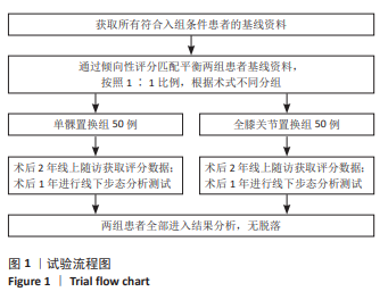
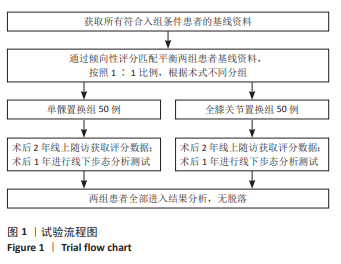
2.1 参与者数量分析 通过倾向性评分匹配,按照1∶1比例,将符合入组标准的患者进行匹配,最终两组各纳入50例(50膝)。术后线上随访全部完成;线下步态随访因地域限制及人员流动,仅完成术后1年的随访。 所有患者均为初次置换且随访期间对侧下肢关节未进行其他手术治疗。单髁置换组随访时间24-29个月,平均(25.0±1.2)个月;全膝关节置换组随访时间24-29个月,平均(26.0±1.7)个月。 2.2 试验流程图 见图1。"
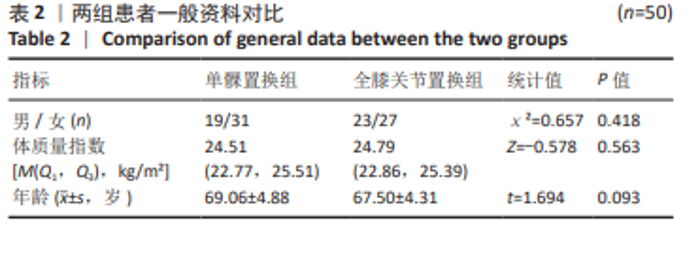
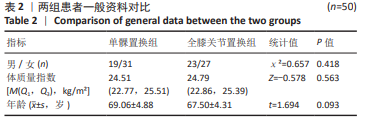
2.3 基线资料对比 两组患者术前体质量指数、性别、年龄对比差异无显著性意义(P > 0.05),见表2。"
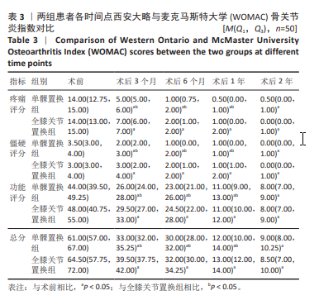
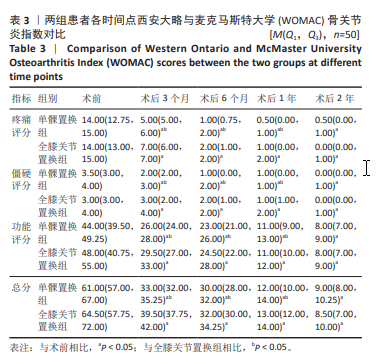
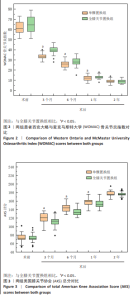
2.4 两组结果数据对比 2.4.1 两组WOMAC骨关节炎指数对比 两组WOMAC骨关节炎指数采用Mann-Whitney U检验,用M(Q1,Q3)表示。结果显示在术后3个月、6个月、1年,单髁置换组WOMAC骨关节炎指数明显小于全膝关节置换组,差异有显著性意义(P < 0.05);而在术后2年,两组差异无显著性意义(P > 0.05),见表3,图2。"
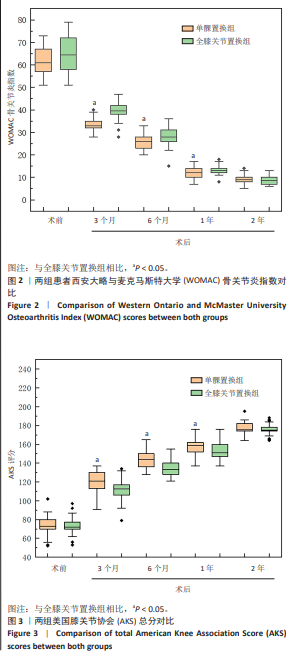
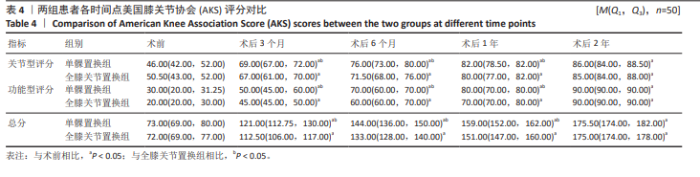
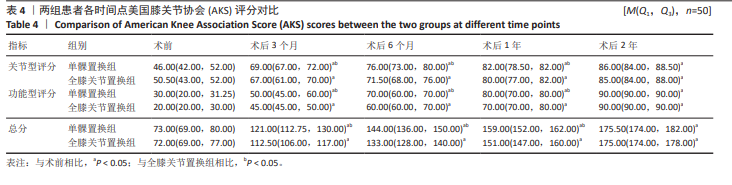
2.4.2 两组AKS评分对比 单髁置换组与全膝关节置换组AKS评分数据采用Mann-Whitney U检验,用M(Q1,Q3)表示。结果显示在术后3个月、术后6个月、术后1年,单髁置换组AKS评分显著高于全膝关节置换组,差异有显著性意义(P < 0.05),而在术后2年,单髁置换组与全膝关节置换组评分差异无显著性意义(P > 0.05),见表4,图3。"
"
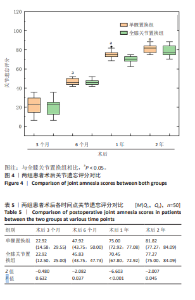
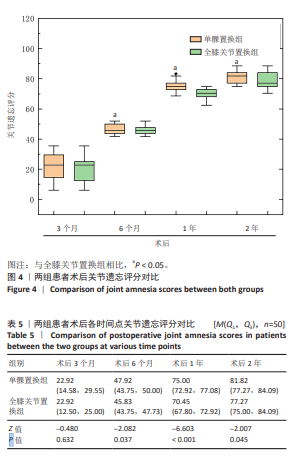
2.4.3 两组关节遗忘评分对比 两组关节遗忘评分采用Mann-Whitney U检验,用M(Q1,Q3)表示。结果显示,在术后3个月,两组关节遗忘评分相比差异无显著性意义(P > 0.05),而在术后6个月、1年、2年,单髁置换组评分高于全膝关节置换组,差异有显著性意义(P < 0.05),见表5,图4。"
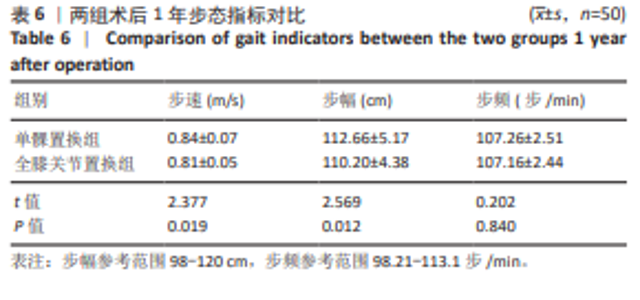
2.4.4 两组步态分析指标对比 单髁置换组与全膝关节置换组术后1年步态分析示单髁置换组步速、步幅优于全膝关节置换组,差异有显著性意义(P < 0.05),而两组步频差异无显著性意义(P > 0.05),见表6。 "
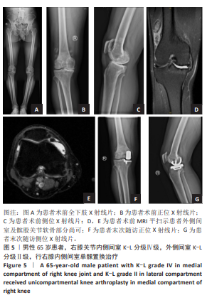
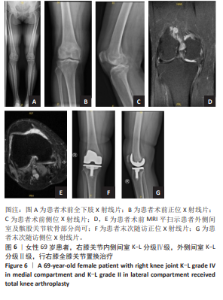
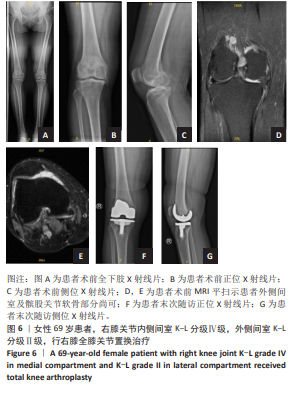
2.5 典型病例影像学资料 在随访期间,未发现患者外侧间室骨关节炎明显进展(Kellgren-Lawrence分级增加),见图5,6。 2.6 并发症 在此次研究中,两组患者随访过程中均未发生垫片脱位、感染、伤口不愈合、深静脉血栓(监测D-二聚体指标,若指标升高则加做下肢血管超声检查)等并发症。 2.7 植入物与宿主的生物相容性 两组患者均未出现植入物周围感染、过敏反应、免疫反应及排斥反应。"
"
| [1] ELKJÆR CHRISTENSEN AL, BREDGAARD JENSEN C, GROMOV K, et al. Champions in usage of medial unicompartmental knee arthroplasty: The story behind the Danish success. Champions im Einsatz der medialen unikompartimentellen Knieendoprothese: Die Geschichte hinter dem dänischen Erfolg. Orthopadie (Heidelb). 2024;53(4): 246-254. [2] MIKKELSEN M, PRICE A, PEDERSEN AB, et al. Optimized medial unicompartmental knee arthroplasty outcome: learning from 20 years of propensity score matched registry data. Acta Orthop. 2022;93: 390-396. [3] D’AMBROSI R, VAISHYA R, VERDE F. Balancing in Unicompartmental Knee Arthroplasty: Balancing in Flexion or in Extension? J Clin Med. 2022;11(22):6813. [4] SEARLE HKC, RAHMAN A, DESAI AP, et al. Incidence and severity of radiological lateral osteoarthritis 15 years following medial unicompartmental knee arthroplasty. Bone Jt Open. 2023;4(3): 210-218. [5] INSALL JN, DORR LD, SCOTT RD, et al. Rationale of the Knee Society clinical rating system. Clin Orthop Relat Res. 1989;(248):13-14. [6] BEHREND H, GIESINGER K, GIESINGER JM, et al. The “forgotten joint” as the ultimate goal in joint arthroplasty: validation of a new patient-reported outcome measure. J Arthroplasty. 2012;27(3):430-436.e1. [7] PLANCHER KD, BEREND KR, DALURY DF, et al. Unicondylar Knee Arthroplasty Made Simple. Instr Course Lect. 2023;72:261-272. [8] MA J, ZHANG L, WANG C, et al. The mid-term outcomes of mobile bearing unicompartmental knee arthroplasty versus total knee arthroplasty in the same patient. Front Surg. 2023;10:1033830. [9] ALBISHI W, ABUDUJAIN NM, ALDHAHRI M, et al. Unicompartmental knee replacement: controversies and technical considerations. Arthroplasty. 2024;6(1):21. [10] KIM TK, MITTAL A, MESHRAM P, et al. Evidence-based surgical technique for medial unicompartmental knee arthroplasty. Knee Surg Relat Res. 2021;33(1):2. [11] KHAN H, DHILLON K, MAHAPATRA P, et al. Blood loss and transfusion risk in robotic-assisted knee arthroplasty: A retrospective analysis. Int J Med Robot. 2021;17(6):e2308. [12] DAXHELET J, DELFOSSE G, LAVAND’HOMME P, et al. Evolution and characteristics of nocturnal knee pain after knee arthroplasty. Arch Orthop Trauma Surg. 2024;144(11):4715-4723. [13] LEISS F, GÖTZ JS, MADERBACHER G, et al. Pain management of unicompartmental (UKA) vs. total knee arthroplasty (TKA) based on a matched pair analysis of 4144 cases. Sci Rep. 2020;10(1):17660. [14] WANG L, WANG Q, LI Q, et al. A Comparative Study of Total Knee Arthroplasty and Unicondylar Knee Arthroplasty in the Treatment of Knee Osteoarthritis. Contrast Media Mol Imaging. 2022;2022:7795801. [15] LAORUENGTHANA A, REOSANGUANWONG K, RATTANAPRICHAVEJ P, et al. Cruciate-Retaining Total Knee Arthroplasty versus Unicompartmental Knee Arthroplasty in Medial Compartmental Osteoarthritis: A Propensity Score-Matched Analysis of Early Postoperative Recovery. Orthop Res Rev. 2024;16:103-110. [16] SCHEELE CB, PIETSCHMANN MF, WAGNER TC, et al. Conversion of UKA to TKA using identical standard implants-How does it compare to primary UKA, primary TKA and revision TKA? Arthroplasty. 2024; 6(1):48. [17] DONG M, FAN H, YANG D, et al. Comparison of spatiotemporal, kinematic, and kinetic gait characteristics in total and unicompartmental knee arthroplasty during level walking: A systematic review and meta-analysis. Gait Posture. 2023;104:58-69. [18] COPP EH, GALE TH, BYRAPOGU VKC, et al. Unicompartmental knee arthroplasty approximates healthy knee kinematics more closely than total knee arthroplasty. J Orthop Res. 2024;42(11):2514-2524. [19] KOZINN SC, SCOTT R. Unicondylar knee arthroplasty. J Bone Joint Surg Am. 1989;71(1):145-150. [20] HANSEN EN, ONG KL, LAU E, et al. Unicondylar Knee Arthroplasty in the U.S. Patient Population: Prevalence and Epidemiology. Am J Orthop (Belle Mead NJ). 2018;47(12):10.12788/ajo.2018.0113. [21] SIMAN H, KAMATH AF, CARRILLO N, et al. Unicompartmental Knee Arthroplasty vs Total Knee Arthroplasty for Medial Compartment Arthritis in Patients Older Than 75 Years: Comparable Reoperation, Revision, and Complication Rates. J Arthroplasty. 2017;32(6): 1792-1797. [22] SENG CS, HO DC, CHONG HC, et al. Outcomes and survivorship of unicondylar knee arthroplasty in patients with severe deformity. Knee Surg Sports Traumatol Arthrosc. 2017;25(3):639-644. [23] KUYUCU E, BÜLBÜL AM, KARA A, et al. Which unicondylar prosthesis is better in the mid- term in obese patients: fixed or mobile?. Acta Orthop Belg. 2018;84(3):257-261. [24] WALDSTEIN W, KASPAREK MF, FASCHINGBAUER M, et al. Lateral-compartment Osteophytes are not Associated With Lateral-compartment Cartilage Degeneration in Arthritic Varus Knees. Clin Orthop Relat Res. 2017;475(5):1386-1392. [25] ABBAS MJ, MARKEL DC, HALLSTROM BR, et al. The Impact of Surgeon Volume on Unicompartmental Knee Arthroplasty Survivorship: A Michigan Arthroplasty Registry Collaborative Quality Initiative Database Analysis. J Arthroplasty. 2025;40(1):15-21. [26] MØLLER JKS, BUNYOZ KI, HENKEL C, et al. Using at least 20% medial unicompartmental knee arthroplasty is associated with improved patient-reported outcome measures across all knee arthroplasty patients. Knee Surg Sports Traumatol Arthrosc. 2025;33(4):1345-1357. [27] WU LP, MAYR HO, ZHANG X, et al. Knee Scores of Patients with Non-Lateral Compartmental Knee Osteoarthritis Undergoing Mobile, Fixed-Bearing Unicompartmental Knee and Total Knee Arthroplasties: A Randomized Controlled Trial. Orthop Surg. 2022;14(1):73-87. [28] YANG B, SHI J, ZHANG H, et al. Changes of knee proprioception in patients with knee osteoarthritis undergoing unicompartmental knee arthroplasty. Gait Posture. 2025;120:205-210. [29] PONGCHAROEN B, LIENGWATTANAKOL P, BOONTANAPIBUL K. Comparison of Functional Recovery Between Unicompartmental and Total Knee Arthroplasty: A Randomized Controlled Trial. J Bone Joint Surg Am. 2023;105(3):191-201. [30] ZHANG M, WANG H, CAI Z, et al. A systematic comparative analysis of gait characteristics in patients undergoing total knee arthroplasty and unicompartmental knee arthroplasty: a review study. J Orthop Surg Res. 2024;19(1):821. [31] LIANG S, ZENG H, YU M, et al. The Impact of Arthroscopy on Surgical Decision-Making and Outcomes in Osteoarthritis Patients Undergoing Unicompartmental Knee Arthroplasty. Cureus. 2023;15(10):e46684. [32] WONG AY, ONG MT, CHOI TL, et al. Comparison of the in vivo kinematics between robotic-assisted Bi-cruciate retaining and Bi-cruciate stabilised total knee arthroplasty. Int J Med Robot. 2024;20(3):e2655. [33] TAKAHASHI T, AE R, KUBO T, et al. Relationship Between Intraoperative Macroscopic Anterior Cruciate Ligament Findings, Perioperative Surgical Findings, and Postoperative Clinical Outcome After Cruciate-Retaining Total Knee Arthroplasty. Cureus. 2024;16(2):e54239. [34] ÇANKAYA D, AKTI S, ÜNAL ŞB, et al. Unicompartmental knee arthroplasty results in a better gait pattern than total knee arthroplasty: Gait analysis with a smartphone application. Jt Dis Relat Surg. 2021;32(1):22-27. [35] STUDENSKI S, PERERA S, PATEL K, et al. Gait speed and survival in older adults. JAMA. 2011;305(1):50-58. [36] PEERSMAN G, VERHAEGEN J, FAVIER B. The forgotten joint score in total and unicompartmental knee arthroplasty: a prospective cohort study. Int Orthop. 2019;43(12):2739-2745. [37] LAORUENGTHANA A, REOSANGUANWONG K, RATTANAPRICHAVEJ P, et al. Cruciate-Retaining Total Knee Arthroplasty versus Unicompartmental Knee Arthroplasty in Medial Compartmental Osteoarthritis: A Propensity Score-Matched Analysis of Early Postoperative Recovery. Orthop Res Rev. 2024;16:103-110. [38] WAUTIER D, THIENPONT E. Changes in anteroposterior stability and proprioception after different types of knee arthroplasty. Knee Surg Sports Traumatol Arthrosc. 2017;25(6):1792-1800. [39] ZHANG Q, ZHANG Q, GUO W, et al. The learning curve for minimally invasive Oxford phase 3 unicompartmental knee arthroplasty: cumulative summation test for learning curve (LC-CUSUM). J Orthop Surg Res. 2014;9:81. [40] CHATELLARD R, SAULEAU V, COLMAR M, et al. Medial unicompartmental knee arthroplasty: does tibial component position influence clinical outcomes and arthroplasty survival? Orthop Traumatol Surg Res. 2013;99(4 Suppl):S219-S225. |
| [1] | Zhang Zizheng, Luo Wang, Liu Changlu. Application value of finite element analysis on unicompartmental knee arthroplasty for medial knee compartmental osteoarthritis [J]. Chinese Journal of Tissue Engineering Research, 2026, 30(9): 2313-2322. |
| [2] | Liu Wenlong, Dong Lei, Xiao Zhengzheng, Nie Yu. Finite element analysis of tibial prosthesis loosening after fixed-bearing unicompartmental knee arthroplasty for osteoporosis [J]. Chinese Journal of Tissue Engineering Research, 2026, 30(9): 2191-2198. |
| [3] | He Yixiang, Qiao Wanjia, Wang Wenji. Effectiveness and safety of tranexamic acid versus epsilon-aminocaproic acid in total hip and knee arthroplasties: a meta-analysis [J]. Chinese Journal of Tissue Engineering Research, 2026, 30(9): 2361-2369. |
| [4] | Wang Nan, Chen Shuang, Xi Zhipeng, Qian Yuzhang, Zhang Xiaoyu, Gu Jun, Kang Ran, Xie Lin. MRI evaluation of nerve root subsidence sign affecting efficacy of percutaneous endoscopic decompression in lumbar spinal stenosis [J]. Chinese Journal of Tissue Engineering Research, 2026, 30(9): 2262-2268. |
| [5] | Cao Xinyan, Yu Zifu, Leng Xiaoxuan, Gao Shiai, Chen Jinhui, Liu Xihua. Effect of repetitive transcranial magnetic stimulation and transcranial direct current stimulation on motor function and gait in children with cerebral palsy: a network meta-analysis [J]. Chinese Journal of Tissue Engineering Research, 2026, 30(6): 1539-1548. |
| [6] | Zhou Jian, Zhang Tao, Zhou Weili, Zhao Xingcheng, Wang Jun, Shen Jie, Qian Li, Lu Ming. Effects of resistance training on quadriceps mass and knee joint function in patients with osteoporosis and sarcopenia [J]. Chinese Journal of Tissue Engineering Research, 2026, 30(5): 1081-1088. |
| [7] | Zhang Anqi, Hua Haotian, Cai Tianyuan, Wang Zicheng, Meng Zhuo, Zhan Xiaoqian, Chen Guoqian . Pain after total knee arthroplasty: current status and trend analysis [J]. Chinese Journal of Tissue Engineering Research, 2026, 30(3): 795-804. |
| [8] | Yong Qiao, Sun Xin, Wang Guoyou, Zhang Lei, Shen Huarui, Liu Huan, Guan Taiyuan. Shaoyang Shenggu Fang inhibits oxidative stress and delays cartilage aging in rats with knee osteoarthritis [J]. Chinese Journal of Tissue Engineering Research, 2026, 30(28): 7251-7259. |
| [9] | Bai Xue, Tian Yukui, Guo Lei, Shi Mengni, Cui Xiaofeng, Wang Cheng, Li Jingxian, Zhu Qingguang, Liu Junchang. Construction of an early knee osteoarthritis rat model: CatWalk-based gait analysis and evaluation [J]. Chinese Journal of Tissue Engineering Research, 2026, 30(28): 7280-7286. |
| [10] | Shao Yunbo, Guo Jiayi, Li Feng. Characteristics of lower limb muscle motor activation in patients with unilateral knee osteoarthritis [J]. Chinese Journal of Tissue Engineering Research, 2026, 30(24): 6174-6181. |
| [11] | Fang Chao, Deng Miao, Wang Yang, Gao Fei, Li Jiahang, Yu Fangfang. Relationship between gait parameter characteristics and joint function recovery after arthroscopic minimally invasive surgery in patients with knee osteoarthritis [J]. Chinese Journal of Tissue Engineering Research, 2026, 30(21): 5468-5476. |
| [12] | Liu Chenglong, Wei Shanwen, Li Di, Zou Mingming, Ma Yanxia. Liposomal bupivacaine versus continuous ropivacaine infusion in adductor canal block for total knee arthroplasty [J]. Chinese Journal of Tissue Engineering Research, 2026, 30(21): 5421-5428. |
| [13] | Cheng Xiaofei, Yang Yuanyuan, Li Sihui, Wang Dehua, Liang Chunting, Li Jiawei, Yao Mingyang, Yao Xiaoduo, Tang Jiqin. Effects of different non-invasive brain stimulation protocols on gait and balance function in patients with Parkinson’s disease: a network meta-analysis [J]. Chinese Journal of Tissue Engineering Research, 2026, 30(18): 4749-4762. |
| [14] | Yu Yueyue, Zhang Xu, Liu Yiwei, Meng Zihan, Hao Xinyue, Tian Chunyu, Li Ji’an, Zhang Yixin . Lipid types and knee osteoarthritis: a genome-wide association study in European populations [J]. Chinese Journal of Tissue Engineering Research, 2026, 30(18): 4763-4770. |
| [15] | Liang Tianqi, Zhang Xiaoquan. Control strategies during gait termination in older adults under cognitive-motor dual-task conditions [J]. Chinese Journal of Tissue Engineering Research, 2026, 30(17): 4390-4399. |
| Viewed | ||||||
|
Full text |
|
|||||
|
Abstract |
|
|||||