Chinese Journal of Tissue Engineering Research ›› 2026, Vol. 30 ›› Issue (21): 5421-5428.doi: 10.12307/2026.775
Previous Articles Next Articles
Liposomal bupivacaine versus continuous ropivacaine infusion in adductor canal block for total knee arthroplasty
Liu Chenglong1, 2, Wei Shanwen3, Li Di4, Zou Mingming5, Ma Yanxia3, 6
- 1Department of Anesthesiology, Gaoyou People’s Hospital, Gaoyou 225600, Jiangsu Province, China; 2Gaoyou Clinical College, Jiangsu Medicine College, Gaoyou 225600, Jiangsu Province, China; 3Department of Orthopedics, 4Department of Neurosurgery, First Affiliated Hospital of Soochow University, Suzhou 215000, Jiangsu Province, China; 5Department of Neurosurgery, First Medical Center of Chinese PLA General Hospital, Beijing 100853, China; 6Institute of Orthopedics, Soochow University, Suzhou 215006, Jiangsu Province, China
-
Accepted:2025-08-09Online:2026-07-28Published:2026-03-04 -
Contact:Ma Yanxia, MS, Experimentalist, Department of Orthopedics, First Affiliated Hospital of Soochow University, Suzhou 215000, Jiangsu Province, China; Institute of Orthopedics, Soochow University, Suzhou 215006, Jiangsu Province, China Co-corresponding author: Zou Mingming, PhD, Attending physician, Department of Neurosurgery, First Medical Center of Chinese PLA General Hospital, Beijing 100853, China -
About author:Liu Chenglong, PhD, Chief physician, Department of Anesthesiology, Gaoyou People’s Hospital, Gaoyou 225600, Jiangsu Province, China; Gaoyou Clinical College, Jiangsu Medicine College, Gaoyou 225600, Jiangsu Province, China Wei Shanwen, MS, Technician-in-charge, Department of Orthopedics, First Affiliated Hospital of Soochow University, Suzhou 215000, Jiangsu Province, China Liu Chenglong and Wei Shanwen contributed equally to this article. -
Supported by:National Natural Science Foundation of China, No. 81801238 (to LD); Jiangsu Medical Vocational College Off-campus Teaching Base Scientific Research Development Special Project (to LCL)

CLC Number:
Cite this article
Liu Chenglong, Wei Shanwen, Li Di, Zou Mingming, Ma Yanxia. Liposomal bupivacaine versus continuous ropivacaine infusion in adductor canal block for total knee arthroplasty[J]. Chinese Journal of Tissue Engineering Research, 2026, 30(21): 5421-5428.
share this article
Add to citation manager EndNote|Reference Manager|ProCite|BibTeX|RefWorks
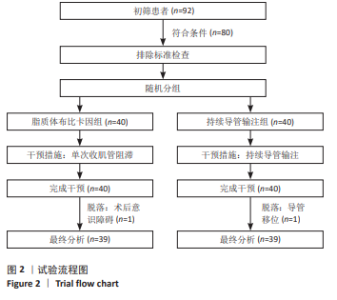
2.1 参与者数量分析 共有80例患者参与了此次研究,其中持续导管输注组1例患者因导管脱落而无法评估,脂质体布比卡因组1例患者因术后意识障碍不能配合评估。因此,最终分析了78例患者的数据,每组39例。 2.2 试验流程图 见图2。"
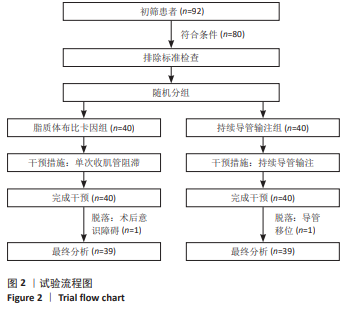
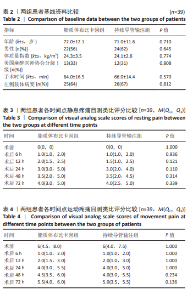
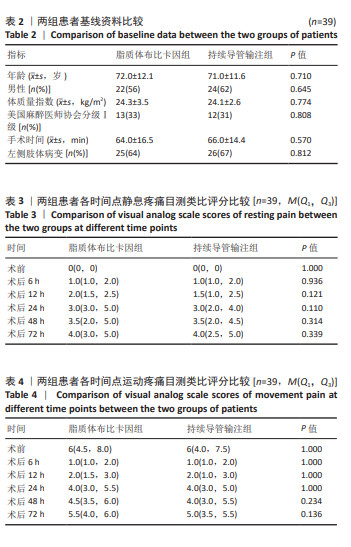
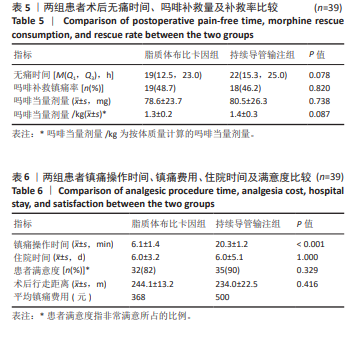
2.3 基线资料比较 两组患者在性别、年龄、体质量指数、手术时间等基本数据上无统计学差异(P > 0.05),具有可比性,见表2。 2.4 镇痛情况比较 术后第6,12,24,48,72小时两组患者在静息疼痛评分和运动疼痛评分上未发现统计学差异,见表3,4,两组患者的无痛时间、吗啡补救镇痛率之间亦无统计学差异。术后72 h,脂质体布比卡因组吗啡补救镇痛量为78.6吗啡当量剂量,而持续导管输注组为80.5吗啡当量剂量,差异无显著性意义。比较脂质体布比卡因组和持续导管输注组按每千克体质量计算的吗啡类药物使用时,也得到了相似的统计学结果,见表5。"
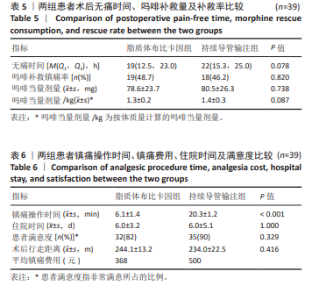
2.5 不良反应 在持续导管输注组中记录到1例股四头肌麻痹,持续8 h后自行恢复。两组均无血肿形成。 2.6 其他指标比较 两组患者在住院时间、患者满意度及术后行走距离上没有差异,但持续导管输注组需要花费更长的镇痛操作时间(P < 0.001)。在镇痛费用上,持续导管输注组每人大约花费元人民币500元,脂质体布比卡因组平均每人大约需要花费人民币元368元,脂质体布比卡因组的费用更低,见表6。"
| [1] SINGH JR S ,MEHTA H, GUPTA S, et al. Comparison of Clinical and Radiological Outcomes of Total Knee Arthroplasty in Osteoarthritic Patients. Cureus. 2024;16(5):e60933. [2] LE STUM M, GICQUEL T, DARDENNE G, et al. Total knee arthroplasty in France: Male-driven rise in procedures in 2009-2019 and projections for 2050. Orthop Traumatol Surg Res. 2023;109(5):103463. [3] LADOUCETTE AD. Management of perioperative pain after TKA.Orthop Traumatol Surg Res. 2023;109(1S):103443. [4] BERIKASHVILI LB, YADGAROV MY, KUZOVLEV AN, et al. Adductor Canal Block Versus Femoral Nerve Block in Total Knee Arthroplasty: Network Meta-Analysis. Clin J Pain. 2024;40(7):447-457. [5] DE ARZUAGA CIS, MIGUEL M, BIARNÉS A, et al. Single-injection nerve blocks for total knee arthroplasty: femoral nerve block versus femoral triangle block versus adductor canal block-a randomized controlled double-blinded trial. Arch Orthop Trauma Surg. 2023;143(11): 6763-6771. [6] FILLINGHAM YA, HANNON CP, KOPP SL, et al. The Efficacy and Safety of Regional Nerve Blocks in Total Knee Arthroplasty: Systematic Review and Direct Meta-Analysis. J Arthroplasty. 2022;37(10):1906-1921.e2. [7] HUSSAIN I, BRULL R, ZHOU S, et al. Analgesic benefits of single-shot versus continuous adductor canal block for total knee arthroplasty: a systemic review and meta-analysis of randomized trials. Reg Anesth Pain Med. 2023;48(2):49-60. [8] BENGTSSON L, THÖRN SE, DYREHAG LE, et al. Intrathecal pain treatment for severe pain in patients with terminal cancer: A retrospective analysis of treatment-related complications and side effects. Scand J Pain. 2024;24(1). doi: 10.1515/sjpain-2024-0041. [9] MITCHELL D, WANG E, SWIEKATOWSKI K, et al. Pain in the Bone Controlled at Home: Nerve Block Versus Pain Pump in Alveolar Bone Grafting. J Craniofac Surg. 2025. doi: 10.1097/SCS.0000000000011551. [10] ERDEN S, GÜLER S, TURA İ, et al. Evaluating patient outcomes in postoperative pain management according to the revised American Pain Society Patient Outcome Questionnaire (APS-POQ-R). Appl Nurs Res. 2023;73:151734. [11] KG G, J R. Efficacy of Intraoperative Periarticular Local Infiltration for Pain Control and Ambulation in Total Knee Arthroplasty: A Randomized Case-Control Study. Cureus. 2024;16(1):e52639. [12] MA HH, CHOU TA, TSAI SW, et al. The efficacy of continuous versus single-injection femoral nerve block in Total knee Arthroplasty: a systematic review and meta-analysis. BMC Musculoskelet Disord. 2020; 21(1):121. [13] WELLE K, COLORAFI K, DARATHA K. Opioid and Nerve Block Administration in Knee Arthroplasty: An Observational Retrospective Evaluation. Pain Manag Nurs. 2023;24(5):542-548. [14] DENG S, CHEN L, SONG X, et al. Analgesic Effect of Intraoperative Intravenous S(+)-Ketamine During Total Knee Arthroplasty Surgery: Study Protocol for a Randomized Controlled Clinical Trial. JMIR Res Protoc. 2023;8:12:e53063. [15] HASABO EA, ASSAR A, MALMOUD MM, et al. Adductor canal block versus femoral nerve block for pain control after total knee arthroplasty: A systematic review and Meta-analysis. Medicine (Baltimore). 2022;101(34):e30110. [16] JENSEN AE, BJØRN S, NIELSEN TD, et al. Distal subsartorial compartment block of the saphenous nerve - A dissection study and a patient case series. J Clin Anesth. 2024;92:111315. [17] YIN X, LI X, ZHAO P, et al. Comparison of adductor canal block and femoral nerve block for pain management in anterior cruciate ligament reconstruction: A meta-analysis of randomized controlled trials. Medicine (Baltimore). 2022;101(25):e29295. [18] HURLEY ET, DANILKOWICZ RM, TOTH AP. Editorial Commentary: Postoperative Pain Management After Anterior Cruciate Ligament Reconstruction Can Minimize Opioid Use and Allow Early Rehabilitation. Arthroscopy. 2023; 39(5):1296-1298. [19] LY E, JOUDI K, RAMANUJAM V. Ultrasound Evaluation of Subsartorial Spread Following Adductor Canal Block: A Case Series. Cureus. 2024; 16(5):e60849. [20] METTU S, SARAN S, SHIRODKAR K, et al. Anatomy and pathology of adductor canal (Hunter’s canal). Skeletal Radiol. 2025;54(6):1169-1177. [21] MATTHEWS D, RELLA RT. Surgeon-placed peripheral nerve block and continuous non-opioid analgesia in total knee arthroplasty is accessible intraoperatively: A cadaveric study. J ISAKOS. 2023;8(3):204-209. [22] LECIGNE R, DUBREIL PX, BERTON E, et al. Anatomical basis for ultrasound-guided infiltration of the saphenous nerve in the subsartorial canal. J Ultrasound. 2022;25(3):429-434. [23] KIM J, KIM SH, MOON HK, et al. Validation of Ultrasound-Guided Approximation of Infrapatellar Branch of the Saphenous Nerve: A Cadaveric Study. Anesth Analg. 2024;139(1):247-249. [24] TSAI PB, KARNWAL A, KAKAZU C, et al. Efficacy of an ultrasound-guided subsartorial approach to saphenous nerve block: a case series. Can J Anaesth. 2010; 57(7):683-688. [25] KIM WJ, CHO EJ, JUNG G, et al. Efficacy of continuous preperitoneal ropivacaine infusion in women with cesarean section: A prospective, randomized controlled, single blinded study. Heliyon. 2024;10(21): e39608. [26] HONES KM, HAO KA, WRIGHT JO, et al. Toxic effects of local anesthetics on rat fibroblasts: An in-vitro study. J Orthop Sci. 2025;30(2):397-404. [27] ROUHENTO EAS, LEHTO JT, KALLIOMÄKI ML. Peripheral nerve blocks in advanced cancer pain: retrospective case series. BMJ Support Palliat Care. 2023;13(e2):e287-e290. [28] WANG S, CHEN Y, GUO J, et al. Liposomes for Tumor Targeted Therapy: A Review. Int J Mol Sci. 2023;24(3):2643. [29] KHAN MS, GUPTA G, ALSAYARI A, et al. Advancements in liposomal formulations: A comprehensive exploration of industrial production techniques. Int J Pharm. 2024;658:124212. [30] NSAIRAT H, IBRAHIM AA, JABER AM, et al. Liposome bilayer stability: emphasis on cholesterol and its alternatives. J Liposome Res. 2024; 34(1):178-202. [31] GBIANN DL, OMRI A. Lipid-Based Drug Delivery Systems for Diseases Managements. Biomedicines. 2022;10(9):2137. [32] SESSLER DI, BAO X, LEIMAN D, et al. A Phase I Study of the Pharmacokinetics, Pharmacodynamics, and Safety of Liposomal Bupivacaine for Sciatic Nerve Block in the Popliteal Fossa for Bunionectomy. J Clin Pharmacol. 2025;65(4):441-451. [33] CHEN JJ, WU YC, WANG JS, et al. Liposomal bupivacaine administration is not superior to traditional periarticular injection for postoperative pain management following total knee arthroplasty: a meta-analysis of randomized controlled trials. J Orthop Surg Res. 2023;18(1):206. [34] GAILEY AD, OSTRUM RF. The use of liposomal bupivacaine in fracture surgery: a review. J Orthop Surg Res. 2023; 18(1):267. [35] LIU HH, QIU D, XU DR, et al. Recovery quality of transversus abdominis plane block with liposomal bupivacaine after cesarean delivery: A randomized trial. J Clin Anesth. 2024;99:111608. [36] MOON AS, ANDIKYAN V, AGARWAL R, et al. Incisional infiltration versus transversus abdominis plane block of liposomal bupivacaine after midline vertical laparotomy for suspected gynecologic malignancy: a pilot study. Gynecol Oncol Rep. 2023;47:101203. [37] EID GM, SHABAN SES, MOSTAFA TA, et al. Comparison of ultrasound-guided genicular nerve block and knee periarticular infiltration for postoperative pain and functional outcomes in knee arthroplasty - A randomised trial. Indian J Anaesth. 2023;67(10):885-892. [38] CHAN TCW, WONG JSH, WANG F, et al. Addition of Liposomal Bupivacaine to Standard Bupivacaine versus Standard Bupivacaine Alone in the Supraclavicular Brachial Plexus Block: A Randomized Controlled Trial. Anesthesiology. 2024;141(4):732-744. [39] LEE PS, MANO YM, HOM BM, et al. Interscalene nerve block with plain bupivacaine versus liposomal bupivacaine for arthroscopic rotator cuff repair: A randomized controlled trial. Saudi J Anaesth. 2025;19(2): 243-250. [40] SCHUMAIER AS, KLOBY M, HASSELFELD K, et al. Interscalene block vs. periarticular liposomal bupivacaine for pain control following reverse shoulder arthroplasty: a randomized trial. J Shoulder Elbow Surg. 2023; 32(7):1412-1419. [41] BRAVO D, ALISTE J, LAYERA S, et al. Randomized clinical trial comparing pericapsular nerve group (PENG) block and periarticular local anesthetic infiltration for total hip arthroplasty. Reg Anesth Pain Med. 2023;48(10):489-494. [42] YU ZX, YANG ZZ, YO LL. Effectiveness of liposome bupivacaine for postoperative pain control in total knee arthroplasty: a PRISMA-compliant meta-analysis of randomized controlled trials. Medicine (Baltimore). 2018;97(13):e0171. [43] DYSART S, SNYDER MA, MONT MA. A Randomized, Multicenter, Double-Blind Study of Local Infiltration Analgesia with Liposomal Bupivacaine for Postsurgical Pain Following Total Knee Arthroplasty: Rationale and Design of the Pillar Trial. Surg Technol Int. 2016;30:261-267. [44] HAMILTON TW, KNIGHT R, STOKES JR. Efficacy of Liposomal Bupivacaine and Bupivacaine Hydrochloride vs Bupivacaine Hydrochloride Alone as a Periarticular Anesthetic for Patients Undergoing Knee Replacement: A Randomized Clinical Trial. JAMA Surg. 2022;157(6):481-489. [45] HUBLER CP, BEVIL KM, GREINER JJ, et al. Liposomal bupivacaine versus standard bupivacaine in the adductor canal for total knee arthroplasty: a randomized, controlled trial. Orthopedics. 2021;44(4):249-255. [46] MALIGE A, PELLEGRINO AN, KUNKLE K, et al. Liposomal bupivacaine in adductor canal blocks before total knee arthroplasty leads to improved postoperative outcomes: a randomized controlled trial. J Arthroplasty. 2022;37(8):1549-1556. [47] HUNGERFORD M, NEUBAUER P, CIOTOAL J, et al. Liposomal bupivacaine vs ropivacaine for adductor canal blocks in total knee arthroplasty: a prospective randomized trial. J Arthroplasty. 2021;36(12):3915-3921. [48] CHEN CM, YUN AG, FAN T. Continuous bupivacaine infusion versus liposomal bupivacaine in adductor canal block for total knee arthroplasty. J Knee Surg. 2022;35(11):1268-1272. [49] TU Q, ZHOU R, LV G, et al. Effects of preemptive acupuncture on cognitive function of older patients after hip replacement: a randomized controlled trial. Front Med (Lausanne). 2025;12:1503727. [50] BONFANTE S, NETTO MB, DE OLIVEIRA JUNIOR AN, et al. Oxidative stress and mitochondrial dysfunction contributes to postoperative cognitive dysfunction in elderly rats dependent on NLRP3 activation. Metab Brain Dis. 2024;40(1):1. |
| [1] | He Yixiang, Qiao Wanjia, Wang Wenji. Effectiveness and safety of tranexamic acid versus epsilon-aminocaproic acid in total hip and knee arthroplasties: a meta-analysis [J]. Chinese Journal of Tissue Engineering Research, 2026, 30(9): 2361-2369. |
| [2] | Zhang Anqi, Hua Haotian, Cai Tianyuan, Wang Zicheng, Meng Zhuo, Zhan Xiaoqian, Chen Guoqian . Pain after total knee arthroplasty: current status and trend analysis [J]. Chinese Journal of Tissue Engineering Research, 2026, 30(3): 795-804. |
| [3] | Cui Pengfei, Wen Zhangkun, Chen Fengjiang, Wang Zhen, Wang Changyao. Unicompartmental knee arthroplasty for severe medial compartment osteoarthritis with moderate lateral involvement: clinical outcomes [J]. Chinese Journal of Tissue Engineering Research, 2026, 30(21): 5452-5459. |
| [4] | Liu Haoyang, Li Hongxu, Zhou Yu, Yue Debo, Wang Bailiang, Ma Jinhui. Differences in clinical function and imaging between robot-assisted and conventional total knee arthroplasty [J]. Chinese Journal of Tissue Engineering Research, 2026, 30(15): 3936-3945. |
| [5] | Zhou Jinhai, Li Jiangwei, Wang Xuquan, Zhuang Ying, Zhao Ying, Yang Yuyong, Wang Jiajia, Yang Yang, Zhou Shilian. Three-dimensional finite element analysis of anterior femoral notching during total knee arthroplasty at different bone strengths [J]. Chinese Journal of Tissue Engineering Research, 2025, 29(9): 1775-1782. |
| [6] | Su Dejun, Dong Wanpeng, Dong Yuefu, Zhang Jichao, Zhang Zhen. Design of asymmetric prosthesis and mechanical analysis of total knee arthroplasty [J]. Chinese Journal of Tissue Engineering Research, 2025, 29(3): 510-516. |
| [7] | Wang Yijun, Zheng Kai, Zhang Lianfang, Zhu Feng, Zhang Weicheng, Li Rongqun, Zhou Jun, Xu Yaozeng. Navigation-assisted total knee arthroplasty using functional alignment restores constitutional alignment and joint line obliquity [J]. Chinese Journal of Tissue Engineering Research, 2025, 29(27): 5810-5818. |
| [8] | Zhang Yilong, Wu Wanling, Yang Wenwu, Wu Hongtao, Liu Wengang, He Minyi, Zhao Chuanxi. Correlation between preoperative knee extensor and flexor muscle strength and postoperative gait function in total knee arthroplasty [J]. Chinese Journal of Tissue Engineering Research, 2025, 29(27): 5819-5825. |
| [9] | Ding Yuan, Gong Jianbao, Zhang Jie, Qiao Yuan, Xu Wenlong. Characteristic analysis of isometric muscle strength of knee joint in patients after unicompartmental knee arthroplasty [J]. Chinese Journal of Tissue Engineering Research, 2025, 29(27): 5833-5838. |
| [10] | Wang Jun, Zhang Hui, Li Zhengyuan, Hao Lin, Chen Shenghong, Yin Zongsheng. Assessment on initial effectiveness of a novel local infiltration anesthesia in total knee arthroplasty [J]. Chinese Journal of Tissue Engineering Research, 2025, 29(27): 5839-5844. |
| [11] | Wang Yuning, Zhu Haotian, Liu Kang, Ding Huanwen, Yan Han. Comparison of short-term therapeutic effects between digital precision total knee arthroplasty and traditional methods [J]. Chinese Journal of Tissue Engineering Research, 2025, 29(21): 4521-4528. |
| [12] | Xu Minglan, Hu Xiaoxue, Shen Jun, Xiang Zheng, Zhang Chengbo, Xiao Lianbo. Opposing needling acupuncture combined with preemptive analgesia in treatment of pain after initial unilateral total knee arthroplasty [J]. Chinese Journal of Tissue Engineering Research, 2025, 29(21): 4529-4536. |
| [13] | Pan Hao, Yang Meng, Liu Guoqiang. Timing of total knee arthroplasty with tourniquet under navigation system: a single-center, retrospective analysis [J]. Chinese Journal of Tissue Engineering Research, 2025, 29(15): 3159-3164. |
| [14] | Shan Jiaxin, Zhang Yilong, Wu Hongtao, Zhang Jiayuan, Li Anan, Liu Wengang, Xu Xuemeng, Zhao Chuanxi. Changes in muscle strength and pain in patients receiving Jianpi Yiqi Huoxue Formula after total knee arthroplasty [J]. Chinese Journal of Tissue Engineering Research, 2024, 28(9): 1378-1382. |
| [15] | Qi Haodong, Lu Chao, Xu Hanbo, Wang Mengfei, Hao Yangquan. Effect of diabetes mellitus on perioperative blood loss and pain after primary total knee arthroplasty [J]. Chinese Journal of Tissue Engineering Research, 2024, 28(9): 1383-1387. |
| Viewed | ||||||
|
Full text |
|
|||||
|
Abstract |
|
|||||